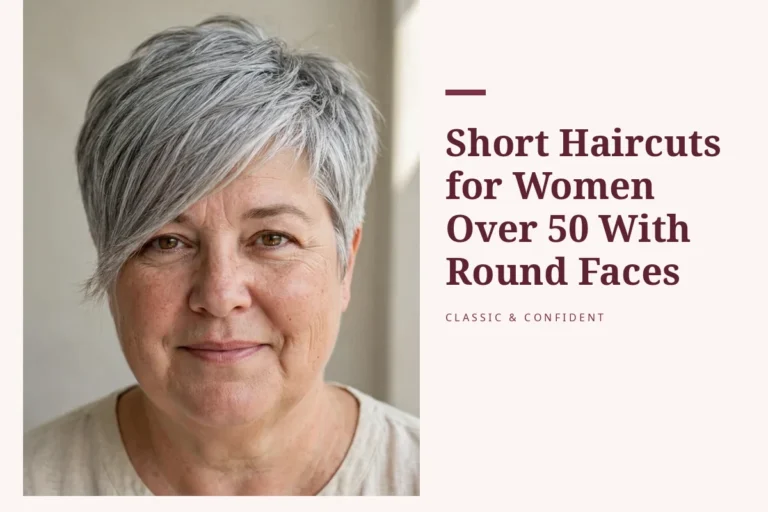
18 Long Pixie Haircuts for Women Over 50

Ask a room of women over 50 what “short hair” means and half of them will picture the severe pixie — cropped close all over, two centimetres of obedience on the crown, nothing left to play with. That is exactly why so many women keep postponing the haircut they actually want.
A longer pixie haircut for older women solves the standoff: it keeps the pixie architecture underneath — the tapered nape, the neat ears, the weightless back — while leaving 10 to 18 centimetres of real, movable length on top. You get the freedom of short hair without the feeling that your hair is gone.
Below are 18 long pixie haircuts, each with the exact mechanism that makes it work, honest top lengths and trim intervals, styling times, the exact words to say to your stylist, and a numbered styling routine.
You will also learn how to tell the difference between a long pixie and a short bob (your stylist may use the words interchangeably, and they are not the same), which versions flatter fine or thick hair, and the one pick I would make if I could only choose once.
Quick picks
- The true all-rounder, longest on the safe list → The Classic Long Pixie (#1)
- Fine hair that needs width, not height → The Deep Side-Swept Long Pixie (#2)
- Maximum length without crossing into bob territory → The Pixie-Bob (#13)
- Thick hair that threatens to triangle → The Undercut Long Pixie (#15)
- The lowest-effort five-minute morning → The Tousled Long Pixie (#6)
- Evening polish that still reads “pixie” → The Sleek Blunt Long Pixie (#18)
Contents
How to choose a longer pixie haircut for older women
Check the nape, not just the top. A long pixie has a tapered, weightless nape and ears that sit close; a short bob keeps perimeter weight around the jaw. If the “long pixie” in a reference photo has a full outline sitting on the jawline, it is a bob, and it will behave like a bob.
Long pixies behave like pixies: they stay off the neck and the upkeep is a trim, not a restyle.
Measure the top before you sit down. In this list, “long” means 10 to 18 cm of top length — long enough to sweep, tuck, wave and pin. Under 10 cm on top is a standard pixie with a different name.
Knowing the number protects you from a miscommunication cut: “long on top” means different things to different stylists, but “keep 14 centimetres on top” means the same thing everywhere.
Match the texture to your hair’s honesty. Fine hair loves long pixies with internal layers and side sweeps (see the pixie cuts for fine hair over 50 for the full picture), because length on top without weight looks fuller than a blunt short cut.
Thick hair loves versions that remove weight — undercuts, heavy texturising — because length without release builds a triangle. Straight hair takes the sleek and graduated versions beautifully; wavy and curly hair takes the tousled and curly versions, which are built around letting the hair do what it wants.
Budget the trims before you fall in love. The trade-off of keeping length on top is that the shape underneath needs maintenance: the precise, clean versions in this list want a 5-to-6-week cycle, the loose and textured ones honestly stretch to 8–10 weeks.
If your real life is a 10-week trim cycle, choose from the forgiving end of the list — the tousled, shaggy and curly long pixies (#6, #8, #17) were designed exactly for that reality.
And if you are still deciding between short families, the newest hairstyles for women over 50 round-up compares pixies against the bobs and crops they compete with.
Bring two photos, not one. Bring the long pixie you want and one standard pixie you do not want, and point at the difference: “this much top length, not this.” Stylists consistently cut what they have been cutting — the anti-photo is the fastest way to reset that default.
Check the fine-hair bob guide too if your hair is thin, since density changes which long pixies flatter you.
At a glance
| Style | Top length | Trims | Best for |
|---|---|---|---|
| 1. The Classic Long Pixie | 12–15 cm | 6–8 weeks | The all-rounder; most face shapes |
| 2. The Deep Side-Swept Long Pixie | 13–16 cm | 6–8 weeks | Fine hair needing width |
| 3. The Textured Long Pixie | 12–14 cm | 7–9 weeks | Thick hair needing movement |
| 4. The Fringed Long Pixie | 11–14 cm | 5–6 weeks | High foreheads, strong brows |
| 5. The Graduated Long Pixie | 12–15 cm | 5–7 weeks | Flat crowns needing lift |
| 6. The Tousled Long Pixie | 10–14 cm | 7–9 weeks | Low-maintenance mornings |
| 7. The Feathered Long Pixie | 13–16 cm | 6–8 weeks | Straight hair needing softness |
| 8. The Shaggy Long Pixie | 14–18 cm | 8–10 weeks | Wavy hair; long trim gaps |
| 9. The Swept-Back Long Pixie | 14–16 cm | 6–8 weeks | Defined cheekbones, evening polish |
| 10. The Airy Long Pixie for Fine Hair | 10–13 cm | 6–7 weeks | Fine or thinning hair |
| 11. The Curtain-Fringe Long Pixie | 12–15 cm | 6–7 weeks | Round and square faces |
| 12. The Asymmetric Long Pixie | 14–16 cm | 5–6 weeks | Strong features, statement wearers |
| 13. The Pixie-Bob (Bixie) | 15–18 cm | 7–8 weeks | Maximum length, pixie behaviour |
| 14. The Wavy Long Pixie | 13–17 cm | 8–9 weeks | Natural waves |
| 15. The Undercut Long Pixie | 14–17 cm | 4–6 weeks | Thick hair, warm necks |
| 16. The Faux-Hawk Long Pixie | 12–15 cm | 4–5 weeks | Bold lift; oval and long faces |
| 17. The Curly Long Pixie | 12–16 cm | 8–10 weeks | Curls 2B–3C |
| 18. The Sleek Blunt Long Pixie | 13–15 cm | 5–6 weeks | Straight, polished hair |
The classics: long tops, clean lines
These five are the reference versions — the cuts that define what a long pixie is before any texture or drama gets added. If you are new to this family, start here and pick your favourite by week one.
1. The Classic Long Pixie

The mechanism here is controlled contrast: 12–15 cm of soft, lightly layered top over a tapered nape and close-cut sides, so the hair’s own length creates the shape instead of product.
Because the perimeter underneath is slim, the top sits where you put it — that is why this cut holds a side sweep all day with almost nothing in it. It is the least demanding version on this list, which is precisely why it is the one most women end up keeping.
- Length: top 12–15 cm, sides 3–5 cm, nape tapered
- Trims: every 6–8 weeks
- Styling time: 5–7 minutes
- Face shapes: oval, heart, square and round
Ask your stylist for: “A long pixie — keep 12 to 15 centimetres of length on top with soft, light layering, taper the nape close and keep the sides slim at 3 to 5 centimetres. I want the top to sweep, not to stand up.”
How to style it:
- Work a pea-sized amount of smoothing cream through damp hair from mid-length to ends.
- Blow-dry with a vent brush, directing the top over to your preferred side; the length should move as one sheet.
- Press the sides flat against the head with the cool shot for 10 seconds a side, then pinch the front ends into two or three defined pieces.
Skip it if you want dramatic texture — this is the smooth, composed version, and it will never look deliberately messy.
Best for: the woman who wants the longest-looking short cut with the least morning effort.
2. The Deep Side-Swept Long Pixie

The side part is doing all the work in this cut: sweeping 13–16 cm of top hair from a part line placed near the temple forces the hair to fall diagonally across the forehead, which is the single most reliable way to widen the appearance of a narrow face and add the illusion of density to fine hair.
A centre part on fine hair shows the scalp’s part line; a deep side part buries it under the sweep. This is the version to choose if your main complaint is that your hair looks thin, because the geometry creates width the hair does not have.
- Length: top 13–16 cm, sides 4–6 cm, nape tapered
- Trims: every 6–8 weeks
- Styling time: 6–8 minutes
- Face shapes: narrow, oval and heart faces; fine hair
Ask your stylist for: “A long pixie with the part placed deep — up near the temple, not the middle — and 13 to 16 centimetres of top sweeping across the forehead. Keep the short side neat at 4 centimetres and let the long side do all the talking.”
How to style it:
- Find the deep part while the hair is wet — comb it from the temple line so the part sets exactly where you want it.
- Blow-dry the long side forward and across with a round brush, rolling the ends under as you go.
- Use a pea-sized drop of light mousse only at the roots of the long side, and leave the ends product-free so they move.
- Lock the sweep with one light pass of flexible spray, aimed from 25 cm away — closer than that and you get a stiff sheet.
Skip it if you strongly prefer centre parts — this cut’s whole personality is the asymmetry, and worn centred it just looks like a grown-out pixie.
Best for: fine hair that needs width and the appearance of density, fast.
3. The Textured Long Pixie

Texture is weight redistribution: point-cutting and slide-cutting through the 12–14 cm top breaks up the hair’s mass so it moves in pieces instead of falling as one block. On thick hair, that is the difference between a cut that balloons and a cut that drapes; on straight hair, it is the difference between flat and interesting.
The mechanism matters here because a long pixie without texture on heavy hair will triangle within three weeks — the texture buys you the full trim cycle.
- Length: top 12–14 cm heavily texturised, sides 3–5 cm, nape tapered
- Trims: every 7–9 weeks
- Styling time: 4–6 minutes
- Face shapes: oval, long and square faces; thick or heavy hair
Ask your stylist for: “A long pixie with heavy texture — point-cut the 12 to 14 centimetre top aggressively so it separates into pieces, thin the underneath, and keep the nape tight. I want movement, not bulk.”
How to style it:
- Rub a chickpea-sized amount of matte paste between your palms and rake it through dry or towel-dried hair, roots to ends.
- Pinch the top into separate pieces with your fingers — the pieces are the style, so do not smooth them away.
- Push the front pieces forward and slightly to the side for the lived-in finish; no brush needed.
Skip it if your hair is very fine and sparse — aggressive texturising removes exactly the density thin hair is trying to keep.
Best for: thick hair that needs its weight managed, and women who style with their fingers.
4. The Fringed Long Pixie

A fringe on a long pixie is proportion control: an 11–14 cm top with a straight-across or slightly curved fringe at brow length shortens a long forehead visually and pulls the eye to the eyes.
The physics is simple — horizontal lines across the face break vertical length — which is why this cut flatters long faces and strong brows more than any other version here. It also hides regrowth at the hairline better than an exposed forehead, a small but real convenience.
- Length: top 11–14 cm, fringe at brow to just above, nape tapered
- Trims: every 5–6 weeks (fringe first)
- Styling time: 6–8 minutes
- Face shapes: long, oval and heart faces
Ask your stylist for: “A long pixie with a real fringe — cut the front to sit at brow length, straight across with softened corners, and keep the top 11 to 14 centimetres with texture so it connects. The fringe has to read as part of the cut, not pasted on.”
How to style it:
- Blow-dry the fringe first, straight down with a small round brush, before the top — wet fringe dries with a mind of its own.
- Style the top up and back lightly with your fingers and a dab of cream, letting it sit behind the fringe line.
Skip it if you wear glasses with heavy frames — fringe plus frames plus pixie sides can crowd the middle of the face; the side-swept versions (#2, #12) handle frames better.
Best for: long faces and high foreheads that want a shorter, younger-looking proportion.
5. The Graduated Long Pixie
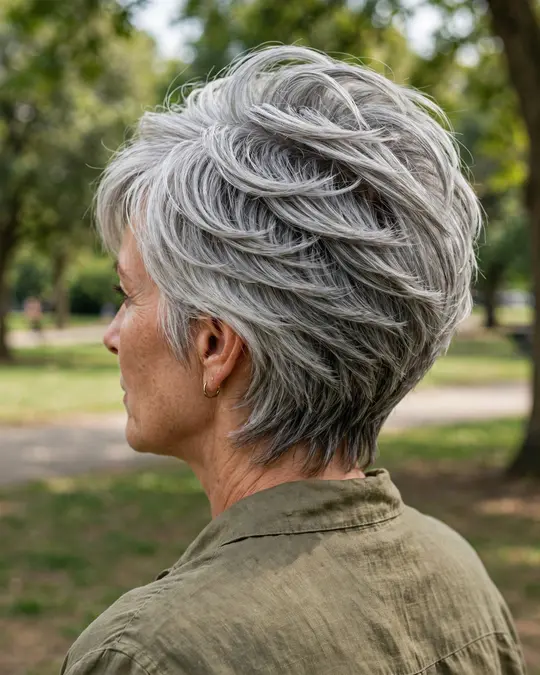
Graduation is architecture: short, stacked layers at the crown that release into the 12–15 cm top, so the hair’s own weight pushes upward and creates lift exactly where flat crowns collapse. A long pixie without graduation on top lies where gravity puts it; with graduation, the shape is built into the cut and survives a whole day.
This is the version for the woman whose hair is long enough everywhere but falls flat on the head within an hour.
- Length: top 12–15 cm, crown stacked short, nape graduated
- Trims: every 5–7 weeks
- Styling time: 7–9 minutes
- Face shapes: oval, round and heart faces; flat crowns
Ask your stylist for: “A long pixie with graduation through the crown — stack the back and crown so the volume builds itself, keep 12 to 15 centimetres on top, and blend the graduation so there is no visible shelf at the back.”
How to style it:
- Apply a golf-ball of volumising mousse to the roots at the crown while the hair is damp.
- Blow-dry the crown first, lifting straight up with a round brush — the graduation needs heat to activate.
- Let the top fall where it wants over the lifted base, and smooth only the very front with your fingers.
- Check the back in a hand mirror: you should see a smooth angled column, not a step.
Skip it if you dislike any height on top — the graduation is the point of this cut, and flattened it just looks over-layered.
Best for: flat crowns and fine hair that collapses by lunchtime.
Easy texture: long pixies that forgive
These five are the forgiving end of the family — the cuts that look better slightly undone and stretch a trim cycle without punishing you. Choose here if your mornings are honest about time.
If you want the length without the pixie commitment, our long shag haircuts for women over 50 keep the movement at shoulder length and beyond.6. The Tousled Long Pixie

The tousled long pixie works because it refuses to have a “wrong” state: the 10–14 cm top is cut with uneven, piece-y ends so that bedhead and styled look nearly identical.
That means the morning routine is closer to fluffing than styling, and the cut genuinely improves between weeks four and eight as it grows — the tousle eats the grow-out. For a woman who has never once enjoyed styling her hair, this is the honest entry point to short hair.
- Length: top 10–14 cm piece-y, sides 3–6 cm, nape tapered
- Trims: every 7–9 weeks
- Styling time: 3–5 minutes
- Face shapes: all, especially oval and heart
Ask your stylist for: “A long pixie cut for air-drying — 10 to 14 centimetres on top with choppy, uneven ends, tapered underneath, no blunt lines anywhere. I want it to look the same whether I style it or not.”
How to style it:
- Scrunch a pea-sized amount of salt spray or texture cream through damp hair.
- Either air-dry or diffuse on low heat while scrunching — the crunchier, the better.
- Shake the roots with your fingertips and walk away; re-scrunching at lunch revives it completely.
Skip it if you need a polished office look every day — tousled reads relaxed, and no amount of smoothing makes it read corporate.
Best for: wash-and-go women and anyone on a stretched trim budget.
7. The Feathered Long Pixie

Feathering is a finishing technique, not a length: the 13–16 cm top is cut with long, tapered layers whose ends are thinned so they lie in soft wisps rather than blunt edges.
On straight, slightly coarse hair — the kind that can look severe in a pixie — feathering is the difference between a cut that looks sharp and a cut that looks kind. It also grows out more gracefully than any blunt perimeter, because there is no hard line to betray the regrowth.
- Length: top 13–16 cm feathered, sides 4–6 cm, nape soft-tapered
- Trims: every 6–8 weeks
- Styling time: 6–8 minutes
- Face shapes: oval, long and square faces; straight hair
Ask your stylist for: “A long pixie with feathered ends — 13 to 16 centimetres on top, every layer feathered with the razor so the ends lie soft, nothing blunt. Keep the nape tapered but soft, not tight.”
How to style it:
- Blow-dry the top with a large round brush, rolling the feathered ends under for softness.
- Smooth a pea-sized amount of anti-frizz serum over the surface only — never underneath, or you flatten the feathering.
Skip it if your hair is very fine — feathering thins the ends, and fine hair needs its ends kept as full as possible.
Best for: straight, medium-to-coarse hair that can look harsh in a standard pixie.
8. The Shaggy Long Pixie
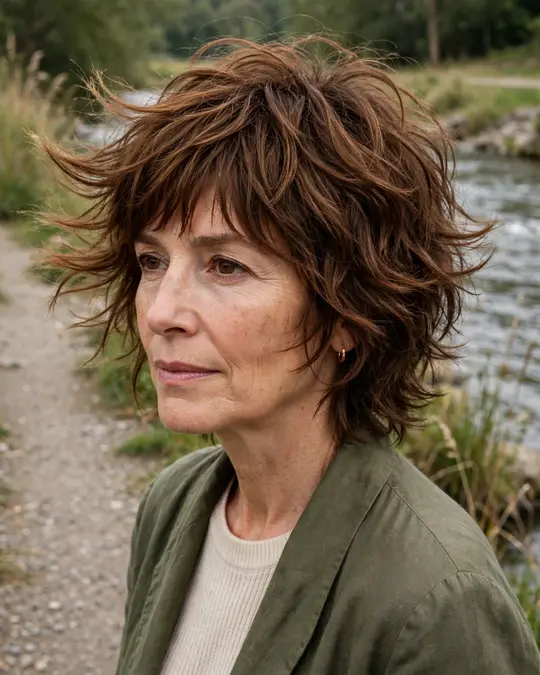
This is the longest and loosest version here — 14–18 cm on top with disconnected shag layers through the crown and a soft, piece-y fringe.
The shag layers do two jobs at once: they remove the internal weight that would turn this much length into a triangle, and they let the ends flip and kick outward in that deliberately undone way.
It is the long pixie for the woman who keeps being told her hair is “too long for a pixie” — this cut says the length is the point.
- Length: top 14–18 cm, disconnected layers, nape tapered but soft
- Trims: every 8–10 weeks
- Styling time: 5–7 minutes
- Face shapes: oval, long and heart faces; wavy or thick hair
Ask your stylist for: “A shaggy long pixie — 14 to 18 centimetres on top with disconnected layers through the crown, a piece-y fringe, and a soft tapered nape. I want the ends to kick out, not lie flat.”
How to style it:
- Apply a golf-ball of mousse to damp hair, roots to ends, and scrunch the layers upward.
- Diffuse on medium heat, lifting the crown layers with your fingers as you dry.
- Once dry, pinch the ends and pull them slightly outward to encourage the kick.
- Finish with a light mist of flexible spray — the movement is the style, so keep it touchable.
Skip it if you need precision — this is the least structured cut on the list, and it will never sit sleek.
Best for: wavy hair, thick hair, and the longest gaps between appointments.
9. The Swept-Back Long Pixie

Sweeping 14–16 cm of top hair straight back off the forehead is the most flattering thing a confident face can do with a pixie: it opens the whole face, shows the cheekbones and eyes, and reads instantly polished.
The mechanism is tension — the hair is directed back with enough root lift to hold, so it stays off the face all day instead of collapsing forward. This is the evening version of the family, but plenty of women wear it daily once they learn the two-minute routine.
- Length: top 14–16 cm, sides 4–6 cm swept back, nape tapered
- Trims: every 6–8 weeks
- Styling time: 5–7 minutes (2 once practised)
- Face shapes: oval, heart and diamond faces; defined cheekbones
Ask your stylist for: “A long pixie cut to sweep back — 14 to 16 centimetres on top, enough length to go straight back off the forehead, with the sides kept slim and swept back too. No fringe to fall forward.”
How to style it:
- Apply a pea-sized amount of firm-hold cream to damp roots, all directed backward.
- Blow-dry everything straight back with a vent brush, lifting at the roots for tension.
- Press the sides back behind the ears with the cool shot; finish with a firm pass of spray only at the roots.
Skip it if you are self-conscious about your forehead or hairline — this cut puts the whole face on display, which is its beauty and its demand.
Best for: evening polish, defined bone structure, and women who love an open face.
Good to know
A long pixie photographs 2–3 cm shorter than it is, because the camera flattens the lift. If you are choosing between this list and reference photos online, assume the cut you are looking at has slightly more length than it appears — and if a photo’s top looks exactly the length you want, ask your stylist for 2 cm more.
Growing out is always easier than growing back.
10. The Airy Long Pixie for Fine Hair

Fine hair’s enemy in a long pixie is weight: too much untextured length on top pulls the roots flat and shows the scalp through the part.
This version solves it with 10–13 cm of internally layered top — layers cut inside the hair, invisible from the surface — so the ends stay full while the interior gains the separation that reads as volume.
It is the only cut in this list designed specifically around the physics of thin hair, and it is why fine-haired women can wear a long pixie at all.
- Length: top 10–13 cm internally layered, ends kept blunt-full, nape tapered
- Trims: every 6–7 weeks
- Styling time: 5–6 minutes
- Face shapes: all; fine, thin or thinning hair
Ask your stylist for: “A long pixie for fine hair — 10 to 13 centimetres on top, but layer it internally so the ends stay full. No thinning shears on the surface, no razor on the ends. I need density, not air.”
How to style it:
- Apply a golf-ball of root-lift mousse to damp roots only — product on fine ends weighs them down.
- Blow-dry upside down for 60 seconds first; the roots set with lift before you style the top at all.
Skip it if your hair is thick — this cut is engineered for hair that needs help looking like more, and on dense hair it just looks over-layered.
Best for: fine, thin or thinning hair that wants pixie length without scalp show-through.
Framing the face: fringes and sweeps
These four use the front of the cut to do the flattering — curtain fringes, asymmetry and maximum-length sweeps that shape the face before the rest of the cut even registers. Pick here if the mirror question is about your face shape rather than your hair type.
11. The Curtain-Fringe Long Pixie

A curtain fringe is two diagonal lines instead of one horizontal one: the 10–14 cm fringe is parted in the middle and sweeps outward, framing the cheekbones and softening the forehead without covering it.
On a long pixie, that matters more than on long hair, because there is no surrounding length to soften a hard fringe line — the curtain does the softening itself. It is the most forgiving fringe a pixie can wear, and it grows out into the side sweep of #2 without an awkward stage.
- Length: top 12–15 cm, curtain fringe 10–14 cm parted centre
- Trims: every 6–7 weeks
- Styling time: 6–8 minutes
- Face shapes: round, square and heart faces
Ask your stylist for: “A long pixie with a curtain fringe — part it in the centre and cut the fringe 10 to 14 centimetres so it sweeps outward along the cheekbones. Keep the top 12 to 15 centimetres so the fringe connects into the sides.”
How to style it:
- Part the fringe dead centre while wet — even a 1 cm drift makes one side sit wrong.
- Blow-dry each half outward and away from the face with a round brush, rolling the ends under.
- Style the top loosely back with your fingers; the fringe should frame, not fight, the forehead.
- Pinch the two front pieces into soft wings with a dab of cream for the finished curtain line.
Skip it if you have a strong cowlick at the front hairline — a centre part plus a cowlick is a daily battle you will lose.
Best for: round and square faces that want forehead softening without a full fringe.
12. The Asymmetric Long Pixie

Asymmetry is a distraction in the best sense: one side at 14–16 cm sweeping long past the cheek while the other side stays neat at 6–8 cm forces the eye to move, which breaks up any face symmetry issues and reads as intentional and modern.
The long side needs the full length to work — under 12 cm it just looks uneven — which is why this cut belongs on a long-pixie list and not a standard one. It also photographs beautifully, if that matters to you.
- Length: long side 14–16 cm, short side 6–8 cm, nape tapered
- Trims: every 5–6 weeks (asymmetry grows out visibly)
- Styling time: 6–8 minutes
- Face shapes: oval, square and long faces
Ask your stylist for: “An asymmetric long pixie — the long side 14 to 16 centimetres sweeping past the cheek, the short side neat at 6 to 8. Make the difference deliberate and visible, not subtle, or it just reads as a mistake.”
How to style it:
- Blow-dry the long side forward and across the cheek with a round brush, tucking nothing behind the ear.
- Press the short side flat and neat with the cool shot — the contrast is the cut.
- Smooth the long side’s ends with serum so the diagonal line reads clean.
Skip it if you want a cut that grows out quietly — the asymmetry needs a 5-to-6-week cycle, or it goes from deliberate to lopsided.
Best for: strong features and women who want their haircut noticed.
13. The Pixie-Bob (Bixie)

The bixie is the longest a pixie can be before it becomes something else: 15–18 cm on top with pixie tapering underneath and just enough perimeter weight at the jaw to soften the outline.
The mechanism is the blend — the tapered nape and ears keep it behaving like a pixie (off the neck, wash-and-go), while the jaw-grazing front keeps it feeling like you still have hair. It is the cut for the woman who has been told a pixie would be “too short” for years, because technically, this one is not.
- Length: top 15–18 cm, front pieces jaw-grazing, nape tapered
- Trims: every 7–8 weeks
- Styling time: 6–8 minutes
- Face shapes: oval, heart and square faces
Ask your stylist for: “A bixie — 15 to 18 centimetres on top with the front pieces reaching the jaw, but taper the nape and keep the ears close like a pixie. I want the length of a bob with the back of a pixie.”
How to style it:
- Blow-dry the front pieces forward over the cheeks with a round brush for the face-framing sweep.
- Lift the crown with your fingers on medium heat — the pixie underneath needs that base lift.
- Smooth the surface lightly with cream, leaving the ends free to move.
- Check the profile: the back should sit close like a pixie, the front should fall like a bob.
Skip it if you want true pixie ease — the extra length means an extra 2 minutes of styling and a round brush, every time.
Best for: the longest possible pixie; bob lovers who want pixie behaviour.
14. The Wavy Long Pixie

Natural wave is free texture, and this cut spends it well: 13–17 cm of top length gives waves enough room to form their S-shape instead of springing into frizz, while the tapered underneath removes the bulk that makes wavy short hair puff.
The key mechanism is length-dependent — waves need about 12 cm minimum to behave, which is why a standard pixie fights wavy hair and a long pixie cooperates with it. If your hair has a natural bend, this is the easiest cut on the list.
- Length: top 13–17 cm, waves need the length, nape tapered
- Trims: every 8–9 weeks
- Styling time: 4–6 minutes
- Face shapes: oval, round and heart faces; natural waves
Ask your stylist for: “A long pixie for my natural wave — 13 to 17 centimetres on top so the waves have room to form, taper the nape and sides close, and please do not thin the top; my waves need that weight to sit.”
How to style it:
- Scrunch a golf-ball of curl cream through damp hair, encouraging the natural wave pattern.
- Diffuse on low heat or air-dry — heat plus wind is what turns waves into frizz.
Skip it if your hair is pin-straight — without natural wave, this cut needs daily heat styling to look like itself.
Best for: natural waves and the truly low-effort wash-and-go routine.
Length with nerve: the bold long pixies
These four keep the long top and add the drama — undercuts, height, curl and polish. They need slightly more commitment (shorter trim cycles, stronger opinions), and they give more back.
15. The Undercut Long Pixie

An undercut under a long pixie is hidden engineering: clippering one or both sides beneath the 14–17 cm top removes up to half the hair’s bulk without touching the visible length.
On thick hair, that is transformative — the top drapes instead of ballooning, the nape stays cool in summer, and the cut keeps its shape weeks longer because the weight that drags it down is simply gone. Worn down, nobody sees it; tucked behind the ear, it is a deliberate flash of edge.
- Length: top 14–17 cm, undercut 1–2 cm (clipper guard 1–2)
- Trims: every 4–6 weeks (undercut grows out visibly)
- Styling time: 5–7 minutes
- Face shapes: oval, heart and square faces; thick hair
Ask your stylist for: “A long pixie with a hidden undercut — clipper the sides to a 1 or 2 guard underneath, and keep 14 to 17 centimetres of top falling over it. The top has to fully cover the undercut when it is down.”
How to style it:
- Blow-dry the top forward and over to one side so it drapes across the undercut side.
- Smooth the surface with a flat brush — the contrast between sleek top and hidden short side is the whole effect.
- Tuck one side behind the ear when you want the undercut visible; let it fall when you do not.
Skip it if you cannot commit to a 4-to-6-week cycle — a grown-out undercut under a long top looks accidental, not edgy.
Best for: thick hair that needs debulking, and warm necks that hate summer.
16. The Faux-Hawk Long Pixie
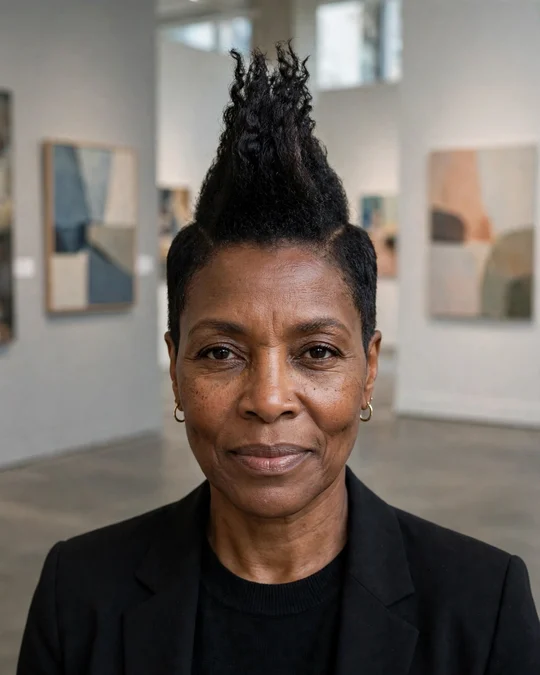
The faux-hawk borrows the mohawk’s centre strip of height and skips the shaved sides: 12–15 cm of top length is styled upward through the middle while the sides lie flat, which creates dramatic vertical lift without any actual commitment.
On longer faces it is risky — height on top lengthens further — but on oval and round faces it is the most sculptural version here. The trick is that the “hawk” is pure styling over a sensible long pixie; washed and air-dried, it is just #1.
- Length: top 12–15 cm centre strip, sides 3–5 cm
- Trims: every 4–5 weeks
- Styling time: 8–10 minutes
- Face shapes: oval and round faces
Ask your stylist for: “A long pixie I can wear as a faux-hawk — 12 to 15 centimetres through the centre top, sides slim at 3 to 5. Cut the centre with enough length to stand up when styled, not so much it flops.”
How to style it:
- Apply a chickpea-sized amount of strong paste to the roots of the centre strip while damp.
- Blow-dry the centre strip straight up with a vent brush, working from the forehead back.
- Press the sides flat and back with the cool shot for contrast.
- Pinch the centre into defined spikes or a smooth ridge — either reads as the hawk.
Skip it if your face is long — height on top adds visible length, and this cut is all about height.
Best for: bold lift, evenings out, and oval or round faces that can carry drama.
17. The Curly Long Pixie

Curls shrink — a 12–16 cm curly top wears at roughly half that length, which is exactly why a long pixie is the right home for curls 2B through 3C. The length gives the curl pattern room to complete its shape instead of frizzing at the root, and the tapered underneath keeps the silhouette from going wide.
Cut dry, curl by curl, this is the version that finally lets curly hair be short without being a fight.
- Length: top 12–16 cm (wears shorter), sides tapered, nape close
- Trims: every 8–10 weeks
- Styling time: 5–8 minutes
- Face shapes: oval, round and heart faces; curls 2B–3C
Ask your stylist for: “A curly long pixie, cut dry curl by curl — 12 to 16 centimetres on top so my pattern has room, tapered underneath, no thinning shears, no razor. Shape the silhouette round, not wide.”
How to style it:
- Rake a golf-ball of curl cream through soaking-wet hair, then scrunch firmly upward.
- Diffuse on low heat, cupping the curls in the diffuser bowl — do not touch them while they dry.
Skip it if your curls are tighter than 3C — very tight coils need a different cutting approach, and this length can spring shorter than expected.
Best for: natural curls that want to be short without the daily battle.
18. The Sleek Blunt Long Pixie

This is the precision instrument of the list: 13–15 cm of top cut with clean, blunt ends and minimal layering, styled glass-smooth. The mechanism is contrast again — the blunt perimeter against the tapered pixie underneath creates a sharp, graphic line that reads expensive and deliberate.
It demands the most styling of the smooth versions, but on straight, healthy hair nothing on this list looks more intentional. Think of it as the long pixie’s evening dress.
- Length: top 13–15 cm blunt, minimal layering, nape tapered
- Trims: every 5–6 weeks
- Styling time: 10–12 minutes
- Face shapes: oval and heart faces; straight hair
Ask your stylist for: “A sleek long pixie with blunt ends — 13 to 15 centimetres on top, cut clean with almost no layering, and taper the nape tight underneath. The line has to be sharp; this cut lives or dies on precision.”
How to style it:
- Apply a pea-sized amount of smoothing serum to damp hair, then blow-dry section by section with a paddle brush, pulling each section taut.
- Run a flat iron over the top in 3 cm sections on medium heat — one slow pass per section is enough.
- Finish with a silicone-free shine mist from 25 cm away; the ends should fall in one clean sheet.
Skip it if your hair is wavy or curly — this cut fights texture every single morning, and the fight is not worth it.
Best for: straight hair, polished occasions, and women who enjoy the ritual of styling.
Keeping a long pixie sharp at home
A long pixie is a low-effort cut, not a no-effort one. These are the small habits that keep it looking like the appointment was last week instead of last month.
- Trim the nape between appointments with small scissors every 3–4 weeks — the nape grows fastest and betrays the cut first.
- Sleep on a silk pillowcase; cotton roughens the top overnight and doubles your morning styling time.
- Refresh second-day hair with a light mist of water at the roots, not more product — product layering is what makes pixies go flat.
- Keep one styling product per texture goal: matte paste for piece-y, cream for smooth, mousse for lift. Three products maximum on the shelf.
- Photograph your cut from three angles the day after the appointment — front, side, back. Bring it to the next trim so your stylist sees the shape, not your description of it.
- Do not wash daily unless your scalp demands it; a long pixie restyles better on day-two hair with natural oils at the roots.
Your five-minute morning reset:
- Mist the roots lightly with water and lift them with your fingertips.
- Warm a pea-sized amount of your one product between your palms.
- Rake or pinch it through the top in the direction the cut wants to go — sweep, back, or piece-y.
- Check the profile in the mirror and smooth the nape flat with the cool shot for 10 seconds.
- Walk away — overworking a pixie is the most common styling mistake there is.
The bottom line
If I had to pick one, I would pick the Swept-Back Long Pixie (#9). It is the cut that makes the strongest case for this whole family: all the freedom of a pixie underneath, 14–16 cm of real hair on top, and a silhouette that goes from school run to evening out with nothing more than a change of product.
It flatters the widest range of faces on this list because an open face is an honest face — and at this stage of life, honest is the best look there is.
If this list helped you find your version, pin it to your hair board — the one with your next appointment date on it — so the photo is there when your stylist asks what you are thinking.
Frequently asked questions
Is a longer pixie haircut right for older women with thin hair?
Often yes, with the right version. A longer pixie haircut for older women works on thin hair when the top is internally layered and the ends are kept full (#10 is built exactly for this) — the short sides remove the weight that drags thin hair flat, which reads as more volume, not less.
Where it fails is on hair that is visibly thinning at the crown with scalp showing through: no pixie can manufacture coverage, and the lift draws attention to the sparse area. If you can see scalp in daylight at the crown, address the thinning first — fibres, a shorter crown, or a cut with a fuller top — before committing.
What is the difference between a long pixie and a short bob?
The nape and the ears. A long pixie tapers the nape close and keeps the ears visible or the hair tucked close around them; a short bob keeps perimeter weight — a visible outline — around the jaw and neck.
That structural difference changes everything about upkeep: a pixie needs its nape and sides trimmed to keep the shape, while a bob needs the outline re-cut.
If your “long pixie” reference photo has a full jaw-length outline sitting on the neck, it is a bob, and you should choose from bob lists instead — cutting a bob like a pixie gives you neither.
How often does a long pixie need trimming?
It depends on the version: the precise ones (#4, #12, #15, #16, #18) need 4–6 weeks because the shape is in the outline and the outline grows out visibly; the relaxed ones (#6, #8, #14, #17) honestly stretch to 8–10 weeks. The classic and middle versions sit at 6–8 weeks.
If your real trim cycle is 10 weeks, choose from the forgiving end of the list and tell your stylist so — a long pixie cut for a 10-week cycle is cut looser and longer than one cut for 5 weeks, and an honest consultation gets you the right version first time.
Will a long pixie work with glasses?
Yes, and some versions are better with glasses than without. The rule is simple: keep the hair around the temples slim and the fringe above the frame line. The side-swept versions (#2, #12) and the swept-back (#9) are the safest, because nothing competes with the frames.
Be cautious with the fringed (#4) and curtain-fringe (#11) versions if your frames are large — fringe plus heavy frames crowds the middle of the face. Bring your glasses to the appointment and wear them for the final check; the fringe should be cut with the frames on.
Can I grow out a long pixie into a bob?
Easily — that is one of its best features. The 10–18 cm top is already most of a bob’s length; you mainly grow the nape and sides while keeping the top trimmed to let the perimeter catch up.
The shaggy (#8), bixie (#13) and wavy (#14) versions are already halfway to a bob, so starting from one of those makes the grow-out nearly invisible. The undercut (#15) and faux-hawk (#16) are the exceptions: the clippered sections need 3–4 months to catch up, so plan the grow-out with your stylist if you choose those.
Does a long pixie need colour to look good?
No, but dimension helps — and grey hair is an advantage here, not a problem. A long pixie shows off silver and salt-and-pepper beautifully because the light hits the top from every angle.
If your colour is one flat tone, ask for subtle lowlights or a gloss rather than a full colour service: the cut’s movement reads best with a little tonal variation.
The sleek (#18) and graduated (#5) versions show flat colour the most, so if you wear either of those, dimension matters more; the tousled and textured versions (#3, #6, #7) hide flat colour best.