20 Hairstyles for Women Over 60
At 60 the useful question about a haircut is not how short or how long, but what it does to the shape of your face. A cut that works on someone else can add width at your cheeks or shorten your jaw, and the difference is often just a few inches of layering. So I organized these hairstyles for women over 60 around face shape, to help you pick a cut that actually flatters you.
You will find a full section for round faces, one for square and long faces, one for oval and heart shapes, and a last section on the length that works as the sweet spot for this decade, plus how to grow out gray without an awkward in-between stage. Whether you search for over 60 hairstyles or hair cuts for women over 60 years, the 20 below are each a specific cut, not a vague category.
Choosing hairstyles for women over 60 by face shape
Hold your hair back and look at your face in the mirror. Round faces are about as wide as they are long, with soft cheeks and a rounded jaw. Square faces have a strong jaw and a wide forehead. Oval faces are slightly longer than wide with balanced features, long faces are narrow and tall, and heart faces are wide at the forehead and narrow at the chin. These are the same simple categories used throughout this guide.
The goals differ. For round faces, aim for angles, structure and vertical lines, and avoid blunt bobs and heavy straight-across bangs, which can emphasize roundness. For square faces, length and soft layers elongate a wide jaw. For long faces, fringes and side volume shorten the length. Oval faces suit almost anything, so choose a cut around your favorite feature. For heart shapes, the idea is to soften the jaw with layers or a textured chin-length bob.
Face shape is only one input. A chin-length curly bob draws the eye up and away from drooping features, and hair that is shorter than the shoulders can spread at the ends into a triangle. Texture, density and gray growth matter as much, so use face shape as a starting point and let your stylist adjust.
Over 60 hairstyles for women with round faces
Short versus long matters less for round faces than shape: height at the crown, lines that move down and out of the cheeks, and softness near the jaw.
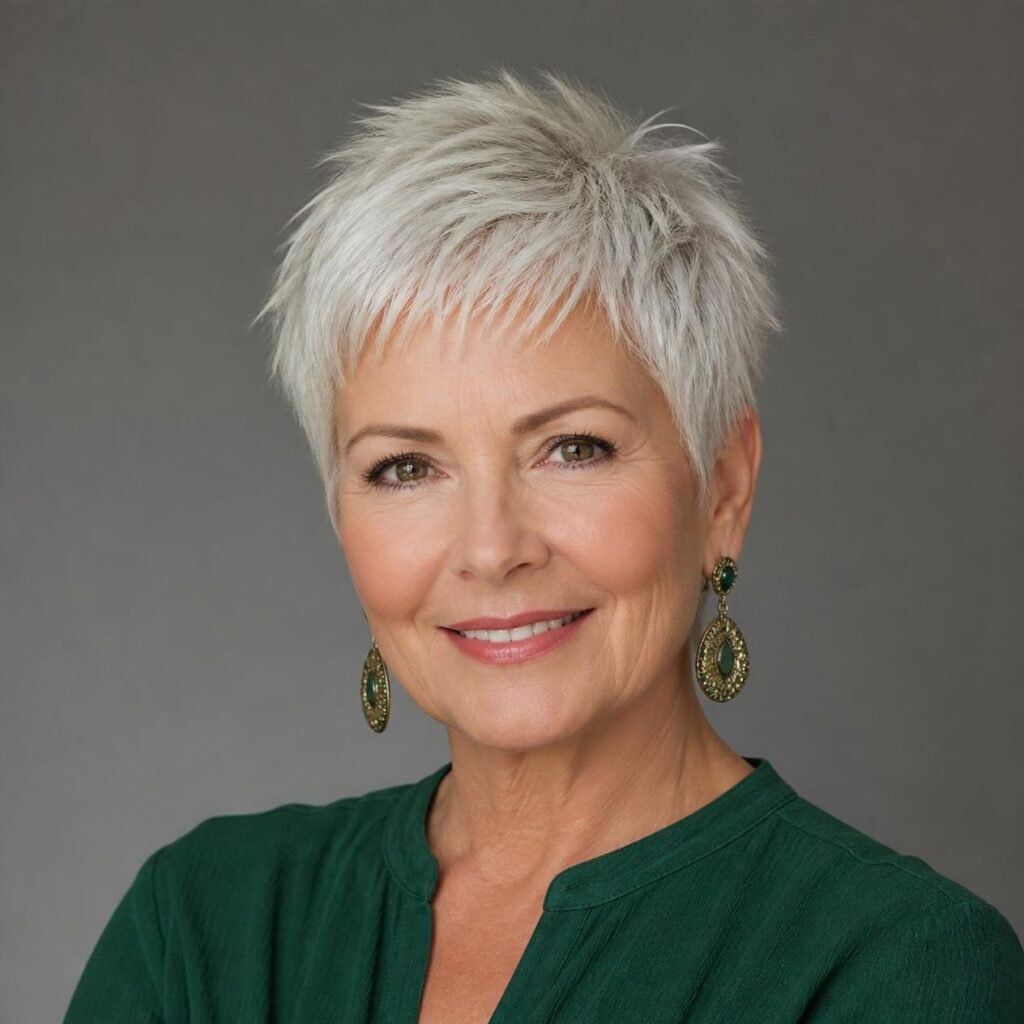
1. Textured pixie with crown height
A tapered pixie with volume at the crown adds height, while the exposed neck and jaw make the face look slimmer. A textured pixie with a longer top does the same, using a styling wax for definition. Very short cuts can make the head look wide on thick hair, so ask for lift on top, not a rounded cap.
Best for: Round faces with fine to medium hair
2. Asymmetrical contour bob
Try asymmetry: tuck one side behind the ear to lift the cheekbone and pull the eye away from the widest part of the face. The bob sits at the jaw or just below, with one side a little longer and a deep side part. It looks intentional rather than lopsided if the angle is soft. An asymmetrical bob suits round and square faces.
How to wear it: Ask your stylist which side should be longer based on where your hair falls.
Best for: Round and square faces; women who like a defined shape
3. Shoulder-length waves with face-framing layers
Long, soft layers cut in a curve past the cheekbones frame the face and create a longer line through the neck. Keep the length away from the jaw and use flowing layers to wrap the face. Waves add movement. This length also appeals in the 60s because it avoids the wispy ends of very long hair. Grey-blonde tones look soft with it.
Best for: Round faces who want to keep length

4. Wispy side-swept fringe
Full, blunt bangs can make a round face look wider, so choose lighter ones. Wispy bangs that let some forehead show create a sense of height, while diagonal bangs brushed to one side draw attention away from wide cheeks. They can be anywhere from brow-skimming to cheekbone-grazing. Keep them feathered and fine.
How to wear it: Ask for point-cutting, and trim every four weeks.
Best for: Round faces; high or lined foreheads
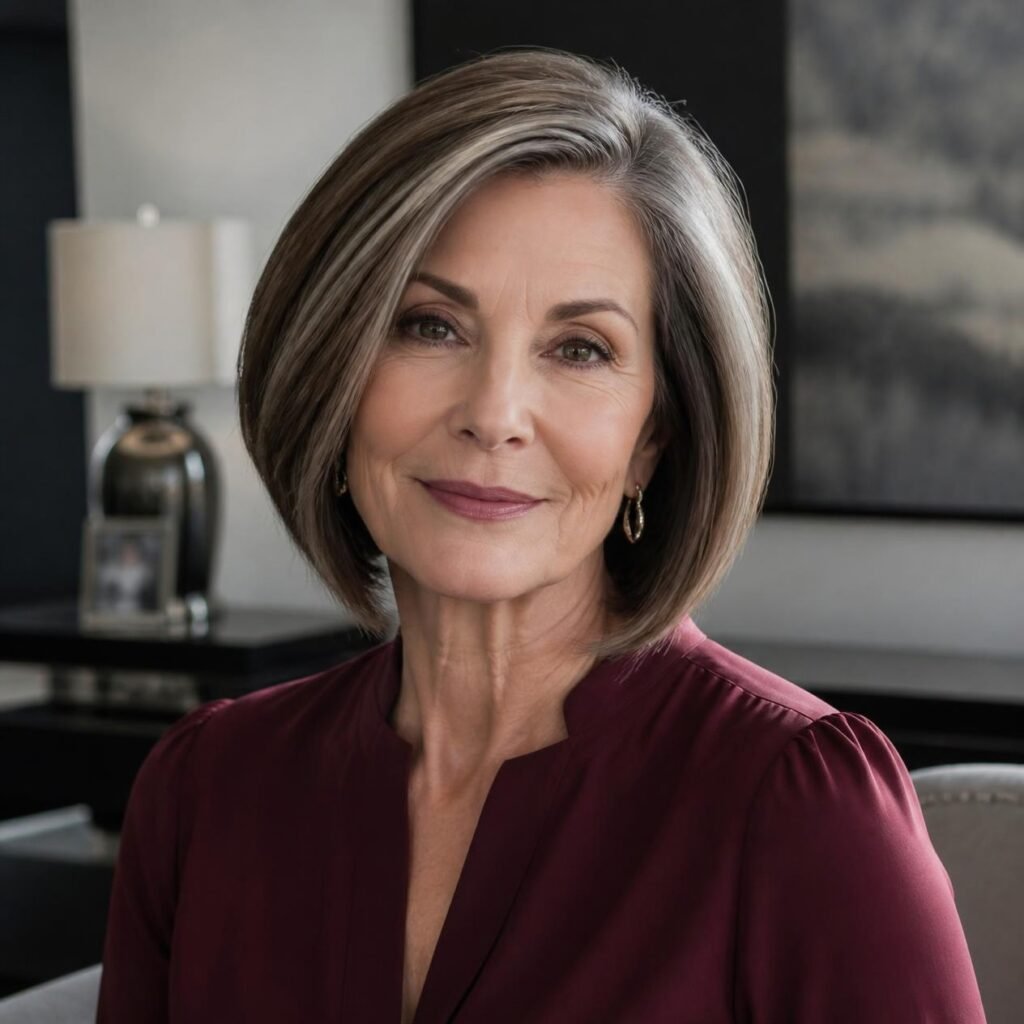
5. Sleek angled bob
An angled bob is cut shorter at the back and gradually longer toward the front, so the lines point down and lengthen the face. This shape elongates and suits straight or curly hair. Brown with silver highlights looks polished on it because the highlights show off the angle. Use a flat iron or smoothing serum for a glossy finish and choose a deep side part.
How to wear it: Keep the front length at or below the chin, not above it.
Best for: Straight, sleek hair; round faces that want polish
Square and long faces
Both shapes benefit from softening the corners, but long faces also want width at the sides.
6. Long layers with a deep side part
For square faces, length is flattering, and a deep side part with long, light layers softens a strong jaw. Hair falls past the shoulders with layers starting around the chin. The side part adds fullness at the crown while lengthening the face. Keep the layers minimal so ends still look dense. Trims every eight to ten weeks keep the ends from looking worn.
How to wear it: Part your hair on the side where it naturally falls.
Best for: Square faces; women with medium to thick hair
7. Low fringe with long layers
Low fringes that sit near the cheekbones work well for square faces. The fringe is cut to graze the cheekbones, not the brows, which breaks up the width of the forehead and jaw. Pair it with long layers that sweep over the sides. It is a sensible option if you are growing out a shorter cut. If you have fine hair, keep the fringe slightly wispy so it does not look heavy.
How to wear it: Style the fringe with a small round brush and a cool setting.
Best for: Square faces with a wide forehead
8. Curly shag with a fringe
A curly shag with a fringe is a top pick for long faces, because the width at the sides balances the length. The shag has choppy, textured layers that stand away from the face. On silver curls the layers show up beautifully. Thinning shears can help trim a fringe, but gray hair usually does better with layers than with thinning shears, so ask your stylist what suits your hair.
Best for: Long faces with natural curl or wave
9. Side-volume lob
A lob or longer cut with volume at the sides makes a long face look shorter. The shape sits between the collarbone and shoulder, with texture at the ear level that adds width. Rather than keeping hair sleek and flat on top, ask for body through the mid-lengths. A deep side part also breaks up length. Avoid piling on hairspray, which flattens the very volume you are building.
How to wear it: Use a volumizing mousse at the ears and mid-lengths.
Best for: Long, narrow faces
10. Jaw-grazing wavy bob
Big curls, side parts and swept-over bangs flatter square faces. A wavy bob ending at the jaw, with a sweep of hair across the forehead, softens corners. Curls at the ends, not the roots, keep the shape light. If your hair is naturally straight, a few passes with a large-barrel curling iron are enough. Finish with a light shine spray so the waves look glossy rather than frizzy.
How to wear it: Wrap the ends forward and brush the curls out gently.
Best for: Square faces who prefer a shorter shape
Oval and heart-shaped faces
Oval faces have the most freedom, and heart shapes benefit from fullness lower down. Both do well with a chin-length cut.
11. Bold cheekbone pixie
Oval faces can choose a cut around a favorite feature, and a bold pixie can show off high cheekbones. A pixie that is tapered at the sides and has length on top fits this shape well. It also grows out evenly. Keep the nape neat, and use a soft paste on the top pieces. It is also an easy cut to maintain with a trim every six to eight weeks.
How to wear it: Ask for a longer top that you can sweep either way.
Best for: Oval faces with defined cheekbones
12. Sleek lob
A sleek lob draws attention to the center of the face, and it works on oval faces especially. Hair ends between the chin and collarbone, with a smooth finish. Use a flat iron or a round brush to keep the line straight. If your hair is fine, ask for a blunt perimeter to preserve fullness. It suits glossy, healthy ends, so a quick conditioning mask each week helps.
How to wear it: Use a lightweight smoothing serum on the ends.
Best for: Oval faces; straight hair
13. Choppy layered bob above the shoulders
A layered, choppy bob that sits above the shoulders is a good match for oval faces. It adds texture without covering the face. This shape is lively, and it suits waves or slight curl. Silver strands look dimensional in choppy layers. Avoid heavy razoring, so ask for scissor-cut texture if your hair is thinning. It dries quickly too.
How to wear it: Use a texturizing spray on dry hair.
Best for: Oval faces; wavy or textured hair
14. Chin-length textured bob
For heart-shaped faces, a chin-length bob with textured ends, not blunt ones, adds fullness near the narrow chin. The bob grazes the jaw and the ends are loosely flicked. Longer lobs need a trim every six to eight weeks. Keep the crown flat and put the volume lower. Ask your stylist to angle the back slightly shorter than the front.
Best for: Heart-shaped faces
15. Wispy fringe with a long lob
Layers around the jawline and wispy fringes flatter heart shapes, and a fringe needs a trim every two to four weeks. A long lob with light layers and a wispy fringe softens the forehead and balances the chin. A light dry shampoo on non-wash days keeps the fringe fresh without weighing it down. Use a texturizing paste or a little cream to keep the fringe feathery.
Best for: Heart-shaped faces with a broad forehead
The 60s sweet spot and the gray transition
A length between the jaw and the shoulders is the sweet spot for this decade. It frames the face, holds a curl and is manageable.
16. Shoulder-grazing lob with ghost layers
A lob that grazes the shoulders with layers frames the face and adds shape to finer hair. Ghost layers hidden under a blunt lob suit baby-fine hair, adding movement without visible steps. Hair shorter than the shoulders can fan out, so this length is a safe middle.
How to wear it: Blow-dry with a round brush and flip the ends in.
Best for: Fine to medium hair; the safest all-purpose length
17. Sleek undercut with a fuller top
Tight sides with a fuller top are a modern choice for 60 and over, and if hair is thin, ask for the ends to be cut for volume. It is short at the nape and sides but with length to style on top. Short sides also show off silver well. Keep the top long enough to sweep or push back.
How to wear it: Keep the sides tidy with a trim every four to five weeks.
Best for: Women who want an edgy, current cut
18. Graduated shoulder length with soft layers
Shoulder length balances versatility and easy upkeep, and a few graduated layers work best, since too many layers thin the ends. It can be curled, straightened or worn up. For wavy hair, use a curl cream. For straight hair, a root-lift spray. It is the cut that suits most face shapes, so it is a good safe choice.
How to wear it: Keep layers shorter at the front and longer in back.
Best for: Women who like variety in styling
19. Silver blend with a gloss
If you are going gray, avoid drastic changes, since the more gray you have, the more your texture may change. Ask your colorist for a root smudge, low-lights and a gloss, so the line between color and silver softens. Demi-permanent color works at home, but leave anything larger to a professional. It works on thick or thin hair.
How to wear it: Cut off colored ends as the silver grows in.
Best for: Women growing out dyed hair
20. Slightly cropped wash-and-wear cut
Shorter cuts reduce the need for heat styling and chemical processing, which can make aging hair look older. Ask the salon for wash and wear, with sides and back kept close to the face. Hair is cropped near the ears, with soft tops. It suits busy mornings and travel. Add a little cream to the top for a soft finish and avoid heavy products.
How to wear it: Tell your stylist you want to air dry.
Best for: Women who want easy upkeep
Good to know
Female pattern hair loss often begins in midlife with a widening part or thinning at the temples. If a cut that used to work now looks flat or sparse, mention it to your stylist and consider seeing a dermatologist to check the cause.
What to ask your stylist
Bring photos of the cut from the front, side and back, and tell your stylist which face shape you think you have. Ask where the longest and shortest lengths will fall, how often you will need to return, and how the cut will look in two months, not just on the day. If you wear glasses, a fringe should sit just above the frames.
Ask about the parting too. A deep side part adds fullness, while a center part frames the face symmetrically on longer hair. Finally, ask what to do if you want to change course. A cut with a strong shape, such as a bob, is easier to grow out than a short layered crop.
Frequently asked questions
Choosing a haircut by face shape takes the guesswork out of the salon visit. Start with the section that matches your face, pick the cut that fits your routine, and give your stylist a clear picture. A good shape does the work for you.