
15 Wedding Guest Outfits for Women Over 50
A wedding invitation has three unspoken questions hidden inside it: what is the dress code really, what will the day be like, and will you still feel like yourself in photos at midnight. Most wedding guest outfits for women over 50 fail on one of those three. Not the dress — the planning.
The women who look best at weddings are not the ones in the newest dress. They are the ones who read the invitation properly and dressed for the day, not just the ceremony.
This guide gives you 15 complete wedding guest outfits — head-to-toe combinations with the exact pieces, shoes and finishing touches. They are grouped by the weddings you actually get invited to: daytime garden and church weddings, formal evenings, and country, barn and destination weddings.
Each one is built to be comfortable from the first photo to the last dance, and every piece is something you can wear again. Start with the dress code on your invitation, then pick your outfit.
Quick picks
- The one dress that handles almost any wedding: the navy crepe column dress (#9)
- Garden ceremony confidence: the floral midi dress with a cropped jacket (#2)
- When the invitation says formal: the tailored jumpsuit (#10)
- Warm-weather outdoor weddings: the chiffon maxi with a pashmina (#13)
- Comfort that still looks dressed: the knit midi dress with block heels (#15)
- For the friend who hates dresses: the velvet blazer with wide-leg trousers (#11)
Contents
Reading the invitation: how to dress for the real wedding
Decode the venue first, the dress code second. “Garden party attire” on a church invitation means something different from the same words on a farm. The venue tells you about the ground (grass means no stilettos), the temperature (a marquee at 6pm cools fast), and the formality of the photos.
The dress code tells you the ceiling — how dressed you can go without outshining the occasion. When the two seem to clash, dress for the venue and polish to the code.
Fit the armhole, not just the waist. Wedding days are long — you will hug people, raise a glass, sit for dinner, and dance. A dress that fits your waist but pulls at the armhole will announce itself in every photo.
When trying on, do the three-move test: reach up as if catching a bouquet, sit down, and twist as if talking to the person beside you. Anything that rides, gapes or needs adjusting fails, whatever the price tag.
One “evening” element is enough. Satin, lace, velvet, sequins and metallics all read as evening — but wear more than one and the outfit tips into costume. Pair your one dressy fabric with something matte and quiet: a satin dress with a plain wool jacket, a lace dress with suede shoes.
The restraint is what makes the expensive-looking piece look expensive.
Build in the temperature plan. Almost every wedding has a cold gap — the walk between ceremony and drinks, the evening when the sun drops. A wrap, pashmina or cropped jacket is not optional; it is part of the outfit.
It should look deliberate from the start, not like an afterthought borrowed from the car. Several of the outfits below, like the grandmother-of-the-bride dresses we covered earlier, treat the cover-up as a design feature rather than a compromise.
Shoes decide how long you last. A 7 cm heel is fine for a 2-hour city ceremony with taxis between venues. For grass, gravel, or a full day on your feet, a block heel of 4–5 cm or a dressy flat keeps you standing through the speeches.
Whatever you choose, wear them for a full evening at home first — a wedding is never the place to break in shoes. If you want everyday versions of these principles, our casual dresses guide covers the same fit logic for daily life.
The 15 outfits at a glance
| Outfit | Key pieces | Shoes | Best for |
|---|---|---|---|
| 1. Wrap midi dress | True wrap, tie at natural waist | Block heel | Nearly every daytime wedding |
| 2. Floral midi + cropped jacket | Small-scale print, waist-length jacket | Wedge | Garden and outdoor ceremonies |
| 3. Pastel tailored sheath | Princess seams, knee length | Low pump | Church and daytime formal |
| 4. Linen shift + unstructured blazer | Breathable linen, soft shoulder | Dressy flat | Hot-weather weddings |
| 5. Printed tea dress | Fit-and-flare, 50–60 cm skirt | Block heel | Afternoon receptions |
| 6. Knit top + pleated midi skirt | Fine knit, knife pleats | Low heel | Long days with sitting |
| 7. Satin slip dress + lace cover-up | Bias cut, opaque cover | Strappy mid-heel | Evening ceremonies |
| 8. Lace cocktail dress | Fully lined, 3/4 sleeves | Classic pump | Formal evening weddings |
| 9. Navy crepe column dress | Matte crepe, one colour | Metallic low heel | The do-anything dress |
| 10. Tailored jumpsuit | Waist seam at natural waist | Pointed flat | Modern formal weddings |
| 11. Velvet blazer + wide-leg trousers | Cotton velvet, full-length leg | Block heel | Dress-avoiders, winter weddings |
| 12. Embroidered shirt dress | Belted waist, knee length | Ankle-strap flat | Barn and rustic venues |
| 13. Chiffon maxi + pashmina | Ankle-skimming, lined bodice | Wedge sandal | Destination and beach weddings |
| 14. Silk blouse + wide-leg trousers | Sandwashed silk, full break | Low block heel | Re-wearable wedding separates |
| 15. Knit midi dress + block heels | Stretch knit, defined waist | Block heel | Comfort-first long days |
Daytime, garden and church weddings
Most invitations you will get fall here: ceremonies before 4pm, daylight photos, and a dress code somewhere between “garden party” and “semi-formal”. These six outfits handle sun, wind, grass and church steps without a costume change.
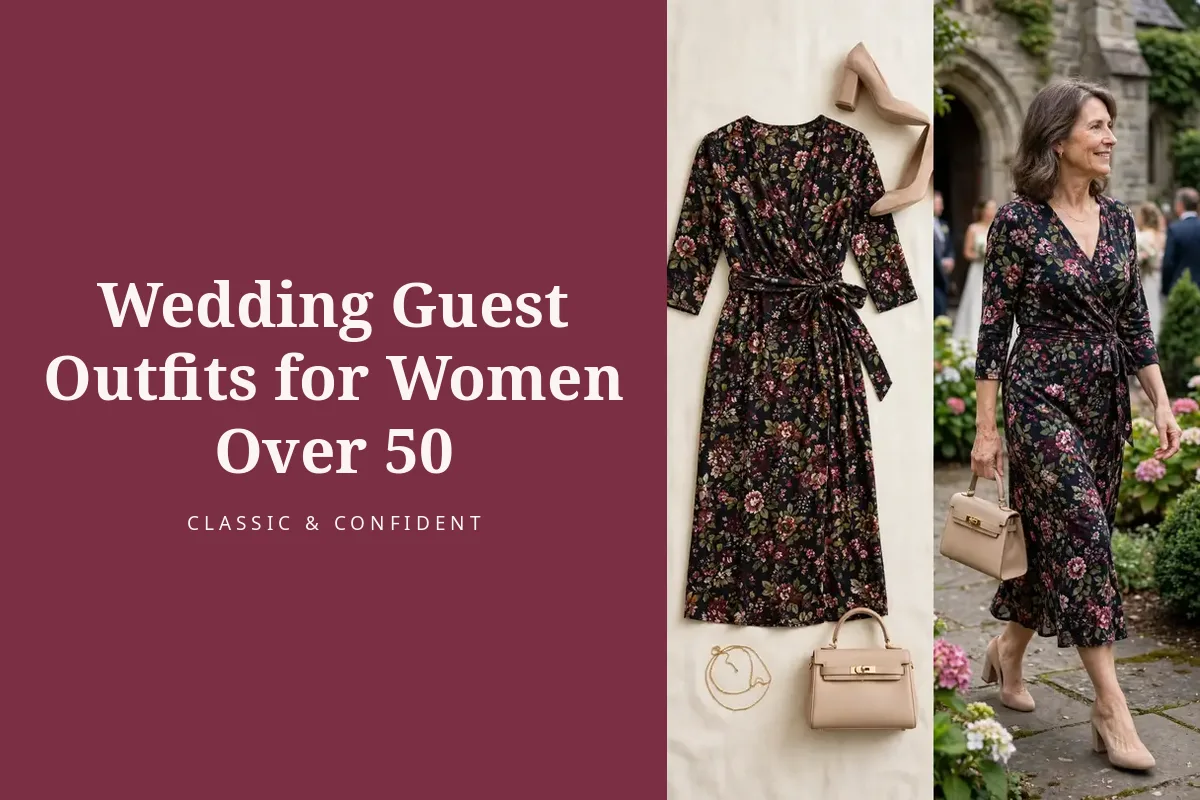
1. The wrap midi dress

A true wrap dress works because of one diagonal line: the crossover pulls the eye from shoulder to opposite hip, creating a waist definition that tailoring alone cannot fake. The tie closes at your natural waist — the narrowest point of your torso — so the dress fits your shape instead of hanging off your bust.
For a wedding, choose a matte jersey or crepe wrap with a skirt that lands 5–8 cm below the knee; shorter reads cocktail, longer reads formal.
- Key pieces: true wrap midi dress, fine chain necklace, small structured handbag
- Shoes: nude or metallic block heel, 4–5 cm
- Occasion: daytime weddings, church ceremonies, afternoon receptions
- Budget tip: a wrap dress in dark floral reads formal at half the price of a plain silk one
Shop for: a true wrap (not a faux-wrap) with ties that close at your natural waist, skirt hem 5–8 cm below the knee, matte fabric — no shine, no stretch sheen.
How to wear it:
- Tie the inner string first, snug at the waist, then wrap the outer panel and tie it at the side — the V should sit 8–10 cm below your collarbone.
- Add one delicate necklace that follows the V-neckline; nothing else near the neck.
- Carry the small structured bag in your left hand so your right is free for handshakes and hugs in photos.
Skip it if the wrap ties above or below your natural waist — the diagonal will pull the eye to the wrong place and the dress loses its whole mechanism.
Best for: pear and hourglass shapes, and anyone who wants one dress that works for nearly every daytime wedding.
2. The floral midi dress with a cropped jacket
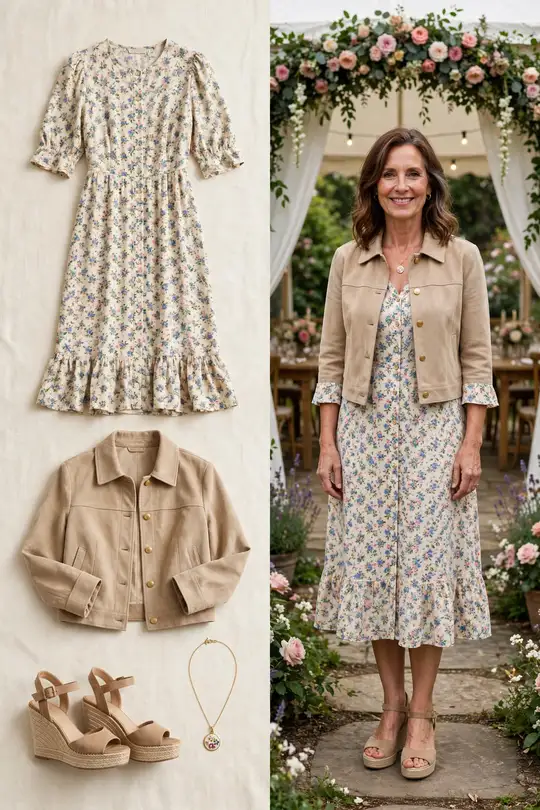
A small-scale floral print does something plain fabric cannot: it breaks up the visual surface, so the eye reads “pattern” instead of “contour”. That is why floral dresses photograph so well — cameras flatten curves, and the print restores the interest.
The cropped jacket matters just as much: ending at the waistband, it shortens your torso line and stops the midi skirt from looking shapeless. Among wedding guest outfits for women over 50, this pairing is built for a garden setting — it handles wind, sun and sitting on grass without a second thought.
- Key pieces: small-floral midi dress with sleeves, cropped jacket hitting the waistband, simple pendant
- Shoes: wedge sandal, 4–6 cm
- Occasion: garden, outdoor and marquee weddings
- Budget tip: the jacket can come from your existing wardrobe — only the dress needs to be new
Shop for: a floral with a print no larger than your palm, sleeves to the elbow or wrist, and a jacket that ends exactly where the skirt’s waistband sits.
How to wear it:
- Put the jacket on and check the back in a mirror — if it covers your seat, it is too long; it should stop at the waistband.
- Match your shoe colour to the darkest colour in the print, not to your bag.
- Wear the pendant at collarbone length so it sits inside the neckline, not on it.
Skip it if the floral scale is larger than your hand — big blooms on a midi dress read as upholstery in photos.
Best for: outdoor ceremonies, and anyone whose upper arms prefer coverage without a shawl.
3. The pastel tailored sheath dress

A sheath dress in one pastel colour works by elimination: no waist seam to place, no skirt volume to manage, no pattern to clash with the venue. The tailoring does the work instead — princess seams from shoulder to hem shape the dress to your body, which is why a £60 tailored sheath looks better than a £200 shapeless one.
Pastel reads daytime-formal instantly, which is exactly the register of a church wedding or a midday ceremony. Keep the length at the knee; longer turns it funereal in pale colours.
- Key pieces: pastel sheath with princess seams, pearl or pearl-effect studs, clutch
- Shoes: low pointed pump, 3–4 cm
- Occasion: church weddings, daytime formal ceremonies
- Budget tip: spend the alteration budget (£15–25) on taking in the waist — fit is the whole outfit here
Shop for: princess seams (not darts alone), a back vent of 12–15 cm for walking, and a colour at least two shades away from white or ivory.
How to wear it:
- Check the shoulder seams sit on your shoulder bones — if they droop, the whole column collapses.
- Hold the fabric up to your face in daylight; pastel that washes you out needs a scarf in a stronger tone at the neck.
- Carry a clutch, not a shoulder bag — straps break the clean column line.
Skip it if the fabric is thin enough to show underwear lines — pastel punishes cheap lining, so check in bright light before you buy.
Best for: straight and rectangular shapes, and traditional daytime ceremonies where you want to look immaculate without trying visibly.
4. The linen shift dress with an unstructured blazer
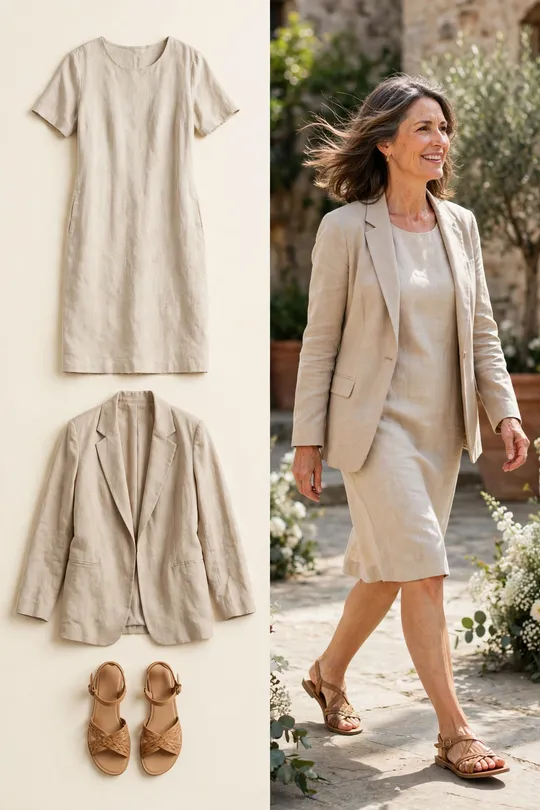
Linen is the only wedding fabric that gets better as the day gets hotter: the fibres wick moisture and the weave lets air through, so you stay cool in a way no synthetic can copy. The trade-off is structure — linen collapses — which is why the unstructured blazer is non-negotiable.
Its soft shoulder gives your silhouette a frame while the dress underneath breathes. Choose a shift with a 3–5 cm ease at the hip so it skims rather than clings when you sit.
- Key pieces: knee-length linen shift, unstructured blazer, leather sandals’ dressier cousin — a heeled sandal
- Shoes: dressy flat or 3 cm heeled sandal
- Occasion: summer weddings, outdoor ceremonies above 25°C
- Budget tip: linen-blend (linen with 20–30% cotton) wrinkles half as much and costs less
Shop for: a shift with side vents of 10 cm for stride, a blazer with zero shoulder padding, and a blazer colour drawn from the dress’s undertone.
How to wear it:
- Steam the dress the morning of — linen’s wrinkles look intentional when they are soft, accidental when they are sharp.
- Push the blazer sleeves to just below the elbow; it reads relaxed instead of corporate.
- Choose a sandal with an ankle strap — heat swells feet and a strap keeps the shoe secure by evening.
Skip it if the wedding is indoors with air conditioning all day — linen’s advantages vanish and its wrinkles remain.
Best for: hot-weather weddings, and anyone who runs warm and dreads being photographed shiny.
5. The printed tea dress
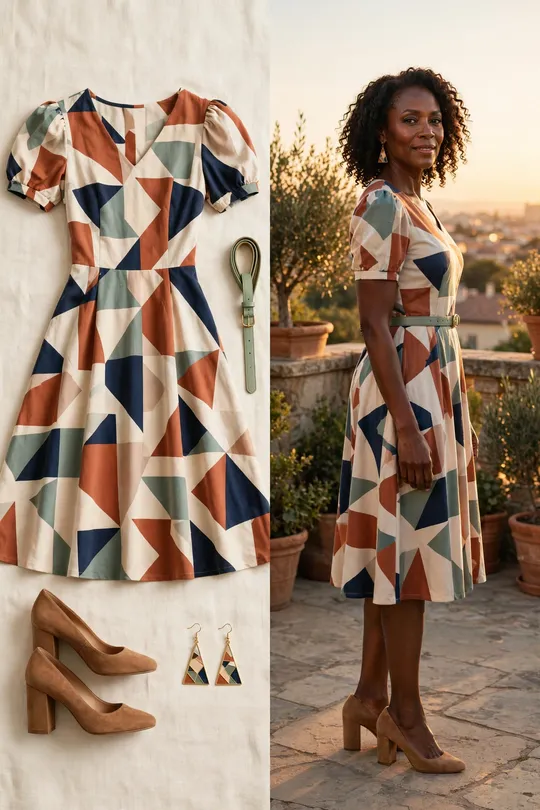
The tea dress silhouette — fitted bodice, skirt flaring from the waist — is geometry that flatters: the flare starts exactly where most women want coverage to begin, and the 50–60 cm of skirt from waist to hem gives the fabric room to move without adding bulk at the hip.
A geometric or abstract print (not floral, to keep this distinct from point 2) keeps it modern. The fitted bodice means you need the right bra — a smooth, supportive one, fitted within the last year — because the dress shows exactly what the bra does.
- Key pieces: fit-and-flare tea dress, belt at the waist (if not built in), drop earrings
- Shoes: block heel, 4–5 cm
- Occasion: afternoon receptions, semi-formal daytime weddings
- Budget tip: a sash belt in a solid colour updates a plain tea dress you already own
Shop for: a bodice with boning or firm interfacing, a skirt with 50–60 cm of sweep from the waist, and a hem that ends mid-calf — never at the widest part of your calf.
How to wear it:
- Check the hem in a full-length mirror: mid-calf lengthens, calf-widest shortens — a 3 cm alteration makes the difference.
- Wear drop earrings and skip the necklace; the print plus a neckline is enough going on near your face.
- Twirl once before you leave — if the skirt lifts above the knee in a breeze, wear a slip.
Skip it if the bodice has no structure — an unstructured tea dress on a fuller bust collapses into a tent by the speeches.
Best for: hourglass and pear shapes, and afternoon events where you will be photographed standing in groups.
6. The knit top with a pleated midi skirt

This is the separates answer to a wedding: a fine-gauge knit top forgives the waist completely — no waistband digging in during a three-course dinner — while the knife-pleated skirt brings the formality. Pleats work because they are vertical lines in motion; standing still they look tailored, walking they look fluid.
Tuck the knit fully and add a slim belt so the outfit reads as one deliberate composition rather than two separates that happened to meet.
- Key pieces: fine-knit top in a solid colour, knife-pleated midi skirt, slim belt, bracelet
- Shoes: low heel or pointed flat
- Occasion: long wedding days, ceremonies with lots of sitting
- Budget tip: both pieces re-wear separately for years — cost-per-wear is the lowest on this list
Shop for: a knit in 14-gauge or finer (no chunky knits at weddings), a skirt with stitched-down pleats for the first 15 cm, and a belt no wider than 2.5 cm.
How to wear it:
- Tuck the knit with a single flat fold at the front — bulky tucking ruins the line.
- Match the belt to your shoes, not your top, to anchor the outfit.
- Add the bracelet on your bag-carrying wrist; the other wrist stays clean for the bouquet toss photos.
- Sit down in the skirt before the day — pleats that splay open need a longer top or a different skirt.
Skip it if the knit is even slightly sheer — wedding lighting is unforgiving, and a camisole underneath changes the whole line.
Best for: apple shapes, and anyone who wants to eat, sit and dance without thinking about their clothes.
Formal, evening and black-tie-optional
Evening weddings ask for one deliberate “dressed” choice — a fabric, a silhouette or a finish that reads after dark. These five keep you firmly on the right side of formal without tipping into bridesmaid territory.
7. The satin slip dress with a lace cover-up
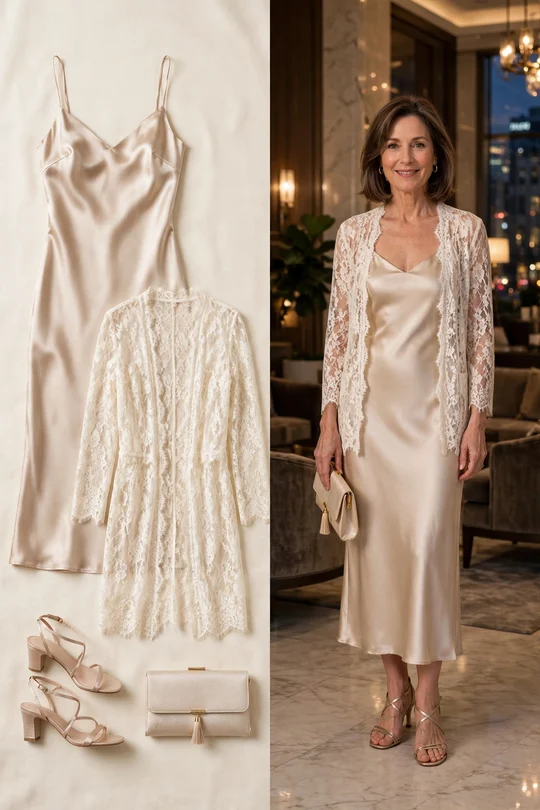
A bias-cut slip dress skims instead of clinging because the fabric is cut at 45 degrees to the grain — it stretches diagonally and falls back, following your shape without gripping it. That is the whole magic, and it is why a good slip flatters sizes 10 to 20 alike.
The lace cover-up is the wedding-guest addition: it gives arm coverage and a second texture, and it stops the slip from reading as lingerie. Choose a cover-up that ends at the hip, not the waist, so the two layers move as one.
- Key pieces: bias-cut satin slip dress, lace hip-length cover-up, strappy clutch
- Shoes: strappy mid-heel, 5–6 cm
- Occasion: evening ceremonies, city weddings
- Budget tip: champagne and pewter satin photograph better than black and cost no more
Shop for: a bias cut (check the seams run diagonally), a slip with adjustable straps, and a cover-up in opaque lace — if you can see skin through it held up to light, it is too sheer.
How to wear it:
- Adjust the straps so the neckline sits 10–12 cm below the collarbone — higher reads daywear, lower reads nightclub.
- Wear the cover-up open; buttoned, it hides the slip’s line entirely.
- Choose seamless underwear one shade darker than your skin — white shows under satin in flash photography.
Skip it if the satin is thin enough to show every seam of your underwear — hold it to a window before buying; cheap satin is the enemy here.
Best for: straight and column shapes, and warm-weather evening weddings where you want to look expensive with minimal effort.
8. The lace cocktail dress

Lace works at weddings for a structural reason most people miss: a fully lined lace dress is effectively two dresses — the lace is decoration, the lining is the garment. That means the fit comes from the lining, so a lined lace dress holds its shape through sitting, hugging and dancing while unlined lace collapses.
For women over 50, the winning formula is 3/4 sleeves and a knee-length hem: the sleeves give coverage, the hem keeps it cocktail rather than gown.
- Key pieces: fully lined lace dress with 3/4 sleeves, simple stud earrings, envelope clutch
- Shoes: classic pump, 5–7 cm
- Occasion: formal evening weddings, black-tie-optional
- Budget tip: navy and burgundy lace look richer than black and are less likely to duplicate another guest’s dress
Shop for: full lining (slip the hand inside — you should feel a second layer everywhere), a scalloped or finished hem, and lace with a motif smaller than a coin.
How to wear it:
- Let the lace be the only texture — pair it with smooth suede or leather, never with sequins or satin.
- Keep jewellery minimal: studs and one ring. Lace is already the decoration.
- Check the back neckline in a mirror; lace dresses often gap at the back of the neck when you sit.
Skip it if the dress is white, ivory, cream or champagne-adjacent — lace in pale tones photographs as bridal, and that is a line you do not cross.
Best for: formal evening weddings, and anyone who wants traditional elegance with built-in coverage.
Good to know
The most common wedding-guest mistake has nothing to do with the dress: it is arriving with no plan for the 45 cold minutes between the ceremony and the drinks reception. Pack your wrap, pashmina or jacket in the car, not the cloakroom — you will need it on the walk, not at dinner.
And if this list is saving you from a last-minute panic buy, save it to your wedding-season board now; you will want it again in June.
9. The navy crepe column dress

This is the hardest-working dress on the list, and the reason is physics: matte crepe absorbs light instead of reflecting it, so it hides texture — the fabric’s and yours — in a way no shiny fabric can. One colour from shoulder to hem creates an unbroken vertical line, which is the oldest lengthening trick in the book.
Navy specifically reads as formal as black in evening light but friendlier in daylight, which is why, among wedding guest outfits for women over 50, this one dress covers ceremonies from 2pm to 10pm. If you buy one wedding outfit this year, make it this one.
- Key pieces: navy matte-crepe column dress, metallic belt or sash, small evening bag
- Shoes: metallic low heel or pointed flat
- Occasion: the do-anything dress — day, evening, formal, semi-formal
- Budget tip: crepe in a dark solid is the single most re-wearable wedding purchase; cost-per-wear beats everything else here
Shop for: matte crepe (no sheen under shop lights), a neckline you can wear without a necklace — boat or modest V — and a hem at the knee.
How to wear it:
- Add the metallic belt at your natural waist — it is the one detail that stops the column reading as a uniform.
- For day ceremonies, wear it with the pointed flat; for evening, switch to the metallic heel — same dress, two registers.
- Carry a wrap in a contrasting texture (not colour) for the cold gap.
Skip it if the crepe is so heavy it pulls at the shoulders — a column dress that needs constant hiking up will ruin your evening.
Best for: every shape, and anyone who wants one purchase to cover the whole wedding season. My pick for the bottom line, for exactly this reason.
10. The tailored jumpsuit

A jumpsuit is a column dress with legs, and it earns its place at formal weddings through the waist seam: placed exactly at your natural waist, it divides you into the same proportions as a dress — one-third above, two-thirds below — which is why a well-cut jumpsuit reads as elegant rather than casual.
The wide leg balances the hip and gives you stride and sitting room no fitted dress allows. Choose one with a defined waist (belted or seamed, never elastic-only) and a neckline that needs no necklace.
- Key pieces: tailored jumpsuit with waist seam, statement earrings, structured mini bag
- Shoes: pointed flat or low heel (the leg must break cleanly on the shoe)
- Occasion: modern formal weddings, city venues
- Budget tip: black or midnight jumpsuits re-wear for every evening event you own
Shop for: a waist seam at your natural waist (not dropped), a leg wide enough to cover the shoe’s vamp, and a back closure you can manage alone.
How to wear it:
- Check the rise sitting down — if it pulls at the crotch when seated, size up and tailor the waist.
- Wear statement earrings and nothing at the neck; the jumpsuit’s neckline is the focal point.
- Hem the leg to just kiss the top of your shoe — pooling fabric shortens you instantly.
- Test the bathroom logistics at home. Seriously. A wedding is not the time to discover a complicated closure.
Skip it if the fabric is jersey with no structure — an unstructured jumpsuit at a formal wedding reads as loungewear.
Best for: tall and long-legged shapes, and confident dressers who want to stand out for the right reasons.
11. The velvet blazer with wide-leg trousers
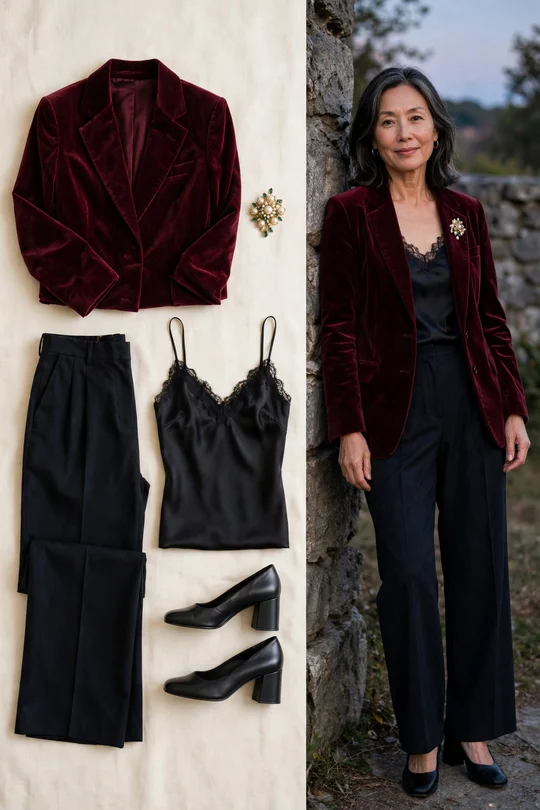
Velvet is evening fabric without being a dress, which makes this the outfit for the woman who simply does not wear dresses to weddings — and there is no rule that says she must. Cotton velvet (not stretch velvet, which shines and clings) has a deep, light-absorbing pile that reads as luxurious in person and in photos.
The wide-leg trouser balances the blazer’s structure and elongates the leg; the two together give you the formality of a suit with none of the boardroom feeling.
- Key pieces: cotton-velvet blazer, wide-leg trousers, silk or satin camisole, brooch
- Shoes: block heel, 4–5 cm
- Occasion: winter weddings, evening receptions, dress-avoiders
- Budget tip: the blazer alone elevates every dark trouser you own — buy it first
Shop for: cotton velvet with a short, dense pile; trousers with a flat front and full-length leg; a camisole in a tone that echoes the blazer, not white.
How to wear it:
- Pin the brooch on the blazer’s left lapel — it is the jewellery, so skip the necklace.
- Leave the blazer open; buttoned velvet across the bust pulls and shows every strain line.
- Choose a camisole with a straight neckline that sits 5 cm below the collarbone.
Skip it if the velvet shows every touch mark — crush it in your fist in the shop; if the marks stay, choose a different pile.
Best for: winter weddings, and anyone who feels more herself in tailoring than in dresses.
Country, barn and destination weddings
Barn floors are uneven, country churches are cold, and destination weddings are hot — these four outfits are built for the weddings where the setting is part of the challenge.
12. The embroidered shirt dress

A shirt dress brings the structure of tailoring — collar, button front, defined shoulder — to a wedding without the stiffness of a suit. The embroidery does the decorating so the silhouette can stay simple; a band of embroidery at the hem or yoke draws the eye to the garment’s edges, away from the middle.
Belt it at the waist with a 2.5 cm leather belt: the belt, not the dress’s own tie, gives you a clean horizontal line that defines the waist in photos.
- Key pieces: embroidered shirt dress, slim leather belt, small hoop earrings
- Shoes: ankle-strap flat or 3 cm heel
- Occasion: barn, farm and rustic outdoor weddings
- Budget tip: embroidery at the hem only costs less and flatters more than all-over embroidery
Shop for: a dress that buttons to the waist (not the neck — a V at the throat is more flattering), embroidery concentrated at the hem or yoke, and a knee-length hem.
How to wear it:
- Undo the top two buttons and fold the collar open — a buttoned-to-the-neck shirt dress reads as office wear.
- Thread the leather belt through the dress’s loops, not over them, so it sits flat.
- Roll the sleeves once to just below the elbow for a relaxed finish.
Skip it if the button front gaps at the bust — a gaping placket ruins the line; size for the bust and tailor the waist.
Best for: rustic and barn venues, and anyone who wants structure without formality.
13. The chiffon maxi with a pashmina
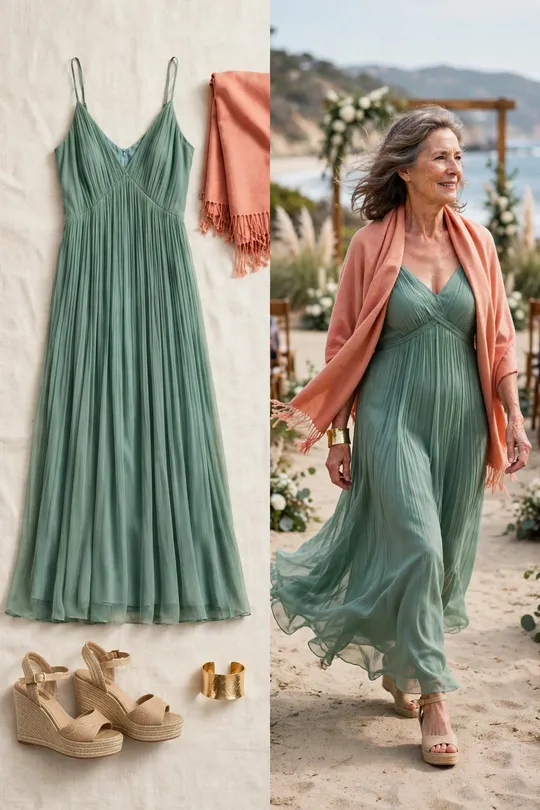
Chiffon earns its place at destination weddings because it moves: the fabric catches sea breezes and air conditioning alike, which means it looks alive in photos instead of static. The trick is the construction underneath — a lined bodice to the waist and a skirt that is ankle-skimming, not floor-dragging, so you can walk on sand, grass or uneven stone.
The pashmina is doing triple duty here: sun cover, evening warmth, and a colour accent against the dress.
- Key pieces: lined chiffon maxi dress, pashmina in a contrasting tone, simple cuff bracelet
- Shoes: wedge sandal, 5–7 cm (never a stiletto on sand or grass)
- Occasion: destination, beach and clifftop weddings
- Budget tip: chiffon packs to nothing — this is the dress for weddings involving a suitcase
Shop for: a bodice lined to the waist, a skirt 3–5 cm off the ground in your wedding shoes, and a pashmina at least 180 cm long so it wraps properly.
How to wear it:
- Walk the stairs at home in the full outfit — a maxi that catches on steps needs hemming before the wedding, not during.
- Drape the pashmina over your shoulders for the ceremony; knot it loosely at the front for the evening.
- Wear the cuff on your upper forearm, not the wrist — it stays visible above the chiffon sleeve.
- Pack fashion tape: sea wind finds every neckline.
Skip it if the chiffon is unlined past the waist — sunlight turns unlined chiffon transparent, and beach weddings have a lot of sunlight.
Best for: destination weddings, and anyone who wants maximum drama with minimum packing.
14. The silk blouse with wide-leg trousers
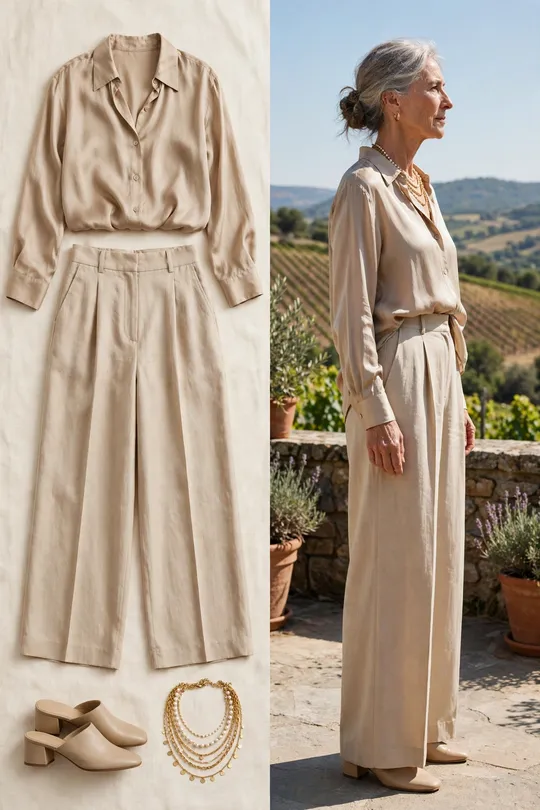
Separates are the most re-wearable wedding outfit you can own, and this pairing works because of contrast: the silk blouse brings sheen and softness at the face, the matte wide-leg trouser brings structure below. Sandwashed silk specifically — with its softened, non-shiny finish — reads as expensive without the high-maintenance glare of traditional silk.
The trouser leg should break once, cleanly, on the shoe: that single break is what makes wide legs look tailored instead of sloppy.
- Key pieces: sandwashed silk blouse, high-waisted wide-leg trousers, delicate layered necklaces
- Shoes: low block heel, 3–4 cm
- Occasion: semi-formal weddings, and every event after
- Budget tip: buy the trousers first — a perfect wide leg is harder to find than a good blouse
Shop for: sandwashed or matte silk (not shiny charmeuse), trousers with a waistband that sits at your natural waist, and a single clean break at the shoe.
How to wear it:
- Half-tuck the blouse at the front — a full tuck with wide legs can look severe; the half-tuck softens it.
- Layer two delicate necklaces at different lengths (40 cm and 50 cm) to fill the blouse’s neckline.
- Hem the trousers wearing the exact wedding shoes — a 2 cm difference changes the whole break.
Skip it if the blouse pulls across the bust when you move your arms — silk shows strain lines mercilessly in photos.
Best for: rectangle and apple shapes, and anyone building a wardrobe where every piece works twice.
15. The knit midi dress with block heels
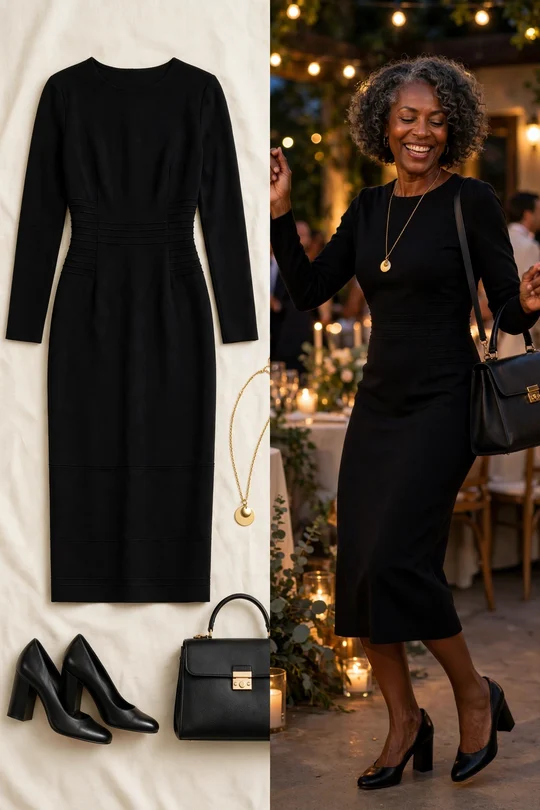
Of all the wedding guest outfits for women over 50, this is the one that admits a wedding is a 10-hour day: a ponte or ottoman knit dress with enough stretch to let you sit, eat and dance, cut with a defined waist so it still reads as dressed.
Knit works here because the fabric’s recovery — its ability to spring back — keeps the silhouette smooth all day where woven fabrics crease and sag. Choose a dress with ruching or seaming at the waist rather than an elastic band; the seaming defines without digging.
- Key pieces: ponte-knit midi dress with waist seaming, pendant necklace, structured tote that doubles as an evening bag
- Shoes: block heel, 4–5 cm
- Occasion: long wedding days, comfort-first dressing
- Budget tip: ponte knit looks far more expensive than it is — this is the list’s best value outfit
Shop for: ponte or ottoman knit (280–320 gsm — substantial, not flimsy), waist seaming rather than elastic, and a hem 5 cm below the knee.
How to wear it:
- Sit in the dress for 20 minutes at home — if the knees bag out and stay bagged, the knit is too light.
- Wear the pendant at 45–50 cm so it lands on the dress’s waist seaming, drawing the eye there.
- Choose a structured bag, not a slouchy one — structure is what keeps knit reading as occasionwear.
Skip it if the knit clings to the tummy when you sit — hold the fabric; if it has less than 5% stretch recovery, walk away.
Best for: anyone who wants to forget about their outfit entirely and enjoy the wedding.
Wedding guest outfits for women over 50: the rules that keep you confident
Five rules cover 90% of wedding-guest anxiety. They are not about fashion — they are about the social contract of being a guest.
- Never wear white, ivory, cream or anything that photographs white. Champagne, blush and pale gold are all risky in flash photography — if you have to ask, choose another colour.
- Match the couple’s effort, not their budget. A barn wedding with a hog roast wants polish, not black tie; a hotel ballroom wants formality. The invitation’s venue is the dress code.
- Cover what the venue requires. Churches and temples often expect covered shoulders — bring the wrap regardless of the weather forecast.
- Break in everything. Shoes get a full evening at home; a new dress gets a full sit-stand-walk test. Weddings expose every unworn-in flaw by hour three.
- Photograph the outfit before the day. A phone photo in daylight shows you what the wedding photographer will see — including the things the mirror hides.
- Bring the emergency kit. Fashion tape, a mini sewing kit, blister plasters and a stain wipe fit in any clutch and have saved more weddings than any accessory.
The two-week wedding-guest checklist:
- Two weeks out: try on the full outfit with the exact shoes, bag and underwear. Photograph it in daylight.
- Ten days out: book any alterations — hems, waist tweaks, strap adjustments. This is the last safe window.
- One week out: break in the shoes for two full evenings at home.
- Three days out: steam or press everything; pack the emergency kit and the wrap.
- The morning of: dress last, after hair and makeup, and do the three-move test one final time.
The bottom line
If I had to pick one wedding guest outfit for women over 50, it would be the navy crepe column dress (#9) — no contest. It is the only piece on this list that works at 2pm and 10pm, in a church and a ballroom, and it asks nothing of you except decent shoes.
Everything else here is excellent for its occasion; the navy dress is excellent for all of them.
Pin this guide to your occasions board before the next invitation lands — future you, staring at a “garden party attire” dress code at 9pm, will be very glad you did.
Frequently asked questions
What are the best wedding guest outfits for women over 50?
A knee-length or midi dress in a solid colour or small print, with a wrap or jacket for temperature changes and shoes you can stand in for hours. The safest formula is a dress with sleeves (or a cover-up), a defined waist, and a heel under 5 cm — it works for roughly 80% of weddings.
If the invitation names a dress code, dress to the venue first: grass and gravel rule out stilettos whatever the code says.
Can I wear black to a wedding?
Yes, with one condition: it must read as celebratory, not funereal. That means texture or detail — lace, velvet, a metallic shoe, a colourful wrap — and never head-to-toe matte black with nothing to lift it. Black is fully accepted at evening and city weddings; for a daytime garden wedding, navy or burgundy is the safer dark choice.
What shoes work for an outdoor or grass wedding?
A block heel of 4–5 cm or a wedge — both spread your weight so you do not sink. Stilettos sink into grass within steps and catch in decking gaps; even heel protectors only partly help. If you genuinely cannot do heels, a pointed dressy flat in metallic or satin reads as intentional, not as giving up.
Whatever you choose, test them on grass before the day if you possibly can.
Is it okay to wear trousers to a wedding as a woman over 50?
Completely — a tailored jumpsuit or wide-leg trousers with a silk blouse or velvet blazer is wedding-appropriate at every dress code except strict black tie. The key is fabric and finish: the pieces must read as occasionwear (satin, velvet, silk, crepe), not office wear.
Add one piece of jewellery with presence and shoes with a heel, and no one will think twice.
How do I dress for a wedding when I am between sizes?
Choose wrap and knit styles first — a true wrap dress and a ponte-knit midi (points 1 and 15) fit a range of sizes without alterations because the closure and the fabric do the adjusting.
Avoid anything with a fixed waistband cut to an exact measurement, and budget £15–25 for a tailor: taking in a waist is cheap and makes an off-the-rack dress look made for you. Buy for your largest measurement and tailor down, never the reverse.
What should I wear to a winter wedding?
Heavier fabrics and real layers: velvet, ponte knit, or a crepe dress with a proper coat rather than a pashmina. A tailored wool coat in a colour that works with the dress is part of the outfit — you will be photographed in it arriving. Closed-toe shoes are expected, and a block heel handles wet pavements.
Skip the bare-legs look below about 10°C; opaque tights in a tone close to your skin or the dress keep the line clean.