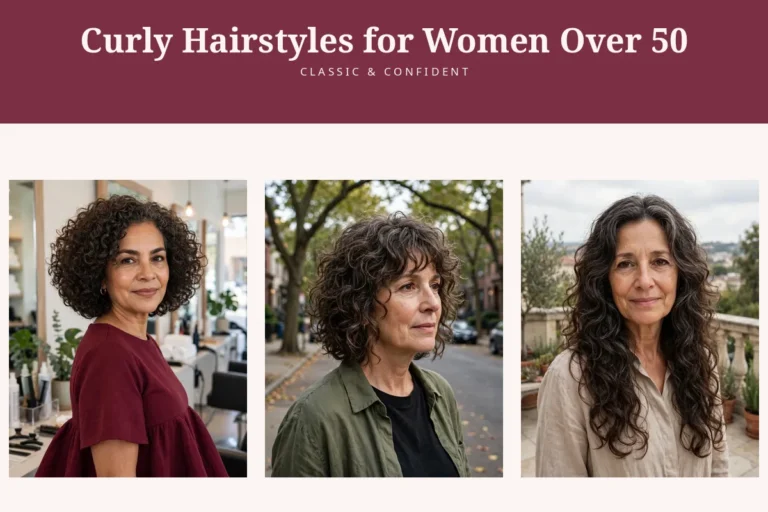
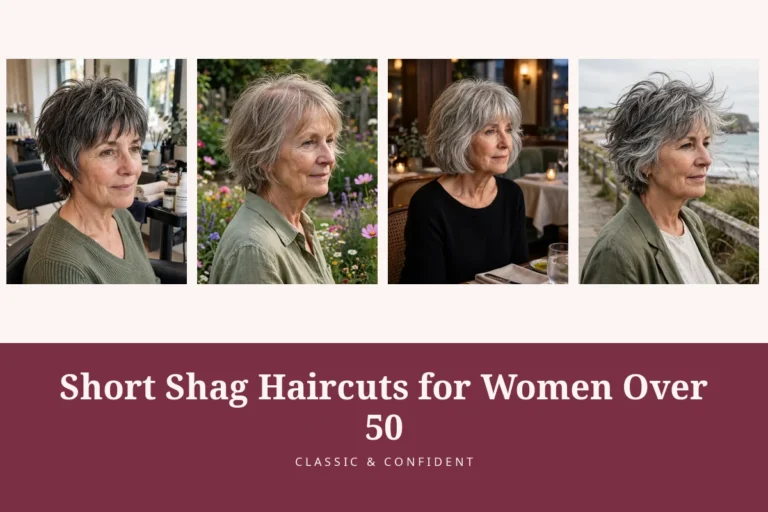
18 Shag Haircuts for Women Over 50
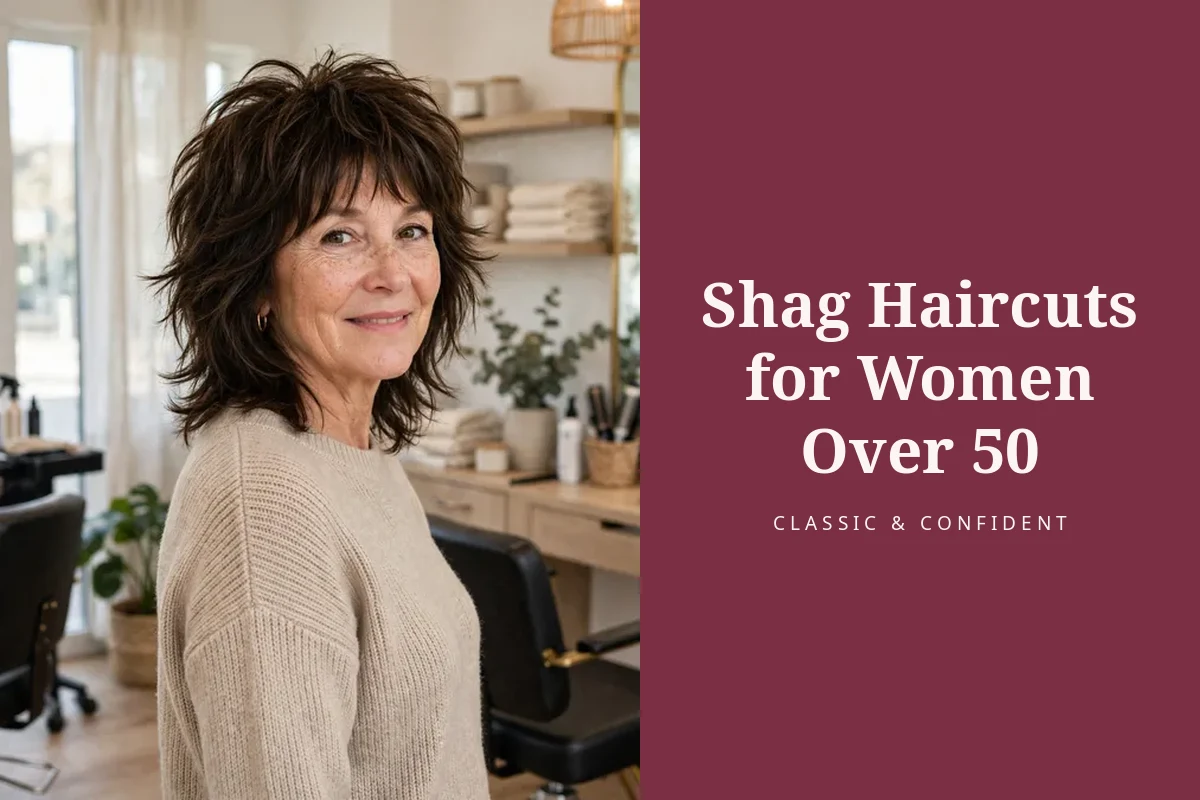
Can a woman over 50 actually wear a shag — and look modern doing it? Yes, and that’s not just encouragement. Today’s shag is nothing like the feathered, over-teased cut from decades ago: it’s a precision cut where short crown layers and piecey ends do the lifting, texturising and movement for you.
These shag haircuts for women over 50 work because the cut itself creates volume, softens the face, and forgives skipped styling days.
You get 18 shags, grouped by where to start, what suits your hair type, what flatters your face, and the lowest-effort options. Every cut comes with the exact lengths to ask for, trim intervals, and the honest verdict on who should skip it. Let’s find yours.
Quick picks
- First shag ever → the classic layered shag (#1).
- Thinning crown → the fine-hair shag (#6).
- Curly hair → the curly shag (#8).
- No heat, no fuss → the air-dried shag (#15).
- Grey and proud → the silver-grey shag (#17).
- Evening polish → the sleek night-out shag (#18).
Contents
How to choose shag haircuts for women over 50
Know what makes a shag a shag. Three things: short layers at the crown (5–8 cm shorter than the perimeter), texture through the mid-lengths, and ends that are thinned or point-cut rather than blunt.
If a “shag” has none of these, it’s just a layered cut wearing the wrong name — ask your stylist which of the three yours will have.
Match the shag to your density. Fine hair needs a conservative shag — longer crown layers and weight kept at the ends (#6). Thick hair needs the opposite: aggressive debulking and interior layers (#7).
The single most common shag complaint (“it went puffy” or “it went flat”) comes from the wrong density match, not the cut itself. If your hair is thinning as well as fine, the fine-hair hairstyles guide explains the density-first principles that apply here too.
Decide on the fringe before the appointment. A shag without a fringe reads casual and modern; a shag with a fringe reads deliberate and face-framing.
Fringe options that suit women over 50 best are curtain fringes, bottleneck fringes and long side-swept fringes (#2, #13, #14) — they grow out gracefully and don’t demand the four-week trim cycle of a blunt fringe.
Be honest about your styling floor. The shag’s reputation as a wash-and-go cut is half true: it air-dries beautifully, but the crown layers need 2–3 minutes of root lifting to look intentional rather than bed-head (#9, #15). If your floor is truly zero styling, choose the grown-out shag (#16) — its longer layers forgive everything.
For the bigger picture across every length, the hairstyles for women over 60 collection puts shags in context.
Ask about the grow-out plan. A well-cut shag grows out into a layered cut, not a mullet — the crown layers lengthen evenly and the shape softens over 10–14 weeks. Ask your stylist “what will this look like at week twelve?” before they pick up the scissors.
The newest hairstyles for women over 60 guide has more on cuts designed to age well between appointments.
At a glance
| Cut | Length | Trims | Best for |
|---|---|---|---|
| 1. The classic layered shag | 25–35 cm | 8–10 weeks | First-timers |
| 2. The curtain-bang shag | 25–35 cm | 8–10 weeks | Softening the forehead |
| 3. The short choppy shag | 15–22 cm | 6–8 weeks | Maximum volume |
| 4. The long shag | 38–45 cm | 10–12 weeks | Keeping length |
| 5. The bob-length shag | 22–28 cm | 7–9 weeks | Bob lovers |
| 6. The fine-hair shag | 22–30 cm | 8–10 weeks | Fine or thinning hair |
| 7. The thick-hair shag | 25–38 cm | 8–10 weeks | Thick, heavy hair |
| 8. The curly shag | 25–35 cm | 10–12 weeks | Natural curls |
| 9. The wavy wash-and-go shag | 25–32 cm | 10–12 weeks | Natural wave |
| 10. The sleek straight shag | 25–35 cm | 7–9 weeks | Straight hair |
| 11. The round-face shag | 25–35 cm | 8–10 weeks | Round faces |
| 12. The long-face shag | 22–32 cm | 8–10 weeks | Long faces |
| 13. The bottleneck-fringe shag | 25–35 cm | 8–10 weeks | Fringe lovers |
| 14. The deep side-part shag | 25–35 cm | 8–10 weeks | Asymmetry fans |
| 15. The air-dried no-heat shag | 25–32 cm | 10–12 weeks | Zero styling |
| 16. The grown-out shag | 30–40 cm | 12–14 weeks | Low maintenance |
| 17. The silver-grey shag | 22–32 cm | 8–10 weeks | Natural grey |
| 18. The polished night-out shag | 25–35 cm | 7–9 weeks | Evenings |
Start here: the classic shags
The four foundational shapes. If you’ve never had a shag, start with #1 or #5.
1. The classic layered shag

The classic shag works through deliberate weight distribution: the shortest layers sit at the crown, roughly 12–15 cm from the scalp, and each layer lengthens by 2–3 cm toward the perimeter. That graduated fall is what creates the shag’s signature crown volume without teasing — the shorter pieces literally prop up the longer ones.
Overall length lands between chin and shoulder, 25–35 cm. The ends are point-cut — cut into with the scissor tips — so they taper instead of forming a blunt shelf. This is the reference cut every other shag on this list is a variation of, which is why stylists understand it instantly.
- Length: 25–35 cm, chin to shoulder
- Trims: every 8–10 weeks
- Styling time: 10 minutes
- Face shapes: all — the most neutral shag here
Ask your stylist for: "A classic shag: shortest crown layers at twelve to fifteen centimetres, graduating down to a twenty-five to thirty-five centimetre perimeter, ends point-cut — no blunt lines anywhere."
How to style it:
- Apply a golf-ball-sized amount of mousse to damp roots, focusing on the crown.
- Blow-dry the crown first, lifting sections upward with your fingers for root volume.
- Scrunch the mid-lengths and ends while drying to encourage the piecey texture.
Skip it if you want a polished, sleek look every day — this cut’s whole character is piecey texture. Point 10 is the sleek alternative.
Best for: Anyone trying a shag for the first time.
2. The curtain-bang shag

Curtain bangs — parted in the middle and sweeping to each side — work on a shag because they continue the cut’s diagonal lines right down through the face. The bang’s shortest point sits at the bridge of the nose, around 8–10 cm, lengthening to 14–16 cm at the cheekbones, so it frames rather than covers the face.
The rest of the cut follows the classic shag blueprint (#1), but the fringe changes the whole feel: softer, more face-framing, and far more forgiving on foreheads with lines, since the diagonal sweep breaks up horizontal creases visually.
- Length: 25–35 cm; fringe 8–16 cm
- Trims: every 8–10 weeks; fringe dusted at 6
- Styling time: 10 minutes
- Face shapes: oval, long and heart — softens the forehead
Ask your stylist for: "A shag with curtain bangs: fringe shortest at the nose bridge, about eight to ten centimetres, sweeping out to fourteen to sixteen at the cheekbones. Keep the parting soft in the middle."
How to style it:
- Blow-dry the fringe forward and down first, then split it to each side while still warm.
- Style the rest as the classic shag — root lift at the crown, scrunched ends.
Skip it if your hairline is very strong or cowlicked at the front — curtain bangs fight cowlicks daily. A side-swept fringe (#14) cooperates better.
Best for: Softening a high forehead or long face.
3. The short choppy shag

The short choppy shag concentrates all the shag mechanics into 15–22 cm: crown layers drop to 8–10 cm, which is short enough to stand almost upright off the scalp. That’s where the volume comes from — at this length, gravity can’t flatten the crown, so the cut looks full all day with minimal help.
The choppiness is deliberate disconnection: layers of visibly different lengths, 3–5 cm apart, with heavily point-cut ends. It’s the boldest shag here and the highest-volume one — genuinely the most hair-per-square-inch look of the eighteen.
- Length: 15–22 cm
- Trims: every 6–8 weeks
- Styling time: 8 minutes
- Face shapes: oval and heart — volume on top balances a narrow chin
Ask your stylist for: "A short choppy shag: crown layers at eight to ten centimetres, disconnected choppy layers through the sides, fifteen to twenty-two centimetre perimeter, ends heavily textured."
How to style it:
- Work a pea-sized amount of texturising paste through dry ends for separation.
- Pinch random 1 cm sections and twist them — that’s what makes the chop read intentional.
- Lift the crown with your fingertips and mist lightly with flexible spray.
- On day two, revive with dry shampoo at the roots only — the texture does the rest.
Skip it if you have very curly hair — short choppy layers on tight curls can spring into a triangle. The curly shag (#8) is cut for that.
Best for: Fine hair that needs maximum lift, and confident personalities.
4. The long shag

The long shag keeps the shag’s layered crown but extends the perimeter to 38–45 cm, so you keep your length while gaining movement. The trick is restraint: the crown layers stay at 15–18 cm — longer than the classic shag’s — so the top doesn’t go wispy and disconnected from the long lengths below.
Long layers, 5–7 cm apart through the bottom half, remove bulk so the hair swings instead of hanging in a curtain. It’s the shag for women who’ve been told they must cut their hair short after 50 — proof that shape, not length, is what matters.
- Length: 38–45 cm
- Trims: every 10–12 weeks
- Styling time: 15 minutes
- Face shapes: all — length is universally flattering when layered well
Ask your stylist for: "A long shag: keep the length at thirty-eight to forty-five centimetres, crown layers no shorter than fifteen centimetres, long layers five to seven centimetres apart through the bottom half."
How to style it:
- Blow-dry the crown with lift, then dry the lengths smooth with a large round brush.
- Wrap 5 cm sections around a large-barrel iron, alternating direction, for loose movement.
- Shake out and finish with one drop of oil on the ends only.
Skip it if your ends are very thin — a long shag needs enough density at the perimeter to look intentional. Build density first, then grow it out.
Best for: Women keeping their length who want movement and shape.
5. The bob-length shag

The bob-length shag — sometimes called the “shob” — puts the shag’s crown layers onto a 22–28 cm bob outline. The perimeter keeps the bob’s clean line at the jaw, while everything above it is shag: short crown layers, textured ends, piecey movement. You get the bob’s polish with the shag’s volume.
It works especially well for women who love bobs but find them flat on top. The crown layers, 10–12 cm, sit exactly where bobs go limp — they fill that dead zone permanently, no backcombing required.
- Length: 22–28 cm, jaw to neck
- Trims: every 7–9 weeks
- Styling time: 10 minutes
- Face shapes: oval, long and square — the jaw line frames well
Ask your stylist for: "A bob-length shag: clean bob outline at twenty-two to twenty-eight centimetres, but with shag crown layers at ten to twelve centimetres and textured ends — polish below, volume on top."
How to style it:
- Blow-dry smooth with a medium round brush for the bob’s clean outline.
- Once dry, pinch the crown pieces with a pea-sized amount of paste to break up the smoothness on top.
Skip it if your jawline is very square and you dislike emphasis there — the jaw-length line draws the eye to it. The classic shag (#1) sits softer.
Best for: Bob devotees who want volume without giving up the shape.
Shags for your hair type
Fine, thick, curly, wavy or straight — the shag adapts, but the cutting approach changes completely.
6. The fine-hair shag

On fine hair, a shag succeeds through conservation: the crown layers stay long — 15–18 cm, not the usual 12 — so no density is sacrificed where it’s thinnest. Texture comes from point-cutting the ends and from exactly two to three interior layers, rather than the heavy layering a thick head of hair can absorb.
This is the most-requested of all shag haircuts for women over 50 with fine hair in salons, because it’s the one that doesn’t backfire.
The perimeter keeps a touch more weight than a standard shag — ends lightly textured rather than wispy — so the outline reads full. Length 22–30 cm: short enough for the crown to lift, long enough to look like real hair.
- Length: 22–30 cm
- Trims: every 8–10 weeks
- Styling time: 10 minutes
- Face shapes: all — density is the priority here
Ask your stylist for: "A conservative shag for fine hair: crown layers no shorter than fifteen centimetres, only two or three interior layers, and keep weight at the perimeter — texture the ends, don’t thin them out."
How to style it:
- Apply volumising mousse to damp roots — fine hair needs the product more than thick hair does.
- Blow-dry upside down for the first two minutes to set root lift, then finish upright.
- Use a pea-sized amount of light paste on the ends only — heavy products collapse fine shags.
- Finish with a cool shot at the crown to lock the lift in place.
Skip it if your hair is both fine and very sparse at the crown — layers expose scalp. A blunt cut with fewer layers serves you better.
Best for: Fine or thinning hair that needs lift without losing density.
7. The thick-hair shag

Thick hair needs the opposite treatment: aggressive weight removal. The thick-hair shag uses interior layering — layers cut underneath the top surface — to remove up to a third of the bulk while the outer lengths stay long enough to lie smooth.
Slide-cutting (scissors sliding down the hair shaft) thins the mid-lengths without creating the frizz that thinning shears can leave.
Crown layers can go properly short here, 10–12 cm, because there’s density to spare. The result moves like a shag should instead of sitting like a helmet — the single biggest transformation thick-haired women report from this cut.
- Length: 25–38 cm
- Trims: every 8–10 weeks
- Styling time: 12 minutes
- Face shapes: round and square — removing bulk slims the silhouette
Ask your stylist for: "A shag for thick hair: debulk with interior layers and slide-cutting through the mid-lengths, crown layers at ten to twelve centimetres, keep the outer lengths smooth."
How to style it:
- Apply a smoothing cream through the mid-lengths and ends on damp hair.
- Blow-dry with a large round brush, keeping sections taut so the debulked layers lie flat.
- Define the ends with a tiny amount of serum — thick hair needs sealing, not more texture.
Skip it if your hair is thick but also very coarse and frizzy — heavy layering can increase frizz. Ask for longer layers and more weight at the ends.
Best for: Thick, heavy hair that sits in one block.
8. The curly shag

The curly shag is cut dry, curl by curl — because curly hair shrinks 5–10 cm when it dries, and a wet cut can’t predict where each layer will land.
Layers are placed to let curls stack in a rounded shape: shorter at the crown for lift, longer at the perimeter for weight, with the ends left full rather than thinned (thinning shears are the enemy of curl definition).
The shag shape is genuinely ideal for curls — the layers break up the dreaded triangle silhouette that one-length cuts give curly hair, and the crown volume reads as intentional shape rather than frizz. Length 25–35 cm dry.
- Length: 25–35 cm dry (cut longer wet)
- Trims: every 10–12 weeks
- Styling time: 10 minutes
- Face shapes: all — curls soften every face shape
Ask your stylist for: "A dry-cut curly shag: curl-by-curl layers, shorter at the crown for lift, full ends — no thinning shears. Cut it at my natural dry length."
How to style it:
- On soaking-wet hair, rake two pumps of curl cream through, then scrunch with a microfibre towel.
- Diffuse on medium heat, cupping sections upward to encourage the crown lift.
Skip it if your stylist insists on cutting it wet and straight — find a curl specialist. A wet cut on curls is guesswork.
Best for: Natural curls and waves that want shape, not a triangle.
9. The wavy wash-and-go shag

Natural wave is the shag’s easiest partner: the cut’s layers amplify the wave pattern you already have, so air-drying produces genuine texture instead of limp almost-waves.
The layers are cut slightly longer than the classic shag — 14–16 cm at the crown — because wave needs length to form its S-shape; too-short layers on wavy hair flip outward instead of waving.
This is the truest wash-and-go shag on the list. Damp, scrunch, leave — the cut does the styling. It’s also the most forgiving grow-out: wavy texture disguises uneven lengths for months.
- Length: 25–32 cm
- Trims: every 10–12 weeks
- Styling time: 5 minutes
- Face shapes: all — wave is universally softening
Ask your stylist for: "A wash-and-go shag for natural wave: crown layers at fourteen to sixteen centimetres — long enough to wave, not flip — and point-cut ends. I want to air-dry it."
How to style it:
- On damp hair, scrunch a golf-ball of mousse through the mid-lengths and ends.
- Twist two or three front pieces away from the face to set the wave direction.
- Leave it alone until fully dry — touching wet wave creates frizz.
- Once dry, shake at the roots and pinch the ends with a drop of oil.
Skip it if your hair is pin-straight — this cut needs your wave to work. Straight hair should look at #10 instead.
Best for: Natural wavy hair and true wash-and-go mornings.
Good to know
The shag’s first two weeks are always the choppiest — freshly cut layers sit at their most separated. By week three the ends soften and the cut settles into itself, which is when most women decide they love it. Judge your shag at week three, not day one.
And if you’re collecting ideas, save this guide to your hair board now — the exact stylist phrases are the part you’ll want at the appointment.
10. The sleek straight shag

A shag on straight hair reads completely differently: the layers create clean, graphic separations instead of tousled texture, and the silhouette stays smooth. The cut uses longer crown layers (14–16 cm) and less point-cutting than the classic version — straight hair shows every snip, so the layering must be precise rather than choppy.
It’s the most polished shag here and the best choice for women who want the shape’s volume without its messiness. Blow-dried smooth, it looks almost like a precision bob with hidden lift; worn with a flat iron, the layers fall in sleek ribbons.
- Length: 25–35 cm
- Trims: every 7–9 weeks
- Styling time: 12 minutes
- Face shapes: oval and long — sleekness suits balanced faces
Ask your stylist for: "A sleek shag for straight hair: longer crown layers at fourteen to sixteen centimetres, precise layering rather than choppy texture, ends lightly point-cut — I want it smooth, not tousled."
How to style it:
- Blow-dry smooth with a paddle brush, directing everything down for a sleek fall.
- Run a flat iron over the mid-lengths in 4 cm sections to polish the layers.
- Finish with a pea-sized amount of serum for shine — straight shags live on gloss.
Skip it if you love tousled texture — this is the anti-tousle shag. The classic (#1) gives you the piecey look.
Best for: Straight hair that wants volume with polish.
Shags that flatter your face
Small adjustments — fringe shape, parting, where the volume sits — that change how a shag frames you.
11. The round-face shag

Round faces need vertical lines and crown height — exactly what a shag provides when it’s cut with intention. This version keeps the volume concentrated at the crown (shorter crown layers, 10–12 cm, for maximum lift) and keeps the sides close and long past the jaw, so the eye travels up and down rather than side to side.
The critical detail is the front: long, diagonal face-framing pieces starting at the cheekbone, never a rounded shape that echoes the face. Those diagonals are what slim — they break the circle.
- Length: 25–35 cm
- Trims: every 8–10 weeks
- Styling time: 10 minutes
- Face shapes: round — crown height and diagonals slim
Ask your stylist for: "A shag for a round face: maximum crown volume with ten to twelve centimetre layers, sides kept close and long past the jaw, and long diagonal face-framing pieces from the cheekbone — no rounded shapes at the front."
How to style it:
- Dry the crown with serious lift — flip your head upside down for the first minute.
- Smooth the sides down and slightly forward so they narrow the face.
Skip it if you have a long face — crown height lengthens further. Point 12 is your version.
Best for: Round faces that want slimming, not hiding.
12. The long-face shag

Long faces need the opposite: width at the sides and something across the forehead to shorten the visual length. This shag keeps crown volume modest (crown layers 14–16 cm, not shorter) and builds fullness at the cheeks and jaw through textured side layers — horizontal volume that balances a long face.
A fringe is almost essential here — curtain or bottleneck, 10–14 cm — because it physically shortens the forehead. The combination of fringe plus side width is what makes this the most face-flattering shag for longer faces.
- Length: 22–32 cm
- Trims: every 8–10 weeks
- Styling time: 10 minutes
- Face shapes: long and oblong — side width balances length
Ask your stylist for: "A shag for a long face: keep the crown modest at fourteen to sixteen centimetres, build width at the cheeks and jaw with textured side layers, and add a curtain fringe at ten to fourteen centimetres."
How to style it:
- Style the fringe first, sweeping it out to each side for forehead coverage.
- Dry the side layers with a round brush, rolling outward to maximise cheek-level width.
- Keep the crown smooth rather than lifted — height is not your friend here.
- Pinch the side pieces with paste to emphasise the horizontal texture.
Skip it if you have a round face — side width adds what you don’t want. Point 11 is cut for you.
Best for: Long faces that want balance and softness.
13. The bottleneck-fringe shag

The bottleneck fringe — narrow at the crown, widening toward the cheekbones like the neck of a bottle — is the most forgiving fringe shape ever designed for a shag. The narrow top means it never looks heavy or helmet-like, while the wider ends melt into the shag’s face-framing layers so seamlessly that regrowth is nearly invisible.
It runs 8–12 cm at its longest points, skimming the cheekbones. Because the shape is open in the middle, it suits more face shapes than any blunt fringe — and it grows out into curtain bangs, then into layers, with zero awkward stage.
- Length: 25–35 cm; fringe 8–12 cm
- Trims: every 8–10 weeks
- Styling time: 10 minutes
- Face shapes: all — the most versatile fringe here
Ask your stylist for: "A shag with a bottleneck fringe: narrow at the top, eight to twelve centimetres at the cheekbones, blending straight into the face-framing layers — no blunt edge."
How to style it:
- Blow-dry the fringe down and slightly outward with a small round brush.
- Style the shag as usual — the fringe will fall into place with the layers.
Skip it if you wear heavy glasses frames — fringe plus frames crowds the eye area. Try the deep side part (#14) instead.
Best for: Anyone who wants a fringe without the commitment.
14. The deep side-part shag

Moving the part 5–7 cm off centre changes a shag’s entire geometry: the heavy side gains dramatic sweep and volume while the lighter side tucks neatly behind the ear.
That asymmetry creates a diagonal line across the forehead that slims round faces and adds instant drama to fine hair — it’s the simplest way to make a familiar cut feel new.
The cut itself is a classic shag (#1), but the layers are cut with the deep part in mind: the heavy side gets slightly longer layers so the sweep has weight to fall with, and the light side is kept close. Tell your stylist where you part before they start — it changes where the layers land.
- Length: 25–35 cm
- Trims: every 8–10 weeks
- Styling time: 10 minutes
- Face shapes: round and heart — the diagonal slims
Ask your stylist for: "A shag cut for a deep side part — five to seven centimetres off centre. Give the heavy side slightly longer layers for the sweep, keep the light side close enough to tuck."
How to style it:
- Set the deep part on damp hair with a tail comb — precision here matters.
- Blow-dry the heavy side forward and over, lifting at the roots for the sweep.
- Tuck the light side behind the ear and pin if needed; mist to hold the asymmetry.
Skip it if your hairline has a strong natural centre part that fights relocation — some hairlines won’t hold a deep part. Work with your growth pattern, not against it.
Best for: Fine hair that needs drama, and round faces.
Low-effort and grown-up shags
Shags for real life: minimal styling, graceful grow-outs, and silver hair shown off properly.
And if you want the same texture at half the length, our short shag haircuts for women over 50 keep the movement with even less styling.15. The air-dried no-heat shag

This shag is engineered for zero heat: the layers are cut longer and more blended than standard — crown at 16–18 cm — so air-drying produces soft, separated texture instead of frizz. The ends are point-cut but not wispy, which means they dry into defined pieces rather than flying away.
It’s the kindest shag for hair health, because daily heat is what ages hair fastest after 50. Many women find their hair’s natural texture improves within a month of dropping the dryer — the cut simply reveals what was always there.
- Length: 25–32 cm
- Trims: every 10–12 weeks
- Styling time: 3 minutes
- Face shapes: all — softness suits everyone
Ask your stylist for: "A no-heat shag: longer blended layers, crown at sixteen to eighteen centimetres, ends point-cut but not wispy — cut it to air-dry, because that’s how I’ll wear it."
How to style it:
- Scrunch a golf-ball of mousse into damp hair and set your part.
- Walk away. Seriously — no touching until it’s fully dry.
- Once dry, shake the roots and smooth the very ends with one drop of oil.
- On day two, mist with water and re-scrunch — no washing needed.
Skip it if your hair is very coarse and air-dries into a triangle — some textures need heat to behave. Be honest about yours.
Best for: Women who’ve retired their hairdryer for good.
16. The grown-out shag

The grown-out shag is a shag designed backwards: cut with 10–14 weeks of growth already factored in. The crown layers start longer (16–18 cm), the perimeter longer (30–40 cm), and the layering more blended — so as everything lengthens, the shape softens into a long layered cut instead of collapsing into a mullet.
This is the shag for women who stretch salon visits, travel for months, or simply dislike the appointment treadmill. It looks good at week one and still looks good at week twelve — the rare cut where neglect is part of the design.
- Length: 30–40 cm
- Trims: every 12–14 weeks
- Styling time: 8 minutes
- Face shapes: all — length is forgiving
Ask your stylist for: "Cut this shag to grow out: crown layers at sixteen to eighteen centimetres, perimeter thirty to forty, everything blended — I want it to look good at week twelve, not just week one."
How to style it:
- Blow-dry or air-dry — both work, since the layers are long enough to behave.
- Refresh the shape between cuts with dry shampoo at the crown for lift.
Skip it if you love a crisp, freshly-cut look — this cut’s virtue is softness, not sharpness. The short choppy shag (#3) stays crisper.
Best for: Low-maintenance women who visit the salon three times a year.
17. The silver-grey shag

Silver and grey hair has a different texture — often coarser, drier, sometimes wirier — and the shag is one of the few cuts that turns that texture into an asset. The layers break up wiriness into piecey separation, and the crown volume counteracts the flatness grey hair can develop. The cut shows off the colour instead of fighting it.
Keep the shape at 22–32 cm with classic shag layering, and ask for the ends to be kept healthy rather than wispy — grey hair shows damage more visibly than pigmented hair. A clear gloss treatment every 8–10 weeks keeps silver bright instead of dull; it’s twenty minutes at the salon and worth every one.
- Length: 22–32 cm
- Trims: every 8–10 weeks
- Styling time: 10 minutes
- Face shapes: all — silver suits every face
Ask your stylist for: "A shag for natural grey: classic layering, twenty-two to thirty-two centimetres, but keep my ends healthy and full — grey shows damage, so no wispy thinning. And book me for gloss every couple of months."
How to style it:
- Use purple shampoo once a week to keep the silver bright — daily use dries grey hair out.
- Style as the classic shag, with a smoothing cream on the ends to tame wiriness.
- A pea-sized amount of shine serum finishes silver beautifully — grey reflects light gorgeously.
Skip it if you’re still colouring and plan to keep colouring — this cut is designed around natural grey’s texture. Any shag works on coloured hair; this one’s texture advice assumes silver.
Best for: Women wearing their natural silver or grey with pride.
18. The polished night-out shag

Proof that a shag can dress up: the night-out shag takes the classic cut and styles it with intention — smooth roots, defined waves through the lengths, piecey ends with polish. The cut is a standard shag (#1), but the styling elevates it: this is about what the cut can do, not a different cut.
The technique is a proper blowout followed by large-barrel waves, with the crown kept smooth rather than tousled. It takes twenty minutes, but the result reads expensive — the layers catch light as they move, which is something one-length hair simply can’t do.
- Length: 25–35 cm
- Trims: every 7–9 weeks
- Styling time: 20 minutes
- Face shapes: all — polish suits everyone
Ask your stylist for: "Just the classic shag — I want to be able to dress it up. Cut it so it can go smooth and polished as well as tousled."
How to style it:
- Blow-dry smooth with a large round brush, keeping the roots sleek and flat.
- Wrap 5 cm sections around a large-barrel iron away from the face for polished waves.
- Let the waves cool for two minutes, then break them up gently with your fingers.
- Finish with a light-hold spray — the movement should move, not crunch.
Skip it if you never style for evenings — the everyday shag (#1) is the same cut with a five-minute routine. This entry is the styling, not a separate haircut.
Best for: Evenings out when your hair should look expensive.
Keeping a shag looking modern
A shag is a living cut — it changes as it grows, and small habits keep it in its best phase.
- Dust the ends, don’t reshape: between full cuts, ask for a 1 cm end-dusting to keep the texture fresh without losing the shape.
- Product goes on the ends, volume at the roots: heavy products on the crown collapse the lift the cut was designed to give.
- Refresh, don’t rewash: dry shampoo at the crown on day two or three revives a shag completely — the texture hides everything else.
- Trim the fringe separately: fringes grow out in 4–6 weeks while the cut lasts 8–10. A ten-minute fringe trim between appointments keeps the whole cut looking fresh.
- Sleep on it properly: a loose high bun or silk pillowcase preserves the crown layers overnight — cotton flattens them.
- Watch the back: shags grow fastest at the nape. Check the back view monthly — when it starts to look mullet-ish, it’s trim time.
The 5-minute shag refresh routine:
- Flip your head upside down and massage dry shampoo into the crown roots.
- Shake the roots with your fingertips to rebuild the lift.
- Pinch the ends with a pea-sized amount of paste to redefine the pieces.
- Smooth or tousle the fringe into place — whichever your version has.
- One light mist of flexible spray, and you’re out the door.
The bottom line
If I had to pick one, it would be #6 — the fine-hair shag. Most women over 50 are working with less density than they had at 40, and this is the shag that respects that: conservative crown layers, weight kept where it counts, and lift that doesn’t sacrifice a single strand.
It’s the smartest version of the cut for the hair most of us actually have.
Spotted your shag? Pin this guide to your hairstyle board so the lengths, trim schedules and exact stylist wording travel with you to the salon.
Frequently asked questions
Are shag haircuts for women over 50 actually flattering, or do they look dated?
They’re flattering when they’re cut as modern shags — precision layering, textured ends, no teasing. The dated look comes from the 1970s version: over-feathered, heavily sprayed, one-shape-fits-all. Show your stylist the exact phrases in this guide (“point-cut ends,” “crown layers at twelve to fifteen centimetres”) and you’ll get the modern cut, not the costume.
Will a shag work on my thin, fine hair?
Yes — if it’s the conservative version (#6): longer crown layers, only two or three interior layers, weight kept at the perimeter. What fails on fine hair is the aggressive, heavily-layered shag, which removes density you can’t spare. Tell your stylist your hair is fine before they pick up the scissors, and use the verbatim phrase from point 6.
How often does a shag need trimming?
Every 8–10 weeks for most shags; 6–8 for short choppy versions, which lose their edge fastest; 10–14 for the grown-out shag, which is designed to stretch. Watch the nape — when the back starts looking mullet-like, it’s time regardless of the calendar. Fringes need dusting every 4–6 weeks, separately from the cut.
Can I wear a shag if I have curly hair?
Absolutely — the curly shag (#8) is one of the best shapes for curls because the layers break up the triangle silhouette. Insist on a dry cut, curl by curl, and no thinning shears. If your curls are loose waves rather than true curls, the wash-and-go shag (#9) is the easier choice.
What’s the difference between a shag and a wolf cut?
The wolf cut is the shag’s wilder sibling: much shorter crown layers, a more dramatic disconnect between top and bottom, and an edgier, almost mullet-adjacent silhouette. A shag is the wearable version — blended enough for the office, textured enough for the weekend.
If you like the wolf cut’s energy but want polish, the short choppy shag (#3) is the middle ground.
How do I style a shag in under 10 minutes?
Mousse on damp roots, blow-dry the crown with lift (two to three minutes), scrunch the ends — that’s genuinely under ten minutes. On day two, skip the wash: dry shampoo at the crown, pinch the ends with paste, done in five. The full routine is in the upkeep section above.