12 Curly Hairstyles for Women Over 50
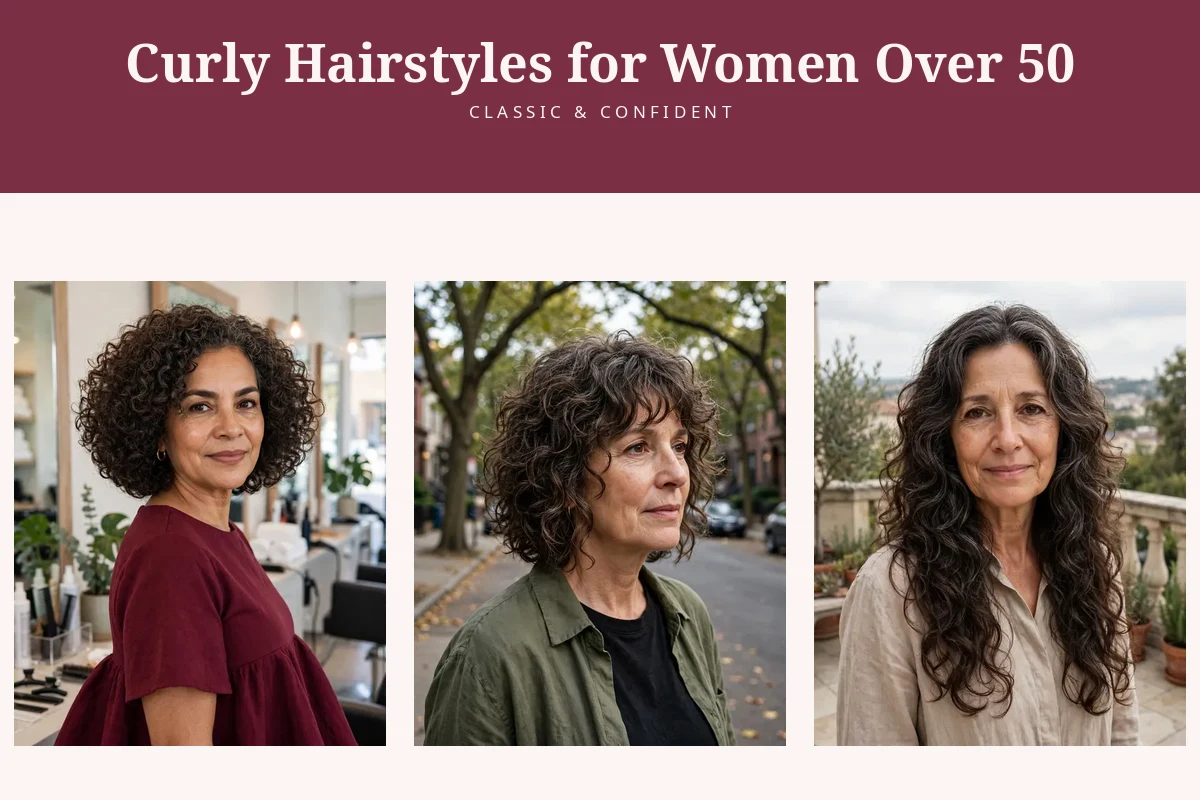
Curly hair is the only texture that lies about its own length — what reads as a chin-length bob wet can spring to the ears dry, and a style that looks effortless on straight hair turns into a geometry problem on curls.
That is why so many curly hairstyles for older women get abandoned: the rules were written for straight hair, and curls were expected to comply. They don’t.
Below are 12 curly hairstyles chosen for what curls actually do after 50 — how they shrink, how they dry out faster, where they thin first, and which shapes keep their volume instead of fighting it.
Every cut here works with the curl pattern, not against it, and each one comes with the exact words for the salon chair, because “just trim it” has never meant the same thing on curls twice.
Quick picks
- If your curls are shrinking into a triangle → the rounded curly bob (#1).
- If you want to stop fighting your hair every morning → the dry-cut layered wash-and-go (#2).
- If short hair scares you but you want a change → the curly lob (#3).
- If you’re ready for the shortest option that still reads feminine → the curly pixie (#4).
- If your coils need shape, not length → the tapered short crop (#5).
- If you want one style for every occasion this month → the two-strand twist-out (#7).
Contents
How to choose curly hairstyles for older women
Shrinkage is the first measurement, not the last. Curls spring up 30–50% shorter than their stretched length, and tighter patterns shrink more — so a cut planned at “chin length” can land at the cheekbone.
Always choose a style by its dry, shrunken result, and ask the stylist to cut your curls dry, in their natural state, checking each curl family’s resting length before the scissors move. A wet cut on curls is a guess, not a plan.
Density beats length for fullness. After 50, many women find their curl pattern loosening at the crown while the ends stay springy, which makes long hair look thin at the top and heavy at the bottom. Layers fix this by redistributing weight upward — shorter crown layers let the top curls spring back instead of being pulled flat.
The same redistribution principle sits behind the hairstyles for fine hair over 50 guide: fullness is built at the roots, never at the ends.
Moisture loss is the real aging mechanism. Curly hair is naturally drier than straight hair because scalp oil can’t travel down the curves, and that dryness deepens after 50.
A style that needs daily heat to behave will destroy the curl pattern within months — choose shapes that look right air-dried or diffused, and treat every heat-styling session as something you budget, not something the style demands.
Pattern, not length, picks the short cut. Loose waves (2A–3A) can carry a pixie with soft edges; springy curls (3B–3C) need a tapered crop so the sides don’t balloon; tight coils (4A–4C) hold a sculpted short shape with the least daily work of all.
Be honest about your pattern in the chair — the cut has to work on your actual curls, not the pattern you had at 35. The short haircuts for women over 50 guide covers the short-cut families in more detail.
Budget the product, not just the cut. A great curly cut still needs 2–4 products (a leave-in, a cream or gel, sometimes an oil to seal) to reach its potential — roughly 30–40 pounds or dollars a month if you buy salon-quality.
If that sounds like too much upkeep, lean toward the wash-and-go and tapered styles here, which genuinely perform with one leave-in and one gel. The hairstyles for black women over 50 article has more on routines that respect coils specifically.
At a glance: all 12 hairstyles
| Style | Curl pattern | Trims | Best for |
|---|---|---|---|
| 1. Rounded curly bob | 3A–3C | 8–10 weeks | Triangle-shaped curls |
| 2. Dry-cut layered wash-and-go | 2C–3B | 10–12 weeks | Lowest daily effort |
| 3. Curly lob | 3A–3B | 10–12 weeks | Face-elongating length |
| 4. Curly pixie | 3A–3C | 4–6 weeks | Bold, wash-and-go short |
| 5. Tapered short crop | 3C–4C | 3–4 weeks | Coils needing shape |
| 6. Curly shag | 2B–3B | 8–10 weeks | Thick hair, movement |
| 7. Two-strand twist-out | 3B–4A | As needed | Uniform definition |
| 8. Defined coil wash-and-go | 4A–4C | 10–12 weeks | Maximum coil definition |
| 9. Curly fringe cut | 3A–3C | 4–5 weeks | Bangs on curls |
| 10. High pineapple puff | All patterns | None extra | Second and third-day hair |
| 11. Softly pinned curly updo | All patterns | None extra | Evenings and events |
| 12. Long curly layers with face-framing | 3A–3C | 12 weeks | Keeping length with shape |
The shape-makers: cuts that build the silhouette
These three cuts do the heavy lifting through architecture — the shape is carved into the hair so your morning routine is mostly hands-off.
1. The rounded curly bob

A rounded bob works on the principle of stacking: instead of a blunt perimeter that lets curls splay outward into a triangle, the nape is cut slightly shorter and each curl is carved dry so the hair stacks upward into a bell shape.
The roundness reads as deliberate volume at the crown rather than width at the jaw, which is exactly what flatters an aging face — lift on top, softness around the cheeks. On curls cut bluntly straight across, gravity and shrinkage pull the ends out and down; the rounded perimeter redirects that energy upward.
- Length: Jaw to chin length, nape 2–3 cm shorter than the front
- Trims: Every 8–10 weeks, dry cut curl by curl
- Styling time: 5–8 minutes with a diffuser
- Face shapes: Round, square, heart — the roundness balances width
Ask your stylist for: “A rounded curly bob cut dry, curl by curl — I want the nape a couple of centimetres shorter than the front so the shape bells upward instead of going triangular. No blunt perimeter.”
How to style it:
- On soaking-wet hair, rake a walnut-size amount of leave-in through, then scrunch a golf-ball of gel upward into the curls.
- Diffuse on medium heat, cupping sections upward into the bowl of the dryer — 10–12 minutes until the cast is fully dry.
- Scrunch the crunch out with two drops of oil on your palms, then shake the roots gently with your fingertips for lift.
Skip it if your curls are tighter than 3C at the nape — the roundness can read as a helmet on very tight coils; the tapered crop (#5) sculpts those better.
Best for: Women whose curls currently form a triangle, anyone who wants a classic shape with almost no daily styling.
2. The dry-cut layered wash-and-go

This is the honesty cut: each curl is cut dry, in its natural resting state, so what you see in the chair is what you get in the bathroom mirror. The mechanism is shrinkage-compensation — a wet cut removes length that doesn’t exist yet, because curls shortened 5–10 cm as they dry and the stylist cut blind.
Long layers spaced 5–8 cm apart through the interior remove the weight that pulls top curls flat, so the crown springs back up and the whole head reads fuller. For women over 50 whose curl pattern is loosening at the roots, this layering is the difference between hair that lies and hair that lifts.
- Length: Shoulder to mid-back, longest layer dry
- Trims: Every 10–12 weeks
- Styling time: 10 minutes wash day, 2 minutes on refresh days
- Face shapes: All — the layers are customised to the face
Ask your stylist for: “A dry cut on my natural curls, worn as I’d wear them day to day — long interior layers about five to eight centimetres apart, and please show me each section’s resting length before you cut it.”
How to style it:
- After conditioning, keep hair dripping wet and smooth a pea-size amount of leave-in per quarter-section.
- Scrunch in gel section by section, then either air-dry (2–3 hours) or diffuse on low heat for 12–15 minutes.
Skip it if you straighten more than twice a month — the layers are calibrated to your curl pattern and a heat-styled finish will look uneven.
Best for: Women who want the genuinely lowest-effort curly routine, and anyone burned by a wet cut that “grew” overnight.
3. The curly lob

A lob — long bob — uses length as a tool: at collarbone length the weight of the hair itself pulls the curl pattern down just enough to elongate the face, while long layers through the mid-lengths keep the ends from stacking into bulk.
The mechanism is controlled elongation — shorter curls spring up and widen the silhouette, but 20–25 cm of hair from the crown gives gravity enough leverage to stretch the curl’s S-shape slightly, narrowing the overall outline. For a round or full face after 50, that vertical line is the most flattering thing length can do.
- Length: Collarbone, 20–25 cm from the crown dry
- Trims: Every 10–12 weeks
- Styling time: 8–10 minutes
- Face shapes: Round, heart — the length narrows the silhouette
Ask your stylist for: “A curly lob to the collarbone, cut dry — long layers only through the mid-lengths, and keep the front pieces a touch longer than the back so it drapes forward.”
How to style it:
- Apply leave-in to soaking hair, then divide into four sections and scrunch cream through each.
- Clip the roots at the crown with two duckbill clips for lift while it dries.
- Diffuse the mid-lengths and ends, leaving the roots to air-dry for the last 20 minutes so the top stays soft, not crunchy.
- Remove the clips, flip your head upside down once, and let everything settle.
Skip it if your curls are finer than 2C — at lob length fine curls can look stringy; the rounded bob (#1) concentrates fine curls better.
Best for: Women who want length without the pyramid effect, round faces, first-time curly converts.
Short and fearless
Short curls are the bravest cut in this guide — and, done right, the easiest to live with. The trick is matching the short shape to the curl pattern.
4. The curly pixie
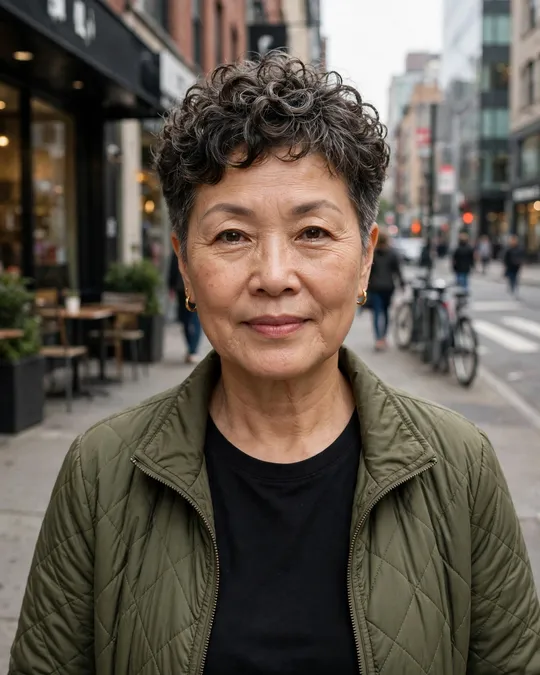
A curly pixie works by relocation: with the sides tapered short and 5–7 cm of curl left on top, all the volume moves to the crown, which lifts the eye upward — the single most flattering shift you can make to a face after 50.
Short sides also solve the nape problem, where curls at the neckline frizz and mat against collars. The top curls are cut long enough to coil rather than spike, so the finish reads soft and feminine instead of severe, and the whole thing air-dries in under an hour.
Among curly hairstyles for older women, this is one of the boldest choices — and paradoxically one of the easiest to maintain.
- Length: 5–7 cm on top, tapered short at sides and nape
- Trims: Every 4–6 weeks
- Styling time: 3–5 minutes
- Face shapes: Oval, heart, long — the crown height elongates
Ask your stylist for: “A curly pixie — tapered at the sides and nape, but leave five to seven centimetres of curl on top so it coils instead of spiking. Cut it dry so we see the real shape.”
How to style it:
- On damp hair, work a pea-size amount of curl cream through the top only.
- Twist the front curls loosely around your finger in the direction they want to go — two minutes of this sets the whole shape.
- Let it air-dry; smooth the tapered sides with a touch of pomade once dry for a clean finish.
Skip it if your curl pattern is looser than 3A — very loose waves can fall flat on top at this length; the curly shag (#6) gives them more to work with.
Best for: Women ready for a real change, hot climates, anyone who wants out of the morning hair routine entirely.
5. The tapered short crop

This is the sculptor’s cut for coils: the sides and nape are tapered close — down to about a centimetre — while 3–5 cm of tight curl or coil is left standing on top.
The mechanism is contrast: the close sides carve a clean line that makes the coil crown read as deliberate height, which elongates a round face and gives strong bone structure something to work against.
Tight coils hold this shape with almost no product because the curl memory is doing the styling — it is the rare cut that looks sharper on day three than day one, as the coils settle into each other.
- Length: 3–5 cm of coil on top, sides tapered to ~1 cm
- Trims: Every 3–4 weeks to keep the taper sharp
- Styling time: 2–3 minutes
- Face shapes: Round, square — the height narrows and lifts
Ask your stylist for: “A tapered crop — tight taper on the sides and nape, three to five centimetres of coil left on top, shaped so the crown has real height. I want the edge-up crisp.”
How to style it:
- On damp hair, smooth a coin-size amount of leave-in over the top coils.
- Pick the crown gently at the roots for height — never brush the coils out.
- At night, tie a silk scarf around the hairline; shake out in the morning and go.
- Refresh the taper’s edges with a damp edge brush and a dab of edge control.
Skip it if you are not ready for maintenance — the taper needs a clean-up every three to four weeks or the sculpture goes soft.
Best for: Tight coils (3C–4C), women who want maximum style with minimum daily effort, strong jawlines.
6. The curly shag

The shag is controlled chaos: short layers at the crown (8–10 cm) sitting over longer, razored ends, which breaks up the curl’s bulk so it moves instead of sitting in one solid mass. On thick curly hair after 50, weight is the enemy — it drags the top flat and pushes the ends wide.
The shag’s shattered ends remove that weight selectively, so each curl family can spring independently. The curtain-length front pieces frame the face at the cheekbones, giving you the face-framing of bangs without a single fringe trim.
- Length: Chin to shoulder, crown layers 8–10 cm
- Trims: Every 8–10 weeks
- Styling time: 6–8 minutes
- Face shapes: All — the layers are placed to suit
Ask your stylist for: “A curly shag — short crown layers, shattered ends, and front pieces long enough to tuck behind my ears. Razor the ends so the weight comes out, but don’t touch the crown length.”
How to style it:
- Scrunch mousse into soaking-wet hair — the shag needs hold more than moisture.
- Diffuse upside down for the first five minutes to build crown volume.
Skip it if your curls are very fine — the shattered ends can look wispy rather than piecey on fine hair; the rounded bob (#1) keeps fine curls denser.
Best for: Thick curly hair that feels heavy, women who like an undone finish, anyone growing out a shorter cut.
Good to know
A curly cut costs more because it takes longer — a proper dry cut runs 60–90 minutes versus 30 for a straight cut — but it also lasts longer, with most of these shapes holding 10–12 weeks instead of 6–8.
Judge the value per month, not per visit, and save this guide to your hair Pinterest board before you book so you can show the stylist the exact shape you mean.
Definition on demand
Sometimes the cut is fine and the curls just need organising. These three are styling approaches that turn a wash day into a week of good hair.
Curls are one texture among many — for the full picture, our hairstyles for women over 50 cover every cut type in one place.7. The two-strand twist-out
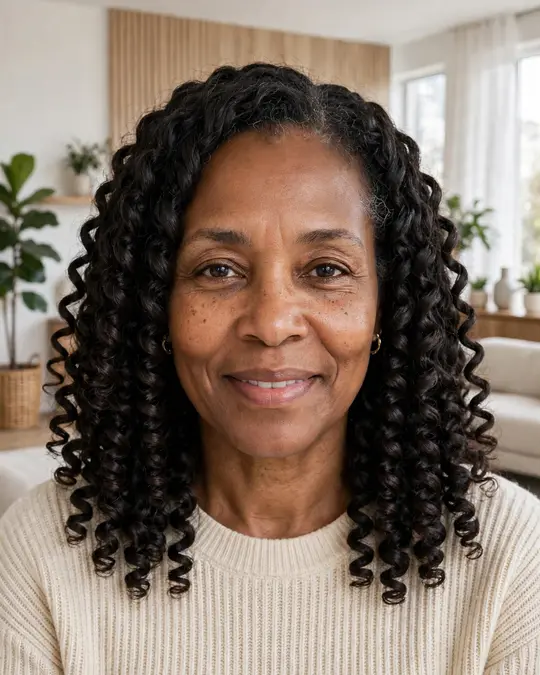
A twist-out works by re-clumping: damp curls are twisted into two-strand twists in 1.5–2 cm sections, and as each twist dries it sets the curl families into uniform, stretched spirals.
Unravelled, the result is the most consistent definition curls can produce — and because the twist stretches the hair while it dries, shrinkage drops by roughly a third, so you see your actual length.
On curls that frizz into one cloud by day two, the twist-out’s set pattern holds for 4–5 days, which makes it the highest-return styling investment in this guide.
- Length: Works at any length past 8 cm
- Trims: Keep your regular cut schedule — this is a style, not a cut
- Styling time: 30–45 minutes to twist, overnight or 4–6 hours to dry
- Face shapes: All — part the twists to flatter your face
Ask your stylist for: nothing to ask — but do ask for “a shape that supports twist-outs, with the ends healthy enough to hold a twist.” Split ends unravel a twist-out by day two.
How to style it:
- On damp, conditioned hair, apply leave-in then a butter or cream, section by section.
- Take 1.5–2 cm sections and twist each from root to tip — the smaller the section, the tighter the finished curl.
- Let the twists dry completely — overnight, or 4–6 hours. Unravelling even slightly damp twists is the number-one cause of frizz.
- Coat your fingertips in oil, unravel each twist once, and separate only where you want fullness. Fluff the roots, not the ends.
Skip it if your hair is shorter than 8 cm — there isn’t enough length to twist and the result unravels within hours.
Best for: 3B–4A curls, anyone who wants a full week of defined hair from one session, special occasions.
8. The defined coil wash-and-go

This is the coil perfectionist’s method: instead of letting curls clump however they fall, each coil is individually encouraged — finger-coiled or shingled with product — into a separated, defined ring.
The mechanism is separation-plus-hold: the gel forms a cast around each coil that locks its shape for 3–5 days, and because every coil dried in its own lane, day-two hair looks nearly as good as day one.
On 4A–4C coils that otherwise shrink into a beautiful but undefined mass, this is what turns texture into visible, countable curls — and it is the single best answer to “my coils have no definition.”
- Length: Any length past 5 cm
- Trims: Every 10–12 weeks to keep the ends sealing
- Styling time: 20–30 minutes wash day, then nothing for days
- Face shapes: All — coil direction can be aimed away from or toward the face
Ask your stylist for: “A coil-friendly shape — even ends all round, no thinning shears, because I finger-coil and I need every coil to have a clean end to hold.”
How to style it:
- On soaking-wet hair, work leave-in through in sections, then smooth gel over each section — a pea-size amount per 5 cm section.
- Either finger-coil the stubborn sections around your index finger, or shingle: rake the gel down each section so the coils separate themselves.
- Dry completely — air-dry or diffuse — before touching anything. Then scrunch the gel cast with oiled hands until the crunch is gone.
Skip it if your pattern is looser than 3C — finger-coiling loose curls produces ringlets that fall out by midday; the twist-out (#7) holds loose patterns longer.
Best for: 4A–4C coils, women who want visible definition, wash-and-go lovers willing to spend 25 minutes once a week.
9. The curly fringe cut

Bangs on curls fail for one reason: they were cut at their wet length. The curly fringe cut obeys the shrinkage rule — curls are cut dry at roughly 1.5 times the desired resting length, so a fringe that should sit at the brows is cut 3–4 cm longer, and lands exactly where it should when it springs up.
Point-cut ends keep the edge soft instead of blunt, which matters because a blunt line on curls reads as a shelf. Done this way, a curly fringe does what bangs do best: it shortens a long forehead and brings the focus to the eyes, with zero straightening required.
- Length: Fringe resting at the brows, cut 3–4 cm longer dry
- Trims: Every 4–5 weeks
- Styling time: 2 minutes — scrunch and go
- Face shapes: Long, oval — the fringe shortens the forehead
Ask your stylist for: “A curly fringe cut dry — I want it to rest at my brows, so cut it three to four centimetres longer than that, point-cut the ends, and don’t straighten it to check.”
How to style it:
- Style the fringe with the rest of your wash routine — gel on the fringe curls just like the rest.
- Shake the fringe curls out once dry; if one curl misbehaves, re-wet just that curl and finger-coil it.
- Never trim the fringe wet — if it needs a tidy, twist each curl and snip the very tip dry.
- On refresh days, mist the fringe with water and scrunch — it resets faster than the rest of the hair.
Skip it if you have a strong cowlick at the hairline — it will lift the fringe curls within hours; a curly shag’s front pieces (#6) work around it instead.
Best for: Long foreheads, women who have always wanted bangs but were told curls can’t have them, 3A–3C patterns.
Up, back and occasion-ready
From pulled-back to fully down — the looks that carry an evening, a wedding, or simply a day when you want your curls off your neck.
10. The high pineapple puff

The pineapple is curl preservation disguised as a style: gathering the hair high at the crown keeps the curl pattern’s volume exactly where it’s most flattering while the ends stay off the neck and collar.
It works because it asks nothing of the curls themselves — no re-wetting, no product, no heat — so it’s the honest answer for second and third-day hair. On wash day it doubles as the overnight method that protects definition: sleep in the pineapple under a silk scarf and the morning curls need thirty seconds, not thirty minutes.
- Length: Any length that reaches a high ponytail — roughly 15 cm plus
- Trims: None extra — works with any cut here
- Styling time: 1–2 minutes
- Face shapes: All — the height is universally flattering
Ask your stylist for: nothing — but mention “I wear my hair in a pineapple a lot” so they check that the shape still looks good pulled back before you leave the chair.
How to style it:
- Flip your head forward and gather the hair loosely at the very crown — not the back of the head.
- Secure with a silk or satin scrunchie, looping once or twice only; tight elastic dents curls.
Skip it if your hair is shorter than about 15 cm — there isn’t enough to gather without pulling; the tapered crop (#5) is the short-hair answer instead.
Best for: Every curl pattern, second-day hair, workouts, sleeping in your style.
11. The softly pinned curly updo

The mistake with curly updos is treating curls like straight hair — one tight bun that crushes every curl flat. The softly pinned version works in sections: curls are gathered in 4–6 loose handfuls and pinned with U-pins, so each section keeps its own volume and the finished shape has dimension instead of a single smooth dome.
Because nothing is pulled tight, the style survives humidity and dancing — there’s no sleek surface to frizz. A few face-framing curls are left out deliberately, which keeps it from reading severe on a mature face.
- Length: Shoulder length or longer for fullness
- Trims: None extra — works with any cut here
- Styling time: 10–15 minutes
- Face shapes: All — leave out curls where your face needs softness
Ask your stylist for: for a salon updo, say “Pin it in sections with U-pins — I want the curls to keep their volume, not one tight bun. Leave the front curls out.”
How to style it:
- Start with day-two or day-three hair — it grips better than freshly washed curls.
- Gather the back into 4–6 loose handfuls, twisting each once and pinning with U-pins crossed for hold.
- Pull two or three curls loose at each temple and let them fall naturally.
- Mist lightly with flexible-hold hairspray from 30 cm — enough to hold, not enough to crunch.
Skip it if your hair is shorter than shoulder length — there isn’t enough to section; the pineapple puff (#10) gives short hair the same lifted effect.
Best for: Weddings, evenings out, any occasion where you want your curls up but still looking like curls.
12. The long curly layers with face-framing

This is the keeper-of-length cut: long layers through the back give the weight that fights frizz, while face-framing pieces cut 12–15 cm around the cheekbones break the curtain effect that makes long curly hair read as one heavy mass.
The mechanism is selective lightness — the back stays heavy enough to hang, the front stays light enough to move, and the face gets the softening it needs without a fringe commitment.
For women who have grown their curls for years and won’t give up the length, this is the shape that makes length look intentional instead of neglected — the most practical of the curly hairstyles for older women when keeping every centimetre matters.
- Length: Past the shoulders, face-framing pieces 12–15 cm
- Trims: Every 12 weeks
- Styling time: 10–12 minutes
- Face shapes: Long, oval, heart — the framing softens length
Ask your stylist for: “Keep all my length — long layers through the back, and face-framing pieces around twelve to fifteen centimetres at the cheekbones, cut dry so the framing lands right.”
How to style it:
- Apply leave-in and cream to soaking hair, raking the product through the lengths.
- Scrunch the face-framing pieces forward and upward so they dry with lift at the roots.
- Diffuse the lengths, or plop in a cotton T-shirt for 20 minutes then air-dry for definition without frizz.
Skip it if your ends are damaged from years of heat — no layering fixes fried ends; cut to the lob (#3) first and grow back healthy.
Best for: Women committed to long hair, 3A–3C patterns, anyone whose length currently looks like one solid curtain.
Keeping curls defined after 50
Curls after 50 need a slightly different maintenance contract — a little more moisture, a little less heat, and a routine you can actually keep.
- Deep-condition every wash day for 10–15 minutes — curls over 50 drink product, and skipping this is where frizz starts.
- Sleep on silk or satin, always — cotton pillowcases pull moisture out of curls overnight and flatten one side by morning.
- Refresh with water, not more product — a light mist reactivates yesterday’s gel without the build-up of reapplying.
- Clarify once a month — product build-up is the hidden cause of curls that “stopped working,” and a clarifying wash resets everything.
- Trim on schedule, not on damage — waiting until the ends split means losing 5 cm instead of 1.
- Hands off while drying — every touch while curls are damp separates clumps and invites frizz; touch only when fully dry.
The wash-day routine that works:
- Cleanse with a sulphate-free shampoo, focusing on the scalp — let the rinse carry it through the lengths.
- Deep-condition 10–15 minutes under a shower cap, then detangle with fingers or a wide-tooth comb while the conditioner is in.
- On soaking-wet hair, apply leave-in, then cream or gel, section by section — never on damp-ish hair.
- Diffuse or air-dry completely, scrunch out the cast with oiled hands, and don’t touch it again until tomorrow.
- At night, pineapple the hair or wrap it in silk — your morning self will thank you.
The bottom line
If I had to pick one, it would be the rounded curly bob (#1) — it fixes the single most common curly complaint after 50 (the triangle), it needs one product and a diffuser, and it looks deliberate from every angle.
Get it cut dry by someone who cuts curls for a living, live with it for two months, and you’ll wonder why you waited. Pin this guide to your curly-hair Pinterest board before your appointment, so you walk in with the shape already decided.
Frequently asked questions
Do curly hairstyles for older women really work, or should I just straighten?
They work — but only when the cut is designed for curls. Most “curly hair doesn’t work after 50” stories are really “a straight-hair cut on curly hair” stories: blunt perimeters, wet cuts, no layers.
Every style in this guide is built on how curls actually behave — shrinkage, dryness, pattern — and none of them needs straightening to look finished. If you’ve been straightening to hide a bad cut, fix the cut first.
My curls are thinning at the crown — which styles hide it best?
Anything with crown layers or height: the rounded bob (#1), the dry-cut wash-and-go (#2), and the curly shag (#6) all lift the top instead of pulling it flat. Avoid heavy one-length styles and centre parts on a thinning crown — a slightly off-centre part with lifted roots covers more with less hair.
If the thinning is significant, shorter is kinder than longer, because length pulls what little density you have downward.
I’ve straightened for years — how do I transition back to curls?
Cut in stages, not all at once: take 5–8 cm off every 8–10 weeks while the natural texture grows in, and use twist-outs (#7) to blend the two textures in between. Deep-condition weekly — heat-damaged ends need it.
Most women find the transition takes 9–14 months depending on length, and the in-between stage is genuinely the hardest part; a curly shag (#6) is the most forgiving cut for growing out damage.
How do I stop the frizz without using heat every day?
Frizz is almost always a dryness or touching problem, not a curl problem. Style on soaking-wet hair (product on damp hair seals in frizz instead of preventing it), don’t touch curls until they’re fully dry, and sleep on silk.
If the canopy still frizzes, your gel isn’t strong enough — move up one hold level before you reach for the flat iron. Gel cast looks crunchy wet and perfect dry; trust the process.
Can I colour my curls, or will it ruin the pattern?
You can, with one rule: never bleach and relax in the same season, and always deep-condition the week after colouring. Single-process colour and glosses are the gentlest options; highlights are fine if they’re not taken to pale blonde.
If your pattern loosens after colouring, that’s damage, not age — drop one level of lift and give the curls a month of deep conditioning before judging.
Are short curly cuts a mistake after 50?
Only if the cut ignores the pattern. A pixie on loose waves can fall flat, and a blunt short cut on tight coils can balloon — but a pixie shaped for the pattern (#4) or a tapered crop (#5) is often easier than any long style, because there’s simply less hair to manage.
The women who regret short curls almost always regret a cut that was planned wet or planned for straight hair. Cut dry, cut for the pattern, and short is a liberation.