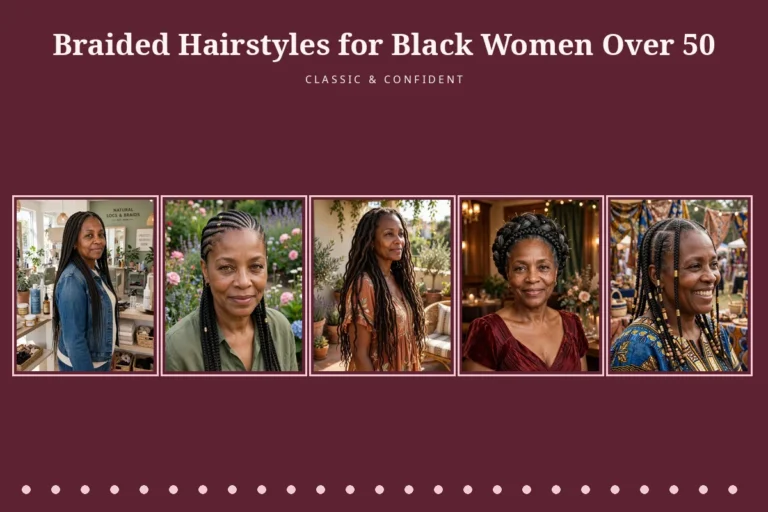
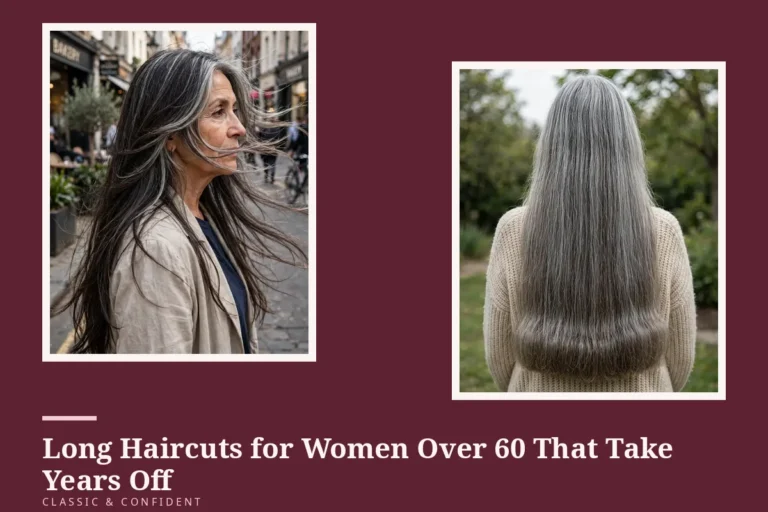
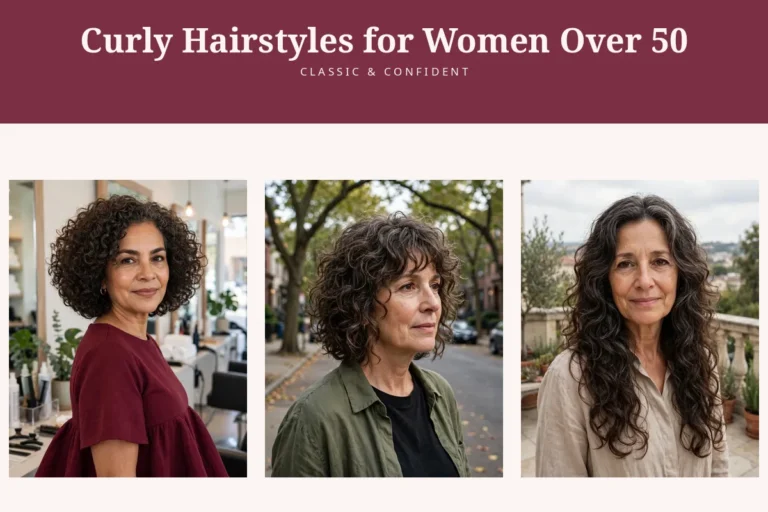
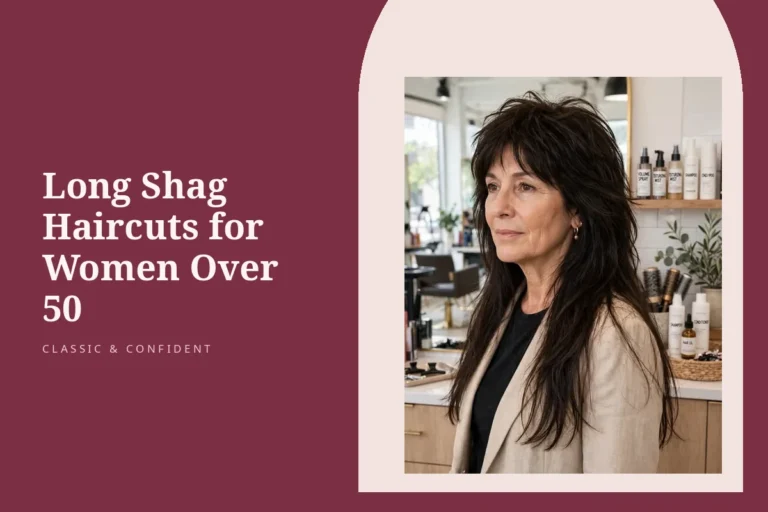
12 Long Haircuts With Bangs for Women Over 50

The reason most women over 50 fear bangs isn’t the bangs — it’s the wrong fringe on the wrong length. A blunt fringe with chin-length hair can read harsh, because there’s nowhere for the eye to travel.
But put the same fringe logic on hair that falls past the shoulders and everything softens: the long perimeter gives weight and movement, and the fringe simply frames what’s already working. These bangs for older women with long hair work because length and fringe are doing two different jobs — length gives you the drape, bangs give you the shape.
You get 12 cuts, grouped by the four safest pairings, the right fringe for your hair texture, the face concerns bangs quietly solve, and polished options that keep every centimetre. Every point carries exact lengths, trim intervals, the verbatim words to say at the salon, and the honest verdict on who should skip it. Let’s find your fringe.
Quick picks
- First bangs in years → the curtain-bang long layers (#1).
- Fine hair → the feathered-fringe long cut (#5).
- Curly hair → long curls with curtain bangs (#7).
- Forehead lines → the camouflage curtain bangs (#10).
- Glasses → the deep side-swept fringe (#9).
- Evening polish → the polished blowout with side-swept bangs (#11).
Contents
How to choose: bangs for older women with long hair
Start with the fringe, not the length. Every cut on this list keeps hair past the shoulders — the length decision is made for you. What changes the result is the fringe: curtain bangs soften, full fringes define, side-swept fringes add movement.
Ask yourself which of those three words you want, then find the point that delivers it.
Match the fringe to your hairline. A high or uneven hairline needs a deeper-set fringe — one that starts 5–7 cm back from the hairline rather than right at it — so it has enough hair to cover properly. A widow’s peak suits side-parted fringes (#3, #9), which work with the peak instead of fighting it.
The fine-hair hairstyles guide explains the hairline-density principles that apply here too, especially for thinning temples.
Budget for two trim schedules, not one. Long hair needs a perimeter trim every 10–12 weeks, but a fringe needs dusting every 4–6 weeks — blunt fringes even sooner, at 3–4.
If you’re not willing to pop in for a 10-minute fringe trim between full appointments, choose a curtain or bottleneck fringe (#1, #4, #8): they grow out into face-framing layers, so missing a trim never looks wrong.
Be honest about your styling floor. Curtain and side-swept bangs need two minutes: a round brush or even your fingers, one pass of the dryer. A straight full fringe (#2, #12) needs daily attention — flat iron or blow-dry, every single morning — or it sits wrong.
For the bigger picture across every length, the hairstyles for women over 60 collection puts bangs in context with the cuts around them.
Check the fringe against your glasses. Frames and fringes compete for the same 5 cm of forehead. Long, side-swept fringes (#9) slide neatly beside frames; short blunt fringes sit on top of them and clash.
If you wear glasses daily, decide on the fringe with your glasses on — ideally at the appointment itself. The newest hairstyles for women over 60 guide has more on cuts designed to work with eyewear.
At a glance
| Cut | Length | Fringe | Trims | Best for |
|---|---|---|---|---|
| 1. Curtain-bang long layers | 40–50 cm | Curtain | 10–12 weeks | First bangs in years |
| 2. Wispy full fringe, one-length | 38–45 cm | Wispy full | 10–12 / fringe 4 | Defined forehead |
| 3. Side-swept fringe layers | 40–50 cm | Side-swept | 10–12 weeks | Movement lovers |
| 4. Long shag, bottleneck bangs | 38–48 cm | Bottleneck | 10–12 weeks | Texture seekers |
| 5. Fine-hair feathered fringe | 40–48 cm | Feathered | 10–12 weeks | Fine or thin hair |
| 6. Thick-hair debulked curtain | 40–50 cm | Curtain | 10–12 weeks | Thick, heavy hair |
| 7. Long curls, curtain bangs | 40–50 cm | Curtain | 12–14 weeks | Natural curls |
| 8. Silver bottleneck fringe | 38–48 cm | Bottleneck | 10–12 weeks | Natural grey |
| 9. Deep side-swept, glasses cut | 40–50 cm | Side-swept | 10–12 weeks | Glasses wearers |
| 10. Camouflage curtain bangs | 40–50 cm | Curtain | 10–12 weeks | Forehead lines |
| 11. Polished blowout, swept bangs | 40–50 cm | Side-swept | 8–10 weeks | Evening polish |
| 12. Sleek straight, dusted fringe | 45–55 cm | Straight full | 10–12 / fringe 3 | Maximum length |
Start here: the four safest pairings
These four are the highest-success combinations — the fringes stylists cut most often on long hair, with the most forgiving grow-outs. If you’ve never had bangs, start here.
1. The curtain-bang long layers
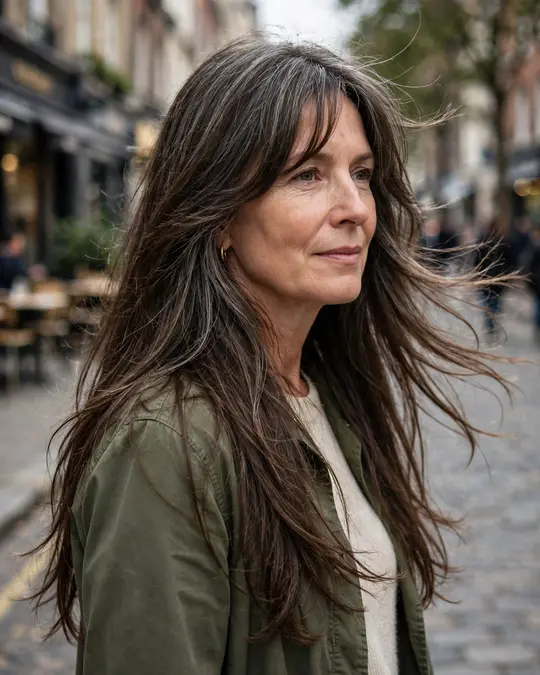
Curtain bangs work on long hair because they’re not really a fringe — they’re face-framing layers that happen to start at the forehead. The bang’s shortest point sits at the bridge of the nose, 8–10 cm, and each side lengthens diagonally to 16–20 cm at the jaw, so the fringe melts straight into the long layers behind it.
The long perimeter (40–50 cm) keeps enough weight below the shoulders that the bangs read as a feature, not a mistake.
Mechanically, this is the easiest fringe to keep. Because the bangs part in the middle and sweep outward, they air-dry in the right direction on their own — no round brush required, just a middle part and two minutes of warm air.
They also grow out into ordinary face-framing layers, which means missing a trim by a month never looks wrong. Among all the bangs for older women with long hair, this is the fringe stylists cut most often — and the one with the most forgiving grow-out.
- Length: 40–50 cm, past the shoulders; fringe 8–20 cm
- Trims: every 10–12 weeks; fringe can stretch to 8
- Styling time: 10–15 minutes; fringe 2 minutes
- Face shapes: all — the most neutral fringe here
Ask your stylist for: "Long layers past the shoulders with curtain bangs: fringe shortest at the nose bridge, eight to ten centimetres, sweeping out to sixteen to twenty at the jaw. Soft middle part, nothing blunt."
How to style it:
- Part hair in the middle while damp and clip each side of the fringe away from your face.
- Blow-dry the fringe first, sweeping each side outward with a medium round brush.
- Dry the lengths with the brush turning ends under, then release the fringe and finger-comb.
Skip it if you want a fringe with a strong, definite edge — curtain bangs are soft by design. Point 2 is the defined alternative.
Best for: Anyone getting bangs for the first time in years.
2. The wispy full fringe on one-length long hair

A full fringe on long hair works when the fringe itself is wispy rather than solid. Here’s why: a dense, heavy fringe eats roughly a third of the hair’s visual weight from the front, which can leave long hair looking thin behind it.
A wispy fringe — cut with the scissor tips so the forehead shows through in places — gives you the defined straight-across line while keeping the perimeter’s fullness. The fringe lands at brow level, 6–8 cm, and the length behind stays one solid sheet at 38–45 cm.
This is the most polished of the four safe pairings, and also the most demanding. A full fringe shows every millimetre of growth, so it needs dusting every 4 weeks, and it needs heat most mornings — 3 minutes with a flat iron or a round brush, minimum.
What you get in return is the strongest face-framing statement of the four: the fringe draws a clean horizontal line that makes cheekbones and eyes the focus.
- Length: 38–45 cm, one length; fringe 6–8 cm, wispy
- Trims: perimeter 10–12 weeks; fringe every 4 weeks
- Styling time: 10–15 minutes; fringe 3 minutes daily
- Face shapes: oval, long and heart — shortens a long forehead
Ask your stylist for: "One-length long hair, thirty-eight to forty-five centimetres, with a wispy full fringe at the brows — cut with the tips, not solid, so the forehead shows through. Not blunt, not baby bangs."
How to style it:
- Blow-dry the fringe first with a small round brush, rolling it slightly under.
- Smooth the lengths straight with a paddle brush while drying for contrast with the fringe’s texture.
Skip it if you can’t commit to monthly fringe trims and daily fringe styling — this one doesn’t forgive neglect. Point 4 is the forgiving alternative.
Best for: Straight to slightly wavy hair that holds a blow-dry.
3. The side-swept fringe long layers

A deep side-swept fringe works on long hair through asymmetry: instead of a horizontal line across the forehead, you get one long diagonal from 6 cm at the short side to 18–22 cm at the long side, sweeping across the brow and blending into the face-framing layers.
That diagonal is doing real work — it breaks up horizontal forehead lines, draws the eye across the cheekbones, and adds movement to the whole front of the cut. The long layers behind (40–50 cm) stay conservative, so the fringe is the only drama.
This is the bangs choice for women who part their hair on the side anyway. There’s almost no styling learning curve: sweep the fringe across, dry it in that direction, and it sits where you put it.
Of all the bangs for older women with long hair, this is also the most weather-proof — a diagonal fringe blown across the forehead just looks windswept rather than wrong.
- Length: 40–50 cm; fringe 6–22 cm, deep diagonal
- Trims: every 10–12 weeks; fringe can stretch to 8
- Styling time: 10–15 minutes; fringe 2 minutes
- Face shapes: square and round — the diagonal narrows width
Ask your stylist for: "Long layers with a deep side-swept fringe: shortest at six centimetres on one side, sweeping down to eighteen to twenty-two on the other, blending into the face-framing layers. Cut on a deep side part."
How to style it:
- Create your deep side part while hair is soaking wet — the part sets the fringe’s direction.
- Blow-dry the fringe in the sweep direction with a medium round brush, lifting at the root.
- Dry the lengths, turning the face-framing layers under so they connect with the fringe.
- Finish with a pea-sized amount of smoothing cream on the fringe only, to keep it in its sweep.
Skip it if you want a middle part or symmetrical look — this fringe only works swept. Point 1 is the middle-part alternative.
Best for: Side-parters and anyone who wants movement, not a line.
4. The long shag with bottleneck bangs

Bottleneck bangs — narrow at the top, widening toward the temples — pair with a long shag because both shapes work on the diagonal. The fringe is cut pinched and short in the middle (4–6 cm) and opens out to 14–16 cm at the temples, while the shag’s crown layers are 5–8 cm shorter than the 38–48 cm perimeter.
The two diagonal systems meet at the temples and continue down through the face-framing layers, so the whole cut reads as one continuous shape instead of “fringe plus haircut.”
This is the most textured, modern pairing of the four, and it’s surprisingly easy over 50: the shag’s layers create the volume, the bottleneck fringe frames without covering, and the whole thing air-dries better than any other fringe on this list.
The trade-off is commitment — the shag needs its layers point-cut every 10–12 weeks or it loses its edge, though the fringe itself grows out gracefully.
- Length: 38–48 cm; fringe 4–16 cm, bottleneck shape
- Trims: every 10–12 weeks, layers point-cut
- Styling time: 8–12 minutes, or air-dry
- Face shapes: oval, long and heart — opens the temples
Ask your stylist for: "A long shag with bottleneck bangs: fringe pinched short in the middle, four to six centimetres, opening to fourteen to sixteen at the temples. Crown layers five to eight centimetres shorter than the perimeter, ends point-cut."
How to style it:
- Work a golf-ball of mousse through damp hair, focusing on the crown layers.
- Blow-dry the fringe with your fingers, pinching it into its narrow-wide shape.
- Scrunch the mid-lengths while drying to build the shag’s piecey texture.
Skip it if you prefer sleek, polished hair — this cut’s whole character is texture. Point 11 is the polished alternative.
Best for: Medium to thick hair that holds texture.
Bangs matched to your hair texture
Fine, thick and curly hair each fail with bangs for a different mechanical reason — and each has a fringe engineered around that reason. Find your texture below.
5. The fine-hair long cut with feathered fringe

Fine hair loses with bangs when the fringe takes too much hair from the front — a solid fringe can eat a third of already-scarce density, leaving the back looking thin.
The fix is a feathered fringe: the fringe is cut into light, separated pieces, 6–9 cm, using only a shallow section of hair, so the perimeter keeps nearly all of its weight.
The long layers behind (40–48 cm) are kept blunt at the ends — no interior layers near the fringe — which preserves the density illusion all the way down.
This is the bangs solution for the hair most women over 50 actually have. The feathered pieces separate naturally, so the fringe never sits as a solid curtain, and it needs almost no heat — a round brush pass or even a blast of warm air gives it lift.
Trim discipline matters though: fine hair shows ragged ends faster, so the 10–12 week perimeter trim is non-negotiable.
- Length: 40–48 cm, blunt ends; fringe 6–9 cm, feathered
- Trims: every 10–12 weeks; fringe dusted at 6
- Styling time: 8–12 minutes
- Face shapes: all — the lightest fringe option
Ask your stylist for: "Long blunt-ended layers, forty to forty-eight centimetres, with a feathered fringe — light separated pieces, six to nine centimetres, taken from a shallow section only. No thinning shears anywhere."
How to style it:
- Apply a pea-sized amount of volumising mousse to the fringe roots only.
- Blow-dry the fringe with a small round brush, lifting for air between the pieces.
Skip it if your hair is thick — a feathered fringe disappears into thick hair. Point 6 is the thick-hair version.
Best for: Fine or thinning hair that can’t spare density.
6. The thick-hair long layers with debulked curtain bangs

Thick hair’s fringe problem is the opposite of fine hair’s: there’s too much of it. A curtain bang cut straight into thick hair lands heavy and shelf-like, sitting on the forehead as a solid wedge.
The fix is debulking the fringe from the inside — the stylist cuts the bangs at full length (10–14 cm each side), then removes interior weight with slide-cutting or channel-cutting, so the fringe has length but not bulk. It falls in separated pieces instead of a slab.
The long layers behind need the same treatment: interior layers 8–10 cm shorter than the 40–50 cm perimeter, point-cut ends, so the weight sits lower and the whole cut moves. Done right, thick hair with bangs feels lighter than thick hair without — the fringe and layers break the mass into moving sections instead of one heavy sheet.
- Length: 40–50 cm; curtain fringe 10–14 cm, debulked
- Trims: every 10–12 weeks, with interior weight removal
- Styling time: 12–18 minutes
- Face shapes: round and square — the separation slims width
Ask your stylist for: "Long layers, forty to fifty centimetres, with curtain bangs at ten to fourteen centimetres — debulked from the inside with slide-cutting, so the fringe separates. Interior layers eight to ten centimetres shorter than the perimeter."
How to style it:
- Rough-dry the fringe upside down for 60 seconds to build root separation.
- Smooth each side of the fringe with a medium round brush, parting in the middle.
- Dry the lengths in sections, turning the brush to encourage the interior layers to fall apart.
- Pinch the fringe pieces with a rice-grain of paste for definition.
Skip it if your hair is fine — debulking removes density you can’t spare. Point 5 is your cut.
Best for: Thick, heavy hair that overwhelms other fringes.
Good to know
Bangs look wrongest on day one, not week one — a fresh fringe sits a centimetre shorter and stiffer than it will after three washes. Give any fringe from this list a full week of wear before you judge it.
And if you’re collecting ideas for your appointment, save this guide to your hair board now — the verbatim stylist phrases are the part you’ll want at the salon.
7. The long curls with curtain bangs

Curls and bangs have a bad reputation because stylists cut the fringe at its stretched length — then it springs up 3–5 cm shorter and everything goes wrong.
The curly curtain bang is cut dry, curl by curl, at its natural shrinkage: each curl is cut 3–4 cm longer than the target, the fringe parts in the middle, and the curls frame the forehead at 10–14 cm shrunken. The long curls behind (40–50 cm) are layered to break up the triangle silhouette that long curly hair falls into.
This is the only fringe on the list that gets better with less styling. The curls’ natural pattern does the shaping; the curtain part means there’s no battle with a straight-across line. Wash, scrunch with curl cream, diffuse or air-dry — the fringe settles into place on its own.
Insist on the dry cut, though: a wet-cut curly fringe is a gamble you won’t win.
- Length: 40–50 cm; curtain fringe 10–14 cm, cut dry
- Trims: every 12–14 weeks, dry cut
- Styling time: 10–15 minutes, mostly diffusing
- Face shapes: oval, heart and long — curls add width
Ask your stylist for: "Curtain bangs cut dry, curl by curl, on long curly hair — cut each curl three to four centimetres longer than where it should sit, parting in the middle. Layers through the back to break the triangle shape."
How to style it:
- Scrunch two pumps of curl cream through soaking-wet hair, fringe included.
- Diffuse the fringe first, cupping each side’s curls upward and outward.
- Diffuse or air-dry the lengths, then fluff the roots once fully dry.
Skip it if your hair is straight with a wave you straighten daily — this fringe only works with the curl pattern left alone. Point 1 is the straighter-hair version.
Best for: Natural curls and waves, 2B to 3C.
Fringes that solve face problems
Bangs aren’t just style — they’re camouflage with a pedigree. These three pair the fringe shape with the specific face concern it handles best.
8. The silver long hair with soft bottleneck fringe

Silver and grey hair is naturally coarser and drier, which makes a heavy fringe sit stiff — but a bottleneck fringe works because its narrow top section (5–7 cm) uses very little hair, and the widening sides (12–15 cm at the temples) lie against the face rather than standing off it.
The long silver lengths (38–48 cm) catch light along the face, and the fringe’s broken edges mean no hard line cutting across — which matters, because grey hair shows contrast more sharply than coloured hair.
The hidden benefit: this fringe grows out beautifully on grey hair, because the silver’s texture keeps the grown-out pieces wispy instead of floppy. Keep purple shampoo to once a week — over-toning makes silver look flat, and this cut needs the dimension. The fringe itself needs only a rough dry; the texture does the work.
- Length: 38–48 cm; bottleneck fringe 5–15 cm
- Trims: every 10–12 weeks; fringe can stretch to 8
- Styling time: 10–15 minutes
- Face shapes: oval, long and heart — opens the temples
Ask your stylist for: "Long silver hair, thirty-eight to forty-eight centimetres, with a soft bottleneck fringe: narrow at the top, five to seven centimetres, widening to twelve to fifteen at the temples. Broken edges, nothing blunt."
How to style it:
- Blow-dry the fringe with your fingers, pinching it into the narrow-wide shape.
- Dry the lengths with a smoothing brush to get the shine silver needs.
Skip it if you colour your hair regularly — the broken edges look best on natural texture. Point 4 is the coloured-hair version.
Best for: Natural silver, grey and white hair.
9. The deep side-swept fringe for glasses wearers

Glasses and fringes collide in the same 5 cm of forehead, so the fringe has to be engineered around the frames. A deep side-swept fringe works because it starts at a side part placed 3–4 cm off-centre, sweeps down and across at 14–20 cm, and lands beside the frames rather than behind them.
The sweep’s lowest edge sits at the cheekbone — below the frame line on most styles — so the fringe and the glasses never compete for the same line.
Bring your glasses to the appointment and put them on for the final check — any good stylist will dry-cut the sweep’s length with the frames on.
The long layers behind (40–50 cm) stay simple so the fringe is the focal point, and this is the fringe most forgiving of a missed trim: as it grows, it simply becomes a longer face-framing layer.
- Length: 40–50 cm; side-swept fringe 14–20 cm
- Trims: every 10–12 weeks; fringe can stretch to 8
- Styling time: 10–15 minutes; fringe 2 minutes
- Face shapes: all — the sweep is the most adaptable fringe
Ask your stylist for: "A deep side-swept fringe on long hair: side part three to four centimetres off-centre, fringe sweeping fourteen to twenty centimetres down to the cheekbone, blending into the layers. Cut it with my glasses on."
How to style it:
- Set the deep side part on soaking-wet hair and comb the fringe in its sweep direction.
- Blow-dry the fringe with a medium round brush, sweeping down and across.
- Dry the lengths, then check the fringe’s landing point with your glasses on.
- Lock the sweep with a light-hold spray, applied from 30 cm away so it stays soft.
Skip it if you don’t wear glasses most days — without frames, this is just a side-swept fringe (point 3), which is simpler to cut.
Best for: Daily glasses wearers of any frame shape.
10. The camouflage curtain bangs for forehead lines
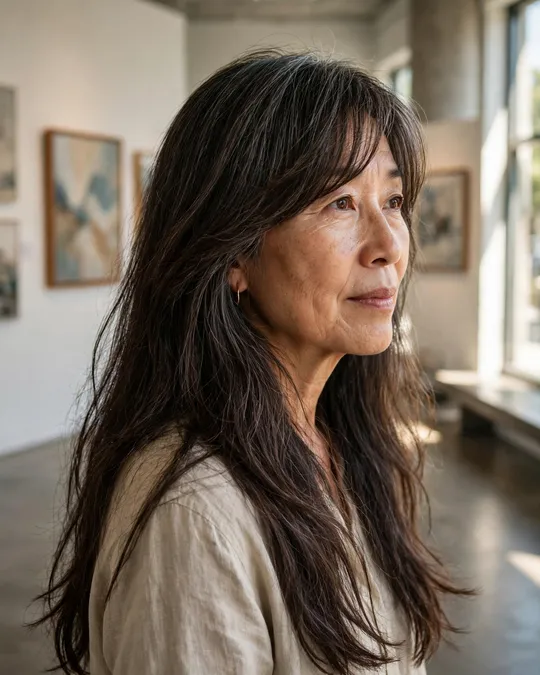
Horizontal forehead lines are made more visible by horizontal lines above them — which is why a straight-across fringe can emphasise exactly what you’re trying to soften. Curtain bangs solve this geometrically: their diagonal sweep breaks the forehead into triangles instead of stripes, so the eye reads movement rather than lines.
The fringe is cut slightly longer than the classic curtain version (10–12 cm at the nose bridge, 18–22 cm at the jaw) so there’s more coverage, and the centre part is softened — nearly invisible — to avoid a hard middle line.
The long layers (40–50 cm) matter here too: they draw the eye downward and outward, away from the forehead entirely. Keep the fringe’s ends textured — blunt ends across the forehead recreate the horizontal line you’re avoiding. A touch of dry texture spray in the fringe gives it the lived-in separation that hides lines best.
- Length: 40–50 cm; curtain fringe 10–22 cm, textured ends
- Trims: every 10–12 weeks; fringe can stretch to 8
- Styling time: 10–15 minutes; fringe 2 minutes
- Face shapes: oval and long — covers without heaviness
Ask your stylist for: "Curtain bangs cut a touch long — ten to twelve centimetres at the bridge, eighteen to twenty-two at the jaw — with textured ends, no blunt lines. Soft, nearly invisible centre part."
How to style it:
- Part softly in the middle on damp hair — don’t force a hard line.
- Blow-dry each side outward with a round brush, lifting at the root for separation.
- Pinch a pea-sized amount of texture paste through the fringe ends for the lived-in finish.
Skip it if forehead lines don’t bother you — the extra length is coverage you don’t need. Point 1 is the standard version.
Best for: Softening horizontal forehead lines without heaviness.
Length keepers with polish
You’ve kept the length this long — these two make sure it looks intentional. Polished cuts for the woman who wants every centimetre to earn its place.
11. The polished blowout with long side-swept bangs
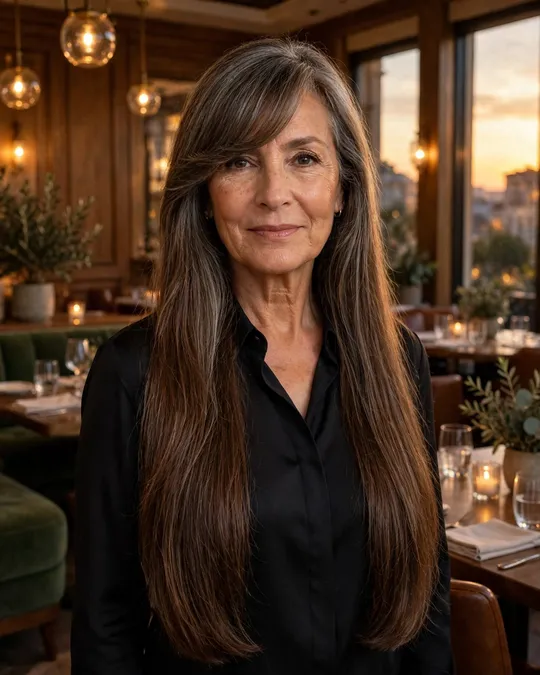
This is the salon-blowout made wearable at home. The cut itself is straightforward — long layers at 40–50 cm with a long side-swept fringe at 14–18 cm — but the styling is the point: everything is dried smooth with tension, the fringe sweeps across with a clean arc, and the ends turn under in one unbroken curve.
On hair over 50, smoothness reads as polish and health, because flyaways and roughness are what age a blowout fastest.
The honest cost is time: 20–25 minutes with a dryer, most mornings. But it’s the highest-impact cut on this list for evenings, weddings and events — the fringe gives you the face-framing of an updo with none of the pinning.
A boar-bristle brush is the tool that makes this achievable: the tension it creates is what gives the fringe its clean sweep.
- Length: 40–50 cm; side-swept fringe 14–18 cm
- Trims: every 8–10 weeks to keep the curve
- Styling time: 20–25 minutes
- Face shapes: oval, heart and square — the sweep balances
Ask your stylist for: "Long polished layers, forty to fifty centimetres, with a long side-swept fringe at fourteen to eighteen centimetres. Ends turned under in one curve — cut for a smooth blowout, no texture."
How to style it:
- Apply two pumps of smoothing cream through damp hair, fringe included.
- Blow-dry in sections with a boar-bristle brush, tension on every pass.
Skip it if your styling floor is under 15 minutes — this cut without the blowout is just long hair. Point 3 gives the sweep without the effort.
Best for: Evenings, events and the woman who loves a dryer.
12. The extra-long sleek hair with dusted straight fringe
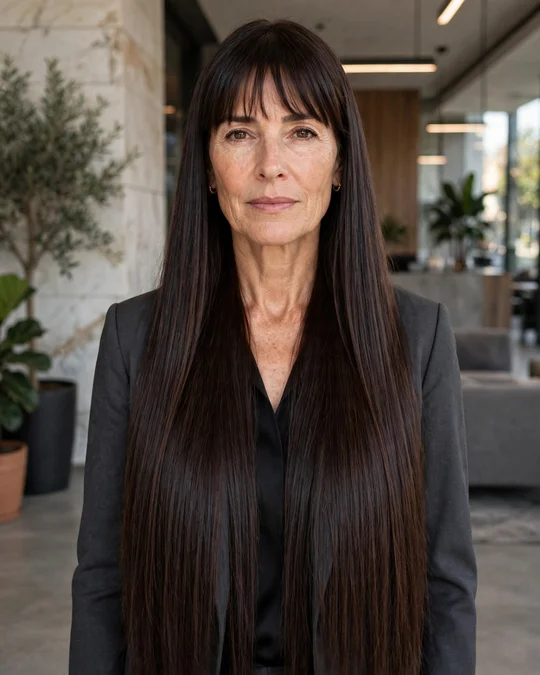
Maximum length with a fringe is a balancing act: the longer the hair, the heavier the fringe needs to be to hold its own — but a heavy fringe on fine over-50 hair eats density.
The solution is a dusted straight fringe: full across at 7–9 cm, but with the very ends dusted — lightly thinned — so it has a solid line without a solid wall. The lengths (45–55 cm, the longest on this list) are kept nearly one-length with only long interior layers, so the weight sits low and the silhouette stays sleek.
This is the statement cut: it only works when the hair is genuinely healthy, because 50 cm of hair shows every split end. Budget for a dusting — a 5-minute ends trim — every 6–8 weeks between full appointments, plus the fringe’s own 3–4 week cycle.
What you get is the most dramatic length-plus-fringe combination on this list, and the fringe’s straight line makes the whole look read deliberate rather than neglected.
- Length: 45–55 cm, near one-length; fringe 7–9 cm, dusted
- Trims: perimeter 10–12 weeks, dusting at 6–8; fringe every 3–4
- Styling time: 15–20 minutes
- Face shapes: oval and long — the fringe shortens a long face
Ask your stylist for: "Near one-length long hair, forty-five to fifty-five centimetres, with a straight fringe at seven to nine centimetres — dusted at the very ends, not solid. Long interior layers only, keep the weight low."
How to style it:
- Blow-dry the fringe straight down with a paddle brush first.
- Smooth the lengths in large sections with the paddle brush, drying ends straight.
- Run a flat iron over the fringe once for the clean line.
- Finish the lengths with a pea-sized drop of shine serum on the ends only.
Skip it if your ends are fragile or thinning — this length exposes both. Get the ends healthy first, then come back for this.
Best for: Thick, healthy hair at its longest.
Keeping long hair with bangs looking sharp
Long hair plus bangs is two maintenance schedules in one head of hair. Get the rhythm right and it’s effortless; get it wrong and the fringe goes ragged while the lengths still look fine.
- Book the fringe trim separately. A 10-minute fringe dusting every 4–6 weeks costs a fraction of a full appointment and keeps every cut on this list looking fresh.
- Dry the fringe first, always. Bangs set in the first 3 minutes after washing — if they air-dry into a cowlick, no amount of heat later fully fixes it.
- Train a cowlick with direction, not force. Dry the stubborn section in the opposite direction first, then sweep it into place — the root gives up after two or three sessions.
- Keep oil and serum off the fringe. Products that make lengths shine make bangs stringy. Apply ends-only, then wash your hands before touching the fringe.
- Dry shampoo is a fringe’s best friend. The forehead oils up faster than the rest of the scalp — a puff of dry shampoo at the fringe roots buys you a full extra day.
- Protect the ends like the investment they are. Silk pillowcase, loose braid for sleep, and a proper trim every 10–12 weeks — long hair’s shine is its whole argument.
The two-minute fringe reset:
- Dampen just the fringe with a spray bottle — not the whole head.
- Blow-dry the fringe in its direction with a round brush, 60 seconds.
- Smooth the lengths with your hands while the fringe cools.
- Puff of dry shampoo at the fringe roots if it’s day two or three.
The bottom line
If I had to pick one, it would be #1 — the curtain-bang long layers. It asks the least of you (two minutes on the fringe, no monthly trim panic) and gives the most back: softness around the face, movement through the front, and a grow-out that never embarrasses you.
Every other fringe on this list is more specific; this one is simply the smartest default for long hair over 50.
Narrowed it to a fringe style? Save this guide to your hair ideas board so the exact lengths and the verbatim salon phrases are with you when you sit in the chair.
Frequently asked questions
Are bangs for older women with long hair flattering, or do they age you?
They’re flattering when the fringe is the right weight — and ageing when it’s the wrong one. A soft curtain, bottleneck or side-swept fringe on long hair reads youthful because it adds movement around the face.
What ages is a heavy, solid fringe that sits stiff and flat, especially on fine hair, because it emphasises thinness and draws attention to the forehead. If you’re nervous, the curtain bang (#1) is the zero-risk entry: it reads as face-framing layers, not a commitment.
How often do bangs need trimming when the rest of my hair is long?
The lengths need a perimeter trim every 10–12 weeks, but the fringe lives on its own schedule: dusting every 4–6 weeks for curtain and bottleneck fringes, every 3–4 for straight full fringes. Most salons will do a fringe-only trim for a small fee between full appointments — ask at your first visit so the rhythm is set.
The exception is the curly curtain fringe (#7), which can stretch to 12–14 weeks alongside the cut.
Will bangs work on my thinning hair?
Yes — if the fringe is feathered and taken from a shallow section (#5), so the perimeter keeps its weight. What fails on thinning hair is a deep, dense fringe, which borrows hair the front can’t spare and leaves the back visibly thinner.
Tell your stylist about the thinning before they section the fringe, and keep the blunt ends of the lengths — a solid perimeter is the best camouflage for low density.
Can I wear bangs with glasses?
Absolutely — the deep side-swept fringe (#9) was designed for exactly this. The rule is simple: the fringe’s lowest edge should sit at or below your frame line, so the two don’t compete. Side-swept and curtain fringes coexist with glasses easily; short straight fringes sit on top of frames and clash.
Wear your glasses to the appointment so the length can be cut against them.
What if I hate the bangs — how bad is the grow-out?
Not bad at all for most of this list: curtain, bottleneck and side-swept fringes grow into ordinary face-framing layers within 8–12 weeks — you just stop trimming and let them blend. The straight full fringe (#2, #12) is the exception: it needs 4–6 months of growing and a few awkward weeks where it’s neither fringe nor layer.
If commitment worries you, avoid the straight fringes and pick any of the sweepers.
How do I style bangs in under 5 minutes?
Dampen just the fringe, blow-dry it in its direction for 60 seconds with a round brush or your fingers, and leave the lengths alone — that’s genuinely under five minutes. On day two, skip the wash: dry shampoo at the fringe roots, quick brush-through, done. The two-minute fringe reset in the upkeep section above is the full routine.