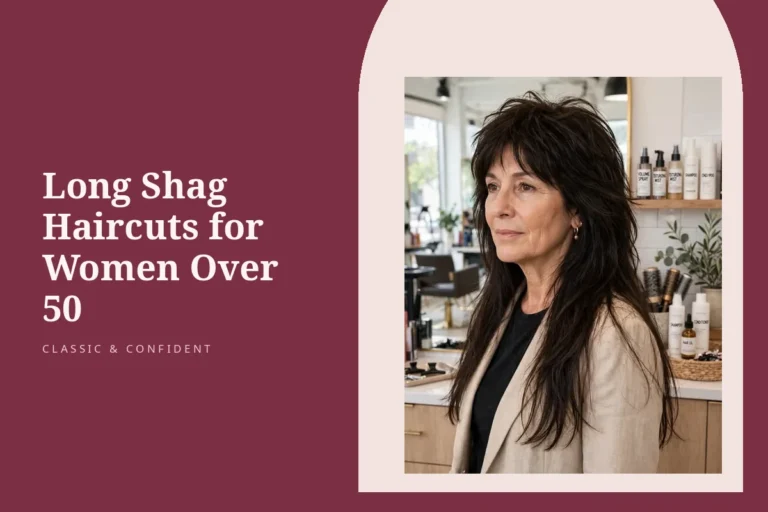
10 Hairstyles With Bangs for Women Over 50

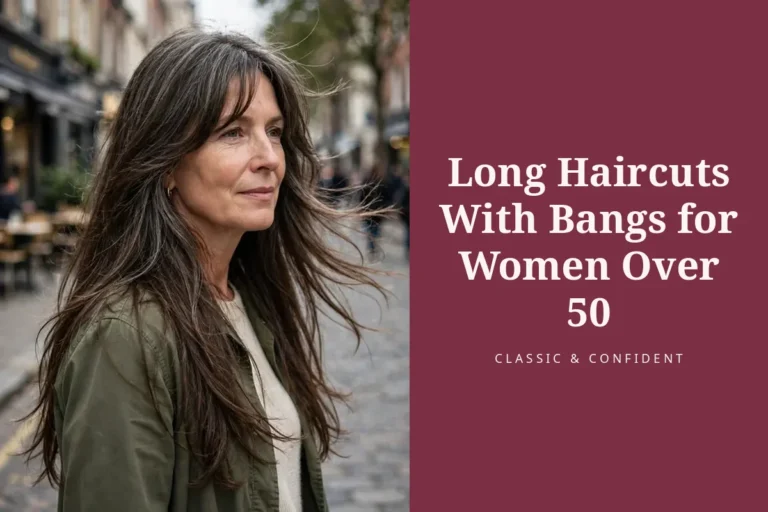
The internet has strong opinions about bangs after 50: either they take ten years off or they add ten years on. Neither is automatic. The truth is more useful — bangs for older women work when the fringe matches your forehead height, your hair’s density, and the amount of daily styling you’re genuinely willing to do.
Get those three right and a fringe draws attention to your eyes instead of your forehead lines; get them wrong and you’re trimming regret every three weeks.
Below are 10 hairstyles with bangs chosen for how they behave on real hair after 50: which fringes stay put without a flat iron, which ones hide a thinning part line, which play well with glasses, and the exact words to say in the salon chair. Start with the fringe that matches your morning, not your mood board.
Quick picks
- If you want bangs without the commitment → the curtain fringe with long layers (#1).
- If you wear glasses and hate fringe in your lenses → the side-swept bangs (#2 or #7).
- If your hair is fine and you need coverage → the full blunt fringe bob (#3).
- If you spend under five minutes on hair → the wispy pixie fringe (#4).
- If you’re brave and your forehead is short → the micro fringe pixie (#8).
- If you want the most forgiving option → the grown-out curtain fringe shag (#10).
Contents
How to choose bangs for older women
Forehead height decides the fringe family. A long forehead (roughly 7 cm or more from brow to hairline) can carry a full blunt fringe; a short forehead needs the fringe to start higher — ask the stylist to raise the starting point 2–3 cm back into the crown, which lengthens the forehead visually.
Measure in the mirror before the appointment, not in the chair.
Density is the real limit, not age. A full fringe needs enough hair at the front to cover skin — with fine or thinning hair, a deep curtain or wispy fringe covers better because it distributes the weight across more scalp area, exactly the principle behind the hairstyles for fine hair over 50 guide.
If you can see scalp through your fringe in sunlight, the fringe is too full for your density — go wispier, not shorter.
Cowlicks choose for you at the front. A cowlick at the hairline will fight any fringe cut against it; bangs cut with a strong cowlick lift within two hours unless the fringe is long enough to be worn side-swept with heat.
Be honest about it in the chair — a stylist who knows about the cowlick cuts the fringe 1 cm longer than planned, because heat styling shortens its appearance.
Budget the trim rhythm before you commit. A blunt or micro fringe looks sharp for about 14–18 days before it starts poking eyes; curtain and grown-out fringes glide for 6–8 weeks.
If salon visits every two weeks aren’t happening, choose from the long-fringe family — a fringe you trim at home with hair scissors is fine, but one snip too short is a three-week problem, so many women keep a separate 15-minute fringe-trim appointment between full cuts.
The bob hairstyles for fine hair over 50 article covers how to find a salon that offers exactly this.
Glasses change the geometry. Frames sit exactly where a short fringe ends, so a blunt fringe can rattle against lenses all day; side-swept and longer curtain bangs tuck behind the frame line naturally. If you wear progressives, keep the fringe off the lenses — smudged lenses from fringe contact are a daily annoyance you don’t need.
The short haircuts for women over 50 guide has more on frame-friendly shapes.
At a glance: all 10 hairstyles
| Style | Fringe style | Trims | Best for |
|---|---|---|---|
| 1. Curtain fringe long layers | Curtain, centre-parted | 6–8 weeks | First-time fringe wearers |
| 2. Side-swept bangs lob | Side-swept, deep part | 4–6 weeks | Glasses wearers |
| 3. Blunt fringe bob | Full blunt | 2–3 weeks | Fine hair needing coverage |
| 4. Wispy pixie fringe | Wispy, feathered | 3–4 weeks | Five-minute mornings |
| 5. Choppy curtain shag | Choppy curtain | 5–6 weeks | Thick hair |
| 6. Feathered fringe layers | Feathered, face-framing | 4–6 weeks | Growing out a fringe |
| 7. Glasses-friendly side bangs | Long side-swept | 4–6 weeks | Progressive lens wearers |
| 8. Micro fringe pixie | Micro, cropped | 2–3 weeks | Short foreheads, bold taste |
| 9. Textured bob fringe | Face-framing, piecey | 4–6 weeks | Round faces |
| 10. Grown-out curtain shag | Grown-out curtain | 6–8 weeks | The lowest maintenance option |
Curtain bangs: the softest way in
Curtain fringes are the gateway drug of bangs for older women — they grow out into face-framing layers instead of a mullet-like disaster, so the risk of the experiment is near zero.
1. The curtain fringe with long layers

A curtain fringe works on the principle of distribution: instead of one horizontal wall of hair across the forehead, the fringe parts in the centre and sweeps outward, so a deep horizontal forehead line gets broken into two diagonal lines that the eye reads as cheekbones.
On hair past the shoulders with long layers, the curtain pieces start at the cheekbone — about 12–15 cm long — and blend into the face-framing layers, which means forehead lines are softened without a single flat-iron pass.
Because the pieces are long and parted, they don’t collapse on a thin hairline the way a blunt fringe does, and when they grow out they simply become face-framing layers — no awkward stage.
- Length: Curtain pieces 12–15 cm, blending into layers past the shoulders
- Trims: Every 6–8 weeks
- Styling time: 3–5 minutes
- Face shapes: Long, square, heart — softens angular lines
Ask your stylist for: “A centre-parted curtain fringe — pieces starting at the cheekbone, 12 to 15 cm, cut dry so you can see exactly how they fall. I want them to blend into my face-framing layers, not sit as a separate fringe.”
How to style it:
- On damp hair, work a pea-size amount of smoothing cream only through the two curtain pieces — not the whole head.
- Blow-dry the pieces forward and down with a round brush, then roll them back off the face while they cool — the roll sets the outward sweep.
- Release the roll, pinch the centre part open with your fingers, and leave the rest alone; a light pass of hairspray from 30 cm holds the shape without stiffness.
Skip it if you have a strong centre cowlick at the hairline — a centre-parted fringe fights it all day. The side-swept bangs (#2) work with a cowlick instead of against it.
Best for: Women trying bangs for the first time after 50, anyone nervous about commitment, long and square faces.
2. Side-swept bangs with a shoulder lob

A side-swept fringe redirects rather than covers: by angling the hairline diagonally from a deep part, it pulls the eye across the face instead of down, which is why it flatters women whose foreheads feel too tall or too lined for a straight fringe.
On a shoulder-length lob, the swept pieces sit 10–14 cm long and land just below the brow on one side, giving the asymmetry that keeps a simple lob from looking blunt and severe.
This is the fringe that plays best with glasses — the sweep starts above the frame line and clears the lenses, so there’s no constant rattle or smudging, and the deep part itself adds crown volume on the heavier side.
- Length: Swept pieces 10–14 cm; lob at the collarbone
- Trims: Every 4–6 weeks
- Styling time: 4–6 minutes
- Face shapes: Round, heart, oval — the asymmetry slims and lengthens
Ask your stylist for: “A deep side part with the fringe swept across — longest pieces reaching just past my brow on the heavy side. Cut it on my natural part so it falls there by itself, and thin the ends slightly so it lies flat over my frames.”
How to style it:
- Blow-dry the fringe in the opposite direction first — sweep it left, dry it right — for 20 seconds; the root memory sets the sweep for the day.
- Flip it back across to your natural part and smooth the top with a paddle brush while it’s still warm.
Skip it if your part naturally falls dead centre and refuses to move — a deep side part on resistant hair collapses by noon. The centre-parted curtain fringe (#1) works with a centre part instead.
Best for: Glasses wearers, round faces, women who want one cut that dresses up or down.
3. The full blunt fringe with a sleek bob

A blunt fringe is the most transformative of all bangs for older women because it does two jobs at once: the solid horizontal edge shortens a long forehead by a visible 2–3 cm, and the density of the fringe across the hairline hides thinning at the front — the one area where thinning shows fastest after menopause.
On a sleek chin-length bob, the fringe is cut at brow level and the weight line sits heavy enough to stay put without daily heat. This is the fringe with the highest payoff and the highest maintenance — but when the density is there, nothing frames the eyes as powerfully.
- Length: Fringe at brow level; bob at chin length
- Trims: Every 2–3 weeks (fringe) / 6 weeks (bob)
- Styling time: 5–8 minutes with a flat brush
- Face shapes: Long, oval — shortens a tall forehead
Ask your stylist for: “A full blunt fringe cut at brow level, wide enough to reach the outer corners of my brows. Keep the weight heavy — no thinning shears in the fringe — and cut the bob to the chin with a clean perimeter so the two lines balance each other.”
How to style it:
- Dry the fringe first, before the rest of the hair — blow it straight down with a flat paddle brush while it’s soaking wet, because once it air-dries with a bend you can’t undo it.
- Run the brush down the fringe in 2 cm sections, nozzle pointed down the hair shaft, until it’s completely dry.
- Smooth the bob under with the same brush, tucking the ends; a pea-size drop of shine serum on the ends only keeps the lines clean.
- On non-wash days, a dry-shampoo blast at the fringe roots lifts the overnight oil — blunt fringes show grease faster than any other style.
Skip it if your hair is fine at the front and the scalp shows through — a blunt fringe needs density to look intentional. The wispy fringe (#4) gives coverage without the weight.
Best for: Long foreheads, women with good front density, anyone who wants maximum change from one cut.
Clean and structured fringes
Structured fringes trade flexibility for impact — the lines are deliberate, the maintenance is real, and the payoff is a face with immediate definition.
4. The wispy pixie fringe

A wispy fringe on a pixie works because it breaks the one flat surface of the forehead into dozens of fine strands — each strand casts a micro-shadow, and the eye reads that texture as interest rather than emptiness.
For fine hair, which many women notice after 50, this is the kinder coverage option: a heavy fringe would reveal scalp through it, but wispiness makes sparseness look deliberate.
The pieces are point-cut to feathered ends at 5–8 cm, sitting just on the brow, so they move with the day instead of collapsing — and on a five-minute morning they need nothing more than finger-styling.
- Length: Feathered fringe pieces 5–8 cm, on the brow
- Trims: Every 3–4 weeks
- Styling time: Under 5 minutes
- Face shapes: Heart, oval, long — softens without weight
Ask your stylist for: “A pixie with a wispy, point-cut fringe — pieces 5 to 8 cm, feathered at the ends, sitting right on the brow. Use point-cutting only, no thinning shears, so the wisps stay separate instead of going gappy.”
How to style it:
- Rub a pea-size amount of texture paste between your palms and pinch the fringe pieces downward — pinching keeps the wisps defined.
- Push the crown up and back with the same paste for contrast against the soft front.
Skip it if you want a fringe that survives rain untouched — wispy ends curl in humidity. The blunt fringe (#3) holds its line in damp weather far better.
Best for: Fine hair, five-minute routines, women who want texture rather than coverage.
5. Choppy curtain bangs with a shag

Choppy curtain bangs bring the softness of a curtain fringe to thick hair, which is the hair type that defeats most fringes by sheer volume.
The mechanism is weight removal: the fringe is cut into the shag’s layering with vertical cuts, so the 8–12 cm curtain pieces have internal space instead of one solid mass — they part in the centre and fall outward without puffing. On thick hair, a blunt fringe would sit like a shelf; the choppy curtain moves.
The shag underneath carries the same choppy logic through the whole cut, so the fringe looks like the top of a unified idea rather than an addition.
- Length: Choppy curtain pieces 8–12 cm; shag past the shoulders
- Trims: Every 5–6 weeks
- Styling time: 5–7 minutes
- Face shapes: Round, square — the vertical cuts slim and break up width
Ask your stylist for: “Curtain bangs cut choppy into the shag — 8 to 12 cm pieces, vertical cuts for separation, and take real weight out of the fringe so it moves. I want the fringe to look like the top layer of the shag, not a separate piece.”
How to style it:
- Scrunch a golf-ball amount of mousse into the damp fringe pieces, roots to ends — mousse gives thick hair memory without weight.
- Diffuse the pieces forward on medium heat, lifting at the roots with your fingers so the curtain separates.
- Once dry, pinch individual pieces apart and let the centre part find itself — forcing a hard part looks stiff on a shag.
Skip it if your hair is fine — choppy cutting on fine hair removes what little density exists and the curtain goes stringy. The smooth curtain fringe (#1) is the fine-hair version.
Best for: Thick, heavy hair, women who air-dry, anyone bored of one-length cuts.
6. The feathered fringe with medium layers

A feathered fringe is the diplomatic fringe — the ends are cut with a razor or slide-cut so they taper to nothing, which means the forehead coverage comes from a soft veil rather than a hard edge.
For women growing out a blunt fringe, or who had one years ago and remember the maintenance, this is the re-entry point: at 8–10 cm with feathered ends, it covers the forehead lines without a visible cut line, and it blends into medium face-framing layers so well that the grow-out is invisible.
The feathering also means the fringe doesn’t need to be dried perfectly — tapered ends forgive a rough blow-dry that would ruin a blunt cut.
- Length: Feathered pieces 8–10 cm, blending into medium layers
- Trims: Every 4–6 weeks
- Styling time: 4–6 minutes
- Face shapes: All — the taper adapts to any face
Ask your stylist for: “Feather the fringe ends with a razor — I want tapered, see-through tips, not a cut line. Pieces 8 to 10 cm, blending straight into my face-framing layers so there’s no line where the fringe ends.”
How to style it:
- Blow-dry with a round brush, rolling the ends under — the feathering wants a slight bend, not poker straight.
- While warm, push the pieces into a soft side part with your fingers; feathered ends settle wherever you guide them.
- A tiny amount of smoothing cream on the very ends only stops the feathering from frizzing without flattening it.
- If it’s growing out, keep the feathering trimmed at the ends every month — that’s the whole maintenance job.
Skip it if you want a fringe with real presence — feathered is deliberately quiet. The blunt fringe (#3) or micro fringe (#8) make the statement this one avoids.
Best for: Growing out a blunt fringe, women who heat-style minimally, anyone fringe-curious but cautious.
Good to know
Fringe trims are the cheapest salon visit you’ll ever buy — most salons do a bang trim for a fraction of a full cut, and it keeps every fringe on this list looking intentional. Pin this guide to your hair-inspiration Pinterest board before your next appointment, so the fringe reference is right there when the cape goes on.
Side-swept and wispy: bangs that forgive
This is the low-consequence family — fringes that survive bad hair days, cowlicks, and the weeks you skip the salon.
7. Glasses-friendly side bangs

This fringe is engineered around frames: the pieces start at 6 cm near the part and graduate to 12 cm at the outer edge, which means the longest hair lands beside the cheek — below the bottom of most frames — while the shortest part stays above the lens line.
No fringe touches glass, so there’s no smudging, no rattling, and no daily pushing-aside. The graduation also solves the progressive-lens problem: because the fringe angles downward away from the face, it never crosses the reading corridor at the bottom of the lens.
Cut with a deep side part, it gives the same slimming diagonal as the lob’s sweep (#2) but at any length.
- Length: Graduated 6–12 cm, longest at the outer edge
- Trims: Every 4–6 weeks
- Styling time: 3–4 minutes
- Face shapes: All — brings asymmetry anywhere
Ask your stylist for: “Bring your glasses to the cut — I want side bangs graduated from 6 cm at the part to 12 cm at the cheek, cut while I’m wearing my frames so nothing touches the lenses. Deep side part, angled away from my face.”
How to style it:
- Blow-dry the bangs down and across in one motion with a paddle brush — the graduation does the shaping, you just smooth it.
- Tuck the longest pieces behind your ear on the outer side if they drift toward the frames; the graduation makes them sit naturally there.
Skip it if you don’t wear glasses — the graduation is designed around frames, and without them it’s just a side sweep. The lob sweep (#2) does the same job more simply.
Best for: Progressive and bifocal wearers, anyone whose fringe keeps smudging their lenses, deep side parts.
8. The micro fringe on a cropped pixie

A micro fringe is cut 3–5 cm long, sitting high on the forehead — and it works after 50 for exactly the reason people assume it won’t.
By exposing most of the forehead, it refuses to hide anything, which reads as confidence rather than camouflage; and on a short forehead (under 6 cm brow to hairline) it’s the only full fringe that fits, because a longer fringe would cover half the face.
The mechanism is proportion: the tiny fringe balances a cropped pixie by giving the eye a horizontal line to rest on, so the cut reads as styled rather than simply short. It needs density — this is a fringe for thick or medium hair — and it needs trims, but the look is unmistakable.
- Length: Micro fringe 3–5 cm, high on the forehead
- Trims: Every 2–3 weeks
- Styling time: 3–5 minutes
- Face shapes: Oval, heart with a short forehead — opens the face up
Ask your stylist for: “A micro fringe, 3 to 5 cm, cut straight across high on the forehead — I want to see most of my forehead. Keep it dense and blunt; this only works if the line is razor sharp. Show me where it’ll sit before you cut.”
How to style it:
- Blow-dry straight down with a small round brush the second you’re out of the shower — a micro fringe sets its shape in the first minute.
- Flat-iron the very ends if needed — one pass, low heat, because there’s so little hair that heat damage shows fast.
- Texture the pixie crown with paste for contrast: soft, lived-in back against the sharp front line.
Skip it if your forehead is long or your front hair is fine — a micro fringe on a long forehead looks like a mistake, and on thin hair it shows scalp. The wispy fringe (#4) is the pixie-friendly alternative.
Best for: Short foreheads, thick hair, women who want a genuinely editorial look.
9. Face-framing bangs with a textured bob

These are bangs for round faces that refuse the usual advice. Instead of avoiding fringes, this cut uses long, piecey face-framing bangs — 8–12 cm, cut with space between the pieces — to break the circle of a round face into vertical segments.
The eye follows the long pieces downward, which reads as length, while the textured bob underneath (chin to jaw length, piecey ends) keeps the jawline from looking boxed in. It’s the opposite of the blunt fringe (#3): where that one adds a horizontal line, this one removes horizontal emphasis entirely.
For women told for years that bangs would “make their face rounder,” this is the correction.
- Length: Piecey bangs 8–12 cm; bob at chin to jaw
- Trims: Every 4–6 weeks
- Styling time: 5–7 minutes
- Face shapes: Round, square — vertical lines slim
Ask your stylist for: “Long, piecey face-framing bangs — 8 to 12 cm, cut with space between the pieces so they separate. I want vertical lines down my face, not a horizontal fringe. Keep the bob textured at the ends so nothing looks boxy.”
How to style it:
- Blow-dry the bangs forward first, then part them roughly in the middle with your fingers — the pieces should fall in separated strands.
- Pinch a pea-size of wax through the ends of each piece to keep the separation visible all day.
- Dry the bob with the ends flicking slightly outward — the outward flick keeps the jawline open.
- Skip the round brush on the bangs; a paddle brush keeps the pieces straight and separated.
Skip it if you want a fringe you can ignore for two months — piecey separation needs refreshing or it mats together. The grown-out curtain shag (#10) is the true low-maintenance pick.
Best for: Round faces, women told bangs wouldn’t suit them, textured-bob lovers.
10. The grown-out curtain fringe shag

This is the fringe for women who’ve decided against trims. Cut once as a curtain fringe and then deliberately grown out, the pieces reach 15–20 cm and merge with the shag’s layers — the fringe never disappears, it just becomes the top layer of the cut.
The genius is that it always looks intentional: at every length, the curtain shape reads as face-framing, so there’s no awkward phase, no pinning-back period, no emergency appointment. On a shag with its built-in texture, the grown-out fringe adds the one thing the shag needs — longer pieces at the front to balance the choppy back.
Trim the very ends every 8 weeks to keep the shape, and that’s the entire maintenance programme.
- Length: Grown-out curtain pieces 15–20 cm, merged into shag layers
- Trims: Every 6–8 weeks (shape only)
- Styling time: 3–5 minutes
- Face shapes: All — the length adapts everywhere
Ask your stylist for: “Cut me a curtain fringe now, and I want the plan for growing it out — pieces that will reach 15 to 20 cm and merge with my shag layers. Feather the ends so there’s never a blunt line as it grows.”
How to style it:
- Scrunch mousse into the damp front pieces and let them air-dry or diffuse — the shag texture does the work.
- Finger-part wherever it falls that day; a grown-out fringe has no wrong part.
Skip it if you want the polished look of a maintained fringe — this one is deliberately undone. The blunt fringe (#3) is the polished opposite.
Best for: The lowest maintenance fringe that exists, shag wearers, women who hate salon schedules.
Keeping a fringe sharp after 50
A fringe is the one part of your haircut the world sees first — these are the habits that keep it looking like the salon visit was yesterday.
- Dry the fringe first, always. It sets its shape in the first two minutes out of the shower; if the rest of your hair dries first, the fringe has already decided to misbehave.
- Keep a mini flat iron by the mirror. One pass on low heat rescues a blunt or micro fringe on non-wash days in under sixty seconds.
- Dry shampoo is a fringe product, not a hair product. A quick blast at the fringe roots on day two absorbs the forehead oil that makes bangs look stringy — the rest of your hair doesn’t need it.
- Trim between appointments, but only the middle. Cut 2–3 mm off the centre of a blunt fringe when it hits your lashes; leave the sides alone, because the sides are what blend it in.
- Sunscreen goes under, not over. Apply SPF to the forehead before styling — sunscreen on top of a styled fringe greases it instantly and breaks down hold.
- Silk pillowcase, fringe down. Sleeping with the fringe tucked under a headband creases it; flat on a silk pillowcase, most fringes wake up wearable.
The 5-minute fringe reset routine:
- Dampen just the fringe with a spray bottle — never re-wet the whole head for a fringe fix.
- Blow-dry forward and down with a paddle brush until completely dry (about 90 seconds).
- Shape into your part — centre, side, or swept — while still warm.
- Pinch definition into the ends with a pea-size of paste or wax.
- One light mist of hairspray from 30 cm, and walk out the door.
The bottom line
If I had to pick one, it would be the curtain fringe with long layers (#1) — it asks the least and gives the most: no awkward grow-out, no two-week trim panic, and it flatters nearly every face in this article. Start there, live with it for two months, and you’ll know exactly which fringe family is yours.
Save this guide to your hair-ideas Pinterest board before your next salon visit, so the fringe conversation starts with pictures, not guesswork.
Frequently asked questions
Do bangs for older women really work, or will they age me?
They work when they’re chosen for your face, not against it. A fringe that’s too heavy on fine hair or too long on a short forehead draws attention to exactly what you’re trying to soften — that’s where the “aging” reputation comes from.
A curtain, side-swept, or wispy fringe matched to your forehead height and density draws the eye to your eyes instead. The fringes that age women are almost always blunt fringes cut too thick on the wrong hair type.
Which bangs are best if my hair is thinning at the front?
Curtain or wispy fringes — never a heavy blunt one. Thinning hair can’t supply the density a blunt fringe needs, and scalp showing through a solid fringe looks worse than no fringe at all. A curtain fringe distributes limited hair across a wider area, and wispy point-cut ends make sparseness look like texture.
If the thinning is advanced at the hairline, a deep side part with long side-swept pieces (#7) covers the most with the least hair.
How often do bangs need trimming after 50?
It depends on the fringe, not your age: blunt and micro fringes need a trim every 2–3 weeks to stay out of your eyes; wispy and feathered fringes go 3–4 weeks; side-swept and curtain fringes stretch to 4–8 weeks.
Most salons offer a quick fringe trim for much less than a full cut — booking it between full appointments is how women keep a sharp fringe without a sharp bill.
Can I wear bangs with glasses?
Yes — choose the fringe around the frames. Side-swept and graduated bangs (#2, #7) are designed to clear the lens line, and longer curtain pieces tuck beside the frames naturally. Avoid short blunt fringes that end exactly at the top of your frames; the constant contact smudges lenses and the fringe rattles against the glass all day.
Bring your glasses to the haircut so the stylist can check the clearance while you wear them.
What if I hate my bangs — how bad is the grow-out?
Less bad than you fear, if you chose from the right family. Curtain, side-swept, feathered, and grown-out fringes (#1, #2, #6, #10) become face-framing layers as they grow — there’s genuinely no awkward stage. A blunt or micro fringe is the harder grow-out: it takes 3–4 months to reach a sweepable length, and pinning or headbands bridge the middle weeks.
When in doubt, start with a curtain fringe — it’s the only fringe with a built-in exit strategy.
Do bangs work on curly hair after 50?
They do, but cut them dry and cut them long. Curls shrink 2–5 cm as they dry, so a curly fringe cut wet ends up far shorter than planned — always insist on a dry cut for curly bangs.
Longer curtain-style fringes (#1, #10) are the safest curly option because shrinkage just makes them bouncier; short blunt fringes on tight curls are the highest-risk choice and need a stylist experienced with curly cutting specifically.