10 Bobs for Women Over 50 With Fine or Thin Hair
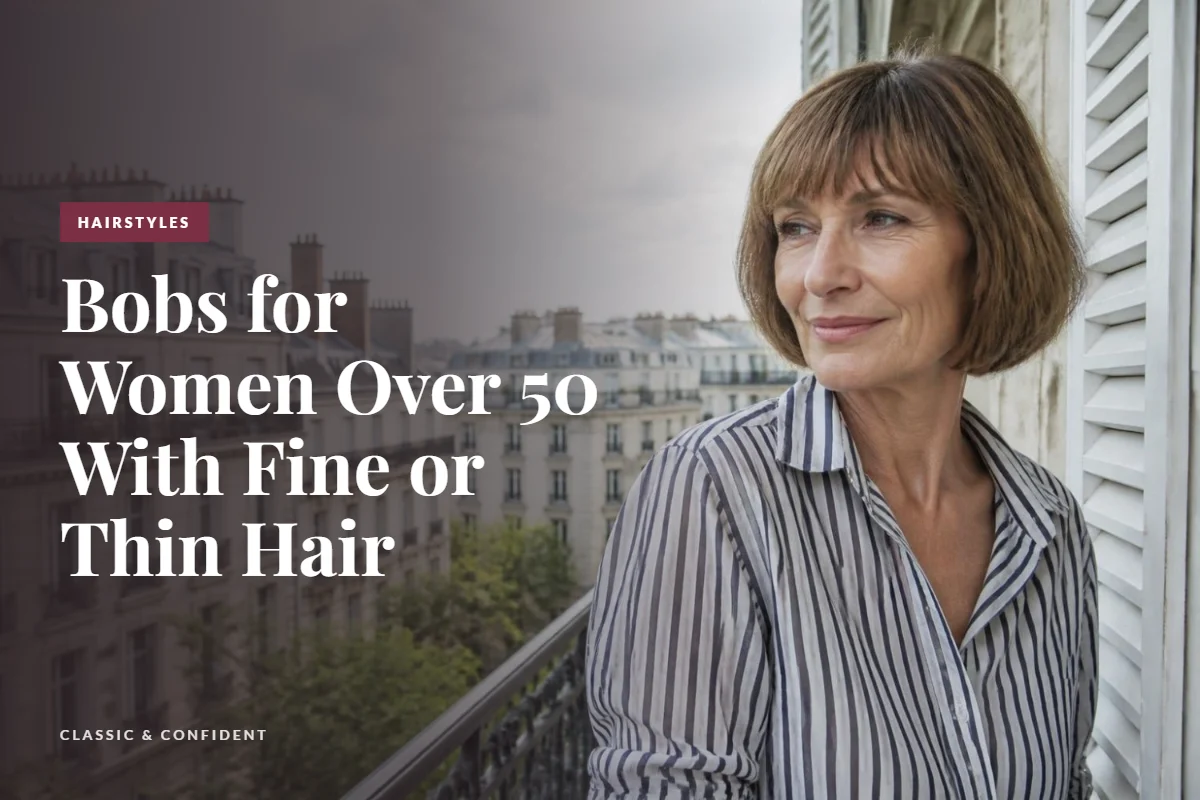
Fine hair after 50 has a habit of going flat by lunchtime, and the wrong bob only makes it worse. The right one does the opposite. It gathers your hair into one clean line, so the ends look thicker and the whole cut looks fuller than it really is.
Below are 10 bobs for women over 50 with fine or thin hair, from the chin-length blunt cut that suits almost everyone to softer French, shaggy and curtain-bang versions. For each one you will find who it suits, exactly what to say to your stylist, how to style it at home in a few minutes, and when to skip it.
Quick picks
- Thinnest hair: chin-length blunt bob with a deep side part (#2)
- Easiest mornings: short, sharp bob (#1)
- Love a fringe: French bob with a soft fringe (#5)
- Keeping some length: beachy lob (#8)
- Ready to go shorter: pixie bob (#10)
How to choose the right bob for fine hair
Fine hair looks thinnest at the ends, where the strands taper off. A bob cuts those ends to one level, so the bottom edge carries as much hair as the top. That solid edge is why a bob reads thicker than almost any other cut. Four things decide whether a particular bob works for you.
Length. The jaw to the chin is the fullest-looking zone for most fine hair. Collarbone length works if your ends are still thick. If they look see-through, go shorter.
Layers. Keep any layers in the bottom few inches or around the face. Layers through the crown take away weight exactly where you need it.
Face shape. Round faces do well with a bob slightly below the chin and a side part. Long faces suit chin length with a fringe. Square jaws soften with face-framing pieces or curtain bangs. Oval faces can wear almost any of these.
Upkeep. A blunt bob loses its crisp line quickly, so plan on a trim every 4 to 6 weeks. Softer, layered bobs can usually go 6 to 8.
The 10 bobs at a glance
| Bob | Length | Trims | Best for |
|---|---|---|---|
| Short, sharp bob | Jaw or just above | Every 4 to 6 weeks | Strong jawlines and straight hair |
| Chin-length blunt bob with a deep side part | Chin | Every 5 to 6 weeks | Very fine hair and round or oval faces |
| Soft blunt bob with face-framing pieces | Chin to just below | Every 6 weeks | Square jaws and anyone who finds a blunt bob too harsh |
| Graduated bob with low layers | Short at the nape, chin at the front | Every 4 to 6 weeks | Hair that is flat at the back |
| French bob with a soft fringe | Cheekbone to jaw | Every 6 weeks, fringe every 3 to 4 | Longer faces and anyone who likes a fringe |
| Italian bob | Jaw to just below | Every 6 to 8 weeks | Women who enjoy styling and want a soft, full shape |
| Light shaggy bob | Chin to collarbone | Every 6 to 8 weeks | Fine hair that has some natural movement |
| Beachy lob | Collarbone | Every 8 weeks | Growing out a shorter cut or keeping enough length to tie back |
| Bob with soft curtain bangs | Chin, with bangs at the cheekbone | Bangs every 3 to 4 weeks | Square jaws and longer faces |
| Pixie bob | Around the ears, longer on top | Every 4 to 5 weeks | Women trying shorter hair |
One honest note: if your part has widened or you are seeing more shedding than usual, a haircut can only disguise it. Mention it to your doctor, because thinning hair can have causes that are worth checking.
Blunt and solid bobs: the fullest-looking cuts
These are the safest choices for fine hair because the solid outline does most of the work.
1. Short, sharp bob

This is the bob at its most graphic: one length all the way round, cut at or just above the jaw with a crisp edge. Because every strand ends at the same point, the bottom line looks solid and fine hair has nowhere to separate into wisps. It also lifts the eye toward your cheekbones, which is flattering at any age.
- Length: jaw or just above
- Trims: every 4 to 6 weeks
- Styling time: about 5 minutes
- Face shapes: oval, heart, strong jaw
Ask your stylist for: “A one-length bob at my jawline, cut blunt with scissors. No thinning shears and no razor.”
How to style it: Blow-dry with a paddle brush, pointing the nozzle down the hair so the cuticle lies flat and shines. If the ends flick out, run a flat iron over the last inch only. A pea-sized amount of light cream on the very ends keeps the edge looking sharp.
Skip it if your hair has a strong wave or a cowlick at the nape. The sharp line will fight you every morning.
Best for: strong jawlines and straight hair
2. Chin-length blunt bob with a deep side part

If I had to pick one cut for the thinnest hair, it would be this one. The blunt edge sits at the chin, where most fine hair still looks dense, and the deep side part flips a section over the crown so the roots stand up instead of lying flat. You get lift on top and weight at the bottom from one simple cut.
- Length: chin
- Trims: every 5 to 6 weeks
- Styling time: 5 to 10 minutes
- Face shapes: round, oval, long
Ask your stylist for: “A blunt bob at my chin with a deep side part. Keep the outline solid, and if you add layers, only a few at the very ends.”
How to style it: Mist root spray along the part while your hair is damp. Dry the roots in the opposite direction first, then flip the part over so it lands with lift. Finish with a round brush, curving the ends under slightly.
Skip it if you have a cowlick at the front hairline that refuses to sit on one side.
Best for: very fine hair and round or oval faces
3. Soft blunt bob with face-framing pieces

A blunt bob can feel severe once our features soften. This version keeps the solid outline at the back and sides, then cuts a few longer pieces around the face to soften the edges. Those pieces catch the light around your cheekbones without thinning out the rest of the cut.
- Length: chin to just below
- Trims: every 6 weeks
- Styling time: about 10 minutes
- Face shapes: square, heart, oval
Ask your stylist for: “A blunt outline at chin length, with a few face-framing pieces starting at my cheekbones. Point cut the front only.”
How to style it: Smooth the back with a paddle brush, then use a round brush to bend the front pieces away from your face. A light mist of texture spray on those pieces separates them just enough.
Skip it if your hair is very thin at the temples. Face-framing pieces can show the scalp there.
Best for: square jaws and anyone who finds a blunt bob too harsh
4. Graduated bob with low layers
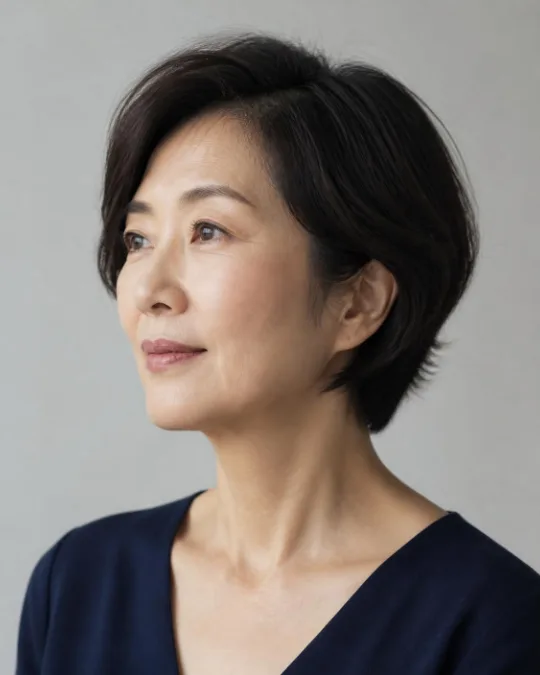
A graduated bob is a little shorter at the back and longer toward the front, with weight stacked at the nape. That stacking pushes the crown up and gives you height at the back of the head, which is exactly where fine hair tends to go flat. The trick is to keep the angle gentle and the layers low.
- Length: short at the nape, chin at the front
- Trims: every 4 to 6 weeks
- Styling time: about 10 minutes
- Face shapes: oval, round, heart
Ask your stylist for: “A soft graduated bob with a gentle angle. Layers only at the nape and in the bottom few inches, none through the crown.”
How to style it: Work mousse into damp roots at the back. Dry the back with a round brush, lifting at the roots, then smooth the front with the brush or a flat iron.
Skip it if you are tempted by a steep A-line. A sharp angle can leave the front looking thin.
Best for: hair that is flat at the back
French and Italian bobs for fine hair
The names matter less than the details: where the line sits, how solid the edge is, and whether you wear a fringe.
5. French bob with a soft fringe

The French bob is shorter and more relaxed than a classic bob. It sits between the cheekbone and the jaw, has a slightly undone edge and is usually worn with a fringe. On fine hair the fringe does a lot of work: it adds a second line of density across the face and draws attention straight to your eyes.
- Length: cheekbone to jaw
- Trims: every 6 weeks, fringe every 3 to 4
- Styling time: about 5 minutes
- Face shapes: oval, long, heart
Ask your stylist for: “A French bob between my cheekbone and jaw, with a soft fringe that grazes my brows. Keep the ends fairly solid.”
How to style it: Dry the fringe first, while it is still wet, brushing it side to side with a flat brush so it lies smooth. Let the rest air-dry with a little texturizing cream scrunched in for that lived-in look.
Skip it if you have a strong cowlick at the front hairline, or you do not want to keep up with fringe trims.
Best for: longer faces and anyone who likes a fringe
6. Italian bob

The Italian bob is the fuller, more glamorous cousin of the French bob. It is usually a little longer, from the jaw to just below it, with a rounded, bouncy shape. On fine hair the bounce comes from styling rather than layering, so keep the cut solid and let a round brush do the rest.
- Length: jaw to just below
- Trims: every 6 to 8 weeks
- Styling time: about 15 minutes
- Face shapes: square, round, oval
Ask your stylist for: “An Italian bob just below my jaw, solid at the ends, with slightly longer pieces at the front. Very little layering.”
How to style it: Use volumizing mousse at the roots, then blow-dry with a large round brush, rolling the ends under. For extra bounce, set a few large velcro rollers at the crown for ten minutes while you do your makeup.
Skip it if you want a wash-and-go cut. This one looks best when it is styled.
Best for: women who enjoy styling and want a soft, full shape
Shaggy bob for fine hair over 50, and the beachy lob
Textured styles are popular and also the most likely to go wrong on fine hair. Here is how to get them right.
7. Light shaggy bob
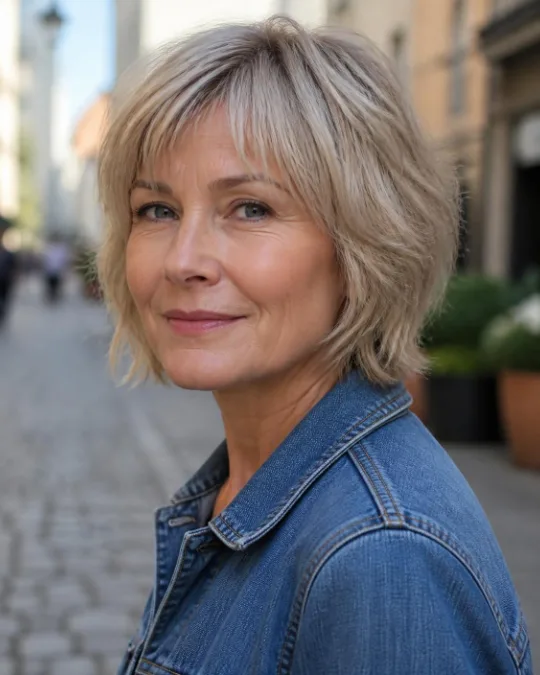
A shag is all about texture and movement, which sounds perfect for flat hair. A heavy shag, though, removes so much weight that fine hair can end up looking stringy. The fix is a light shag: a solid outline with soft texture at the crown and ends and a side-swept fringe. You get the movement without the see-through ends.
- Length: chin to collarbone
- Trims: every 6 to 8 weeks
- Styling time: 5 to 10 minutes
- Face shapes: oval, square, long
Ask your stylist for: “A light shaggy bob with a solid outline, a little texture at the crown and ends, and a side-swept fringe. Point cut it, please, no razor.”
How to style it: Scrunch a light mousse into damp hair and rough-dry with your fingers. Twist a few random pieces around a 1-inch curling iron, then finish with texture spray rather than hairspray.
Skip it if your hair is very straight as well as very fine. The texture will not hold, and the layers will just look thin.
Best for: fine hair that has some natural movement
8. Beachy lob

If you are not ready to go short, a lob (a long bob) is the gentlest step. It sits around the collarbone, leaves enough length to tie back, and soft waves add volume all the way down. The bottom line still needs to be solid, or the extra length starts to look thin.
- Length: collarbone
- Trims: every 8 weeks
- Styling time: about 15 minutes
- Face shapes: round, square, oval
Ask your stylist for: “A lob at my collarbone with a blunt bottom line and a few long, soft layers at the front only.”
How to style it: Smooth anti-frizz cream through damp hair, then blow-dry with a small round brush, lifting sections straight up at the roots. Once dry, wave the mid-lengths with a 1.25-inch iron, leave the last inch straight, and shake the waves out with your fingers.
Skip it if your ends already look see-through at this length. Go a few inches shorter instead.
Best for: growing out a shorter cut or keeping enough length to tie back
Bobs with bangs and shorter shapes
A fringe or a shorter shape can change a bob more than any other tweak.
9. Bob with soft curtain bangs

Curtain bangs part in the middle and sweep to either side, framing your eyes and cheekbones. On fine hair they add instant fullness around the face, as long as they are cut soft. Heavily thinned or over-texturized curtain bangs are the version to avoid.
- Length: chin, with bangs at the cheekbone
- Trims: bangs every 3 to 4 weeks
- Styling time: about 5 minutes
- Face shapes: square, long, heart
Ask your stylist for: “Soft curtain bangs that start just below my brows and blend into a chin-length bob. Please do not thin them out.”
How to style it: Blow-dry the bangs first with a small round brush, rolling each side away from your face. A light puff of dry shampoo at the roots of the bangs keeps them lifted on day two.
Skip it if your hair is very thin right at the front hairline.
Best for: square jaws and longer faces
10. Pixie bob

The pixie bob, also called a bixie, sits between a short bob and a pixie: tapered at the back and sides, with more length on top and around the ears. It is a good middle ground if a full pixie feels too drastic. Short hair has less weight pulling it down, so fine hair gets natural lift at the crown.
- Length: around the ears, longer on top
- Trims: every 4 to 5 weeks
- Styling time: about 5 minutes
- Face shapes: oval, heart, petite features
Ask your stylist for: “A bixie: short and tapered at the nape, more length on top and around my ears, soft edges, no razor.”
How to style it: Rub a pea-sized amount of light paste between your fingertips and work it through dry hair, lifting at the crown. Push the front to one side for a softer finish.
Skip it if you do not want to book a trim every month.
Best for: women trying shorter hair
Good to know
Bring two photos to the salon, one from the front and one from the side, and say where the line should sit: jaw, chin or collarbone. Ask for point cutting, and be frank about how much morning styling time you really have.
Salon talk and styling for a fuller bob
What to ask your stylist
- Point cutting instead of a razor. Razor finishes leave fine ends wispy.
- A blunt or softly graduated outline, so the bottom edge stays thick.
- Layers only in the bottom few inches or around the face, never through the crown.
- No thinning shears. Fine hair has no extra bulk to remove.
- Two photos, one from the front and one from the side, so you agree on where the line sits.
A five-minute styling routine
- Spray a root lifter or work a little mousse into damp roots.
- Rough-dry with your fingers until your hair is about 80 percent dry.
- Finish the crown with a round brush, lifting each section straight up.
- Flip your part to the other side once dry for instant lift.
- Mist texture spray through the lengths instead of using heavy serum or oil.
Habits that make fine hair look thinner
- Heavy conditioner or oil at the roots. Keep them on the ends only.
- Waiting too long between trims, so the solid edge wears away.
- Too much dry shampoo. A light puff on day two is enough.
- Very light, flat color all over, which can make the scalp easier to see.
If you color your hair, stay close to your natural shade or ask for a few soft lowlights. A little dimension makes fine hair look thicker than one flat color does.
The bottom line
If you are unsure where to start, book the chin-length blunt bob with a deep side part. It is the most forgiving cut for fine hair and easy to adjust later with a fringe, softer edges or a little more length. Save this guide to your hair board so you have the photos and the exact wording ready for your next appointment.