15 Short Haircuts for Women Over 50 With Fine or Thin Hair
Short fine hair over 50 has one big advantage: less length means less weight, so the roots can stand up on their own. It also has a real risk, because a short cut shows the ears, neck and scalp, and a poor cut makes thin hair look thinner. This guide covers 15 short hairstyles for fine hair over 50, with the technical details worth taking to the salon.
This guide covers lengths at the crown, sides and nape, when to texturize and when not to, and how to get through the grow-out. If you are looking at short hair for thinning hair over 50, you will also find the downsides stated plainly, so the decision is an informed one.
Is short right for fine or thin hair? Lengths, texture and trade-offs
Going shorter gives fine hair more lift and bounce, and a short cut can look fuller without extensions. The catch is exposure. Textured crops reveal everything around the ears, jaw and neck, so test the idea first by slicking wet hair flat against your head or wearing a ponytail for a week, then checking both profiles and the back view.
On lengths, the principle matters more than the numbers. Keep the most length at the crown, because fine hair needs volume at the roots and crown. The sides and nape can be shorter, though not necessarily clipper-close. A fine-hair pixie can leave the back sections 2 to 3 inches long. Your stylist should adjust this to your hairline and ears.
On texture, be careful. Texturize only dry hair, with deliberate point cuts, since lots of short layers across the top can look sparse. Too much texturizing makes fine hair look sparse, while internal layers add lift. Point cutting is a better choice than thinning shears.
The downsides are practical. Pixies need trims every four to eight weeks, and growing one out takes patience. A cut also cannot treat thinning. Female pattern hair loss often begins at the center part and gets wider over time, so see a doctor if your part is widening or shedding has increased.
Short fine hair over 50: pixie cuts that add lift
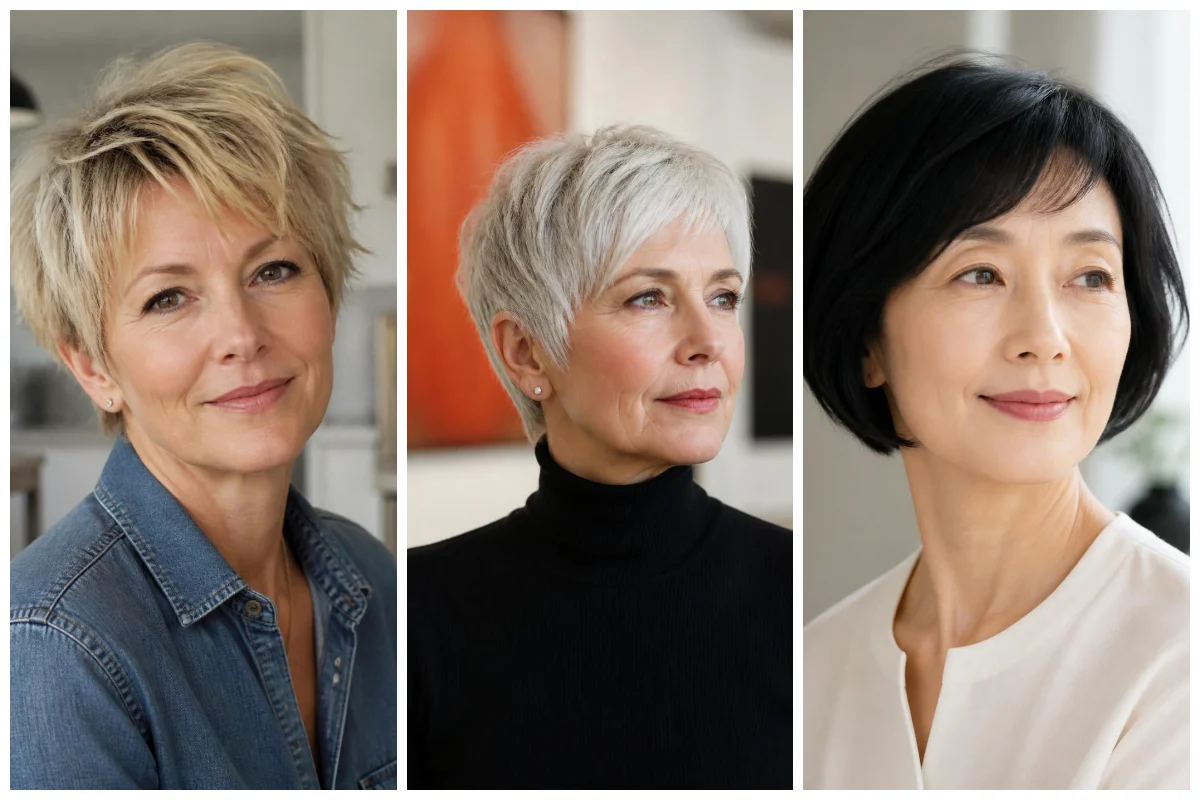
A pixie can be soft or sharp. These six variations differ in where the length sits.
1. Layered pixie with a scrunched finish
A layered pixie that is light but dimensional looks best on straight or fine hair. Use a volume spray at the roots and a tonic on the ends, let the hair air-dry partway, then scrunch with your hands. The layers add movement without removing much density, and rich brunette or auburn color can add visual thickness. Keep the layers soft and ask for the length to be longest at the crown.
Best for: straight, fine hair
2. Long pixie with crown length
The long pixie has layers and length at the crown, with soft pieces around the ears, so it can be shaped into waves and volume. That is useful for fine hair because the longer crown gives you something to lift. Check your profile with wet hair first, since this cut shows your ears and neck. Ask for the shortest layers to sit at the sides, not the crown.
Best for: women comfortable showing their ears and neck
3. Face-framing pixie with scalp prep
A face-framing pixie built around scalp health helps fine hair lift without buildup. Prep with a thickening, texturizing spray, and if your scalp is oily, use an exfoliating scrub to loosen hair from the scalp. Keep wispy pieces at the temples and ears so the shape looks soft, not cropped. Plan on a quick root-lift blow-dry every few days to keep the crown from collapsing.
Best for: hair that clings to an oily scalp
4. Pixie with downward-angled layers
Angle pixie layers downward instead of spiking them, which masks sparse areas and lets the bangs blend in. This is a gentle choice if you dislike a spiky look. Short sides and back with a slightly longer top, plus short side-swept bangs, is the classic version. Style with your fingers and a pea-sized amount of texturizing product so the layers lie down.
Best for: women who want a soft, low-fuss pixie
Crops, bixies and swoopy shorties
These cuts keep a little more length than a pixie, especially around the face.
5. Bixie
The bixie, a bob-pixie hybrid, is a gentler step from a bob to a short cut, and it suits most face shapes and hair types. Keep more length at the nape and around the ears than in a true pixie, with short crown layers and a longer fringe. Go shorter in stages if you are unsure.
Best for: women leaving a bob
6. Crop with long bangs
Crops with long bangs can be brushed aside, swept up at the crown or gelled back, and they can hide forehead lines. For fine hair, the long bangs add weight at the front, and the short sides keep the rest light. It works best if you have worn bangs before and have no front cowlick. Ask for the fringe to be cut long first, since it is easier to shorten later.
Best for: a thin front hairline
7. Swoopy shortie
A swoopy shortie has a long swoop-over at the hairline and feathery pieces at the nape, and suits you if you want height at the crown or have a widow’s peak or front cowlick. It is cut gradually shorter, so you can stop at any stage. The swoop covers the forehead edge, where thin hair often starts to recede. If your hairline is receding, keep the swoop long enough to sweep across.
Best for: women who want crown height and a soft front
8. Sleek combed-back crop
Combing balm through a short cut gives a sleek finish. Combing back shows the scalp more, so this suits hair with decent density at the front. Use a light balm instead of a heavy gel, and avoid heavy products near the roots, which flatten fine hair. Use only a dab on damp hair, then comb it back before it dries for the neatest finish.
Best for: women with density at the hairline
Short bobs and tapered shapes
A bob cut short enough to stay light can still look dense.
9. Short blunt bob
A blunt bob relies on precision cutting, not layers, to create density. The solid perimeter keeps the ends from looking thin and needs little styling. Bring a photo to the salon so the stylist can get the clean lines right. Light layering at the very ends is fine, but keep the outline solid. Book a trim every six weeks or so.
Best for: women who want a clean line
10. Graduated short bob
A graduated bob works well for fine hair: longer in front, shorter and layered at the back, with chin-grazing lines. The stacked back adds shape to the crown, and the short length avoids the dragging effect of longer hair. Keep the stacked layers rounded, not sharp. Ask your stylist to blend the transition between the stacked back and longer front. It suits fine hair that falls flat at the crown.
Best for: fine hair that lies flat at the back
11. Tapered neckline cut
A tapered neckline leaves the nape short and the top longer, which gives the cut a clean, finished edge. It also helps in the grow-out, since keeping the nape short helps it blend. Ask for the taper to follow your natural hairline, and avoid clipper-close. Ask the stylist to taper rather than shave, so the nape keeps a soft edge.
Best for: women with a neat natural hairline
12. Short cut with soft curtain bangs
Soft curtain bangs create the look of fullness without removing bulk, while blunt bangs can thin quickly and draw attention to the mid-face. Cut a very small section at the hairline so the bangs blend in. They suit a short bob or a long pixie. Plan on bang trims every three to four weeks. Skip a razor on bangs, since it can be rough on fine hair.
Best for: women who want a fringe without a heavy block
Color, styling and grow-out
A short cut still depends on color and a few smart habits.
13. Rich brunette or auburn pixie
Rich brunette or auburn color can make a fine layered pixie look thicker. Deeper shades add contrast between strands and shadows, which gives the illusion of density. Ask your colorist to keep the shade near your natural color so regrowth is not obvious, and finish with a gloss for shine. Gloss refreshes the shade between appointments. Bring a photo of the shade you like so the colorist can match the depth.
Best for: fine hair that looks washed out
14. Air-dried wash-and-go crop
For a layered pixie, air-dry partway, then scrunch. A short cut cut well can dry into shape with fingers and a root spray on damp roots, which helps fine hair avoid heat. Choose light products and use them sparingly to add separation without stiffness. Skip heavy styling creams, which weigh down a short cut quickly. Choose products you can rinse out easily.
Best for: mornings with little time
15. Grown-out pixie to graduated bob
Grow out in stages: longer pixie, graduated bob, bob, lob, then long. Leave the top alone at first, trim the sides and back so they do not mushroom, and keep the nape short so it blends. Setting smaller goals along the way makes the in-between lengths easier to live with. Book the next trim before leaving the salon so the stages stay on schedule.
Best for: women who want to grow their hair out
Good to know
Ask for point cutting instead of thinning shears, especially on gray hair. Thinning shears remove weight, and fine hair has little to spare.
Salon script, upkeep and growing it out
Tell your stylist the shortest point you can accept: nape, ears or jaw. Bring a photo from the front and the side. Ask where the crown will sit, whether the top will be point cut dry, and whether any layers are internal. These questions give the stylist the information to leave density where you have it.
Plan the upkeep. Pixie trims fall every four to eight weeks, and bangs need attention more often. For styling, use a volumizing mousse or root-lifting spray on damp hair, focusing on the crown, then flip the part while drying.
If you decide to grow it out, avoid a puffy shape by trimming the sides and back while leaving the top. No product will make hair grow faster. Heat damage can force you to cut again, so keep heat low.
Frequently asked questions
A short cut is a good tool for fine hair when the details are right: length at the crown, a solid outline, and texture added with restraint. Try the wet-hair test, take photos to your stylist, and give yourself a few weeks to settle into the shape.