12 Concert Outfits for Women Over 50
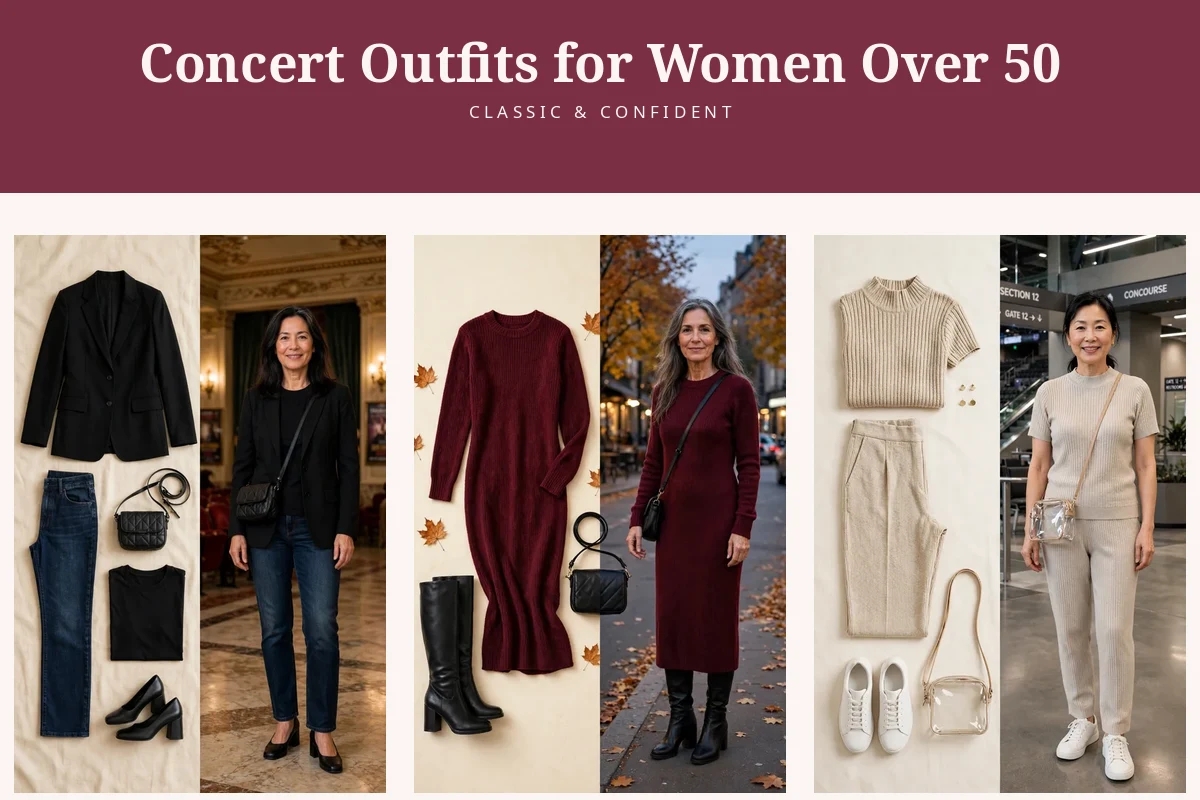
A concert is one of the hardest things to dress for after 50. You want to look like you belong in the crowd without freezing, overheating, or spending three hours on your feet in shoes you secretly hate. These concert outfit ideas for women over 50 solve that exact problem.
Each of the 12 outfits below is built for real venues: standing-room floors, grassy amphitheatres, air-conditioned arenas, and those long queues at the door. For every look you get the exact pieces to buy, the shoes that actually last all night, and the things to skip — so you can get dressed once and forget about it until the encore.
Quick picks
- The safest pick that always works → dark jeans and a black blazer (#1).
- For a seated show with dinner after → the wrap dress with block heels (#9).
- When it is all standing room → black trousers and a silk blouse with flats (#3).
- For outdoor summer gigs → linen trousers and a camp-collar shirt (#8).
- Want one piece and done → the black jumpsuit (#4).
- For arenas with strict bag rules → the co-ord set with a crossbody (#12).
Contents
How to choose your concert outfit
Start with the venue, not the wardrobe. A standing-room club means flat, closed-toe shoes and nothing you mind getting jostled. A seated theatre lets you dress up and wear a heel.
An outdoor amphitheatre means layers and shoes that survive grass or gravel. Check the venue’s website for bag rules — many arenas now require clear bags no bigger than about 15 x 10 x 10 cm — before you plan anything.
Dress for temperature swings, not the forecast. Concert halls run hot once the crowd arrives, but queues and walks to the car run cold. The fix is a true layering system: a top that works alone, plus a jacket or wrap you can tie around your waist or stash.
Anything you have to carry in your hands for two hours will feel like a mistake by the last song.
Build around one elevated piece. The difference between looking dressed and looking like you just came from errands is usually a single item: a blazer instead of a hoodie, leather-look trousers instead of joggers, a silk blouse instead of a tee.
If you need everyday building blocks, my casual outfits for women over 50 guide covers the foundations these looks start from.
Shoes decide whether you enjoy the night. You will stand in queues, climb stairs to your row, and possibly dance. A 5 cm block heel or a smart flat outlasts a stiletto every time, and it reads just as dressed-up under a good trouser.
Test-drive any heel at home for a full hour before the night — not ten minutes.
Keep it practical but finished. Crossbody bags beat shoulder bags (hands free, nothing sliding off). Dark colours survive spilled drinks and close crowds.
And if you love dresses but worry about draughty venues, a longer hem plus tights solves it — the dresses for women over 50 round-up has more cuts that work for evening.
At a glance
| Outfit | Key pieces | Shoes | Best for |
|---|---|---|---|
| 1. Dark Jeans and a Black Blazer | Dark straight-leg jeans, black blazer, simple top | Block heels or loafers | Any venue, any genre |
| 2. Midi Dress and Denim Jacket | Print midi dress, classic denim jacket | White sneakers or flat sandals | Daytime and festival shows |
| 3. Black Trousers and Silk Blouse | Black straight trousers, silk-look blouse | Pointed flats | Standing-room floors |
| 4. The Black Jumpsuit | Wide-leg black jumpsuit | Low block heels | One-piece ease |
| 5. Wide-Leg Trousers and Fitted Knit | Wide-leg trousers, fitted fine knit | Loafers or mules | Smart casual venues |
| 6. Sweater Dress and Boots | Knit midi sweater dress | Knee-high or ankle boots | Cold-weather concerts |
| 7. Denim Midi Skirt and Striped Top | Denim midi skirt, Breton-stripe top | Flat ankle boots | Outdoor evening gigs |
| 8. Linen Trousers and Camp-Collar Shirt | Linen drawstring trousers, camp-collar shirt | Leather sandals | Hot summer nights |
| 9. Wrap Dress and Block Heels | Knee-length wrap dress | 5 cm block heels | Seated shows, dinner after |
| 10. Leather-Look Trousers and Tunic | Leather-look trousers, long tunic | Pointed flats or low boots | Rock and evening shows |
| 11. Maxi Dress and Leather Jacket | Dark maxi dress, cropped leather-look jacket | Flat sandals or ankle boots | Evening concerts |
| 12. The Co-ord Set | Matching knit top and trousers | Minimal sneakers or loafers | Arenas with strict bag rules |
Relaxed classics
These three are the no-fail formulas: comfortable enough for standing, polished enough for anywhere.
1. Dark Jeans and a Black Blazer
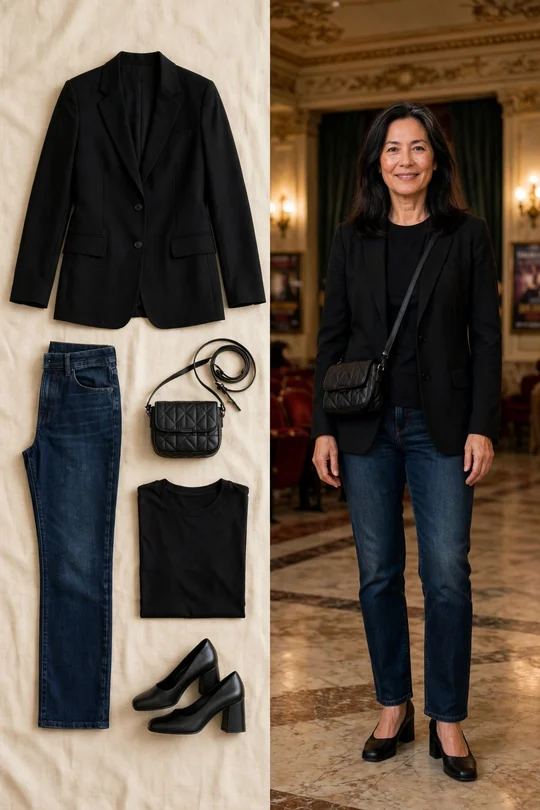
Dark denim works because of how light hits it. An indigo or black wash reflects less light than a pale wash, which reads as dressier to the eye even in the exact same cut — this is why dark jeans pass at evening venues where light jeans do not.
The blazer does the second job: structured shoulders and a defined lapel line add a tailored frame that makes the whole outfit look intentional rather than thrown on.
The mechanics are simple but exact. The jeans should be straight-leg or slim, sitting at your natural waist with no more than 2–3 cm of extra fabric at the thigh. The blazer should be single-breasted with the sleeves ending right at your wrist bone — push them up to the forearm and you lose the structure.
A plain top underneath in black, ivory or charcoal keeps the colour story quiet so the silhouette does the talking.
- Key pieces: dark indigo straight-leg jeans, single-breasted black blazer, plain crew or V-neck top
- Shoes: 5 cm block heels, or leather loafers for all-standing nights
- Occasion: indoor theatres, clubs, dinner-and-a-show
- Budget tip: the blazer is the spend piece — a £60–£80 blazer in a wool blend reads expensive for years; the jeans can be high-street
Shop for: dark indigo straight-leg jeans with no distressing, a single-breasted black blazer that buttons without pulling, a plain top in black or ivory, and a small crossbody bag in black leather-look.
How to wear it:
- Put the blazer on over the top and button it — check the front lies flat with no X-pulling at the button.
- Roll or push the blazer sleeves to just below the elbow if the night is casual; keep them full-length for theatres.
- Add one metal element only: hoop earrings or a cuff bracelet, not both.
Skip it if the venue is very hot and crowded with no coat check — you will be carrying the blazer all night. Choose a lighter layering piece instead.
Best for: women who want one formula that works for every genre and every seat type.
2. Midi Dress and Denim Jacket

A midi dress earns its place at daytime and festival concerts because the hem sits at the most forgiving point on the leg — just below the knee or mid-calf — so it moves when you walk and does not ride up when you sit on grass or bleachers.
The denim jacket works as the practical counterweight: it takes the formality down a notch and gives you a real layer for when the temperature drops after sunset, which it always does at outdoor shows.
Pick the dress by its waist definition. A dress with a tie waist or an elasticated waist you can position at your natural waist creates the hourglass line that keeps a midi from looking shapeless; a straight shift in a busy print will read frumpy next to the jacket’s structure.
The jacket itself should be a classic mid-blue, hitting at or just below your waist — cropped enough that it does not hide the dress’s waistline.
- Key pieces: print midi dress with a defined waist, mid-blue denim jacket
- Shoes: clean white sneakers, or flat leather sandals in warm weather
- Occasion: daytime festivals, outdoor concerts, matinee shows
- Budget tip: a denim jacket is a buy-once piece — spend £50+ on sturdy denim; the dress can be a £30 high-street find
Shop for: a midi dress with a tie or elastic waist in a small-scale print, a mid-blue denim jacket with a slightly relaxed fit, white leather-look sneakers, and a crossbody in tan or black.
How to wear it:
- Wear the jacket open over the dress — buttoning it hides the waist and breaks the line.
- Roll the jacket sleeves once to the forearm for a relaxed feel.
- Keep jewellery light: small studs and one delicate necklace.
- Put your phone, tickets and card in the crossbody and leave the big tote at home.
Skip it if rain is forecast and there is no covered seating — a wet midi hem clings and gets heavy. Swap in trousers for that night.
Best for: daytime and festival shows where comfort and a light layer matter most.
3. Black Trousers and a Silk Blouse

This is the standing-room specialist. Black straight-leg trousers give you a long, unbroken line from waist to shoe, and the silk-look blouse brings the sheen that light washes away in a dark venue — fabric with a soft lustre catches stage lighting and reads expensive even from ten rows back.
Because the top half carries the interest, the bottom half can stay utterly simple.
The blouse matters more than the trousers here. Look for a fluid fabric — silk, or a good silk-look viscose — with a relaxed cut that skims rather than clings; 2–3 cm of ease through the body is the target. Front-tuck just the centre 10 cm into the trousers to mark the waist without the bulk of a full tuck.
The trousers should be ankle-grazing: any longer and they pool over flats, any shorter and the line breaks.
- Key pieces: black ankle-grazing straight trousers, fluid blouse in ivory, champagne or black
- Shoes: pointed flats in black or nude
- Occasion: standing-room floors, clubs, jazz and acoustic nights
- Budget tip: a £25 viscose blouse drapes like one three times the price — spend the saving on trousers that hold their crease
Shop for: black straight-leg trousers that graze the ankle, a fluid V-neck blouse in ivory or champagne, pointed ballet flats with a slight stretch back, and a slim crossbody.
How to wear it:
- Front-tuck only the centre of the blouse, about 10 cm, and let the sides fall loose.
- Push the blouse sleeves to the elbow — it stops the fabric bunching when you lean on a barrier or table.
Skip it if the venue has no seating at all and you know you will be dancing hard — swap the blouse for a fluid knit top that survives movement without constant re-tucking.
Best for: nights when you will be on your feet the whole time and need to look polished doing it.
Dressed up without trying too hard
For the nights that call for a little more — one-piece dressing and elegant separates that do the work for you.
4. The Black Jumpsuit

A jumpsuit is the fastest route to looking dressed at a concert because it removes every matching decision. One piece gives you a single continuous column of colour, and the eye reads that unbroken line as taller and leaner — the same principle that makes a column dress work, without the fuss of separates.
In black, it is also the most forgiving option on this list for close crowds and dim lighting.
The cut is everything: wide-leg from the hip, with the waist defined by a tie belt or seaming — not elastic alone, which can bunch. The leg should fall to just cover the top of your shoe.
Two details to check in the fitting room: sit down (the rise must not pull at the front), and check you can manage the fastening alone in a venue bathroom — a jumpsuit you cannot get in and out of solo will ruin your night.
- Key pieces: black wide-leg jumpsuit with a defined waist
- Shoes: low block heels (3–5 cm) in black
- Occasion: theatres, tribute acts, evening shows with dinner
- Budget tip: crepe-look fabrics hold their shape all evening — worth £60–£90 for the one-piece payoff
Shop for: a black wide-leg jumpsuit with a tie or seamed waist, low black block heels, statement earrings (one pair is enough), and a small clutch or mini crossbody.
How to wear it:
- Try the bathroom test at home: can you undo and redo the fastening in under a minute?
- Let the earrings be the jewellery — skip the necklace, since the neckline area is already busy.
- Carry a cropped jacket or wrap for the walk in; remove it once seated.
Skip it if the venue has a long queue for the toilets — you will resent the jumpsuit by the interval. Separates are the kinder choice that night.
Best for: women who want to get dressed in one decision and look instantly evening-ready.
5. Wide-Leg Trousers and a Fitted Knit

This pairing works on pure proportion. Wide-leg trousers add volume below the waist, so the top must do the opposite — a fitted fine knit keeps the upper body slim and stops the outfit reading shapeless.
The contrast between the two is what creates the elegant line; two loose pieces together would drown the figure, two fitted pieces would look stiff for a concert.
Choose the knit in a fine gauge — 12-gauge or finer — so it lies flat under the trouser waistband without bulk. The trousers should sit at your natural waist with the leg falling straight from the hip; if they flare from the knee instead, the line reads dated rather than current.
A half-tuck of the knit shows exactly where the waist is, which is the whole point of the outfit.
- Key pieces: wide-leg trousers in navy, charcoal or black; fine-gauge fitted knit
- Shoes: loafers or backless mules
- Occasion: smart-casual venues, concert halls, seated shows
- Budget tip: the knit can be a £20 fine-gauge find; put the money into trousers with a proper pressed crease
Shop for: wide-leg trousers with a pressed front crease, a fine-gauge crew or boat-neck knit in a contrasting tone, leather loafers, and a structured small bag.
How to wear it:
- Half-tuck the knit at the front centre only, about 8 cm.
- Check the side view: the knit should skim, not pull, across the hip.
- Add a belt only if the trousers have loops and the knit is thin enough to sit flat — otherwise skip it.
- Finish with a lip colour one shade deeper than daytime; it balances the outfit’s simplicity.
Skip it if you are between sizes in the trousers — a wide leg that is tight at the hip loses the drape that makes this work. Size for the hip and tailor the waist.
Best for: seated venues where you want to look refined without a dress.
6. The Sweater Dress and Boots
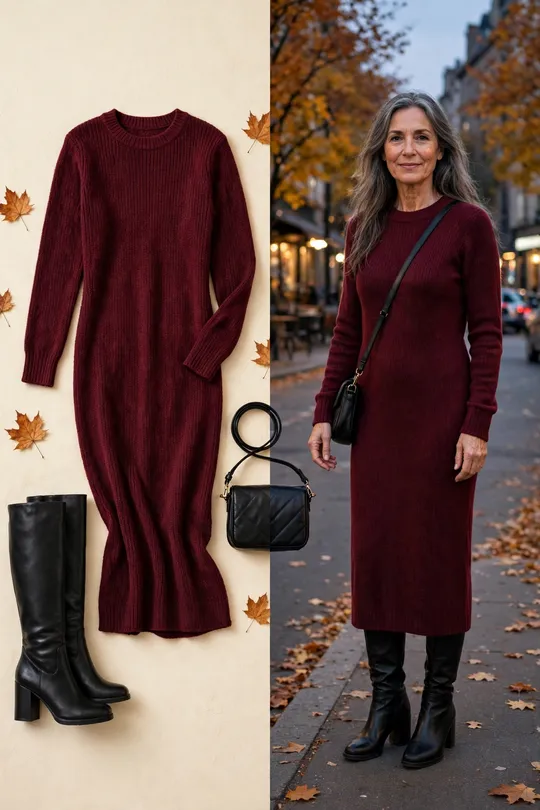
Cold-weather concerts ask for warmth that does not look bulky, and a knit midi dress answers it. A medium-weight knit in a rib or cable texture holds its shape against the body instead of clinging, which means you stay warm and keep a defined silhouette at the same time.
The boots finish the equation: knee-high or ankle boots in a dark leather-look add the structure the soft knit lacks.
Fit check: the dress should skim with about 2–3 cm of ease — if it clings at the hip it will ride up when you walk to your seat. Long sleeves in the same knit keep the proportions balanced with boots.
For the boots, a 3–5 cm block heel is the concert sweet spot: enough lift to look evening, low enough for stairs and queues.
- Key pieces: knit midi sweater dress in charcoal, burgundy or forest
- Shoes: knee-high boots or ankle boots, 3–5 cm block heel
- Occasion: autumn and winter concerts, indoor arenas
- Budget tip: a wool-blend knit (30%+ wool) at £50–£70 outlasts acrylic three times over and pills far less
Shop for: a midi sweater dress in a rib or cable knit with long sleeves, dark knee-high or ankle boots with a block heel, opaque tights if the dress sits above the knee, and a crossbody that fits under a coat.
How to wear it:
- Pull the dress down at the hip after sitting — knits settle, and a quick smooth keeps the line clean.
- If wearing ankle boots, match the tight colour to the boots for an unbroken leg line.
Skip it if the dress is a fine, clingy knit with no texture — it will show every line and ride up all evening. Rib or cable texture is non-negotiable.
Best for: cold nights when you want warmth and polish in a single piece.
Good to know
Check the venue’s bag policy the day before, not the day of. Most large arenas now only allow clear bags around 15 x 10 x 10 cm, plus one small clutch — and the list of banned items (including some over-the-counter medicines in original packaging rules) varies.
A £10 clear crossbody bought once lives in your drawer forever and saves a miserable walk back to the car.
For outdoor shows and summer nights
Warm-weather gigs bring their own rules: breathable fabrics, grass-proof shoes, and layers for the walk home.
Outdoor shows are where linen earns its keep — our guide to how to wear linen over 50 covers the breathable pieces that survive grass and heat.7. Denim Midi Skirt and a Striped Top

A denim midi skirt is the warm-weather answer to dark jeans: the same sturdy, casual fabric, but with airflow. The midi length matters mechanically — it covers the knee, which means you can sit on a blanket or a low wall without adjusting anything, and the A-line cut gives your legs room to move.
The Breton stripe on top adds a classic pattern that photographs well and never looks like you tried too hard.
Get the skirt’s waist right and the rest follows. It should sit at your natural waist with the button or zip lying flat; a skirt that gaps at the waist will twist all evening.
The stripe top should be a cotton or cotton-modal with the stripes running horizontally across the body — vertical stripes on a top read corporate, horizontal reads relaxed. A front tuck of 5–8 cm marks the waistline where skirt meets top.
- Key pieces: A-line denim midi skirt, navy-and-white Breton-stripe top
- Shoes: flat ankle boots or clean low-profile sneakers
- Occasion: outdoor evening gigs, summer festivals
- Budget tip: the skirt is the keeper — a £40–£60 A-line in rigid denim keeps its shape; stripe tops are £15 basics
Shop for: an A-line denim midi skirt in mid-blue with a flat waistband, a navy Breton-stripe top in cotton, flat ankle boots with a low heel, and a crossbody in cognac or black.
How to wear it:
- Front-tuck the stripe top 5–8 cm at the centre.
- Push the sleeves to the elbow for a relaxed line.
- Add a lightweight scarf in your bag — it doubles as a shawl when the temperature drops.
Skip it if the ground is wet — a denim midi hem soaks up water and gets heavy fast. Trousers are the safer call on muddy festival days.
Best for: summer evening shows where you want to look classic and stay comfortable.
8. Linen Trousers and a Camp-Collar Shirt

When the temperature stays above 24°C, linen is not a style choice — it is a physics choice. Linen fibres absorb moisture without feeling damp and release heat faster than cotton, which is why you feel cooler in it even in the same cut.
The camp-collar shirt keeps the neckline open, letting air circulate instead of trapping heat at the collar the way a buttoned shirt does.
Manage the wrinkle reality: linen creases, and that is the point — but a linen-viscose blend (around 55% linen, 45% viscose) creases far less than pure linen while keeping the cool feel. Choose drawstring or elastic-back trousers that sit at the waist without a tight waistband, and a shirt with 2–3 cm of ease through the body.
Darker linen (navy, olive, chocolate) shows creases less than white.
- Key pieces: linen-blend drawstring trousers, camp-collar shirt
- Shoes: flat leather sandals with an ankle strap
- Occasion: hot-weather concerts, open-air amphitheatres
- Budget tip: linen blends at £30–£45 outperform pure linen at twice the price for wrinkle resistance
Shop for: linen-blend trousers in navy or olive with a drawstring waist, a camp-collar shirt in a tone that contrasts the trousers, flat leather sandals with an ankle strap, and a small straw or canvas crossbody.
How to wear it:
- Wear the shirt untucked if it hits mid-hip, or do a loose front tuck — never a tight full tuck, which fights the fabric’s drape.
- Roll the sleeves to the forearm.
- Choose sandals with an ankle strap so your feet stay put on stairs and grass.
- Take a light pashmina — outdoor venues cool fast after 9 pm even in summer.
Skip it if the evening turns cool — linen has no insulation, and you will feel every degree. Layer a knit over the shirt or pick a different outfit.
Best for: the hottest nights of the year, when staying cool is the whole brief.
9. The Wrap Dress and Block Heels

The wrap dress is the rare garment engineered for real bodies. The diagonal wrap line draws the eye across the waist at an angle, which visually narrows it, and the V-neckline it creates lengthens the neck and shows just enough skin to read evening.
Because you tie it yourself, the waist lands exactly where yours is — not where a manufacturer guessed.
Knee length is the concert sweet spot: long enough to sit comfortably in a theatre seat, short enough to show the shoe. The fabric should be a fluid jersey or crepe with enough weight to drape — about 200–250 gsm; anything lighter clings, anything heavier loses the wrap’s softness.
Block heels at 5 cm give you the lift of a heel with the stability of a flat, which matters on theatre stairs in the dark.
- Key pieces: knee-length wrap dress in a fluid jersey or crepe
- Shoes: 5 cm block heels in nude or black
- Occasion: seated shows, concerts with dinner before or after
- Budget tip: a £35–£50 jersey wrap in a dark floral or solid jewel tone looks far more expensive than it is
Shop for: a knee-length wrap dress that ties at the true waist, 5 cm block heels, a small clutch or mini crossbody, and one pair of drop earrings.
How to wear it:
- Tie the wrap snugly at your natural waist, then check the neckline in a mirror — the V should sit 10–12 cm below the collarbone.
- Do the sit test: the hem should still cover the knee when seated.
Skip it for standing-room gigs — a wrap dress in a crush of people needs constant checking, and the tie can loosen. Save it for seated venues.
Best for: the full evening out: dinner, the show, and drinks after.
Evening and arena concerts
Big rooms, bright lights, long walks from the car park — these three are built for scale.
10. Leather-Look Trousers and a Tunic
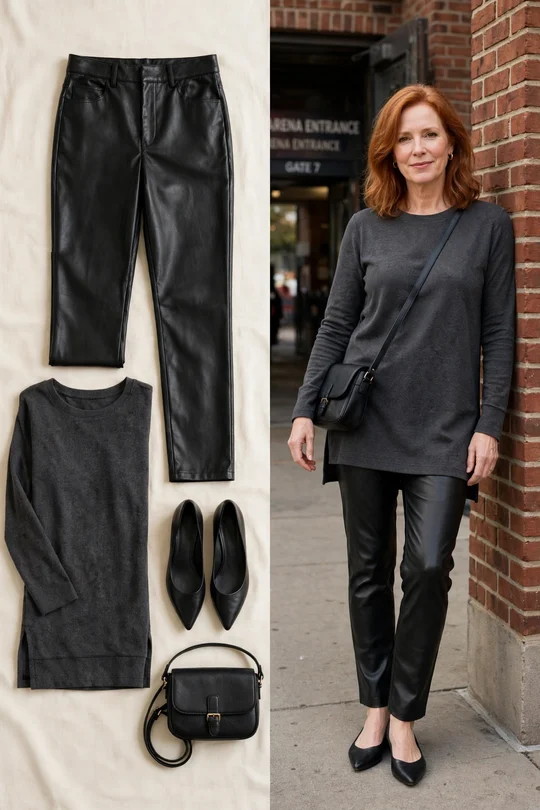
Leather-look trousers carry a concert’s attitude without the discomfort of real leather. The slight sheen of a good faux leather reflects stage light the way matte fabric cannot, which is why this outfit photographs so well and reads “evening” instantly.
The long tunic does the balancing work: it covers the hip and upper thigh, so the slim trouser line stays sleek without anything feeling exposed.
The tunic’s length is the critical measurement: it should end mid-thigh, around 70–75 cm from the shoulder on most frames — long enough to cover, short enough not to read as a dress over trousers.
Look for a tunic with side slits of 8–10 cm so it moves when you walk and does not bunch at the hip when you sit. The trousers should be a straight or slim cut with a mid-rise; low-rise faux leather gaps and creases unflatteringly.
- Key pieces: black leather-look trousers, mid-thigh tunic in black, charcoal or deep green
- Shoes: pointed flats or low-heeled ankle boots
- Occasion: rock, pop and evening arena shows
- Budget tip: good faux leather trousers run £35–£55 — check the inside seams for clean finishing, which is what separates the good from the shiny-cheap
Shop for: black leather-look straight trousers with a mid-rise, a mid-thigh tunic with side slits, pointed flats or low ankle boots, and a crossbody with a chain or slim strap.
How to wear it:
- Put the trousers on first and check the seat: no pulling lines across the back when you sit.
- Let the tunic fall straight — do not tuck any of it; the line from shoulder to mid-thigh is the design.
- Add one bold element: a cuff bracelet or a dark lip, not both.
Skip it on genuinely hot nights — faux leather does not breathe, and you will feel it by the second song. This is an autumn-to-spring outfit.
Best for: evening shows where you want a little edge without a costume.
11. The Maxi Dress and Leather Jacket
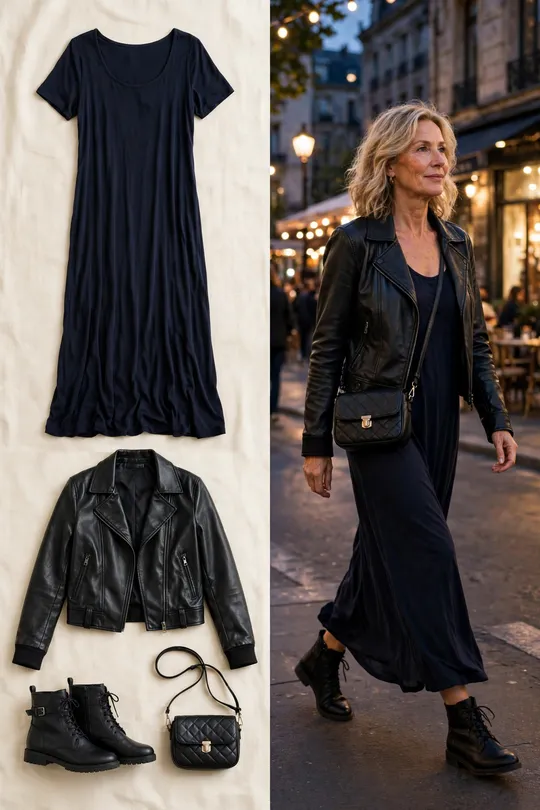
A dark maxi dress plus a cropped leather-look jacket is the evening-concert classic for a reason: the two pieces solve each other’s problems. The maxi gives you full coverage and movement — no tugging, no adjusting — while the cropped jacket adds the structure and attitude the dress lacks on its own.
Cropped is the operative word: ending at the waist, it preserves the dress’s long line instead of cutting it in half the way a hip-length jacket would.
Choose the dress in a fluid fabric with some weight — viscose or a viscose blend — so it moves when you walk rather than billowing. The neckline should be modest enough for leaning forward in your seat: a scoop or square neckline sits safer than a deep V in a dark venue.
The jacket should be genuinely cropped, ending within 2–3 cm of your natural waist, with the sleeves at full length.
- Key pieces: dark maxi dress in viscose, cropped leather-look jacket
- Shoes: flat sandals or flat ankle boots depending on season
- Occasion: evening concerts, outdoor night shows
- Budget tip: the jacket is the investment — a £70–£100 cropped style in soft faux leather lasts years; the dress can be high-street
Shop for: a dark viscose maxi dress with a scoop or square neckline, a cropped leather-look jacket ending at the waist, flat sandals or ankle boots, and a small crossbody.
How to wear it:
- Wear the jacket open and pushed slightly back off the shoulders — the dress’s neckline should stay visible.
- Check the back view: the jacket should end cleanly at the waist with no bunching over the dress.
- Keep the bag small and crossbody so it sits under the jacket.
- If the night is cool, add a pashmina rather than a bigger coat — the jacket is the outer layer.
Skip it if the dress is very full or tiered — volume plus a jacket reads bulky. This pairing needs a dress with a relatively straight fall.
Best for: evening concerts where you want to look striking with zero effort after the first five minutes.
12. The Co-ord Set
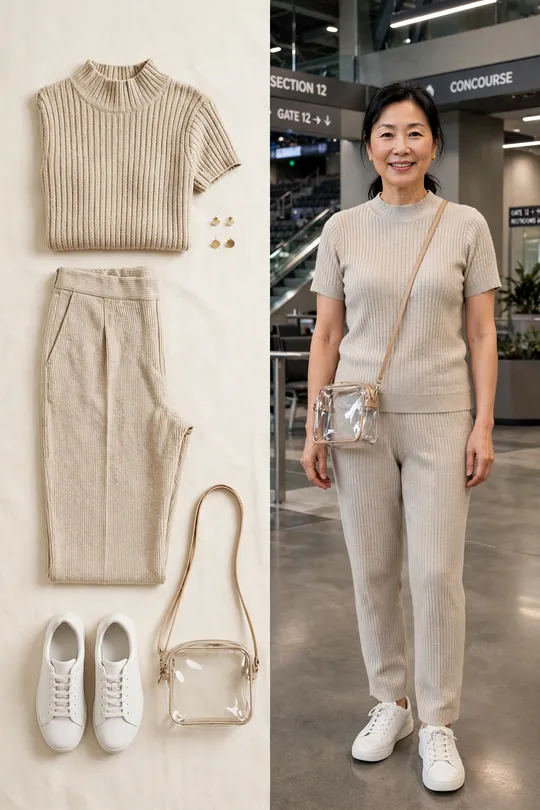
A matching knit top and trousers looks deliberate in a way separates rarely manage, because the eye reads the matched colour and texture as a single outfit rather than two decisions.
For arenas with strict entry rules, it has a practical edge too: the look is complete with just a phone, a card and keys, so it pairs perfectly with the tiny clear bag most venues now require — no jacket, no extra layers to check.
Pick the set in a fine knit or a soft woven — ribbed knits in particular hold their shape through a long evening. The top should hit at the high hip and the trousers at the natural waist, with the top worn untucked but not oversized: 3–4 cm of ease is enough.
Neutral tones (oatmeal, charcoal, navy) look the most expensive; if you want colour, keep it to one deep shade like burgundy or forest.
- Key pieces: matching knit top and trousers in a neutral or deep tone
- Shoes: minimal white sneakers or leather loafers
- Occasion: large arenas, venues with strict bag and entry rules
- Budget tip: knit co-ords at £40–£60 read far more polished than their price — check the knit recovers when stretched
Shop for: a knit co-ord set with a high-hip top and natural-waist trousers, minimal sneakers or loafers, a clear crossbody that meets arena bag rules, and simple stud earrings.
How to wear it:
- Steam or press the set before you go — knit shows creases from the drawer more than woven fabric.
- Keep accessories minimal: the matched set is the statement.
Skip it if the knit is thin enough to show underwear lines — hold it up to the light in the shop. A set that needs perfect underpinnings is a set you will think about all night.
Best for: big-venue nights when you want to sail through security and still look put-together.
Comfort notes for a long evening
A concert is a marathon in evening clothes. These are the small things that decide whether you remember the music or your feet.
- Break shoes in with two full evenings at home before the concert — not a quick try-on.
- Pack blister plasters and a folded tote in your bag; the tote holds the layer you shed.
- Eat a proper meal two hours before — standing on an empty stomach through a support act is miserable.
- Charge your phone fully and screenshot your tickets; venue signal is unreliable.
- Put a thin insole in any flat shoe — it adds the cushioning most ballet flats lack.
- Choose earrings you can sleep in; heavy drops ache by the encore.
Your get-ready routine:
- Lay out the full outfit — including shoes, bag and jewellery — three hours before you leave.
- Do the three tests: sit, climb stairs, and raise your arms. Fix anything that pulls or rides.
- Pack the bag with tickets, card, phone, plasters and the folded tote — nothing else.
- Check the venue’s bag rules and weather one last time, and adjust the layer.
- Leave 20 minutes earlier than you think you need; queues are the part nobody plans for.
The bottom line
If I had to pick one, it would be the dark jeans and black blazer (#1). It is the only outfit here that works at every venue on the list — club, theatre, arena, outdoor stage — and it asks nothing of you: no special underwear, no bag-policy gymnastics, no shoe anxiety.
Build it once, wear it for years, and spend the money you save on better seats.
Found the look you will wear to your next show? Pin this guide to your concert-night board so it is waiting when the tickets land in your inbox.
Frequently asked questions
What are the best concert outfit ideas for women over 50 who will be standing all night?
Build from the feet up: flat, closed-toe shoes with a cushioned insole, then trousers or dark jeans, then one elevated piece like a blazer or silk-look blouse. Outfits #1 and #3 in this guide were designed for exactly that.
If your feet are sensitive, prioritise the shoe over the outfit — a great shoe makes a simple outfit work, but no outfit survives a painful shoe.
Can I wear jeans to a concert after 50?
Yes — dark, undistressed jeans are the most versatile concert bottom you can own. The rules that keep them looking intentional: a dark indigo or black wash, a straight or slim cut with no rips, and one structured piece on top (a blazer or a crisp jacket).
Light-wash or distressed jeans read daytime-casual, so save those for festivals rather than evening shows.
What should I wear to an outdoor concert when the weather is uncertain?
Dress for the coldest hour, not the warmest. Wear a base outfit that works alone (like #7 or #8), add a layer you can tie around your waist, and pack a pashmina in your bag.
Flat, closed shoes beat sandals when grass turns damp — and if rain is genuinely likely, swap any midi hem for trousers, because wet hems cling and get heavy.
Are dresses practical for concerts?
They are, with two conditions. First, the length: midi or knee-length lets you sit, climb stairs and manage venue seating without adjusting. Second, the venue type: dresses shine at seated shows (#9) and evening concerts (#11), but for crush-barrier standing rooms, trousers give you one less thing to think about.
A wrap or midi dress with flat boots is the practical middle ground.
What bag should I take to a concert?
A small crossbody, full stop — it keeps your hands free and stays put in crowds. Check the venue’s policy before you go: many arenas now require a clear bag no bigger than about 15 x 10 x 10 cm. A £10 clear crossbody kept in a drawer solves this permanently.
Leave the big tote at home; there is nowhere good to put it once you are inside.
How do I look dressed up for a concert without wearing heels?
Put the polish in the fabric and the silhouette instead of the shoe. A silk-look blouse, leather-look trousers, a blazer with structure, or a jumpsuit all read evening in flat shoes — pointed flats or sleek loafers keep the line elegant.
Dark, unbroken colour from waist to shoe also helps: it is the oldest trick for looking dressed without any heel at all.