How to Wear Linen Over 50 Without Looking Like You Forgot to Iron

Every May the same question lands in my inbox, worded a dozen different ways: how to wear linen over 50 without looking like you got dressed out of a laundry basket. You love linen — the coolness on your skin, the way it moves — but the wrinkles have talked you out of it more than once.
Here is the honest answer: linen is the best hot-weather fabric you can wear after 50, and wrinkles are a solvable problem, not a verdict. This guide gives you 8 complete looks, each built around one specific anti-wrinkle trick — grouped by the body concern that worries you most, so you can go straight to your answer.
Five to try first
- The zero-iron starter: the linen-cotton blend top (#5)
- The tummy-skimmer: the long tunic over slim trousers (#1)
- The evening upgrade: the belted shirt dress (#3)
- The leg-lengthener: the tailored linen co-ord (#8)
- The arm-cover fix: the structured linen blazer (#4)
Contents
How do you keep linen looking crisp after 50?
Fabric blend matters more than price. Pure linen creases the hardest because flax fibres have almost no stretch — they break at the fold instead of springing back. A linen-cotton or linen-viscose blend (look for 50–70% linen) wrinkles noticeably less and costs less too.
Check the label before you check the mirror.
Darker colours and small patterns hide creases. White linen shows every fold; navy, olive, ink and small prints swallow them. This is the same principle behind our general advice on how to dress well over 50 — work with the fabric’s nature instead of fighting it, and the whole outfit looks more expensive.
Structure beats softness. A linen piece with a defined shoulder seam, a waistband, or a belt holds its shape where an unstructured one collapses into creases. If a garment has no seams to anchor it — a shapeless sack dress, a too-big tunic — the wrinkles become the whole look.
Choose the tailored version every time.
Match the look to the day. For days on your feet, pick forgiving cuts (the tunic, the duster, the co-ord) in darker tones. For evenings, a linen-blend dress with a defined waist does the work.
And if you love one-piece dressing, our jumpsuit guide applies the same fit rules to linen jumpsuits — the fit principles are identical.
Build around one hero piece, then add polish. Linen plus one structured element — a blazer, a belt, a proper shoe — reads intentional. Linen head to toe with nothing anchoring it reads holiday.
For evenings, pair linen with a silk camisole underneath; the silk guide shows how a touch of sheen lifts the whole outfit.
At a glance
| Look | The rule that beats wrinkles | Body concern it solves |
|---|---|---|
| 1. The Long Linen Tunic | Fabric falls straight from the bust, never clings | Tummy |
| 2. The Structured Linen Blazer | Seams and light interfacing hold the shape | Arms, shoulders |
| 3. The A-Line Linen Midi Skirt | Vertical flare hides fold lines | Legs, hips |
| 4. Wide-Leg Trousers + Tucked Top | Volume below, fitted above — no tent effect | Tummy, waist |
| 5. The Belted Linen Shirt Dress | Placket draws a straight eye-line; belt defines waist | Tummy, waist |
| 6. The Linen-Blend 3/4-Sleeve Top | 50–70% linen blend creases far less | Arms |
| 7. The Linen Duster Over a Column Dress | Two vertical layers = one long line | Arms, hips, height |
| 8. The Tailored Linen Co-ord | Matching set reads as one elongating column | Height, legs |
When your tummy is the worry
The question I hear most: “Won’t linen cling to my middle and show everything?” Only if the cut is wrong. These three looks keep fabric floating past the tummy, never gripping it.
1. The Long Linen Tunic Over Slim Trousers

A long tunic works because it detaches the fabric from the body at the exact point where linen usually fails: the midriff. Cut to fall straight from the bust, with a hem at mid-thigh (about 60 cm from the shoulder), the linen floats over the tummy instead of stretching across it.
Slim — not skinny — trousers underneath keep the lower half clean so all the softness sits on top, which is what keeps the proportions from looking sloppy.
- Key pieces: long linen tunic, slim ankle trousers in navy or ink, flat leather sandals
- Fabric spec: linen-viscose blend tunic; woven (not jersey) trousers
- Fit numbers: tunic hem at mid-thigh, 8–10 cm side slits; trousers tapered, hem at the ankle bone
- Wrinkle defence: darker trousers hide creases; the tunic’s straight cut never pulls
Shop for: a knee-skimming linen-blend tunic with 3/4 sleeves, side slits 8–10 cm, in navy, olive or a small stripe; plus slim (not skinny) ankle trousers in ink or dark grey with an elastic-back waistband.
How to wear it:
- Pull the tunic from the machine while still damp, smooth the front panels flat with your hands, and hang it on a padded hanger — no iron needed.
- Wear the tunic untucked, sleeves pushed to just below the elbow, with the trousers’ waistband sitting at your natural waist underneath.
- Finish with flat sandals and one simple necklace; the neckline is the only jewellery zone this look needs.
Skip it if the tunic is cut shorter than the hip — a tunic that ends at the widest point of the tummy draws a line exactly where you don’t want one.
Best for: warm days of errands and lunches, when you want to look put-together with almost no effort.
2. Wide-Leg Linen Trousers With a Tucked Fitted Top
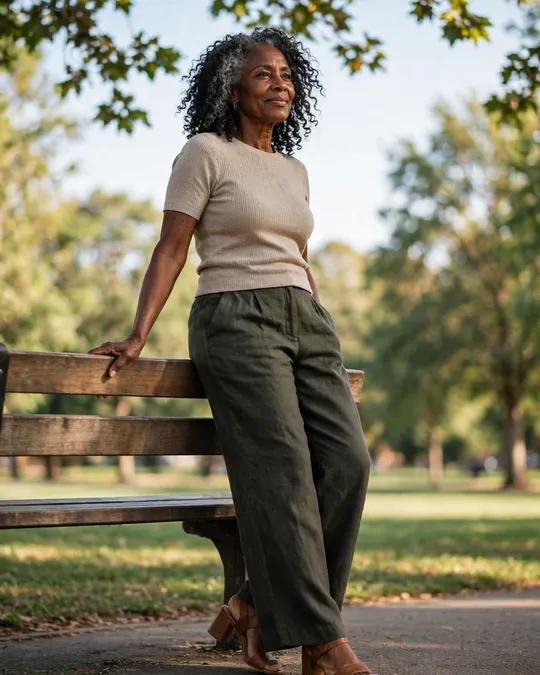
This look uses proportion contrast as its wrinkle strategy. Wide-leg trousers carry volume below the waist, so your eye expects softness there — and a fitted top tucked in (just 2–3 cm of fabric at the front) marks the waist clearly, which stops the whole outfit from reading as one shapeless tent.
The tuck is the whole trick: it tells the eye where your body starts and ends, and it pins the trousers’ waistband flat so it doesn’t roll or bunch.
- Key pieces: wide-leg linen trousers, fitted ribbed or jersey top, block-heel sandals
- Fabric spec: trousers in a linen-cotton blend; top in a stable knit that won’t ride up
- Fit numbers: trousers high-waisted with an elastic-back waistband, hem skimming the top of the shoe; top long enough to tuck 5 cm
- Wrinkle defence: dark or printed trousers; the tucked top keeps the waistband smooth
Shop for: high-waisted wide-leg linen trousers in a dark tone or small print with an elastic-back waistband; plus a fitted (not tight) 3/4-sleeve knit top in a solid colour, long enough to stay tucked.
How to wear it:
- Steam the trousers for 2 minutes while they’re on the hanger — faster than ironing and enough for linen.
- Tuck the top in at the front only, leaving the back loose; this gives the waist definition without the bunching a full tuck creates.
- Add a low block heel (4–5 cm) so the wide leg falls long instead of pooling.
- Check the side view in the mirror: the trouser leg should hang straight from the hip, not flare from the thigh — that line is what makes it elegant.
Skip it if the trousers have a drawstring front with no structure — a floppy drawstring waist ruins the clean line the tuck is trying to create.
Best for: dinners out and dressier daytime events where you want comfort that still looks deliberate.
3. The Belted Linen Shirt Dress

A shirt dress is linen’s best behaviour because the front placket does structural work: a vertical row of buttons draws a straight line down the centre of the body, and the eye follows lines, not creases. Add a belt 3–4 cm wide at your natural waist and you’ve created a waist where linen alone would have offered none.
The collar frames the face the way a necklace would, which is why this dress needs almost no accessories.
- Key pieces: linen-blend shirt dress, 3–4 cm belt, low wedge or block-heel sandals
- Fabric spec: linen-cotton blend (50–70% linen); avoid 100% linen here — the placket needs the blend’s body
- Fit numbers: hem at or just below the knee; belt at the natural waist, not the hips
- Wrinkle defence: the placket and belt break up the fabric into panels, so creases can’t travel
Shop for: a knee-length linen-blend shirt dress with a proper collar and a full button front, in chambray blue, khaki or a small stripe; plus a tan or cognac belt 3–4 cm wide with a simple buckle.
How to wear it:
- Button the dress fully, then belt it at the smallest point of your waist — stand sideways to find it before you commit.
- Roll the sleeves once to just below the elbow and leave the top button open; both moves say “relaxed” instead of “uniform”.
Skip it if the dress has no waist shaping at all and the belt is the only thing creating it — the belt will ride up and the dress will blouse over it like a sack.
Best for: summer weddings, garden parties and any event where you want one-and-done dressing.
Good to know
The single best wrinkle trick costs nothing: pull linen from the washing machine while it’s still damp, smooth the seams and panels flat with your hands, and hang it on a padded hanger. It dries smooth enough for everyday wear — no iron, no steamer.
Save the ironing for evenings out, and save this guide to your summer style board so the trick is there when you need it.
When your arms are the worry
The next question: “Does linen leave my arms exposed?” It doesn’t have to. These three looks give you coverage — a blazer, proper sleeves, a long layer — while keeping you cool.
4. The Structured Linen Blazer

A blazer is the one linen garment that barely wrinkles, and the reason is construction, not fabric. Shoulder seams sit exactly on the shoulder bone, light interfacing backs the lapels, and a half-lined back keeps the linen from clinging when you sit.
All that structure holds the cloth away from the body, so it can’t fold into creases the way a soft top can. Worn open over a simple top, it also gives you instant arm coverage without a hint of heat.
- Key pieces: unstructured-but-seamed linen blazer, plain cotton or silk camisole, straight-leg trousers
- Fabric spec: linen blend with a half lining; check the shoulder seam sits on the bone, not past it
- Fit numbers: body skims without pulling when buttoned; sleeves to the wrist bone, pushed up to 3/4 for day
- Wrinkle defence: the seams and lining do the work — hang it, don’t fold it, and it stays smooth
Shop for: a single-breasted linen-blend blazer with a defined shoulder seam and half lining, in natural, sand or navy; plus a simple scoop-neck camisole and straight-leg trousers in a matching neutral.
How to wear it:
- Wear it open over the camisole for day; the open fronts create two vertical lines that lengthen the torso.
- Push the sleeves to just below the elbow — this one styling move takes a blazer from office to weekend.
- Hang it on a proper hanger the second you take it off; a blazer draped over a chair is where wrinkles are born.
- For evening, button the middle button and add a silk camisole underneath — the sheen against the matte linen looks expensive.
Skip it if the shoulders are soft with no seam — that’s a cardigan pretending to be a blazer, and it will wrinkle like one.
Best for: work lunches, travel days and cool summer evenings when you need one polished layer.
5. The Linen-Blend 3/4-Sleeve Top With Dark Ankle Trousers

This is the everyday answer to “linen without wrinkles over 60”: change the fabric, not the look. A top in a linen-cotton blend (about 60% linen, 40% cotton) keeps linen’s cool, dry hand-feel but creases roughly half as much as pure linen, because the cotton fibres spring back where flax fibres snap.
The 3/4 sleeve — ending just below the elbow — covers the upper arm while leaving the forearm bare, which keeps the whole look cool and avoids the frumpy feel of a long sleeve in summer.
- Key pieces: linen-blend 3/4-sleeve top, dark ankle trousers, comfortable flat sandals or loafers
- Fabric spec: 55–70% linen blended with cotton or viscose; trousers in a dark woven that hides creases
- Fit numbers: top skims with 5–8 cm of ease at the bust; sleeves end 3–5 cm below the elbow; trousers hem at the ankle bone
- Wrinkle defence: the blend plus the dark bottom half — creases have nowhere visible to land
Shop for: a 3/4-sleeve top in a 60/40 linen-cotton blend with a modest scoop or V neckline, in white, stone or a soft stripe; plus dark navy or black ankle trousers with a flat front and elastic-back waistband.
How to wear it:
- Wash the top inside out on a 30°C cycle and hang it damp — with a blend, this is genuinely all the care it needs.
- Half-tuck the front of the top into the trousers to mark the waist; leave the back loose for comfort when you sit.
- Add a pendant necklace that ends at the collarbone — it fills the neckline without competing with it.
Skip it if the top is 100% linen and boxy — that combination is the exact garment that gave linen its wrinkled reputation.
Best for: everyday summer dressing — the outfit you reach for when the temperature hits 28°C and you still want to look neat.
6. The Linen Duster Over a Column Dress

A duster — a long, open-front linen layer — works on the same principle as the blazer but with more drama and less structure. Worn open over a simple column dress, it creates two unbroken vertical lines from shoulder to hem, and vertical lines are what make a body look longer and leaner.
The duster also solves the arm question completely (full coverage, full airflow) and skims over hips without touching them, because it never closes.
- Key pieces: knee- or mid-calf-length linen duster, sleeveless or short-sleeve column dress, heeled sandals
- Fabric spec: duster in a fluid linen-viscose so it moves; dress in a stable knit or cotton that won’t cling
- Fit numbers: duster hem at the knee or mid-calf; dress hem within 5 cm of the duster hem so neither peeks awkwardly
- Wrinkle defence: the open front never folds against the body; movement hides the rest
Shop for: an open-front linen duster with 3/4 sleeves in natural, sand or black, ending at the knee or mid-calf; plus a simple sleeveless column dress in a solid dark colour that sits close without clinging.
How to wear it:
- Put the dress on first and check it skims — if it clings, size up; the duster can’t fix a clinging base.
- Add the duster and leave it open; resist belting it, which breaks the long line you’re building.
- Finish with a heel of at least 4 cm — the duster’s length needs the lift to keep proportions right.
Skip it if the duster is shorter than the dress by more than a few centimetres — the peeking hem looks like a mistake, not a layer.
Best for: evening events and holidays, when you want coverage that still feels glamorous.
When your legs or height are the worry
The last question: “Doesn’t all that linen fabric swamp a shorter frame?” Only if the hemlines are wrong. These two looks use hem placement and matching sets to make legs look longer, not shorter.
7. The A-Line Linen Midi Skirt

An A-line skirt flares from the waistband, which means the fabric hangs vertically from your smallest point — and vertical drape is the enemy of visible wrinkles, because creases form where fabric folds horizontally.
A 4–5 cm waistband anchors the whole thing at the natural waist, and a hem at mid-calf (75–85 cm from the waist) shows the slimmest part of the leg while the skirt does the work above it. Paired with a tucked-in top, it’s one of the most forgiving silhouettes linen offers.
- Key pieces: A-line linen midi skirt, tucked fitted top, heeled sandals or wedges
- Fabric spec: skirt in a linen blend with enough body to hold the A shape; avoid tissue-thin linen that collapses
- Fit numbers: waistband 4–5 cm at the natural waist; hem at mid-calf, 75–85 cm from the waist; flare starts immediately below the band
- Wrinkle defence: the flare keeps fabric off the thighs when you sit — fewer contact creases
Shop for: an A-line linen-blend midi skirt with a 4–5 cm waistband and side zip, hem at mid-calf, in navy, olive or a subtle print; plus a fitted solid top to tuck in.
How to wear it:
- Sit down in the fitting room before you buy — the skirt should fall back into its A shape when you stand, not hold the seat crease.
- Tuck the top in fully and add a slim belt if the waistband is plain; the defined waist is what keeps the volume elegant.
- Wear a heel or wedge of 4–6 cm; a mid-calf hem with flat shoes shortens the leg visibly.
- When you sit for a long lunch, smooth the skirt flat under your thighs once — one smoothing prevents the deep crease that ironing can’t fix.
Skip it if the hem hits at the widest part of your calf — mid-calf means the narrow point below the calf muscle, not the muscle itself.
Best for: daytime events and warm-weather dressing when you want feminine without fussy.
8. The Tailored Linen Co-ord

A matching top and trouser in the same linen reads as one continuous column of colour, and a single unbroken column is the oldest lengthening trick in styling — the eye travels top to bottom with nowhere to stop.
The tailored part matters: an elastic-waist pull-on trouser with a clean front plus a camp-collar shirt worn open over a camisole (or buttoned and half-tucked) keeps the set from looking like pyjamas. Same fabric, same colour, clear waist — that’s the whole formula.
- Key pieces: linen camp-collar shirt + matching pull-on trousers, simple camisole, flat sandals or loafers
- Fabric spec: both pieces in the same linen-cotton blend and the same dye lot — buy them as a set, not separates
- Fit numbers: trousers full length, hem skimming the top of the shoe; shirt long enough to half-tuck 5 cm
- Wrinkle defence: matching tones make creases nearly invisible; the set reads intentional even when it’s soft
Shop for: a two-piece linen set — camp-collar shirt and pull-on trousers in the same colour (sand, sage, navy or terracotta), both in a linen-cotton blend; plus a plain camisole in a tone that matches or contrasts deliberately.
How to wear it:
- Wear the shirt open over the camisole for day, or button it and half-tuck for evening — the same set does both.
- Roll the shirt sleeves once to the forearm; the rolled cuff adds the structure the soft set needs.
Skip it if the two pieces are merely similar colours rather than a true match — “close enough” breaks the column effect and looks accidental.
Best for: travel days and holidays, when you want one outfit that works from the airport to dinner.
Making it work: how to wear linen over 50 every day
Linen stops being intimidating once the care routine is automatic. These are the habits that keep it looking good with almost no effort.
- Wash cold and gentle. 30°C, gentle cycle, inside out. Hot water and harsh spinning are what age linen prematurely.
- Hang it damp, every time. Pull pieces out before they’re fully dry, smooth the seams with your hands, and hang on padded hangers. This replaces ironing for 90% of wears.
- Steam beats ironing. A 2-minute steam on the hanger relaxes creases faster than 10 minutes with an iron — and you can’t scorch anything.
- Roll, don’t fold, for travel. Rolling avoids the hard fold lines that folding presses into linen. Unroll, hang in the bathroom during a hot shower, and it recovers.
- Keep a lint roller handy. Linen attracts lint more than cotton; a 10-second roll before you leave keeps dark linen looking new.
- Buy the blend for daily wear, pure linen for statements. Everyday tops and trousers: 55–70% linen blends. The special-occasion blazer or dress: pure linen is fine, because you’ll care for it properly.
Your 5-minute linen routine:
- The night before: check tomorrow’s outfit on the hanger — if it looks creased, hang it in the bathroom while you shower.
- Morning: give it a 60-second steam or a shake and smooth; linen responds to both.
- Dress, then do the sit test: sit for 30 seconds, stand, and check the seat and elbows — smooth once with your hand where needed.
- Before leaving: lint-roll dark pieces, check the back view, and go — linen is supposed to look lived-in, not pressed.
The bottom line
If I had to pick one for a real, busy life — school runs, errands, lunches that turn into afternoons — make it #2, the wide-leg trousers with a tucked top.
It’s the most forgiving cut in this guide, the tuck keeps you looking intentional from morning to evening, and in a dark tone it hides every crease the day throws at it. If your life leans more toward evenings out, swap to #3, the belted shirt dress — same wrinkle logic, dressed up.
Pin this guide to your summer wardrobe board so it’s waiting when linen season arrives — and send it to the friend who swore off linen years ago. She’ll thank you in May.
Frequently asked questions
Can I really wear linen over 50 without looking rumpled?
Yes — rumpled linen is almost always a fabric or fit problem, not an age problem. Choose linen-cotton blends for everyday pieces, pick structured cuts with seams and waistbands, and hang pieces damp instead of ironing. Do those three things and linen looks crisp, not crushed.
What blend of linen wrinkles the least?
Around 55–70% linen blended with cotton or viscose is the sweet spot: you keep linen’s cool, dry feel but the added fibres spring back where pure flax snaps. Below 50% linen you lose the breathability that makes linen worth wearing; at 100% you get the maximum creasing. Check the label — “linen look” with no linen content is just marketing.
Is linen too casual for evenings after 60?
Not if you choose the right pieces. A belted linen shirt dress, a linen blazer over a silk camisole, or a linen duster over a column dress all read evening-appropriate — the structure does the dressing-up work. What reads too casual is head-to-toe unstructured linen with flat sandals; add one polished element and the whole outfit shifts.
Do I have to iron linen every time I wear it?
No. For everyday wear, pulling it from the machine damp and hanging it smooth is enough — the fabric dries nearly crease-free. A 2-minute steam handles anything left over. Save the iron for evenings out or 100% linen pieces; for blends, you may never need it at all.
What shoes work best with linen outfits for older women?
Comfort and proportion decide it: flat leather sandals for tunics and co-ords, a 4–6 cm block heel or wedge for midi skirts and wide-leg trousers, loafers for the blazer look. Avoid very delicate strappy heels with heavy linen — the textures fight. And make sure trouser hems are fitted to the shoe height, or the leg line collapses.
Will linen trousers stretch out at the knees by evening?
Pure linen can bag slightly at the knees after a long day of sitting — another reason to favour blends for trousers, which hold their shape far better.
If you love pure linen trousers, choose a cut with some structure (a flat front, a proper waistband) rather than a soft drawstring style, and stand up and smooth them when you can.
Is white linen a mistake after 50?
White linen isn’t a mistake, but it’s the least forgiving choice — it shows every crease and every shadow. If you love it, wear it in structured pieces (a blazer, a shirt dress) rather than soft ones, and keep the fit skimming rather than tight. Off-white, stone and sand give you the same fresh feeling with half the maintenance.
How to wear linen over 50 in winter — is it summer only?
Linen works in winter as a layering fabric, not a standalone one. A linen blazer over a fine knit, or a linen shirt under a wool sweater with the collar and cuffs showing, adds texture without bulk.
Keep the linen away from direct skin contact in cold weather — it has no insulation — and save the breezy dresses for May.