The Best Colours for Warm Undertones Over 50 That Make You Glow
Hold a cool grey top against a warm-undertoned face, then swap it for camel, and the verdict takes about two seconds: the grey flattens the skin and pulls a faint blue shadow under the eyes, while the camel throws warm light straight back up at the cheekbones.
That is the entire science of the best colours for warm undertones over 50 — not taste, not trends, but light. Warm skin has a yellow, golden or peachy base, and colours with that same warmth bounce it back at you; colours with a blue base steal it away.
Below are the ten colours that do the bouncing, grouped by colour family: three warm neutrals to build on, three earthy mid-tones for everyday depth, and four rich warm brights for the days you want to glow.
Each one comes with the mechanism that makes it work, exact shopping specs, and one hard rule — the thing to get right so the colour works for you instead of against you.
Elisa’s shortlist
- Your everyday neutral → camel (#2)
- The white that actually flatters you → warm ivory (#1)
- Your new black → chocolate brown (#3)
- The colour that makes gold jewellery sing → mustard (#6)
- The event colour → burnt orange (#7)
- The instant-glow colour → coral (#9)
Contents
How to choose the best colours for warm undertones over 50
Confirm your undertone before you shop. In natural daylight, look at the veins on the inside of your wrist: greenish veins and gold jewellery that makes your skin look alive both point to warm undertones, while bluish veins and silver that flatters point the other way.
If you are unsure, start with our guide to what colours suit you over 50 — it walks you through the three tests in two minutes.
Warm means yellow-based, not loud. The common mistake is hearing “warm colours” and reaching for neon orange. Warmth is about the undertone of the dye: camel, olive and terracotta are quiet colours, but every one of them sits on a yellow base that harmonises with warm skin.
If these ten colours all look wrong on you, you may be cool-toned instead — our best colours for cool undertones over 50 is the mirror list.
The 30 cm rule decides everything. Colour within 30 cm of your face — tops, scarves, collars, necklaces — matters roughly three times more than colour anywhere else, because it is the light your face is photographed in all day.
Get the neckline colour right and the trousers can be almost anything; get it wrong and the perfect trousers will not save you.
Keep one cool exception on purpose. A wardrobe of nothing but warm colours can look monotone in photographs. One deliberate cool piece — navy trousers, a grey bag — adds contrast the way a frame adds to a picture, as long as it stays below the waist.
Once you know whether you lean autumn or spring, our find your colour season over 50 guide refines the exact shades.
Build from neutrals outward. Start with the three warm neutrals below — ivory, camel, chocolate — because they carry 80% of your outfits. Add the mid-tones next, then let the brights be the smallest part of the wardrobe and the biggest part of the impact.
Three neutrals, three mid-tones, four brights: that is the whole formula.
The ten colours at a glance
| Colour | The rule in one line | Wear it as | Best for |
|---|---|---|---|
| 1. Warm ivory | Ivory near the face, never optic white | Blouses, scarves, tees | Everyday tops |
| 2. Camel | Your neutral base — coat, trousers, shoes | Coats, knitwear, bags | The whole wardrobe |
| 3. Chocolate brown | Wear it where you would wear black | Blazers, trousers, evening | Depth without harshness |
| 4. Olive green | Yellow-based olive only — never emerald | Trousers, utility jackets | Casual autumn dressing |
| 5. Terracotta | Near the face when skin needs warmth | Sweaters, scarves | Autumn and winter glow |
| 6. Mustard gold | One warm accent per outfit | Tops, scarves, knitwear | Making gold jewellery sing |
| 7. Burnt orange | The loudest thing you wear — one piece | Coats, event dresses | Occasions and energy |
| 8. Tomato red | Orange-based reds only, never blue-reds | Lipstick, evening tops | Confidence days |
| 9. Coral | The only pink in a warm wardrobe | Summer tops, blush shades | Instant glow |
| 10. Golden bronze | Evenings and holidays, not daytime | Metallic tops, accessories | Parties and celebrations |
The warm neutrals
These three carry your wardrobe the way grey, navy and black carry a cool-toned one — they go with everything, never argue with your skin, and make every bright on this list easier to wear.
1. Warm Ivory (Not Stark White)
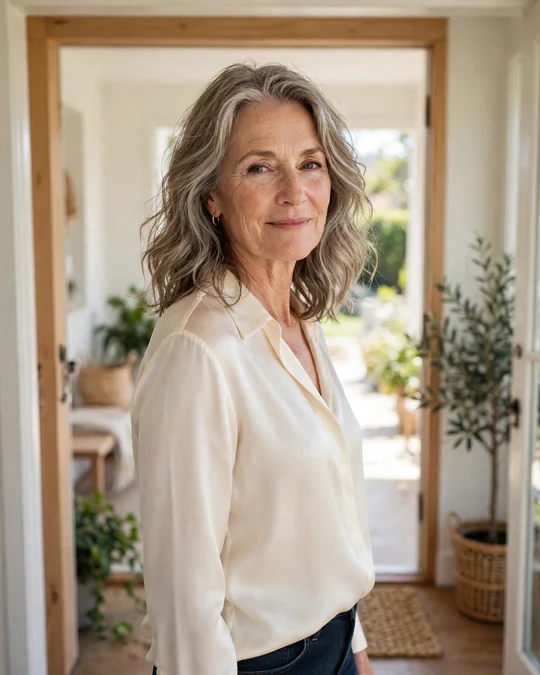
Stark white is dyed with a blue base, and that blue base is what puts the grey shadow on a warm-undertoned chin — the fabric and your skin are literally reflecting different light. Warm ivory is the same brightness with a yellow-cream base, so it bounces warm light back up at your face instead of stealing it.
It is the single fastest fix in this whole guide: women who swap their white tees for ivory usually see the difference in the first mirror glance.
- Shade: ivory, cream or eggshell — hold it to your chin in daylight; it should disappear into your skin, not sit on top of it
- Fabric: cotton poplin, silk or linen — matte finishes read warmer than shiny ones
- Placement: within 30 cm of the face — blouses, tees, scarves, collars
The rule: wear warm ivory — never optic white — within 30 cm of your face: tops, scarves and collars in ivory; keep stark white out of the neckline entirely.
How to wear it:
- Do the daylight test in the shop: hold the garment under your chin facing a window. If your under-eye shadows deepen, it is too cool — put it back.
- Choose a V, scoop or open collar rather than a high crew — an open neckline lets the ivory frame your face instead of ringing it.
- Pair it with camel or chocolate below the waist; ivory on top and a warm neutral below is the warm-skin uniform that never fails.
Skip it if you are dressing for high-contrast evening drama — then reach for chocolate brown (#3) instead of any light neutral.
Best for: everyday blouses, white-tee replacements, scarves that sit against the throat, summer tops.
2. Camel and Tan

Camel works on warm skin for the simplest reason on this list: it is roughly the same warmth as the skin itself, so instead of competing with your colouring it extends it. A camel coat over a cream top creates one continuous warm column from face to knee, and the eye reads that unbroken warmth as glow.
It is also the hardest-working neutral you will own — camel goes with all nine other colours here, which is why it sits at the centre of every warm skin tone colours wardrobe for older women.
- Shades: true camel for coats, lighter tan for spring tops and shoes — stay between milky coffee and digestif biscuit
- Fabric weight: wool or wool-blend for outerwear (it holds the colour’s depth); cotton or linen for warm-weather pieces
- The big buy: a knee-length camel coat — worn 4–5 months a year, cost per wear under $2 within two winters
The rule: build your neutral base on camel and tan, not grey and black — coat, trousers and shoes in camel; keep black to a single accent piece per outfit.
How to wear it:
- Start with the coat: knee length, single-breasted, in a wool blend — it is the piece that makes every outfit underneath look intentional.
- Add tan in the middle: a tan knit or trousers bridges a dark bottom and a light top without the harsh line black would draw.
- Finish with shoes and bag in the same family — tan loafers, a camel tote — so the neutral column runs head to toe.
- Let one bright do the talking: a camel base with a terracotta scarf or coral top is the whole warm-undertone formula in one outfit.
Skip it if your colouring is very deep and you want evening contrast — swap the camel coat for chocolate (#3) after dark.
Best for: coats, knitwear, trousers, handbags, shoes — the skeleton of the wardrobe.
3. Chocolate Brown

Chocolate brown is warm black: it gives you the same slimming, grounding depth as black, but its red-yellow base harmonises with warm skin instead of throwing the blue shadow that makes black so draining near a warm face.
That is why it replaces black in a warm wardrobe piece for piece — the trousers, the blazer, the evening dress — while looking softer and, frankly, more expensive. If you have worn black for thirty years out of habit, this is your permission slip.
- Shade: deep espresso to milk chocolate — avoid anything so dark it reads black in indoor light
- Pairings: ivory on top, camel beside it, gold jewellery always — chocolate, cream and gold is the warm evening trio
- Shoes: chocolate pumps or boots instead of black — they lengthen the leg on warm skin where black cuts it
The rule: make chocolate your black — wear it exactly where you would wear black (trousers, blazers, evening dresses), and retire black from anywhere within 30 cm of your face.
How to wear it:
- Swap one black staple at a time — trousers first, since they sit furthest from the face and the change feels safe.
- For evening, wear chocolate head to toe with a warm ivory blouse or gold necklace at the neckline to keep light near your face.
- Choose matte fabrics (crepe, wool, suede) over shiny ones — shine on dark brown can read dated, matte reads rich.
Skip it if you want a light, airy summer look — chocolate is a cold-weather and evening colour; reach for camel or ivory instead.
Best for: work trousers, blazers, evening dresses, winter boots — anywhere you used to default to black.
Earthy mid-tones
These three sit between the neutrals and the brights: colours with real presence that still behave like neutrals in an outfit. They are the autumn palette over 60 in its purest form.
4. Olive Green
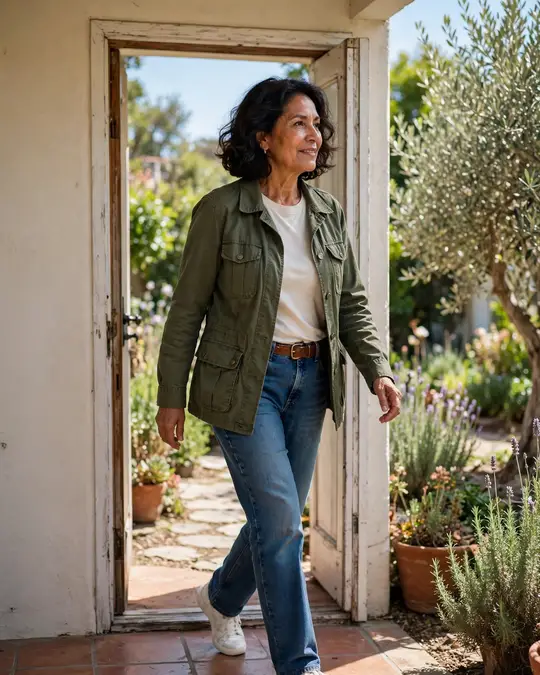
Not all greens are equal on warm skin: emerald and forest are dyed on a blue base, and that blue is what makes them sit apart from a warm face like a stranger at the table.
Olive is green built on yellow — army, moss, khaki-olive — so it echoes the golden tones already in warm skin instead of fighting them. The result is a green that behaves like a neutral: it grounds brights, flatters denim, and never drains you.
- Shade: olive with visible yellow in it — army, moss, golden khaki; if it looks blue next to a lemon, it is the wrong olive
- Best pieces: straight-leg trousers, utility jackets, knit polo tops — olive loves structured cotton and twill
- Pairings: ivory, camel, chocolate and mustard — olive sits happily inside the whole warm family
The rule: choose olive with a visible yellow base — army and moss, never emerald or forest — and wear it as trousers or a jacket where it can anchor the outfit.
How to wear it:
- Start with olive trousers in a straight leg — they do the same casual job as dark jeans but stay inside your colour family.
- Top them with warm ivory or a mustard knit; the light-on-top, earth-below balance keeps the outfit from going muddy.
- Add a utility or field jacket in the same olive family for autumn — one colour, two textures, zero effort.
- Finish with tan shoes and gold jewellery; silver against olive reads accidental, gold reads deliberate.
Skip it if your own skin is strongly olive-yellow and you want contrast rather than camouflage — then terracotta (#5) will lift you more.
Best for: casual trousers, weekend jackets, autumn layers, travel outfits that need to go with everything.
5. Terracotta

Terracotta is baked earth — orange softened with red and brown until it matches the exact warmth sitting under warm skin. Because the match is so close, the colour seems to disappear into the face in the best way: instead of noticing the sweater, people notice that you look well.
It is the colour equivalent of good lighting, and in the low light of autumn and winter, when warm skin loses its summer glow, it gives that light back.
- Shade: true terracotta — clay-pot orange-red; too orange and it shouts, too red and it becomes brick
- Best pieces: crew or V-neck sweaters, wool scarves, knit dresses — terracotta loves soft textures
- Season: September to March — this is a low-light colour, wasted in high summer
The rule: wear terracotta near the face in autumn and winter — a sweater, a scarf, a cowl neck — exactly when your skin needs borrowed warmth most.
How to wear it:
- Choose a V or scoop neck so a triangle of skin shows — terracotta against skin is the whole point; a turtleneck hides the effect.
- Pair it with chocolate trousers or dark denim below and ivory nowhere near it — terracotta wants depth around it, not competition.
- Repeat the shade small: a terracotta-toned lipstick or blush ties the face to the sweater and doubles the glow.
Skip it if your complexion flushes red easily — terracotta amplifies redness; olive (#4) gives you the autumn feeling without the flush.
Best for: autumn sweaters, winter scarves, any day your skin looks tired and you need the colour to do the work.
Good to know
The two-minute jewellery test settles your undertone question for good: in daylight, hold a gold necklace against your cheek, then a silver one. On warm skin, gold melts in and silver stands apart like cutlery; on cool skin it is the reverse.
Warm undertones glow in gold, brass and copper — so as you shop these ten colours, reach for gold-toned jewellery every time. It is the cheapest way to double every colour’s effect.
6. Mustard Gold

Mustard contains the same yellow pigment that sits in warm skin, and that shared pigment is why it does something no other colour on this list does: it reflects your own warmth back at you.
Put a mustard top on and the eyes look brighter, the teeth look whiter, the whole face looks like it just came back from a walk. It is a strong colour, so it works as an accent rather than a base — but as accents go, there is nothing kinder to warm undertones over 50.
Warm undertones glow with the right makeup shades too — our mother of the bride makeup looks over 50 use the same earthy palette for a polished finish.- Shade: deep mustard, Dijon, goldenrod — rich and spiced, never neon or highlighter yellow
- Best pieces: knit tops, silk scarves, cardigans — mustard loves to sit near the face
- The one rule of quantity: one mustard piece per outfit — two mustards argue with each other
The rule: wear mustard as the single warm accent — one top, one scarf, one cardigan — and keep everything else in the outfit neutral.
How to wear it:
- Put the mustard at the neckline: a crew-neck knit or a scarf looped twice, so the colour’s light lands on your face.
- Anchor it with chocolate or olive below — dark warm bottoms let the mustard be the star without the outfit floating.
- Add gold jewellery — hoop earrings or a pendant — because mustard and gold are the same colour family and they amplify each other.
- Keep makeup warm too: a peachy blush and a warm nude lip stop the face from looking cooler than the outfit.
Skip it if your skin is very yellow-toned and sallow in winter — mustard can double the sallowness; coral (#9) will lift you instead.
Best for: knit tops, scarves, days you want to look lit-from-within, making every gold piece you own look better.
Rich warm brights
The high-impact end of the warm spectrum: saturated colours that energise your face instead of draining it, because every one of them is built on a warm base. One piece at a time is the whole discipline here.
7. Burnt Orange

Burnt orange is the saturated end of terracotta — all the warmth, twice the voltage. It works on warm skin because saturation and warmth are different things: a colour can be vivid without being cool, and burnt orange proves it.
It creates contrast against your skin without introducing a single blue-based note, so you get the energy of a bright colour with none of the draining effect brights usually have on mature skin.
- Shade: burnt orange, pumpkin, paprika — deep and spiced, never traffic-cone bright
- Best pieces: wool coats, event dresses, structured blazers — burnt orange needs a confident silhouette
- Quantity: strictly one piece — a burnt orange coat over chocolate, or a dress with camel shoes
The rule: let burnt orange be the loudest thing you wear — one piece per outfit, everything else quiet and neutral.
How to wear it:
- Choose the piece with the strongest shape you own in this colour — a tailored coat or a sheath dress — because a loud colour in a sloppy shape reads costume.
- Keep everything else in the warm-neutral family: chocolate trousers, camel shoes, an ivory top underneath an open coat.
- Wear it in daylight first — burnt orange is at its most flattering in natural light, which is why it owns autumn.
Skip it if your colouring is soft and muted and brights usually wear you — terracotta (#5) gives you the same family at half the saturation.
Best for: autumn coats, event dresses, holidays, any day you want to be the warmest thing in the room.
8. Tomato Red
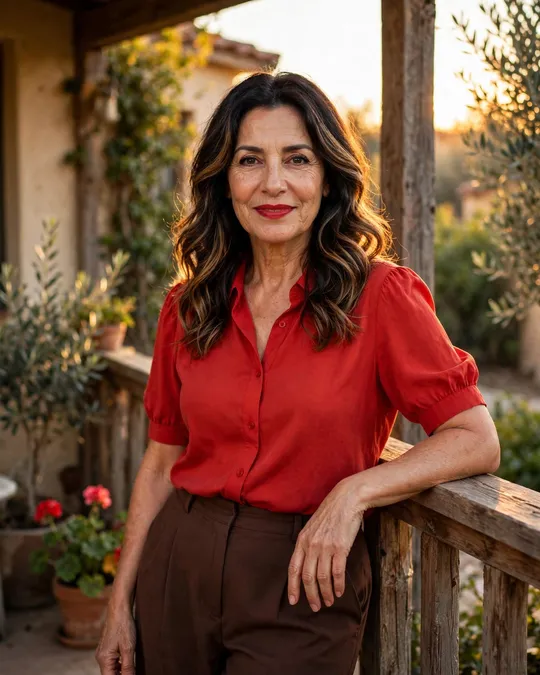
Red splits into two families and only one of them loves warm skin: orange-based reds (tomato, poppy, brick) share your skin’s warm base, while blue-based reds (cherry, crimson, raspberry) put a pink-grey cast across a warm face. Tomato red is the warm family’s flagship — vivid, confident, and harmonising instead of clashing.
It is also the most flattering lipstick family for warm undertones, for exactly the same reason.
- Shade: tomato, poppy, warm brick — if it leans orange in the tube or on the hanger, it is yours
- Best pieces: lipstick first, then an evening top or a knit — red near the face is where the magic is
- Pairings: chocolate, camel, ivory — warm neutrals let the red be the headline
The rule: choose reds with an orange base — tomato, brick, poppy — and never let a blue-based cherry or crimson within 30 cm of your face.
How to wear it:
- Start with the lipstick — it is the cheapest experiment: a tomato-red lip against warm skin brightens the whole face in seconds.
- For clothing, pick one red piece — a top, a knit — and keep the rest of the outfit in chocolate, camel or ivory.
- Match your blush to the family: a warm peachy blush with a tomato lip; a cool pink blush will fight the lipstick all evening.
- Keep jewellery gold — silver next to warm red creates a temperature clash the eye reads as “off” without knowing why.
Skip it if you want red but find tomato too vivid — brick red is the same family at a lower volume and works for everyday.
Best for: lipstick, evening tops, confidence days, holidays — anywhere you want to look decisive.
9. Coral

Coral is pink with the cool taken out — pink warmed with orange until it stops clashing with warm skin and starts mimicking a natural flush. That is the mechanism: where a blue-pink like fuchsia sits on top of warm skin as an obvious outsider, coral sinks in and looks like health.
It is the only pink that belongs in a warm wardrobe, and it is the fastest way to look rested without changing anything else.
- Shade: true coral, warm peach, salmon — pink you can see the orange in
- Best pieces: summer tops, linen shirts, blush and lipstick shades — coral is a warm-weather colour
- Pairings: ivory, tan, white denim — coral wants light, easy companions
The rule: pick coral for blush, lipstick and summer tops — it is the only pink that belongs in a warm wardrobe, so retire fuchsia and bubblegum.
How to wear it:
- Wear it closest to the face first — a coral top or scarf — because the flush-mimicking effect only works near skin.
- Pair it with tan or ivory below; coral with dark bottoms loses its lightness, which is its whole point.
- Echo it in your makeup: a coral blush with a coral top multiplies the glow — mismatched cool blush cancels it.
Skip it if you want depth and authority rather than freshness — coral is a daytime glow colour; choose terracotta (#5) for weight.
Best for: summer tops, holiday wardrobes, blush and lipstick shades, tired-skin rescue days.
10. Golden Bronze
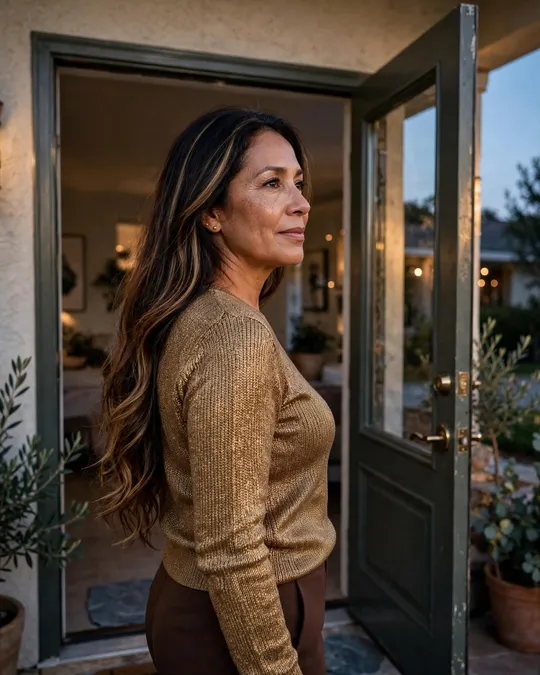
Bronze is brown lifted with a golden metallic sheen, and that sheen is doing real work: it reflects light upward onto the face the way candlelight does, which is why bronze reads as glow rather than just colour. On warm skin it does double duty — neutral enough to behave like chocolate, luminous enough to replace jewellery.
Silver and pewter put a cold metallic cast on warm skin; bronze puts a warm one. For evenings and holidays, it is the metallic you were meant to wear.
Leopard is a warm-toned neutral in disguise — our how to wear leopard print over 50 shows how it anchors rich brights without competing with them.- Shade: golden bronze, antique gold — warm metallics; avoid rose gold if it reads pink on you
- Best pieces: metallic knit tops, pleated skirts, evening blouses, accessories — one metallic piece per outfit
- Timing: after 5 p.m. and holidays — metallics read festive, not office
The rule: wear bronze for evenings and holidays — a metallic top, skirt or accessory — in place of silver, pewter or any cool metallic.
How to wear it:
- Choose a knit or crepe metallic rather than lamé — a soft sheen glows, a hard shine glares.
- Pair it with chocolate — a bronze top over chocolate trousers is the warm evening uniform.
- Keep the rest of the jewellery minimal: the top is already doing the jewellery’s job; add small gold studs and stop.
- Warm up the makeup to match: a bronze eye, a warm nude lip — cool makeup with warm metallic looks unfinished.
Skip it if the shimmer feels like too much for your life — keep bronze to accessories (a belt, a clutch, shoes) and let chocolate do the evening work.
Best for: holiday parties, evening events, festive dinners, any night you want candlelight built into your outfit.
Warm-colour wardrobe tips that make every shade work
You do not need ten new outfits — you need the habits that make the warm colours you already own behave. These are the ones that do the heavy lifting.
- Shop in daylight or by a window. Store lighting is designed to flatter the clothes, not you — a colour that glows under fluorescents can go muddy in daylight, which is where you will actually wear it.
- Keep a “face frame” kit: one ivory scarf, one camel scarf, one gold necklace. Any outfit, however cool its colours, can be rescued by putting a warm frame around your face.
- Match your foundation to your undertone first. The wrong foundation base undoes every good colour choice — if your base is pink and your skin is warm, even camel will look off.
- Photograph the outfit, not the mirror. A quick phone photo in daylight shows you the colour truth your bathroom mirror hides — check the face, not the clothes.
- Retire one cool staple per month, not all at once. The grey blazer goes first (it sits at the face), then the black top; the navy trousers can stay — they live below the waist.
- Let white hair be the cool accent. Silver hair against a warm wardrobe is genuinely striking — the contrast is deliberate and beautiful, so do not dye it to “match.”
The 5-minute colour check routine:
- Stand by a window in daylight and look at your face first, not the outfit — bright eyes and even tone mean the colours are right.
- Check the 30 cm zone: whatever sits at your neckline should be from this list’s warm family, or rescued with a scarf or necklace that is.
- Count the brights: more than one saturated colour means one of them has to go back in the closet.
- Confirm the metals: gold, brass or copper with warm colours — if you reached for silver, swap it before you leave.
The bottom line
If I had to pick one, it is #2: camel. It is the only colour here that builds an entire wardrobe by itself — coat, trousers, shoes, bag — and it makes every bright on this list easier to wear. Start with the camel coat this week and you will feel the difference before you buy anything else.
The runner-up is #6, mustard: the single most transformative accent for warm skin, and the cheapest experiment on the list — one scarf, worn at the neckline, and your gold jewellery suddenly looks twice as expensive.
Save this one to your “colours that love me” board — next time you are standing in a fitting room holding two tops and cannot decide, the answer will be waiting on your phone.
Frequently asked questions
How do I know if I really have warm undertones?
Three tests, all in natural daylight: greenish wrist veins point warm while bluish veins point cool; gold jewellery that makes your skin look alive points warm while silver that flatters points cool; and if you tan easily and rarely burn, that is warm too. If two of the three agree, trust them.
If they split, you are likely neutral — in which case wear the muted versions of these colours (terracotta over burnt orange, camel over mustard) and you will be right either way.
Can I still wear black if I have warm undertones?
You can, but keep it away from your face. Black trousers, a black skirt or black boots are fine — below the waist, black is just a neutral. The problem is only black at the neckline, where its blue base throws shadow onto a warm face.
If you love a black top, rescue it with a warm ivory or camel scarf at the throat, or swap the top for chocolate brown, which gives you the same depth without the draining effect.
What are the best colours for warm undertones over 50 to wear to a wedding?
For a daytime wedding: coral or terracotta in a dress, with tan shoes and gold jewellery — festive, flattering and photograph-safe. For an evening wedding: chocolate brown or golden bronze, which read formal without the harshness black brings to warm skin.
Avoid stark white (it competes with the bride and fights your undertone) and avoid head-to-toe beige, which photographs flat — you want one colour with presence, not a whisper.
Does my hair colour change which warm colours suit me?
It changes the intensity, not the family. If your hair is silver or white, you can carry the brights — burnt orange, tomato red — because the hair gives you contrast to balance them. If your hair is warm brown, auburn or golden blonde, lean on the mid-tones and neutrals so hair and clothes harmonise instead of competing.
If you colour your hair cool ash blonde, know that it fights every colour on this list at the hairline — warm the hair or keep the brightest colours below the neckline.
I flush red easily — which warm colours should I avoid?
Skip terracotta and tomato red near the face — both amplify visible redness because they sit in the same colour family as a flush. Your best friends are olive, mustard and chocolate: all the warmth with none of the red.
And keep coral to your wardrobe rather than your blush — a coral top is fine, but choose a neutral-warm blush over a pink one so you are not doubling the red.
Can warm-undertoned women wear navy or grey at all?
Below the waist, yes — navy trousers and a grey bag are useful contrast pieces and the 30 cm rule means they never touch your face’s light. At the neckline, both are risky: navy is better than grey (it has depth), but neither flatters like the warm neutrals do.
If you must wear a grey or navy top, put a warm scarf or gold necklace between it and your chin and the problem mostly disappears.
What metals should I wear — gold or silver?
Gold, every time — yellow gold, brass and copper all share your skin’s warm base, which is why they look like they belong on you. Silver, platinum and white gold put a cool cast against warm skin that reads as slightly off, especially near the face.
If you own beloved silver pieces, wear them below the waist (a belt buckle, a bag charm) and keep gold at the ears and throat where it does its best work.