How to Find Your Colour Season After 50, Even With Grey Hair

Every morning at about 7:40 you stand in front of the wardrobe and reach for the same two or three tops — the ones that never disappoint. Then you try the ambitious one, the colour that looked beautiful on the hanger, and something looks off. Your skin looks tired, your eyes look smaller, and you change back.
If you want to find your colour season over 50, this is the room where it starts — not at a consultant’s studio, and not with an online quiz.
This guide gives you 8 tests and rules in the order to run them, most taking five minutes or less, all designed for the way colour behaves on a woman past 50 — including the big change: grey hair. Work through them once, in real daylight, and you will know your season and exactly what to do with it.
The fast picks
- The daylight mirror test (#1) — colour only tells the truth in daylight, never at 7:40 under the bedroom lamp
- The white-versus-ivory chin check (#2) — the fastest cool-or-warm sort there is
- The silver-and-gold foil drape (#3) — when the tests disagree, the metals settle it
- The grey-hair season reset (#5) — grey hair changes your contrast, and usually softens your season
- The scarf trick (#8) — wear any colour you love if you keep it off your face
Contents
How to choose which test to run first
Start with light, never with colour. Every seasonal colour analysis for older women that goes wrong goes wrong at the window — tests run under warm bathroom bulbs make everyone look warm. Run all of these between 10 am and 3 pm near a window, with a bare face, and the answers stop arguing with each other.
If you want the deeper version first, our guide to how to find your undertone over 50 walks through the same daylight rules step by step.
Your jewellery box already voted. The metal you reach for every day is a diagnostic you have been running for years: silver that makes you look fresh points cool, gold that makes you glow points warm. Metals sit against the skin at the neckline and wrists, exactly where colour seasons are decided.
This is why our warm undertone colours guide starts with jewellery — it is data you already own.
Grey hair is a lighting change, not a new season. Going grey softens your overall contrast — the frame around your face gets lighter and cooler — which usually moves women one notch softer and lighter within their season, or into the neighbouring soft season. It does not throw out everything you knew.
For the full picture of how undertone, season and grey hair work together, see the full guide to what colours suit women over 50.
Trust the sequence, not any single test. One test can lie — bad light, a tan, tired eyes. Three tests pointing the same way cannot.
Run points 1 to 3 in order, and only call it decided when at least two agree. That is the whole method; the rest of this guide is what to do with the answer.
The 8 steps at a glance
| Step | The 30-second check | What you need | Best for |
|---|---|---|---|
| 1. The daylight mirror test | Bare face, midday window light, and one honest look | A window, 5 minutes | Every reading that follows |
| 2. The white-versus-ivory chin check | Hold white, then ivory, under your chin | Two plain fabrics or tops | The fastest cool-or-warm sort |
| 3. The silver-and-gold foil drape | Drape silver foil, then gold, at your neckline | Two squares of kitchen foil | Settling a split verdict |
| 4. The wrist-vein and jewellery reading | Veins in daylight plus the metals you wear most | Daylight, your jewellery box | A cross-check with zero cost |
| 5. The grey-hair season reset | Re-test contrast now your frame is lighter | Your current hair, honestly seen | Newly or fully grey hair |
| 6. The four-season shorthand | Sort yourself into one of four seasons in two questions | Your answers from steps 1–4 | Naming the season |
| 7. The wardrobe audit | Pull your ten most-worn pieces and sort them | Your wardrobe, 20 minutes | Turning the answer into outfits |
| 8. The scarf trick | Keep “wrong” colours below the chin | One scarf in your season | Colours you refuse to give up |
At home: run the three draping tests
These three tests are the actual colour analysis — everything else in this guide interprets them. Do all three in one sitting, in the same daylight, with no makeup on. Twenty minutes, one honest mirror, and you will have your answer.
1. The daylight mirror test

Colour only reads accurately in full-spectrum daylight because artificial light is missing parts of the spectrum — warm bulbs add yellow your skin does not have, and cool LEDs drain the pink. Stand 1 to 1.5 metres from a north- or east-facing window between 10 am and 3 pm, bare-faced, hair pulled back, wearing white or nothing at the neckline.
Look at three things in this order: the skin under your eyes (does it look even or shadowed?), your lips (do they look like they have colour or have they disappeared?), and your eyes (do they look clear or tired?). This is your baseline — every fabric you hold up next is judged against what you see right now.
- Time: 5 minutes, between 10 am and 3 pm
- You need: a window, a bare face, hair tied back
- Watch for: under-eye shadows, lip colour, eye clarity
The rule: judge every colour against your bare-face baseline in the same daylight, never against another colour.
How to do it:
- Stand 1 to 1.5 metres from the window, facing it — never with the light behind you. Study your bare face for a full minute.
- Note your baseline in three words: under-eyes (even or shadowed), lips (coloured or pale), eyes (clear or tired).
- Keep this baseline in your head for every test that follows — a colour is “yours” only if it improves on this, not merely matches it.
Skip it if … you have just come in from exercise or are flushed — wait 20 minutes. Blood at the surface flatters every colour and tells you nothing.
Best for: the one reading every other test depends on.
2. The white-versus-ivory chin check
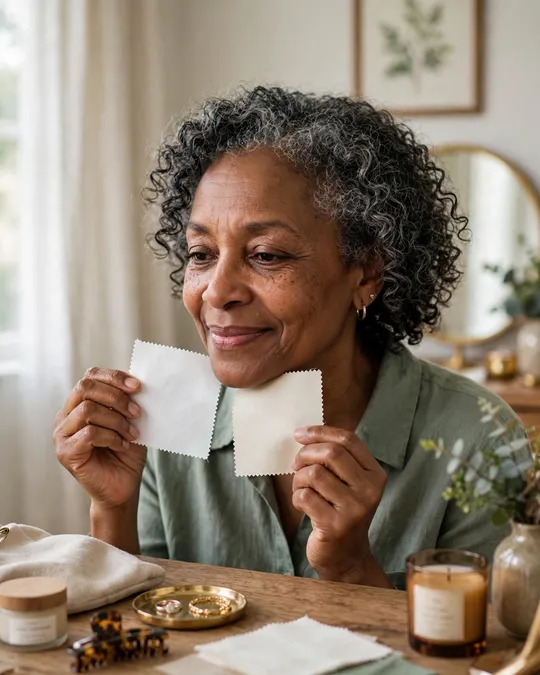
This is the fastest cool-or-warm sort in colour work, and it works because of contrast at the jawline: pure optic white contains blue undertones, so it harmonises with cool skin and clashes with warm skin, while ivory contains yellow and does the reverse.
Hold a plain white fabric under your chin in your daylight spot, look at your baseline three things, then swap to ivory. One of them will make your under-eyes look smoother and your teeth look whiter; the other will throw a shadow across your jaw and make your skin look sallow.
The winner names your temperature — cool (white) or warm (ivory) — which eliminates two of the four seasons immediately.
- Time: 3 minutes
- You need: one plain white and one plain ivory fabric, at least 30 cm square
- Decides: cool versus warm — half of your season
The rule: the right white makes your skin look rested; the wrong one makes you look like you need sleep.
How to do it:
- Drape the white fabric under your chin, covering your top. Look at under-eyes, lips and jawline shadow for 20 seconds.
- Swap to ivory and repeat. Do not rush this — the difference is in the shadows, not the fabric.
- Name the winner: smoother under-eyes and brighter teeth means that temperature is yours. If you genuinely cannot tell, move to the foil test next.
- Write it down. “Cool” or “warm” — this word follows you through the rest of the guide.
Skip it if … you are wearing any base makeup at all — even tinted moisturiser shifts the reading. Bare face or it does not count.
Best for: the fastest single answer in this guide.
3. The silver-and-gold foil drape

Metals are the tiebreaker because they are the purest temperature signal you can hold to your face — silver reflects cool blue-spectrum light onto the skin, gold reflects warm yellow-spectrum light, and your skin visibly accepts one and fights the other. Tear two squares of kitchen foil, roughly 25 cm each, and scrunch each loosely so it catches the light.
Drape the silver at your neckline in your daylight spot: cool skin looks clearer, eyes look brighter, and the jawline looks defined. Swap to gold: warm skin looks luminous and even, while cool skin looks greyish and the shadows deepen. When the white-versus-ivory test felt like a guess, this one rarely does.
- Time: 3 minutes
- You need: two 25 cm squares of plain kitchen foil
- Settles: any split verdict from the first two tests
The rule: your metal is the one that makes you look lit from within — the other makes you look lit from a hospital corridor.
How to do it:
- Scrunch the silver foil loosely — flat foil glares, scrunched foil glows. Drape it at your neckline.
- Judge the same three baseline markers: under-eyes, lips, eye clarity. Note the verdict.
- Repeat with gold. The metal that smooths and brightens wins — and it should agree with your white-versus-ivory answer.
Skip it if … both metals look fine on you — that means you are likely neutral-leaning, and you should choose by which one you wear more happily, then favour the softer colours of your season.
Best for: ending the “but I wear both” argument with your mirror.
In your wardrobe: read the clues you already own
You have been running colour experiments on yourself for decades — every top you kept and every one you quietly stopped wearing is data. These three steps turn that history into a reading, and handle the one change that rewrites the rules: grey hair.
4. The wrist-vein and jewellery reading

Veins look blue or green depending on how your skin’s undertone filters the light passing through it — cool undertones let the blue show, warm undertones add yellow to the mix and the eye reads green. In your daylight spot, look at the inside of your wrist: clearly blue or purple veins point cool, clearly green veins point warm.
Now open your jewellery box and count: the metal you have bought most often over the years is the one your eye already knew flattered you. Veins and jewellery should agree with your draping tests. When all three point the same way, your temperature is settled beyond argument.
- Time: 2 minutes
- You need: daylight and your jewellery box
- Counts as: your third vote — two out of three decides
The rule: blue veins plus a silver habit means cool; green veins plus a gold habit means warm — and the habit is the more honest witness.
How to do it:
- Check the inner wrist in daylight only — bathroom light turns every vein green. Note blue/purple or green.
- Count your everyday metals: the necklace, earrings and watch you actually wear. Majority silver or majority gold?
Skip it if … your veins are genuinely hard to read — very deep or very fair skin can hide them. Trust the two draping tests instead.
Best for: a free, instant cross-check before you commit to a season.
Good to know
Your phone camera is a useful second opinion and a terrible first one: front cameras auto-white-balance, which erases exactly the undertone differences you are testing. Take the selfie if you like, but make the decision in the mirror.
And if you have a summer tan, re-run the white-versus-ivory test in October — a tan adds warmth that fades, and seasons should be decided on your October-to-April skin.
5. The grey-hair season reset

Grey hair changes the frame, and the frame changes the season: hair is the largest block of colour near your face, so when it goes from dark brown to silver, your overall contrast — the difference between your lightest and darkest features — drops.
Lower contrast suits softer, lighter colours; the deep, high-contrast shades of a Winter or Autumn palette can start to overpower you. This usually means a shift one notch softer and lighter within your temperature family — a Winter softens toward Summer, an Autumn toward Spring — not a jump to the opposite side.
Re-run the white-versus-ivory test with your grey as it is now: if ivory suddenly beats the white that used to win, your season has softened and your wardrobe needs the memo.
- Time: 10 minutes, re-running tests 2 and 3
- Applies to: fully grey, growing-out grey, and silver-blonde transitions
- Usual shift: one notch softer and lighter, same temperature
The rule: grey hair doesn’t change your season — it softens it. Dress one notch lighter than you used to.
How to do it:
- Hold your darkest “power colour” top — black, deep navy, chocolate — to your chin in daylight. If it now looks heavier than your face, your contrast has dropped.
- Re-run the white-versus-ivory test. Note any change from the last time you knew your colours.
- Shift your palette one notch: same temperature family, softer and slightly lighter versions of your best colours.
- If you are mid-transition with two-tone hair, test with your hair pulled fully back — judge the skin, not the stripe.
Skip it if … you colour your hair exactly as before — then your old season still holds, because the frame has not changed. Revisit this the month you stop.
Best for: anyone whose hair is lighter now than it was at 45.
6. The four-season shorthand

With your temperature settled, the season names itself from two questions — and you only need the shorthand, not the twelve-season chart. Question one: cool or warm (your tests answered this). Question two: light and soft, or deep and vivid?
Cool plus light-and-soft is Summer; cool plus deep-and-vivid is Winter; warm plus light-and-soft is Spring; warm plus deep-and-vivid is Autumn. Grey hair most often lands women in Summer or soft Autumn territory. Write your season on a card and keep it in your purse for the next month — every shopping decision gets easier when the answer is one word.
Once your season is set, your haircut should play along — our hairstyles with bangs for women over 50 frame the face in ways that show off your best colours.- Cool + soft/light: Summer — powder blue, rose, soft navy, silver grey
- Cool + deep/vivid: Winter — black, cobalt, emerald, pure white
- Warm + soft/light: Spring — peach, warm aqua, camel, ivory
- Warm + deep/vivid: Autumn — rust, olive, teal, chocolate
The rule: two questions, one word. If naming your season takes longer than a minute, you are overthinking it.
How to do it:
- Answer question one from your tests: cool or warm.
- Answer question two honestly: do deep, saturated colours energise your face (vivid) or sit heavily on it (soft)?
- Match the pair to the four seasons above and write it down — “I am a soft Summer” beats a vague memory every time you shop.
Skip it if … you landed between two seasons — then you are a soft subtype, and you should shop the lighter, muted half of either neighbour’s palette rather than forcing a choice.
Best for: turning three test results into one usable word.
Out and about: wear the answer
A season you do not wear is trivia. These two steps put the answer into your wardrobe and your daily routine — including the escape hatch for every colour you love that your season says no to.
7. The wardrobe audit: sort your top ten

Your ten most-worn pieces are a better colour analyst than any quiz, because wear is a vote: you reach for what flatters you, even when you cannot name why. Pull the ten tops and dresses you wore most in the last month and lay them on the bed in daylight.
Sort them into two piles — the ones that match your season’s palette and the ones that fight it. Most women find six to eight already belong; those are your proof the season is right.
The fighters are not automatically banished — they move to the bottom half of outfits, away from the face, which is exactly what the next step is for.
- Time: 20 minutes
- You need: your ten most-worn tops and dresses, daylight
- Expect: 6–8 of 10 already in your season — that is your confirmation
The rule: your most-worn clothes are already your palette — the audit just reads the votes.
How to do it:
- Lay the ten pieces on the bed near a window. Hold each to your chin for ten seconds — season match or season fight?
- Count the matches. Six or more means your instincts were right all along; trust them going forward.
- Move the fighters to bottom halves — trousers, skirts, shoes — where colour never touches the face.
Skip it if … your wardrobe is mostly black and navy workwear — the audit still works, but run it on your weekend tops, where your real preferences live.
Best for: proving the season with your own clothes, not a stranger’s chart.
8. The scarf trick for “wrong” colours

Here is the physics that makes this whole guide forgiving: colour only affects your face when it sits within about 30 cm of it — reflected light falls off fast with distance. A “wrong” colour at the neckline casts its undertone straight onto your skin; the same colour as trousers, a skirt or a bag barely registers.
So keep the beloved-but-wrong top and break its contact with your face: a scarf, open collar or necklace in your season’s colour between the fabric and your chin. The eye reads the colour nearest the face, and the outfit reads as entirely yours.
Knowing your season makes minimalist dressing easy — our casual minimalist outfits for women over 50 build whole outfits from just a few of your best shades.- The distance: colour matters within ~30 cm of the face
- You need: one scarf or open-neck layer in your season
- Saves: every “wrong” colour you already own and love
The rule: the face only answers to the colour nearest it — put your season between you and everything else.
How to do it:
- Put on the “wrong” colour top. Drape your season-coloured scarf at the neckline, or open the collar two buttons.
- Check the mirror in daylight: the face should read the scarf’s colour, not the top’s.
- No scarf? A necklace in your metal, or a jacket in your season worn open, does the same job.
- For bottom halves, skip the trick entirely — trousers and skirts in any colour are automatically safe.
Skip it if … the colour genuinely suits you and you are only doubting it because a chart said so — the mirror outranks the chart, always.
Best for: keeping the colours you love without arguing with your season.
Colour tips that make the season stick
The tests give you the answer once; these habits keep it working every morning without a second thought. None of them costs money, and they compound fast.
- Photograph your palette. Lay your four or five best colours on the bed, photograph them in daylight, and keep the photo on your phone — it is your shopping reference for the next year.
- Test in the shop doorway. Shop lighting lies as badly as bathroom lighting. Carry the garment to the shop’s front window or doorway before you decide.
- Neckline first, always. When choosing between two tops, pick the one whose neckline colour is in your season — the rest of the garment matters far less.
- Re-test every October. Summer tans fade, winter paleness arrives, and grey grows in — one five-minute chin check each autumn keeps your season honest.
- Keep one “rescue” scarf. A scarf in your very best colour, kept by the front door, fixes any outfit whose top turned out to be a fighter.
- Match lipstick to temperature. Blue-based reds and roses for cool seasons, orange-based corals and bricks for warm — lips sit at the face, so they count double.
The 3-minute doorway colour check:
- Stand in natural light at the front door or a window — never the bedroom lamp (30 seconds).
- Ask the three baseline questions: under-eyes even, lips visible, eyes clear? (1 minute).
- If something looks off, swap the top or add your rescue scarf — never “hope” a colour improves by lunchtime (1 minute).
- Glance at your metals: the right metal at the neckline finishes what the colour started (30 seconds).
The bottom line
If I had to pick the one that matters most, it is #5 — the grey-hair season reset. Every other test in this guide assumes the contrast you have today, and grey hair quietly changes that contrast more than any other single thing after 50.
Women who ran these tests at 45 and never re-ran them are dressing for a frame they no longer have. Re-test once, shift one notch softer and lighter, and suddenly the colours in your wardrobe start working again.
Pin this guide to your style board as your personal colour cheat sheet — run the chin check on every new top before it comes home, and the 7:40 am wardrobe standoff ends for good.
Frequently asked questions
How do I find my colour season over 50 if I’ve never done colour analysis before?
Start with the three draping tests in this guide — the daylight baseline, the white-versus-ivory chin check and the silver-and-gold foil drape — all in one sitting, in daylight, with a bare face. When two of the three agree on cool or warm, you have your temperature; the four-season shorthand then names your season. Twenty minutes, no consultant needed.
Does going grey change my colour season?
It softens it rather than replacing it. Grey hair lowers the contrast between your features, which usually moves you one notch softer and lighter within your temperature family — a Winter leans toward Summer, an Autumn toward Spring. Re-run the chin check with your grey as it is now; if softer colours suddenly win, shift your palette accordingly and keep your temperature.
Can I still wear black after 50?
If you are a Winter, black near the face is still your power colour. If you are any other season, move black below the chin — trousers, skirts, shoes and bags are all safe — and put your season’s colour at the neckline with a scarf or open collar. Soft navy, charcoal and espresso usually replace black more flatteringly for Summers, Springs and Autumns.
What if I’m between seasons and no test gives a clear answer?
Then you are almost certainly a soft subtype, which is very common after 50. Stop forcing a single-season verdict and shop the lighter, muted middle of your temperature family — soft navy instead of black, rose instead of fuchsia, camel instead of chocolate. The muted colours flatter every season in the family, so indecision costs you nothing.
Do seasonal colour rules work for deeper skin tones over 50?
Yes — temperature and contrast work the same way on every skin tone. On deeper skin, the white-versus-ivory test can be subtler, so lean harder on the silver-and-gold foil drape, which reads clearly at any depth. Rich, saturated colours in your temperature family are usually your strongest shades; if a colour looks ashy on the skin, it is the wrong temperature, not the wrong depth.
How often should I re-check my colours?
Once a year is plenty — make it October, when the summer tan has faded. Re-check sooner if you stop colouring your hair, go fully grey, or notice your old favourites suddenly looking heavy. One five-minute chin check keeps the whole system honest.