How to Layer Clothes in Winter Over 50 Without Feeling Bulky

This post contains affiliate links. If you buy through them, I may earn a small commission at no extra cost to you. As an Amazon Associate I earn from qualifying purchases. Read my full disclosure.
You know the feeling: three layers on, and suddenly you cannot find your waist, your arms will not hang straight, and the mirror shows a marshmallow. That is the problem with most winter layering advice — it tells you to add layers without telling you which ones, so the result is warmth you cannot move in.
Learning how to layer clothes in winter over 50 without feeling bulky is not about owning less; it is about choosing thinner layers in the right order.
By the end of this guide you will have a five-step system for every cold morning: a base layer that disappears, a middle layer that does the warming, a waist you can see, an outer layer chosen for the room, and edges that seal the warmth in.
No new wardrobe required — most of it starts from what you already own.
Start here
- Start here — Step 1: Start thin with a base layer that disappears
- Start here — Step 2: Add the middle layer that does the warming
- Start here — Step 3: Put your waist back with a belt, a tuck or a half-tuck
- Start here — Step 4: Choose the outer layer by the room, not the weather
- Start here — Step 5: Finish the edges — neck, wrists and ankles
Contents
- How to choose your layers
- Step 1: Start thin — pick a base layer that disappears
- Step 2: Add the middle layer that does the warming
- Step 3: Put your waist back — belt, tuck or half-tuck
- Step 4: Choose the outer layer by the room, not the weather
- Step 5: Finish the edges — neck, wrists and ankles
- Winter layering tips
- The bottom line
- Frequently asked questions
How to choose your layers
Layer thin to thick, always. Your thinnest layer sits closest to the skin — a fine thermal or silk-blend base — then the knit, then the structured outer layer. Each layer is slightly roomier than the one under it, which is what keeps your shape visible instead of turning you into a marshmallow.
Keep one slim line visible. An ankle, a wrist, a waistline, a collar — the eye needs one place where your outline shows, or a winter outfit swallows you. This is not about skin: a cuff of thermal peeking from a sleeve and the ankle gap above a boot do the same job.
Our 15 elegant winter outfits for women over 50 follow the same rule, with length doing the slimming work.
Warmth lives between layers, not inside bulk. A slim merino base under a knit traps a pocket of warm air that a single chunky sweater never will. Two thin layers plus a wind-blocking outer layer keep you warmer than one thick jumper, and you can peel one off indoors.
Our 12 casual winter outfits for women over 40 use the same principle all season.
Match your longest pieces. A long tunic under a short jacket cuts your torso in half; a long coat over a long dress makes one clean column. Pair hem lengths deliberately — long with long, short with short — and your proportions stay long even in February.
For the full seasonal system, our 18 winter outfits for women over 50 show thin-to-thick layering across coats, knits and boots.
Step 1: Start Thin — Pick a Base Layer That Disappears
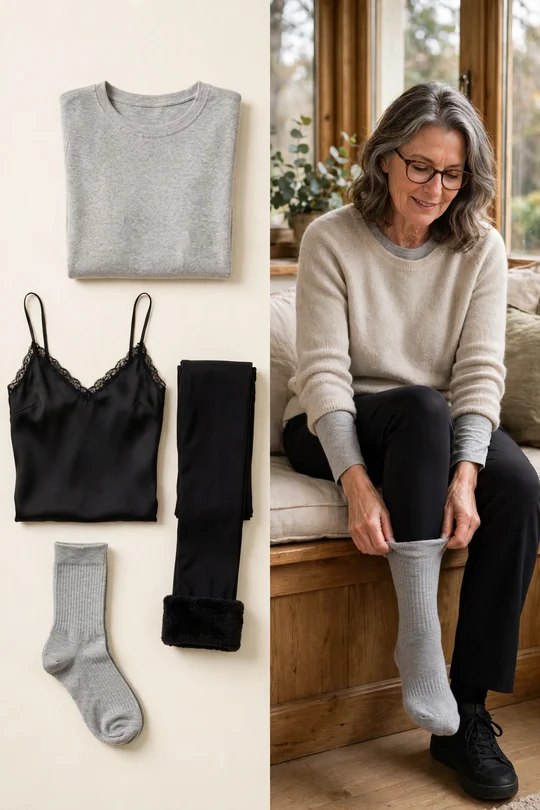
The base layer is the whole secret, because it does the warming without adding a single visible centimetre. A fine merino thermal or a silk-blend camisole sits flat against the skin, traps a thin pocket of warm air, and disappears under everything else you wear.
If your base layer is visible under a fine knit, it is too thick — that is the test.
Choose merino first if you run cold: a 150 to 200 gsm merino long-sleeve top regulates temperature, wicks moisture, and does not itch the way cheap wool does.
Choose a silk blend if you run warm or wear fitted tops, because silk is the thinnest warm layer there is — about half the thickness of a cotton tee at the same warmth.
Fit matters more than fabric here. The base layer must be close-fitting with no bunching at the waistband, long enough to stay tucked in when you sit, and with sleeves that reach the wrist bone.
Buy your true size, not a size up — a loose base layer wrinkles under a knit and adds the very bulk you are trying to avoid.
Do not forget the bottom half. Fleece-lined opaque tights under trousers or a skirt add the warmth of a whole extra layer with nobody knowing, and thin merino socks do the same inside boots. Warmth from below is invisible warmth, which is the best kind.
The rule: your base layer should add no more than 2 mm of visible bulk. If you can see it under a fine knit, it is too thick.
💡 Tip: buy two base layers in the same colour — one to wear, one in the wash. A base layer you wear three times a week is the hardest-working piece in your winter wardrobe, and two of them cost less than one chunky sweater.
As an Amazon Associate, Classic & Confident earns from qualifying purchases.
Step 2: Add the Middle Layer That Does the Warming
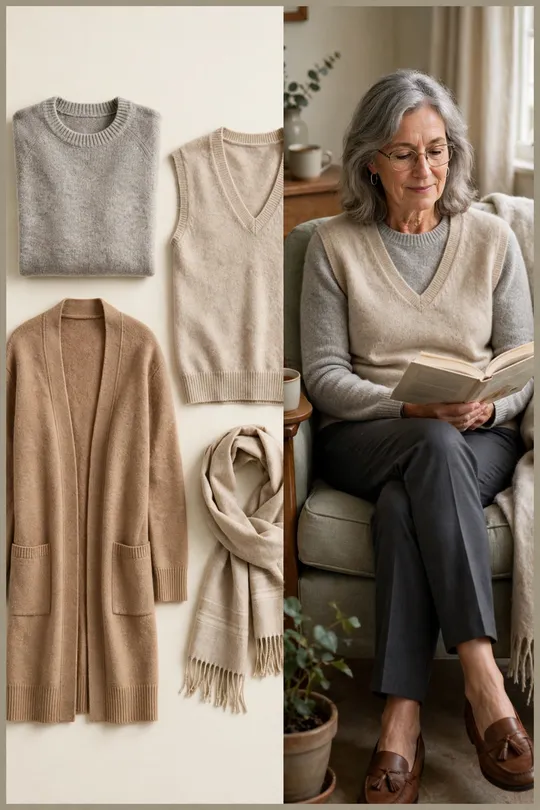
The middle layer is where most women go wrong, because this is where the bulk creeps in. One fine-gauge knit — merino, cashmere blend or a smooth viscose — traps warm air between itself and your base layer, and that trapped air is doing the warming, not the thickness of the wool.
Two chunky knits add about 4 cm of width at the waist; one fine knit plus a vest adds the same warmth with none of it.
Choose a fine knit in 12-gauge or finer, with a crew or V-neck that sits flat under a coat. A V-neck opens the face and gives a scarf somewhere to sit; a crew neck is warmer at the throat and simpler under a blazer.
Either way, the knit must be smooth, not fleecy — a fleecy surface catches on your base layer and bunches at the waist.
If one knit is not warm enough, add a vest, not a second sweater. A cashmere sweater vest over a long-sleeve base keeps your core warm and your arms completely free, and it is the smartest way to add warmth indoors without the bulk of a second sweater.
A longline open-front cardigan does the same job with a longer, leaner line.
Colour does quiet work in this layer too. A knit in the same colour family as your coat — camel on camel, navy on navy — removes the visual break between layers, which makes you look taller and slimmer with no extra effort at all.
The rule: one mid layer, not two. Two chunky knits add 4 cm of width at the waist; one fine knit plus a vest adds warmth with none of it.
⚠️ Common mistake: wearing a chunky fisherman knit under a fitted coat. The knit compresses, the coat pulls, and you spend the day tugging at both. Chunky knits belong under swing coats and open cardigans, never under anything tailored.
Step 3: Put Your Waist Back — Belt, Tuck or Half-Tuck

Layers hide the waist, and a hidden waist is what makes a layered outfit read bulky. The fix takes ten seconds: a belt, a tuck or a half-tuck puts the waistline back where the eye expects it, and the whole outfit suddenly has a shape again.
This is the step most layering guides skip, and it is the one that matters most after 50.
A belt works best over a knit or a coat. Choose a slim belt — 2 to 3 cm wide — at your natural waist, which is the narrowest point, usually 2 to 3 cm above the navel.
A wide belt over layers adds a second horizontal line and fights the coat; a slim belt marks the waist and disappears into the outfit.
A half-tuck is the fastest option of all: tuck just the front 8 cm of your knit into your trousers or jeans and leave the back loose. It marks the waist under a cardigan or an open coat, it takes five seconds, and it works with almost every knit except a very chunky one.
If the knit is chunky, skip the tuck and belt the coat instead.
If neither a belt nor a tuck suits the outfit, use a long pendant necklace or an open cardigan instead. Both create a vertical line down the centre of the body, which gives the eye a waist to find even when the waist itself is covered. The rule is simple: if the waist is hidden, something must mark it.
The rule: the waistband of your middle layer must sit within 2 cm of your natural waist, or the belt has nothing to hold.
💡 Tip: belt the coat, not the knit, when you are wearing three layers. A belt over the coat holds all three layers in place at once, and you can loosen it by one notch indoors without undoing the whole outfit.
Step 4: Choose the Outer Layer by the Room, Not the Weather
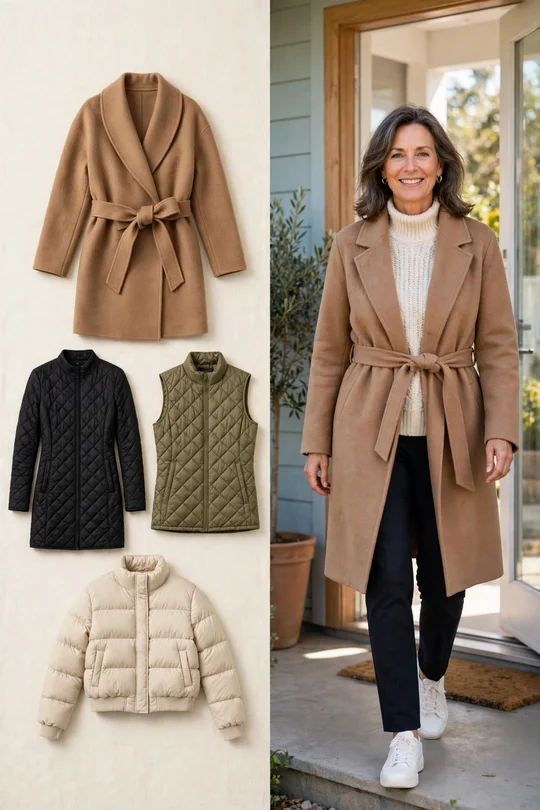
Most of us choose a coat for the street and then suffer in it for three hours indoors. Choose it for the room you are going into instead: a restaurant, a theatre and an overheated house all run at about 19 to 21°C, which is warm enough that a heavy coat becomes a burden the moment you sit down.
The outer layer should be the easiest layer to take off, not the hardest.
A belted wool wrap coat is the most versatile outer layer there is, because the belt defines the waist over all three layers underneath and camel is softer near the face than black.
Check that it closes over your knit and base with about 3 cm of ease — if it pulls, the coat is the wrong size, not your body.
For cold, dry days, a slim quilted coat with a stand collar is warm, neat and light, and the collar keeps wind off your neck without a scarf.
For active days, a hip-length quilted vest over your knit keeps your core warm with your arms free — and if you are only going from car to door, a cropped puffer over a fine knit is enough.
The test is the doorway test: put the coat on over all three layers, walk through a doorway, sit down in a chair, and take the coat off. If any of those four moves fights you, the coat is wrong for the day.
A good outer layer disappears the moment you are indoors, which is exactly what a heavy parka never does.
The rule: your coat must close over all three layers with 3 cm of ease. If it pulls, the coat is the wrong size, not your body.
⚠️ Watch out for: a coat shorter than your tunic or dress underneath. The hem sticking out cuts you in half and ruins the whole column — the coat must always be longer than the longest layer beneath it.
Step 5: Finish the Edges — Neck, Wrists and Ankles

Heat escapes through the gaps, and the gaps are always the same three: the neck, the wrists and the ankles. Cover those three and you gain the warmth of a whole extra layer with zero bulk added anywhere. This is the cheapest warmth in winter dressing, and it is the step that makes the other four work.
At the neck, a scarf is worth more than a second sweater. Loop a wool scarf once around the neck and let the ends fall inside the coat — it seals the gap between collar and chin where cold air pours in.
A turtleneck base layer does the same job with no scarf at all, which is the neater option under a blazer.
At the wrists, push your base-layer cuff out 2 to 3 cm past the knit sleeve. That deliberate slice of contrast reads as styling, not accident, and it seals the gap between sleeve and glove.
Lined leather gloves finish the job outside — choose a pair with a touchscreen fingertip so you never have to take them off to answer the phone.
At the ankles, the rule is simple: no skin showing between hem and boot. Opaque tights under a midi skirt, tall socks inside knee boots, or trousers hemmed to meet the boot — any of the three works, but a bare ankle in January costs you more warmth than a whole extra sweater gives you back.
The rule: cover the three gaps — neck, wrists, ankles — and you gain the warmth of a whole extra layer with zero bulk.
💡 Tip: keep a spare scarf and a pair of gloves by the front door. The edges are the layers you forget most often, and having them where you leave the house is worth more than owning a third coat.
How to layer clothes in winter over 50 without feeling bulky: 7 tips that work every day
- Start with the thinnest layer you own. If the base layer is thick, every layer on top of it is thicker.
- One mid layer, not two. A vest beats a second sweater every time — same warmth, half the width.
- Mark the waist every single day. Belt, half-tuck or open cardigan — never leave the waist to chance.
- Match the coat to the room. A coat you cannot take off indoors is the wrong coat for the day.
- Seal the three gaps. Neck, wrists, ankles — cover them and you gain a whole layer of warmth for free.
- Keep the colours close. One colour family head to toe removes every visual break and makes you look taller.
- Do the doorway test. Walk, sit, take the coat off — if any move fights you, change the coat, not the layers.
Your 5-minute winter layering routine, for the mornings when you cannot think:
- Base layer on first, tucked in, sleeves to the wrist bone.
- One fine knit on top, half-tucked at the front if it is long.
- Belt at the natural waist, or belt the coat instead.
- Coat on, doorway test, then scarf, gloves and boots last.
The bottom line
If I had to pick one change that fixes winter layering, it would be Step 1: start thin. A fine merino base layer costs less than one chunky sweater, and it is the single piece that makes every other layer work — warmth without bulk, a waist you can still see, and a coat that actually closes.
Pin this one to the board you check on cold mornings, so the five steps are there before the wardrobe wins the argument.
Frequently asked questions
How to layer clothes in winter over 50 without feeling bulky?
Use three thin layers in order: a fine merino or silk-blend base that disappears, one fine-gauge knit as the middle layer, and a structured outer layer that closes with 3 cm of ease. Mark your waist with a belt or a half-tuck, and seal the neck, wrists and ankles.
The bulk most women feel comes from two chunky mid layers, not from layering itself.
How many layers do I actually need in winter?
Three is enough for most winter days: base, middle and outer. Below freezing, add a vest between the middle and outer layers rather than a second sweater — a vest warms the core without adding width at the arms or waist.
If you are still cold in three layers plus a vest, the problem is usually a gap at the neck or ankles, not a missing layer.
What is the warmest thin base layer for women over 50?
Fine merino wool at 150 to 200 gsm is the warmest thin base layer for most women: it regulates temperature, wicks moisture and does not itch. Silk blend is thinner and better under fitted tops or if you run warm.
Avoid cotton as a base layer in winter — it holds sweat, goes cold against the skin, and adds bulk without adding warmth.