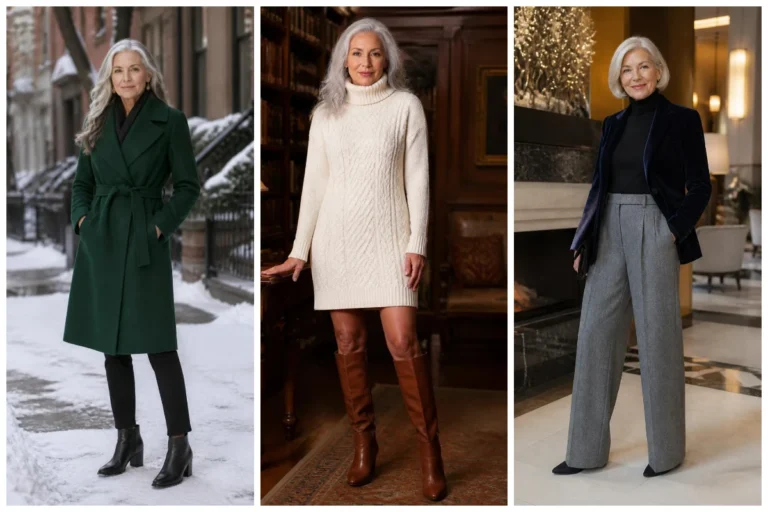
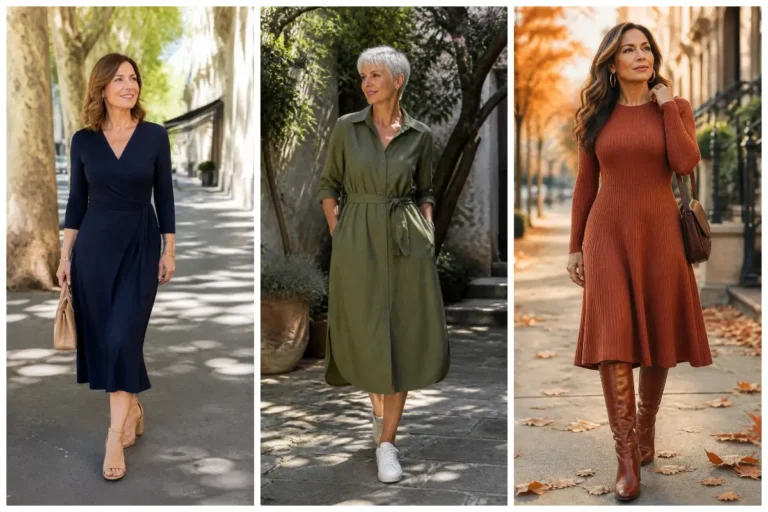
18 Winter Outfits for Women Over 50
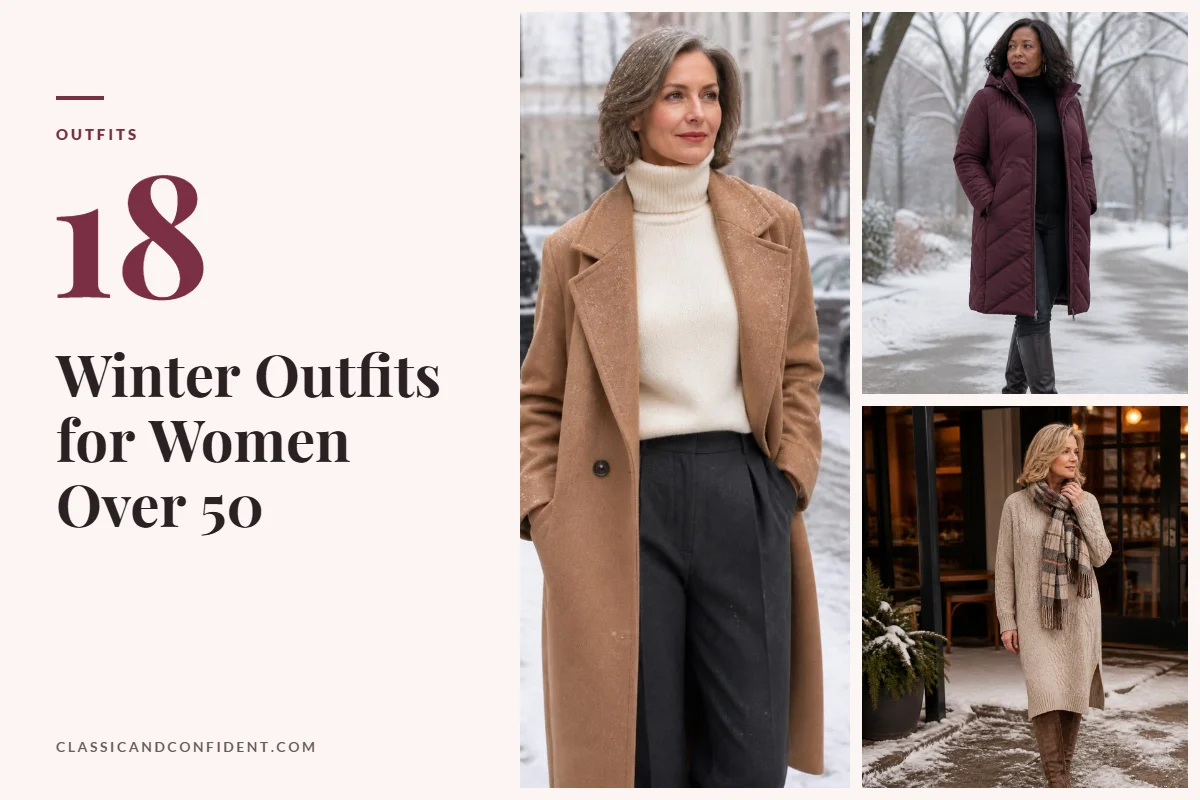
If you are searching for winter outfits for women over 50, you probably want two things at once: to be warm, and not to look like a walking duvet. I pulled together what really works, from fit to fabric to footwear, to find out how that is actually done. This is the guide that came out of it.
The short version is that warmth comes from the system, not from one heavy piece. A thin base, an insulating middle and a coat that fits well will beat a bulky sweater every time. As the colder months settle in this winter, the 18 outfits below show that system in practice: layers, coats, knits, trousers, dresses with tights, boots and the accessories that finish the job. Where a point touches health, I keep it general, and a doctor’s opinion always outranks mine.
How to choose winter outfits for women that really keep you warm
Outdoor-clothing guides describe a three-part system. A base layer sits against the skin and keeps it dry, a mid layer insulates, and an outer layer blocks wind and wet. Merino wool is a favorite base because it is soft, resists odor and stays warm even when damp, while cotton is best avoided in real cold because it holds moisture. Down offers the best warmth for its weight but performs poorly when wet, so a water-resistant shell or a synthetic fill suits damp climates.
For the look, build layers like a sandwich, with the heaviest piece on top and the lightest underneath, and double two thin layers instead of wearing one thick one. Sticking to one or two colors also gives a streamlined line. For coats, good fit starts at the shoulders. Petite frames do better with minimal details, a larger bust suits a belted coat, and a straighter figure can carry a shorter, more textured style.
If you feel colder than the people around you, it may not be about clothing. Anemia, low thyroid function and poor circulation are among the possible causes, so see a doctor if the chill seems out of proportion, comes with tingling or fatigue, or arrives suddenly. Sudden cold flashes are also common in perimenopause and menopause, when the body’s temperature control becomes less stable. For cold fingers and toes, layers, gloves and thick socks are a useful self-care start.
Layering systems that add warmth, not bulk
1. Thermal turtleneck, merino pullover and a wool coat
This is the three-layer formula in its simplest form. Start with a close-fitting thermal or stretch mock neck against your skin, add a fine merino or lambswool pullover, then finish with a wool coat that has room across the shoulders. Thin layers trap warm air without adding volume, and a high neck closes the gap at your throat where cold air sneaks in. Outdoor guides describe the same order: a dry base, an insulating middle, a protective shell.
Best for: Daily errands and cold commutes
2. Cashmere sweater vest over a long-sleeve base
A knit vest warms your core, which matters most, and leaves your arms free in a fitted long-sleeve top. A cashmere vest is a good pick for exactly this reason: warmth across the torso without extra bulk in the sleeves. Choose a fine-gauge knit that skims rather than clings, and slip it under a jacket or tweed blazer when the day starts cold and warms by afternoon.
How to wear it: Pick a base with snug cuffs at the wrist, and let the vest hem land at the hip so it sits neatly under a hip-length jacket.
Best for: Days that swing between indoors and outdoors
3. Puffer vest over a turtleneck and straight jeans
A lightweight quilted or puffer vest adds core warmth and keeps your arms mobile, which is handy for driving, carrying shopping or reaching into a bag. Wear it over a fine turtleneck and straight-leg jeans. Look for a vest that ends at the hip with a slightly shaped waist rather than a boxy cut. In mild cold it can be your outer layer, and on freezing days it slips under a longer coat as an extra mid layer.
Best for: Crisp days in the 40s and 50s
4. Belted chunky knit over a silk-blend base
A thick cable or rib sweater can swallow a frame, so cinch it. A slim belt at your natural waist defines your shape and keeps the layers snug against you, which helps them hold warmth. Underneath, a thin silk-blend or thermal top in a neutral adds heat without a visible line. Balance one roomy piece with fitted ones, so here the sweater is generous and the trousers are slim.
Best for: Women who feel swamped by chunky knits
Coats for every figure and every degree
5. Belted wool wrap coat in camel
A wrap coat has no buttons to fuss with and cinches at the waist, so it shapes whatever you wear beneath it. Wool holds heat well, and camel, charcoal or navy keep the look classic. Belted styles flatter a fuller bust by adding definition, and good fit starts at the shoulders. Check you can move your arms with a sweater on before you commit.
How to wear it: Tie the belt loosely at the waist, not tight, so there is room for a chunky knit underneath.
Best for: Office days, dinners and church
6. Slim quilted coat with a stand collar
A coat with a small quilted pattern gives strong warmth with a sleeker line than a big puffer. The stitching divides the fill into narrow channels, so the coat skims your body instead of ballooning. Aim for a knee-skimming length if you want your legs covered, and a stand collar that closes at the throat. Vertical quilting lines also tend to read taller.
Best for: Cold, damp days with lots of walking
7. Hip-length puffer with a shaped waist
For serious cold, a puffer is hard to beat for warmth per ounce. The trick is shape: choose one with a tapered waist or elastic hem. Textured puffers with elastic hems can add curves on a straighter figure, while petite women should skip big collars that overwhelm a small frame. Down is warmest when dry, so look for a water-resistant outer fabric if you live somewhere wet.
How to wear it: Pair it with fitted trousers so all the volume stays on top and your lower half looks lean.
Best for: Snow, wind and long time outdoors
8. Long swing coat for hips and layers
A swing coat suits a pear shape because it fits through the shoulders and sleeves, then flares to leave room over the hips. It is also a smart pick if you love layering, since the flare moves over a thick sweater without pulling. A wool or wool-blend cloth gives structure. Make sure the hem lands at or below the knee so the swing looks intentional rather than cape-like.
Best for: Pear shapes and big-knit lovers
Knits, trousers, dresses and skirts
9. Tonal knit with a matching scarf
Match your scarf to your jumper in one shade, which makes layers look streamlined instead of chunky. Try oatmeal on oatmeal or deep green on deep green, with a slightly different texture in each so the outfit does not look flat. The unbroken line also flatters under a coat, because the colors do not chop your torso into sections.
How to wear it: Choose a wool-blend scarf long enough to loop once and tuck inside the coat so nothing dangles.
Best for: Anyone wanting a calm, pulled-together look
10. Wide-leg wool trousers with a fine turtleneck
High-rise wide-leg trousers in wool are warmer than jeans and drape rather than cling, which is kinder when you have thermals underneath. Wool, tweed and velvet are good fabrics for wide-leg styles. Choose a hem that skims the top of your shoe so it does not drag through slush, and balance the volume with a fitted turtleneck, tucked or half-tucked.
Best for: Dressier days under a long coat
11. Ponte trousers, tunic sweater and long cardigan
Ponte is a dense stretch knit that is warmer than most trouser fabrics and moves like leggings, so you can sit through a long lunch comfortably. Pair straight-leg ponte pants with a hip-length tunic sweater and a long open cardigan to make a column of color. The vertical line lengthens you, and the cardigan is an insulating layer you can remove once you are indoors.
Best for: All-day comfort without looking casual
12. Wide-leg jeans over opaque tights
Wear opaque tights under wide-leg jeans and relaxed pants for extra warmth. It is an invisible layer, since the hem covers everything, and it is a softer option than thermal leggings. Choose dark denim with a high rise so there is no gap at the waist when you sit, and add a fine knit, tucked or half-tucked.
How to wear it: Match your tights to your boots, and size up slightly in the jean so there is room over the tights.
Best for: Weekend errands and cold legs
13. Midi sweater dress, opaque tights and tall boots
A knit midi dress is a one-piece outfit with built-in warmth. Pair midi dresses with tall boots so no bare leg shows, and choose a high neck and snug sleeves to close other gaps. Look for a rib or fine cable knit with some stretch and a hem just below the knee, where the boot shaft can meet or overlap it.
Best for: Lunches, church and family dinners
14. Wool midi skirt with knee-high boots
Knee-length boots with a midi skirt cover your legs without tights, because the boots and hemline leave no skin exposed. Pick a wool or heavy knit skirt that falls to mid-calf and a boot that reaches just under the knee so the two overlap. It is a good route if tights feel constricting. Add a thermal turtleneck and a hip-length jacket.
Best for: Women who dislike tights
Boots and accessories that finish the job
15. Waterproof boots with a rubber lug sole
Warm feet start at the sole. Look for boots with slip-resistant rubber soles, a tread that grips, a low and broad heel and good ankle support. Deep grooves, much like a snow tire, tend to help on ice, and insulated waterproof boots keep feet dry. Choose wool or synthetic socks rather than cotton, and leave a little room so your toes can move.
How to wear it: Try them on with the thickest socks you plan to wear, and break them in before the first snowfall.
Best for: Snow, ice and school drop-offs
16. Higher-shaft Chelsea boots with crew socks
Choose tall boots or higher-shaft Chelsea boots when you want more of your leg covered, and add knee-high or crew socks to fill the gap between hem and boot. A Chelsea pulls on without laces, which helps if bending is tiring, and the elastic sides keep the ankle snug. Check for a grippy rubber sole with visible tread and a low, broad heel.
How to wear it: Wear them with cropped or straight trousers and let a ribbed crew sock show at the ankle.
Best for: Everyday wear in cold but not icy weather
17. Soft hat, liner gloves and a neck gaiter
Try a microfleece hat with ear flaps, thin touchscreen liner gloves under thicker gloves or mittens, and a neck gaiter in place of a loose scarf that can trip you or catch in a car door. Long scarves are best avoided on icy days. Together these three pieces cover the places you lose warmth fastest while keeping your hands free.
How to wear it: A wool beret or a knit hat in your coat color feels more polished than a sports cap and still covers the ears.
Best for: Windy walks and waiting at bus stops
18. Belted coat and a bright scarf
Cinching a belt over your coat streamlines the outfit and snugs layers together so they trap more warmth. A bright scarf can also lift a plain winter coat. Combine the two on a gray day: a neutral coat, a slim belt and one confident color near your face.
How to wear it: Pick a scarf shade that echoes your lipstick or earrings so it looks planned.
Best for: Dull winter days that need a lift
Good to know
Falls are a leading cause of injury death for adults 65 and older, and they are not an inevitable part of aging. On icy days, take shorter steps, use a wider stance and carry a backpack or cross-body bag so your hands stay free. If you have a health condition that affects balance or circulation, ask your own clinician for advice.
Small details that make winter outfits work harder
Color is the cheapest upgrade there is. Brighter knitwear pulls a wardrobe out of gray and black, and a monochrome approach, with several shades of one family such as brown, beige and camel, lengthens the line. If you wear a lot of black, add one color near your face rather than replacing everything.
When you shop, try pieces on with the layers you will really wear. Size up for length, a larger bust or wider hips, but not if you are petite or straighter in shape, where an oversized coat can swamp you.
Frequently asked questions
Winter dressing after 50 is mostly a matter of order and fit: the right thin layers, one coat you love and boots you trust on slippery pavement. Pick two or three outfits from this list and wear them on repeat for a week.