How to Wear Anything After 50: The Fit, Proportion and Polish Guide
Ask any group of stylists what separates the best-dressed women over 50 from everyone else and you will hear the same answer, every time: it is not the budget, the labels or the trends. It is fit, proportion and polish — and the good news is that all three are skills, not gifts. If you have been wondering how to dress well over 50 without starting your wardrobe from scratch, this is where the answer lives.
This guide gives you 8 rules in a step-by-step order you can run through in your own bedroom in about five minutes. Each rule fixes one specific problem: clothes that no longer fit the way they used to, outfits that feel unbalanced, looks that stop just short of finished. No new wardrobe is required — only better decisions about the clothes you already own.
The quick five
- The two-finger fit check (#1) — the single test that catches 80 per cent of fit problems
- The one-third rule (#3) — the proportion trick every stylist uses
- The finishing layer (#5) — the 10-second addition that makes an outfit look deliberate
- Shoes and the finishing five minutes (#7) — where most outfits actually fail
- The doorway edit (#8) — the last look that saves you every time
Contents
How to choose what to fix first
Start with fit, never with trends. The biggest upgrade behind every well-dressed woman over 50 is clothes that actually fit — shoulder seams on the bone, trousers the right length. Get this right and a good finishing layer, like a well-cut trench, does half the work for you — our guide to how to wear a trench coat over 50 shows which length and cut work hardest.
Proportion is a decision, not a body type. Proportion dressing over 50 is not about hiding anything; it is about deciding where the eye goes. Where a top ends and where a trouser breaks are small choices that create the balance off-the-rack rarely gives you.
Colour confidence starts near your face. The fastest test of any colour is holding it to your chin in daylight. A crisp white or ivory top is the simplest way to learn what contrast does for you — see our guide on how to wear white over 50.
One-piece outfits demand the most from fit. Dresses and jumpsuits cannot hide a poor fit the way separates can, which makes them the best diagnostic in your wardrobe — and the most rewarding once the fit is right, as our jumpsuit guide proves.
The 8 rules at a glance
| Rule | The 30-second check | Time it costs | Best for |
|---|---|---|---|
| 1. The two-finger fit check | Shoulder seams on the bone; waistband takes two fingers | 5 minutes | Every outfit, every day |
| 2. Tailor, don’t just buy | Three alterations cheaper than a new top | One trip | Wardrobes full of “almost right” |
| 3. The one-third rule | Top a third, bottoms two thirds | 30 seconds | Outfits that feel unbalanced |
| 4. One loose, one fitted | Only one relaxed piece per outfit | None | Relaxed dressing without shapelessness |
| 5. The finishing layer | Add a third piece before you leave | 10 seconds | Looks that feel “fine but not finished” |
| 6. Colour that frames your face | Hold colour to your chin in daylight | 1 minute | Wash-out colours and safe black |
| 7. Shoes and the finishing five minutes | Shoes match the outfit’s intention | 5 minutes | Outfits that photograph badly |
| 8. The doorway edit | Remove one thing at the front door | 1 minute | Days you feel overdressed |
When nothing seems to fit like it used to
Bodies change after 50 — that is a fact, not a complaint. What ruins outfits is clothes bought for the body you had ten years ago. These two rules fix that without replacing a thing. (In a one-piece the fit has nowhere to hide, which is why our jumpsuit guide spends so long on it — and silk exposes every pull, as our silk guide shows.)
1. The two-finger fit check

Fit reads as polish for one simple reason: when a garment meets the body where the body expects it — shoulder seam on the shoulder bone, waistband at the waist — the eye sees intention instead of accident. Lay two fingers flat under the shoulder seam: snug means the shoulder sits right; if four fingers slide in, the piece is a size too big, whatever the label says. Run the same test at the waistband — two fingers flat means comfort with shape, a whole fist means slipping and sagging by lunchtime. Sleeves should end at the wrist bone; trouser hems should just graze the shoe, with no more than 2 cm of pooling at the ankle.
- The check: shoulder seams on the bone, two fingers at the waistband, sleeves at the wrist bone
- Key number: no more than 2 cm of trouser pooling at the ankle
- Time: 5 minutes, in front of a full-length mirror
Shop for: a soft fabric measuring tape, 150 cm — it lives with your everyday things now, not in a sewing box.
How to run the check:
- Stand straight, arms relaxed. Slide two fingers flat under each shoulder seam — snug means right, four fingers means too big.
- Press two fingers flat against your side at the waistband. Two fingers means the garment holds its shape all day.
- Check sleeves and hems last. Anything that fails goes into a “to tailor” pile, not back on the hanger as-is.
Skip it if … the garment is meant to be oversized — then it should look generous everywhere, not tight in one spot and loose in another.
Best for: the morning “does this actually work?” decision.
2. Tailor, don’t just buy
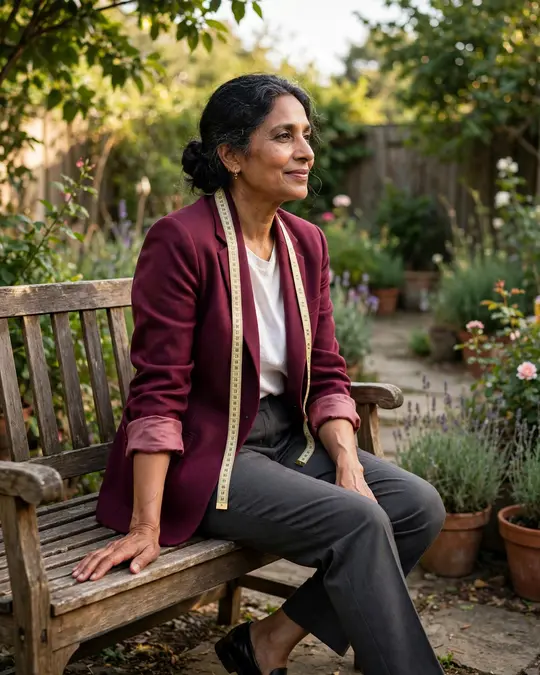
Taking a waist in by 3 cm costs less than a new top and makes ten outfits wearable again. A tailor cuts the garment to the body that is actually in it — which is why tailored “old” clothes consistently look more expensive than new ones that almost fit. For anyone learning how to dress well over 50, this is the cheapest upgrade available. Three alterations are worth paying for every time: taking in a trouser or skirt waist (stops all-day hiking-up), shortening a hem (lengthens the leg) and shortening sleeves (restores arm length). Reserve shoulder-narrowing for weekly favourites only — it is the priciest job.
- Worth it: waist take-in, hem shortening, sleeve shortening
- Turnaround: most simple jobs take 3–7 days
- Pin it first: wear the garment inside out at home and pin where it should sit
Shop for: 20 safety pins and a stick of tailor’s chalk — pin the fix at home before you pay anyone to make it.
How to get it right:
- Wear the garment inside out, pinch the excess at the mirror and pin where it should sit — this is the exact language a tailor works from.
- Choose the tailor with a test job: one simple hem first. Even, on time and at the quoted price means you have found your person.
- State measurements out loud: “take the waist in 3 centimetres,” not “a bit tighter.” Numbers get remembered; “a bit” gets guessed.
- Collect wearing the shoes you will actually wear with it — a hem that looks right standing still can ride up when you walk.
Skip it if … the fabric is cheap or worn thin — tailoring cannot rescue material that has given up.
Best for: the “almost right” pile — trousers that gap, jackets whose sleeves swallow your hands.
When your proportions feel off
Nothing is wrong with your body when an outfit feels unbalanced — the outfit is asking the eye to look in two places at once. Proportion is the management of where a garment starts and stops. (Relaxed fabrics change how proportion reads — our linen guide treats drape and line carefully — and print scale works exactly like proportion, as our polka dots guide shows.)
3. The one-third rule

The eye reads balance in thirds — this is the mechanism behind every “she always looks put together” compliment. When your top covers roughly one third of your visible length and your bottoms take two thirds, the silhouette looks longer and more deliberate. When a top covers half and trousers cover half, the body reads cut in two, which is why an untucked long tunic with cropped trousers so often feels “off” without anyone knowing why.
- The ratio: top one third, bottoms two thirds — measured by eye in the mirror
- The tool: a front tuck or a 3 cm-wide belt marks where the top ends
Shop for: a 3 cm-wide belt in dark brown — the clean line marking where your top ends and trousers begin.
How to style it:
- Look at the whole length in the mirror, not just the top half. If the top covers half, it needs tucking, belting or shortening.
- Do the front tuck — 8–10 cm of the top’s front pulled into the waistband. The fastest way to claim the waist.
Skip it if … you are wearing a deliberate column — a long dress or tunic over slim trousers — where one unbroken line is the point.
Best for: separates outfits that feel unbalanced for no clear reason.
4. One loose, one fitted

Shapelessness has a precise cause: when every piece is relaxed, the eye finds no reference point and the silhouette blurs. The mechanism is contrast — one relaxed piece against one closer-cut piece gives the eye an anchor, and the outfit reads as a choice. A flowing blouse over slim trousers looks elegant; the same blouse over wide trousers reads as a tent. Style rules women over 50 often come down to this single discipline: choose your one loose piece on purpose.
- The rule: exactly one relaxed piece per outfit — never two
- Fitted means: closer to the body, not tight — slim, straight or gently shaped
- Quick test: if you cannot tell where your waist is, both pieces are loose
Shop for: one pair of straight-leg trousers in dark navy — the anchor for every loose top you own.
How to style it:
- Name the loose piece out loud — “the blouse is the loose one.” If you name two, something has to change.
- Swap the second-loosest piece for its closer-cut equivalent: wide trousers become straight-leg.
- Check the side view, not just the front — volume hides at the sides and back.
- If it still feels shapeless, the loose piece is too loose — size down in that one item only.
Skip it if … you are going deliberately oversized — exaggerated proportions are a style; half-hearted ones are a mistake.
Best for: relaxed, comfortable dressing that still looks intentional.
Good to know
The mirror lies to people who know their angles — you stand the way you always stand. Take a phone photo of the full outfit from 2 metres away and look at it small. A photo shows what a stranger sees in the first three seconds, which is exactly what proportion rules are for.
When the outfit looks fine but unfinished
You know this feeling: the clothes are right, the fit is right, and yet the whole thing looks like you got dressed in a hurry. What is missing is almost always a finishing layer or considered colour. (The classic finishing layer is a great coat — our trench coat guide covers the length and cut that work hardest — and colour confidence begins with the simplest shade of all, in our white guide.)
5. The finishing layer

Two pieces look like getting dressed; three pieces look like an outfit. The mechanism is simple: a third layer — jacket, cardigan, scarf — adds a visible decision, and visible decisions read as polish. It also creates vertical lines that lengthen the silhouette and gives you something to add or remove as the temperature changes, which is half of real-world elegance.
- The rule: three visible pieces minimum before you leave the house
- Best third pieces: unlined trench, open blazer, long cardigan
- Length: end at mid-thigh or the hip — never at the widest point you want to minimise
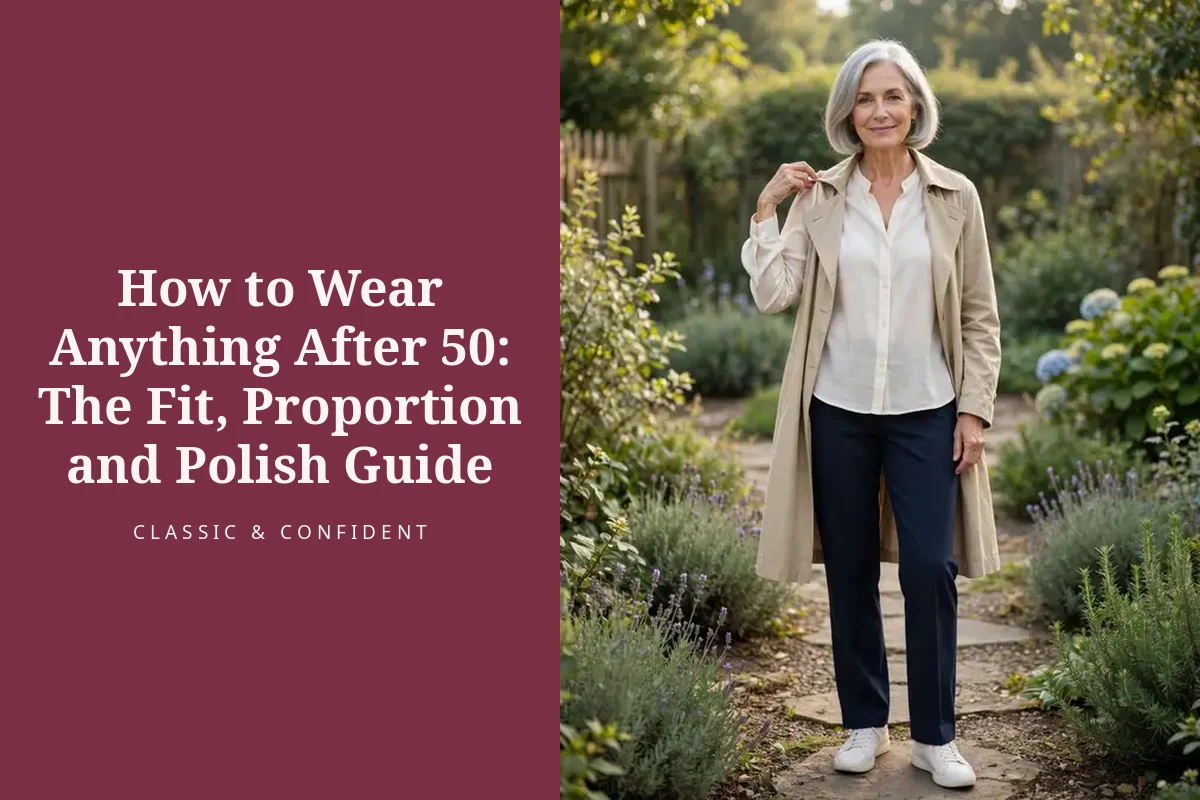
Shop for: an unlined trench in beige cotton gabardine, ending at mid-thigh — the third piece that works over dresses, trousers and jeans.
How to style it:
- Dress in your two base pieces, then ask “what is the third piece?” Put it on before anything else — polish is planned, not found.
- Check where the layer ends. If it cuts across the widest part of hip or thigh, swap for a shorter or longer one.
Skip it if … the weather genuinely forbids it — on the hottest days, the third piece becomes jewellery or a great bag.
Best for: simple outfits that feel flat, and days you want to look considered without dressing up.
6. Colour that frames your face

People look at your face first, so colour near the face does more work than colour anywhere else. A clear, lively colour against the skin reflects light upward and sharpens the features; a washed-out tone near the chin does the opposite, no matter how good the cut is. Colour is the quiet half of how to dress well over 50 — and the practical test takes one minute. Hold the garment to your chin facing a window: brighter eyes and even-looking skin means it is your colour; a tired, greyish face means the colour is wearing you.
- The test: hold the colour to your chin in daylight — brighter eyes means yes
- Safe strong colours: ivory, cobalt, berry, clear teal — clear beats muddy after 50
- The fix for “wrong” colours: wear them below the waist; keep your best colours at the neckline
Shop for: one top in a clear colour that suits you — ivory, cobalt or berry — in cotton poplin or silk.
How to style it:
- Hold your three most-worn tops to your chin in daylight, one by one. Sort them into “lifts me” and “drains me” — be ruthless.
- Move every “drains me” top to below-the-waist duty or out of the wardrobe. New purchases start with neckline colours.
- Love black but it drains you? Wear it with a clear-coloured scarf or necklace at the neckline — you keep the black, the colour does the framing.
Skip it if … you feel best in head-to-toe neutrals — then get the polish from texture and the third piece instead.
Best for: mornings when your face needs the clothes to do some of the work.
When the details let you down
The outfit can be perfect and still fail at the extremities: shoes that argue with the clothes, accessories chosen in a rush. Details decide polish, because they are what people notice up close. (Pearls are the classic detail that elevates everything — our guide to how to wear pearls over 50 keeps them modern — and a confident print like leopard is a detail with opinions, covered in our leopard print guide.)
7. Shoes and the finishing five minutes

Shoes carry more visual weight than anything except the face, because the eye travels the full length of the body and stops at the feet. The mechanism behind most “something is wrong” outfits is a shoe telling a different story from the clothes: delicate dress with heavy boots, tailored trousers with worn trainers. When the shoe matches the outfit’s intention, the whole look snaps into focus.
- The question: “would I wear these shoes to the occasion I’m dressed for?”
- Heel height: under 5 cm for all-day polish
- Colour rule: shoes close to skin tone or trouser colour lengthen the leg
Shop for: court shoes in a low-contrast shade — nude for you, or dark brown — heel under 5 cm, rounded or almond toe.
How to style it:
- Dress fully, then look down. Name the occasion your shoes belong to — if it is not today’s, change the shoes first.
- Check them in the full-length mirror from 2 metres back. If they chop your leg in half, swap to a shade closer to your trousers or skin.
Skip it if … you are walking all day on uneven ground — then the right shoe is the comfortable one, and the outfit adjusts around it.
Best for: outfits that look right in the mirror but wrong in photos.
8. The doorway edit

Every outfit benefits from one final subtraction. The mechanism is simple: a fresh glance after stepping away resets your eyes, and the thing that is one accessory too many suddenly becomes obvious. It is the difference between “well dressed” and “trying too hard” — which, after 50, is the whole game. At the front door, remove one thing: the necklace, scarf or bracelet you added last is usually the extra one. What remains looks intentional because it was chosen twice — once when you put it on, once when you decided it could stay.
- The rule: remove one accessory at the front door
- The candidate: the last thing you added is usually the extra one
- The requirement: a full-length mirror near the door
Shop for: a full-length mirror for your hallway — the doorway edit only works if you can see yourself at the door.
How to style it:
- Finish getting ready, then leave the bedroom for five minutes — you need genuinely fresh eyes.
- Stop at the hall mirror on your way out and look once, quickly. The first thing that feels like “a bit much” comes off.
- Look again. If the outfit holds together without it, leave the house — the edit is done.
Skip it if … you are already at three pieces and minimal jewellery — the edit is for busy outfits, not existing restraint.
Best for: days you feel overdressed but cannot say why.
Everyday polish tips: how to dress well over 50 on autopilot
The 8 rules are the system; these are the habits that keep it running without thinking. None costs money, and all of them compound.
- Steam, don’t iron, knits. Three minutes with a handheld steamer keeps knitwear from going shiny at the elbows.
- Keep one hanger rule. Jackets and coats on shaped hangers, never wire — shoulder bumps undo the two-finger check overnight.
- Match your metals. Gold with gold, silver with silver — matched metals read as deliberate after 50.
- Rotate, don’t repeat. The rules above make more of your clothes wearable, so the “safe” outfit stops carrying three days a week.
- Check the back. It is the view strangers see most — glance over your shoulder before you leave.
- Keep a doorway kit. Lint roller, the belt you always forget and your good earrings by the front door fix 90 per cent of last-minute problems.
The five-minute doorway routine:
- Run the two-finger fit check on shoulders and waistband (1 minute).
- Confirm the one-third proportion — front-tuck if needed (1 minute).
- Add the third piece and check the shoes match the occasion (1 minute).
- Hold your top’s colour to your chin in daylight (30 seconds).
- Step away, then do the doorway edit at the hall mirror (1 minute).
The bottom line
If I had to pick the one that matters most, it is #1 — the two-finger fit check. Everything else in this guide decorates fit: the thirds, the third piece, the colour, the edit. Get the fit right and an ordinary outfit looks considered; get it wrong and no accessory saves it. Run the check tomorrow morning. Five minutes, no cost, the fastest upgrade here.
Pin this guide to your style board as your pre-shopping checklist — run the 8 rules on anything new before it comes home, and your wardrobe will work twice as hard.
Frequently asked questions
What is the most important rule for how to dress well over 50?
Fit, without question. Clothes that meet your body where it expects them read as polish regardless of price. Run the two-finger fit check every morning — it catches the problems that make outfits look accidental.
How do I know if my clothes fit properly after 50?
Two fingers flat under the shoulder seam means it sits right; four fingers means too big. At the waistband, two fingers means comfort with shape — a whole fist means slipping and sagging by lunchtime. Sleeves end at the wrist bone; trousers just graze the shoe.
What is the one-third rule in dressing?
Your top covers roughly one third of your visible length while your bottoms take two thirds — a balance that reads as longer and more deliberate. The fastest route is a front tuck: 8–10 cm of the top’s front pulled into the waistband.
Do I really need to spend money on tailoring?
Not on everything — but for a wardrobe of “almost right” clothes, tailoring is the cheapest upgrade there is. Worth paying for: waist take-ins, hem and sleeve shortening. If the fabric is cheap or worn thin, skip it; tailoring cannot rescue material that has given up.
What colours should women over 50 wear near the face?
Clear, lively colours — ivory, cobalt, berry, clear teal — reflect light upward and sharpen the features. Hold any colour to your chin in daylight: brighter eyes means yes. If black drains you, keep it and add a clear-coloured scarf at the neckline.
Can I still wear relaxed, comfortable clothes after 50?
Yes — the rule is “one loose, one fitted,” not “nothing loose.” A flowing blouse over slim trousers looks elegant; two relaxed pieces together look shapeless. Comfort dressing works perfectly as long as exactly one piece per outfit is the relaxed one.
How can I look polished without dressing up?
Add the third piece. Two pieces look like getting dressed; three — a jacket, cardigan or open overshirt — look like an outfit, because they show a visible decision. On hot days, the third piece becomes jewellery or a good bag. Polish is intention, not formality.
What is the fastest morning routine for looking put-together?
The five-minute doorway routine: fit check (1 minute), one-third proportion (1 minute), third piece and shoes (1 minute), colour-to-chin test (30 seconds), then the doorway edit at the hall mirror (1 minute). Five minutes, every rule that matters.