How to Wear White After 50 Without Any of the Usual Worries

The invitation lands in your inbox — a garden wedding in July, a niece’s christening, a cruise with two “white nights” on the itinerary — and your eye lands on white.
Then the worries start queuing up: will it be see-through, will I stain it by noon, will it wash me out, and (the big one) will someone think I’m trying to upstage the bride?
Learning how to wear white over 50 is really a three-step method: choose the right white, pick a forgiving fabric, and check three worry points before you leave the house.
Below are 8 white looks that work on real bodies after 50, grouped by the life you actually wear them in: everyday ease, out-and-about days, and the special occasions that caused the worry in the first place. Each comes with the fabric specs that make white behave, the exact fit rules, and a blunt line on who should skip it.
The quick five
- Everyday errands that still look pulled together → the white jean anchor (#1)
- The tee that doesn’t go see-through → the heavyweight white tee (#2)
- One piece, zero decisions → the white shirtdress (#3)
- Hot evenings when you want to look taller → the all-white column (#6)
- White that works all winter → winter white knits (#8)
Contents
How to wear white over 50: how to choose the right pieces
Pick your white, not just white. Pure optic white reflects the most light and is the hardest to wear against paler skin; off-white, ivory and ecru reflect about 15–20% less and sit far more flatteringly. Hold the garment against your face in daylight — if your skin looks washed out, the white is too bright for you.
Good dressing well after 50 always starts with colour that agrees with your face, and white is no exception.
Buy fabric weight, not just the look. Thin white fabric is the source of nearly every white disaster — opacity lives in density. For tops, look for 180–220 gsm (grams per square metre) cotton; for trousers, a cotton twill around 240–280 gsm.
The retail tag rarely lists gsm, so use the light test: hold the fabric up to a window. If you can clearly see the outline of your hand, walk away.
Plan the layer that saves you. A third piece — a blazer, a cardigan, a trench coat styled the Parisian way — does double duty in white outfits: it breaks up a large pale expanse and gives you somewhere to hide the small mark you’ll notice at 3 pm.
White worn as a column of one piece always looks more intentional than white worn as one lonely item.
Anchor white with texture or print. Head-to-toe flat white can read blank; a woven straw bag, tan sandals, a tortoise-shell belt or a leopard-print scarf tied on a handbag gives the eye somewhere to land. Keep the anchor neutral and the white stays the star.
Know the wedding rule cold. Guests do not wear pure white to a wedding — the bride’s colour, full stop. But ivory, champagne, ecru or a white ground with a visible print are all perfectly polite.
When in doubt, ask the bride; the question takes 30 seconds and removes the only real white-wearing anxiety.
At a glance
| Look | Why it works | Fabric to buy | Best for |
|---|---|---|---|
| 1. White jean anchor | Off-white denim softens the light; straight leg balances hips | Off-white denim, 2% elastane, 9–10 in rise | Everyday, travel days |
| 2. Heavyweight white tee | 180+ gsm cotton ends see-through at the source | 220 gsm cotton tee, ribbed neckline | Weekends, layered looks |
| 3. White shirtdress | Vertical button line lengthens; belt defines the waist | Crisp cotton or cotton-poplin shirtdress | Daytime events, holidays |
| 4. White blazer outfit | Structure at the shoulder reads polished, hides marks | Tailored blazer in twill or crepe | Work, dinners, evenings |
| 5. White midi skirt | A-line shape skims the midsection; hem below the knee | White cotton sateen or eyelet midi | Lunches, church, spring days |
| 6. All-white column | Tonal whites stack into one long line — adds inches | Mixed whites: ivory + cream + soft white | Hot evenings, occasions |
| 7. Wedding-guest white | Ivory and prints honour the occasion, not the bride’s dress | Ivory, champagne or white-print dress | Weddings as a guest |
| 8. Winter white knits | Cream wool looks richer in low light; hides everything | Cream or ivory wool/cashmere knit | Winter days, evenings |
Everyday ease
Three white outfits for older women that handle school runs, grocery aisles and coffee with friends without a single moment of worry — each one built on fabric that does the heavy lifting for you.
1. The White Jean Anchor

This is the white outfit most women over 50 actually live in, and the reason it works is the shade: off-white denim (sometimes called ecru or vintage white) reflects noticeably less light than optic white, so it flatters real skin instead of competing with it.
Add 2% elastane and the denim skims the thigh instead of clinging, while a straight leg with a 9–10 inch mid-rise balances hips without cutting you in half at the waistband.
Wear them like this: off-white straight-leg jeans, a navy or chambray knit top, tan leather flats. The darker top keeps the eye moving vertically, and the tan shoes stop the outfit reading “uniform.” This is the foundation white piece — if you own one white thing, make it these.
- Denim spec: off-white/ecru, 98% cotton with 2% elastane, mid-rise 9–10 inches
- Leg: straight (not skinny, not wide) — hem to kiss the ankle bone
- Price: good ones run $60–$120; hemming $15–$20 if needed
- Care: wash inside out in cold water, skip the bleach — it yellows denim
Shop for: straight-leg jeans in off-white or ecru denim with 1–2% elastane, a mid-rise around 9–10 inches, and no whiskering at the hips (fading at the thigh draws the eye exactly where you don’t want it).
How to style it:
- Pick a top in a mid-tone — navy, chambray, sage — tucked in at the front only, so the waistband shows and the eye reads one long leg line.
- Add tan or cognac shoes and a bag; the warm leather stops white denim looking stark and anchors the outfit for daytime.
- Cuff the hem once (about 2 inches) to show the ankle — it shortens the visible white and keeps the leg from looking cut off.
Skip it if you do a lot of kneeling or garden work in your clothes — denim at the knee will tell that story by Friday. Keep these for town days.
Best for: everyday errands, travel days, lunch with friends — the white outfit with the lowest worry of all.
2. The Heavyweight White Tee

Ninety percent of white-tee complaints — see-through fabric, clinging to the midsection, neckline that gapes by noon — are really one complaint: the tee is too thin. A heavyweight cotton tee (180–220 gsm, sometimes labelled “heavyweight” or “boxy”) holds its shape away from the body instead of vacuum-sealing to it, and the denser knit is simply opaque.
The mechanism is structural: thicker yarn plus a tighter knit leaves fewer gaps for light, and the fabric’s own weight pulls it straight down instead of rippling.
Fit matters as much as fabric. Choose a neckline that sits at or just above the collarbone (a ribbed crew or modest scoop — no gaping V), and a cut that skims rather than hugs: you should be able to pinch an inch of fabric at the side seam.
A bra that matches your skin tone, not white, disappears under the tee; white bras show as grey shadows through white fabric.
- Fabric spec: 100% cotton, 180–220 gsm, labelled heavyweight
- Neckline: ribbed crew or modest scoop; no gaping, no clinging V
- Length: long enough to cover the waistband — around 26–28 inches on average
- Price: $25–$45 for a good heavyweight tee; worth it over a 3-pack
Shop for: a heavyweight white cotton tee (check the tag for “heavyweight” or 180+ gsm), with a ribbed neckline that springs back when you stretch it and a body that falls straight from the bust without pulling.
How to style it:
- Half-tuck the front into jeans or chinos — it defines the waist without the formality of a full tuck.
- Layer an open overshirt, denim jacket or cardigan over it; the third piece turns “just a tee” into an outfit and covers the midsection in motion.
- Add one warm accessory — tortoise-shell earrings, a tan belt — so the white has a frame.
- Check the back view in daylight before you leave; thin tees betray most from behind.
Skip it if the tee is tissue-thin or the neckline has already gone wavy — a tired white tee drags everything down with it. White tees are a replaceable staple: retire them the season the collar sags.
Best for: weekends, casual Fridays, as the base layer under everything from blazers to cardigans.
3. The White Shirtdress
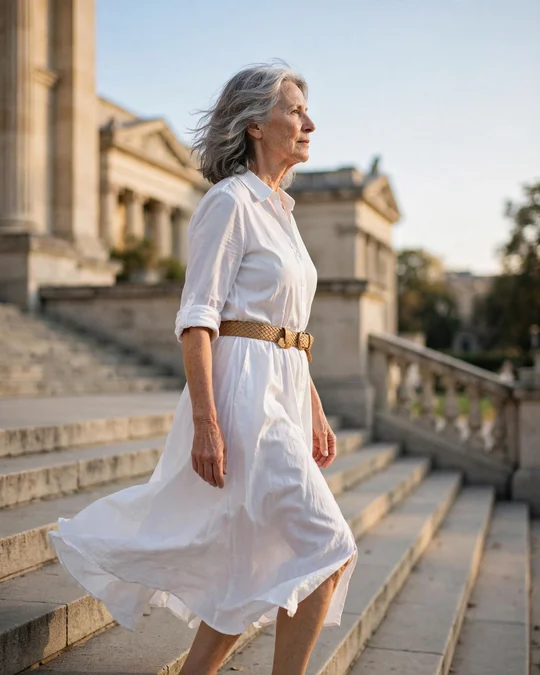
A white shirtdress works because it borrows two flattering structures at once: the vertical line of buttons draws the eye straight down the body’s centre (the same elongating trick a long necklace performs), and the shirt collar frames the face with a neat, intentional edge.
Unlike a plain white dress, it has built-in architecture — collar, placket, cuffs — so it never reads like a blank canvas.
Choose a crisp cotton or cotton-poplin with enough body to hold the collar up, and a length that hits just below the knee — around 40–42 inches from the shoulder on average.
Add your own belt at the natural waist (tan woven leather is ideal) rather than relying on the dress’s sewn waist, so the cinch sits exactly where you want it. Roll the sleeves to just below the elbow for a relaxed arm line.
- Fabric: cotton poplin or broadcloth with enough crispness to hold a collar
- Length: just below the knee — check sitting length, not just standing
- Belt: add your own 1–1.5 inch belt at the natural waist
- Price: $70–$150 for a well-cut cotton shirtdress
Shop for: a white or off-white shirtdress in cotton poplin, with a real collar (not a band), buttons all the way down, sleeves you can roll, and a skirt that falls in an A-line rather than clinging straight.
How to style it:
- Belt it at your natural waist — not where the dress suggests — and let the skirt fall free below.
- Wear it with flat sandals or low wedges and a woven bag for daytime; swap to heeled mules and a clutch for evening.
Skip it if the buttons strain across the bust — gaping buttons are the one thing that ruins a shirtdress. Size up and belt it, or add a discreet snap between the top two buttons.
White linen is the warm-weather version of everything in this section — our how to wear linen over 50 covers the weights that drape rather than cling.Best for: daytime events, summer holidays, any day you want one piece and zero decisions.
Out and about
Three looks for the days you’re seen — work, lunches, evenings — where white needs to stay smart from morning to night. These lean on tailoring and proportion so the white does the talking and the fit does the worrying.
4. The White Blazer Outfit

A white blazer is the most forgiving white piece you can own, and the reason is structure: shoulder padding and a defined lapel hold the garment away from the body, so it never clings, and the tailored lines read “polished” even over a plain tee and jeans.
It also solves the stain anxiety physically — a structured shoulder and lapel keep the fabric from brushing against counters, car doors and restaurant tables the way a soft white cardigan would.
Look for a single-breasted blazer in white cotton twill or stretch crepe with one button, and a length that covers the hip — about 28–30 inches from the back of the neck. Wear it over colour (navy dress, black trousers, a striped tee) so the white is the frame, not the whole picture.
Push the sleeves to the forearm for an effortless line.
- Fabric: cotton twill or stretch crepe — structured, not floppy
- Fit: single-breasted, one button; shoulders sit exactly at your shoulder bone
- Length: covering the hip, around 28–30 inches from back neck
- Price: $90–$200 for a blazer that keeps its shape
Shop for: a single-breasted white blazer in twill or crepe with real shoulder structure, one button that closes without pulling, and a lining (unlined white blazers wrinkle by noon).
How to style it:
- Wear it over a darker base — navy trousers, a black dress, dark denim — so the white blazer is the deliberate contrast.
- Push the sleeves up one fold; it softens the boardroom edge and shows a bracelet.
- Keep everything else simple — nude or tan shoes, one bag — and let the blazer carry the outfit.
Skip it if the blazer is unlined and unstructured — without a lining it wrinkles fast and the white goes grey-looking by evening. Structure is the whole point.
Best for: work, dinners, any evening where you want to look instantly finished.
Good to know
White underwear is the classic mistake: white bras and pants show through white clothes as grey shadows. Wear underwear in your skin tone — beige, tan, deep brown — and it disappears. For dresses and skirts, a simple nude slip (about knee length) solves sheerness, static and cling in one move, and costs less than $20.
5. The White Midi Skirt Look

A white midi skirt works on a proportion rule: the A-line shape widens gently from the waist to a hem that lands mid-calf (around 30–32 inches long), which skims the midsection and thighs while showing the slimmest part of the leg below the knee.
Because the volume sits low, the eye travels down instead of across — the opposite of what a straight white pencil skirt does.
Pair it with a tucked-in top in a soft colour — blush, sage, pale blue — and a flat or low-heeled sandal. Keep the top fitted or half-tucked: a billowy top over a full skirt adds bulk everywhere. A white eyelet or broderie midi adds texture that reads expensive and hides every wrinkle a flat white skirt would show.
- Shape: A-line, hem mid-calf — never at the widest part of the calf
- Fabric: cotton sateen, eyelet or broderie for texture and opacity
- Waist: a defined waistband you can tuck into; add a slim belt
- Price: $50–$110 for a lined white midi
Shop for: a white A-line midi skirt in cotton sateen or eyelet, fully lined to at least the knee, with a waistband that sits at your natural waist and a hem that lands mid-calf.
How to style it:
- Tuck in a soft-coloured knit or blouse — the colour on top balances the white volume below.
- Add a slim tan belt to mark the waist; it stops the skirt reading like a uniform.
- Finish with flat sandals or low block heels and a crossbody bag — keep the lines clean.
- If it’s windy, the A-line will lift: wear it with lined security (a nude slip) and don’t think twice.
Skip it if the skirt is unlined and lightweight — it will go sheer in sunlight and cling in humidity. Lining is non-negotiable in white skirts.
Best for: lunches, church, spring days out — feminine white without a hint of fuss.
6. The All-White Column

Head-to-toe white is the single most elongating thing you can wear, and the mechanism is pure optics: with no horizontal colour break, the eye travels the full length of the body in one sweep, which reads as height.
The trick that keeps it from looking flat is mixing your whites — ivory trousers, a soft-white top, cream shoes — so the outfit has depth from tone variation instead of colour contrast.
Build it in three pieces: wide-leg or straight ivory trousers, a soft-white blouse or knit tucked in, and cream or nude shoes. Add one metallic or tan accessory — a gold cuff, a tan belt — to give the eye a resting point. Keep fabrics matte rather than shiny; sheen on white reads bridal.
- Formula: 3 pieces in 3 different whites (ivory, soft white, cream)
- Fabrics: mix textures — linen trousers + silk-blend blouse + knit
- Accessory: one warm accent (tan belt, gold cuff, nude shoe)
- Avoid: all-over shine or satin — it tips into bridal territory
Shop for: wide-leg or straight trousers in ivory, a soft-white blouse in a matte fabric, and cream or nude shoes — three tones, three textures, one long line.
How to style it:
- Start with the trousers in the darkest white (ivory); go lighter as you move up so the face gets the brightest tone.
- Tuck the top fully and add the tan belt — the waist definition keeps the column from reading shapeless.
Skip it if everything you own is the same optic white — one flat white from head to toe can wash out fair skin. The tonal mix is what makes this work.
Best for: hot evenings, summer parties, occasions where you want to look taller and completely at ease.
Special occasions
The two occasions that generate nearly all white-wearing anxiety: the wedding you’re attending, and the winter months when white feels off-limits. Both have simple rules — here they are.
7. Wedding-Guest White

Yes, you can wear white to a wedding as a guest — you just can’t wear the bride’s white. The etiquette rule is about colour identity, not the colour family: a floor-length optic-white gown reads bridal; an ivory cocktail dress, a champagne midi or a white dress with a clear floral print reads guest.
Prints are your best friend here — a white ground with visible flowers or pattern is unmistakably not a wedding dress.
Choose a knee-length or midi dress in ivory, champagne or a white-based print, with sleeves or a wrap style that suits the venue. Keep the accessories colourful — a berry clutch, metallic sandals — so nothing about the look whispers bridal.
And the golden rule: if the invitation says the bride is wearing colour, you’re freer; if you don’t know, choose ivory over pure white and you’ll never be wrong.
- Safe choices: ivory, champagne, ecru, or white with a visible print
- Avoid: floor-length pure white, all-white lace, anything veil-adjacent
- Length: knee to midi — never floor-length as a guest
- Insurance: ask the bride — a 30-second question removes all doubt
Shop for: a knee-length or midi dress in ivory, champagne or a white-ground floral print, with sleeves or a wrap neckline — and colourful accessories that mark it clearly as a guest’s outfit.
How to style it:
- Pick ivory or champagne over pure white — the warmth reads celebratory, not bridal.
- Add colour with intention: metallic heels, a berry or navy clutch, a coloured wrap for the church.
- Check the dress code on the invitation first — “black tie” and “garden party” want very different whites.
Skip pure white — and skip white lace — if there’s any chance the bride is wearing white. This is the one white rule with no exceptions.
Best for: weddings, christenings and garden parties as a guest — white you can wear with a clear conscience.
8. Winter White Knits

White in winter works for a reason most women discover by accident: low winter light is softer and bluer, and cream and ivory knits look richer against it than they ever do in July glare.
A chunky cream sweater also solves every white worry at once — thick knit is opaque by nature, wool hides small marks in its texture, and the cosy volume forgives the midsection completely.
Build it around one hero piece: a cream or ivory crewneck or turtleneck in wool or a wool blend, worn with dark denim or charcoal trousers and brown boots. The dark bottom half keeps the outfit grounded and practical; the cream top brings the light to your face where winter needs it most.
Add a camel coat and the whole thing reads expensive.
- Hero piece: cream or ivory knit — crewneck, turtleneck or cowl
- Fabric: wool or wool blend; chunky knit hides everything
- Pairing: dark denim or charcoal trousers, brown or tan boots
- Price: $60–$140 for a good wool-blend cream sweater
Shop for: a cream or ivory sweater in a wool blend with a substantial knit (hold it up — no light through it), in a relaxed rather than tight cut, long enough to cover the waistband.
How to style it:
- Let the cream knit be the lightest thing you wear — dark jeans, brown boots, camel coat.
- Roll the cuffs once to show a bracelet and keep the chunky knit from swallowing your hands.
- Choose cream or ivory over stark white — winter light flatters the warmer tones.
- Carry a structured bag in tan or cognac; it keeps the cosy knit looking intentional.
Skip stark optic white in deep winter if your skin is very fair — it can look harsh against pale winter skin. Cream and ivory are the winter whites.
White at a winter wedding is a delicate call — our winter wedding guest outfits for women over 50 show how to wear pale shades without upstaging the bride.Best for: winter days, holiday gatherings, any cold-weather day you want to look soft and pulled together.
White fabric tips that end the worry
Most white anxiety isn’t about style at all — it’s about fabric behaving badly. These are the practical rules that make white boringly reliable.
- Do the daylight test. Before you buy any white top, hold it up to a window with your hand behind it. If you can read your knuckles through it, it’s too thin — no styling trick fixes sheerness.
- Match underwear to skin, not to the garment. White bras under white tops show as grey outlines. Beige, tan or deep brown for your skin tone disappears completely.
- Keep a nude slip. One knee-length nude slip (under $20) under any white dress or skirt solves sheerness, static cling and thigh friction in a single move.
- Wash white separately, always. One dark sock turns white grey in a single load. Wash whites alone in warm water, and add half a cup of baking soda every few washes to keep them bright.
- Carry the 3 pm kit. A stain-removal pen and a small packet of wet wipes in your bag handle the coffee splash before it sets — most marks lift if you catch them within minutes.
- Steam, don’t iron flat. A handheld steamer relaxes wrinkles in white linen and cotton in about 3 minutes without the shine marks an iron leaves on white fabric.
- Retire on schedule. White has a visible lifespan: when the collar yellows, the armpits grey or the fabric goes thin, the piece is done. Replacing a $30 tee once a year beats wearing a tired one for three.
The 4-step white outfit check (do this before you leave):
- Stand in daylight — not bathroom light — and check front, back and side for sheerness.
- Sit down and check the lap and bust: fabric stretches and thins where you sit.
- Bend forward once: does the neckline gape? If yes, add a camisole or a small stitch.
- Glance at shoes and bag: one warm anchor (tan, cognac, gold) keeps white looking deliberate.
The bottom line
If I had to pick one white piece for a woman over 50, it’s the white jean anchor (#1) — off-white straight-leg jeans with a navy top. It has the lowest worry of anything here, works nearly every day of the year, and it’s the piece that quietly teaches you that white was never the problem; thin fabric was.
Save this guide to your “over 50 style” board before your next white occasion — the daylight test and the fabric weight numbers are the two things you’ll want with you in the fitting room.
Frequently asked questions
Can women over 50 really wear white without looking washed out?
Yes — the washed-out look comes from the wrong white, not from white itself. If your skin is fair, choose ivory, ecru or champagne instead of optic white; the warmer tone reflects less harsh light at the face. If your skin is medium to deep, optic white is usually flattering because the contrast works in your favour.
The five-second test never lies: hold the garment to your face in daylight, and trust what you see.
How do I stop white tops from being see-through?
Buy opacity at the source: choose tops in 180–220 gsm cotton and do the daylight hand test before you buy. Underneath, wear a bra and camisole matched to your skin tone — never white under white. If a beloved top is borderline, a nude slip or camisole underneath fixes it completely; no one will ever know it’s there.
Is it ever okay to wear white to a wedding?
It depends on which white. Pure white, floor-length white and white lace are off-limits — that’s the bride’s territory, no exceptions. But ivory, champagne, ecru or a white dress with a clear floral or patterned print are all perfectly polite guest choices.
If you’re unsure, ask the bride; the question takes seconds and it’s always appreciated.
What do I do about stains when wearing white all day?
Prevention first: structured pieces like blazers keep fabric away from surfaces, and darker trousers with a white top localise the risk. Carry a stain-removal pen and wet wipes — most food and coffee marks lift completely if treated within minutes, and set permanently if left for hours.
For the truly anxious days, choose textured fabrics like eyelet or chunky knit, which hide small marks in their weave.
How do I keep white clothes white in the wash?
Wash whites completely separately — one dark item greys a whole load. Use warm (not hot) water, a good detergent, and add half a cup of baking soda every few washes to lift dinginess. Skip chlorine bleach on a regular basis: it yellows cotton and denim over time.
Dry in sunlight when you can; UV is the gentlest whitener there is.
Can I wear white in winter, or is it a summer-only colour?
White in winter is not only allowed, it’s one of the most elegant cold-weather moves — but choose the winter whites. Cream, ivory and ecru knits look richer in low winter light than stark white does, and chunky wool is opaque and forgiving by nature.
Pair the cream knit with dark denim or charcoal trousers and brown boots, and it reads intentional rather than confused.
Does wearing white over 60 make me look bigger?
White reflects light, so it does show volume more honestly than black — but “more honestly” is not “bigger.” The fix is structure, not avoidance: A-line shapes that skim (#5), vertical lines like a button placket (#3), tonal columns with no horizontal breaks (#6) and fabrics with enough weight to fall straight.
Wearing white at 60 is entirely flattering when the cut does the shaping instead of the colour doing the hiding.
What shoes go best with white outfits for older women?
Tan, cognac and nude shoes are the universal answer — they extend the leg line under white trousers and warm up white dresses without competing. Metallic sandals (gold or pewter) dress white up for evenings, and white sneakers keep white jeans casual and modern.
Avoid stark black shoes with all-white outfits unless you want a deliberate graphic contrast; the hard break shortens the leg.