20 Short Winter Nails for Women Over 50

Every Sunday evening from November through March, I do the same small ritual: file, buff, base coat, two thin coats of colour, top coat — twenty minutes while the kettle boils twice. Winter nails, short and strong, are not about glamour for me; they’re about survival.
Cold air sucks the moisture from your nail beds, gloves snag on chips, and one deep crack can make you wince every time you button a coat.
You don’t need long extensions to look polished — winter nails short and well-kept beat fragile length every single time. What follows is a countdown of 20 winter shades that look expensive on short nails, ordered from lovely to the one I’d pick with my own money.
Every shade here was chosen for short nail beds: no long-stiletto-only colours, no art that needs 10 mm of canvas.
If you only pick three
- Warmest winter classic: Mulled Wine (#1) — glows in firelight, hides chips
- Most expensive-looking: Espresso Gloss (#13) — the one-shade manicure that reads rich
- The hero pick: Midnight Gold Leaf (#20) — black-gold depth, made for December parties
- Chips least: Stone Pebble (#10) — the neutral that forgives a whole week
- Best value finish: Champagne Chrome (#18) — salon-effect shine from one powder
Contents
How to choose short winter nails that survive January
Pick darker than you think, in a crème or jelly finish. Short nails carry deep colour better than long ones because the colour-to-skin ratio stays balanced — a dark crème on 5 mm of nail reads chic; on 15 mm it can read costume.
Crème finishes also show chips less than metallics, which matters when you’re scraping ice off a windscreen in week two.
Match your undertone, not the bottle. Hold the bottle against your wrist: if the veins look green, lean warm (mulled wine, espresso, champagne); if they look blue, lean cool (bordeaux, evergreen, glacier silver). The wrong temperature makes short nails look sallow; the right one makes them look groomed even with a visible grow-out gap.
Budget for the top coat, not just the colour. A £6 polish under a proper plumping top coat outlasts a £16 polish worn bare — the top coat is the shock absorber that takes the glove-on, glove-off abrasion.
Reapply it on day four and you buy yourself another three to four days before a redo, which is the difference between a Sunday ritual and a midweek emergency.
Think about what the nails sit next to. Winter means chunky winter outfits — heavy knits, wool coats, leather gloves. A bright neon fights those textures; deep, complex colours harmonise with them.
If you live in casual winter layers most days, one rich everyday shade beats five party shades you’ll wear once.
When in doubt, go one shade sheerer. Sheer formulas are the training wheels of winter nails: a jelly or wash lets your natural nail show through, so chips and tip-wear blend into the gradient instead of flashing white.
If a full-cover crème feels like too much commitment, start sheer — and save the full-cover drama for the coastal grandmother evenings when you’ll actually look at your hands.
All 20 shades at a glance
| Shade | Finish | Coats | Wears |
|---|---|---|---|
| 1. Mulled Wine | Crème | 2 | 7–9 days |
| 2. Bordeaux Glass | Jelly | 2–3 | 6–8 days |
| 3. Black Cherry | Crème | 2 | 7–9 days |
| 4. Fig Compote | Satin shimmer | 2 | 6–8 days |
| 5. Sage Smoked | Crème | 2 | 7–9 days |
| 6. Moss Agate | Crème | 2 | 7–9 days |
| 7. Pine Needle | Crème | 2 | 7–9 days |
| 8. Evergreen Velvet | Velvet matte | 2 + matte top | 5–7 days |
| 9. Winter Ivy | Micro-glitter | 2 | 8–10 days |
| 10. Stone Pebble | Crème | 2 | 9–11 days |
| 11. Greige Silk | Crème | 2 | 7–9 days |
| 12. Chai Latte | Jelly | 2–3 | 6–8 days |
| 13. Espresso Gloss | Crème | 2 | 7–10 days |
| 14. Taupe Truffle | Crème | 2 | 7–9 days |
| 15. Ice Queen Blue | Crème | 2–3 | 6–8 days |
| 16. Periwinkle Frost | Shimmer | 2 | 6–8 days |
| 17. Glacier Silver | Frost metallic | 2 | 6–8 days |
| 18. Champagne Chrome | Chrome powder | 1 + powder + top | 7–9 days |
| 19. Rose Gold Foil | Foil | 2 + foil flakes | 6–8 days |
| 20. Midnight Gold Leaf | Crème + leaf | 2 + leaf accents | 7–9 days |
The deep reds and wines
The family that never fails short nails in winter. Red pigments are the most opaque in any polish line, so you get full coverage in two thin coats — and deep reds camouflage the two enemies of short winter nails: tip wear and cuticle grow-out.
1. Mulled Wine

A mulled-wine red works because its brown undertone absorbs the yellow cast that indoor winter lighting throws on skin — the colour literally cancels sallowness instead of competing with it. On short nails the warmth reads cosy rather than vampy, which is why this is the shade strangers compliment in January.
Red crèmes self-level better than any other finish, so even a shaky hand gets a glassy result. Two thin coats (three minutes apart) build depth without the thick edge that catches on wool.
Wear it at the full 2-coat opacity and you get 7–9 days of honest wear; the chips that do appear at the tips read as dark rather than flashing white, buying you two grace days before a redo.
- Finish: crème, full opacity
- Coats: 2 thin, 3 minutes apart
- Dry time: 8–10 minutes to touch-dry
- Upkeep: reapply top coat on day 4
- Best nail shape: rounded square, 3–6 mm free edge
Shop for: a deep warm-red crème polish with a brown — not blue — undertone; base coat, two thin coats, and a plumping top coat.
How to do it:
- Push cuticles back after a 2-minute warm soak, then wipe each nail with a drop of white vinegar on cotton — it dehydrates the plate so the base grips.
- Apply base coat in one centre stripe, then two thin colour coats, capping the free edge each time.
- Finish with top coat 2 hours later if you can wait — the colour layer needs to fully set or the top coat drags it.
Skip it if your nails stain easily — reds are the worst offenders; use two base-coat layers or pick Bordeaux Glass (#2) instead.
Best for: firelight evenings, family dinners, the weeks when you want one colour and no decisions.
2. Bordeaux Glass

A bordeaux jelly works on short nails for a physical reason: the translucent layers create depth without bulk, so a 4 mm nail looks like it has a glass of wine sitting on it rather than a flat red stamp. Sheer formulas also forgive uneven application, which makes this the most beginner-friendly dark on the list.
The trade-off is opacity: jellies need 2–3 coats and show ridges if your nail plate is uneven. A ridge-filling base coat solves that completely — one layer, let it dry 3 minutes, then build the jelly in whisper-thin coats.
Because the colour is translucent, grow-out at the cuticle is nearly invisible, which is why this stretches to 8 days even with fast-growing nails.
- Finish: jelly, translucent
- Coats: 2–3 whisper-thin
- Dry time: 5 minutes between coats
- Upkeep: ridge-filling base is non-negotiable
- Best nail shape: oval, any short length
Shop for: a bordeaux jelly polish (see-through in the bottle), a ridge-filling base coat, and a glossy quick-dry top coat.
How to do it:
- Buff lightly with a 240-grit buffer — 3 strokes per nail, no more — then ridge-filling base, 3 minutes dry.
- Float the jelly on in thin coats without pressing the brush; 3 coats for wine depth, 2 for a stained-lip look.
- Seal with top coat, then once fully dry, dab cuticle oil around (not on) the nails to stop winter cracking.
- Day 5: one fresh top-coat layer refreshes the glass effect for 3 more days.
Skip it if you want maximum coverage — jellies are designed to be seen through; choose Mulled Wine (#1) for full opacity.
Best for: first-time darks, uneven nail plates, the “are my nails done?” quiet-luxury effect.
3. Black Cherry

Black cherry works by flirting with black without committing to it: in daylight it reads as the deepest red; indoors it goes near-black, which gives short nails an elongating effect because the eye follows the dark shape to its tip. This is the shade that makes 4 mm nails look deliberate.
The depth comes from heavy pigment load, which means it stains — plan for it. Double base coat (two thin layers, fully dry between) is the price of admission, and you’ll want a latex-free remover with a drop of jojoba rather than pure acetone, which dries winter nails to the point of peeling.
With that routine, black cherry gives 7–9 days of drama with almost zero visible tip wear.
- Finish: crème, near-black depth
- Coats: 2 thin over 2 base layers
- Dry time: 10 minutes to touch-dry
- Upkeep: moisturising remover; oil cuticles nightly
- Best nail shape: squoval, filed straight across
Shop for: a black-cherry crème (looks black in the bottle, red on the nail), double base coat, and a non-acetone moisturising remover.
How to do it:
- Two base-coat layers, 2 minutes apart — this is your stain shield, don’t rush it.
- Two thin colour coats, keeping 1 mm clear of the cuticle so removal doesn’t drag dark pigment into the skin.
Skip it if you have pale, thin nail plates that stain permanently — the double base helps but doesn’t guarantee it.
Best for: evening events, black coats, when you want short nails to look intentional and bold.
4. Fig Compote

Fig compote — a muted plum-brown with a whisper of satin shimmer — works because the shimmer particles scatter light and blur the outline of chips. Under office fluorescents it reads sophisticated brown; in evening light the purple wakes up.
It’s the chameleon of the red family, and short nails love chameleons because the colour does the work the length can’t.
The shimmer here is satin-fine, not glitter — particles around 30 microns that sit inside the formula rather than on top of it. That matters for removal: it comes off like a crème, not like a glitter that needs a 10-minute soak.
Two coats give full coverage; the shimmer also means you can stretch wear to 8 days because the sparkle distracts from the cuticle line.
The deep reds here cross over neatly into December — our short Christmas nails for women over 50 use the same shades with a little more sparkle for party season.- Finish: satin shimmer (fine, not glitter)
- Coats: 2, no streaking
- Dry time: 8 minutes to touch-dry
- Upkeep: standard remover works fine
- Best nail shape: round, 4–6 mm
Shop for: a fig/plum-brown polish with fine satin shimmer (not chunky glitter); base and glossy top coat.
How to do it:
- Roll the bottle between your palms for 30 seconds — never shake, or bubbles trap in the shimmer.
- Apply two medium coats; the shimmer self-distributes if you don’t overwork the brush.
- Glossy top coat deepens the fig tone; matte top coat turns it moody — pick your evening.
Skip it if you hate shimmer of any kind — Mulled Wine (#1) is the same warmth in pure crème.
Best for: office-to-evening transitions, anyone who finds flat red boring but glitter too much.
The winter greens
Green is winter’s bravest choice and, done right, its most flattering. Deep greens sit opposite red on the colour wheel, which means they make warm skin glow and cool skin look crisp — and on short nails they read as a deliberate style statement rather than a trend accident.
5. Sage Smoked

Smoked sage — grey-green with the saturation turned down — is the gateway green for anyone nervous about colour. The grey in the formula desaturates it to the point where, from two metres away, it reads as a chic neutral. That’s the mechanism: it gives you green’s personality with a neutral’s forgiveness.
Muted crèmes like this are the easiest to apply of any finish — no shimmer to streak, no jelly to layer, no dark pigment to stain. One base, two coats, done in twelve minutes. It wears 7–9 days and chips show as a slightly lighter grey-green, which at arm’s length is invisible.
If you’ve never worn green, start here and see how many compliments follow.
- Finish: muted crème
- Coats: 2 thin
- Dry time: 7 minutes to touch-dry
- Upkeep: minimal — chips blend
- Best nail shape: squoval, short
Shop for: a greyed-out sage-green crème (more grey than green in the bottle); base and glossy top coat.
How to do it:
- File into a soft squoval — sharp corners chip fastest on muted crèmes because you see the white.
- Two thin coats, capping edges; this shade covers so well that thick coats just add dry time.
Skip it if you want a statement green — this one whispers; Pine Needle (#7) shouts.
Best for: green beginners, grey wardrobes, the whole of January without a second thought.
6. Moss Agate

Moss agate — deep green with brown marbling undertones — works because it echoes the colours winter actually puts around you: pine branches, wet bark, stone. It never clashes with a winter wardrobe because it’s already in it. The brown undertone also flatters warm skin that can look sallow in blue-greens.
Application is straightforward crème territory, but one technique note: greens show brush strokes more than reds because the pigment particles are larger. Use the “three-stroke” method — one centre stripe, one each side, brush lifted cleanly at the tip — and don’t go back over a stroke.
Two coats with three strokes each gives a streak-free finish in about fifteen minutes total.
- Finish: deep crème
- Coats: 2, three-stroke application
- Dry time: 8–10 minutes
- Upkeep: oil cuticles to prevent edge lifting
- Best nail shape: oval, 4–7 mm
Shop for: a deep moss-green crème with brown (not blue) undertones; base, top coat, and cuticle oil for nightly use.
How to do it:
- Wipe nails with alcohol or vinegar after shaping — greens lift at the edges if any oil remains.
- Base coat, then two coats using three clean strokes each, lifting the brush at the free edge.
- Top coat while the second coat is still slightly tacky (about 2 minutes) — it melts the layers together and hides strokes.
- Nightly: one drop of cuticle oil per nail, massaged in for 10 seconds.
Skip it if your skin is very cool-toned — the brown undertone can look muddy; try Pine Needle (#7) instead.
Best for: nature lovers, tweed and wool wardrobes, long country weekends.
7. Pine Needle

Pine needle green — the true, saturated Christmas-tree green — is the boldest pick in the countdown so far, and it earns its place through contrast: against winter-pale hands it creates the maximum colour pop of any shade here. Short nails keep it chic because the pop is contained; the same green on long nails tips into costume.
Saturated greens are pigment-heavy and can stain like reds, so the double-base routine from Black Cherry applies. The payoff is 7–9 days of the most commented-on manicure you’ll wear all season. One styling note: pine needle looks best against gold jewellery — the warm metal picks up the yellow in the green and the whole hand glows.
- Finish: saturated crème
- Coats: 2 over double base
- Dry time: 10 minutes
- Upkeep: pairs best with gold jewellery
- Best nail shape: rounded, short-to-medium
Shop for: a true pine/tree green crème (saturated, not muted), double base coat, glossy top coat.
How to do it:
- Double base coat, 2 minutes between layers, as with any staining dark.
- Two colour coats — this pigment covers so fully that a third coat only adds bulk.
- Wear it with warm metals: gold rings make the green look richer; silver cools it down.
Skip it if your workplace frowns on colour — this one gets noticed; Sage Smoked (#5) is the discreet version.
Best for: December itself, gold jewellery days, when you want your hands to be the outfit.
8. Evergreen Velvet

The velvet-matte technique — a matte top coat over a deep crème — turns ordinary green into something that looks like fabric. The mechanism is light: matte finishes scatter light instead of reflecting it, so the colour reads deeper and the nail looks like cut velvet.
On short nails the effect is luxurious rather than flat because there’s so little surface to go dull.
Matte wears faster than gloss — 5–7 days versus 8–10 — because the matte layer is porous and absorbs oils and dye from daily life. The fix is simple: don’t cook turmeric or handle newsprint without gloves, and accept that matte is a one-week manicure, not a two-week one.
What you get in exchange is the most tactile, expensive-looking finish in this entire article.
- Finish: velvet matte (matte top coat over crème)
- Coats: 2 colour + 1 matte top
- Dry time: 12 minutes — matte must set fully
- Upkeep: avoid dyes and oils; 5–7 day wear
- Best nail shape: almond-oval, neat
Shop for: a deep evergreen crème plus a dedicated matte top coat (not a “satin” one — you want full flat).
How to do it:
- Apply colour exactly as a gloss manicure — two coats, fully dry (wait a full 10 minutes).
- One thin matte top coat, applied quickly in three strokes — going back over matte creates bald patches.
- Do not add glossy top coat over it “for wear” — it defeats the entire effect.
- Refresh on day 4 with one more matte layer if the tips start to shine.
Skip it if you need 10-day wear — matte’s porosity makes that unrealistic; choose Pine Needle (#7) in gloss.
Best for: velvet dresses, holiday parties, the week you want to feel decadent.
9. Winter Ivy

Winter ivy — deep green loaded with micro-glitter — is the practical glitter: the particles are under 50 microns, so they lay flat, reflect light from every angle, and — crucially — the glitter base grips the nail better than plain crème. Micro-glitter manicures routinely outwear crèmes by two days because the texture hides both chips and grow-out.
Removal is the honest trade: you’ll need the foil-wrap method (cotton soaked in remover, wrapped in foil, 10 minutes) rather than a quick wipe. But you only do it once every 8–10 days, and the wear is the longest in the green family. On short nails the glitter reads as candlelight rather than disco — contained sparkle, maximum effect.
- Finish: micro-glitter over deep green
- Coats: 2 (glitter builds fast)
- Dry time: 10 minutes
- Upkeep: foil-wrap removal; 8–10 day wear
- Best nail shape: round, short
Shop for: a deep-green micro-glitter polish (fine sparkle, not chunky hexagons); acetone remover and foil squares for takedown.
How to do it:
- One base coat — glitter grips well, so a single layer is enough.
- Two coats of glitter, dabbing slightly at the tips on the second coat for extra density where chips start.
Skip it if you dread glitter removal — no shame in it; Moss Agate (#6) gives the green without the soak-off.
Best for: the longest wear in the article, New Year’s Eve week, glitter lovers who’ve been burned by chunky formulas.
The winter neutrals
The workhorses. Neutrals are the shades you wear for the three ordinary weeks between the holidays — and on short nails they’re secretly the most flattering family, because they lengthen the finger by blurring where nail ends and skin begins.
10. Stone Pebble

Stone pebble — a mid-taupe grey — earns its place through camouflage: it’s close enough to most skin’s shadow tone that chips, tip wear and even a broken corner become nearly invisible. This is the shade with the longest honest wear in the article: 9–11 days, because there’s simply nothing to see when it degrades.
The mechanism is low contrast. Every other shade on this list creates a hard line where colour meets skin; stone pebble creates a gradient. That also means it flatters every skin tone — cool, warm, deep, fair — since it’s neither.
If you can only buy one winter polish and you type all day, this is the one.
- Finish: crème, mid-tone
- Coats: 2 thin
- Dry time: 7 minutes
- Upkeep: 9–11 days; chips nearly invisible
- Best nail shape: any — the most forgiving shade here
Shop for: a mid-taupe grey crème (not too brown, not too grey); base and any top coat you own.
How to do it:
- Shape and base as normal — this shade needs no special tricks.
- Two thin coats; because the colour is mid-tone, even slightly uneven coats look fine.
- One top coat on day 1 and again on day 6, and you’ll honestly forget when you last did your nails.
Skip it if you want colour with personality — this is the quiet professional of the list.
Best for: typists, nurses, gardeners — anyone whose hands take a beating.
Good to know
Winter is the season nails break, and it’s not the cold — it’s the central heating. Indoor air at 20–30% humidity pulls moisture from the nail plate, which is why nails peel in January even when you’re being careful. The fix costs nothing: keep hand cream by every sink and push a drop of oil into each cuticle before bed.
Oiled nails bend instead of snapping, and every shade in this article wears 2–3 days longer on hydrated nails.
11. Greige Silk

Greige — grey-beige — is the fashion insider’s neutral because it contains both temperatures: the grey cools, the beige warms, and the blend flatters skin that can’t decide. On short nails it reads as the most “done” neutral, the one that looks like you have a standing salon appointment.
Greige’s trick is that it darkens slightly as it dries, so judge the bottle one shade lighter than you want. Two thin coats give a silk-like finish with no shimmer — pure, flat, expensive. It pairs with everything in a winter wardrobe because it sits in the same tonal family as camel coats, grey knits and taupe boots.
- Finish: flat crème, no shimmer
- Coats: 2 thin
- Dry time: 8 minutes
- Upkeep: 7–9 days; choose a shade slightly lighter than your target
- Best nail shape: oval, 4–6 mm
Shop for: a greige crème (balanced grey-beige, neither pink nor yellow); base and glossy top coat.
How to do it:
- Test one nail first and let it dry fully — greige deepens as it sets, and you want to love the dry colour.
- Two thin coats, then top coat; the gloss is what sells the “silk” effect.
Skip it if your skin is very warm and golden — greige can look ashy; Chai Latte (#12) is the warm equivalent.
Best for: camel coats, grey knitwear, job interviews, any “I have my life together” week.
12. Chai Latte

Chai latte — a milky spiced-brown jelly — flatters warm skin the way greige flatters cool. The translucency is the point: on short nails, a sheer warm brown looks like healthy nail with better lighting, not like polish at all. It’s the “no-makeup makeup” of the nail world.
Because it’s sheer, application is nearly foolproof — streaks disappear into the gradient. Build 2–3 coats depending on how much spice you want; two reads as a tint, three as a proper milky brown. The jelly finish also means zero visible grow-out for a full week, which is why this is the lowest-maintenance warm neutral here.
- Finish: milky jelly
- Coats: 2–3, build to taste
- Dry time: 5 minutes between thin coats
- Upkeep: 6–8 days; invisible grow-out
- Best nail shape: round, natural
Shop for: a milky caramel-brown jelly polish; ridge-filling base optional but helpful; glossy top coat.
How to do it:
- Base coat, then float on thin jelly coats — don’t press, or you’ll get bald spots.
- Stop at 2 coats for a tint, 3 for milky depth; seal with top coat while the last coat is tacky.
- Wear it with warm metals and brown leather — the whole palette harmonises.
- Day 6 top-up: one more jelly coat instead of starting over — it melts in seamlessly.
Skip it if you want full coverage — sheers are a look, not a compromise; Espresso Gloss (#13) covers completely.
Best for: warm skin tones, minimalist style, weeks when nails are the last thing on your mind.
13. Espresso Gloss

Espresso — deep, near-black brown in high gloss — is the shade that made me write this article. It has the drama of black with the warmth of brown, which means it flatters instead of starkening. On short nails in winter light, it looks like the most expensive thing in the room.
The gloss is doing the heavy lifting: a high-shine top coat over deep brown creates reflections that make 5 mm nails look sculpted. This is a two-coat crème with the pigment load of the reds, so the double-base routine applies for stainers — but the result wears 7–10 days and looks freshly done until day 8.
It’s my desert-island winter shade.
- Finish: deep crème, ultra-gloss
- Coats: 2 over double base
- Dry time: 10 minutes
- Upkeep: 7–10 days; refresh top coat day 5
- Best nail shape: squoval or almond, neat
Shop for: a deep espresso-brown crème (near-black in the bottle); double base coat; a high-gloss plumping top coat.
How to do it:
- Double base, two thin colour coats — keep the edges immaculate, because dark gloss shows every wobble.
- Plumping top coat in one confident pass; don’t go back over it.
- Day 5: wipe with a dry cloth, apply one fresh top-coat layer — the gloss reblooms like new.
Skip it if you bite your nails or have very ragged cuticles — dark gloss magnifies imperfections; heal first, then wear it.
Best for: leather jackets, evening plans, the shade I’d wear if I could only wear one all winter.
14. Taupe Truffle

Taupe truffle sits one shade deeper than greige, with a whisper of mauve that keeps it from going flat. The mauve is the clever bit: it echoes the natural pink of the nail bed, so the polish looks like an extension of you rather than something applied.
Short nails in taupe truffle look longer — the low-contrast colour lets the eye travel the full finger.
Application is easy crème work, but colour-matching matters more here than anywhere: hold the bottle to your bare nail — if the bottle looks like your nail’s shadow, it’s right. Too dark and it reads brown; too light and it vanishes. Get the match right and you have 7–9 days of the most quietly flattering manicure in this article.
If you want the same short lengths in autumn tones first, our short Thanksgiving nails for women over 50 start with warm neutrals before the winter shades take over.- Finish: crème with mauve undertone
- Coats: 2 thin
- Dry time: 8 minutes
- Upkeep: 7–9 days
- Best nail shape: oval, 4–7 mm — visually lengthening
Shop for: a mid-taupe crème with a mauve/pink undertone (test against your bare nail); base and glossy top coat.
How to do it:
- Match the shade to your nail’s shadow tone before buying — this one lives or dies on the match.
- Two thin coats; file into a soft oval to maximise the lengthening illusion.
Skip it if you want visible colour — this is a whisper, not a statement.
Best for: short nail beds you want to look longer, conservative offices, elegant minimalism.
The frosted cool tones
The icy family — blues, frosts and silvers. These are the shades that look like the season itself, and they suit cool undertones the way the reds suit warm ones. A note of honesty: frosts show imperfections more than crèmes, so the prep matters here.
15. Ice Queen Blue

Ice queen blue — a pale, frosty periwinkle-blue — works on short nails because pale colours make nails look wider, and short-wide reads cute rather than stubby when the colour is this deliberate. It’s the Elsa shade, but wearable: frosty without being childish, because the blue has grey in it.
Pale crèmes are the hardest to apply streak-free — the pigment is sparse, so every brush mark shows. The fix is three thin coats instead of two thick ones, with 3 full minutes between each. It feels slow; it’s fifteen minutes total and the result is worth it.
Wear is 6–8 days, and tip wear shows — keep the free edge short to minimise it.
- Finish: pale frosted crème
- Coats: 3 thin (non-negotiable)
- Dry time: 3 minutes between coats
- Upkeep: 6–8 days; keep nails short
- Best nail shape: round, short
Shop for: a pale grey-blue crème (frosty, not pastel baby-blue); base and glossy top coat.
How to do it:
- Buff the nail plate smooth — pale shades magnify every ridge.
- Three thin coats, 3 minutes apart; resist the urge to thicken coat two.
- Glossy top coat is essential — without it, pale blue looks chalky instead of frosty.
- File the free edge to 3–4 mm max; longer pale nails chip visibly.
Skip it if your hands are very warm-toned — icy blue can make them look ruddy; Periwinkle Frost (#16) is the bridge shade.
Best for: snowy weeks, silver jewellery, cool undertones, the January blues (the good kind).
16. Periwinkle Frost
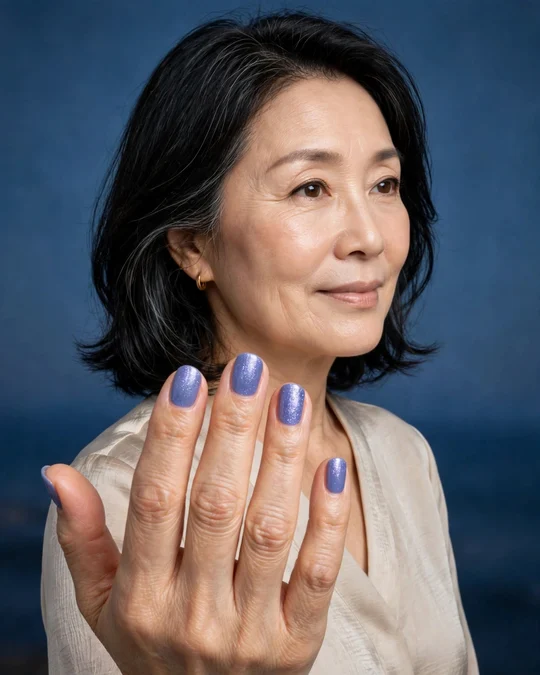
Periwinkle frost — blue-violet with fine shimmer — is the diplomatic icy shade: the violet warms it just enough for neutral and warm skin, while the shimmer does what shimmer always does and blurs imperfections. It’s ice blue for people who can’t wear ice blue.
The shimmer also solves the pale-shade application problem — particles scatter light and hide the streaks that plague flat pastels. Two coats give full, even coverage where Ice Queen Blue needed three. Wear is 6–8 days, and the shimmer means tip wear reads as sparkle rather than damage.
- Finish: fine shimmer
- Coats: 2
- Dry time: 8 minutes
- Upkeep: 6–8 days; shimmer hides wear
- Best nail shape: oval or round, short
Shop for: a periwinkle/violet-blue polish with fine shimmer (not chunky glitter); base and glossy top coat.
How to do it:
- Roll the bottle 30 seconds to distribute shimmer — never shake.
- Two medium coats; the shimmer self-levels, so don’t overwork it.
- Top coat while tacky to lock the shimmer flat and glossy.
Skip it if you dislike any sparkle — Ice Queen Blue (#15) is the same family, flat.
Best for: violet lovers, evening lights, the bridge between icy and wearable.
17. Glacier Silver
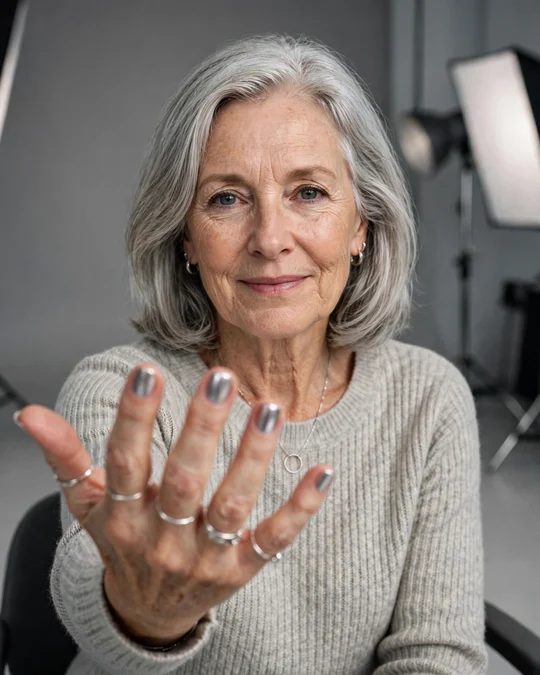
Glacier silver — a true metallic frost — is the mirror of the ice family, and it works on short nails for one reason: metallics reflect the maximum light per square millimetre, so even 4 mm of nail throws real shine. It’s jewellery for your fingertips.
Metallics demand perfect prep because the reflective finish shows every ridge and bump — buff smooth, ridge-fill, then apply in thin coats with minimal brushwork. The classic mistake is going back over a stroke; metallics record every pass as a visible line. Three light strokes per nail, lift, move on.
Done right, glacier silver wears 6–8 days and looks like liquid metal.
- Finish: true metallic frost
- Coats: 2 thin, minimal brushwork
- Dry time: 8 minutes
- Upkeep: 6–8 days; shows ridges — prep is everything
- Best nail shape: smooth oval, well-buffed
Shop for: a true silver metallic polish (mirror-like, not grey crème); ridge-filling base; glossy top coat.
How to do it:
- Buff smooth with a fine buffer, then ridge-filling base — 3 full minutes dry.
- Two thin coats, three strokes each, never reworking a stroke.
Skip it if your nail plates are ridged and you won’t buff — the metallic will broadcast every ridge.
Best for: New Year’s week, silver jewellery, maximal shine on minimal length.
The metallics
We’ve climbed the countdown to the top three — the finishes with the most impact per millimetre. Metallics are short nails’ superpower: they turn the smallest canvas into the brightest object in the room.
18. Champagne Chrome
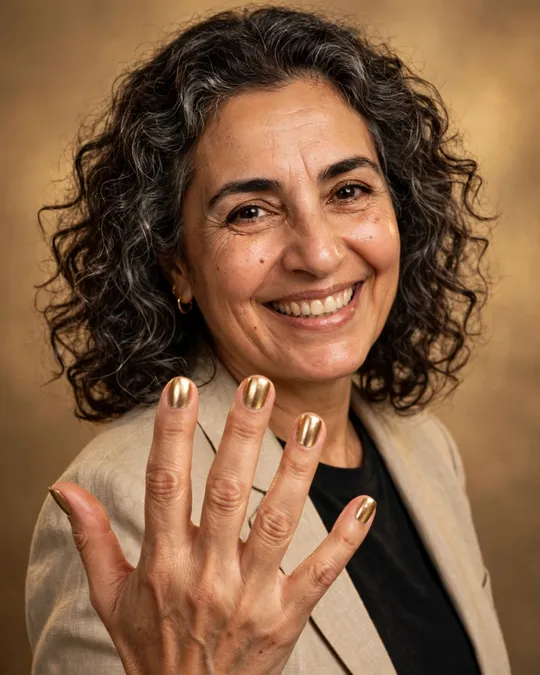
Champagne chrome — achieved with a rub-on chrome powder over a nude base — gives a liquid-metal finish no bottle polish can match. The powder particles are so fine they form a continuous reflective film, which is why chrome looks expensive: the eye reads uninterrupted shine as luxury. On short nails the effect is a perfect golden mirror.
The technique sounds fussy but takes five extra minutes: apply a nude or pale-gold base, cure or dry it, rub the powder on with a silicone applicator or even a fingertip, dust off the excess, and seal with top coat. The seal is critical — unsealed chrome rubs off in a day; sealed, it wears 7–9 days.
One £8 pot of powder does roughly 40 manicures, making this the best value finish in the article.
- Finish: chrome powder over nude base
- Coats: 1 base + powder + sealing top coat
- Dry time: base fully dry first (10 min)
- Upkeep: 7–9 days sealed; ~40 manicures per pot
- Best nail shape: smooth oval — chrome shows everything
Shop for: a champagne-gold chrome powder pot, a nude/pale-gold base polish, a silicone eyeshadow applicator, and a no-wipe glossy top coat to seal.
How to do it:
- Buff smooth, base coat, one coat of nude base — let it dry completely, 10 full minutes.
- Pick up powder on the applicator and rub firmly in small circles until the nail turns to mirror.
- Dust off excess with a soft brush, then seal with top coat in one pass — two sealing layers for a full week.
- Day 6: one more top-coat layer revives the mirror for 3 extra days.
Skip it if you won’t do the prep — chrome over ridges looks cheap, which defeats the point.
Best for: the salon look at home, gold jewellery, best shine-per-pound of anything here.
19. Rose Gold Foil

Rose gold foil — irregular metallic flakes suspended in a sheer rose base — catches light the way champagne chrome can’t: in fragments, like sun on water. The irregularity is the luxury signal; perfect uniformity reads manufactured, while foil’s randomness reads artisanal.
On short nails, one accent nail in full foil with the rest in the sheer base is the most complimented combination I know.
Application is forgiving because the flakes hide everything: two coats of the sheer rose base, then press extra flakes where you want density using the brush tip. No precision needed — randomness is the design. Seal well, because foil edges can lift; two top-coat layers, the second 2 hours later, lock it down for 6–8 days.
- Finish: foil flakes in sheer rose base
- Coats: 2 + pressed flakes
- Dry time: 8 minutes; second top coat 2 hours later
- Upkeep: 6–8 days; seal foil edges well
- Best nail shape: any short shape
Shop for: a rose-gold foil-flake polish (flakes in a sheer base, not chunky glitter); base and plenty of top coat.
How to do it:
- Two coats of the sheer base; while the second is tacky, press the brush tip to place extra flakes on one accent nail (or all ten).
- Seal with top coat, then a second top-coat layer 2 hours later — foil edges must be buried or they catch.
Skip it if you work with your hands roughly — foil edges lift under abrasion faster than smooth finishes.
Best for: accent-nail designs, romantic evenings, rose-gold jewellery wardrobes.
20. Midnight Gold Leaf

And here is the top of the countdown — my hero pick. Midnight gold leaf is a near-black base with fragments of real-look gold leaf pressed into the tips, and it works through pure contrast: the darkest ground makes the gold read twice as bright, and the gold makes the black read twice as deep.
It’s the night sky on your fingertips, and on short nails it’s perfection — all drama, zero maintenance of length.
The technique is simpler than it looks: two coats of near-black crème, then while the second coat is tacky, press tiny torn pieces of gold leaf (or gold foil flakes) onto the outer third of each nail with tweezers. Seal with two top-coat layers.
The leaf fragments are irregular, so every nail is unique — and because the base is near-black, chips are invisible and grow-out barely registers. Seven to nine days of the most striking manicure in this article, for about twenty-five minutes of work.
- Finish: near-black crème with gold leaf tips
- Coats: 2 black + leaf + 2 top coats
- Dry time: 10 minutes; seal 2 hours later
- Upkeep: 7–9 days; chips invisible on black
- Best nail shape: squoval or oval, neat and short
Shop for: a near-black crème polish, gold leaf sheets or gold foil flakes, fine tweezers, double base coat, and glossy top coat.
How to do it:
- Double base, two thin black coats — keep 1 mm clear of cuticles for clean removal.
- While the second coat is tacky, tear gold leaf into 2–3 mm fragments and press onto the outer third of each nail with tweezers.
- Seal with top coat once dry, then a second sealing layer 2 hours later to bury every leaf edge.
Skip it if you want subtle — this is the opposite of subtle, and that’s exactly the point.
Best for: New Year’s Eve, the whole of December, anyone ready for their nails to be noticed.
Winter nail survival tips
Colour is only half the battle in winter — the other half is keeping short nails intact through heating, gloves and hand-washing. These are the habits that make every shade above wear longer.
- Oil beats cream for nails. Hand cream sits on skin; jojoba or sweet-almond oil penetrates the nail plate. One drop per cuticle at bedtime, massaged in for ten seconds.
- File in one direction only. Sawing back and forth frays the free edge, and frayed edges peel within days in dry air. One direction, fine grit (240+).
- Wear gloves for wet work. Water swells the nail plate; repeated swelling and shrinking causes peeling. Fifteen minutes of washing up without gloves undoes a week’s oiling.
- Keep the free edge short in the coldest months. Every millimetre of length is leverage for a break. January is the time for 3–4 mm, not 7.
- Reapply top coat on day 4, not day 7. The top coat is sacrificial — it takes the abrasion so the colour doesn’t have to. A mid-week layer buys three extra days.
- Don’t use nails as tools. Scraping, prising, peeling stickers — each one micro-fractures the edge. Keep a coin or a proper tool in your coat pocket instead.
- Remove polish before it chips badly. Picking at a chip tears layers off the nail plate. If day 8 looks tired, take it off cleanly and start fresh rather than picking for three days.
The Sunday twenty-minute routine:
- Remove old polish with moisturising remover; file into shape (one direction), 2 minutes.
- Warm-water soak 2 minutes, push cuticles back gently, wipe nails with vinegar on cotton.
- Base coat, two thin colour coats (3 minutes apart), top coat — 12 minutes.
- Cuticle oil once dry; hand cream over the top. Done until next Sunday.
The bottom line
If I had to pick one: Midnight Gold Leaf (#20). It’s the only shade here that works for a Tuesday and a gala, hides every flaw short nails have, and takes twenty-five minutes. Buy the gold leaf once and you’ll use it all winter.
And what to skip: ultra-long stiletto extensions “for the holidays” (they break, they snag, and they make every winter task harder), neon shades against heavy winter textures, and pure black crème — espresso and midnight give you the depth without the starkness.
Save this guide to your winter board now, because the Sunday you need it, you’ll want the shade names in front of you.
Frequently asked questions
Can winter nails, short and natural, really look elegant without extensions?
Yes — and often more elegant than extensions. Short nails carry deep, complex colour better because the proportions stay balanced, and finishes like chrome, velvet matte and gold leaf give you all the drama without length. The key is neatness: tidy cuticles, a smooth edge and glossy top coat make 4 mm nails look intentional.
If your nails are very short (under 3 mm free edge), lean on the neutrals and jellies in this list — they flatter minimal length best.
Why do my nails peel every January no matter what polish I use?
It’s the indoor heating, not the polish. Central heating drops indoor humidity to 20–30%, which dehydrates the nail plate until its layers separate — that’s peeling. Polish actually protects against it by sealing the nail, but only if the nail underneath is hydrated.
The fix: oil your cuticles nightly (jojoba penetrates best), wear gloves for washing up, and keep nails slightly shorter in the coldest months. If peeling is severe, take a one-week polish break and oil twice daily — the new growth will come in stronger.
How do I stop dark winter shades from staining my nails yellow?
Two thin base-coat layers, fully dry between them — one layer isn’t enough for reds, near-blacks and deep greens. If staining still happens, it’s usually because the base was applied over oily nails; wipe with vinegar or alcohol first. For existing stains, buff very lightly and soak in a paste of baking soda and lemon juice for 5 minutes.
And if your nails stain no matter what, the jelly shades in this article (Bordeaux Glass, Chai Latte) are the kindest to nail plates.
Are matte winter nails practical, or do they mark too easily?
They’re beautiful but high-maintenance — matte top coats are porous, so they absorb dye from turmeric, newsprint and even dark denim, and they show oils from your skin. Expect 5–7 days of perfect wear versus 8–10 for gloss. If you love the velvet look, wear it for party weeks and keep a glossy shade for ordinary life.
One trick: a matte manicure can be “reset” with one fresh matte layer on day 4, which evens out marks and buys a few more days.
What’s the best winter nail colour if I only want to buy one polish?
Stone Pebble (#10) if you want invisible wear and zero fuss — 9–11 days, chips you can’t see, suits everything. Espresso Gloss (#13) if you want one shade with presence — dramatic, flattering, and still office-safe. Mulled Wine (#1) if you want the classic winter red that earns compliments.
Honestly, one of those three plus a good top coat covers the entire season; everything else in this article is joyful excess.