Everything a Woman Over 50 Should Have in Her Closet: The No-Nonsense List

What should a woman over 50 actually have in her closet? It is the question I hear most, and the honest answer is shorter than you expect: ten pieces, bought in the right order, cover roughly 80 per cent of real life.
This wardrobe essentials for women over 50 checklist is that ten — no aspirational pieces, no “maybe one day” items, just the workhorses that get dressed in five minutes on a Tuesday morning.
The order matters as much as the pieces. Base layers first, because everything sits on them; the bottom half next, because trousers and jeans decide the silhouette; middle pieces after that; and shoes, bags and the finishing jacket last, because they only make sense once the clothes exist.
Work the list in four routine steps, and you stop shopping by impulse and start shopping by gap — which is where the money goes missing in most closets.
The fast picks
- The foundation → The white crew tee (#1)
- The shirt that goes with everything → The crisp button-down (#2)
- The jean that never dates → Dark straight-leg jeans (#3)
- The polish piece → The black or navy blazer (#7)
- The shoe rule → The pointed flat (#8)
- The bag that behaves → The structured medium bag (#9)
Contents
- How to use this wardrobe essentials for women over 50 checklist
- The 10 essentials at a glance
- Step 1: Lay the base — against-skin pieces
- Step 2: Build the bottom half
- Step 3: Add the middle pieces
- Step 4: Finish with shoes, bags and the third piece
- Keep your 10 essentials working all year
- The bottom line
- Frequently asked questions
How to use this wardrobe essentials for women over 50 checklist
Count to ten, then stop. This list is deliberately complete at ten pieces — the moment it becomes twenty, it stops being a checklist and becomes a shopping spree.
Tick off what you already own first; most women over 50 find they have six or seven of the ten in some form, and the gaps are smaller than the morning panic suggests. If you have never audited honestly, run our closet audit guide first — you cannot buy gaps you have not found.
Buy the gap, not the outfit. The rule for every purchase on this list: it must work with at least three pieces you already own. A blazer that only matches one pair of trousers is not an essential; it is a guest.
Work down the steps in order, and buy step 4 last — shoes and bags chosen to match clothes you already have will always outperform shoes and bags bought on their own. Our wardrobe refresh guide shows how to slot new pieces into what survived the audit.
Fit beats the label every time. Each point below gives exact specifications — rises, lengths, openings — because a £40 tee with the right neckline outdresses a £120 one with the wrong one. If a piece fails the fit spec, it is not the piece, whatever the price tag says.
Say the spec out loud in the fitting room; it stops the “it’ll do” purchases that become the donate pile.
Take the list shopping, literally. Photograph this checklist on your phone or print it — and read our guide to shopping for clothes over 50 before you go, because the fitting-room rules there are what keep this list honest. No piece comes home without passing its spec and the three-outfit test.
Replace on a schedule, not on a whim. Essentials wear out — tees lose their neckline after 12–18 months, jeans thin at the inner thigh after 2–3 years of weekly wear. Each quick-facts box below gives the lifespan; put a recurring note in your calendar and replace before the piece starts looking tired.
A tired essential drags down everything it is worn with.
The 10 essentials at a glance
| # | Essential | The 30-second spec | How many | Pairs with |
|---|---|---|---|---|
| 1 | The white crew tee | 100% cotton, crew at the collarbone, mid-hip hem | 3 | Jeans, trousers, blazer, under knitwear |
| 2 | The crisp button-down shirt | Cotton poplin, single chest pocket, hip-covering length | 2 (white + blue or stripe) | Everything on this list |
| 3 | Dark straight-leg jeans | Dark indigo, 25–28 cm rise, 35–38 cm leg opening | 2 | Tees, shirts, sweaters, blazer, flats, heels |
| 4 | The tailored trouser | Black or navy, natural waist, hem kissing the shoe | 2 | Blouses, knits, blazer, the dress-up shoe |
| 5 | The knit midi dress | 90–100 cm long, elbow or 3/4 sleeves, ponte or viscose | 2 (one dark, one colour) | Flats, heels, the everyday jacket, blazer |
| 6 | The cashmere crew sweater | 2-ply, hip length, crew at the collarbone | 2 (neutral + one colour) | Jeans, trousers, over the button-down |
| 7 | The black or navy blazer | Single-breasted, seat-covering length, structured shoulder | 1 | Literally everything above |
| 8 | The pointed flat (or low heel) | Heel 5 cm or under, nude-for-you or black | 2 pairs | Jeans, trousers, dresses |
| 9 | The structured medium bag | 25–30 cm wide, holds phone, wallet, glasses, keys | 1–2 | Day to evening, all ten pieces |
| 10 | The everyday trench or utility jacket | Mid-thigh, belted or drawstring waist | 1 | Jeans, dresses, the blazer underneath |
Step 1: Lay the base — against-skin pieces
The problem: you open the wardrobe, see plenty of clothes, and still reach for the same tired top because nothing underneath feels right. The fix starts at the skin.
Base layers decide how every neckline sits, how every tuck falls, and whether you look crisp or crumpled by 4 pm — so these are the first two pieces to get right, before a single pair of trousers is bought.
1. The white crew tee

The mechanism is light. A white crew neckline sitting at the collarbone acts like a small reflector, bouncing daylight up onto the face — which is why a good white tee makes you look rested and a greyed-out one makes you look tired in the same mirror.
The cut does the rest of the work: a crew that skims the shoulder seam, a body that falls straight from the bust, and a hem that ends at mid-hip, about 65 cm from the shoulder.
That length tucks cleanly into high-rise jeans and sits flat under a blazer without blousing, so the tee disappears into the outfit instead of fighting it.
- Fabric: 100% combed cotton or cotton-modal; no polyester shine
- Neckline: crew sitting at or just above the collarbone — not a scoop
- Length: mid-hip, about 65 cm from shoulder; sleeves ending mid-bicep
- Lifespan: 12–18 months of weekly wear before the neckline gives
Do this: buy three — one white, one ivory, one grey marl — in 100% combed cotton with the neckline at your collarbone, and replace them the month the collar starts to ripple.
How to wear it:
- Tuck the front 10 cm into high-rise jeans and leave the back loose — the half-tuck defines the waist without the full-tuck fuss.
- Layer it under the blazer (#7) with the sleeves pushed to the elbow; the white cuff against a dark sleeve is the whole trick.
- Steam, don’t iron — 2 minutes with the steamer takes out the drawer creases cotton always picks up.
Skip it if … the neckline rides up when you raise your arms — a tee that moves is cut too small, and sizing up one fixes the neckline, the sleeve and the hem in one go.
Best for: the daily uniform — jeans, trousers, under knitwear, under the blazer. If you own only one item on this list, own this one.
2. The crisp button-down shirt

A button-down is architecture for the torso. The centre placket draws one long vertical line from neck to hem, which the eye reads as length — the same reason pinstripes work, delivered by a shirt you already own.
A structured collar does the second job: it frames the jaw and lifts attention to the face, where a soft knit lets it slide downward. The specification that matters is stiffness without armour: cotton poplin or oxford cloth, woven tightly enough to hold the collar up on its own, but soft enough at the body to tuck.
Length should cover the hip bone (about 70 cm from the shoulder) so it can be worn out over trousers or tucked without pulling, and the single chest pocket keeps it casual enough for jeans while the placket keeps it sharp enough for the blazer.
- Fabric: cotton poplin or oxford; avoid non-iron finishes that shine
- Fit: skims the bust with no button gap; shoulder seam on the shoulder
- Length: about 70 cm — covers the hip bone, tucks without pulling
- Own two: white plus light blue or a fine stripe
Do this: try it on, raise both arms overhead, and buy only if no button gaps and the hem stays put — then roll the sleeves twice to just below the elbow.
How to wear it:
- Wear it open over the white tee (#1) with the sleeves rolled — an instant light jacket for spring.
- Tuck it fully into the tailored trouser (#4) and add the blazer (#7): the sharpest thing you can wear to a lunch.
- Knot the front tails at the waist over the knit midi dress (#5) for an evening variation that costs nothing.
- Leave the top two buttons undone and push a necklace inside the V — the open collar does the jewellery’s job.
Skip it if … you are between sizes and the bust pulls — a button-down that gaps will never sit right, and the size up with the sleeves shortened is always the better buy.
Best for: the piece that pairs with all nine others. When in doubt about what to wear, start here.
Step 2: Build the bottom half
The problem: tops come and go, but the wrong trousers can sink ten good outfits a week. The fix is two bottoms with opposite jobs — one relaxed and everyday, one sharp and deliberate. Get the rise, the leg shape and the hem right on these two, and every top on this list suddenly has somewhere to go.
3. Dark straight-leg jeans

Dark indigo is a visual receding colour: where light wash brings the eye forward and highlights every curve, a deep, even indigo lets the leg read as one clean line. That is the whole mechanism, and it is why this jean has outlasted every trend cycle since the 1950s.
The numbers do the work: a high rise of 25–28 cm sits at the natural waist so nothing spills over when you sit; a straight leg with a 35–38 cm opening balances hips and shoulders instead of flaring or tapering; and an inseam that breaks exactly once over the shoe.
No fading, no whiskering, no distressing — every one of those details is a spotlight, and a closet must have over 50 works harder without them. Two per cent elastane at most; more than that and the knee bags out by lunchtime.
- Wash: dark, even indigo — no fading, whiskers or rips
- Rise: 25–28 cm high rise; leg opening 35–38 cm
- Stretch: 2% elastane maximum; 100% cotton if you hate bagging
- Own two: identical pairs — one always ready while one washes
Do this: sit down in the fitting room — if the waistband gaps at the back or digs at the front, it is the wrong rise, not the wrong size.
How to wear it:
- Half-tuck the white tee (#1), add the pointed flat (#8) — the everyday uniform, done in 90 seconds.
- Dress it up with the blazer (#7) and a low heel: dark denim reads as evening when the top half is sharp.
Skip it if … the back waistband stands away from your body when you sit — that gap never closes with a belt, and a tailor can take a waist in for about £12–£15, which is cheaper than a second pair.
Best for: four to five days a week of real life — school runs, lunches, travel, evenings that turn out smarter than planned.
4. The tailored trouser

A pressed crease is a free vertical line down each leg — the tailor’s oldest trick, and it works because the eye follows uninterrupted lines and reads them as length.
That is what separates a tailored trouser from a casual one: not the price, but the crease, the waistband that sits at the natural waist instead of the hips, and the hem that just kisses the top of the shoe.
Black or navy, flat front or a single pleat (pleats forgive a fuller tummy; flat fronts suit a straighter line), in a mid-weight woven with a little drape — wool blend or good viscose. The hem is the whole fitting: too long and the crease collapses into puddles, too short and the line breaks.
Budget £10–£15 for hemming at purchase; it is the cheapest alteration in tailoring and the one that matters most.
Every essentials list needs one great outer layer — our how to wear a trench coat over 50 explains why the trench earns its place and how to choose yours.- Colour: black or navy — the two neutrals that dress up
- Waist: natural waist, flat front or single pleat
- Hem: just touching the shoe; budget hemming at purchase
- Own two: one black, one navy covers every occasion
Do this: buy them long and have them hemmed to your shoes — a £12 hem is what makes a £50 trouser look like a £150 one.
How to wear it:
- Full tuck of the button-down (#2), blazer (#7) over the top — the boardroom-to-dinner formula.
- With the cashmere sweater (#6) half-tucked and the pointed flat (#8): polished without trying.
- Steam the crease back in after washing — 30 seconds per leg keeps the line sharp all week.
Skip it if … the pockets flare open at the hip — that means the hip is too tight, and no amount of tailoring fixes a trouser cut too small through the seat.
Best for: work, events, restaurants, and every day you want to look like you meant it.
Step 3: Add the middle pieces
The problem: separates are versatile, but some mornings you want one decision, not five. The fix is three middle pieces that each make an outfit on their own — a dress that needs nothing, a sweater that lifts everything it touches, and the blazer that turns the whole list up a notch.
These are the pieces people compliment, and they earn it by doing the styling for you.
5. The knit midi dress
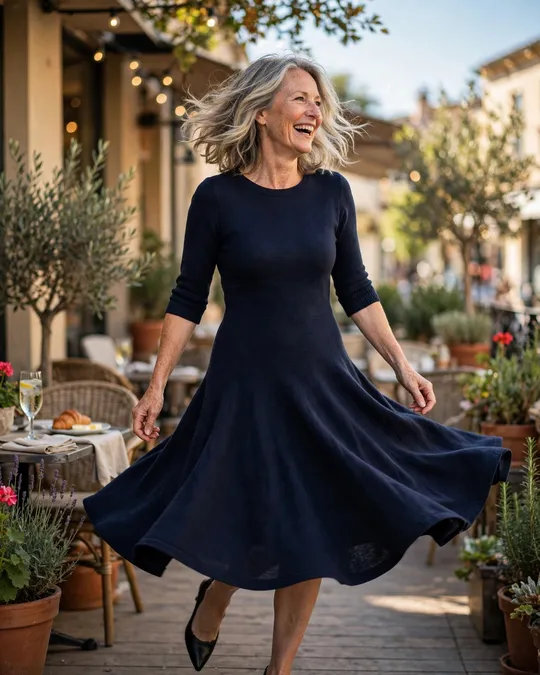
One-piece dressing removes every proportion decision from the morning: no tuck to judge, no hem-to-top ratio to balance, no waistband to negotiate. The mechanism is continuity — a single column of colour from shoulder to calf reads as one long line, which is why a simple knit dress looks pulled-together with flat shoes and no jewellery at all.
The knit is doing quiet work underneath: ponte or a good viscose blend skims the body without clinging, holds its shape through a full day of sitting, and forgives the tummy in a way woven dresses never do.
The numbers: 90–100 cm from shoulder to hem (midi, ending mid-calf on most heights), elbow or three-quarter sleeves to cover the upper arm, and a neckline at or above the collarbone. Own two — one dark (navy or black), one colour you love — and the dress handles everything from desk to dinner.
- Fabric: ponte or viscose-blend knit — skims, never clings
- Length: 90–100 cm, mid-calf; sleeves to elbow or 3/4
- Neckline: at or above the collarbone — boat, crew or shallow V
- Own two: one dark neutral, one in your best colour
Do this: sit down in it before you buy — if the skirt rides up or the knit pulls across the hips seated, the cut is wrong for your day, not just the mirror.
How to wear it:
- Add the pointed flat (#8) and walk out — the dress needs nothing else on an ordinary day.
- Throw the blazer (#7) over the shoulders for evening; the structured shoulder against soft knit is the whole look.
- Belt it at the natural waist with a slim belt when you want shape — 3 cm wide, no wider, or it cuts you in half.
- Layer the everyday jacket (#10) over it in cold weather; the midi hem under a mid-thigh coat is the right proportion.
Skip it if … the knit is thin enough to show every line underneath — hold it up to the shop light; if you can see through it, it will show everything in daylight too.
Best for: the days you want to look dressed with one decision — work, travel, dinners, funerals, weddings.
Good to know
The 3-colour rule keeps this list cheap: build 80 per cent of your ten in three neutrals that suit you — for most women over 50 that is navy, black and ivory or grey — and spend the colour budget on the remaining 20 per cent.
Ten pieces in three neutrals make roughly 30 outfits; ten pieces in ten colours make about ten.
6. The cashmere crew sweater

Cheap knit adds visual bulk; fine knit removes it. The mechanism is drape: a 2-ply cashmere or cashmere-merino knit falls in a clean line from shoulder to hip instead of standing away from the body, so the sweater reads as a layer, not a lump.
That drape is also why it layers so well — under the blazer without bunching, over the button-down with just the collar and cuffs showing, half-tucked into jeans without the dreaded shelf of fabric at the waist. Crew neckline at the collarbone, hip length, sleeves to the wrist bone.
The care rule is non-negotiable: fold, never hang (hangers stretch the shoulders in a week), wash by hand in cool water twice a season, and a cashmere comb removes pilling in 5 minutes. Bought well, it lasts a decade; bought thin, it pills by Christmas.
- Fabric: 2-ply cashmere or cashmere-merino; fine gauge, not chunky
- Fit: hip length, crew at the collarbone, sleeves to the wrist
- Care: fold always; hand-wash cool, comb out pilling
- Own two: one neutral, one in a colour that flatters your face
Do this: scrunch a handful of the knit in your fist for 10 seconds — if the wrinkles fall out on their own, the ply is good; if they stay, walk away.
How to wear it:
- Half-tuck into the dark jeans (#3) with the pointed flat (#8) — the weekend uniform that looks intentional.
- Layer over the button-down (#2) so collar and cuffs show; the two textures together look expensive.
Skip it if … it is labelled cashmere but feels rough against your cheek — low-grade cashmere pills faster than good merino, and a 100% merino crew at half the price will outlast it.
Best for: the cold-weather workhorse — October to April, layered under everything on this list.
7. The black or navy blazer

This is the piece with the highest return on the list. The mechanism is structure: a defined shoulder, a notched lapel and a nipped waist turn a tee and jeans into an outfit in the 30 seconds it takes to put on, because tailoring signals intention the way nothing else does.
Single-breasted, one or two buttons, length covering the seat (about 70 cm from the shoulder) — that length works over both trousers and the midi dress without cutting the leg line. The shoulder seam must sit exactly on your shoulder; everything else can be altered, but a dropped or pinched shoulder cannot be fixed.
Navy is the friendlier choice for most wardrobes (it pairs with black, brown and grey); black is the sharper one. One is enough — this is the piece you will reach for 200 days a year, so buy the best construction your budget allows and have the sleeves shortened if needed.
The dress on your essentials list should work three ways at least — our dresses for women over 50 collect the shapes that dress up and down without fuss.- Cut: single-breasted, 1–2 buttons, structured shoulder on the shoulder
- Length: covering the seat, about 70 cm from shoulder
- Colour: navy for versatility, black for sharpness — one only
- Alterations: sleeves shortened (£10–£15) is normal; shoulders never
Do this: put it on over a tee and jeans in the shop — if you do not instantly look 20 per cent sharper, it is the wrong blazer, not the wrong you.
How to wear it:
- Over the white tee (#1) and dark jeans (#3) — the fastest smart-casual outfit in existence.
- Over the knit midi dress (#5) for evening; push the sleeves to show the dress’s sleeves beneath.
- With the tailored trouser (#4) and button-down (#2) when the day needs to look serious.
Skip it if … the button pulls when fastened — a blazer should close without strain, and the next size with the waist taken in is always better than a tight one.
Best for: everything you want to look deliberate — work, dinners, travel, the days you need armour.
Step 4: Finish with shoes, bags and the third piece
The problem: the clothes are right, but the outfit still looks unfinished. The fix is the last 10 per cent — the shoes that extend the leg, the bag that holds the day, and the jacket that turns two pieces into a look.
Buy these last, because a nude flat chosen to match jeans you own will always beat a beautiful shoe bought for a wardrobe that does not exist yet.
8. The pointed flat (or low heel)
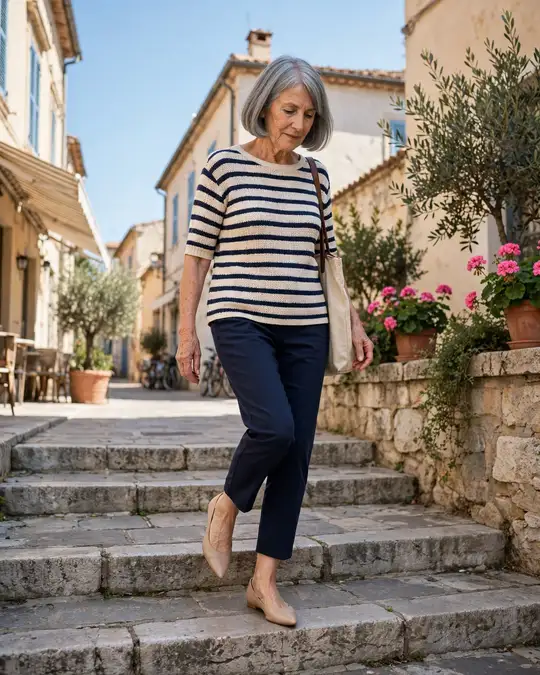
A pointed toe adds 3–5 cm of visible leg line without a single centimetre of heel — the eye follows the point and keeps going, which is why pointed flats read as elongating while round toes read as stopping.
That is the whole reason this shoe earns its place: it does the work of a heel with the comfort of a flat.
The specification: a low, almond-to-pointed toe (not a stiletto point, which looks dated), a heel of 5 cm or under if you choose the heeled version, and a colour that disappears against your leg — a nude-for-you shade in summer, black in winter. Leather, not synthetic, because a daily shoe in plastic will not survive a season of real walking.
Two pairs in rotation last three times as long as one pair worn daily, since leather needs 24 hours to dry out and recover its shape between wears.
- Toe: low almond-to-pointed — elongates, never costume
- Heel: flat, or 5 cm maximum for the heeled version
- Colour: nude-for-you in summer, black in winter
- Own two pairs: rotated daily, leather recovers between wears
Do this: shop for shoes after 3 pm — feet swell through the day, and a shoe that fits at 10 am will pinch by dinner.
How to wear it:
- With the dark jeans (#3) and a half-tucked sweater (#6) — the leg line runs unbroken from hip to toe.
- With the knit midi dress (#5) for day; swap to the low heel for evening and the dress does both.
- Match the nude shade to your skin, not the outfit — a disappearing shoe goes with everything.
- Keep the black pair for the tailored trouser (#4); the nude pair for jeans and dresses.
Skip it if … your heel slips out when you walk — a gaping heel means the last is wrong for your foot, and heel grips are a patch, not a fix.
Best for: the daily shoe — 8,000-step days, travel, everything except the muddiest walk.
9. The structured medium bag

A slouchy bag relaxes an outfit; a structured bag sharpens it — and since nine of the ten pieces on this list lean casual, the bag is doing deliberate counterweight work.
The mechanism is geometry: clean lines and a firm base read as intention, the same way the blazer’s shoulder does, so the bag lifts jeans-and-tee days without any extra effort. The numbers: 25–30 cm wide, big enough for phone, wallet, glasses, keys and a small diary, small enough not to swallow you.
A structured base so it stands up on its own, a top handle plus a crossbody strap so it works over a coat, and hardware in one metal only. One good medium bag in tan or black covers day to evening; a second in the other colour is a luxury, not a need.
- Size: 25–30 cm wide — fits the day, never swallows you
- Structure: firm base, stands alone; top handle plus crossbody strap
- Colour: tan or black first; the other is optional
- Hardware: one metal throughout — mixed metals look accidental
Do this: load it with your actual daily carry in the shop — if your phone, wallet, glasses and keys do not all fit with room to close it, it is the wrong bag.
- Carry it by the top handle with the blazer (#7) — the two structured pieces echo each other.
- Switch to the crossbody strap for travel and market days; a bag that adapts earns its keep.
Skip it if … it needs two hands to open — a bag you fight at the till is a bag you will leave at home.
Best for: the one bag that does day, evening and travel without changing.
10. The everyday trench or utility jacket
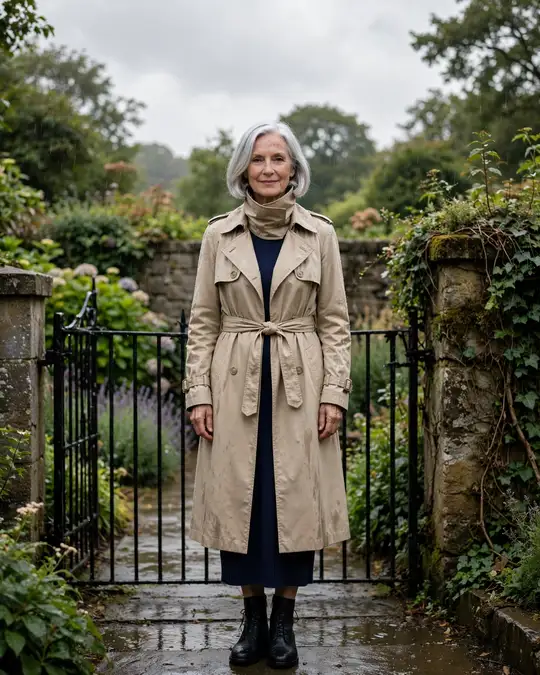
Stylists call it the third piece, and it is the difference between “dressed” and “finished”. The mechanism is framing: a jacket worn open creates two long vertical lines down the front of the body, which narrows the silhouette and gives every outfit underneath a deliberate edge.
A classic trench does it with polish — water-resistant cotton gabardine, mid-thigh length (about 85 cm), belted waist, storm flap and horn-effect buttons. A utility jacket does it with ease — olive or stone, drawstring or belted waist, patch pockets that actually hold a phone. Either one works over all nine other pieces; the choice is temperament, not rules.
Buy it roomy enough to layer over the blazer, because the coldest months are when the third piece matters most.
- Length: mid-thigh, about 85 cm — covers the blazer, shows the leg
- Waist: belted or drawstring — definition, not bulk
- Fit: roomy enough to layer over the blazer (#7)
- Own one: trench for polish, utility for ease — temperament decides
Do this: try it on over your bulkiest layer — if you cannot comfortably close it over the blazer, size up; a third piece that only fits over a tee is useless half the year.
How to wear it:
- Belt it over the knit midi dress (#5) — the defined waist against the soft dress is the classic pairing.
- Wear it open over jeans (#3), tee (#1) and blazer (#7) — three layers, one weatherproof finish.
- Push the sleeves to the elbow in spring; the forearm showing keeps a long coat from overwhelming a petite frame.
Skip it if … the shoulders pull when you reach forward — a jacket that fights you over layers will live in the wardrobe unworn.
Best for: the finishing layer, nine months of the year — rain, wind, and the days in between.
Keep your 10 essentials working all year
Owning the ten is the easy half; keeping them earning their hangers is the other. These are the habits that keep a complete wardrobe list for older women from quietly expanding into forty pieces again.
- Audit the ten every spring and autumn — 20 minutes, one question per piece: did I wear it this season?
- Replace tees the month the neckline ripples; do not wait until they look tired in photos.
- Keep a running gaps list on your phone — buy only what is on it, never what catches your eye.
- Steam knits and blazers after wearing; wash less, air more — most pieces need washing half as often as you think.
- Photograph your five best outfits from this list and save them in a phone album — the morning decision disappears.
- When a piece wears out, replace it with the same spec, not a “nicer” version — the spec is what worked.
The seasonal 20-minute reset:
- Pull out all ten pieces and lay them on the bed — the full list, visible at once.
- Check each against its quick-facts box: necklines, hems, knees, elbows, soles.
- Move anything tired to the replace list with its exact spec written down.
- Re-hang by step — base, bottoms, middles, finishers — so the wardrobe reads like the list.
The bottom line
If I had to pick one piece from this list, it is the blazer — #7. It is the only item here that changes how every other item behaves: jeans become an outfit, the dress becomes evening, the trousers become deliberate.
Buy it first if your budget only stretches to one thing this month, and buy it well — it will be the hardest-working thing you own.
Pin this checklist to your wardrobe board before your next clear-out — ten pieces, four steps, and mornings that finally run themselves.
Frequently asked questions
How many wardrobe essentials does a woman over 50 really need?
Ten, done properly. This wardrobe essentials for women over 50 checklist is built on the maths: ten pieces in three neutrals make roughly 30 outfits, because each piece works with most of the others. If your life is mostly casual, you can run the list at eight — drop the tailored trouser and the heel.
If you work full-time in an office, add two blouses, not two new categories. The number is a ceiling, not a target.
I hate jeans. What can I wear instead of the straight-leg jean?
Swap in a second tailored trouser in a different neutral — navy if your first pair is black — and add a dark ponte pull-on trouser for the casual days. You lose nothing: the checklist’s logic is one relaxed bottom and one sharp bottom, and the fabric is negotiable.
What is not negotiable is the dark, even colour and the clean leg line, whatever the garment.
What colours should my ten essentials be?
Mostly three neutrals that suit your colouring — for many women over 50 that is navy, black and ivory or grey — with one or two pieces in a colour you love. Keep the big, expensive pieces (blazer, bag, coat) neutral and put the colour in the cheaper, replaceable pieces (tee, sweater).
If you are unsure which neutrals flatter you, settle it before you shop: the wrong neutral in a blazer is a £150 mistake, the wrong neutral in a tee is a £20 one.
Can I build this list on a tight budget?
Yes — spend where construction matters and save where it does not. The blazer and the bag deserve the biggest share of the budget because tailoring and hardware cannot be faked; tees, the button-down and jeans can come from the high street at £20–£50 without losing anything, as long as the specs in the quick-facts boxes are met.
Build it over three months, one step per month, and the cost spreads itself.
How do I stop this ten-piece list becoming forty pieces?
The one-in-one-out rule: a new piece only comes home if an old one leaves the same week. It works because it forces the comparison — is this new sweater better than the one it replaces, honestly? If yes, the old one goes; if no, the new one stays in the shop.
The seasonal 20-minute reset above is the enforcement mechanism. Without the rule, every checklist becomes a wish list within a year.
My size has changed. Should I rebuild the whole list?
Adapt it, do not rebuild it. The ten categories do not change with size — the specs just move with you. Buy the two bottoms and the blazer in your current size first, because fit is where a size change shows most; the knits and the bag usually carry over.
Give yourself one full season before deciding anything is “wrong” — bodies settle, and a checklist bought in a transition month is a checklist bought twice.