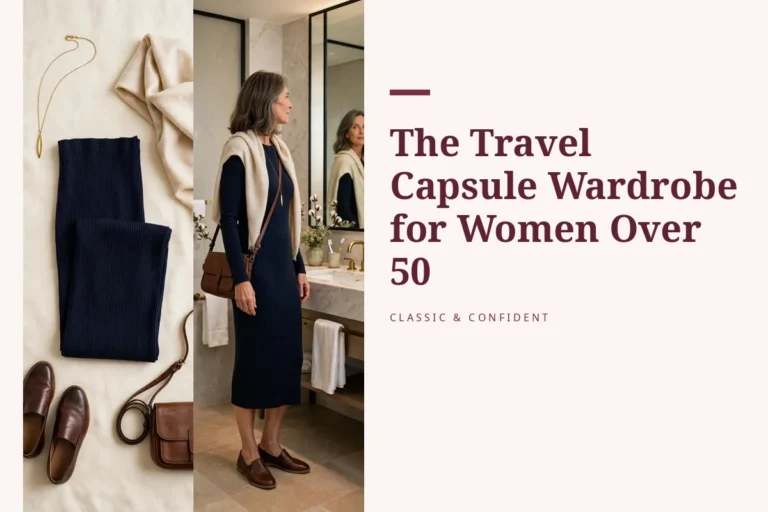
The Capsule Wardrobe for Women Over 50

Picture two women getting dressed at eight in the morning. The first opens a wardrobe of 200 pieces, stands there for twenty minutes trying things on and taking them off, and leaves the house in something she already regrets.
The second opens a wardrobe of 24 pieces — every one of them chosen to work with the rest — and is dressed in seven minutes flat, looking better than the first. That second woman owns a capsule wardrobe for women over 50.
This guide builds yours piece by piece: eight formulas, each anchored to one hero piece, grouped by the length it lands at — above the waist, at the knee, past the knee — so you can see at a glance which lengths your own wardrobe is missing and which formulas will fill them.
The maths is what sells it. When every piece shares a palette of three neutrals plus two accents, and every top fits every bottom, 24 pieces stop being 24 outfits and start being sixty or more. Most of us wear 20% of our wardrobe 80% of the time — a capsule simply makes that 20% the whole wardrobe.
If your closet is full but your mornings are empty, start here: building the full system usually costs what you’d spend on two or three good outfits, and most women over 50 already own half of what they need, so the real spend to fill the gaps is often under $200.
Fast answers
- The cropped jacket formula (#1) — the polish piece that finishes everything
- The knee sheath dress (#3) — the one-and-done for days you can’t think
- The palazzo trouser (#6) — the comfort win that looks like effort
- The longline coat (#8) — the instant outfit over anything underneath
- The shirt dress (#5) — the summer-to-fall bridge piece
- The waist-length silk blouse (#2) — the tucked-in staple that never pills
Contents
How to build a capsule wardrobe for women over 50
Start with your palette, not your pieces. Pick three neutrals (navy, camel and cream will do most of the work) and two accents (burgundy and olive, say) before you buy a single thing. Every formula below assumes this discipline — it is the reason a cream sweater works with six bottoms instead of one.
Audit before you shop. Pull out the ten things you actually wore last month and lay them on the bed. The lengths that repeat — that’s your real life talking.
Fill the missing lengths from the groups below rather than buying more of what you already own; most of us are short on the long pieces and drowning in the short ones. If your everyday rotation still needs season-proofing, start with winter outfits for women over 50 and build the capsule around what survives October.
Fit beats fashion at every price. A $60 trouser hemmed to the right length out-dresses a $300 one that pools at the shoe. In a capsule, each piece gets worn thirty to fifty times, so the tailoring math is absurdly generous: $25 to shorten sleeves on a jacket you’ll wear forty times costs 60 cents a wear.
Shoes set the limit. Three pairs carry a whole capsule — a pointed flat, a block-heel ankle boot (4–5 cm), and a clean white sneaker. If a formula only works with one specific shoe, it doesn’t belong in the capsule; every outfit below is built to survive at least two of the three.
For the dressed-up end of the rotation, see classy outfits for women over 50.
Budget by cost-per-wear. A $150 coat worn 60 times costs $2.50 a wear; a $40 top worn twice costs $20. Spend where the formula demands structure (jackets, coats, trousers) and save where it only needs colour (shells, scarves).
The dress formulas are the easiest place to practise this — dresses for women over 50 shows which silhouettes earn their keep.
The 8 formulas at a glance
| Formula | The one piece to buy | Multiplies with | Budget note |
|---|---|---|---|
| 1. The Cropped Bouclé Jacket | Waist-length jacket, 38–42 cm back | 5+ bottoms, any shell | Worth tailoring — the workhorse |
| 2. The Waist-Length Silk Blouse | Untucked-able blouse | Every trouser and skirt here | Buy the real thing; it outlasts polyester 3:1 |
| 3. The Knee-Length Sheath Dress | One dress, knee-skimming | Coat #8, jacket #1, boots or flats | Highest cost-per-wear of the eight |
| 4. The A-Line Midi Skirt | Waist-defining flare | Blouse #2, sweater, boots, flats | Easy secondhand win — the cut is timeless |
| 5. The Knee-Length Shirt Dress | Belted button-front | Boots, flats, coat #8 over the top | One piece, three seasons |
| 6. The Wide-Leg Palazzo Trouser | Full-length, high rise | Blouse #2, jacket #1, shell tops | Hem to the shoe, not the floor |
| 7. The Maxi Column Dress | Head-to-toe one colour | Coat #8, jacket #1 over the top | Zero styling effort required |
| 8. The Longline Wool Coat | Hip-grazing-plus, knee or below | Literally everything above | Buy once, wear for a decade |
Above the waist: pieces that end short
These two set the structure of the capsule. Everything below them hangs on the line they draw — get the short pieces right and the long pieces take care of themselves.
If this feels like unfamiliar territory, How to Wear Silk Over 50 is a gentle, practical place to start.1. The Cropped Bouclé Jacket
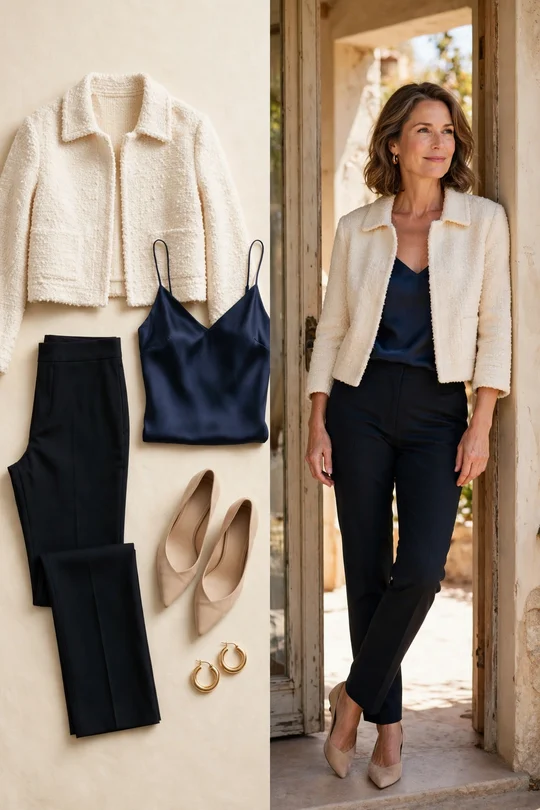
A jacket that ends exactly at the waistband draws a hard horizontal line where the trousers begin, and that line reads as proportion instead of bulk. Cropped cuts hand you back 5–8 cm of perceived leg length compared with hip-length jackets, because the eye starts measuring the leg from the waist instead of from the jacket’s hem.
Bouclé’s nubby texture does a second job: it breaks up the flat light that makes dark jackets look severe after 50.
This is the formula that makes the capsule look deliberate. Throw it over a shell and trousers and you look dressed; throw it over a dress and you look finished. One jacket, worn open or closed, multiplies across at least five of the other formulas.
- Key pieces: cropped bouclé jacket, silk shell, high-rise straight trouser
- Shoes: pointed flats or 4–5 cm block heels
- Occasion: dinners, events, anything that needs polish
- Budget tip: the one piece worth tailoring — sleeve shortening pays for itself in 10 wears
Shop for: a boxy cropped jacket with the back hem hitting exactly at your waistband — measure 38–42 cm from the nape for most women between 5’3″ and 5’7″ — bracelet-length sleeves, patch pockets optional, in cream or navy bouclé.
How to wear it:
- Wear it open over a shell in the same colour family — the open front draws a vertical line down the torso, which is where the lengthening happens.
- Push the sleeves to just below the elbow. A flash of wrist slims the arm and shows the bracelet sleeve was a choice, not an accident.
- Keep the trouser high-rise and flat-fronted; a tucked shell with a low-rise waistband breaks the line this jacket is building.
Skip it if you run cold and need real outerwear — this is a finishing layer, not a coat, and it won’t replace one.
Best for: evenings and events where a blazer feels corporate but you still want structure.
2. The Waist-Length Silk Blouse
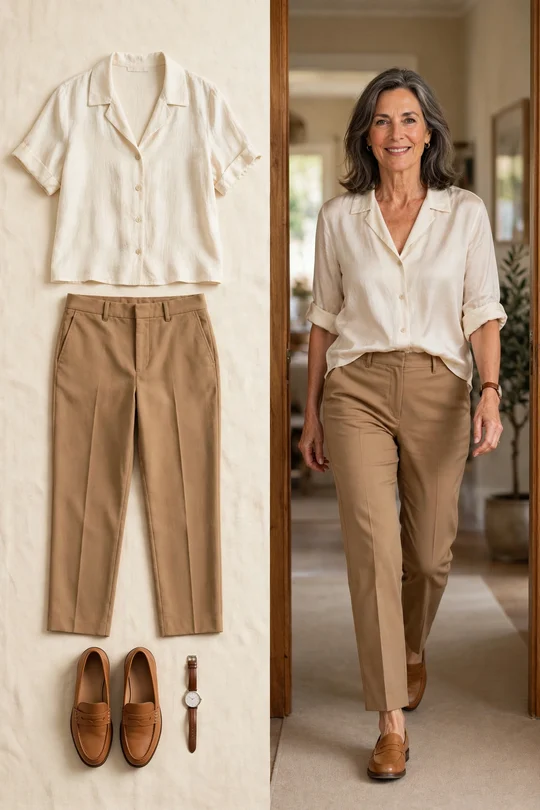
Silk’s weight is the mechanism: it falls straight from the shoulder and skims past the waistband instead of clinging to it, which means a blouse that ends at the waist can be worn untucked without the tent effect that makes most untucked tops look sloppy after 50.
The hem stops exactly where the leg line starts, so the torso reads contained and the legs read long. A silk blouse also outlasts polyester three to one — it keeps its surface and its drape through hundreds of wears instead of pilling by the dozen.
This is the tucked-in staple of the capsule: it goes under the jacket, inside the trousers, over the skirt waistband. Buy it in cream first, then in your accent colour.
- Key pieces: waist-length silk blouse, straight trouser or midi skirt
- Shoes: pointed flats, loafers, or low heels
- Occasion: office, lunches, anything daytime-polished
- Budget tip: buy the real thing once rather than the copy three times
Shop for: a sandwashed silk blouse with a camp collar or small point collar, back length 60–64 cm so it clears the waistband untucked, in cream first and burgundy second.
How to wear it:
- Do the half-tuck — front 10 cm tucked, the rest loose. It marks the waist without the fussy full tuck that pulls at the hips.
- Roll the sleeves twice to three-quarter length; the forearm showing balances the blouse’s softness with a bit of edge.
Skip it if you hate hand-washing — silk needs a gentle cycle in a mesh bag or a sink wash, and machine-dried silk dies young.
Best for: daytime polish, office days, and every formula in this guide that needs a top.
At the knee: the midi pieces
The knee is the most forgiving landmark on the leg — it is where skirts and dresses can end without arguing with your proportions. These three are the workhorses: worn more often than anything else in the capsule.
3. The Knee-Length Sheath Dress

A sheath that ends at the top of the knee shows the slimmest part of the leg — the few centimetres just below the kneecap — so the eye reads leg, not thigh. The close fit through the torso does the tailoring work a jacket would do, which is why this is the one-and-done formula: dress, shoes, done, no decisions.
In a capsule wardrobe for women over 50 it earns the highest cost-per-wear of all eight formulas, because it covers work, events and dinners with zero styling effort.
Navy is the first buy — it photographs well, hides everything, and takes any shoe from sneaker to heel.
- Key pieces: knee-length sheath dress, cropped jacket or longline coat over the top
- Shoes: pointed flats by day, block heels by night
- Occasion: work, dinners, events — the default dress
- Budget tip: the hem is everything — budget $15 for the tailor to set it exactly at the knee
Shop for: a ponte or double-knit sheath with 3–5% elastane, boat or scoop neckline, hem hitting the top of the kneecap, fully lined, in navy first.
How to wear it:
- Check the hem in the mirror seated — it should still cover the knee when you sit. If it rides more than 5 cm above, size up.
- Add the cropped jacket (#1) for evenings; the two hemlines — jacket at waist, dress at knee — frame the torso in thirds, which is the classic proportion trick.
- One piece of jewellery at the neckline, nothing at the wrist — the sheath is clean, so edit the accessories to match.
- For day-to-night, swap flats for heels and add a lip colour; the dress does the rest.
Skip it if you hate fitted skirts when seated — the sheath is honest about the hip, and no amount of fabric fixes that if it bothers you.
Best for: the days you can’t think — one piece, two minutes, fully dressed.
4. The A-Line Midi Skirt

An A-line cut flares from the waist and releases over the hip and thigh without the fabric ever touching them, which is why it skims every body shape instead of fitting only some. The waist stays defined — the one place most of us can still show shape — while everything below moves freely.
It is the most forgiving silhouette in the capsule and the easiest to find secondhand, because the cut hasn’t changed in forty years.
Pair it with the waist-length blouse and the line from shoulder to hem never breaks — the blouse ends where the skirt begins.
- Key pieces: A-line midi skirt, waist-length blouse or fine-knit sweater
- Shoes: knee-high boots in winter, pointed flats in summer
- Occasion: office, weekends, travel days
- Budget tip: the easiest secondhand win in this guide — the cut is timeless
Shop for: a high-waisted A-line skirt with the hem 5–8 cm below the knee, side zip (no back vent pulling), in camel twill or navy crepe.
How to wear it:
- Tuck the blouse fully — the skirt’s waistband is the star here, so show all of it.
- Match the boot or shoe colour to the skirt in winter; the unbroken colour line adds the length the flare takes away.
Skip it if you’re very petite and hate volume — the flare can read as more skirt than you; choose the sheath (#3) instead.
Best for: days when comfort matters but sweatpants aren’t an option.
5. The Knee-Length Shirt Dress

The button front is the mechanism: a single vertical line of buttons draws the eye straight down the torso, which lengthens it, while the belted waist marks the narrowest point. It is a dress and a jacket-layer in one — wear it alone in September, under the longline coat in November, open over trousers as a duster in between.
One piece, three seasons, which is exactly the kind of arithmetic a capsule demands.
Stripes are the classic, but a solid olive or burgundy reads more expensive and stains less visibly.
- Key pieces: belted shirt dress, knee boots or flats
- Shoes: knee-high boots, white sneakers, pointed flats
- Occasion: travel, weekends, smart-casual workplaces
- Budget tip: one piece covering three seasons — buy the best fabric you can
Shop for: a shirt dress with a real collar (not a band), self belt, buttons that run the full length, hem at the knee, in olive cotton-poplin or burgundy tencel.
How to wear it:
- Belt it at your natural waist — not the hips — and blouse the fabric 3–4 cm above the belt so the waist looks defined, not cinched.
- Undo the top two buttons and fold the collar open; the V at the neck lengthens the face and shows a necklace.
- In cold weather, layer the longline coat (#8) over the top and let the dress hem show 10–15 cm below the coat — the layered lengths look intentional.
Skip it if you’re large-busted and hate gaping — the button front needs a well-placed button at the bust or tailoring to sit flat.
Best for: travel days and shoulder seasons, when one piece has to do the work of three.
Good to know
The rule that makes all eight formulas work is the rule of three colours: never wear more than three colours at once, and make sure two of them are your neutrals. It is the difference between “capsule” and “random clothes that happen to match.”
Photograph your five favourite combinations the first week and save them to a “capsule formulas” board on Pinterest — on rushed mornings you’ll dress from the photos, not the closet.
Past the knee: the long pieces
Long pieces are the capsule’s secret weapon: they cover everything underneath, which means they forgive whatever’s going on below. These three are why the system works on bad days too.
6. The Wide-Leg Palazzo Trouser
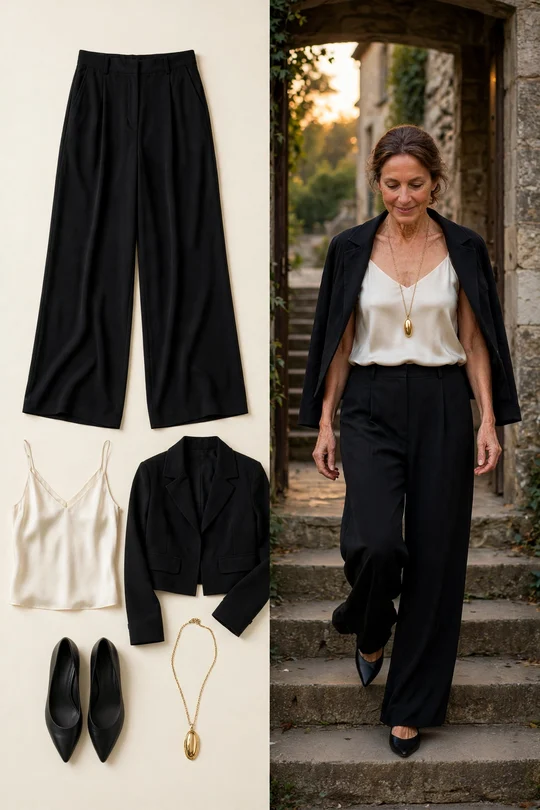
A trouser that falls straight from the hip in one unbroken column adds 5 cm or more of perceived height, because there is no taper, no crop and no break to stop the eye. The width does the balancing: it matches the shoulder line, so the silhouette reads even instead of top-heavy.
And the comfort is real — a palazzo in fluid crepe moves like a skirt and sits like pyjamas, which is why this formula gets worn on the days nothing else appeals.
The rise matters more than the width: high-rise, flat front, worn with the waist-length blouse half-tucked.
- Key pieces: high-rise palazzo trouser, waist-length blouse or shell
- Shoes: pointed flats or low block heels — the hem should kiss the shoe
- Occasion: evenings, events, long days when comfort wins
- Budget tip: hem to the shoe, not the floor — pooling fabric kills the column effect
Shop for: a high-rise palazzo in fluid crepe or heavy satin-back, full length with a 2–3 cm break at most, in black or navy — the dark colour keeps the column unbroken.
How to wear it:
- Keep the top fitted and short — the blouse (#2) or a shell. Volume below needs containment above, or the outfit wears you.
- Show a pointed toe. The shoe peeking from under the hem extends the leg line by another few centimetres.
- Add the cropped jacket (#1) for evening; the short jacket over the long trouser is the proportion contrast that makes the whole thing look styled.
- Steam, don’t iron — crepe relaxes with steam and the column stays clean.
Skip it if you’re under 5’2″ and hate hemming — the palazzo only works at full length, and that means the tailor.
Best for: evenings and events when you want to look formal and feel like you’re in pyjamas.
7. The Maxi Column Dress

One colour, one line, head to toe: the maxi column is the longest unbroken line you can wear, and unbroken lines read as elegant with zero effort. There is no waistband to manage, no tuck to maintain, no hem to check — the dress is the outfit.
In dark burgundy or forest green it does evening; in black with good jewellery it does everything.
The trick is the shoulder: a defined shoulder — a small pad, a clean seam — keeps the column from reading as a nightgown.
- Key pieces: maxi column dress in one colour, statement earrings or necklace
- Shoes: heeled sandal or pointed flat — the hem should just graze
- Occasion: weddings, dinners, occasions that need one strong look
- Budget tip: zero styling effort means this is where cheap fabric shows — buy matte, not shiny
Shop for: a matte-jersey or crepe maxi with a defined shoulder seam, V or scoop neckline, hem grazing the top of the foot, in black, burgundy or forest green.
How to wear it:
- Put the jewellery on first — with one clean line of fabric, the accessories are the outfit’s personality.
- For daytime occasions, throw the cropped jacket (#1) over the shoulders; the short-over-long contrast keeps it from reading bridal.
Skip it if you need to move fast — stairs, cobbles and maxi hems are a negotiation, not a given.
Best for: occasions when you want one strong look and no decisions.
8. The Longline Wool Coat
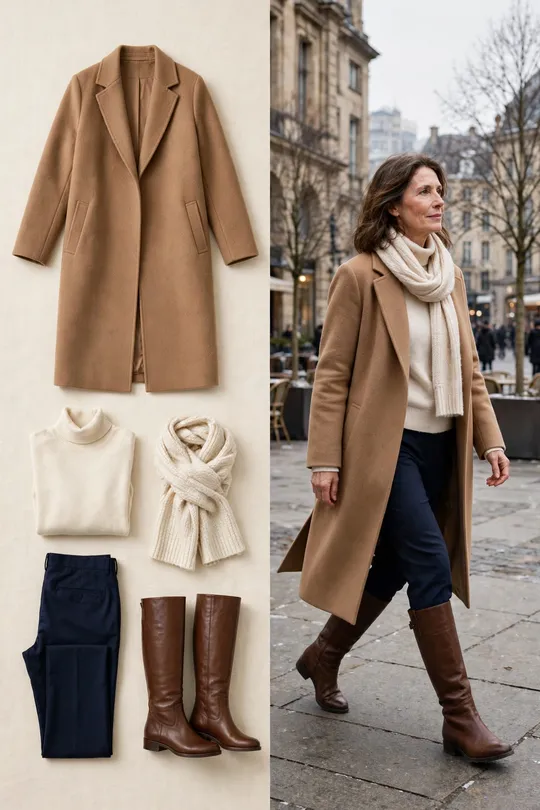
A coat that covers everything underneath turns any combination into an outfit — that is the whole mechanism. The long vertical front panels narrow the silhouette the way a frame narrows a picture, and because the coat is the first and last thing anyone sees, what you wore beneath it barely registers.
This is why the coat is the highest-impact single purchase in the capsule: it multiplies every formula it touches, including the ones you’d never leave the house in alone.
Camel is the classic for a reason — it lifts navy, black, burgundy and grey without competing — but charcoal is the harder-working neutral if your palette leans cool.
- Key pieces: longline wool coat, literally anything from this guide underneath
- Shoes: knee-high boots or clean sneakers — the coat carries the polish
- Occasion: every cold-weather day, dressed up or down
- Budget tip: buy once, wear for a decade — this is where the budget goes
Shop for: a single-breasted wool-blend coat (60%+ wool) with the hem at or just below the knee, notched lapel, in camel or charcoal — sized to close over the palazzo trouser without pulling.
How to wear it:
- Wear it open whenever the temperature allows — the open fronts frame the outfit underneath and double the vertical lines.
- Push the sleeves once to show 2–3 cm of cuff; it keeps the long coat from swallowing a smaller frame.
- Belt it loosely at the back with the coat’s own tie for shape on the days you want a waist — never belted tight at the front, which reads dated.
Skip it if you live somewhere warm year-round — the coat is dead weight in a capsule that never sees November.
Best for: every cold-weather day, and for making an ordinary outfit look considered in ten seconds.
Making the capsule work every day
A capsule only saves you time if you maintain it. These are the habits that keep the 24 pieces working instead of drifting back into a random closet.
- Hang by formula, not by type. Keep the jacket with its trousers and shells, the dress with its coat — when the combinations live together, you grab outfits, not pieces.
- One in, one out. Every new purchase has to earn its hanger by replacing something or filling a named gap. No named gap, no purchase.
- Steam on Sunday. Fifteen minutes with the steamer on the week’s five outfits beats emergency ironing every morning.
- Photograph the winners. When a combination gets a compliment, photograph it. In six months you’ll have a lookbook of twenty proven outfits and never think in the morning again.
- Repair, don’t replace. A $12 heel tip, a $20 hem, a replaced button — capsule pieces earn maintenance because you actually wear them.
- Review each season. Twice a year, try everything on. What didn’t get worn in six months leaves — even if you love it in theory.
The five-minute morning routine:
- Check the weather and pick your length — short pieces for mild days, long pieces for cold ones.
- Grab the formula, not the pieces — jacket-plus-trouser lives on one hanger, so it’s one grab.
- Shoes second, jewellery last — two decisions, thirty seconds each.
- Coat check at the door — if it’s cold, the longline coat goes over everything and you’re done.
When the weather turns cold, my list of winter wardrobe essentials for women over 50 shows which pieces earn a place in your capsule. And if you are packing for a trip abroad, the Europe travel capsule wardrobe for women over 50 uses the same idea to fit everything into one carry-on.
The bottom line
If I had to pick one formula, it would be the longline wool coat (#8) — it is the only piece here that improves outfits you already own, which makes it the cheapest way into the whole system. Buy the coat first, then build around it.
And the one I’d skip? The shirt dress (#5) — unless you already reach for dresses three days a week. It’s a lovely formula, but in a capsule every piece has to earn its hanger, and a dress you wear monthly doesn’t earn one.
Pin this guide to your “wardrobe reset” board before your next closet clear-out — the at-a-glance table is the shopping list, and the rule of three colours is the test every new purchase has to pass.
Frequently asked questions
How many pieces are in a capsule wardrobe for women over 50?
A working capsule runs 20–30 pieces including shoes and outerwear — the eight formulas in this guide cover the core, and most women add a second trouser, a knit or two, and seasonal swaps on top. Fewer than 15 and you’ll feel the gaps by week three; more than 35 and you’re back to a regular wardrobe with better intentions.
Start with the formulas, count what you already own against them, and buy only the missing lengths.
What colours work best for a capsule wardrobe over 50?
Three neutrals plus two accents is the formula that never fails: navy, camel and cream as the base, burgundy and olive (or forest green) as the accents.
If your skin runs cool, swap camel for grey and burgundy for plum; if you wear mostly black already, keep it but add cream — an all-black capsule photographs flat and reads severe in daylight.
Can I build a capsule wardrobe on a budget?
Yes — most women over 50 already own half of what’s needed, so the real spend is the gaps, often under $200. Spend where structure matters (the coat, the jacket, the trousers) and save on shells and scarves. Cost-per-wear is the only budget rule that matters: a $150 coat worn 60 times beats a $40 top worn twice.
I’m petite — do the same lengths work for me?
The formulas work, but the measurements shift: take 3–5 cm off every hem length given here, and be ruthless about the palazzo trouser (#6) — it only works at full length, so budget for the tailor or choose the straight trouser from formula #1’s companions instead.
The cropped jacket (#1) is your best friend at 5’2″ and under; the maxi dress (#7) needs the most careful hemming.
What if I’m plus size — does a capsule still work?
It works better, because the capsule is built on proportion rules rather than trends. The A-line skirt (#4) and the palazzo trouser (#6) are the most forgiving silhouettes here; size up in the sheath dress (#3) and have the waist taken in rather than squeezing into the smaller size.
The only formula to treat carefully is the tucked blouse (#2) — choose the half-tuck and a fluid fabric so nothing pulls.
Does a capsule wardrobe work year-round?
The eight formulas cover roughly nine months; summer needs two swaps — a sleeveless shell for the blouse and sandals for the boots. Everything else layers: the shirt dress works alone in September and under the longline coat in November.
If you live somewhere with a real winter, add a heavier knit and call the capsule done — the structure doesn’t change, only the insulation.
How often should I replace capsule pieces?
Wool coats and jackets: 8–10 years with brushing and airing. Trousers: 3–4 years before the seat shines. Silk blouses: 4–5 years if you rotate two.
Knitwear pills fastest — budget a replacement knit every two seasons. Review the whole capsule twice a year and retire anything you haven’t worn in six months, no matter how much you paid for it.
Where do I start if my closet is already full?
Don’t purge first — build first. Lay the eight formulas out as a checklist and tick what you already own; most women find they own five or six of the eight.
Buy only the missing one or two pieces, wear the system for a month, and then the purge becomes obvious — the things you stopped reaching for will be staring at you. One in, one out from that day on.