
20 Plus Size Outfits for Women Over 50
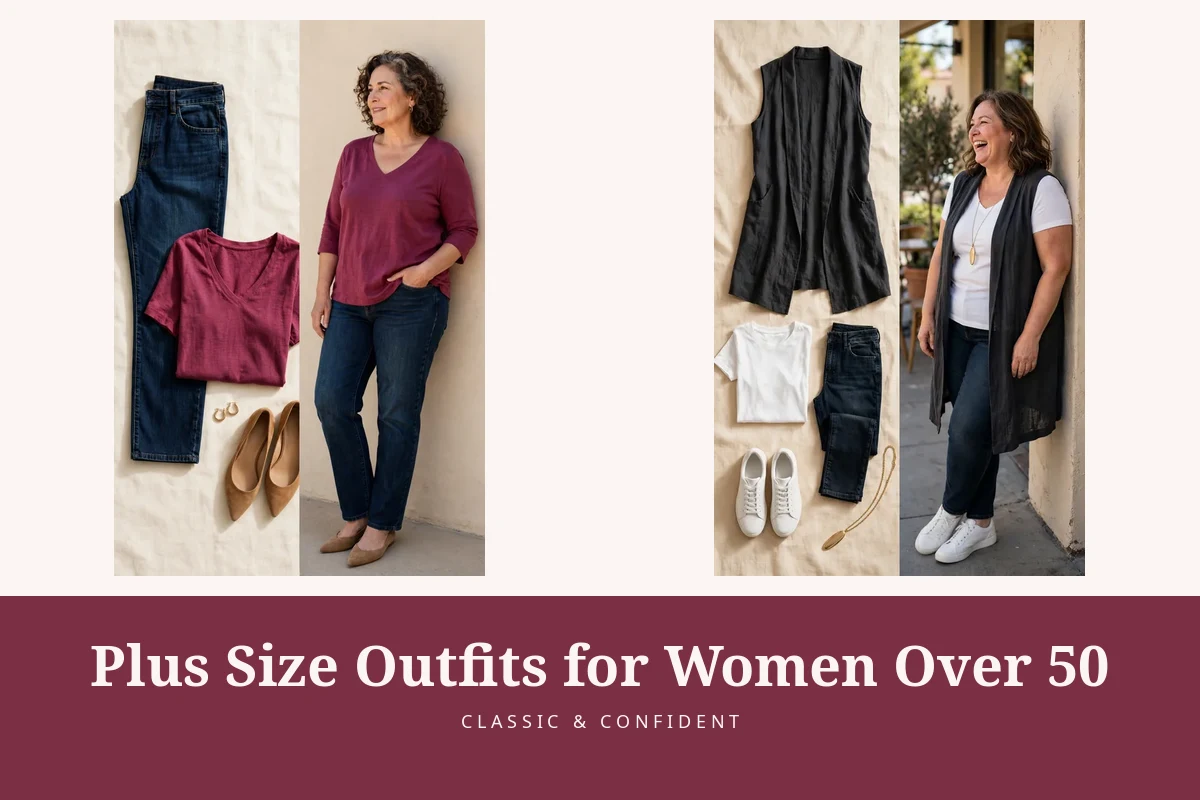
The most expensive mistake in plus size fashion for women over 50 has nothing to do with money. It is the “cover it up” reflex — reaching for everything two sizes too big, in the darkest colour available, and hoping to disappear.
Here is the problem: fabric that never touches you never shapes you, and a tent of jersey adds kilos your body does not actually carry.
The fix is not a diet, a shapewear drawer, or a £200 blazer. It is structure: a defined waist, a V-shaped neckline, and fabrics with enough body to skim instead of cling.
This list pairs the five most common fit problems I see with the outfit that solves each one — organised by what it costs, because good fit should not depend on a big budget. Every outfit below was chosen for a plus-size body in its fifties, photographed on one.
Quick picks
- Most saved: The True Wrap Dress (#6)
- Most saved: The Belted Shirt Dress (#5)
- Most saved: The Wide-Leg Trousers + Cropped Jacket (#7)
- Most saved: The Fit-and-Flare Midi Dress (#8)
- Most saved: The Longline Cardigan Layer (#2)
- Most saved: The Third-Piece Vest (#20)
Contents
- How to choose plus size fashion for women over 50
- At a glance
- The cling problem: under-$40 pieces that skim
- The boxy-coverup mistake: $40–$80 tailoring that defines your shape
- The one-occasion splurge: statement pieces worth paying more for
- The accessory afterthought: under-$30 finishers that lift everything
- Small fit tweaks, big payoff
- The bottom line
- Frequently asked questions
How to choose plus size fashion for women over 50
Fit beats size every time. Two women wearing the same “size 18” can look entirely different in it, because labels measure circumference, not proportion. If your bust, waist and hips sit in three different size brackets, buy for your largest measurement and tailor the rest — a £12 hem is cheaper than a wardrobe of almost-right.
Weight is a fit tool, not a luxury. Fabrics under 150 gsm (thin jersey, cheap chiffon) cling to the midsection and show every line underneath. Look for ponte, scuba-crepe, structured cotton-poplin and medium-weight knit — fabrics that hold their own shape for 30 cm away from your body.
Our winter guide for plus-size women leans on exactly these weights.
One defined point per outfit. A waist tie, a V-neckline, a cropped jacket ending at the hip bone — each outfit below builds in exactly one place where the eye lands. Two competing focal points (belted waist AND statement shoulders AND bold print) divide attention and add visual noise.
Pick one, let the rest be quiet.
Length is doing half the work. Tops that end at the widest point of the hip cut you in two; tops that end 5–8 cm above or below it skim past. Skirts that hit the knee’s narrowest point or 10 cm below it.
Trousers that break exactly at the ankle bone. If you build a tight capsule wardrobe around these lengths, everything starts matching.
Try the sit test. Whatever you are considering, sit down in the fitting room, cross your legs, and reach for something on a high shelf. If a button gaps, a waistband digs, or a hem rides more than 8 cm, the garment fails — no matter how good it looked standing still.
Comfort you can feel is confidence other people can see.
At a glance
| Outfit | Budget tier | The fit trick |
|---|---|---|
| 1. Dark stretch jeans + tunic | Under $40 | Tunic 72–75 cm skims the hip |
| 2. Longline cardigan layer | Under $40 | 85–90 cm line slims the torso |
| 3. A-line jersey skirt + tee | Under $40 | A-line clears the thigh |
| 4. Wrap-front top + ponte trousers | Under $40 | Diagonal line narrows the waist |
| 5. Belted shirt dress | Under $40 | Belt marks the natural waist |
| 6. True wrap dress | $40–$80 | Tie sits at the smallest point |
| 7. Wide-leg trousers + cropped jacket | $40–$80 | Crop ends above the hip |
| 8. Fit-and-flare midi dress | $40–$80 | Fitted bodice, skirt floats free |
| 9. Peplum blazer + slim trousers | $40–$80 | Peplum flares over the hip |
| 10. V-neck ponte jumpsuit | $40–$80 | One column, no waistband break |
| 11. Structured occasion blazer dress | $80+ | Tailoring holds the line all day |
| 12. Silk-blend blouse + palazzo trousers | $80+ | Fluid fabrics move, never cling |
| 13. Tailored trench, worn open | $80+ | Open front makes a long V |
| 14. Column skirt + statement top | $80+ | Narrow bottom, interest on top |
| 15. Evening wrap gown | $80+ | Floor line elongates everything |
| 16. Wide statement belt, reworn | Under $30 | One belt, five outfits defined |
| 17. Long pendant necklace | Under $30 | Vertical line down the torso |
| 18. Silk-print scarf layer | Under $30 | Colour at the face, drape over the rest |
| 19. Structured tote + pointed flats | Under $30 | Finish the silhouette cleanly |
| 20. The third-piece vest | Under $30 | Open vest = instant verticals |
The cling problem: under-$40 pieces that skim instead of stick
The problem with most budget clothing is not the price — it is the fabric weight. Thin, flimsy jersey collapses onto the body and maps everything underneath, which is why cheap tops so often look worse than their price tag suggests.
The five outfits below solve it the same way: medium-weight fabrics with a cut that floats 2–3 cm off the body instead of pressing against it.
1. The Dark Stretch-Jeans + Tunic Top Fix

A dark indigo jean works because the deep, even dye visually recedes — the leg reads as one unbroken column, especially with 2–3% elastane holding the shape through a full day of sitting.
The tunic does the real work: at 72–75 cm long it covers the hip and upper thigh, but because it skims rather than tents, the body’s outline stays readable instead of turning into a rectangle.
The mistake to avoid is a tunic that ends exactly at the widest point of the hip — that horizontal hem becomes a line the eye stops on, which is the opposite of slimming. Five centimetres longer and the hem falls past the curve; the silhouette reads longer and narrower for zero extra effort.
- Budget: under $40 for the pair
- Jean spec: mid-rise, straight leg, inseam 75–78 cm, dark indigo rinse
- Tunic length: 72–75 cm from shoulder, V or scoop neckline
- Fabric: medium-weight jersey or ponte, not thin viscose
Shop for: “mid-rise straight-leg jean, dark indigo, 2% elastane” and “tunic top, 74 cm long, V-neck, medium jersey” — bring a tape measure; labels lie about length.
How to wear it:
- Cuff the jean once, 4 cm, so the ankle bone shows — a visible ankle narrows the whole leg.
- Half-tuck the tunic’s front corner into the waistband to mark where your waist is.
- Add a flat shoe with a low vamp to extend the leg line.
Skip it if the tunic pulls across the bust when you sit — that means the shoulders are too narrow, and no amount of tugging will fix a too-small shoulder seam.
Best for: everyday errands, school runs, casual lunches — the uniform you will reach for four days a week.
2. The Longline Cardigan Layer

A longline cardigan works as optical tailoring: the two open front edges form a long vertical frame down the torso, and the eye follows verticals, which reads as length.
At 85–90 cm — hitting mid-thigh — it covers the hip and seat while the front opening keeps the body’s centre visible, so you get coverage without the tent effect of a closed, boxy layer.
Weight matters more here than anywhere in the budget tier. A cardigan in fine, drapey knit collapses and clings; one in a medium-weight knit with a ribbed hem holds its edges and keeps that slimming frame intact from morning to evening.
Hold the fabric up to the light in the shop — if you can read print through it, put it back.
- Budget: under $40
- Length: 85–90 cm, open front, no belt, no buttons
- Knit: medium-weight, fine-gauge; opaque when held to light
- Underneath: a column of one colour (top + trousers matching)
Shop for: “open-front longline cardigan, 88 cm, medium knit, waterfall or straight edge” — waterfall fronts drape softer over the bust.
How to wear it:
- Wear it over a same-colour top and trousers so the cardigan is the only contrasting layer.
- Push the sleeves to just below the elbow — a flash of wrist slims the arm.
- Let it hang open; never belt a longline cardigan, which breaks the vertical it creates.
- Steam the front edges once a week so they fall straight instead of curling.
Skip it if the back pulls into horizontal folds across the shoulder blades — the cardigan is too narrow and is fighting your frame instead of framing it.
Best for: office days, travel, and any outfit that needs one more layer to feel finished.
3. The A-Line Jersey Skirt + Fitted Tee
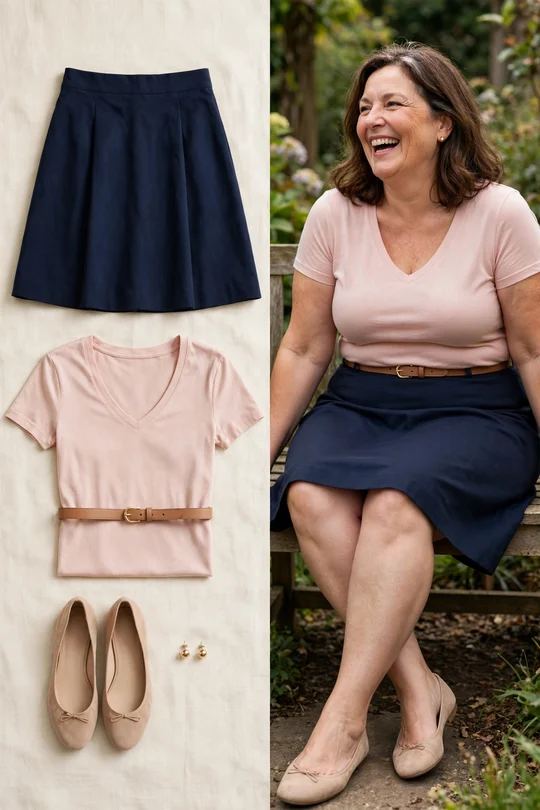
An A-line skirt is the rare garment that gets narrower at the top and wider at the bottom while making the wearer look slimmer — because the flare starts at the hip bone and clears the thigh completely, the leg emerges from fabric rather than being wrapped by it.
Pair it with a fitted (not tight) tee and the proportion reads: defined top, floating bottom, visible waist in between.
The skirt length decides everything. At 55–60 cm it hits just at or below the knee, the narrowest part of the lower leg, so the eye travels down an unbroken line from hip to ankle. Shorter, and the hem cuts the thigh at its widest; longer, and without a defined waist the column loses its shape.
- Budget: under $40 for the pair
- Skirt: A-line, 55–60 cm, waistband sits at the natural waist
- Tee: fitted crew or V-neck, medium jersey, tucked in
- Colours: skirt dark or printed, tee in a lighter solid
Shop for: “A-line skirt, knee length, natural-waist band” and “fitted V-neck tee, medium-weight cotton” — the tee must stay tucked after you sit; test it in the fitting room.
How to wear it:
- Tuck the tee fully and smooth it flat — a half-tuck with a skirt looks accidental.
- Add a slim belt in the skirt’s waistband if there are belt loops; it marks the narrowest point.
Skip it if the skirt’s waistband rolls or flips when you sit — it is cut too straight through the waist for your shape; an A-line still needs waist shaping to work.
Best for: warm-weather days, garden parties, and workplaces where trousers feel too casual.
4. The Wrap-Front Top + Ponte Trousers

A wrap-front top creates a diagonal line from shoulder to opposite waist, and diagonals are the hardest-working lines in dressing: they break the torso into asymmetric sections, which the eye reads as narrower than a horizontal hem ever could. The crossover also forms a V at the neckline, lengthening the neck and drawing attention up to the face.
Ponte trousers are the budget fabric hero — a double-knit with enough body to smooth the hip and thigh while stretching 15–20% for comfort. In a straight or gently tapered leg with a wide, flat waistband, they give the polish of tailored trousers without a single clasp digging in after lunch.
- Budget: under $40 for the pair
- Top: true wrap (not mock), ties at the natural waist, 3/4 sleeves
- Trousers: ponte, straight leg, ankle length, flat wide waistband
- Fit check: the wrap’s crossover must not gape when you lean forward
Shop for: “wrap-front top, true wrap tie, 3/4 sleeve” and “ponte ankle trousers, pull-on, flat waistband” — if the wrap is a mock wrap with a sewn crossover, the tie will not sit where your waist actually is.
How to wear it:
- Tie the wrap at your natural waist — find it by bending sideways; the crease is the spot.
- Tuck the top’s front hem 3 cm into the waistband so the diagonal continues into the trouser.
- Finish with a low block heel; the ankle trouser needs 4–5 cm of heel to keep the leg long.
Skip it if the crossover pulls open at the bust — size up and have the side seams taken in, or choose a top with a hidden snap at the crossover point.
Best for: dinners out, date nights, and any evening where you want polish without a dress.
5. The Belted Shirt Dress
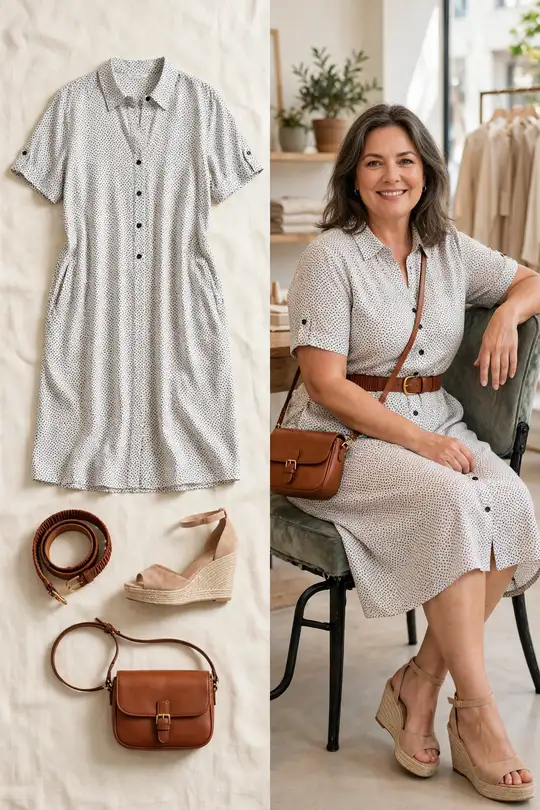
A shirt dress gives you the two most slimming features in one garment: a button-front vertical line and a collar that frames the face.
Left loose it is a sack; belted at the natural waist with a medium-width belt (3–4 cm), it becomes an hourglass — the belt creates the waist the dress does not have on its own, and the skirt falls in soft folds from that defined point.
The shirt dress earns its “most saved” status because it solves the morning decision in one piece: no matching, no tucking, no second-guessing. Choose one in a small-scale print — a micro-dot or fine stripe — and the pattern breaks up the body’s surface into smaller sections, which reads slimmer than a large, bold print at this size range.
- Budget: under $40 including the belt
- Dress: knee length, button front, small-scale print, 3/4 or long sleeves
- Belt: 3–4 cm wide, worn at the natural waist, not the hips
- Fabric: cotton-poplin or viscose with body; avoid tissue-thin weaves
Shop for: “shirt dress, knee length, small print” plus “medium belt, 3.5 cm, elastic back” — an elastic-back belt stays comfortable through a long lunch.
How to wear it:
- Button to just below the bust, then let the V open — the partial opening lengthens the neck.
- Belt at the natural waist and blouse the fabric 2 cm above the belt for softness.
- Roll the sleeves to the forearm to show the slimmest part of the arm.
- Nude-to-you flats or low wedges keep the leg line clean.
Skip it if the buttons strain across the bust when you breathe normally — the dress is too small in the shoulders, and belting it will only emphasise the pull.
Best for: workdays, parent-teacher evenings, and travel days when one piece must do everything.
The boxy-coverup mistake: $40–$80 tailoring that defines your shape
The second big mistake is the coverup reflex in its tailored form: the oversized blazer, the tunic that could house a family, the “flowy” top with no waist whatsoever. It feels safe in the fitting room and photographs 5 kilos heavier than you are.
This tier spends a little more to buy what cheap clothes skip — darts, seams, and cuts that acknowledge a waist exists.
6. The True Wrap Dress
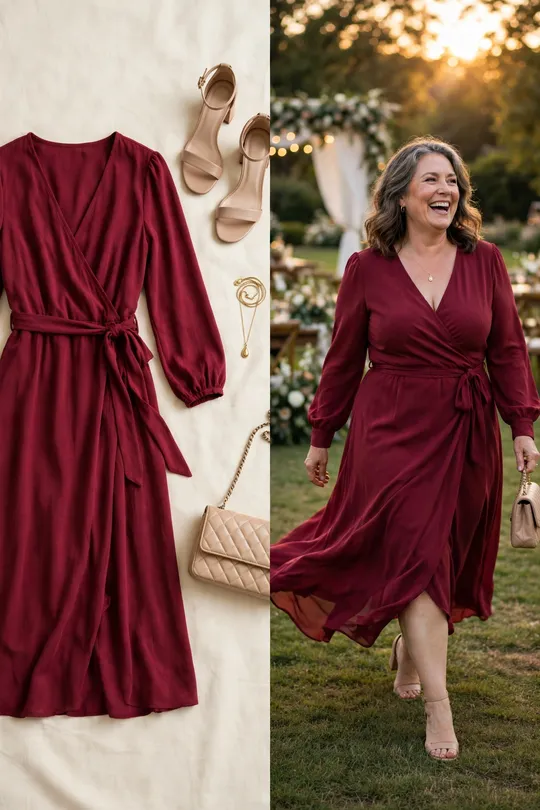
If I could only keep one dress formula for plus size fashion for women over 50, it would be this one. A true wrap dress ties exactly where your waist actually is — not where a manufacturer guessed it might be — because you place the tie yourself.
The diagonal crossover slashes across the midsection, the V-neckline lifts the eye to the face, and the skirt’s A-line flare clears the hip and thigh without a whisper of cling.
“True” matters: a mock wrap with a sewn crossover cannot be adjusted, so the waist seam lands wherever the pattern put it. A real wrap with interior ties plus an exterior tie stays closed in wind, when bending, and after lunch — three situations where a mock wrap betrays you.
Knee length (58–62 cm from waist) keeps it day-appropriate; the 3/4 sleeve shows the forearm, the slimmest part of most arms.
- Budget: $40–$80
- Cut: true wrap with interior + exterior ties, knee length
- Sleeve: 3/4 length to show the forearm
- Fabric: jersey with 5% elastane or a fluid crepe
Shop for: “true wrap dress, knee length, interior ties, 3/4 sleeves” — sit down in it; the crossover must stay put without you holding it.
How to wear it:
- Fasten the interior tie first, snug at the natural waist, then wrap and tie outside.
- Position the knot slightly off-centre — asymmetry reads slimmer than a centred bow.
Skip it if the skirt’s crossover rides up when you walk — the skirt is cut too narrow for your stride; look for a wrap with 10–15 cm of overlap at the hem.
Best for: weddings, christenings, and every invitation that arrives with the words “dress code”.
7. The Wide-Leg Trousers + Cropped Jacket

Wide-leg trousers work on a plus-size frame for a counterintuitive reason: the volume is below the hip, so the leg reads as one long, fluid line instead of being segmented by a taper at the ankle.
The cropped jacket is the essential partner — ending at 48–52 cm, just above the hip bone, it defines the waist and stops the wide leg from reading as shapeless. Long jacket plus wide trouser equals tent; cropped jacket plus wide trouser equals silhouette.
Keep the trouser’s waistband flat and smooth — a contoured or wide elastic waistband that sits at the natural waist — and let the leg fall from there. A heel of 4–6 cm keeps the wide hem off the floor and adds the length the volume borrows.
- Budget: $40–$80 for the pair
- Trousers: wide leg, flat waistband, hem kissing the top of the shoe
- Jacket: cropped, 48–52 cm, structured shoulder, open or single button
- Underneath: a fitted shell or tee in a quiet colour
Shop for: “wide-leg trousers, flat waistband, full length” and “cropped jacket, 50 cm, structured” — the jacket must end above your hip’s widest point; measure, don’t guess.
How to wear it:
- Choose the trouser and jacket in the same colour family for one long column.
- Wear the jacket open to show the waist definition underneath.
- Have the trouser hemmed to your heel height — pooling fabric shortens the leg.
Skip it if the trouser’s waistband gaps at the back — the rise is wrong for you; a tailor can take the back waist in for very little.
Best for: work presentations, gallery openings, and dinners where you want to look quietly powerful.
8. The Fit-and-Flare Midi Dress
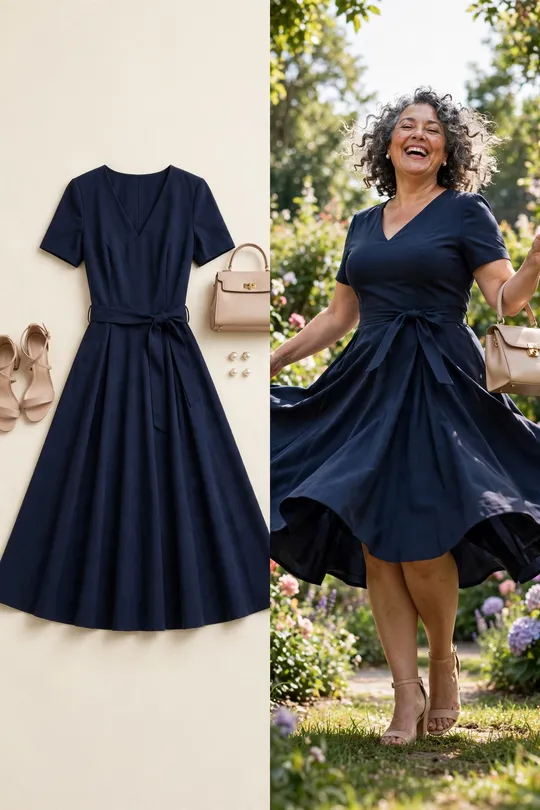
The fit-and-flare is engineering disguised as a dress: a fitted bodice with bust darts holds the top half close, a defined waist seam marks the narrowest point, and a skirt cut in a full circle from 100–105 cm floats completely free of the hip, stomach and thigh.
Nothing clings because nothing touches below the waist — the fabric’s own movement does the skimming.
Midi length is doing quiet work here too. Ending 10–15 cm below the knee, it shows the slimmest part of the lower leg while giving the skirt room to swing, and that movement is flattering in a way static fabric never is. A neckline that sits at or just below the collarbone keeps the frame open and elegant.
- Budget: $40–$80
- Bodice: fitted with darts, waist seam at the natural waist
- Skirt: full circle or gathered, 100–105 cm total length
- Neckline: scoop, square or V at the collarbone
Shop for: “fit-and-flare midi dress, defined waist, 105 cm” — the waist seam must sit at YOUR waist; if it sits 5 cm too high or low, the proportions collapse.
How to wear it:
- Check the waist seam in a mirror from the side — it should sit in the crease when you bend.
- Let the skirt move; don’t size up “for room” — the flare is the room.
- Pair with a heel that shows the ankle; the midi needs that flash of leg.
- A small structured bag keeps the proportions ladylike, not bulky.
Skip it if the bodice pulls the waist seam upward at the front — the bodice is too short for your torso; look for “long torso” or tall-range options.
Best for: summer weddings, afternoon tea, and any event where you will be photographed from every angle.
9. The Peplum Blazer + Slim Trousers

A peplum blazer is the tailored answer to the hip question: the little flare that starts at the waist and kicks out over the hip disguises the exact point where hip meets thigh, while the blazer’s structured shoulders balance the lower half.
Worn over slim (not skinny) trousers, the proportion is classic — volume where you want it, line where you need it.
The peplum must start at your natural waist, not above or below it. Too high and it flares over the ribcage; too low and it emphasises the hip it is meant to skim. When it sits right, the eye reads the narrowest point and glides over the rest.
- Budget: $40–$80 for the pair
- Blazer: peplum starting at the natural waist, single button, structured shoulder
- Trousers: slim straight leg, ankle length, dark solid
- Ratio: blazer covers the seat; trouser shows a slim ankle
Shop for: “peplum blazer, waist seam, single button” and “slim ankle trousers, flat front” — button the blazer and check the peplum still flares; if it strains flat, size up.
How to wear it:
- Button the blazer at the waist — the single button is the focal point.
- Keep everything underneath fitted so the peplum is the only volume.
Skip it if the peplum sticks out sideways instead of falling — the flare is too stiff or too short for your hip; a softer, longer peplum drapes better.
Best for: the office, interviews, and evenings that need a jacket with authority.
10. The V-Neck Ponte Jumpsuit

A jumpsuit in ponte solves the two-piece problem — no waistband digging, no top untucking, no gap between the pieces — by making the whole outfit one continuous column. The V-neckline opens the neck and chest, the defined waist seam (or tie) marks the narrowest point, and the straight leg falls clean from hip to ankle.
One colour from shoulder to shoe reads as height.
Ponte is non-negotiable here: a jumpsuit in thin jersey shows every line of underwear and seat, while ponte’s double-knit smooths and holds. Look for a back zip or a wrap front for bathroom practicality — the wrap-front jumpsuit gives you the diagonal slimming line of point 4 in a one-piece.
- Budget: $40–$80
- Cut: V-neck, defined waist, straight full-length leg
- Fabric: ponte or scuba-crepe, never thin jersey
- Closure: wrap front or back zip for practicality
Shop for: “ponte jumpsuit, V-neck, waist tie, straight leg” — check the torso length; petite and tall ranges exist for a reason, and a too-short torso pulls uncomfortably.
How to wear it:
- Belt or tie at the natural waist to break the column at its narrowest.
- Add a long pendant or scarf to extend the V’s vertical line.
- Choose a heel with a low vamp; the leg should look endless.
Skip it if the crotch pulls when you sit — the rise is too short, full stop; no styling trick fixes a jumpsuit that fights your body.
Best for: evening events, parties, and days when you want to get dressed in sixty seconds.
Good to know
Alterations are the cheapest luxury in plus-size dressing. Taking in a waist (£10–£15), hemming a trouser (£8–£12) or moving a button transforms an “almost” garment into a custom one — and a £40 dress with £15 of tailoring will always look better than an £80 dress worn as it came off the rail.
Find a local tailor before you find a new shop.
The one-occasion splurge: statement pieces worth paying more for
The third mistake is avoidance: declining the wedding, the gala, the milestone birthday because nothing in the wardrobe feels equal to the occasion. Occasion dressing fails for plus-size women not because the options do not exist but because cheap occasion wear is cut for a straight-size block and graded up, which never works.
If you have something special on the calendar, our plus size christmas party outfits will help you pick something you feel genuinely good in.This tier is where spending more genuinely buys something — proper grading, boning, linings and fabrics that hold their line from the first photograph to the last dance.
11. The Structured Occasion Blazer Dress
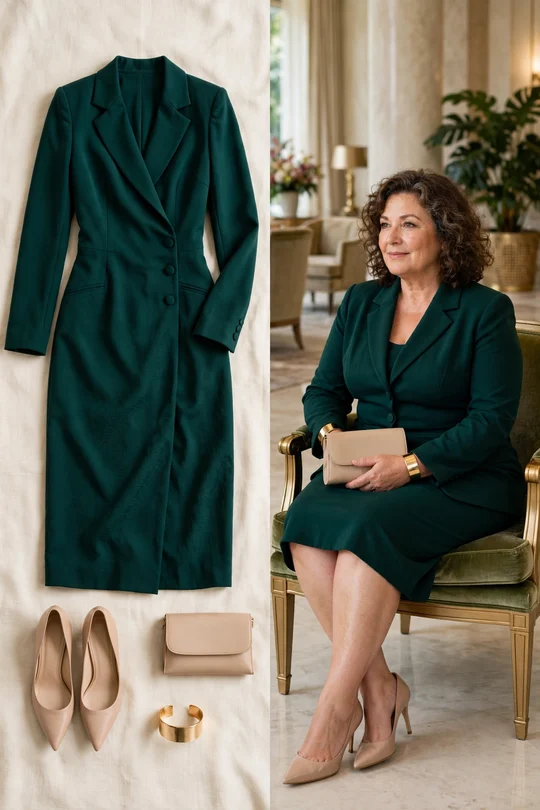
A blazer dress built with real tailoring — canvas interlining, a defined shoulder, seaming through the waist — holds its architecture all day, which is exactly what occasion dressing demands. The deep V of the lapels lengthens the torso, the single button marks the waist, and the skirt, cut just above the knee, keeps the leg visible and long.
Structure photographs beautifully; softness wrinkles by noon.
This is the piece to spend on because the difference between a £30 blazer dress and a £90 one is entirely in the interior: interlining that keeps lapels sharp, a lining that lets the skirt glide instead of clinging, and armholes cut high enough to move in. You feel that engineering from the first wear.
- Budget: $80+
- Build: lined, interlined lapels, single button at the waist
- Length: just above the knee, 55–60 cm skirt
- Colour: ink, berry or deep emerald — darks with depth, not flat black
Shop for: “tailored blazer dress, lined, single button, knee length” — check the lapel roll; it should lie flat without gaping at the bust.
How to wear it:
- Wear the button fastened — the blazer dress is designed to be closed.
- Choose a heel that matches your leg tone to extend the line.
- Keep jewellery to one strong piece; the lapels are the statement.
- Carry a clutch, not a shoulder bag, to keep the shoulder line clean.
Skip it if the button pulls into an X across the front — the dress is too small through the waist; tailoring cannot add fabric that is not there.
Best for: daytime weddings, graduations, and any event with a photographer.
12. The Silk-Blend Evening Blouse + Palazzo Trousers
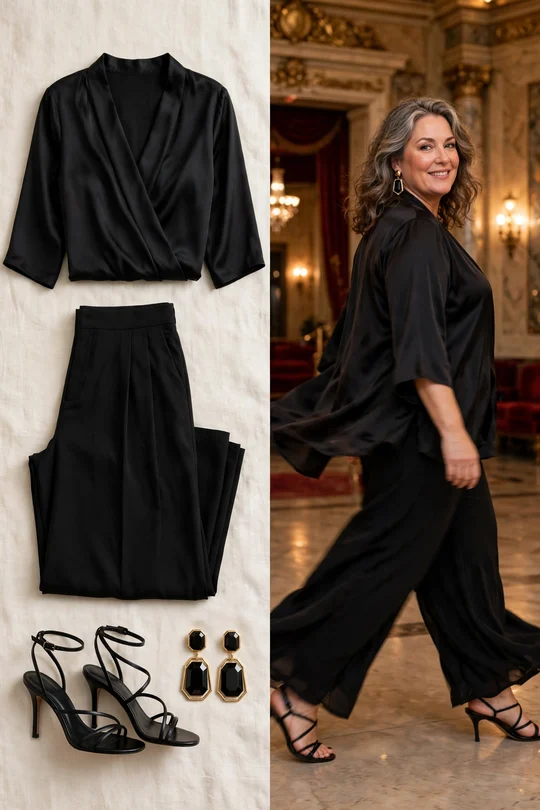
Fluid fabrics are a plus-size evening secret: a silk-blend blouse moves around the body instead of pressing against it, so the torso reads as draped rather than wrapped. Paired with palazzo trousers — wide from the hip, pooling just over the shoe — the outfit creates two long, moving columns. Movement is flattering; stillness in stiff fabric is not.
The blouse must have a V or surplice neckline to open the frame, and the trousers need a flat, wide waistband that sits at the natural waist — the blouse’s hem tucks in, the waistband defines, and the palazzo leg does the rest. In one dark tone head to toe, this is the most elongating outfit on the list.
- Budget: $80+ for the pair
- Blouse: silk-blend, V or surplice neck, long sleeves with cuffs
- Trousers: palazzo, wide from the hip, flat waistband
- Colour: one dark tone head to toe for maximum length
Shop for: “silk-blend surplice blouse” and “palazzo trousers, flat waistband” — the blouse should blouse 3–4 cm over the waistband, not balloon.
How to wear it:
- Tuck the blouse fully and let it relax over the waistband.
- Push the cuffs back to show the wrist.
Skip it if the blouse clings to the midsection when you move — the blend is too light or too small; fluid only works when the fabric has room to move.
Best for: evening dinners, theatre nights, and New Year’s Eve.
13. The Tailored Trench, Worn Open

A trench worn open is the outerwear equivalent of the longline cardigan’s trick: the two open fronts form a long vertical frame, and everything inside that frame reads narrower. But a trench brings something the cardigan cannot — structured shoulders, a storm flap with horizontal interest at the chest, and gabardine with enough body to hold its line in wind.
Thrown over any outfit on this list, it adds instant polish.
Fit rules are strict here. The shoulder seam must sit at your shoulder bone — a trench that hangs off the shoulder adds width everywhere. Length to just below the knee (105–110 cm on most frames) keeps the leg visible; longer, and the coat starts wearing you.
And wear it open: belting a trench over a plus-size frame often creates bulk at exactly the waist you are trying to define.
- Budget: $80+
- Cut: single-breasted, shoulder seam at the bone, 105–110 cm long
- Fabric: cotton gabardine with body; water-resistant finish a bonus
- Worn: open, sleeves pushed or full length
Shop for: “single-breasted trench, 108 cm, cotton gabardine” — try it over your bulkiest knit; if the shoulders still sit right, the cut is generous enough.
How to wear it:
- Wear it open over a one-colour column underneath.
- Pop the collar for evenings; flat for day.
- Let the belt hang tied loosely at the back — never belted over the front.
Skip it if the back vents pull open when you walk — the hips need more room; look for a trench with a deeper back vent or a straight rather than fitted cut.
Best for: spring and autumn — the coat that makes every outfit underneath look deliberate.
14. The Column Skirt + Statement Top
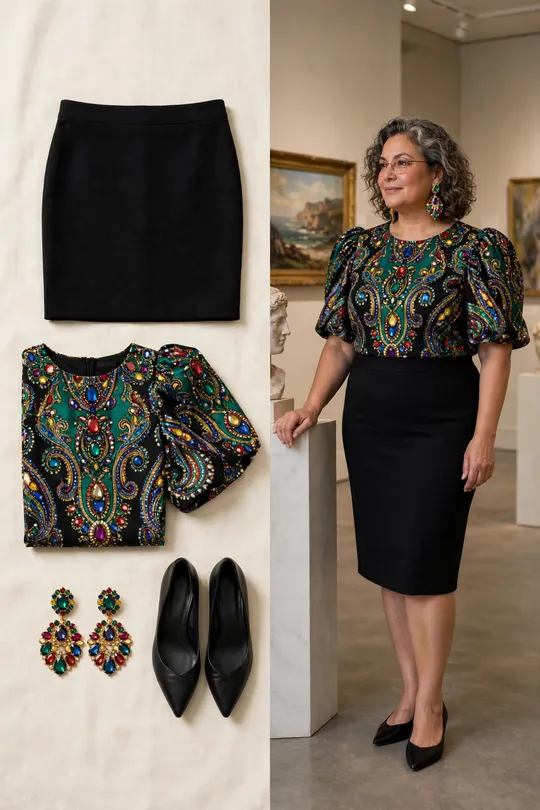
This outfit uses the oldest proportion trick in the book: keep the bottom half quiet and narrow, put all the interest on top. A column skirt — straight, knee length, in a dark solid — gives the lower body one clean line.
A statement top with an interesting neckline, sleeve or print draws every eye upward to the face, which is exactly where you want the attention.
The skirt must skim, not grip: look for a back vent or kick pleat of at least 15 cm so you can walk and sit, and a waistband that stays put without a belt.
The top should end at the hip bone or be tucked in — anything ending mid-hip cuts the torso at its widest and undoes the whole trick.
- Budget: $80+ for the pair
- Skirt: column, knee length, dark solid, 15 cm vent
- Top: statement neckline or sleeve, ends at hip bone or tucked
- Balance: if the top is printed, the skirt stays solid
Shop for: “column skirt, knee length, back vent” and one “statement top” you love — the top is the personality piece; the skirt is the frame.
How to wear it:
- Tuck or crop the top so the waistband shows — the narrow line must be visible.
- Keep shoes and bag quiet; the top is doing the talking.
- A bold earring echoes the top’s statement without competing.
- Check the back view: the skirt should fall straight, not ride up.
Skip it if the skirt twists around when you walk — the grain is off or the hips need more ease; a twisting skirt will never sit right no matter the top.
Best for: gallery evenings, restaurant birthdays, and anywhere you want to be remembered for the top, not the fit.
15. The Evening Wrap Gown

For true black-tie, the wrap principle scales up: a floor-length wrap gown gives you the adjustable waist, the diagonal crossover and the V-neckline of point 6, extended into one unbroken vertical line from shoulder to floor. Nothing elongates like an unbroken line, and nothing photographs like fabric that moves when you do.
Choose a jersey with weight or a fluid crepe — never a stiff satin, which shows every fold when you sit. A thigh-high slit (25–30 cm) is not about daring; it lets you walk and sit, and the flash of leg keeps the long column from reading as a curtain.
Interior ties are essential at this length — a floor-length wrap that opens is a disaster no exterior knot can prevent.
- Budget: $80+
- Cut: true wrap, floor length, interior ties, 25–30 cm slit
- Fabric: weighted jersey or fluid crepe; lined bodice
- Colour: jewel tones photograph best — emerald, sapphire, berry
Shop for: “wrap evening gown, floor length, interior ties” — walk, sit and climb imaginary stairs in the fitting room; the wrap must stay closed through all three.
How to wear it:
- Set the interior tie at the natural waist before wrapping.
- Steam the skirt’s hem so it falls in one clean line.
Skip it if the bodice needs constant adjusting — at this price the interior construction should hold you; if it does not, the grading is wrong for your shape.
Best for: black-tie weddings, charity galas, and the cruise formal night.
The accessory afterthought: under-$30 finishers that lift everything
The final mistake is stopping too early: the outfit is right, the fit is right, and then it ends at the neckline with nothing to finish it. Accessories are the cheapest transformation in dressing — for under $30, a belt, a necklace or a scarf can make a £20 outfit read as £80, because finish signals intention.
These five are the ones worth owning.
16. The Wide Statement Belt, Reworn

One good wide belt (5–6 cm) worn over five different dresses and tunics is the highest-value purchase on this list. It does what tailoring does — marks the waist, creates an hourglass, gives a shapeless piece architecture — but it moves from outfit to outfit.
The width matters: a skinny belt disappears on a plus-size frame, while 5–6 cm of leather reads as a deliberate design choice.
Wear it at the natural waist over shirt dresses, tunics, cardigans and even blazers. An elastic-back belt stays comfortable for twelve hours; a tooled or textured finish adds interest without hardware that digs when you sit.
- Budget: under $30
- Spec: 5–6 cm wide, elastic back, neutral leather tone
- Worn over: dresses, tunics, open cardigans, blazers
- Position: natural waist, always — never the hips
Shop for: “wide waist belt, 5 cm, elastic back” in tan or cognac — it works over black, navy, prints and brights alike.
How to wear it:
- Place it at the natural waist — bend sideways to find the crease.
- Blouse 2 cm of fabric above it for softness, never pulled drum-tight.
- Let it be the only belt-level detail; skip the statement necklace with it.
Skip it if it rides up to the ribcage within an hour — the waist it is sitting on is not your natural waist; reposition and check in a mirror.
Best for: every dress you own that currently looks “fine” instead of finished.
17. The Long Pendant Necklace Trick

A pendant that falls 50–60 cm — to the mid-torso — draws a vertical line straight down the body’s centre, and verticals lengthen. It also fills the empty space a V-neckline creates, which keeps the eye moving down the torso instead of stopping at the bust.
On a plain top, it is the difference between “unfinished” and “styled” for the price of a sandwich.
Length is the whole trick: a choker or 40 cm chain shortens the neck and stops the eye at the bust, which is the opposite of what you want. The pendant itself should have some scale — a stone or medallion of 3–4 cm — so it reads from across a room.
- Budget: under $30
- Length: 50–60 cm chain, pendant 3–4 cm
- Worn with: V-necks, scoop necks, plain shells and jumpers
- Avoid: chokers and short chains that stop at the bust
Shop for: “long pendant necklace, 55 cm” — hold it against a top you own; the pendant should land below the bust, not on it.
How to wear it:
- Layer it over plain necklines — it needs a quiet background to work.
- Match the metal to your other jewellery; mixed metals dilute the line.
Skip it if the chain flips the pendant backwards all day — the chain is too fine for the pendant’s weight; a slightly heavier chain sits properly.
Best for: plain work tops, black dresses, and any outfit that feels one detail short.
18. The Silk-Print Scarf as a Top Layer

A 90 cm square scarf in silk or a silk blend, folded into a triangle and draped over the shoulders, puts colour and pattern exactly where they flatter most — at the face — while the long points fall over the bust and torso, breaking up the body’s largest surface. It is camouflage and highlighter in one piece of fabric.
Choose a print with a dark background and bright motifs: the dark recedes, the bright draws the eye up. Worn over a plain dark dress or top, it transforms the outfit’s entire mood — and because it sits on top, it works over anything that fits, regardless of the season’s trends.
- Budget: under $30
- Size: 90 cm square, silk or silk-blend for drape
- Print: dark ground, bright motifs
- Worn over: plain dark dresses, blazers, coats
Shop for: “silk square scarf, 90 cm, dark print” — scrunch it in your fist; if it springs back without hard creases, the silk content is real enough to drape.
How to wear it:
- Fold into a triangle, drape over the shoulders with the point down the back or front.
- Let the ends hang — tucking them in kills the drape that does the work.
- Knot it loosely at the neck for a bolder look with plain tops.
- Echo one of the scarf’s colours in a shoe or bag to tie the outfit together.
Skip it if the fabric is stiff polyester — it will sit like a bib instead of draping; the drape is the entire point.
Best for: lifting a dark winter wardrobe, travel (it weighs nothing), and gifts that always fit.
19. The Structured Tote + Pointed Flats

The bag and shoe finish the silhouette the clothes start. A structured tote — one that stands up on its own — holds a clean rectangular line against the body instead of collapsing into a soft blob that adds visual bulk at the hip.
Pointed flats extend the leg line by 3–4 cm compared with round toes, because the eye follows the shoe’s point outward.
Scale matters for both: a tiny bag disappears against a plus-size frame and a giant one overwhelms it. A medium tote (30–35 cm wide) and a shoe with a moderate point — not a stiletto toe — keep everything in proportion.
- Budget: under $30 for the pair at high-street prices
- Tote: structured, 30–35 cm wide, stands upright empty
- Flats: pointed or almond toe, low vamp showing the foot’s arch
- Colours: tan, cognac or black — neutrals that match everything
Shop for: “structured tote, medium” and “pointed flats, low vamp” — the tote test is simple: set it on the shop floor; if it slumps, walk away.
How to wear it:
- Carry the tote in hand or on the forearm, not wedged under the arm.
- Match the flats to your leg tone (nude-to-you) for maximum leg length, or to your hem for grounding.
Skip it if the flats’ pointed toe pinches — a moderate almond toe gives 90% of the lengthening with none of the pain.
Best for: every day — the finishing pair that makes the other nineteen outfits look intentional.
20. The Third-Piece Rule: A Vest Over Anything

Stylists swear by the third-piece rule for a reason: any outfit of top plus bottom looks 40% more finished the moment a third layer goes over it. A vest — sleeveless, open-front, hitting at mid-thigh — is the warm-weather, arm-baring-friendly version of the longline cardigan’s trick, and its two open edges draw the same slimming verticals down the torso.
The vest works because it adds structure without adding heat or sleeve bulk. In a fluid crepe or soft suiting, worn open over a tee and trousers or a simple dress, it gives the outfit a frame — and because the arms stay bare, the overall effect is lighter than a cardigan while doing the same visual work.
- Budget: under $30
- Cut: sleeveless, open front, mid-thigh length (75–80 cm)
- Fabric: fluid crepe or soft suiting with drape
- Worn over: literally anything — tees, dresses, jumpsuits
Shop for: “longline vest, open front, mid-thigh” — check that the front edges hang straight and don’t curl outward; curling edges break the vertical line.
How to wear it:
- Throw it over your simplest outfit — plain tee and jeans is the perfect canvas.
- Keep it open; a closed vest is just a waistcoat and loses the verticals.
- Add one necklace or scarf so the neckline isn’t bare.
Skip it if the armholes gape and show your bra from the side — the vest is too wide through the chest; size down or choose a narrower cut.
Best for: the days you “have nothing to wear” — the vest makes the nothing look like something.
Small fit tweaks, big payoff
Before you buy anything new, these are the adjustments that make what you already own look like it was chosen on purpose.
- Half-tuck everything. Tucking 8–10 cm of a top’s front hem into your waistband marks the waist on any outfit — it takes four seconds and works on tees, shirts and knits alike.
- Show the wrist and ankle. Pushing sleeves to the forearm and choosing ankle-length hems puts the eye on the body’s narrowest points.
- Steam, don’t iron flat. Five minutes with a steamer removes the creases that make fabric cling and look tired, especially on jersey and crepe.
- Move the button. A shirt or blazer that gaps at the bust often just needs its button moved 1.5 cm — a two-minute hand-sewing job that saves the garment.
- Match your underwear to your skin, not your outfit. Nude-to-you smooth underwear disappears under light fabrics; white shows through white, and black outlines under pale knits.
- Hem to the shoe. Trousers hemmed to your actual heel height — not the model’s — are the difference between “long leg” and “drowning in fabric”.
Your five-minute fitting-room routine:
- Sit down, cross your legs, reach overhead — the garment must pass all three.
- Check the side view: waist seams and ties should sit in your natural crease.
- Check the back view: no horizontal pull lines across the shoulders or seat.
- Walk 20 paces: hems should stay put, wraps should stay closed.
- Photograph yourself in it — the camera shows proportion honestly, the mirror flatters.
The bottom line
If I had to pick one outfit from this list, it would be the true wrap dress (#6) — no contest.
It is the only piece here that adjusts to your actual waist instead of a pattern’s guess, it works for weddings and for Tuesday, and it has been flattering plus-size women for fifty years without a single trend cycle touching it.
Buy it in the best fabric your budget allows, in a colour that makes your skin glow, and wear it until it falls apart.
Pin this guide to your “Over 50 style” board before your next shopping trip — twenty outfits, four budgets, zero guesswork waiting for you there.
Frequently asked questions
What should I wear if I am between plus sizes?
Buy for your largest measurement and tailor down — it is always easier (and cheaper) to take in than to let out. If your bust is a 20 and your hips an 18, buy the 20 and have the hips taken in; a £12 alteration beats a garment that pulls across the bust.
For knit pieces with stretch, size down if you are between, because the fabric gives 10–15% with wear.
Can plus size women over 50 wear tucked-in tops?
Yes — if the bottom half is structured enough to hold the tuck. A full tuck works over a flat-waistband trouser or an A-line skirt with a real waistband; it fails over elastic-waist leggings or drawstring bottoms, where the tuck creates bulk instead of definition.
When in doubt, use the half-tuck: 8–10 cm of the front hem in, the rest out.
Are prints or solids more flattering in plus size fashion for women over 50?
Both — it depends on scale and placement. Small-scale prints (micro-dots, fine stripes, ditsy florals) break the body’s surface into smaller sections and read slimmer; large, high-contrast prints do the opposite.
The safest formula is one printed piece with the rest solid, and the print worn where you want attention — a printed top with dark solid bottoms is the classic for a reason.
How do I stop wrap dresses from gaping open?
Choose a true wrap with interior ties — not a mock wrap — and fasten the interior tie snugly at your natural waist before wrapping the outside. If you already own a mock wrap that gapes, a tailor can add a hidden snap at the crossover point for a few pounds.
A well-cut wrap should survive sitting, bending and wind without you holding it closed.
What is the one alteration worth paying for?
Hemming trousers to your heel height. Off-the-rail trousers are cut for a 5’7″ model; if you are shorter, the pooling fabric at the ankle shortens your whole leg visually. A £10 hem restores the proportion the designer intended.
Second place: taking in the back waist of trousers and skirts that fit the hip but gape at the waist.
