15 Short Gray Haircuts for Women Over 50
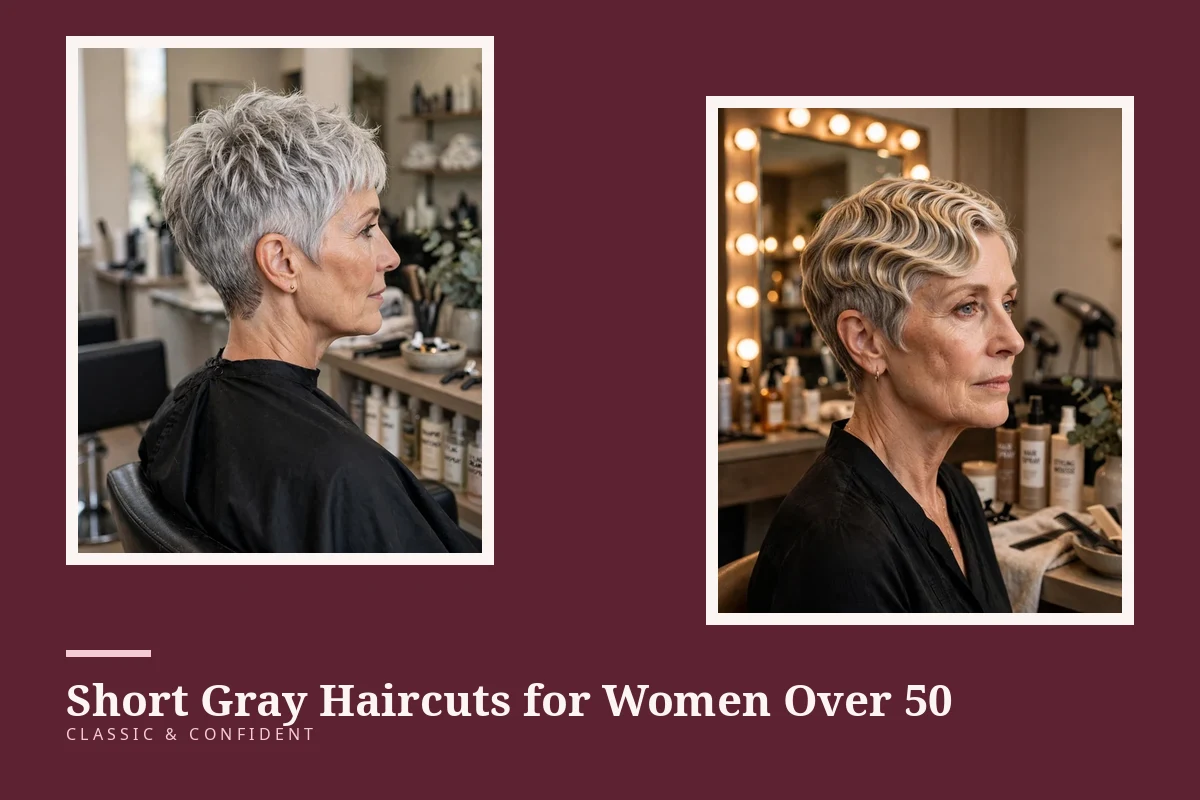
If you sat in my chair tomorrow and asked for short gray hair over 50, the first thing I would do is ignore the colour and read the texture.
Gray hair behaves differently from the hair you had at forty — the strand is coarser, the cuticle lifts more easily, and the cut has to do the work that pigment used to do.
These 15 short gray haircuts are the ones I keep in my mental file. Each one is chosen because the shape creates its own light, its own edge, its own polish. No dye required — just geometry, the right products, and a stylist who knows gray.
Quick picks
Start here:
- The Classic Silver Pixie — the cut that makes thin gray hair look denser (#1)
- The Deep-Side-Part Short Cut — instant coverage for a thinning hairline (#11)
- The French Gray Bob — jaw-length polish with a fringe that hides the forehead (#10)
- The Tapered Gray Crop — the lowest-maintenance appointment on this list (#2)
- The Stacked Silver Bob — back-of-the-head volume without teasing (#14)
- The Silver Buzz Cut — the boldest reset, grows out evenly (#3)
Contents
Short gray hair over 50: how to choose
Read your texture first. Straight gray hair shows every millimetre of length difference, so blunt lines and graduation read crisp. Wavy and curly gray hair shrinks 2–5 cm when dry — choose a cut with 5 cm of room for shrinkage, and never judge the shape on wet hair alone.
Match the cut to your real routine. A buzz cut needs a trim every 2–3 weeks; a tapered crop stretches to 5–6. Be honest about how often you will sit in a salon chair before you fall for a high-precision cut.
The best short gray hair over 50 is the one you will actually maintain.
Let the shape do the colour work. Without pigment, gray hair can look flat — so the cut must create its own light. Stacked backs, pointed ends and piece-y texture scatter light across the head, which is the same job a salon gloss used to do.
See 18 gray hair ideas for women over 50 for how shape and tone work together.
Cover what you want covered on purpose. A deep side part moves hair across a thinning hairline; a fringe breaks up a high forehead; longer fronts frame a jawline you are not sure about.
Decide which one feature matters most and pick a cut that solves it directly — that is what short haircuts for women over 50 were chosen to do.
Budget the upkeep, not just the appointment. Below I have grouped the cuts by what they cost to keep, not what they cost the first day. A $60 pixie you trim six times a year costs more than a $90 stacked bob you trim four times.
If your hair is fine, the trims also keep the ends dense — hairstyles for fine hair over 50 explains why short gray hair rewards frequent, small cuts.
The 15 cuts at a glance
| Cut | Trim cycle | Home upkeep | Best for |
| 1. Classic Silver Pixie | 5–6 weeks | 90-second paste styling | Fine, thin hair |
| 2. Tapered Gray Crop | 5–6 weeks | Almost nothing | Busy, low-effort routines |
| 3. Silver Buzz Cut | 2–3 weeks | Clipper pass at home | Full commitment to gray |
| 4. Gray TWA | 6–8 weeks | Weekly twist-outs | Coily, natural texture |
| 5. Graduated Silver Bob | 6 weeks | Blow-dry with round brush | Flat hair that needs lift |
| 6. Sleek Chin Bob | 6 weeks | Flat-iron 5 minutes | Straight, fine hair |
| 7. Asymmetric Silver Cut | 5–6 weeks | Side-swept styling | Strong jawlines |
| 8. Shaggy Silver Pixie | 6–7 weeks | Air-dry with salt spray | Thinning crowns |
| 9. Short Curly Gray Bob | 8 weeks | Diffuse once a week | Natural curl and waves |
| 10. French Gray Bob | 4–5 weeks | Fringe trims between visits | High foreheads |
| 11. Deep-Side-Part Short Cut | 5–6 weeks | Re-part while drying | Thinning hairlines |
| 12. Pixie-Bob with Fringe | 5 weeks | Piece-y fringe styling | Growing out a pixie |
| 13. Undercut Silver Crop | 3–4 weeks | Clipper the undercut | Very thick hair |
| 14. Stacked Silver Bob | 6 weeks | Root lift spray + dryer | Flat back-of-head |
| 15. Sculpted Finger-Wave Pixie | 4 weeks | 20-minute weekly set | Evening and occasions |
The low-maintenance trims
These four cuts look right with almost nothing done to them. The shape is the style — you wash, you go.
1. The Classic Silver Pixie
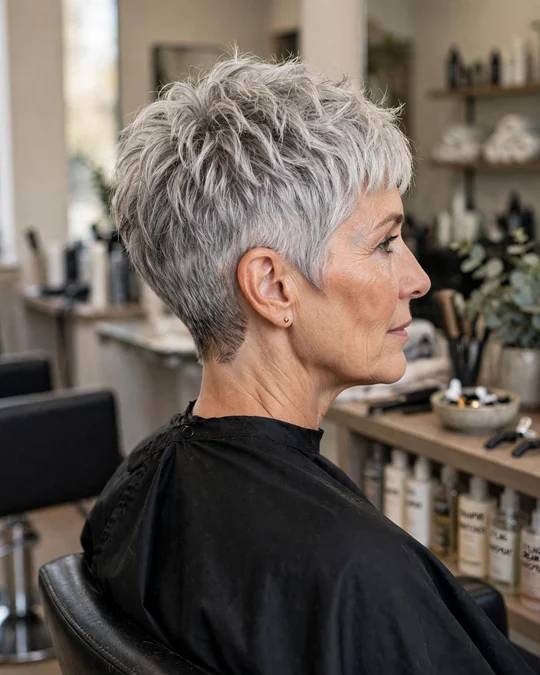
The pixie works on gray hair because it removes the weight that drags thin roots flat. With 3–5 cm left on top and 1.5–2 cm at the sides and nape, there is not enough length for fine gray hair to separate into wisps — so it reads as density instead of thinness.
The short length also exposes the natural variation in gray tones, which is what makes it look intentional rather than grown-out.
- Length: 3–5 cm on top, 1.5–2 cm at the sides
- Trim: every 5–6 weeks
- Styling time: 90 seconds with a pea-size of matte paste
Ask your stylist for: “A textured pixie — 4 cm on top, graduated down to 1.5 cm at the nape, point-cut ends so it grows out soft, not shelf-like.”
How to style it:
- Work a pea-size of matte paste between your palms until it disappears.
- Push the top forward and up with your fingertips, separating 1-cm pieces.
- Smooth the sides down toward the ears — done.
Skip it if you hate trims — this one loses its shape by week seven and starts to look like a grow-out.
Best for: fine or thinning gray hair that needs to look fuller with zero effort.
2. The Tapered Gray Crop
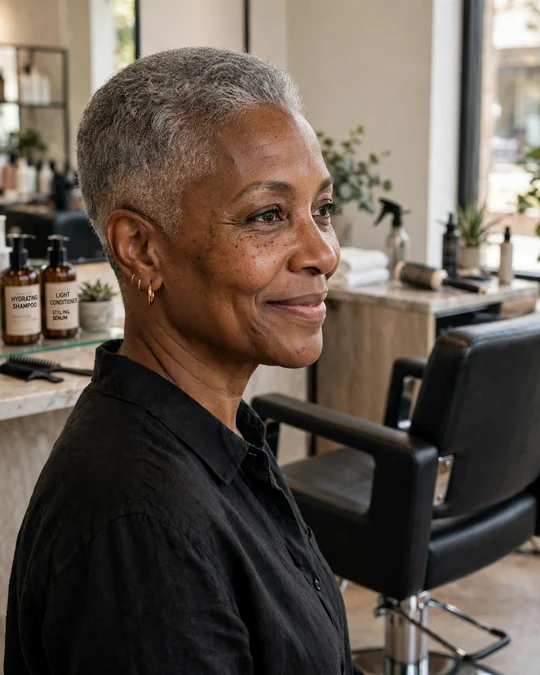
The taper does two jobs at once. It removes bulk at the nape and sides — exactly where gray hair goes frizzy and yellow first from friction and sweat — while leaving 3–4 cm on top for shape.
The graded silhouette (about 0.5 cm at the hairline blending to 3 cm on top) means regrowth has nowhere to create a shelf, so the cut stays presentable two weeks longer than a blunt pixie.
- Length: 0.5 cm at hairline, graduating to 3–4 cm on top
- Trim: every 5–6 weeks
- Styling time: under a minute, damp or dry
Ask your stylist for: “A tapered crop — tight at the nape and sides, about 3 cm on top, blended with shears so there is no visible line when it grows.”
How to style it:
- Towel-dry, then rake a fingertip of lightweight cream through the top.
- Direct the front slightly to one side with your fingers while it dries.
Skip it if you want softness around your ears and neck — this cut deliberately exposes them.
Best for: women who want the shortest possible routine without going full buzz.
3. The Silver Buzz Cut
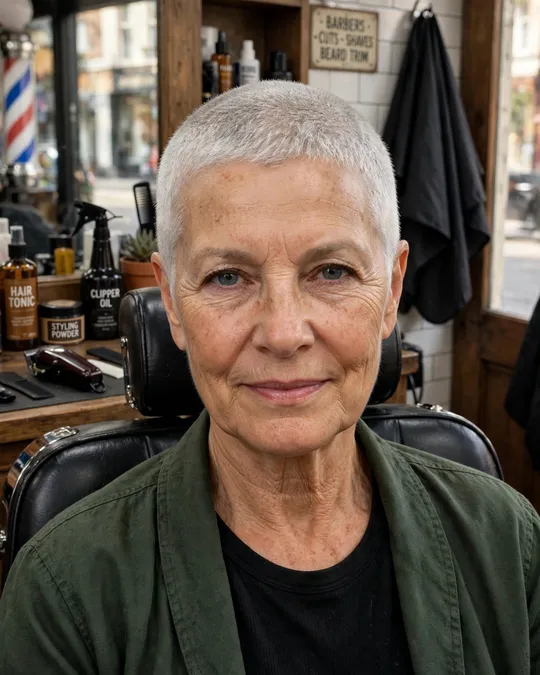
At 6–10 mm all over, the buzz cut makes gray hair read as a deliberate style choice rather than a grow-out — the uniform length removes the visual reference of “short versus long” that makes regrowth look scruffy. It also eliminates the dullest 80% of the hair shaft, since the oldest, most yellow-prone ends are simply gone.
What is left is fresh growth at its brightest.
- Length: 6–10 mm (clipper guard #2 to #4)
- Trim: every 2–3 weeks (a home clipper pass works)
- Styling time: zero — sunscreen on the scalp in summer
Ask your stylist for: “A #3 all over — one even length, no taper, clean around the ears. I will maintain it at home.”
How to style it:
- Massage a drop of scalp oil in once a week — short gray hair exposes the scalp.
- Clipper the back and sides with your guard number every 14–18 days.
Skip it if you are not ready for your head shape to be the whole style — there is nothing to hide behind.
Best for: a full gray reset, and for women tired of fighting a grow-out line.
4. The Gray TWA

The TWA — teeny weeny afro — is the cut that lets coily gray hair be its own volume. At 5–8 cm, each coil springs into its neighbours, so the hair holds a rounded silhouette with no heat and no product weight.
Gray coils are drier than pigmented ones, which actually helps here: the lower natural oil means the shape holds its definition instead of collapsing by midday.
- Length: 5–8 cm, rounded silhouette
- Trim: every 6–8 weeks (shape-up only)
- Styling time: weekly twist-outs, 20 minutes
Ask your stylist for: “A rounded TWA shape at 6 cm — cut dry, coil by coil, so the silhouette is even when it shrinks back.”
How to style it:
- On damp hair, apply a two-pump amount of leave-in conditioner in sections.
- Two-strand twist 2-cm sections across the head and let dry fully.
- Untwist and fluff at the roots with your fingertips for the week.
Skip it if your hair is fine and straight — this shape belongs to coily texture.
Best for: natural gray coils that want maximum shape with minimum daily work.
The seasonal refreshers
Two appointments a year keep these going — roughly spring and autumn — with home styling in between.
Not sure a shorter cut will suit you? Our edgy undercut pixie cuts guide shows who each style flatters and exactly what to ask your stylist for.5. The Graduated Silver Bob

Graduation — stacking the back from about 3 cm at the nape up to 8 cm at the crown — is the mechanism that lifts flat gray hair. Each shorter layer pushes the layer above it outward, so the back of the head builds its own volume instead of needing backcombing.
The chin-length front then frames the face, which keeps the silhouette from reading boxy.
- Length: 3 cm nape stacking to 8 cm crown, chin-length front
- Trim: every 6 weeks
- Styling time: 8 minutes with a round brush
Ask your stylist for: “A graduated bob — stacked at the nape at a 45-degree angle, chin-length in front, the back lifting on its own.”
How to style it:
- Apply root-lift spray to the crown on damp hair.
- Blow-dry the back with a medium round brush, rolling each section under.
- Smooth the front sections straight down past the jaw.
- Finish with a pea-size of smoothing cream on the ends only.
Skip it if your hair is very curly — the stack fights curl and grows into a triangle.
Best for: fine, straight gray hair that falls flat at the back of the head.
6. The Sleek Chin Bob
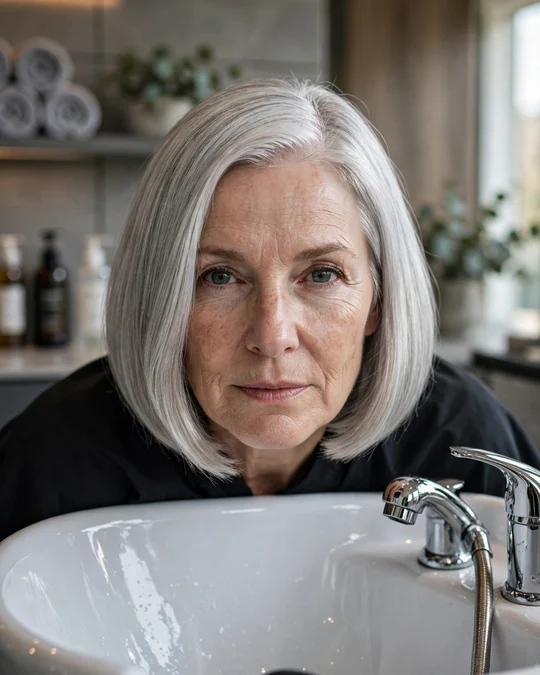
The blunt one-length line is what makes thin gray hair look thicker at the ends. When every strand stops at exactly the same 14–16 cm point, the perimeter reads as a solid edge instead of wisps — an optical thickening no product can replicate.
On silver hair the blunt line also catches light as a single reflective plane, which is why it photographs so glossy.
- Length: 14–16 cm, one blunt line at the chin
- Trim: every 6 weeks to keep the line crisp
- Styling time: 5 minutes with a flat iron
Ask your stylist for: “A one-length bob at the chin — no layers, no texture on the perimeter, cut dry so the line is exact.”
How to style it:
- Blow-dry smooth with a paddle brush, nozzle pointing down.
- Run the flat iron once over 5-cm sections at 160°C — gray hair burns faster than it used to.
Skip it if you wear your hair air-dried most days — this cut only earns its keep when it is smooth.
Best for: straight, fine gray hair where the ends need to look as thick as the roots.
7. The Asymmetric Silver Cut

Asymmetry is a directional trick. When one side sits 2–3 cm longer than the other, the eye travels along the diagonal line instead of stopping on any single feature — the jawline, the neck, the hairline all get skimmed rather than studied. On gray hair the longer side also drapes, which adds movement that short symmetric cuts can lack.
- Length: short side at the ear, long side 2–3 cm past the jaw
- Trim: every 5–6 weeks
- Styling time: 3 minutes, sweep to the long side
Ask your stylist for: “An asymmetric cut — tucked behind the ear on one side, 3 cm longer on the other, the diagonal line clean and deliberate.”
How to style it:
- Part deeply on the short side while hair is damp.
- Blow-dry the long side forward over the cheek.
- Tuck the short side behind the ear and leave the long side free.
Skip it if you wear your hair in a centre part — the whole point is the diagonal.
Best for: strong jawlines and anyone who wants a cut with a point of view.
8. The Shaggy Silver Pixie

Razor-cut feathering breaks the surface of the hair into dozens of small planes, and each plane catches light differently. On a thinning crown that scattered reflection is what disguises the scalp showing through — there is no single flat surface for the eye to compare against.
The longer 6–8 cm pieces on top also give you somewhere to push hair from, which short pixies do not allow.
- Length: 6–8 cm on top, feathered down the sides
- Trim: every 6–7 weeks
- Styling time: 2 minutes air-dried with salt spray
Ask your stylist for: “A shaggy pixie — razor-cut texture on top, longer feathered pieces at the crown, soft around the ears.”
How to style it:
- Mist salt spray through damp hair, 3–4 pumps.
- Scrunch and let air-dry; do not brush.
- Once dry, pinch the ends to separate the feathered pieces.
Skip it if you need polished-for-the-office hair — this one is permanently undone.
Best for: thinning crowns and anyone whose hair looks better slightly messy.
Good to know
Gray hair turns yellow from sun, pollution, heat tools and hard water — not from age. A purple shampoo used once a week, left on for 3–5 minutes, neutralises that brassy cast; more often than that and silver goes lavender.
Rinse with cool water, keep hot tools at 160°C or below, and sleep on a satin pillowcase — cotton drags the cuticle open overnight, and lifted cuticles catch yellow tones fastest.
The keep-it-shaped cuts
Every 6–8 weeks in the chair, and these four hold their lines — they are the appointments you put in the calendar and forget about.
Before you book, skim our pixie cuts and save the two or three cuts that match your face shape and the time you actually have.9. The Short Curly Gray Bob

Cut dry at 6–9 cm per layer, a curly bob uses shrinkage as volume: each curl springs up 2–5 cm shorter than it was cut, so the silhouette sits full at chin level instead of dragging.
Gray curls are more porous than pigmented ones, which means they absorb leave-in products deeply — the one texture where gray’s dryness works in your favour, because the curls hold their definition all week.
- Length: 6–9 cm layers, cut dry
- Trim: every 8 weeks
- Styling time: 10 minutes with a diffuser, once a week
Ask your stylist for: “A dry-cut curly bob — cut curl by curl at chin length, layers kept long so the weight holds the shape.”
How to style it:
- On soaking-wet hair, rake two pumps of curl cream through, then a palm of gel.
- Diffuse on medium heat, lifting sections at the roots for 8–10 minutes.
- Refresh mid-week with a water mist — do not re-wet fully.
Skip it if your hair is straight — forcing this shape on straight hair means heat styling every day.
Best for: natural waves and curls that need a shape, not a fight.
10. The French Gray Bob
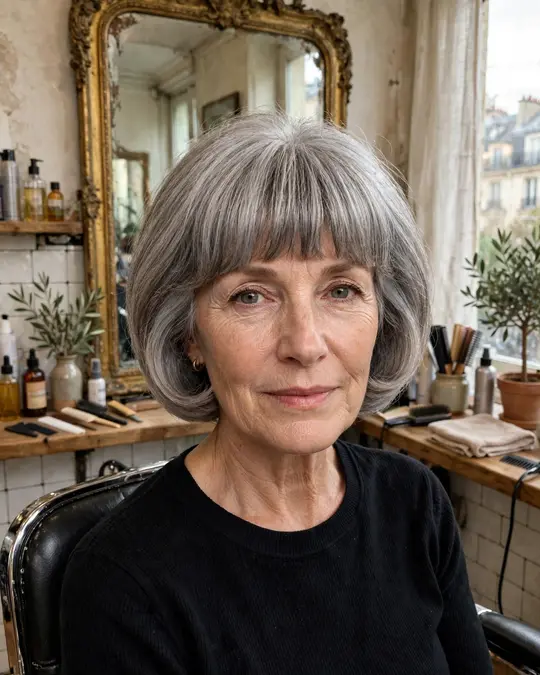
The brow-skimming fringe is the mechanism here. It puts weight where gray hair thins most — the temples and forehead — so sparse areas read as deliberate texture under the fringe instead of as thinning. Kept at jaw length with a blunt perimeter, the bob underneath stays crisp enough that the fringe looks like a style choice, not camouflage.
- Length: jaw-length bob, fringe at the brows
- Trim: bob every 6 weeks, fringe every 4
- Styling time: 4 minutes — fringe first, then ends
Ask your stylist for: “A French bob — jaw length, full brow-skimming fringe, ends point-cut so the line is soft.”
How to style it:
- Blow-dry the fringe first, rolling it back and forth over a small round brush so it sits straight.
- Smooth the bob with a paddle brush, tucking nothing behind the ears.
Skip it if you wear glasses that sit on the brow — the fringe will fight them all day.
Best for: high foreheads and sparse temples that want covering with intention.
11. The Deep-Side-Part Short Cut

Part geometry is the whole story. A part placed 5–7 cm off-centre — high over, near the temple — redirects the heaviest fall of hair across the hairline, so a thinning part line and sparse temples disappear under weight that actually exists.
With 8–10 cm on top, the sweep has enough length to stay put; shorter than that and it springs back to the middle.
- Length: 8–10 cm on top, sides cropped short
- Trim: every 5–6 weeks
- Styling time: 3 minutes, re-part while drying
Ask your stylist for: “Length on top at 9 cm, sides short — and set the part deep, over near the temple, not at the side.”
How to style it:
- Find the deep part with a comb while hair is wet — 5–7 cm off-centre.
- Blow-dry the heavy side flat across the forehead, nozzle pointing down.
- Smooth the short side tight to the head with a dab of cream.
Skip it if your hair is very fine and slippery — without texture product the sweep slides back by noon.
Best for: visible part lines and temples that need coverage without a fringe.
12. The Pixie-Bob with Fringe

This hybrid solves the awkward middle of growing out a pixie. The back stays cropped and neat at 3–4 cm, so it always looks finished, while the front grows to 5–6 cm with a soft fringe that disguises forehead lines and any uneven grow-out at the temples.
Two lengths in one cut means the transition reads as a style, not a phase.
- Length: 3–4 cm back, 5–6 cm front with fringe
- Trim: every 5 weeks (back only, mostly)
- Styling time: 4 minutes, fringe piece-y with wax
Ask your stylist for: “Keep the back pixie-short, let the front grow to a soft fringe — I want the grow-out to look planned.”
How to style it:
- Flat-dry the fringe forward, then pinch 1-cm pieces with a fingertip of wax.
- Push the back flat to the head — no volume there.
- Sweep the sides forward slightly to blend the two lengths.
- Set with a light mist of flexible spray.
Skip it if you are keeping the pixie — this cut only makes sense as a bridge.
Best for: growing out a pixie into a bob without a bad year in between.
The investment cuts
Precision work, more frequent appointments, bigger payoff — these are the cuts you pay a specialist for.
13. The Undercut Silver Crop

The shaved underlayer — buzzed to 3–6 mm underneath while 8–12 cm stays on top — removes 40–50% of the hair’s bulk without touching the visible length. For thick gray hair that poufs and resists every product, that missing bulk is the difference between a shape that sits and one that fights.
The contrast between the shaved nape and the silver sweep on top also reads younger than any styling product could.
- Length: undercut 3–6 mm, top 8–12 cm
- Trim: every 3–4 weeks (the undercut grows fastest)
- Styling time: 3 minutes, sweep the top over
Ask your stylist for: “An undercut — buzzed tight at the nape and above the ears, with 10 cm of silver on top to sweep over it.”
How to style it:
- Blow-dry the top in one direction, over the undercut side.
- Smooth a pea-size of paste through the ends for separation.
Skip it if your hair is fine — there is no bulk to remove, and the shave will show through.
Best for: very thick, wiry gray hair that has never sat the way you wanted.
14. The Stacked Silver Bob
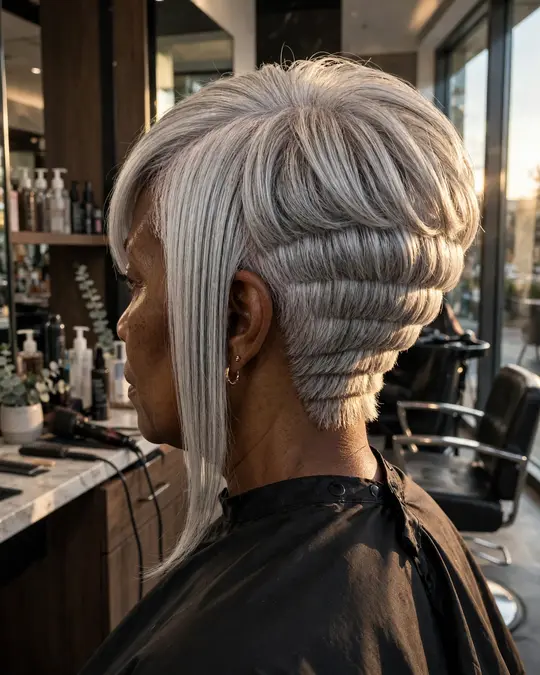
Extreme stacking — the nape cut to 3 cm while the front reaches 10–12 cm — builds a wedge of hair at the back of the head that pushes the crown layers outward. The result is permanent-looking volume at the back without teasing, backcombing or a single hot roller.
Because the front stays long, the silhouette reads as a bob from the front and a volume machine from behind.
- Length: 3 cm stacked nape to 10–12 cm front
- Trim: every 6 weeks to hold the wedge
- Styling time: 7 minutes with root spray and dryer
Ask your stylist for: “A stacked bob — aggressive stack at the nape, long in front, the wedge clean so the back holds its own volume.”
How to style it:
- Spray root-lift at the crown and nape on damp hair.
- Blow-dry the back sections upward with a round brush to activate the stack.
- Smooth the long front pieces down over the jawline.
Skip it if you have a very short neck — the stack adds visual width exactly there.
Best for: flat backs of the head and fine hair that needs engineered lift.
15. The Sculpted Finger-Wave Pixie
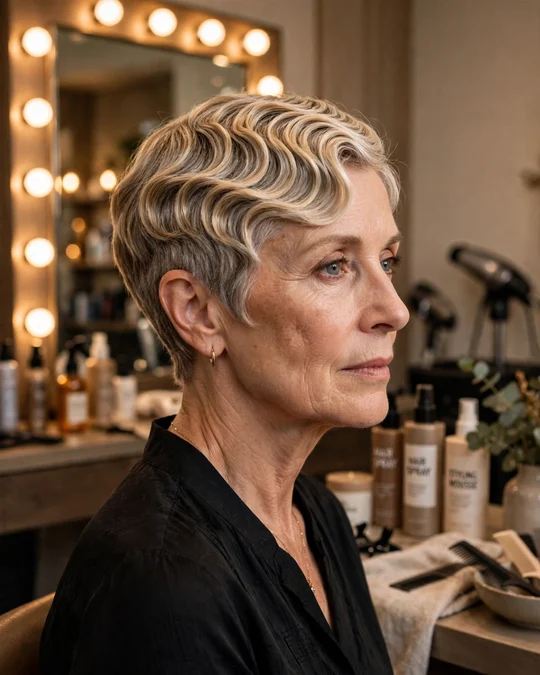
Finger waves turn gray’s wiry texture into an asset. The S-shaped ridges are set into damp hair with wave lotion and a fine comb, and as they dry each ridge becomes a raised reflective band — light bounces off the ridges the way it bounces off jewellery.
Wiry gray hair holds a set longer than soft hair does, so the waves survive an entire evening without a touch-up.
- Length: 5–7 cm on top, close at the sides
- Trim: every 4 weeks
- Styling time: 20-minute set, then it holds for days
Ask your stylist for: “A finger-wave set on a pixie base — classic S-waves across the top, sides close and smooth.”
How to style it:
- Comb wave lotion through damp hair in 2-cm sections.
- Ridge each section into S-curves with a fine comb, pinning each ridge with a clip.
- Dry under a hooded dryer or with a diffuser for 15 minutes, then remove clips and brush the waves smooth once.
Skip it if you want wash-and-go hair — this is an occasion cut, not a Tuesday one.
Best for: evenings out, weddings and anyone who wants silver hair to look like jewellery.
Silver-hair care tips
Short gray hair is low-fuss, but gray hair itself has rules. Keep these and the cuts above do the rest.
- Wash with lukewarm water, never hot — heat opens the cuticle and dulls silver fastest.
- Use purple shampoo once a week for 3–5 minutes; daily use turns silver lavender.
- Apply conditioner only from mid-length to ends — gray roots go limp under heavy product.
- Sleep on satin — cotton pillowcases rough up the cuticle overnight, which catches yellow tones.
- Wear a hat or UV spray in strong sun; gray hair has no melanin and yellows in direct light within hours.
- Book the trim before you need it — short cuts lose their line in week six, and the line is the style.
Your weekly silver routine:
- Wash twice weekly with a sulphate-free shampoo, lukewarm rinse.
- Once a week, swap in the purple shampoo for 3–5 minutes.
- Condition ends only, leave on for 2 minutes.
- Style with a pea-size of product — gray hair needs less than you think.
- Check the cut’s line in the mirror every Sunday; when the shape is gone, book the trim.
The bottom line
If I had to pick one, it would be #10, the French gray bob — the fringe does more work than any product in your cabinet, and the jaw-length line suits more faces than any cut on this list.
And I would skip #3, the silver buzz cut, unless you are fully committed: it is magnificent on the right woman and a three-month grow-out on the wrong one. Screenshot the “Ask your stylist for” line of your favourite and pin this guide to your “gray hair goals” board before your next appointment — your stylist will thank you.
Frequently asked questions
Will short gray hair over 50 make me look older?
Only if the cut is shapeless. A precise line — a blunt bob edge, a clean taper, a deliberate fringe — reads as style, which reads as confidence. What ages is hair that looks neglected: grown-out layers, a yellow cast, ends that have not been trimmed in months.
Keep the line and the tone, and short gray hair does the opposite of ageing you.
How often should I trim a short gray cut?
It depends on the cut’s geometry, not the calendar. Precision cuts like the undercut or finger-wave pixie need attention every 3–4 weeks; pixies and tapered crops every 5–6; bobs and TWAs can stretch to 6–8. The test is the mirror: if the silhouette has softened into a blob, you are overdue.
Why does my gray hair look yellow, and can a haircut fix it?
Yellowing comes from sun, pollution, heat tools and hard water settling on a porous cuticle — the oldest ends yellow first. A shorter cut removes those dull ends instantly, which is why a fresh chop makes gray look brighter overnight.
After that, weekly purple shampoo for 3–5 minutes keeps the tone; if your water is hard, a shower filter does more than any product.
Can I go short while I am still growing out my dye?
Yes — and it is the fastest route through. A pixie or tapered crop can remove the dye line in a single appointment if your regrowth is at least 4–5 cm. If you want to keep length, the pixie-bob hybrid (#12) lets the dyed front grow while the back stays tidy.
Either way, tell your stylist the grow-out is the goal, not the problem.
Is gray hair too coarse for a sleek bob?
Gray hair is coarser on average, but that is an advantage in a sleek cut — the strand holds a smooth line better than fine pigmented hair. The real enemy is heat damage: keep the flat iron at 160°C or below, use a heat protectant, and the coarseness becomes body and shine instead of frizz.
What should I ask for if my stylist has never cut gray hair well?
Use the verbatim “Ask your stylist for” lines in this guide — they are written to be read aloud. Beyond that, ask for the cut to be checked dry: gray hair’s behaviour changes as it dries, and a stylist who only checks wet is guessing. If they resist, that tells you what you need to know.