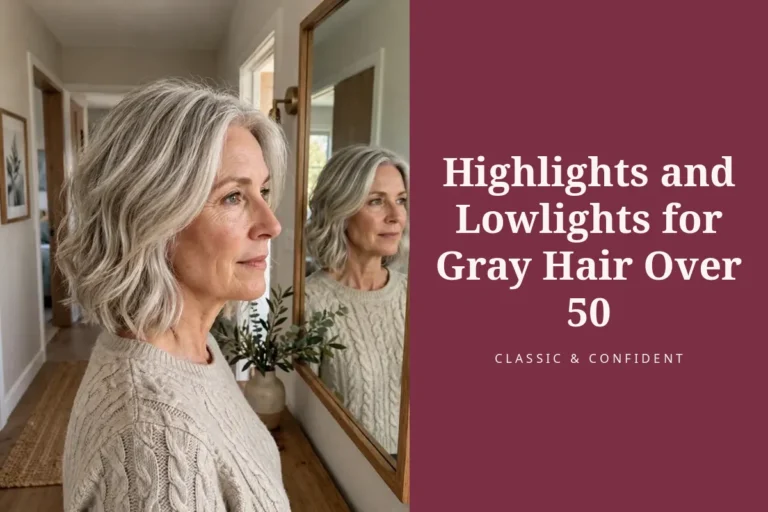
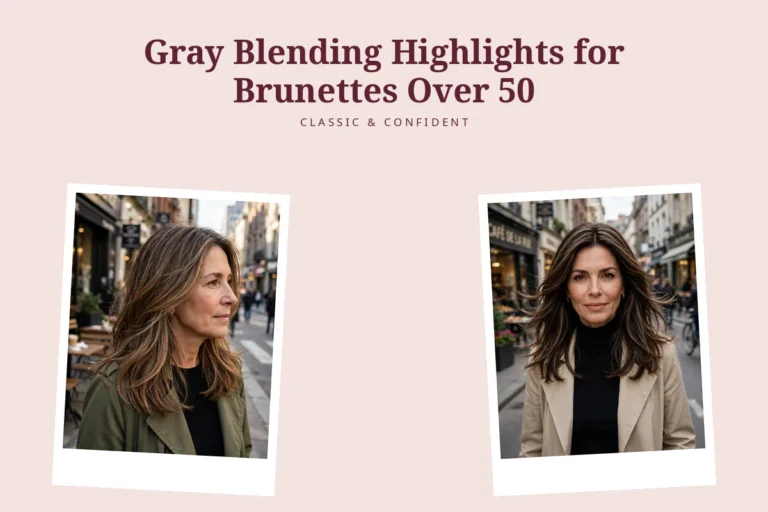
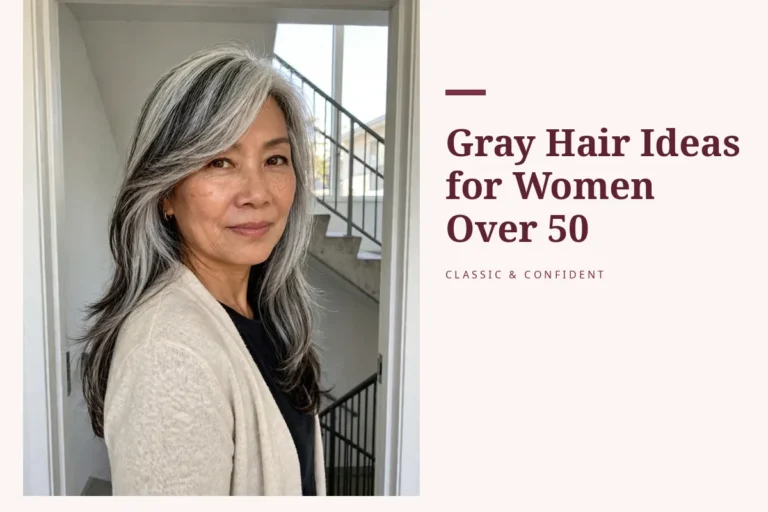
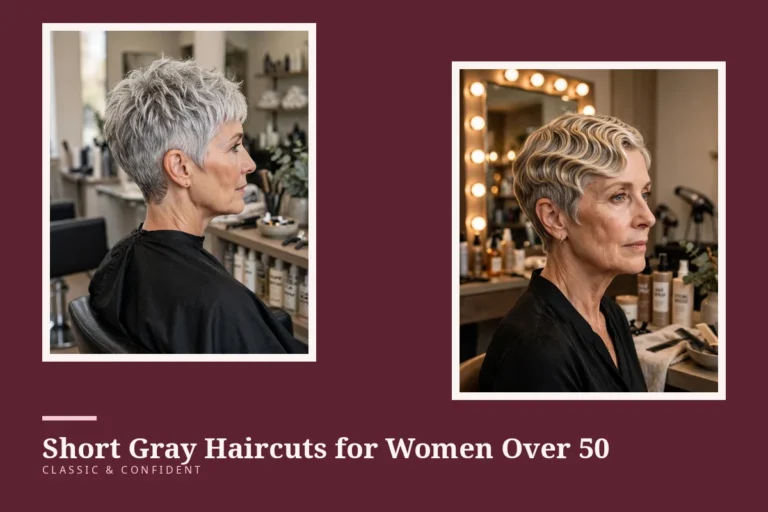
18 Silver Blonde Hair Ideas for Women Over 50
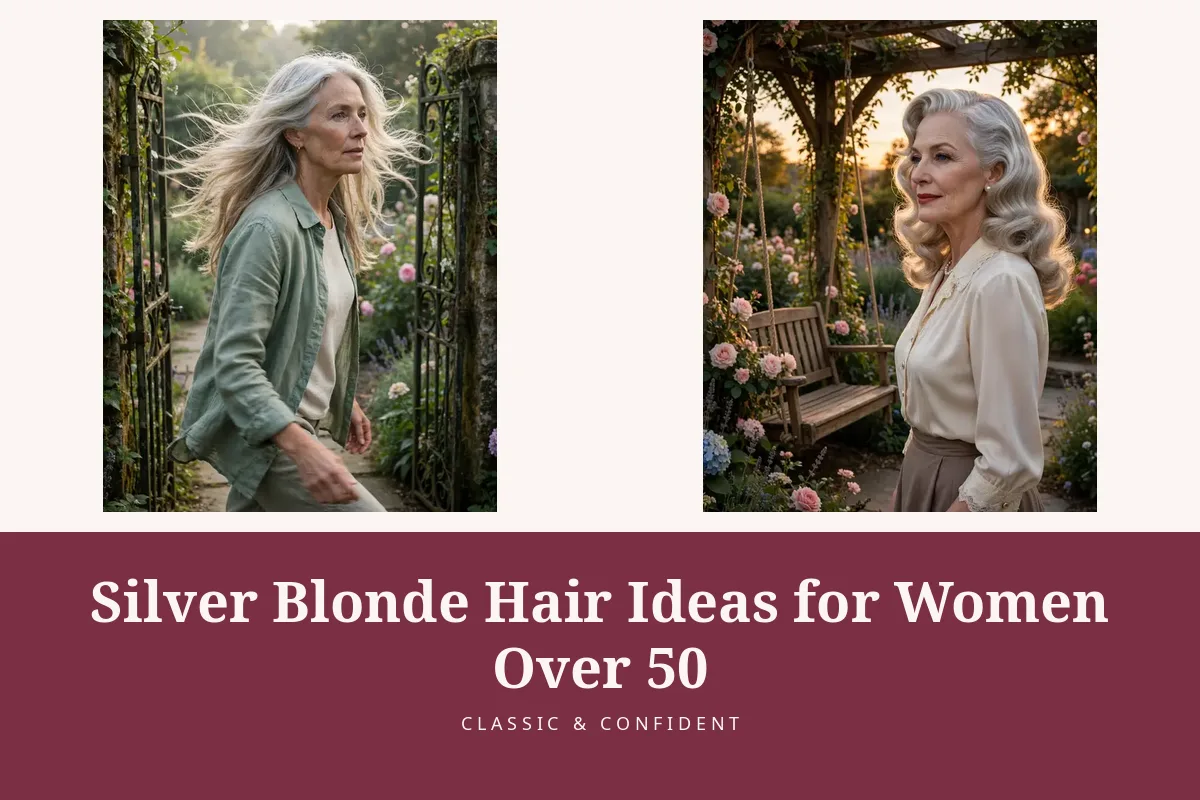
Think about your Tuesday morning. You wash, you rough-dry for about 12 minutes, you’re out the door by 8:15 — and your colour has to work inside that routine, not demand a brand-new one.
That’s the test every one of these 18 ideas for blonde grey hair over 50 passes: they’re chosen for women whose mornings are real, whose hair is going grey or has gone, and who want silver blonde that looks deliberate rather than grown out.
Below you’ll find the looks ordered the way your day actually runs — office hours, everyday hours, weekend hours, and after dark — so you can pick the silver blonde that fits the life you live.
Each one names the cut, the exact words to say to your stylist, how many minutes it takes to style, and who should walk past it.
Quick picks
Best first tries:
- Best first tries: the safest grey-to-blonde bridge → The Soft Silver-Blonde Blend (#1)
- Best first tries: the sharpest office hair → The Polished Champagne Bob (#2)
- Best first tries: ten minutes and no more → The Wash-and-Go Blonde Shag (#6)
- Best first tries: one look for Saturday plans → The Textured Blonde Wolf Cut (#12)
- Best first tries: evening hair in under half an hour → The Silver-Blonde Hollywood Waves (#18)
Contents
- How to choose your silver blonde
- At a glance: all 18 ideas
- The workday hours: office-ready silver blondes (#1–#5)
- The everyday hours: errands, gym and school runs (#6–#10)
- The weekend hours: lunches, markets and Saturdays out (#11–#14)
- After dark: evenings, events and nights out (#15–#18)
- Silver blonde tips: the morning-to-night routine
- The bottom line
- Frequently asked questions
Blonde grey hair over 50: how to choose
Start from your grey percentage, not your age. If you’re 60%+ white, lean into cool silver-blonde tones woven mostly through the front and top — the blonde reads as brightness, and there’s so little dark regrowth that touch-ups stretch to 10–12 weeks.
If you’re 30–50% grey, warm champagne pieces melt the line between your natural colour and the silver coming through, and you keep 6–8 weeks between appointments.
Match the tone to your skin undertone. Cool, blue-grey blonde on warm, golden skin can look stark at first glance — ask for 3–4 golden or honey lowlights at the hairline to bridge the gap, which drops the visual contrast by roughly 20%. Cool pinkish skin takes ash and platinum straight; warm skin usually prefers champagne, honey or caramel.
When in doubt, hold a silver spoon and a gold spoon to your cheek in daylight — whichever flatters you tells your stylist your tone family.
Budget the salon honestly. Silver blonde is a 2-visit commitment: a demi gloss every 6–8 weeks to keep the tone clean (30–40 minutes), and a full foil or balayage refresh every 10–14 weeks (2–3 hours).
If that cadence sounds like too much, the root-melted and balayage options below are the forgiving ones — they grow out like a gradient, not a line. The full lowdown on appointment cycles is in highlights and lowlights for gray hair over 50.
Check your real styling minutes. A Hollywood wave costs 30 minutes and a curling iron; a pixie crop costs 3 minutes and a pea-size of cream. Neither is better — but the look you won’t style is the look you shouldn’t get.
If mornings are tight, scan the everyday group below, and browse grey hair ideas for women over 50 for more low-effort shapes that pair well with blonde.
Mind the brass before it starts. Blonde on grey hair yellows from heat and minerals, not from age. A purple shampoo used once a week for exactly 3 minutes, plus a shower filter if your water is hard, keeps silver blonde bright for months.
If your hair is fine, pick from hairstyles for fine hair over 50 first and blonde the cut — a cut that holds its own means the colour does less of the work.
At a glance: all 18 ideas
| Idea | Tone | Trims | Style time |
|---|---|---|---|
| 1. Soft Silver-Blonde Blend | Cool silver | 8 weeks | 15 min |
| 2. Polished Champagne Bob | Warm champagne | 6 weeks | 12 min |
| 3. Blonde-Grey Balayage Lob | Neutral blend | 10 weeks | 15 min |
| 4. Low-Key Root-Melt Pixie | Smoky root | 4 weeks | 5 min |
| 5. Sleek Icy White Blowout | Icy white | 9 weeks | 25 min |
| 6. Wash-and-Go Blonde Shag | Sandy blonde | 8 weeks | 7 min |
| 7. Towel-Dried Silver Pixie Crop | Natural silver | 4 weeks | 3 min |
| 8. Blonde Curtain-Fringe Lob | Cool beige | 8 weeks | 10 min |
| 9. Messy Blonde Bun | Any blonde | 10 weeks | 5 min |
| 10. Low-Pony Blonde-Grey Sweep | Silver blonde | 10 weeks | 8 min |
| 11. Honey-Blonde Face Frame | Warm honey | 8 weeks | 10 min |
| 12. Textured Blonde Wolf Cut | Dirty blonde | 8 weeks | 10 min |
| 13. Platinum Bob With Deep Side Part | Platinum | 6 weeks | 12 min |
| 14. Wavy Caramel-Blonde Lob | Warm caramel | 10 weeks | 12 min |
| 15. Gilded Silver Updo | Gilded silver | 12 weeks | 20 min |
| 16. High-Shine Ash-Blonde Waves | Cool ash | 9 weeks | 20 min |
| 17. Bold Platinum Pixie With Dark Roots | Platinum/dark root | 5 weeks | 5 min |
| 18. Silver-Blonde Hollywood Waves | Old-glamour silver | 9 weeks | 30 min |
The workday hours: office-ready silver blondes (#1–#5)
Morning light is the most honest light your hair will face. These five are the ones that look sharp at 8 am in the lift — polished, professional, and bright enough to carry you through a day of meetings without fading by lunch.
1. The Soft Silver-Blonde Blend
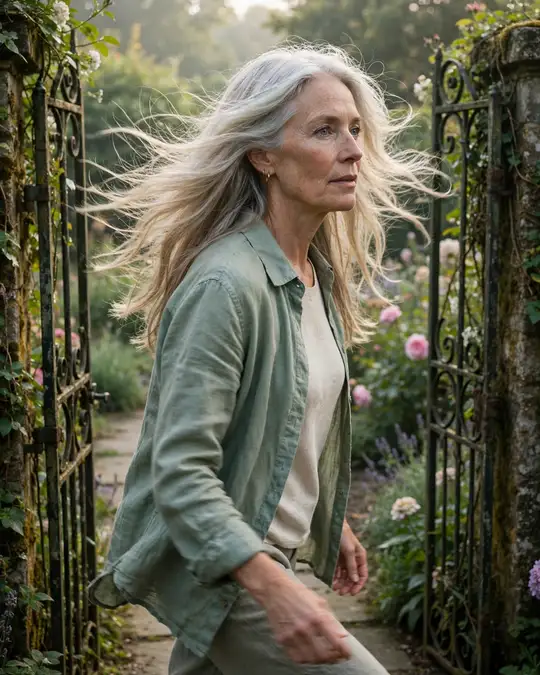
The mechanism is light scatter. Twenty to thirty ultra-fine woven foils — each no wider than 2 mm — break up a solid grey sheet into hundreds of tiny light-catchers, so the eye reads texture and movement instead of one flat colour.
The blonde concentrates through the front hairline and crown, which throws light onto the face like a built-in soft-focus, while the underneath stays closer to natural grey so regrowth never draws a line.
Keep 25–35 cm of length so the blend has room to graduate from root to ends.
A demi silver gloss over the top every 6–8 weeks keeps the blonde bright without bleach damage, and it’s the single best first step into blonde grey hair over 50 if you’ve been nervous — everything about it can be softened or deepened at the next visit.
- Length: 25–35 cm, layered at the ends
- Colour: 20–30 fine foils, cool silver; demi gloss every 6–8 weeks
- Trims: every 8 weeks
- Styling time: 15 minutes
Ask your stylist for: “Fine woven foilyage through the top and front, 2 mm slices, cool silver over my natural grey — I want dimension, not all-over blonde, and a demi silver gloss to finish.”
How to style it:
- Blow-dry with a medium round brush, lifting the crown in 3 sections — the lift at the root is what shows off the blonde dimension.
- Smooth the mid-lengths with the brush pointing down; grey cuticles snag less when the airflow goes one direction.
- Finish with a pea-size of smoothing cream on the bottom 8 cm only — roots stay product-free so the foils keep catching light.
Skip it if your hair is very dark underneath — the contrast between foils and dark base needs refreshing every 4 weeks, and the whole point of this look is ease.
Best for: first-time blondes, 50%+ grey patterns, and anyone who wants the face-brightening effect of blonde without committing to a full head of colour.
2. The Polished Champagne Bob
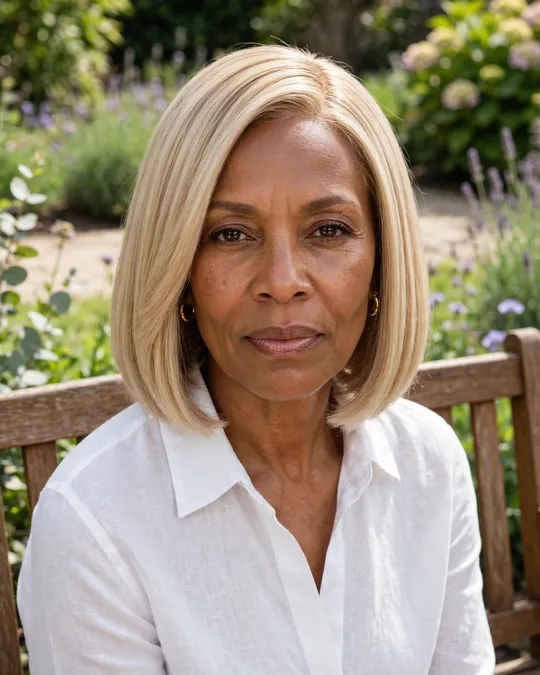
The mechanism is a reflective plane. A blunt, jaw-length perimeter creates one continuous surface of hair, and light bounces off that surface evenly — which is why a blunt bob can make fine hair read up to 30% denser.
The warm champagne tone counters grey’s naturally cool flatness: on warm or neutral skin it puts colour back into the face instead of draining it.
Cut it blunt at the jawline with the very ends left clean — no layering in the bottom 5 cm, or the dense line breaks. Eight to ten foils of warm champagne through the top layer are enough; the density does the talking.
This is the sharpest silver blonde in the office, and it photographs well because there are no flyaways at the perimeter.
- Length: jawline, blunt perimeter
- Colour: 8–10 warm champagne foils, gloss every 7 weeks
- Trims: every 6 weeks to hold the line
- Styling time: 12 minutes
Ask your stylist for: “A blunt bob at the jawline, zero layers in the bottom 5 cm, with warm champagne foils through the top — polished and dense, no texture on the line.”
How to style it:
- Blow-dry straight down with a paddle brush in 4 sections — the blunt line needs the ends to sit dead straight.
- One pass of the flat iron at 170°C on the last 5 cm only; grey scorches easily, and the perimeter is all anyone sees.
Skip it if your hair is very curly — the blunt perimeter fights the curl pattern and the ends kick out instead of sitting.
Best for: fine, straight-to-wavy hair; warm and neutral skin tones; anyone who wants one hairstyle that works for the boardroom and the school gate.
3. The Blonde-Grey Balayage Lob

The mechanism is regrowth camouflage. Balayage’s hand-painted application leaves a diffused, feathered root — no hard foil line — and that diffused transition happens to match the way natural grey grows in: softly, unevenly, at the temples first. The result is that grey regrowth and blonde highlights merge instead of colliding, stretching the refresh interval from 6 weeks to 10–12.
Keep the lob at 25–30 cm with long, invisible layers that start below the chin. The blonde should be neutral — not icy, not golden — so it sits halfway between your grey and your old colour, bridging them. This is the grow-out-friendly blonde: the appointment you skip in January won’t show by March.
- Length: 25–30 cm, long invisible layers
- Colour: neutral blonde balayage, refresh every 10–12 weeks
- Trims: every 10 weeks
- Styling time: 15 minutes
Ask your stylist for: “Hand-painted neutral blonde balayage on a 25 cm lob, soft diffused root with no hard line, long layers below the chin — I want it to grow out invisibly.”
How to style it:
- Rough-dry to 80%, then wrap 5 cm sections around a large-barrel iron away from the face — loose bends show the balayage gradient best.
- Let each section cool 60 seconds before touching it; cooled waves set twice as long.
- Break up with fingers, never a brush — the point is painted dimension, and brushing blurs it into one tone.
- A pea-size of texturising cream on the ends only.
Skip it if you want a crisp, defined blonde — balayage is deliberately soft; precise highlights are a different appointment.
Best for: busy calendars, mid-transition grey, and anyone who wants the blonde without the 6-week tether to the salon.
4. The Low-Key Root-Melt Pixie

The mechanism is shadow physics. A root melt — a demi colour dragged 3–5 cm down from the root in a smoky grey-blonde — creates artificial depth at the scalp, and depth at the scalp reads as thickness.
On a short pixie, where there’s no length to create dimension, that manufactured shadow is what stops the cut looking flat and one-note.
Keep 3–6 cm on top with the sides tapered neat but not tight. The root melt is the key instruction: it should be one level darker than the ends and feathered, never a line. Regrowth merges into the melt invisibly for 6–8 weeks, which is unusually forgiving for a pixie.
- Length: 3–6 cm top, tapered sides
- Colour: smoky grey-blonde root melt, refreshed with the cut
- Trims: every 4 weeks
- Styling time: 5 minutes
Ask your stylist for: “A textured pixie, 5 cm on top, with a smoky grey-blonde root melt feathered 4 cm down — depth at the root, brightness at the ends.”
How to style it:
- Work a pea-size of matte cream through dry hair, pushing the top forward and to one side.
- Pinch 2–3 small sections at the front for separation — the texture shows off the root-to-end gradient.
Skip it if you have strong cowlicks at the hairline — at 5 cm there’s no weight to hold them down.
Best for: the 3-minute morning, strong features that carry short hair, and anyone transitioning from full dye to natural grey.
5. The Sleek Icy White Blowout

The mechanism is maximum reflection. White hair is the most reflective hair there is — with no melanin to absorb light, every strand bounces it back — and a tension blowout aligns the cuticles so the reflection comes back as shine instead of scatter.
An icy gloss on top removes the yellow cast that dulls white hair, and the combination reads as luminous rather than flat.
Keep 30–40 cm of length so the blowout has somewhere to move. The gloss is non-negotiable: book it every 8 weeks, because white hair shows warmth faster than any other shade. This is the most dramatic of the workday looks — not edgy, but undeniably deliberate.
- Length: 30–40 cm, long layers
- Colour: icy white gloss every 8 weeks
- Trims: every 9 weeks
- Styling time: 25 minutes
Ask your stylist for: “Long layers at 35 cm with an icy white gloss — no warmth, maximum shine. I want it cool and clean.”
How to style it:
- Apply heat protectant to damp hair — white hair scorches yellower than pigmented hair, and you can’t fix scorch with gloss.
- Blow-dry in 6 sections with a large round brush, rolling each section under at the ends for the polished finish.
- One pass of the flat iron at 160°C over the top layer only — that’s where the light hits.
Skip it if your ends are fragile — 35 cm of white hair needs to be healthy to shine; if it’s snapping, cut first and grow back to this.
Best for: 70%+ white hair, thick textures, and the woman who wants her silver to look like a statement, not a default.
The everyday hours: errands, gym and school runs (#6–#10)
These are the looks that survive a school run, a workout bag, and a supermarket trip in the same afternoon. Wash-and-go friendly, tie-backable, and blonde enough to look styled even when you’ve done almost nothing.
6. The Wash-and-Go Blonde Shag
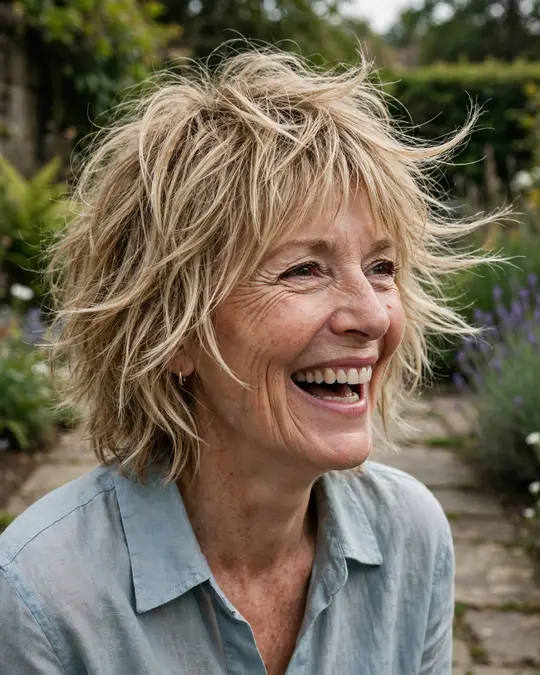
The mechanism is controlled volume from weight removal. A shag takes weight out of the interior — short layers at the crown, longer at the perimeter — so whatever natural wave or bend your hair has springs up instead of being dragged flat.
On blonde-grey hair, the layers also create automatic dimension: the shorter pieces sit lighter and the longer pieces fall darker, no extra colour needed.
Keep it 20–28 cm with the shortest crown layer at 10–12 cm and a piece-y fringe optional. Sandy blonde is the tone that asks least of you — it’s close enough to most greys that regrowth barely registers. Air-dry or diffuse; a brush is genuinely unnecessary.
- Length: 20–28 cm, interior layers
- Colour: sandy blonde, gloss twice a year
- Trims: every 8 weeks
- Styling time: 7 minutes
Ask your stylist for: “A shag with the crown cut to 11 cm, interior weight removed, sandy blonde that stays close to my natural grey — I want to air-dry and go.”
How to style it:
- Scrunch a walnut-size of mousse into damp hair, crown first — the crown is where the shag gets its lift.
- Diffuse on medium heat for 5 minutes or air-dry; do not brush, ever.
- Shake at the roots once dry and leave it.
Skip it if you prefer sleek, controlled hair — this cut’s entire job is controlled mess, and fighting it daily defeats the purpose.
Best for: wavy and curly textures, active mornings, and anyone who wants the lowest-maintenance blonde on this list.
7. The Towel-Dried Silver Pixie Crop
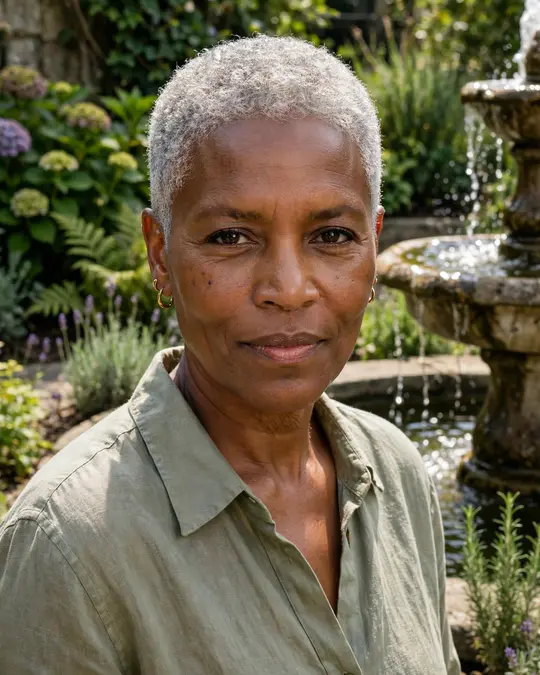
The mechanism is honesty at short length. At 2–4 cm, hair can’t lie about texture — and silver hair at this length reflects light as one bright, even cap, which reads as deliberate and modern rather than sparse.
Removing the damaged, thinned ends of a lifetime of colour leaves only the newest, densest growth, which is why so many women say their hair looks thicker after going short.
Keep the top at 2–4 cm, sides tapered close but soft. Let your natural silver be the colour — no dye, no gloss needed beyond a monthly clarifying wash if your water is hard. This is the 3-minute morning: towel, pea of cream, door.
- Length: 2–4 cm, tapered sides
- Colour: natural silver, no colour work
- Trims: every 4 weeks
- Styling time: 3 minutes
Ask your stylist for: “A soft tapered crop, 3 cm on top, sides close but not harsh — I’ll wear my natural silver, so the shape has to be perfect.”
How to style it:
- Towel-dry until just damp.
- Rub a pea-size of soft cream between your palms and push the top forward and slightly to one side.
Skip it if you’re not ready for the comments — a silver crop gets noticed, mostly admiringly, but constantly.
Best for: the confident minimalist, the gym-goer, and anyone who wants hair to be the least interesting thing about her morning.
8. The Blonde Curtain-Fringe Lob

The mechanism is forehead geometry. A curtain fringe, parted in the middle and sweeping to each side, splits the forehead visually into two soft panels — the eye reads two curves instead of one wide expanse.
On blonde-grey hair it does double duty: the fringe is the lightest part of the cut, so it throws brightness onto the face, and the parted shape breaks up a solid silver sheet with movement right where people look first.
Keep the lob at the collarbone, blunt, with the fringe longest at the cheekbones and shortest at the bridge of the nose. Cool beige is the tone that suits the most people — it flatters warm and cool skin alike. The fringe needs a trim with every haircut, but it blends into the lob, so there’s never an awkward grow-out.
- Length: collarbone lob, curtain fringe to the cheekbones
- Colour: cool beige blonde, gloss every 8 weeks
- Trims: every 8 weeks
- Styling time: 10 minutes
Ask your stylist for: “A collarbone lob with a true curtain fringe — longest at the cheekbones, shortest at the nose bridge — in a cool beige blonde.”
How to style it:
- Dry the fringe first, while it’s wettest — it sets fastest and goes flat if you leave it.
- Use a small round brush, sweeping each side away from the centre part.
- Dry the lob with a paddle brush, ends tucked under for 2 minutes of polish.
Skip it if you have a very strong cowlick at the centre hairline — the middle part is the whole point, and fighting it daily is a losing battle.
Best for: longer foreheads, fine-to-medium hair, and anyone who wants face-framing brightness without committing to full bangs.
9. The Messy Blonde Bun

The mechanism is strategic imperfection. A bun pulled up with the ends left loose and a few face-framing pieces out reads as effortless — but the trick is that the loose pieces are the blonde ones.
Light-coloured strands around the face catch the eye and soften the features, while the pulled-back mass stays out of the way for errands, cooking and workouts.
This isn’t a hairstyle you get cut — it’s what any length past 25 cm can do. The key is texture: second-day hair, a little dry texture spray, and a bun twisted loosely at the crown or nape. Keep the front pieces 10–15 cm so they frame rather than dangle.
- Length: 25 cm or longer
- Colour: any blonde — the updo shows it off
- Trims: every 10 weeks
- Styling time: 5 minutes
Ask your stylist for: “Long layers that gather into a bun easily — keep 10–15 cm face-framing pieces at the front, and thin the very ends so the twist isn’t bulky.”
How to style it:
- Spray dry texture spray at the roots — clean hair is too slippery to hold a loose bun.
- Gather at the crown, twist once, and pin — leave the ends sticking out deliberately.
- Pull two 10 cm pieces loose at the temples and let them fall.
- Tug gently at the crown for lift; done.
Skip it if your hair is shorter than 25 cm — the bun won’t hold without the length, and bobby pins will show.
Best for: second-day hair, busy days, gym bags, and anyone whose blonde looks best when it’s a little undone.
10. The Low-Pony Blonde-Grey Sweep
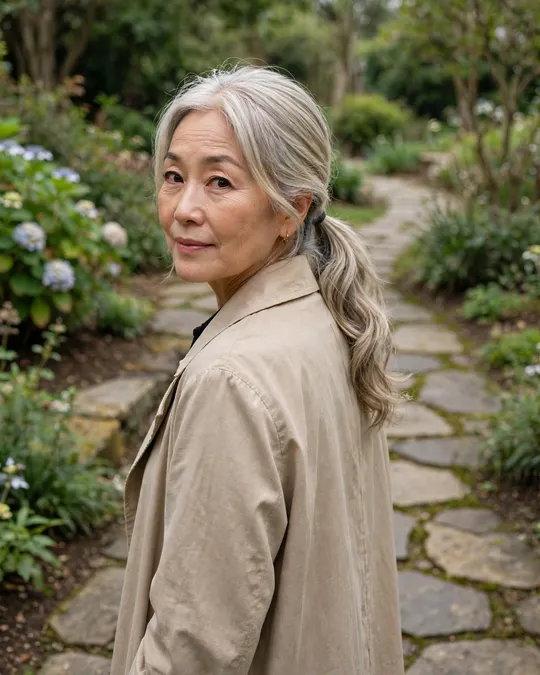
The mechanism is a swept part line. A deep-ish side sweep on a low ponytail pulls the hair across the forehead diagonally, and a diagonal line is the most flattering line there is — it breaks up symmetry, lifts the eye upward, and shows off blonde dimension along the sweep.
The low placement keeps it grown-up; high ponytails skew young, low ones read chic.
Part the hair from above the outer corner of one eyebrow, sweep everything to the nape, and secure low. Wrap a 2 cm section of hair around the elastic — it hides the band and takes 20 seconds, and it’s the difference between “ponytail” and “style.” Silver blonde along the sweep catches the light with every turn of the head.
- Length: 25 cm or longer
- Colour: silver blonde with dimension at the sweep
- Trims: every 10 weeks
- Styling time: 8 minutes
Ask your stylist for: “Long layers with brightness through the front third — I sweep it into a low side pony daily, so the blonde needs to live along the sweep.”
How to style it:
- Smooth with a paddle brush, parting from above the outer eyebrow corner.
- Gather low at the nape, slightly to one side, and secure.
- Wrap a 2 cm section around the band and pin underneath.
Skip it if your hair is very fine and slippery — the sweep won’t hold without texture spray, and fighting it all day isn’t worth it.
Best for: the school-run-to-desk day, humid weather, and anyone who wants one elegant default for busy mornings.
Good to know
Blonde on grey goes brassy for two reasons: heat and minerals. Keep every hot tool at 170°C or under, use purple shampoo once a week for exactly 3 minutes (longer turns white hair lavender — set a timer), and if your tap water is hard, a £15 shower filter does more for your colour than a £40 toner.
Save this guide to your “silver blonde” Pinterest board before your appointment — the exact stylist wordings under each look are the part you’ll want in the chair.
The weekend hours: lunches, markets and Saturdays out (#11–#14)
Saturday hair can have a little more personality. These four have warmth, texture and movement — the kind of silver blonde that looks like you chose it on purpose, whether you’re meeting friends for lunch or wandering the market.
If you are weighing up length before your next cut, our short haircuts for fine hair round-up shows how each shape sits on real women over 50.11. The Honey-Blonde Face Frame
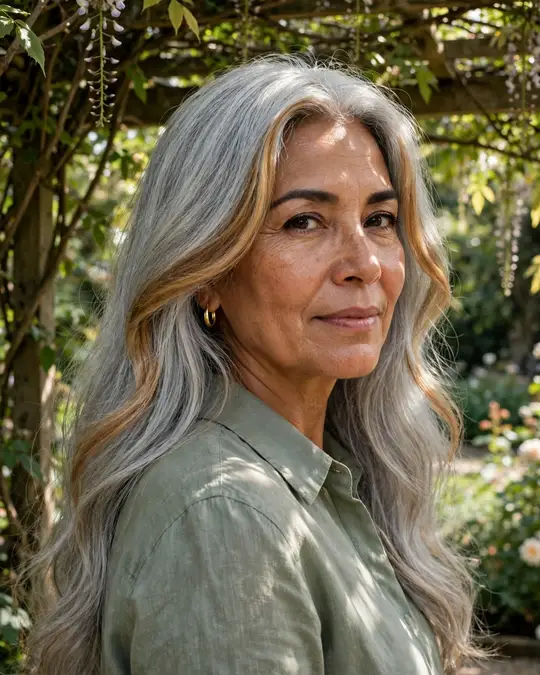
The mechanism is warm contrast. Honey-blonde pieces placed in a 5 cm frame around the face do what highlighter does for makeup: they bounce warm light onto the skin, softening shadows under the eyes and around the mouth.
On cooler silver-grey hair, that ring of warmth is the difference between “striking” and “stark” — and because the colour only lives at the face frame, it refreshes in a 45-minute partial appointment.
Any length works, but shoulder length or longer shows the frame best. The honey should be one to two levels warmer than your base — golden, not orange. This is the warmest blonde on the list, and the best choice for women with warm or olive skin who want silver without going cold.
- Length: shoulder length or longer
- Colour: honey face frame, 5 cm wide, partial refresh every 8 weeks
- Trims: every 8 weeks
- Styling time: 10 minutes
Ask your stylist for: “Honey-blonde pieces in a 5 cm frame around my face, one to two levels warmer than my silver — keep the back cool, I only want warmth at the front.”
How to style it:
- Blow-dry the front sections forward with a round brush — the frame has to sit toward the face to do its job.
- Pull the rest back loosely so the honey pieces are the first thing anyone sees.
Skip it if your skin is very cool and pink — honey against pink skin can clash; cool beige suits you better.
Best for: warm and olive skin tones, women who find all-cool silver too stark, and anyone who wants maximum effect from a minimum appointment.
12. The Textured Blonde Wolf Cut

The mechanism is layered dissonance. The wolf cut pairs a short, shaggy crown with longer length at the back — two lengths that shouldn’t work together, but do, because the contrast creates automatic volume at the top and swing at the bottom.
In dirty blonde, the choppy layers read as rock-and-roll texture rather than mess, and the colour’s mid-tone warmth keeps it flattering instead of edgy-for-edgy’s-sake.
Keep the crown at 8–10 cm and the back at 20–25 cm, with the fringe piece-y and brow-skimming. Dirty blonde — that in-between shade of blonde and light brown — is the tone that makes this cut wearable past 50: it’s dimensional by default, so regrowth barely shows. This is the personality pick of the weekend group.
- Length: 8–10 cm crown, 20–25 cm back
- Colour: dirty blonde, gloss every 10 weeks
- Trims: every 8 weeks
- Styling time: 10 minutes
Ask your stylist for: “A wolf cut — short shaggy crown at 9 cm blending into 22 cm at the back, piece-y fringe, in a dirty blonde that sits between my grey and light brown.”
How to style it:
- Apply mousse to damp hair and scrunch the crown upward — the top layers need to stand away from the head.
- Diffuse or air-dry; the back length can be left smoother by pulling it straight while damp.
- Pinch the fringe into 3–4 separated pieces with a tiny bit of cream.
Skip it if your workplace leans conservative — the silhouette still reads fashion-forward to some eyes, whatever the colour.
Best for: the style-forward reader, wavy textures, and anyone who wants her grey to look like a fashion choice — because it is.
13. The Platinum Bob With Deep Side Part
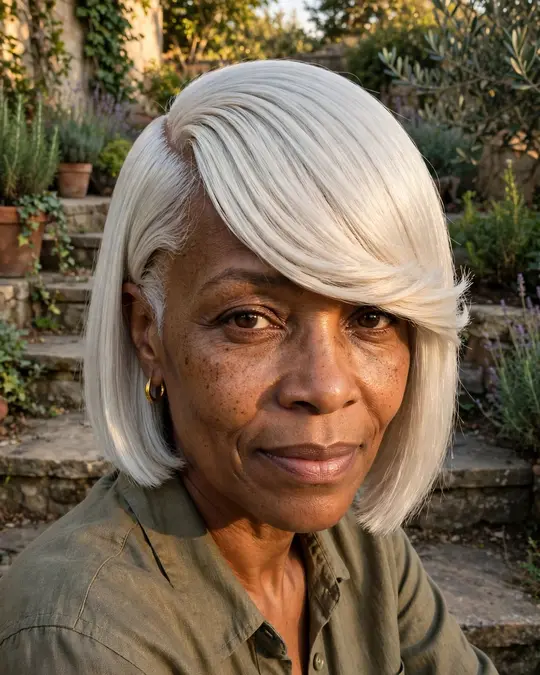
The mechanism is asymmetric lift. An unmistakably deep side part — swept far over, with the part line starting up near the temple, never anywhere near the centre — throws all the hair’s weight to one side, and weight thrown sideways lifts the roots on the heavy side by 2–3 cm.
On platinum hair, that sweep of bright, cool blonde across the forehead is also the most dramatic face-brightener on this list.
Keep the bob at the jawline or just below, cut blunt so the sweep has a clean edge. Platinum needs a purple shampoo weekly and a gloss every 6 weeks — it’s the highest-maintenance tone here, but nothing else photographs like it. Make sure your stylist sets the part deep: near-centre is a completely different, much flatter look.
- Length: jawline to just below
- Colour: platinum, gloss every 6 weeks, purple shampoo weekly
- Trims: every 6 weeks
- Styling time: 12 minutes
Ask your stylist for: “A blunt platinum bob with the part set unmistakably deep — far over, up near the temple — and all the length swept heavily to one side. Not a centre part, not a soft side part.”
How to style it:
- Set the deep part while the hair is soaking wet — part lines set permanently as hair dries, so don’t wait.
- Blow-dry the heavy side forward and across with a round brush for the sweep.
- Tuck the light side behind the ear to show the asymmetry.
- One pass of the flat iron over the sweep for the glassy finish.
Skip it if you have a strong natural centre part with a cowlick — forcing it sideways daily is a battle you’ll lose by lunchtime.
Best for: fine hair that needs the volume trick, dramatic features, and the woman who wants Saturday hair with real presence.
14. The Wavy Caramel-Blonde Lob
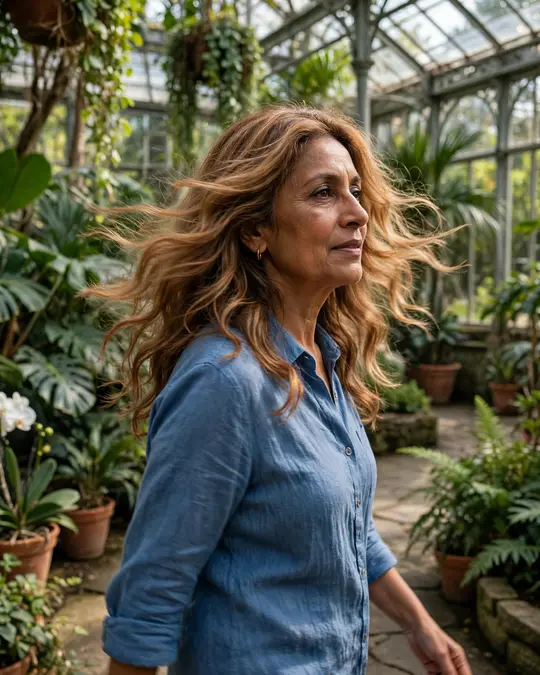
The mechanism is warm depth on waves. Caramel blonde sits halfway between blonde and brunette, and on loose waves each bend catches the light differently — so one colour reads as three.
That built-in dimension is why this lob looks styled with almost no effort: the waves do the work the foils would otherwise have to do, and the warm tone keeps grey regrowth blending softly instead of glaring.
Keep it 25–28 cm with long layers and loose, undone waves — not curls. Caramel is the most forgiving blonde tone for regrowth because it sits so close to most natural mid-tones. Refresh with a gloss every 10 weeks; the waves hide everything in between.
- Length: 25–28 cm, long layers
- Colour: caramel blonde, gloss every 10 weeks
- Trims: every 10 weeks
- Styling time: 12 minutes
Ask your stylist for: “A 26 cm lob with long layers in caramel blonde — warm but not coppery — and I’ll wear it in loose undone waves.”
How to style it:
- Wrap 5 cm sections around a large iron, alternating directions — alternating is what makes waves look natural instead of pageant.
- Leave the last 3 cm of every section out of the iron for the undone ends.
- Cool, then rake through with fingers and a drop of oil.
Skip it if your hair is very fine and straight — without natural bend, the waves drop by noon and you’re left with a plain lob (which is fine, but not this look).
Best for: natural waves, warm skin tones, and the low-maintenance weekend blonde that still looks done in photos.
After dark: evenings, events and nights out (#15–#18)
Evening light is low and warm, and hair can afford to be bolder. These four turn the blonde up — more shine, more contrast, more drama — for dinners, weddings, and nights when the photos matter.
15. The Gilded Silver Updo
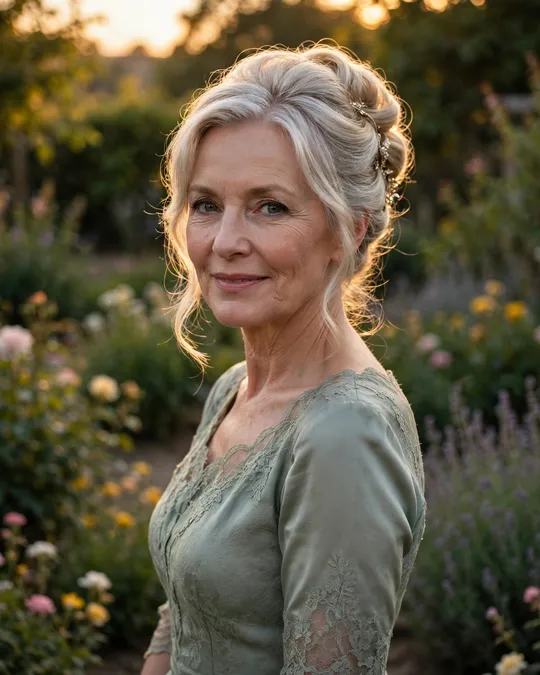
The mechanism is upward focus. An updo lifts the hair — and the eye — away from the jawline and neck, which is flattering at any age but especially after 50, when the jawline softens.
The “gilded” part is a warm-toned gloss over silver hair: it adds golden reflect to every strand, so under evening light the whole updo glows instead of going flat grey.
This is a salon updo, not a DIY project — budget 45 minutes at the salon or 20 with practice. Any length past 25 cm works; the stylist pins loosely at the crown with the ends textured. Keep the front soft with two face-framing pieces — a severe scraped-back updo hardens the features.
- Length: 25 cm or longer
- Colour: gilded silver gloss, refreshed per event
- Trims: every 12 weeks
- Styling time: 20 minutes (or salon 45)
Ask your stylist for: “A soft pinned updo with texture at the crown, two face-framing pieces left out — and a warm gilded gloss over my silver so it glows under evening light.”
How to style it:
- Backcomb the crown in 3 small sections — the lift is what makes an updo flattering rather than severe.
- Twist loosely and pin at the crown, leaving the ends textured and a little undone.
- Pull two 10 cm pieces loose at the temples; curl them once with the iron for softness.
Skip it if your hair is shorter than 25 cm — a pinned updo needs the length, and extensions for one evening aren’t worth it.
Best for: weddings, formal dinners, and anyone who wants her silver to look like jewellery.
16. The High-Shine Ash-Blonde Waves

The mechanism is gloss as structure. An ash-blonde demi gloss doesn’t just change the tone — it seals the cuticle, and a sealed cuticle reflects light in a continuous sheet instead of scattering it. On waves, that means every bend becomes a highlight and every dip a lowlight, all from one colour.
It’s the closest thing to a filter for real hair.
Keep 28–35 cm with long layers so the waves have room to form. Cool ash suits cool and neutral skin best; if your skin is warm, ask for “ash with a drop of gold” so it doesn’t go flat. The gloss fades in 6–8 weeks, which is actually the rhythm you want — it means the tone is always fresh.
- Length: 28–35 cm, long layers
- Colour: ash-blonde demi gloss every 6–8 weeks
- Trims: every 9 weeks
- Styling time: 20 minutes
Ask your stylist for: “Long layered waves in an ash-blonde demi gloss — maximum shine, sealed cuticle. Cool, but not icy.”
How to style it:
- Blow-dry smooth first — waves on top of frizz just look frizzy.
- Set 6 large sections in the iron away from the face, holding each 8 seconds.
- Brush through once with a soft bristle brush for the continuous wave — then stop touching it.
- One light mist of shine spray, held 30 cm away.
Skip it if your hair is very porous from old bleach — ash grabs unevenly on porous hair and can go greenish at the ends; get the ends cut first.
Best for: evening events, photographs, and anyone whose grey has gone dull and needs the shine back.
17. The Bold Platinum Pixie With Dark Roots

The mechanism is deliberate contrast. Platinum ends against a 3–4 cm dark root create a sharp, graphic line — and because the line is obviously intentional (no one grows out that precisely), it reads as fashion rather than neglect.
The dark root also does the heavy lifting of depth: it makes the platinum look brighter by comparison and gives the pixie the dimension short hair otherwise lacks.
Keep 4–7 cm on top, tapered at the sides, with the root left dark for 3–4 cm. This is the boldest look on the list and the only one where visible roots are the point — maintain the line with a root touch every 5 weeks so it stays crisp rather than blurry.
- Length: 4–7 cm top, tapered sides
- Colour: platinum with 3–4 cm dark root, touch-up every 5 weeks
- Trims: every 5 weeks
- Styling time: 5 minutes
Ask your stylist for: “A textured platinum pixie with a deliberate 3 cm dark root — I want the contrast crisp and graphic, like a fashion choice, not grow-out.”
How to style it:
- Work a pea-size of matte paste through dry hair, lifting the top up and forward.
- Define 3–4 pieces at the front with your fingertips — the texture shows off the root-to-platinum line.
Skip it if you want low-key hair — this is the opposite of blending in, and the contrast draws the eye.
Best for: strong features, the style-confident, and evenings when you want your hair to be the accessory.
18. The Silver-Blonde Hollywood Waves
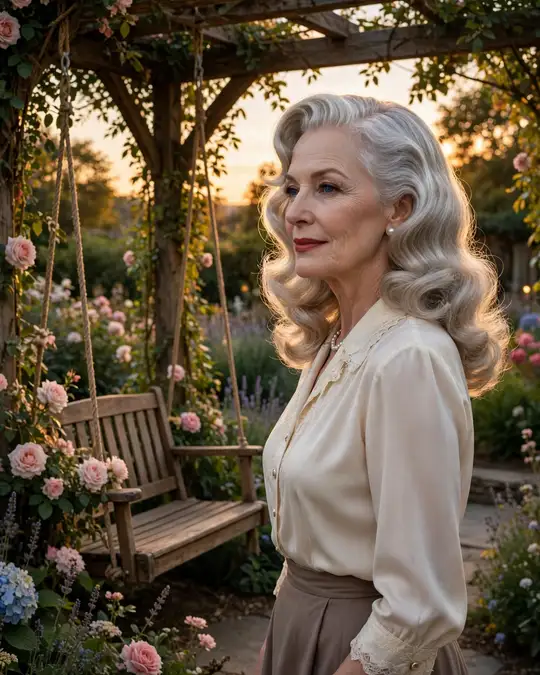
The mechanism is vintage optics. Hollywood waves — deep, uniform, brushed-out S-curves — were engineered for black-and-white film: they create alternating bands of light and shadow that the camera reads as dimension. On silver-blonde hair the effect is even stronger, because the lightest shade reflects the most light.
In evening light, each wave becomes a ribbon of shine.
Keep 30–40 cm of one-length hair — layers break the continuous wave. Set with a medium iron, pin each curl to cool, then brush out with a soft bristle brush until the curls merge into waves. It takes 30 minutes and it is worth every one for a wedding or a milestone birthday.
- Length: 30–40 cm, one length
- Colour: silver blonde with icy gloss
- Trims: every 9 weeks
- Styling time: 30 minutes
Ask your stylist for: “One-length hair at 35 cm in silver blonde with an icy gloss — I’ll be setting Hollywood waves, so no layers to break the wave pattern.”
How to style it:
- Curl 4 cm sections around a medium iron, all in the same direction, and pin each curl to cool — same direction is what merges into waves.
- Once fully cool, remove the pins and brush through with a soft bristle brush until the curls melt into S-waves.
- Smooth the top with your palms and a drop of shine serum.
Skip it if your hair is heavily layered — the layers poke out of the wave pattern and break the vintage line.
Best for: weddings, milestone birthdays, and the evening you want to look back on in photos for years.
Silver blonde tips: the morning-to-night routine
Silver blonde rewards routine, not effort. This short day-shaped routine keeps the tone clean and the hair healthy from the first mirror check to the last look of the night.
- Morning: dry the roots first. Grey hair frizzes fastest at the root — 2 minutes of focused root-drying buys you 6 hours of smoothness.
- Midday: keep a travel brush, not product. Blonde-grey hair revives with 30 seconds of brushing; adding dry shampoo on top of product buildup dulls the tone.
- Evening: brush before bed, 50 strokes. It redistributes natural oils to the ends, which is exactly where grey goes wiry.
- Weekly: purple shampoo, 3 minutes, timer set. Longer turns white hair lavender; shorter doesn’t lift the brass.
- Monthly: clarify once. A clarifying wash every 4 weeks strips the mineral buildup that makes blonde look beige instead of bright.
- Heat rule: 170°C maximum. White and silver-blonde hair scorches yellower than pigmented hair — one pass, always with protectant.
The 5-step weekly colour-keeping routine:
- Sunday wash: purple shampoo for 3 minutes, then conditioner for a full 5 — grey’s raised cuticle needs the time.
- Midweek refresh: dry shampoo at the roots only, brushed through after 2 minutes.
- Daily: two drops of lightweight oil on the bottom 5 cm to stop the wiry ends.
- Nightly: silk or satin pillowcase — it roughly halves morning frizz on grey hair.
- Every 6–8 weeks: the gloss appointment, booked before you leave the last one.
If you would like a warmer or more classic shade, see my blonde hair ideas for women over 50.
The bottom line
Pick by occasion: for everyday life, take #7 — the towel-dried silver pixie crop asks 3 minutes and never has a bad day. For the office, #2’s polished champagne bob is the sharpest blonde in the building. For weekends, #12’s textured wolf cut has the most personality per minute of styling.
For evenings, #18’s Hollywood waves are unmatched. And if I had to pick one — the single look I’d send a friend to the salon with tomorrow — it’s #3, the blonde-grey balayage lob, because it’s the only blonde here that flatters every skin tone, survives a skipped appointment, and grows out like it was always meant to be there.
Silver blonde is a commitment to the gloss appointment, not to high maintenance — pin this guide to your “hair colour ideas” board and screenshot your favourite “ask your stylist for” line, so you walk into the salon with the exact words instead of a vague hope.
Frequently asked questions
Does blonde grey hair over 50 work on all skin tones?
Yes, but the tone has to match the skin. Cool and neutral skin takes ash, platinum and icy silver straight; warm and olive skin needs champagne, honey or caramel to avoid looking washed out. If your skin is warm and you love cool silver, the honey face frame (#11) is the compromise — cool hair, warm brightness at the face.
The wrong tone on the wrong skin is the only way blonde grey genuinely ages you.
How often will I need the salon for silver blonde?
It depends on the technique. Full foils and platinum need a touch-up every 4–6 weeks; a demi gloss refresh lands every 6–8 weeks; balayage and root melts stretch to 10–12 weeks because they grow out as a gradient, not a line.
If you’re choosing between two looks you love equally, pick the one whose appointment cycle you’ll actually keep — a skipped balayage still looks fine, a skipped platinum does not.
Will blonde make thinning hair look worse?
Done wrong, yes — over-bleached hair snaps, and snapped hair looks thinner. Done right, blonde helps: light colours show less scalp contrast than dark ones, so fine hair actually looks denser blonde than brunette. The rules are blunt cuts (no razored ends), no bleach on already-fragile hair, and keeping the blonde within two levels of your natural grey.
If your hair is actively shedding, fix the shedding with your doctor first — no colour fixes that.
Can I go silver blonde if my hair is still mostly dark?
You can, but plan it in two appointments, not one. Going from dark to silver blonde in a single session risks breakage and a brassy middle stage.
The safer path is the balayage lob (#3) or the root-melt pixie (#4) first — both are designed to carry dark regrowth gracefully — then lift lighter at the next visit 8–10 weeks later. Your stylist can do a strand test to tell you honestly how many sessions your hair needs.
How do I stop silver blonde going brassy or yellow?
Three defences, in order of impact: a shower filter if your water is hard (minerals are the number-one yellowing cause), purple shampoo once a week for exactly 3 minutes, and keeping hot tools at 170°C or under with heat protectant.
If the brass is already there, a salon toner fixes it in 20 minutes — but the toner is a reset, not a routine; without the filter and the weekly purple wash, the yellow comes back in about 3 weeks.