10 Layered Bobs With Bangs for Women Over 50
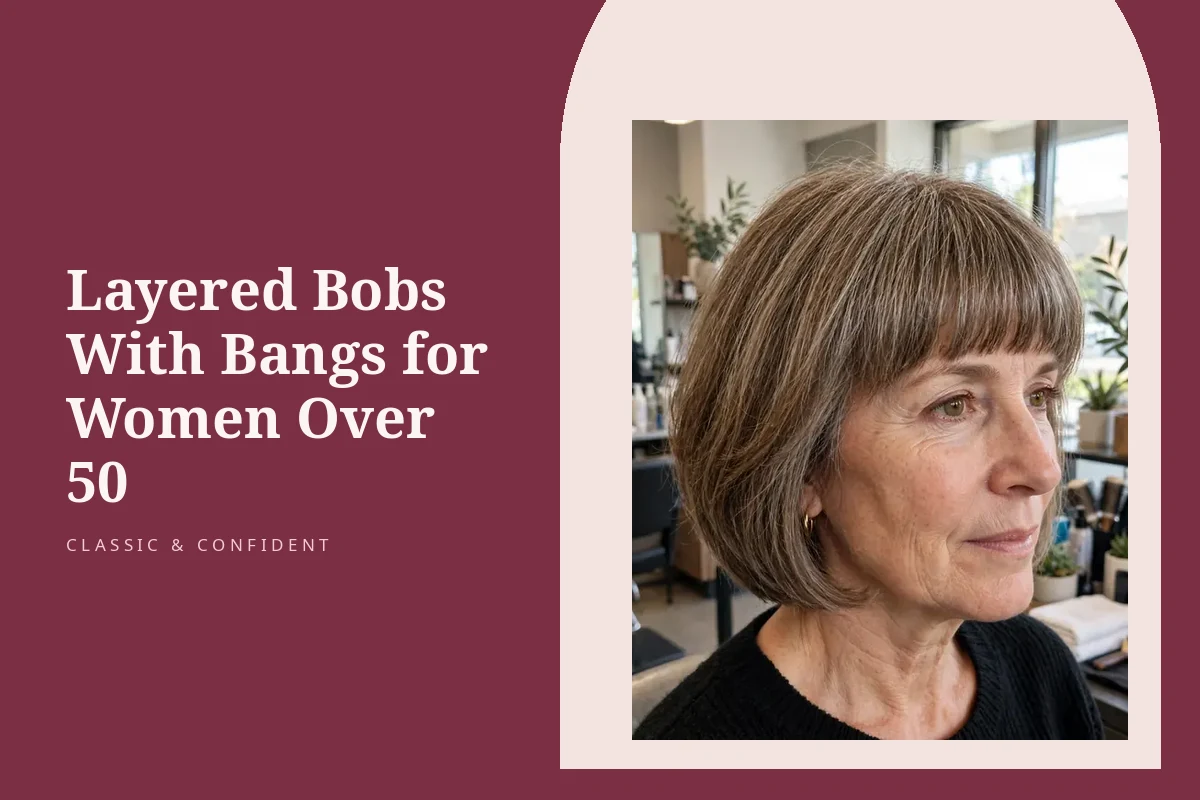
A layered bob with bangs over 50 is the rare haircut that does double duty: the layers give fine hair movement and lift, and the bangs do the visual work of a whole skincare routine on your forehead. But here is the honest part — bangs are a commitment measured in weeks, not seasons, and the wrong fringe is a fortnightly regret.
This guide pairs ten layering patterns with their matching fringe type, and states the upkeep plainly for each: how long the fringe is, where it sits, and exactly how many weeks before it needs a trim. Find the one that fits your forehead, your glasses, and your patience.
Quick picks
- A softer forehead line, zero drama → Lob with curtain bangs (#5)
- Maximum coverage, minimum fuss → Classic layered bob with a full fringe (#1)
- Parisian ease on a jaw-length cut → French bob with wispy bangs (#2)
- A fringe that respects your glasses → Layered bob with side-swept bangs (#6)
- Curl-safe bangs, cut dry → Curly layered bob with curly bangs (#9)
- Silver hair, framed on purpose → Silver layered bob with a soft fringe (#10)
Contents
How to choose your layered bob with bangs over 50
Measure your forehead honestly. Hold a tape measure from your hairline to your brow: under 6 cm is a short forehead (choose wispy or curtain fringes), 6–8 cm is average (any fringe works), over 8 cm is long (a full or blunt fringe shortens it visually by 4–5 cm). If your hair is fine on top, layering underneath matters as much as the fringe — our guide to bob hairstyles for fine hair over 50 covers the lift-first cuts these bangs sit on.
Fringe upkeep is measured in weeks, not months. A full blunt fringe shows growth within 3 weeks; a long curtain fringe buys you 5–6. If you will not sit for a 15-minute fringe trim between full cuts, pick points #5, #6 or #7 — they are the only fringes that stay presentable past week five. The medium-length layering underneath needs its own schedule, so read medium layered bobs for fine hair over 50 before you commit to the lob in point #5.
Glasses set the clearance. A fringe must end at least 1.5–2 cm above your top frame rim, or it will sit on the lenses and smudge them by noon. If your frames are bold or dark, a softer fringe (#6, #10) balances them; fine wire frames can carry a stronger full fringe (#1). Point #6 was designed for glasses wearers — start there.
Cowlicks and growth direction decide the fringe type. A strong front cowlick will fight a straight-across fringe every morning — piece-y or side-swept fringes (#6, #8) work with the swirl instead of against it. Very short fringes magnify cowlicks; longer fringes hide them. For shorter overall lengths with fringe options, see short bobs for fine hair over 50.
At a glance
| Style | Bangs type | Fringe trims | Best for |
|---|---|---|---|
| 1. Classic layered bob | Full, straight across | Every 3–4 weeks | Long foreheads, fine hair |
| 2. French bob | Wispy, see-through | Every 4–5 weeks | Short foreheads, easy regrowth |
| 3. Stacked layered bob | Blunt, brow level | Every 3 weeks | Flat crowns, narrow chins |
| 4. Layered bob, bottleneck | Narrow centre, long corners | Every 4 weeks | Wide foreheads, square jaws |
| 5. Lob | Curtain, centre parted | Every 5–6 weeks | First-time fringes, low upkeep |
| 6. Layered bob, side-swept | Diagonal, 5–12 cm | Every 5 weeks | Glasses, easiest grow-out |
| 7. A-line layered bob | Long, melted into layers | Every 6 weeks | Jawline focus, soft finish |
| 8. Wavy layered bob | Piece-y, textured | Every 5 weeks | Cowlicks, uneven hairlines |
| 9. Curly layered bob | Curly, cut dry | Every 6–8 weeks | Curly hair, no heat styling |
| 10. Silver layered bob | Soft, feathered | Every 5–6 weeks | Silver hair, coarse hairlines |
Full and wispy fringes
The straight-across family: maximum forehead coverage, from the bold full fringe to the forgiving wispy version. These suit longer foreheads and anyone who wants the bangs to do the most visible work.
1. Classic layered bob with a full fringe
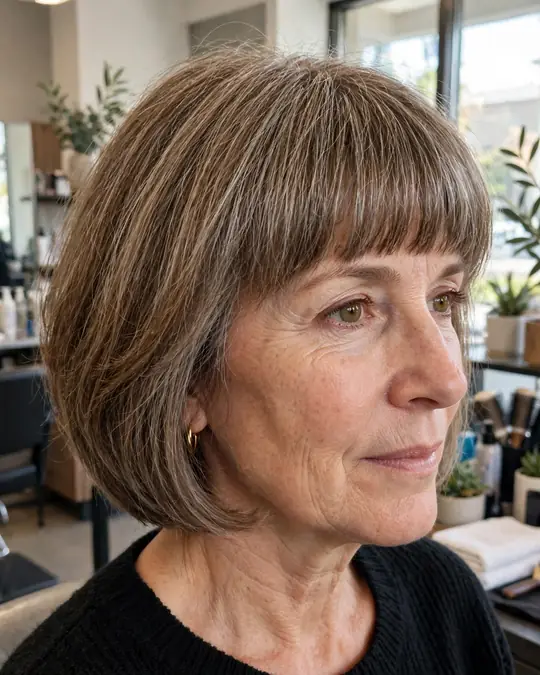
A solid fringe cuts the vertical line of the forehead — that is the whole mechanism. By placing a firm horizontal edge at brow level, you visually shorten a long forehead by 4–5 cm and draw attention to the eyes instead of the hairline. The layers underneath (starting at the cheekbone, 3–4 of them) keep the cut from reading as a helmet, giving fine hair movement that a one-length bob with bangs never manages.
- Length: bob at the jaw (23–25 cm); fringe 4–5 cm from hairline, straight across at brow level
- Trims: cut every 8–10 weeks; fringe every 3–4 weeks
- Styling time: 8 minutes daily
- Face shapes: long, oval, oblong
Ask your stylist for: “A jaw-length layered bob with three layers from the cheekbone down, and a full fringe cut dry at brow level, temple to temple — solid, not thinned.”
How to style it:
- Blow-dry the fringe first, while it is wettest — direct the airflow down over a flat brush so it sets straight, not puffy.
- Dry the rest of the bob with your head tipped forward for lift at the roots, then flip back.
- Smooth the mid-lengths with a round brush, curving the ends slightly under for that classic finish.
Skip it if you will not book a fringe trim between cuts — a grown-out full fringe pokes the eyes and looks scruffy within 5 weeks.
Best for: long foreheads and fine hair that needs the cut, not product, to create shape — the highest-coverage layered bob with bangs over 50 on this list.
2. French bob with wispy bangs

The see-through fringe works by suggestion rather than coverage. Feathered, uneven pieces — 5–6 cm long, with visible gaps — break up forehead lines without committing to a solid line, so regrowth looks intentional instead of neglected. The jaw-length French bob (24–26 cm, minimal layering) keeps the silhouette chic and the styling to almost nothing: this is the fringe for women who suspect they will not maintain one.
- Length: bob at the jaw (24–26 cm); wispy fringe 5–6 cm, feathered ends
- Trims: cut every 10–12 weeks; fringe every 4–5 weeks
- Styling time: 5 minutes daily
- Face shapes: oval, heart, short foreheads
Ask your stylist for: “A jaw-length French bob, barely layered, with a wispy see-through fringe — point-cut the ends so I can see skin through it.”
How to style it:
- On damp hair, rough-dry the fringe forward with your fingers — no brush needed, the texture is the point.
- Tuck the bob sides behind the ears or leave them loose; both read as intentional with this cut.
Skip it if your forehead is very long (over 8 cm) — a see-through fringe will not shorten it the way a full one does.
Best for: short-to-average foreheads and anyone trying bangs for the first time in years.
3. Stacked layered bob with a blunt fringe
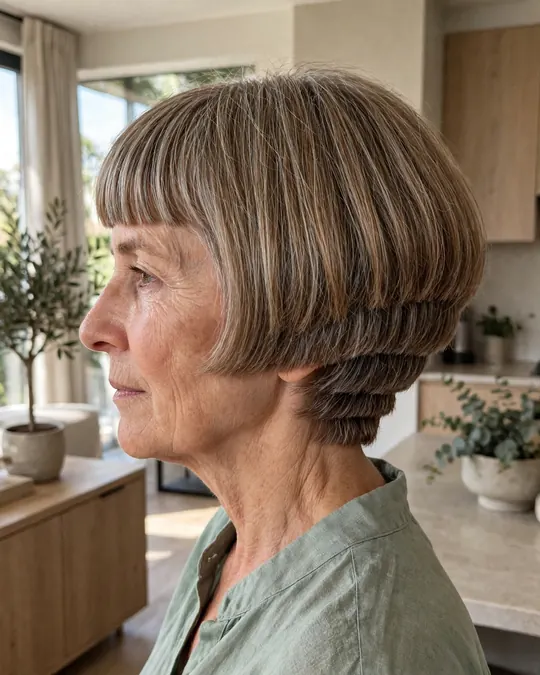
Stacking is an engineering solution: graduated layers at the nape — each one 1–2 cm shorter than the one below — build volume exactly where fine hair lies flat, while the longer front pieces keep the face open. The blunt fringe across the brow adds a strong horizontal line that balances a narrow chin or pointed face, giving the whole head a wider, more grounded proportion.
- Length: nape 5 cm stacked to 20 cm at the front; blunt fringe at brow level
- Trims: cut every 7–8 weeks; fringe every 3 weeks (blunt edges show growth fast)
- Styling time: 10 minutes daily
- Face shapes: oval, long, narrow chins
Ask your stylist for: “A stacked bob — 3 to 4 graduated layers at the nape, longer at the front — with a blunt fringe cut straight across at brow level, no thinning.”
How to style it:
- Blow-dry the fringe straight down first with a paddle brush — blunt fringes show every wave.
- Lift the crown with a round brush, directing each stacked section upward so the graduation reads as volume.
- Smooth the longer front pieces forward and slightly under to frame the jaw.
- Finish with a pea-size amount of smoothing cream on the ends only — never on the fringe, or it separates.
Skip it if your hair is very thick at the nape — stacking adds volume there, and thick hair will pyramid instead of graduate.
Best for: flat crowns and fine hair that needs built-in lift at the back.
4. Layered bob with bottleneck bangs

Bottleneck bangs work like a picture frame with curved corners. The centre is narrow — 6–7 cm wide, sitting at brow level — while the corners lengthen to 10–12 cm at the cheekbones, creating a curve that softens a wide forehead and a square jaw at once. Because the longest pieces melt into the bob’s front layers, the fringe never reads as a separate wig-piece the way blunt fringes sometimes do.
- Length: chin bob (22–24 cm); centre fringe at brow, corners 10–12 cm at cheekbones
- Trims: cut every 8–10 weeks; fringe every 4 weeks
- Styling time: 7 minutes daily
- Face shapes: square, wide foreheads, heart
Ask your stylist for: “Bottleneck bangs — narrow at the centre, about 6 cm wide, lengthening to the cheekbones at the corners — on a chin-length layered bob.”
How to style it:
- Blow-dry the fringe forward and slightly outward, so the corners flick toward the cheekbones.
- Dry the bob with a round brush, turning the front layers back away from the face to echo the fringe curve.
- Pinch a pea-size of texture cream through the fringe ends to keep the centre and corners distinct.
Skip it if you wear your hair scraped straight back most days — the curved corners only work when the bob is worn down around the face.
Best for: wide foreheads and square jawlines that need softening from above and below.
Side-swept and curtain
The forgiving family: fringes that part, sweep, or melt away from the forehead. These are the lowest-maintenance bangs on the list and the easiest to grow out — start here if commitment makes you nervous.
5. Lob with curtain bangs

A centre-parted curtain fringe works by division, not coverage. Splitting at the middle and sweeping to each side, the 12–14 cm pieces frame the face’s widest point and visually narrow it — while showing enough forehead that the look stays light. The collarbone lob (30–33 cm) adds the weight fine hair needs to stop flying, so this is the combination stylists reach for when a client says “bangs, but I’m scared.”
- Length: lob at the collarbone (30–33 cm); curtain pieces 12–14 cm, centre-parted
- Trims: cut every 10–12 weeks; fringe every 5–6 weeks (longest interval on this list)
- Styling time: 6 minutes daily
- Face shapes: round, wide, oval
Ask your stylist for: “A collarbone lob with long curtain bangs — centre-parted, the pieces hitting 12 to 14 cm so they sweep to each side of my face.”
How to style it:
- Part the fringe dead centre while damp, then blow-dry each side away from the face with a round brush.
- Dry the lob ends with a slight bend — too straight reads severe next to soft bangs.
Skip it if your hair will not hold a centre part — curtain bangs need that middle split, and a stubborn side part ruins the symmetry.
Best for: first-time fringes, round faces, and anyone who wants the most forgiving layered bob with bangs over 50 for a first fringe.
Good to know
Always cut a first fringe 2–3 cm LONGER than the target. Hair springs up as it dries — especially fine or wavy hair — and a fringe cut too short on day one cannot be fixed. You can take length off next week; you cannot add it back. Tell your stylist “longer than we discussed” and mean it.
6. Layered bob with side-swept bangs

A diagonal fringe — 5 cm at the inner corner sweeping to 12 cm at the cheekbone — draws the eye sideways across the face instead of straight down it. That sideways movement visually widens a narrow face, softens forehead lines, and, crucially, clears glasses frames: the fringe lands beside the rim, never on it. It is also the easiest fringe to grow out — just keep sweeping it longer until it joins the front layers.
- Length: chin-to-jaw bob (23–26 cm); diagonal fringe 5 cm to 12 cm at the cheekbone
- Trims: cut every 9–11 weeks; fringe every 5 weeks
- Styling time: 6 minutes daily
- Face shapes: narrow, long, glasses wearers
Ask your stylist for: “A side-swept fringe, shortest at the inner corner around 5 cm, sweeping down to 12 cm at the cheekbone — cut so it sits above my glasses frames.”
How to style it:
- Blow-dry the fringe in the direction of the sweep — never against it — using a flat brush.
- Dry the bob with the front layers directed slightly back so they do not compete with the fringe angle.
- Tuck the short side behind the ear for a clean asymmetric finish.
- Set the sweep with a light mist of flexible hold spray — heavy spray makes it crack.
Skip it if you want maximum forehead coverage — a side-swept fringe deliberately shows half the forehead.
Best for: glasses wearers, narrow faces, and anyone planning to grow bangs out eventually.
7. A-line layered bob with long bangs

The A-line pulls the whole silhouette forward: a shorter back (18 cm) rising to longer front pieces (23–25 cm) creates a diagonal that visually lifts the jawline. The fringe — 14–16 cm, melted into those front layers — never reads as a separate piece; from the side it is simply where the layers begin. This is the most “grown woman, not trying too hard” option on the list, and the fringe trim interval of 6 weeks is the most relaxed here.
- Length: A-line 18 cm back to 23–25 cm front; fringe 14–16 cm, blended into front layers
- Trims: cut every 9–11 weeks; fringe every 6 weeks
- Styling time: 7 minutes daily
- Face shapes: round, oval, soft jaws
Ask your stylist for: “An A-line bob, shorter at the back, longer at the front, with long bangs around 15 cm that blend straight into the front layers — no hard fringe line.”
How to style it:
- Blow-dry the fringe with the front layers as one section — separating them creates a visible line.
- Smooth the longer front pieces forward and under with a round brush to emphasise the A-line diagonal.
Skip it if you want the fringe to make a statement — this one whispers, by design.
Best for: jawline definition and the lowest-drama fringe on this list.
Texture-led combinations
For waves, curls and silver: fringes that work with texture instead of fighting it. These need the right cutting method — dry for curls, gloss for silver — more than they need frequent trims.
8. Wavy layered bob with piece-y bangs

Piece-y texture breaks the forehead into irregular columns instead of one flat sheet — and irregularity is camouflage. Separated 6–8 cm pieces hide uneven hairlines, soften cowlicks, and make regrowth invisible, because there was never a clean line to outgrow. The wavy layered bob underneath (25–28 cm, layers from mid-length) adds width at the sides, balancing the face so the fringe does not have to do all the work.
- Length: wavy bob 25–28 cm; piece-y fringe 6–8 cm, separated
- Trims: cut every 10–12 weeks; fringe every 5 weeks
- Styling time: 8 minutes daily
- Face shapes: all, especially uneven hairlines
Ask your stylist for: “Piece-y bangs, 6 to 8 cm, point-cut so the pieces separate — on a wavy layered bob with the layers starting at mid-length.”
How to style it:
- Scrunch a pea-size of curl cream into the damp fringe and let it air-dry — the separation forms on its own.
- Twist two or three individual pieces with your fingers if any section clumps too much.
- Diffuse the bob on low heat for volume, or leave it — this cut forgives either finish.
Skip it if your hair is pin-straight and will not hold separation — piece-y bangs on straight hair just look stringy.
Best for: cowlicks, uneven hairlines, and wavy hair that hates being told what to do.
9. Curly layered bob with curly bangs

The rule for curly bangs is shrinkage maths: curls spring up 2–5 cm as they dry, so a fringe cut to the target length while wet lands far too short. Cut dry, cut long — 3–4 cm longer than where you want it to sit — and the fringe frames the face without the dreaded triangle. The layered bob (24–27 cm, long layers to remove bulk at the ends) keeps the silhouette narrow at the bottom and full where it flatters.
- Length: curly bob 24–27 cm dry; fringe cut dry, 3–4 cm longer than target
- Trims: cut every 10–12 weeks; fringe every 6–8 weeks
- Styling time: 10 minutes (wash days only; refresh between)
- Face shapes: all curl types, especially long faces
Ask your stylist for: “Curly bangs cut DRY, 3 to 4 cm longer than the target, curl by curl — on a layered curly bob with long layers to take out the bulk at the ends.”
How to style it:
- On soaking wet hair, rake a generous amount of curl cream through the fringe, then scrunch.
- Diffuse the fringe on low heat, lifting at the roots with your fingers — never brush it.
- Once dry, separate any clumps with oiled fingertips for definition.
- Refresh between wash days with a water-and-conditioner mist, scrunched in.
Skip it if your stylist reaches for the thinning shears on your curls — thinning creates frizz, and a curly fringe cannot survive it.
Best for: curly and coily hair worn natural, and anyone done with heat styling.
10. Silver layered bob with a soft fringe

Silver hair changes the fringe equation: grey grows in coarsest at the hairline, exactly where a fringe sits, so a blunt cut there looks wiry and harsh. A soft, feathered fringe — 5–7 cm, ends thinned with point-cutting, never razored — diffuses that coarse texture into something deliberate. A gloss treatment every 8–10 weeks makes the silver reflect light instead of reading dull, and purple shampoo every third wash keeps it bright rather than yellow.
- Length: layered bob 24–27 cm; soft feathered fringe 5–7 cm
- Trims: cut every 9–11 weeks; fringe every 5–6 weeks; gloss every 8–10 weeks
- Styling time: 7 minutes daily
- Face shapes: all, especially with coarse silver texture
Ask your stylist for: “A soft feathered fringe, 5 to 7 cm, point-cut — not razored — to diffuse my coarse hairline, on a layered silver bob, plus a clear gloss.”
How to style it:
- Blow-dry the fringe with a small round brush, rolling it under gently for softness.
- Smooth the bob with a paddle brush — silver shows frizz more than pigmented hair.
Skip it if your silver is very yellow-toned and you will not use purple shampoo — a fringe puts that tone front and centre.
Best for: natural silver and grey hair that deserves to look intentional, not accidental.
Keeping bangs behaving
A fringe is the only part of your haircut the whole world sees every single day. These rules keep it on your side.
- Dry the fringe first, always — it sets in the first 90 seconds, before the rest of your hair.
- Keep a mini flat iron for fringe emergencies: 10 seconds on a cowlick beats re-washing.
- Blot oily fringes with tissue or blotting paper midday instead of adding dry shampoo, which builds up.
- Sleep with the fringe clipped loosely to the side if it kinks overnight — a duckbill clip, not a tight pin.
- Book fringe trims as standing appointments: 15 minutes, every 3–6 weeks depending on your type.
- On greasy-hair days, wash just the fringe in the sink — 2 minutes, and the whole head reads as fresh.
The 4-step fringe morning:
- Dampen the fringe (or wash it in the sink) — styling dry yesterday-hair never works.
- Blow-dry forward and down with a flat or small round brush, in the fringe’s natural direction.
- Pinch a pea-size of lightweight cream through the ends for separation — none at the roots.
- Check it in daylight, not bathroom light — fringes lie in warm indoor lighting.
The bottom line
If I had to pick one, it is #5 — the lob with curtain bangs. It asks the least of you (a trim every 5–6 weeks), flatters the most faces, and if you ever change your mind it grows out invisibly. Bangs should make your mornings easier, not add an appointment to them — and this is the one fringe that keeps that promise.
Found your fringe? Pin this guide to your hairstyle board so it is there when you are sitting in the salon chair, showing your stylist exactly what you mean.
Frequently asked questions
Will a layered bob with bangs over 50 suit a long forehead?
It is one of the best solutions for a long forehead, because the mechanism is simple geometry: a fringe at brow level removes 4–5 cm of visible forehead height. Choose a full (#1) or blunt (#3) fringe for maximum shortening. If your forehead is average (6–8 cm), any fringe on this list works — the choice becomes about upkeep and glasses rather than coverage.
How often do bangs really need trimming after 50?
It depends on the fringe type, not your age. Blunt and full fringes (#1, #3) need a trim every 3–4 weeks because the clean edge shows growth immediately. Wispy, curtain and side-swept fringes (#2, #5, #6) stretch to 5–6 weeks. Budget 15 minutes and book them as standing appointments — most salons do fringe-only trims cheaply between full cuts.
I wear glasses — which bangs will not fight my frames?
Side-swept bangs (#6) are the safest: the diagonal lands beside the frame, never on it. Keep any fringe 1.5–2 cm above your top frame rim so it does not sit on the lenses. If your frames are bold and dark, choose a softer fringe to balance them; fine wire frames can carry a stronger full fringe. Avoid heavy blunt fringes with oversized frames — the two strong horizontals compete.
What if I have a cowlick at my hairline?
Work with it, not against it. A strong front cowlick will defeat a straight-across fringe every morning, so choose a side-swept (#6) or piece-y (#8) fringe that follows the swirl’s direction. Ask your stylist to cut the fringe with the cowlick dry and in its natural position — cutting it wet and stretched guarantees a surprise when it springs back.
Can I grow out bangs without an awkward stage?
Yes, if you start with the right type. Side-swept (#6), curtain (#5) and long A-line fringes (#7) grow out by simply sweeping longer — they merge into the front layers with no ugly middle. Blunt and full fringes (#1, #3) are harder: plan a transition through a side-swept shape at week 6–8, trimming the rest while the fringe catches up.
Do bangs work on curly hair after 50?
They work beautifully — but only cut dry. Curls shrink 2–5 cm as they dry, so a wet-cut fringe lands far too short. The curly fringe (#9) is cut 3–4 cm longer than the target, curl by curl, and needs a trim only every 6–8 weeks. Never let anyone use thinning shears on curly bangs: thinning creates frizz, and frizz on a fringe is all you see.