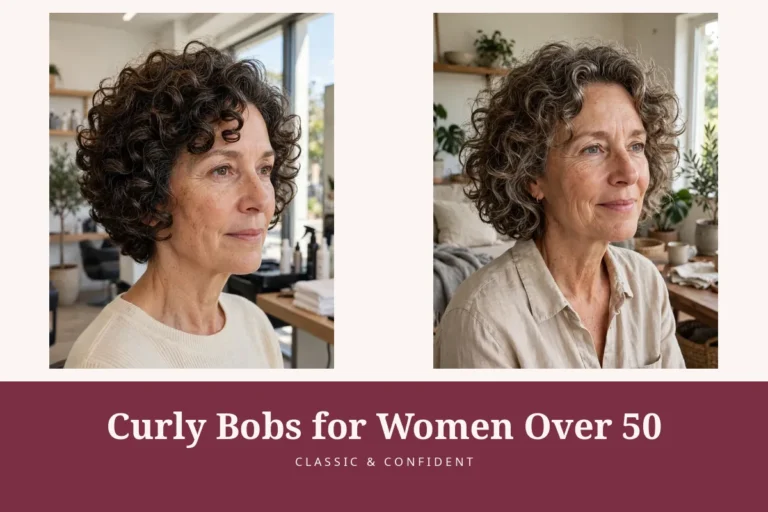
15 Bobs for Women Over 50
When most women say “bob haircuts for women over 50”, they picture one haircut: a neat chin-length box. But there are at least fifteen genuinely different bobs, and the one most women walk out of the salon with is rarely the one that would suit them best.
Below are 15 bobs grouped by what they do for your hair: four classics that never date, three that take weight off thick or heavy hair, four with fringe, movement or an edge, and four made for curls, waves and natural texture. Every one comes with the exact words for your stylist, honest upkeep, and how to style it at home.
Quick picks
- Want zero styling effort → #6. Stacked bob
- Need to look taller and slimmer → #5. Blunt midi bob
- Hiding forehead lines → #8. Bob with curtain bangs
- Curly hair that fights short cuts → #12. Curly bob
- The safe one everyone loves → #1. Classic chin-length bob
- Ready for something braver → #10. Shaggy bob
Contents
How to choose your bob after 50
Start with thickness, not length. Fine hair looks fuller in blunt or stacked bobs where the ends form one clean line; layered bobs can make it look thinner if the layers are cut too short. If your hair is very fine, a stylist who adds “invisible layers” only at the crown will keep the bottom edge dense — a cut like the chin-length bobs for fine hair shows exactly how that balance works.
Your natural texture decides half the cut. Straight hair takes to any of these bobs, but curly or wavy hair needs a stylist who cuts curls dry or stretches them first — a wet-cut curly bob can spring up 5–8 cm shorter than planned. Points 12 to 15 are built for texture; don’t force a blunt straight-hair bob onto strong curls.
Match the cut to your neck and jaw. A chin-length bob sharpens a soft jawline and lifts a short neck; if you dislike your neck, choose a bob that ends above the chin or below it at collarbone length, never right at the jaw’s weakest point. Your face shape still matters, but bob placement matters more — the guide to choosing hairstyles after 50 explains how thickness and face shape work together.
Be honest about styling time. A stacked bob needs two minutes and a comb; a curly bob needs twenty minutes and a diffuser. Pick the cut whose morning routine you will actually do, not the one you wish you would do — a low-maintenance cut styled daily always looks better than a high-maintenance one worn half-styled.
Think in 6-week cycles. Most bobs hold their shape for 6–8 weeks, stacked and blunt cuts for 5–6. When you choose, budget the trim — a £40–60 salon visit every six weeks costs roughly the same per year as a more expensive cut you stretch to ten weeks. If long salon gaps suit you better, the longer bobs in this short-haircut guide grow out more gracefully.
At a glance
| Style | Length | Trims | Best for |
|---|---|---|---|
| 1. Classic chin-length bob | Chin, ~22–25 cm | Every 6 weeks | First-time bob wearers |
| 2. Layered bob | Chin to collarbone | Every 7–8 weeks | Thick, heavy hair |
| 3. French bob | Jaw, ~18–20 cm | Every 5–6 weeks | Oval faces, fine hair |
| 4. A-line bob | Front longer than back | Every 6 weeks | Round faces |
| 5. Blunt midi bob | Collarbone, ~28 cm | Every 8 weeks | Fine hair needing fullness |
| 6. Stacked bob | Nape short, crown full | Every 5–6 weeks | Zero-styling mornings |
| 7. Choppy bob | Chin to jaw | Every 7 weeks | Texture and volume |
| 8. Bob with curtain bangs | Chin + bangs | Every 6 weeks | Forehead lines, long faces |
| 9. Side-swept bob | Chin to collarbone | Every 6–7 weeks | Asymmetric faces |
| 10. Shaggy bob | Jaw to shoulder | Every 8–10 weeks | Wavy hair, low upkeep |
| 11. Wavy beach bob | Chin to shoulder | Every 8 weeks | Natural wave |
| 12. Curly bob | Jaw to shoulder dry | Every 8–10 weeks | Strong curls |
| 13. Inverted bob | Stacked back, long front | Every 5–6 weeks | Fine hair, flat crowns |
| 14. Long bob (lob) | Collarbone, ~30 cm | Every 8–10 weeks | Nervous about short hair |
| 15. Bob with deep side part | Chin to collarbone | Every 6 weeks | Thinning at the crown |
The classics that never date
Four bobs that have been flattering women over 50 for decades. If you are trying a bob for the first time, choose from this group — the shapes are forgiving and every good stylist knows how to cut them.
1. Classic chin-length bob
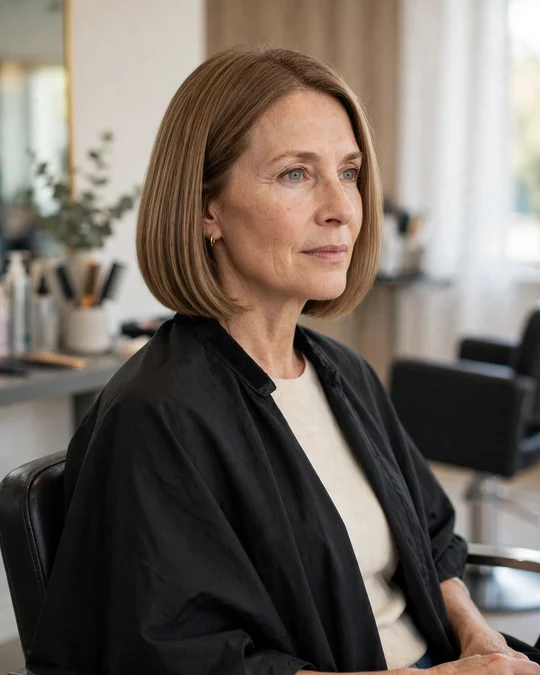
The blunt line lands exactly at the chin, where even thinning hair still has enough density to look full, and the horizontal edge pulls the eye sideways, which makes a narrow jaw look stronger and a long face look shorter. It is the lowest-risk bob in this guide because there are no layers to grow out awkwardly and no bangs to maintain.
- Length: chin, about 22–25 cm from the crown
- Trims: every 6 weeks to keep the line crisp
- Styling time: 5 minutes
- Face shapes: oval, long, square
Ask your stylist for: “A one-length bob to the chin, no layers, cut blunt and slightly undercut at the nape so it tucks in naturally.”
How to style it:
- Towel-dry until just damp, then apply a pea-size amount of smoothing cream from mid-length to ends.
- Blow-dry with a paddle brush, pulling each section straight down and slightly under at the ends.
- Run a flat iron over the bottom 5 cm only, curving the ends a fraction inward — this sharpens the line without making it poker-straight.
Skip it if your hair is very thick and very straight — without layers it can look like a solid helmet. Best for: first-time bob wearers and fine to medium hair.
2. Layered bob

Layers cut from the crown downward remove bulk where thick hair pyramids out at the ears, so the silhouette narrows into a flattering tapered shape instead of a triangle. For hair that is heavy rather than fine, this is the difference between a bob that sits flat and one that moves.
- Length: chin to collarbone, shortest layer at the crown
- Trims: every 7–8 weeks
- Styling time: 10 minutes
- Face shapes: round, square, oval
Ask your stylist for: “A chin-length bob with long layers through the crown — no layer shorter than 10 cm, and keep the bottom edge solid, not razored.”
How to style it:
- Blow-dry upside down for 2 minutes to build lift at the roots where the layers start.
- Flip upright and smooth the outer layer only with a round brush — leave the inner layers slightly tousled for volume.
Skip it if your hair is fine and sparse — layers thin out the ends. Best for: thick or heavy hair that needs movement.
3. French bob

The French bob ends at the jaw with a soft, lived-in edge rather than a hard line, which is why it suits fine hair: the shorter length means less weight pulling the roots flat, and the tousled finish hides the sparseness that a strict blunt cut can reveal. At 18–20 cm it is also the bob that shows off earrings and necklaces best.
- Length: jaw, about 18–20 cm
- Trims: every 5–6 weeks
- Styling time: 8 minutes
- Face shapes: oval, heart, long
Ask your stylist for: “A French bob to the jawline, point-cut through the ends for softness, with the fringe optional at cheekbone length.”
How to style it:
- Scrunch a golf-ball of mousse into damp hair to wake up texture.
- Diffuse or air-dry, then rough up the roots with your fingertips — perfection ruins this cut.
- Pinch a pea-size of matte paste into the ends to separate them.
Skip it if you have a very round face — the width at the jaw can widen it further. Best for: fine hair and oval or long faces wanting character.
4. A-line bob

Short at the back, angling down to longer pieces in front — the diagonal line draws the eye downward along the face, which lengthens a round face visually by several centimetres. The stacked weight at the back also gives the crown built-in lift, so flat hair at the top of the head gets structure for free.
- Length: nape short, front pieces to the chin
- Trims: every 6 weeks (the angle blurs fast)
- Styling time: 7 minutes
- Face shapes: round, heart, oval
Ask your stylist for: “An A-line bob, graduated at the back, with the front two inches longer than the back and a clean diagonal line when dry.”
How to style it:
- Blow-dry the back sections forward and under with a round brush to emphasise the graduation.
- Smooth the longer front pieces straight down — they are the frame of the cut, keep them sleek.
- Finish with a light serum on the front ends only, to keep the angle sharp.
Skip it if you hate frequent trims — lose the angle and it becomes a plain bob within weeks. Best for: round faces and flat crowns needing lift.
Shorter and lighter on top
Three cuts that take weight off — the nape is kept short and the volume sits at the crown, which is exactly where hair over 50 tends to go flat.
5. Blunt midi bob
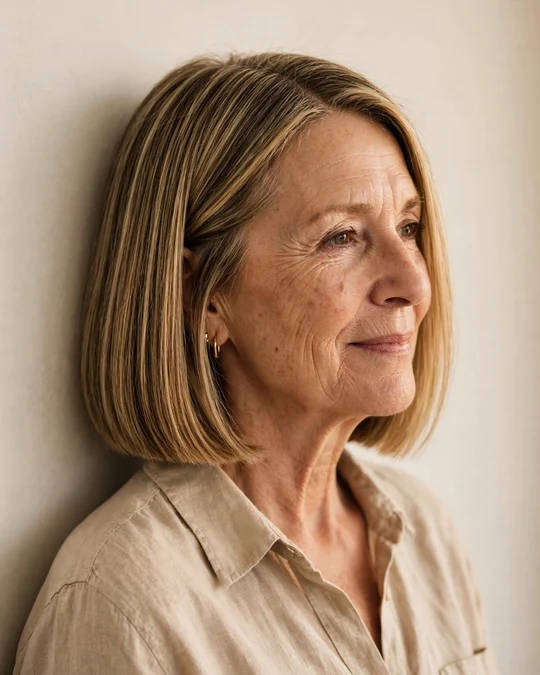
One clean line at the collarbone (about 28 cm) makes fine hair look twice as thick, because every strand ends at the same point and the eye reads that solid edge as density. The extra length over a chin bob also lets the hair fall past the neck, which slims the neckline and shoulders.
- Length: collarbone, about 28 cm
- Trims: every 8 weeks
- Styling time: 10 minutes
- Face shapes: all, especially long and square
Ask your stylist for: “A one-length blunt bob to the collarbone, cut dry if my hair is fine, with no layers — just a very slightly bevelled edge.”
How to style it:
- Rough-dry to 80% with your head upside down for root lift.
- Smooth the lengths with a large round brush, turning the ends under a touch.
- A drop of shine serum on the outer surface gives the blunt edge its polished look.
Skip it if your hair is very curly — the blunt edge fights the curl pattern. Best for: fine hair that needs maximum fullness.
6. Stacked bob
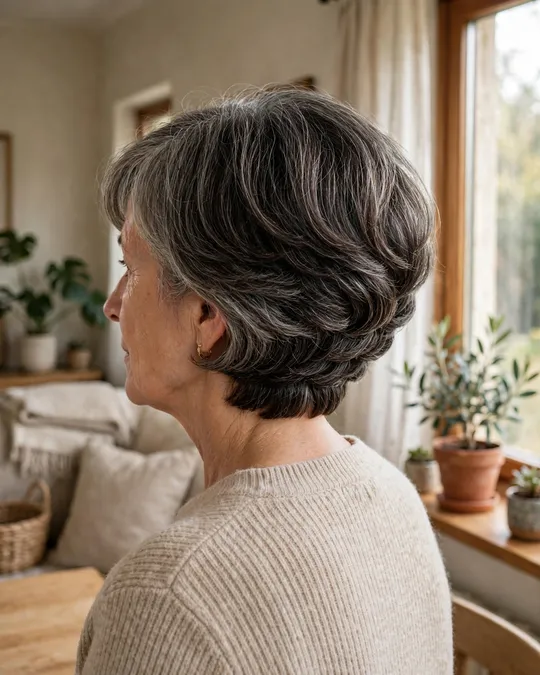
This is the one I recommend to anyone who says “I don’t style my hair in the morning.” The layers are stacked at the back, each one slightly longer than the one above, so the cut holds its own rounded shape by gravity alone — the nape stays tucked and the crown stays full with zero effort.
- Length: nape cropped, crown full, front to chin
- Trims: every 5–6 weeks
- Styling time: 2 minutes
- Face shapes: oval, round, heart
Ask your stylist for: “A stacked bob with real graduation at the nape — I want to feel the layers stepping up at the back — and soft pieces framing the face.”
How to style it:
- Comb damp hair into place and let it air-dry — the shape is built in.
- If the nape flips out, press it down with a flat iron for five seconds.
Skip it if your neck is very short — the stacked nape can make it look shorter. Best for: low-maintenance mornings and fine to medium hair.
7. Choppy bob

Point-cut ends break the bottom line into irregular pieces, and each little piece catches light separately — that is the whole trick behind “texture” in a bob. The eye reads the broken ends as movement and volume, which is why this cut makes straight, limp hair look like it has body even when it doesn’t.
- Length: chin to jaw, ends point-cut
- Trims: every 7 weeks
- Styling time: 8 minutes
- Face shapes: oval, heart, square
Ask your stylist for: “A chin-length bob with choppy, point-cut ends and a few shorter pieces around the crown for texture — keep it piecey, not blunt.”
How to style it:
- Work a hazelnut-size of texturising cream through damp ends.
- Blow-dry with your fingers, twisting random sections as they dry.
- Once dry, pinch individual ends with a touch of wax to define the chop.
- Shake the crown loose — volume is the point.
Skip it if you want a polished, office-sharp look — this is deliberately undone. Best for: straight hair needing texture and lift.
With fringe, movement or an edge
Four ways to make a bob more interesting: bangs that hide forehead lines, a sweep that balances the face, and a shag for the woman ready to have fun with it.
8. Bob with curtain bangs
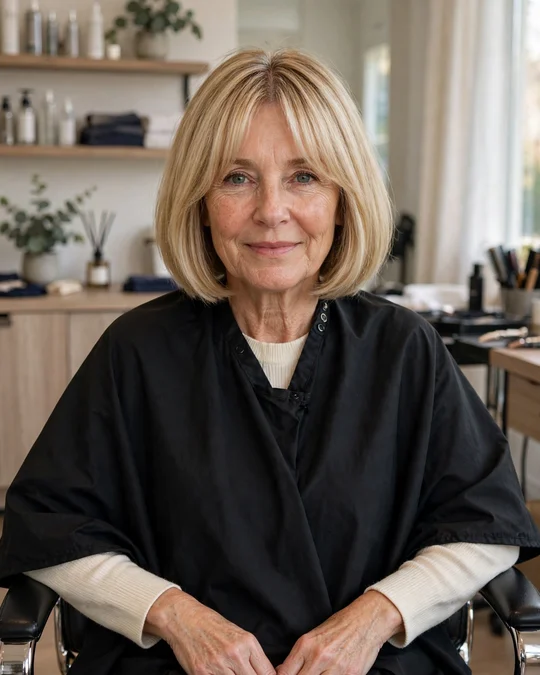
Curtain bangs part in the middle and fall to each side, covering the forehead’s outer thirds where lines are deepest while leaving the centre of the forehead partly open — so you get the softening effect of a fringe without a heavy straight-across line that can look severe after 50. They also shorten a long face by hiding 2–3 cm of forehead height.
- Length: chin bob, bangs to cheekbone
- Trims: every 6 weeks (bangs need 3-week micro-trims)
- Styling time: 8 minutes
- Face shapes: long, oval, heart
Ask your stylist for: “A chin-length bob with curtain bangs — longest at the cheekbones, shortest at the centre, and cut so they fall open naturally.”
How to style it:
- Blow-dry the bangs first, while wettest — use a small round brush, sweeping each side away from the centre part.
- Dry the rest of the bob as usual; the bangs set the direction for everything.
Skip it if your hair is very curly at the hairline — the bangs will spring shorter than planned. Best for: long faces and anyone softening forehead lines.
9. Side-swept bob
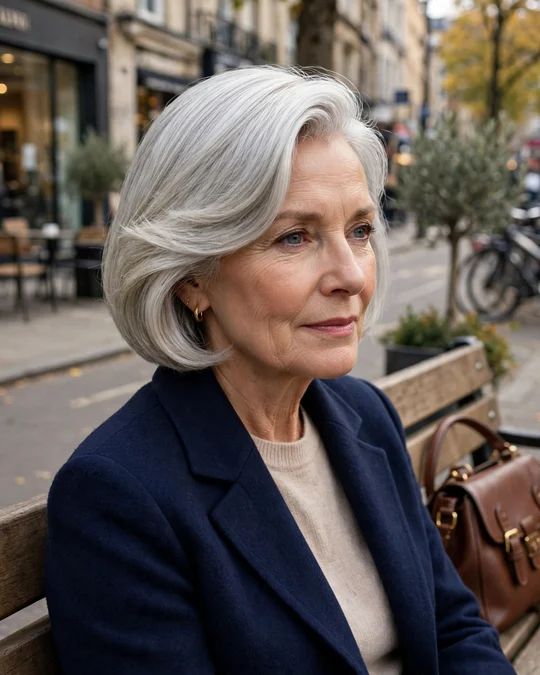
A deep side part shifts the hair’s weight to one side, which does two things at once: it covers a thinning crown on the heavier side and breaks the symmetry of an asymmetric face, making both look more balanced. Of all the bobs here, this one changes your face the most without changing the cut’s length at all.
- Length: chin to collarbone
- Trims: every 6–7 weeks
- Styling time: 6 minutes
- Face shapes: all, especially asymmetric faces
Ask your stylist for: “A chin-to-collarbone bob cut with a deep side part in mind — longer layers on the heavy side so it sweeps cleanly, nothing bulky at the part.”
How to style it:
- Part deeply while hair is soaking wet — the part sets where it dries, not where you comb it later.
- Blow-dry the heavy side forward and across, lifting at the roots for volume that holds the sweep.
- Tuck the light side behind the ear; a small clip keeps it there all day.
Skip it if your hair is very fine and the part keeps migrating back to the middle — some hair simply won’t hold a deep part. Best for: thinning crowns and faces that need rebalancing.
Good to know
Every bob on this list can be cut in a dry-cut appointment, and for hair over 50 that is often the better choice: dry cutting shows the stylist exactly where your hair falls at its natural length, so there are no surprises when the curls spring or the fine ends settle. Ask for it by name — “can we do this as a dry cut?” — and pin this guide so you have the wording ready in the chair.
10. Shaggy bob
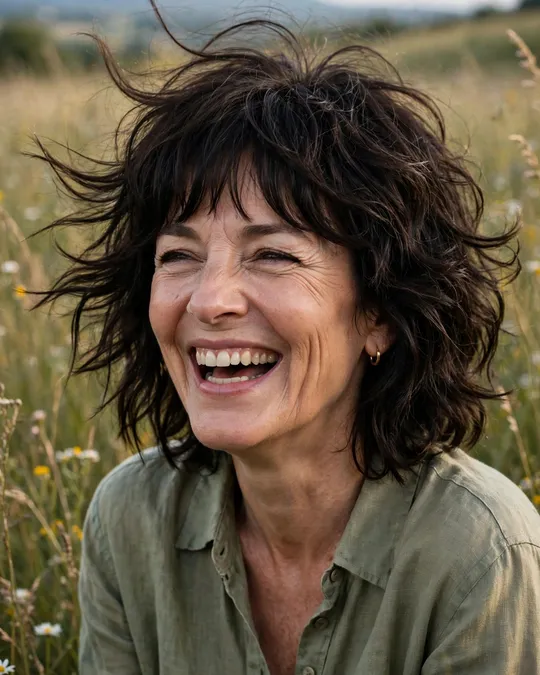
Layers all through the cut, razored ends, and a fringe that blends into the sides — the shag removes weight everywhere, so thick or wavy hair that would pyramid in a classic bob falls into a soft, airy shape instead. It is the most forgiving bob to grow out, because the layers are already uneven by design.
- Length: jaw to shoulder, heavily layered
- Trims: every 8–10 weeks
- Styling time: 10 minutes
- Face shapes: oval, long, heart
Ask your stylist for: “A shaggy bob with a soft fringe, lots of internal layering, razored ends — I want it piecey and lived-in, not blunt anywhere.”
How to style it:
- Scrunch mousse into damp hair and diffuse or air-dry — heat-styling defeats the purpose.
- Once dry, rake your fingers through to separate the layers.
- Salt spray on the mid-lengths adds the gritty texture this cut wants.
Skip it if you want sleek and polished — this cut’s whole personality is undone. Best for: wavy or thick hair and low-maintenance routines.
11. Wavy beach bob

A chin-to-shoulder cut worn with loose bends rather than curls. The bends sit at different heights on each side, which breaks up the bottom line visually and makes even one-length hair look layered — all the softness of layers with none of the grow-out hassle. On naturally wavy hair, this is a wash-and-go cut.
- Length: chin to shoulder
- Trims: every 8 weeks
- Styling time: 12 minutes (or 0 on wavy hair)
- Face shapes: oval, square, heart
Ask your stylist for: “A one-length bob between chin and shoulder with the ends very lightly point-cut, so my natural wave does the work.”
How to style it:
- On damp hair, twist 2-cm sections away from the face and let them set while you do your makeup.
- Release and shake out — don’t brush.
- A flat iron with a single bend per section fixes any stubbornly straight pieces.
- Salt spray or texture spray, scrunched in, locks the bends.
Skip it if your hair is pin-straight and fine — the bends will drop out by midday. Best for: natural waves and relaxed weekend hair.
Made for curls, waves and texture
Four bobs designed around what your hair already does. Curly and textured hair cut into the right bob needs less product, less heat and less fighting — the shape works with the curl pattern instead of against it.
12. Curly bob

Curls are cut in their dry, sprung state, each one shaped where it actually lives — that is the only way to control a curly bob, because a curl cut wet can lose 5–8 cm of length when it dries. The rounded shape keeps the volume up at the crown where curls naturally want to expand, instead of letting it all sit at the ends.
- Length: jaw to shoulder when dry
- Trims: every 8–10 weeks
- Styling time: 15–20 minutes
- Face shapes: oval, heart, long
Ask your stylist for: “A curly bob cut dry, curl by curl, shaped round — I want the length to sit at my jaw when the curls are dry and sprung.”
How to style it:
- On soaking wet hair, rake a leave-in cream through, then a golf-ball of gel, section by section.
- Scrunch upward to encourage the curl pattern, then diffuse on low heat until 90% dry.
- Once fully dry, scrunch out the gel cast — the curls should feel soft, not crunchy.
Skip it if you straighten your hair most days — fighting your curl pattern daily defeats the cut. Best for: natural curls worn curly.
13. Inverted bob
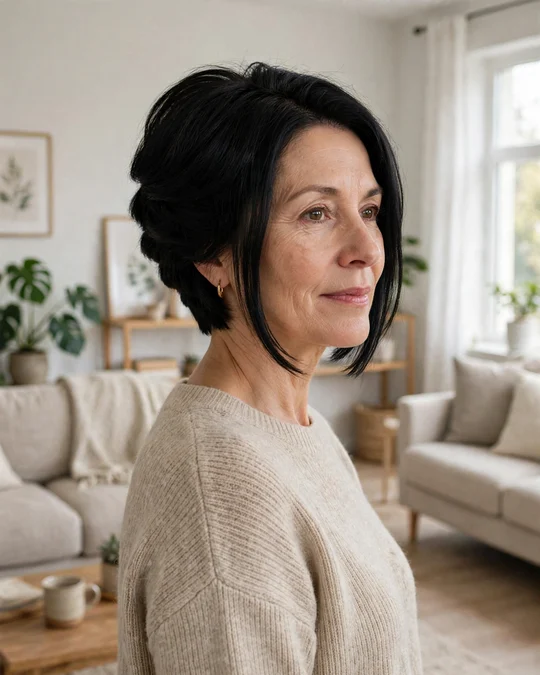
The back is stacked short while the front falls long, so the cut’s weight sits high at the crown — exactly where fine, flat hair needs it. The long front pieces also frame the face and can be tucked behind the ear on one side for a sleeker line, which makes this the most versatile bob in the list for fine hair.
- Length: stacked back, front to chin or below
- Trims: every 5–6 weeks
- Styling time: 10 minutes
- Face shapes: oval, round, heart
Ask your stylist for: “An inverted bob — stacked at the back for height, front pieces left long to frame my face, and the graduation visible when dry.”
How to style it:
- Blow-dry the back sections up and under with a round brush — the stack is the star, give it lift.
- Smooth the front pieces down and slightly forward so the inversion reads clearly.
Skip it if you dislike upkeep at the nape — the stack grows out visibly. Best for: fine hair and flat crowns needing built-in height.
14. Long bob (lob)

If the thought of going short makes you nervous, this is your bob: at about 30 cm it still goes into a low ponytail, so you keep the security of longer hair while getting the thick-ended, face-framing benefits of a bob. The weight of the extra length also pulls fine hair straighter, which can be an advantage if your hair frizzes at shorter lengths.
- Length: collarbone, about 30 cm
- Trims: every 8–10 weeks
- Styling time: 12 minutes
- Face shapes: all
Ask your stylist for: “A long bob to the collarbone, one length with just the tiniest bevel at the ends, and face-framing pieces no shorter than my chin.”
How to style it:
- Blow-dry smooth with a large round brush, rolling the ends under.
- For waves, wrap 3-cm sections around a 32 mm iron, alternating direction, and leave the last 3 cm straight.
- Brush through once the hair is cool — the waves should look soft, not done.
- One pump of smoothing oil on the ends finishes it.
Skip it if your ends are very damaged — the blunt line shows split ends mercilessly. Best for: bob-curious women who still want a ponytail option.
15. Bob with deep side part

Same bob, different part — but the part changes everything. Moving the part 5–7 cm off-centre piles the hair’s volume onto one side, which camouflages a thinning crown better than any product, and the diagonal sweep across the forehead softens the whole face. It costs nothing and takes thirty seconds.
- Length: chin to collarbone
- Trims: every 6 weeks
- Styling time: 5 minutes
- Face shapes: all
Ask your stylist for: “Cut my bob so it works with a deep side part — thin out any bulk that sits right on the part line, and keep the heavy side long enough to sweep.”
How to style it:
- Set the part while hair is wet, 5–7 cm from the centre.
- Blow-dry the roots on the heavy side upward — that lift is what keeps the sweep in place.
Skip it if your hairline has a strong cowlick at the side — it will fight you every morning. Best for: thinning crowns and instant volume.
Everyday bob care
A bob lives or dies on the small daily habits. Keep these and your cut looks salon-fresh between appointments; skip them and even the best cut goes shapeless in three weeks.
- Sleep on silk or satin — cotton roughs up the cuticle overnight and a bob shows every bit of it by morning.
- Refresh day-two hair with dry shampoo at the roots only, then a 60-second blast with the dryer upside down — never re-wash a bob daily.
- Book the next trim before you leave the salon; bobs are the one cut where “I’ll call later” always means four weeks too late.
- Use half the product you think you need — weighed-down ends are the top reason bobs look flat by evening.
- Protect the ends from heat every single time; a bob’s bottom line is its whole identity.
- Keep a small round brush in your bag — five seconds of re-curling the front pieces at lunch revives the whole shape.
Your 5-minute bob routine:
- Dampen the roots with a spray bottle if hair is dry.
- Blast upside down for 60 seconds for lift.
- Smooth the outer layer with a round brush, ends under.
- Pinch product into the ends only.
- Set your part, tuck one side, go.
The bottom line
If I had to pick one bob for a woman over 50 who wants to look current without thinking about her hair every morning, it would be #6, the stacked bob — it holds its own shape, flatters nearly every face, and asks for nothing more than a comb. Second choice for fine hair: #5, the blunt midi bob, for the fullness.
Pin this guide to your hairstyle board before your next salon visit — having the exact stylist wording from your chosen point on your phone changes the appointment completely.
Frequently asked questions
Which bob haircut is best for women over 50 with fine hair?
The blunt midi bob (#5) and the stacked bob (#6) — both keep the ends dense, which is what makes fine hair look full. If your hair is very fine, avoid heavy layering: ask for a dry cut so the stylist can see exactly where the ends thin out, and keep layers only at the crown.
How often should I get my bob trimmed after 50?
Most bobs need a trim every 6–8 weeks; stacked, blunt and A-line cuts lose their shape fastest, at 5–6 weeks, while shaggy and long bobs can stretch to 8–10. If you colour grey coverage too, book the trim with the colour appointment and you will never fall behind.
Can I wear a bob if my hair is curly?
Yes — but choose a bob designed for curls (#12) and a stylist who cuts dry, curl by curl. A wet-cut bob on strong curls can shrink 5–8 cm when it dries, so the dry cut is not optional. Curly bobs need the most styling time of any on this list, about 15–20 minutes, but they need the least heat.
Do bobs make you look older or younger?
A well-placed bob usually takes years off: it lifts the eye upward, shows the neck, and removes the dragging weight of long hair. The exception is a bob that is too severe or too long and straight with no movement — that can look harsh. Soft ends, a little texture, or a side part keep it youthful.
What is the lowest-maintenance bob for women over 50?
The stacked bob (#6) — about two minutes, because the graduation holds the shape by itself. The shaggy bob (#10) is second: it is designed to look undone, so it grows out gracefully and needs trims only every 8–10 weeks.
Should I get bangs with my bob at 50?
If forehead lines bother you, yes — curtain bangs (#8) soften them without the commitment of a straight fringe, and they grow out into face-framing layers if you change your mind. The trade-off is maintenance: bangs need a micro-trim every 3 weeks, though many salons do it free between appointments.