15 French Bob Haircuts for Women Over 50
You have a wedding in three weeks, a work dinner next month, and Tuesday mornings that allow exactly six minutes between the shower and the school run.
A french bob for women over 50 is one of the few haircuts that behaves for all three: it is short enough to style fast, polished enough for photographs, and — because the fringe and the blunt perimeter do the framing — it forgives the mornings when you do almost nothing to it.
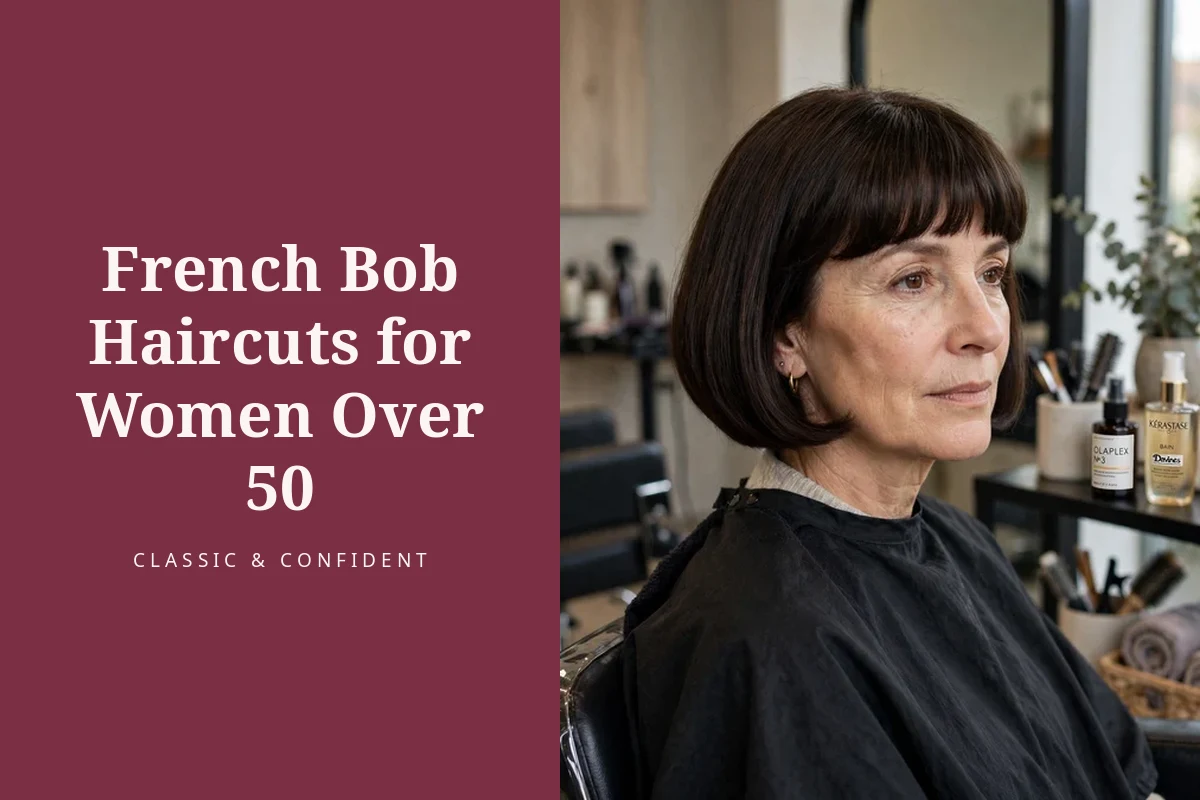
The French bob is not a fussy fashion cut. At its heart it is a jaw-skimming blunt bob with a full or soft fringe, cut so the silhouette is slightly rounded rather than razor-sharp.
That roundness is what makes it kind after 50: it softens the jawline, the fringe fills in a thinning hairline, and the blunt ends make fine hair look denser than it is. Below are 15 French bob haircuts, grouped by what they cost to keep up — from the ones that thrive on neglect to the ones worth paying for.
Fast answers
- Cheapest to keep → The Slightly Longer French Lob (#2)
- Fine, flat hair → The Textured Parisian French Bob (#4)
- Hiding forehead lines → The Wispy-Fringe French Bob (#5)
- Going grey gracefully → The Silver French Bob (#11)
- Special evenings → The Sleek Polished French Bob (#15)
- If you only try one → The Classic Jaw-Length French Bob (#1)
Contents
How to choose a french bob for women over 50
Start with your budget, not the photo. The French bob’s crisp line and fringe are its whole identity, which means the polished versions are 5-week cuts. But half the list below is built to blur — longer lengths and textured finishes that survive 8 weeks between appointments.
Decide what you will realistically pay for before you fall for a cut that needs monthly shaping.
Match the fringe to your forehead, not your age. The fringe does half the work of a French bob: a full fringe covers forehead lines and fills a thinning hairline, while a curtain or wispy fringe opens the face and suits glasses.
The comparison table below lines up which version asks what of you, so read it against your own mirror and your calendar before choosing.
Check the jawline geometry. A true French bob ends at or just under the jaw, and that horizontal line draws the eye across the lower face. If your jaw is your favourite feature, the classic length is perfect; if you want lengthening, go a touch longer — the lob-bob version in this list keeps the French spirit while slimming.
Related lengths and their upkeep are compared in our bob hairstyles for fine hair over 50 roundup.
Ask about the grow-out, not just day one. A good French bob should look intentional at week five, not just in the salon chair. The versions that survive have slightly longer perimeters and softened fringes — ask your stylist to show you what it looks like grown out before they pick up the scissors.
For neighbouring short styles with similar lines, see our guide to short haircuts for women over 50.
Factor in your texture honestly. The French bob’s smooth, rounded silhouette is easiest on straight to wavy hair; strong curls will fight the blunt line unless the cut is adapted for them. If your hair has real curl, the wavy version (#9) is cut to work with it, not against it.
More on choosing cuts by texture is in our hairstyles for fine hair over 50 guide.
All 15 French bobs at a glance
Use this table as your shortlist: find the upkeep column that matches your real life, then read the full breakdown for the cut’s exact specs and stylist wording.
| Cut | Upkeep cost | Trim every | Best for | Grow-out friendly |
|---|---|---|---|---|
| 1. The Classic Jaw-Length French Bob | $$ | 5–6 weeks | The signature Parisian look | Fairly |
| 2. The Slightly Longer French Lob-Bob | $ | 8 weeks | Stretching salon visits | Yes — built to grow |
| 3. The French Bob With Curtain Bangs | $ | 7–8 weeks | Softer face framing | Yes |
| 4. The Textured Parisian French Bob | $ | 7–8 weeks | Fine, flat hair | Yes |
| 5. The Wispy-Fringe French Bob | $ | 6–7 weeks | Forehead lines, glasses | Yes |
| 6. The Chin-Length Blunt French Bob | $$ | 5–6 weeks | Maximum density look | No — line goes fast |
| 7. The Side-Parted French Bob | $$ | 5–6 weeks | Thinning at the part | Fairly |
| 8. The Layered French Bob | $$ | 6 weeks | Movement without mess | Yes |
| 9. The Wavy French Bob | $$ | 6–7 weeks | Natural wave or curl | Yes |
| 10. The French Bob With Face-Framing Highlights | $$$ | 5–6 weeks + colour | Brightness around the face | No — roots show |
| 11. The Silver French Bob | $$ | 5–6 weeks | Going grey with intent | Fairly |
| 12. The Asymmetric French Bob | $$$ | 4–5 weeks | Edge without effort daily | No — asymmetry shows |
| 13. The Voluminous Evening French Bob | $$$ | 5 weeks | Photographs and occasions | No |
| 14. The Micro-Fringe French Bob | $$$ | 4 weeks (fringe trims) | The bold statement | No — fringe grows fast |
| 15. The Sleek Polished French Bob | $$$ | 4–5 weeks | The sharpest version | No |
French bobs that cost almost nothing to keep
These five ask the least of your wallet and your mornings: longer perimeters, textured or softened finishes, and fringes that blur instead of demanding precision. If you want the French look on a twice-a-season salon schedule, start here.
1. The Classic Jaw-Length French Bob
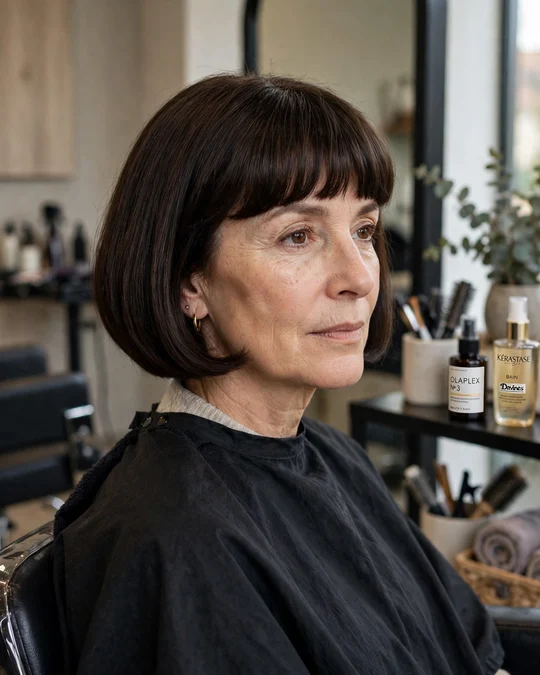
This is the reference cut every other version is measured against, so it is worth understanding properly. The classic French bob ends right at the jaw — about 18–20 cm from crown to perimeter on most women — with the ends cut dead blunt and the silhouette very slightly rounded, narrower at the nape and fuller through the cheeks.
That geometry does two things at once: the blunt perimeter stacks the ends into one dense line, which makes fine hair look up to twice as thick at the bottom edge, while the rounded cheek line lifts the eye upward instead of dragging it down the way a long straight cut does.
The full fringe is load-bearing here, not decorative. Cut at brow level, it shortens the apparent length of the forehead and adds visible density at the hairline — the exact spot where hair thins first after 50.
Together, fringe plus blunt jaw line create a frame around the face that reads as deliberate and chic even when the styling is minimal, which is why this cut photographs so well. It suits straight to slightly wavy textures best; the straighter your hair, the crisper the line.
What makes this a deep-dive rather than a quick look is the maintenance reality most articles skip. The jaw line grows roughly 1 cm a month, which means by week six the perimeter sits a full centimetre below the jaw — and on a cut whose identity is the jaw line, that centimetre changes everything.
The sweet spot is a trim every 5–6 weeks, but the fringe is the real schedule-driver: a straight fringe needs attention every 4 weeks even when the rest of the cut is holding. Ask your salon about complimentary fringe trims between appointments — many offer them, and it turns a $$ cut into a $ one in practice.
- Key numbers: 18–20 cm crown to perimeter, fringe at brow level, perimeter dead blunt
- Trim every: 5–6 weeks; fringe tidy every 4 weeks
- Styling time: about 8 minutes with a round brush
- Best hair type: fine to medium, straight or slightly wavy
Ask your stylist for: “A classic French bob — jaw length, blunt all the way around, slightly rounded through the cheeks, with a full fringe just skimming my brows. No layers, no thinning — I want the perimeter solid.”
How to style it:
- On damp hair, work a pea-size amount of smoothing cream from mid-lengths to ends — keep product off the roots or the fringe will separate.
- Blow-dry the fringe first, rolling it under with a small round brush while it is still very damp; a dry fringe will not sit flat.
- Dry the sides down and slightly under, following the round shape with the brush, and finish the nape with the brush tucked under against the neck.
- Once dry, run flat irons over just the very ends (one pass, 180°C max) for that crisp French line, then press a rice-grain of serum over the surface.
Skip it if your hair is strongly curly — the blunt jaw line becomes a triangle, and you will fight it daily.
Best for: the woman who wants the definitive French bob and will book the 5-week trim without resenting it.
2. The Slightly Longer French Lob-Bob

Take the classic French bob and let it drop 5–7 cm below the jaw, to collarbone-grazing length, and the economics of the cut change completely. That extra length is the whole mechanism: a jaw-line perimeter shows a centimetre of growth immediately, but a collarbone perimeter absorbs two months of growth before the shape reads as “grown out”.
You get the French bob’s blunt line and full fringe with an 8-week trim cycle instead of five.
The fringe stays true French — full, brow-skimming — while the longer sides elongate the face slightly, which suits rounder faces better than the jaw-length original.
It is also the version that transitions best if you are growing out a shorter cut or are nervous about going short: the length feels like a safety net while the fringe delivers the style.
- Key numbers: 25–28 cm crown to perimeter, fringe at brow level
- Trim every: 8 weeks
- Styling time: 10 minutes; air-dry friendly
- Best hair type: fine to thick, straight or wavy
Ask your stylist for: “A French bob grown a little long — collarbone length, blunt perimeter, full fringe at the brows. I want the French shape but I need eight weeks between trims.”
How to style it:
- Rough-dry with your fingers until 80% dry, directing the fringe forward and under.
- Smooth the lengths with a paddle brush and a two-pump shot of smoothing serum, tucking the ends under lightly.
Skip it if your hair is very fine and completely straight — at this length it can hang a little limp without the jaw line’s structure.
Best for: stretching salon visits to twice a season without losing the French identity.
3. The French Bob With Curtain Bangs

Swap the full fringe for curtain bangs — parted softly in the middle and sweeping to each side — and the French bob becomes dramatically more forgiving. The mechanism is simple: a middle-parted curtain fringe has no hard horizontal line to maintain, so as it grows it just becomes longer face-framing layers instead of an overgrown fringe.
You go from 4-week fringe trims to none at all.
The curtain opening also suits faces the full fringe does not: it reveals the centre of the forehead, which lengthens a round face, and it parts around glasses instead of competing with them. Keep the bob itself classic — jaw length, blunt — and let the bangs do the softening.
- Key numbers: jaw length 18–20 cm, curtain bangs from brow to cheekbone
- Trim every: 7–8 weeks
- Styling time: 6 minutes
- Best hair type: straight to wavy, any density
Ask your stylist for: “A jaw-length French bob with curtain bangs instead of a full fringe — parted in the middle, sweeping from the brows to the cheekbones. Blunt perimeter, soft front.”
How to style it:
- Blow-dry the bangs with a round brush, rolling each side away from the centre part to create the curtain sweep.
- Dry the bob smooth and under at the ends, then set the part with a light mist of flexible hairspray.
- On day two, revive the sweep with a damp hand and five seconds of heat — curtain bangs reset faster than any fringe.
Skip it if your hairline has a strong cowlick at the centre — it will fight the middle part every morning.
Best for: glasses wearers and anyone who wants the French look with zero fringe appointments.
4. The Textured Parisian French Bob

This is the French bob for women whose hair went flat somewhere in their late forties and never came back. The texture is the mechanism: instead of a glassy blunt edge, the ends are point-cut — snipped vertically into the perimeter — which breaks the bottom line into dozens of tiny pieces.
Each piece catches light separately, so the eye reads volume and movement where a solid line would read as one flat sheet. On fine hair the difference is immediate and a little startling.
It is also the most honest low-maintenance French bob here. The textured ends disguise two months of growth, the fringe is cut slightly piece-y so it never needs precision, and the whole thing air-dries into something that looks intentional. If your mornings are a negotiation, this is the cut that negotiates best.
- Key numbers: jaw to chin length, ends point-cut 1–2 cm into the perimeter
- Trim every: 7–8 weeks
- Styling time: 5 minutes — genuinely air-dry friendly
- Best hair type: fine to medium, straight or wavy
Ask your stylist for: “A French bob with textured, lived-in ends — point-cut into the perimeter, not blunt — and a soft piece-y fringe. I want it to look good air-dried.”
How to style it:
- Scrunch a pea-size of texturising cream into damp ends and let it air-dry, or rough-dry with a diffuser for 3 minutes.
- Once dry, pinch random 2 cm sections at the ends and twist — this separates the point-cut pieces so the texture reads.
Skip it if you want the crisp, graphic Parisian line — texture and crispness are opposites, and this is firmly the texture camp.
Best for: fine, flat hair and six-minute mornings; the lowest-effort French bob that still looks French.
5. The Wispy-Fringe French Bob

A full fringe is a commitment; a wispy fringe is a suggestion. Cut with the hair pulled thin — your stylist takes less hair into the fringe section — the wispy fringe covers the forehead without a hard line, which means forehead lines are softened rather than hidden behind a curtain of hair.
The see-through quality also keeps the cut light around the face, flattering for women who find a full fringe too heavy or too young-looking.
Because the fringe is thin, it grows out invisibly: a wispy fringe at week six just looks like face-framing layers. Pair it with the classic jaw-length blunt bob and you get the French silhouette with training wheels — all of the chic, a fraction of the upkeep.
- Key numbers: jaw length 18–20 cm, fringe thinned to 50% density, brow-skimming
- Trim every: 6–7 weeks
- Styling time: 6 minutes
- Best hair type: fine to medium; ideal with glasses
Ask your stylist for: “A jaw-length French bob with a wispy, thinned-out fringe — I want it see-through, not solid. Take half the usual amount of hair into the fringe.”
How to style it:
- Blow-dry the fringe straight down with a flat brush while damp — a wispy fringe kinks if it air-dries.
- Dry the bob smooth and under, then separate the fringe with your fingers and a drop of serum for the piece-y finish.
- Refresh on day two by spritzing the fringe with water and re-drying for 30 seconds — it resets faster than any other part.
Skip it if your hairline is significantly thinning — a see-through fringe over a see-through hairline doubles the problem instead of hiding it.
Best for: forehead lines, glasses, and anyone easing into fringe territory for the first time.
French bobs worth the regular salon visit
These five are the classics: crisp lines, true fringes, and shapes that reward a standing appointment every 5–6 weeks. The payoff for the schedule is the sharpest version of the French bob — the one people photograph.
For the full rundown, How to Wear Leopard Print Over 50 covers what works, what to avoid and how to make it feel like you.6. The Chin-Length Blunt French Bob

Shorter than the classic by 3–4 cm, the chin-length blunt French bob is the maximum-density version of the cut. The mechanism is pure geometry: the shorter the perimeter, the less length over which fine hair can taper, so the bottom edge reads at full thickness.
On thinning hair this is the difference between “styled” and “strategic” — every strand ends at the same line, and the eye sees mass.
The trade-off is honesty about the schedule. A chin-length line shows growth faster than any other version here — by week six it is a jaw-length bob, which is a different cut. Book the 5-week trim and mean it, and this is the most flattering short cut a woman with fine hair can wear.
- Key numbers: 15–17 cm crown to perimeter, chin length, fringe at brow level
- Trim every: 5–6 weeks, no exceptions
- Styling time: 8 minutes with a round brush
- Best hair type: fine to medium, straight
Ask your stylist for: “A French bob cut short — chin length, blunt, with a full fringe. I want the shortest, densest version, and I’ll be back in five weeks.”
How to style it:
- Blow-dry the fringe first with a small round brush, rolling under while damp.
- Dry the sides smooth and slightly under, keeping the silhouette close to the cheeks.
- Finish with one pass of flat irons over the perimeter at 180°C for the crisp line.
- Press a rice-grain of serum over the surface — short blunt cuts show every flyaway.
Skip it if you will not keep the trim schedule — this cut at week eight is just a grown-out bob, and a sad one.
Best for: fine, thinning hair that needs maximum apparent density; the boldest everyday French bob.
7. The Side-Parted French Bob

Move the part 5–7 cm off-centre and the French bob changes character entirely. A deep side part does two physical things: it sweeps a heavy curtain of hair across the forehead, which covers thinning at the temples and the part line — the two places age shows first — and it creates instant asymmetry, which the eye reads as volume.
Flat-on-top hair disappears under a deep side part in a way no product can match.
The bob itself stays classic — jaw length, blunt — but the fringe becomes a long side-swept panel rather than a straight-across band. It needs a genuinely deep part to work: ask your stylist to find it while your hair is wet, because a part chosen on dry hair migrates by morning.
- Key numbers: jaw length 18–20 cm, part 5–7 cm off-centre, swept fringe to the cheekbone
- Trim every: 5–6 weeks
- Styling time: 7 minutes
- Best hair type: fine to medium, straight or wavy
Ask your stylist for: “A jaw-length French bob with a deep side part — far over, near the temple — and the fringe swept long across my forehead. The part has to be unmistakably deep, not near the middle.”
How to style it:
- Set the deep part on soaking-wet hair with a tail comb — it will not hold if you choose it dry.
- Blow-dry the heavy side over to the opposite direction first for root lift, then sweep it back into place.
Skip it if your hair has a strong natural centre part or cowlicks — a deep side part is a daily argument you will lose.
Best for: thinning at the part or temples, and flat crowns that need instant lift.
8. The Layered French Bob

A French bob can turn helmet-like on thicker hair — all that blunt perimeter with nowhere for the bulk to go. The fix is hidden interior layering: the underneath sections are cut 2–3 cm shorter than the surface, so the top layer falls over a slightly shorter foundation.
You keep the smooth French silhouette from the outside while the inside has room to move, which means swing when you walk and no triangle when it grows.
This is also the most grow-out-friendly cut in the mid-range group, because the layers blur the perimeter line as it lengthens. It suits medium to thick hair best; on very fine hair, interior layers can make the ends look thinner rather than fuller.
- Key numbers: jaw length, interior layers 2–3 cm shorter underneath
- Trim every: 6 weeks
- Styling time: 7 minutes
- Best hair type: medium to thick, straight or wavy
Ask your stylist for: “A French bob shape with hidden interior layers — underneath cut two to three centimetres shorter so it moves, but the outside must still look smooth and blunt, not choppy.”
How to style it:
- Rough-dry with your fingers until 80% dry, lifting at the roots.
- Smooth the surface with a paddle brush, tucking the ends under, and finish with a two-pump shot of smoothing serum.
- Shake the ends out with your fingers — the interior layers need separating to read as movement.
Skip it if your hair is very fine — layers remove bulk you cannot spare.
Best for: thicker hair that turns blunt bobs into helmets, and anyone who wants the French shape with swing.
Good to know
A fringe grows roughly 1 cm a month, which means a straight-across fringe needs attention every 4 weeks even when the rest of your French bob is holding its shape.
Ask your salon about complimentary fringe trims between full appointments — many offer them, and it is the single cheapest way to keep any of the crisper cuts on this list looking deliberate.
9. The Wavy French Bob

If your hair has natural wave, do not straighten it into a French bob — cut the French bob into the wave. The mechanism: a blunt jaw-length perimeter gives waves a stopping point, so instead of frizzing outward into a triangle, the wave pattern stacks into defined, piece-y bends that end in one clean line.
The fringe is cut slightly longer and textured so it falls into a soft wave rather than fighting to lie flat.
This version is cut dry or on the wave pattern, which matters — a wavy French bob cut wet and straight will spring up 3–5 cm shorter than planned. Tell your stylist you wear it wavy, and ask them to cut it in its natural state. It air-dries better than any other version here.
- Key numbers: jaw length plus 3–5 cm allowance for shrinkage, textured fringe
- Trim every: 6–7 weeks, cut dry on the wave
- Styling time: 5 minutes — the air-dry champion
- Best hair type: naturally wavy to loosely curly
Ask your stylist for: “A French bob cut for my natural wave — jaw length allowing for shrinkage, textured fringe, blunt perimeter. Please cut it dry so we see the real length.”
How to style it:
- Scrunch a two-pump shot of curl cream into soaking-wet hair, then do not touch it.
- Air-dry or diffuse on low for 4 minutes, scrunching upward — the perimeter line does the shaping, the wave does the rest.
Skip it if your hair is pin-straight — this cut needs your wave to exist; manufactured waves are a different article.
Best for: natural wave or loose curl, and women who have never once enjoyed blow-drying.
10. The French Bob With Face-Framing Highlights

Colour is the only item on this list that changes the cut’s apparent shape, and face-framing highlights do it through contrast.
Two or three shades lighter woven through the front 5 cm of hair create vertical brightness against the darker lengths behind, which draws the eye forward and up — the face looks lifted, and the bob’s blunt line looks sharper by comparison. On grey-blending hair, the highlights also camouflage the grow-out line for an extra two weeks.
This is the first $$$ on the list because it is two appointments in one: the cut every 5–6 weeks and the colour every 8–10. Ask for the highlights to be painted, not foiled, so the regrowth is soft — harsh foil lines will send you back to the salon twice as often.
- Key numbers: jaw length 18–20 cm, highlights 2–3 shades lighter, front 5 cm
- Trim every: 5–6 weeks; colour every 8–10 weeks
- Styling time: 8 minutes
- Best hair type: any density; best on hair already coloured
Ask your stylist for: “My usual French bob, plus painted face-framing highlights two to three shades lighter through the front — soft regrowth, no foil lines. I’m blending grey, so keep it natural.”
How to style it:
- Style as the classic (#1): fringe first with a round brush, sides smooth and under.
- Use a purple-toning shampoo once a week if the highlights are blonde — 5 minutes, no longer, or they go flat.
- Finish with a shine spray rather than serum — highlights need light reflection, not weight.
Skip it if you are done with colour appointments — this is a standing date with the salon, not a one-off.
Best for: brightening a tired face and stretching grey-blending colour further between appointments.
The French bobs worth the investment
These five cost the most to keep — colour work, precision lines, and 4-to-5-week schedules — but they are also the most transformative. If the haircut is the centrepiece of how you present yourself, this is where the money goes.
11. The Silver French Bob

Going grey is a colour decision; wearing it in a French bob is a style decision, and the two multiply each other. Silver hair reflects more light than pigmented hair, which means the French bob’s blunt perimeter and fringe read crisper and more graphic in silver than in any other shade.
The cut gives the grey intention — this is not hair you gave up on, it is hair you chose — and the grey gives the cut an edge no dye job can fake.
The upkeep is in the tone, not the shape: silver goes yellow from sun, heat and hard water, so a weekly purple shampoo (5–7 minutes) and a gloss appointment every 8–10 weeks keep it icy rather than dull.
Cut-wise it behaves like the classic — 5–6 week trims, full fringe — which makes it a $$ cut wearing a $$$ colour.
- Key numbers: jaw length 18–20 cm, full fringe, purple shampoo weekly 5–7 min
- Trim every: 5–6 weeks; gloss every 8–10 weeks
- Styling time: 8 minutes
- Best hair type: any density, 70%+ grey or fully silver
Ask your stylist for: “A classic French bob to show off my silver — jaw length, blunt, full fringe. And I need a toning plan: purple shampoo at home and a gloss every couple of months.”
How to style it:
- Style as the classic (#1): fringe first, sides smooth and under.
- Once a week, swap your shampoo for a purple toning shampoo — leave it 5–7 minutes, then condition well.
- Finish with shine spray; silver’s whole impact is light reflection, and dull silver reads as grey in the tired sense.
Skip it if your grey is still patchy — this cut needs commitment-level silver to read as intentional.
Best for: the grey transition done properly, and anyone who wants their hair to be the outfit.
12. The Asymmetric French Bob

Cut one side 2–3 cm longer than the other and the French bob stops being polite. The asymmetry works because the eye follows the longer line: on a round or full face, the diagonal from the short side to the long side creates a lengthening diagonal that a symmetrical cut cannot.
It is the edgiest version here, and paradoxically one of the easiest to wear day to day — the cut does all the talking, so the styling can be minimal.
The cost is precision maintenance. Asymmetry shows growth unevenly — by week five the difference reads as a mistake rather than a design — so this is a 4-to-5-week cut with no flexibility. It also suits straight hair best; waves blur the line that makes the asymmetry legible.
- Key numbers: one side 2–3 cm longer, jaw length on the short side, full or swept fringe
- Trim every: 4–5 weeks
- Styling time: 7 minutes
- Best hair type: straight to slightly wavy, medium density
Ask your stylist for: “A French bob with real asymmetry — one side two to three centimetres longer than the other, blunt on both sides. I know it needs a five-week trim; I’m in.”
How to style it:
- Blow-dry smooth with a paddle brush, keeping both sides tucked slightly under so the length difference reads clean.
- Tuck the short side behind the ear to exaggerate the asymmetry when you want the full effect.
Skip it if you are not ready for comments — this is the one strangers ask about.
Best for: round or full faces that need lengthening, and anyone bored of symmetrical hair.
13. The Voluminous Evening French Bob

Some occasions want hair with presence, and volume is the cheapest glamour there is. The evening French bob is cut like the classic but styled for maximum body: the crown is layered 5–8 cm shorter than the perimeter underneath, so when you blow-dry with lift the top expands while the jaw line stays crisp.
The result photographs like twice the hair — which, on camera, it effectively is.
This is a styling cut more than a cutting cut: the layers are invisible when it air-dries (it just looks like the classic), and they only activate with heat and a round brush. That makes it the perfect occasion version — everyday you wear it quiet, and for the wedding you spend fifteen minutes turning up the volume.
- Key numbers: jaw length, crown layers 5–8 cm shorter underneath
- Trim every: 5 weeks
- Styling time: 6 minutes daily, 15 for full volume
- Best hair type: fine to medium — the layers do the lifting
Ask your stylist for: “A classic French bob with hidden crown layers — five to eight centimetres shorter underneath at the crown — so I can blow it up big for occasions but wear it smooth day to day.”
How to style it:
- Apply a golf-ball of volumising mousse to damp roots — this is the one version where mousse earns its place.
- Blow-dry the crown in the opposite direction of how it will fall, lifting each section straight up with a round brush.
- Smooth the perimeter under for the crisp jaw line, then backcomb two sections at the crown and smooth over.
- Set with a firm-hold hairspray from 25 cm — close spraying collapses the lift you just built.
Skip it if you will never spend fifteen minutes on your hair — the layers are invisible without the styling, and then you have just paid for the classic.
Best for: weddings, photographs, and any evening where your hair needs to arrive before you do.
14. The Micro-Fringe French Bob

The micro-fringe — cut 2–3 cm above the brow — is the boldest move on this list, and its power is pure proportion. By exposing the full forehead, it lengthens the face dramatically and throws all the attention onto the eyes and cheekbones.
Against the French bob’s blunt jaw line, the short fringe creates a striking long-short tension that reads as fashion-forward rather than severe, provided the rest of the cut stays soft.
It is also the highest-maintenance fringe here: a micro-fringe grows out of its proportions in three weeks, so this is a 4-week fringe trim on top of the 5-week cut. Book it only if you love the salon — or love the look enough to learn the fringe trim yourself, which many women do with this cut.
- Key numbers: jaw length 18–20 cm, fringe 2–3 cm above the brow
- Trim every: 5 weeks; fringe every 4 weeks
- Styling time: 6 minutes
- Best hair type: straight, fine to medium
Ask your stylist for: “A French bob with a micro-fringe — two to three centimetres above my brows, straight across. I know it’s high maintenance and I want it anyway.”
How to style it:
- Blow-dry the micro-fringe straight down immediately — at this length it sets in under a minute.
- Smooth the bob under with a round brush, keeping the silhouette neat so the fringe is the only drama.
Skip it if you are fringe-ambivalent — the micro-fringe is a personality, not a haircut detail, and half-commitment looks accidental.
Best for: the bold statement, strong eyes and cheekbones, and women who enjoy being noticed.
15. The Sleek Polished French Bob

This is the French bob at its most exacting: every strand smoothed, the perimeter a single unbroken line, the fringe a perfect brow-skimming band. The mechanism is shine — sleek, light-reflecting hair reads as healthy and expensive, and on a blunt cut the reflection runs the full length of the hair without interruption.
It is the version that looks like money because, frankly, it takes the most work to look this effortless.
The polish comes from technique, not product overload: a proper blowout with tension, one pass of flat irons at 180°C, and a shine spray rather than heavy serums. Book it for the occasions that matter and wear one of the softer versions the rest of the month — nobody maintains this daily, and nobody needs to.
- Key numbers: jaw length 18–20 cm, flat-ironed at 180°C, shine spray finish
- Trim every: 4–5 weeks to keep the line perfect
- Styling time: 15 minutes for full polish
- Best hair type: straight, fine to medium
Ask your stylist for: “The sharpest French bob you can cut — jaw length, dead blunt, perfect fringe. I’m booking it for occasions, so cut it for maximum polish.”
How to style it:
- Blow-dry in small sections with real tension — pull each section taut with the brush, which is what creates the sleek foundation.
- Flat-iron the lengths in 3 cm sections at 180°C, one slow pass each; do the fringe last, pressing it flat against the forehead.
- Mist with shine spray from 30 cm — never serum on this cut, which needs reflection, not weight.
Skip it if your hair frizzes in humidity — sleek and humid are enemies, and this cut has no texture to hide behind.
Best for: the sharpest evenings, photographs, and anyone who wants the definitive polished French look.
French bob care and styling tips
Whichever version you choose, these habits keep a French bob looking deliberate between appointments.
- Dry the fringe first, always — it sets in the first two minutes, and a fringe dried last will never sit right.
- Sleep on a silk pillowcase; the blunt perimeter creases overnight on cotton, and the fringe is the first casualty.
- Keep heat at 180°C or below — the blunt ends show damage faster than layered cuts because every strand ends at the same line.
- Use purple shampoo weekly if your bob is silver, blonde or highlighted — 5 minutes, then condition well.
- Ask about fringe trims between appointments; most salons do them free or cheap, and they double the life of the cut.
- On day two, revive the shape with damp hands and 30 seconds of heat on the fringe — full re-styling is rarely needed.
Your 5-step French bob morning routine:
- Dampen the fringe (and only the fringe) with wet hands or a spray bottle.
- Blow-dry the fringe under with a small round brush — 60 seconds.
- Smooth the sides down and under with the brush, two minutes.
- Press a pea-size of cream over the surface to settle flyaways.
- Check the back with a hand mirror — the nape line is the French bob’s signature, and it is the part you cannot feel.
The bottom line
Pick by your lifestyle, because the French bob is that adaptable: for everyday six-minute mornings, the Textured Parisian French Bob (#4) asks almost nothing and still looks French. For office days when polish matters, the Chin-Length Blunt French Bob (#6) is the sharpest line you can wear. For evenings and photographs, the Sleek Polished French Bob (#15) is unbeatable.
And for low-effort weeks and travel, the Slightly Longer French Lob-Bob (#2) stretches to eight weeks without complaint.
If I had to pick one for most women over 50, it would be the Classic Jaw-Length French Bob (#1): it is the reference the others are measured against, it flatters nearly every face, and once you accept the 5-week trim it is the chicest short cut you can own.
Pin this guide to your “salon day” board before your appointment — one saved screenshot of your favourite cut beats ten minutes of trying to describe a fringe to your stylist.
Frequently asked questions
Is a french bob flattering for women over 50?
Yes — a french bob for women over 50 is one of the most flattering short cuts, because the full fringe fills a thinning hairline while the blunt jaw-length perimeter makes fine hair look denser.
The key is choosing the right version: fine, flat hair does best with the textured or classic versions, thicker hair suits the layered French bob, and round faces benefit from the slightly longer lob-bob. Avoid the micro-fringe only if you are not ready for its 4-week maintenance.
How long is a French bob?
A classic French bob ends at the jaw — roughly 18–20 cm from crown to perimeter — with a full fringe at brow level. The chin-length version runs 15–17 cm and reads denser, while the lob-bob stretches to 25–28 cm at the collarbone for easier grow-out.
If your stylist cuts it wet, remember hair springs up 1–2 cm as it dries, so agree the dry length before they start.
Will a French bob work on fine, thin hair?
It is one of the best short cuts for fine, thin hair — provided the perimeter stays blunt. The French bob’s jaw-length line stacks the ends into one dense edge, and the fringe adds apparent thickness at the hairline.
What ruins it for fine hair is over-layering or thinning shears: ask your stylist to keep both away from this cut, because removing bulk from already-fine hair defeats the whole mechanism. The chin-length blunt version (#6) is the densest of the lot.
What is the difference between a French bob and a regular bob?
A regular bob can be any length with any finish; a French bob is specifically jaw-skimming (or close to it) with a full or soft fringe and a slightly rounded, Parisian silhouette. The fringe is the defining feature — a bob without a fringe is just a bob.
French bobs also tend to be worn with less styling product and a more lived-in finish than the average salon bob, which is part of the chic.
How often does a French bob need trimming?
It depends on the version: the crisp classic and chin-length blunt need a trim every 5–6 weeks, the micro-fringe needs fringe attention every 4 weeks, and the textured, lob-bob and curtain-bang versions stretch to 7–8 weeks.
The fringe is usually the schedule-driver rather than the length — ask your salon about complimentary fringe trims between appointments, which many offer and which can halve your effective maintenance.
Can I wear a French bob with glasses?
Absolutely — the curtain-bang (#3) and wispy-fringe (#5) versions were made for it. A middle-parted curtain fringe parts around your frames instead of competing with them, and a thinned wispy fringe sits lightly above the frames without pushing them down.
What to avoid is a heavy straight fringe with large frames: the two fight for the same space on your face, and the frames usually lose.
What colour suits a French bob after 50?
Any — but the cut rewards contrast and shine. Silver and grey make the blunt line look crisper (see #11), face-framing highlights add lift around the face (#10), and a rich all-over shade keeps the silhouette graphic.
What matters more than the shade is condition: a blunt perimeter shows damage on every strand, so keep heat at 180°C or below and trim on schedule. Dull ends will undo a French bob faster than the wrong colour ever could.
How do I grow out a French bob?
Grow it through the lob-bob stage (#2): let the perimeter drop past the jaw to the collarbone while keeping the fringe trimmed, and you pass through a deliberate-looking longer French bob instead of an awkward in-between. The layered version (#8) also grows gracefully because the interior layers blur the line.
Avoid growing out the micro-fringe or asymmetric versions — both read as mistakes within weeks, so transition their fringes to curtain bangs early in the grow-out.