The Best Colours to Wear With Grey Hair After 50
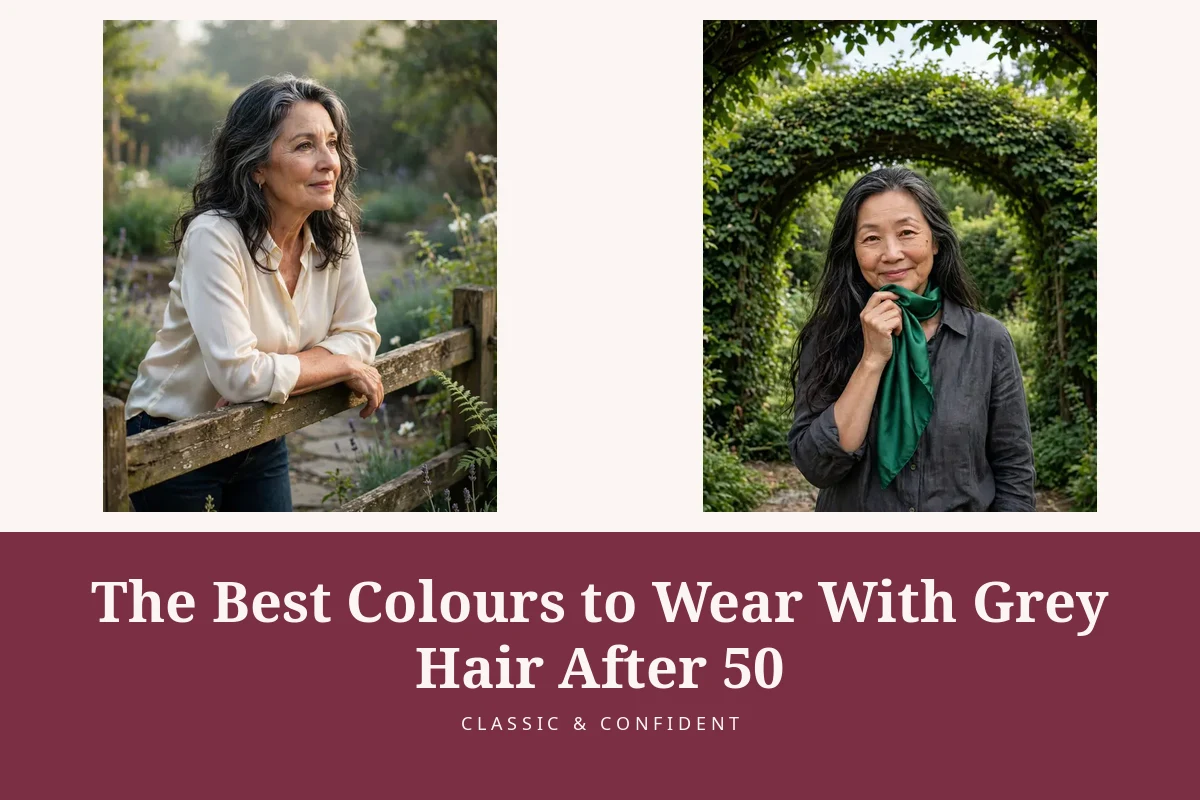
You are dressing for the family wedding in three weeks, your silver hair is doing exactly what it wants, and the black dress you have worn to every occasion for a decade suddenly looks severe.
Finding the best colours to wear with grey hair is not about starting over — it is about swapping a handful of shades that used to flatter dyed hair for the ones that flatter the hair you actually have now.
Grey and silver hair reflects light upward onto your face instead of absorbing it, which changes how every colour behaves near your chin. This guide is a checklist: ten colours that work with silver hair, grouped by the problem each one solves, so you can fix your wardrobe piece by piece rather than panic-buying a whole new one.
The cheat sheet
- If you only buy one colour this season: emerald green (#3)
- If black drains you now: charcoal (#7)
- If white makes you look tired: warm ivory (#1)
- The fastest lift for a grey-haired woman: fuchsia (#6)
- For a big occasion: ruby red (#5)
- The colour that flatters your hair itself: soft silver metallics (#9)
Contents
- How to choose colours for grey hair
- At a glance: the 10-colour checklist
- When your old favourites now fight your hair
- When you look tired even after eight hours’ sleep
- When your neutrals look flat next to silver
- When you want grey hair to look deliberate
- How to test the best colours to wear with grey hair before you buy
- The bottom line
- Frequently asked questions
How to choose colours for grey hair
Grey hair changes the frame, not the face. Silver and white hair reflects light upward, which means pale colours wash out faster and dark colours read harsher than they did against brown or blonde hair. Judge a colour by what it does to your face, not by whether you liked it five years ago.
Keep your undertone, not the old dye chart’s. Whether your skin runs warm or cool matters more than whether your hair is silver, salt-and-pepper or snow white.
If you have not checked yours since going grey, it takes twenty minutes with daylight and a mirror — the method in how to find your undertone over 50 still works once your hair has changed.
Judge colour at your chin, not on the rail. A shade looks different folded on a hanger than held under your face, and shop lighting flatters nothing. Hold every candidate under your chin in daylight and look at your under-eyes first — if the shadows deepen, walk away.
The full list of shades to screen out lives in the colours that wash you out over 50.
One strong colour beats five shy ones. Silver hair gives you a striking frame for free, so a single confident colour near the face does more than a whole outfit of careful beiges.
This is why so many women find their style sharpens after going grey — the full guide to which colours suit you works beautifully as a second read once you have your undertone sorted.
Saturation is the dial that matters most. As a rule, colours with a bit of depth and clarity flatter grey hair better than dusty, faded versions of the same hue — a clear emerald over a sage, a true navy over a washed denim blue. You do not need brighter clothes; you need colours that are not half-faded.
At a glance: the 10-colour checklist
Work through this list like a checklist. You do not need all ten — most women only need three or four from it to fix an entire wardrobe.
| Colour | Why it works with grey hair | Best worn as |
|---|---|---|
| 1. Warm ivory | Softens the contrast at the chin that stark white creates | Blouses, knit tops, scarves |
| 2. True navy | Deep, clear dark that does not compete with silver | Trousers, blazers, dresses |
| 3. Emerald green | Counteracts sallowness and makes skin look rested | A top or dress near the face |
| 4. Sapphire and cobalt | Echoes and intensifies silver tones | Blouses, knitwear, evening pieces |
| 5. Ruby red | Warm depth that keeps silver hair from reading icy | Occasion dresses, coats |
| 6. Fuchsia and magenta | Instant brightness; lifts under-eye shadows | Scarves, tops, lipstick’s fabric echo |
| 7. Charcoal | All of black’s slimming power, none of its harshness | The black replacement everywhere |
| 8. Camel and chocolate | Warmth that keeps grey from reading cold | Coats, knitwear, boots |
| 9. Soft silver metallics | Harmonises with the hair instead of fighting it | Tops, cardigans, accessories |
| 10. One bold near-face accent | One deliberate pop beats a whole timid outfit | Scarf, necklace, lipstick echo |
When your old favourites now fight your hair
The first problem most women meet: the whites and blues that always worked suddenly look wrong. The fix is almost never a new colour family — it is a better version of the colour you already own.
1. Warm Ivory (Not Stark White)

Stark white next to silver hair creates the highest possible contrast at your chin, and that contrast throws every shadow on your face into relief — under-eye circles look deeper, lines look sharper.
Warm ivory works because it lowers that contrast by half a step: the fabric still reads as “light” from across the room, but it reflects a softer, warmer light upward that flatters skin instead of auditing it.
- What to buy: warm ivory, cream, soft ecru — any white with a whisper of yellow or beige
- What to avoid: optic white, blue-white, anything described as “bright”
- Fabric matters: matte weaves (cotton poplin, silk crepe) reflect softer than high-shine satins
- The 2-second test: hold it under your chin in daylight — if your teeth look yellower, it is too warm; start over
The rule: if it glows blue-white under the shop lights, it will glare next to silver hair — choose the white that looks almost cream.
How to style it:
- Wear ivory nearest your face — a blouse, a scarf, a knit top — where the softness pays off.
- Pair it with one of the deeper colours from this list (navy, charcoal, emerald) so the outfit still has shape.
- Keep stark white below the waist only: white jeans and trainers are fine, because they never meet your chin.
Skip it if your undertone runs very cool and your skin is fair — some cool-toned women genuinely wear a soft white better than ivory. Test both at your chin and believe what you see.
Best for: anyone whose white blouses suddenly started looking “too much” once the grey came in.
2. True Navy Instead of Faded Blues

Denim blues and washed chambray were easy with brown hair because the hair supplied the depth. Against silver hair, faded blues have no depth left to borrow — the whole outfit goes pale and you look rinsed out.
True navy works for the opposite reason: it is a dark with real saturation, so it frames silver hair crisply without the harshness of black, and the blue undertone quietly echoes the cool tones in most grey hair.
- What to buy: a navy that looks almost black indoors but reads blue in daylight
- What to retire: faded denim, powder blue and chambray worn near the face
- Shopping words: “midnight navy” or “true navy” — skip anything labelled “washed”, “vintage” or “faded”
- Bonus: navy and silver hair together read expensive the way black and blonde used to
The rule: every faded blue near your face gets swapped for a saturated one — depth is what grey hair needs to lean on.
How to style it:
- Make navy your dark-neutral default: navy trousers, a navy blazer, a navy knit dress.
- Keep your favourite faded denim for below the waist — dark-rinse jeans keep the depth, light-wash goes to weekends.
- Add one warm metal — gold hoops, a tan bag — so navy and silver never read cold together.
- For evening, navy crepe or velvet with silver jewellery does everything black used to do.
Skip it if your hair is still mostly dark with a few silver streaks — navy can blend into dark hair and lose its framing effect until the grey is further along.
Best for: the woman who lived in blue and wants one swap that fixes half her wardrobe.
When you look tired even after eight hours’ sleep
If people keep asking whether you are unwell, the problem is rarely your face — it is the colours meeting it. These four jewel tones put colour back into your skin by contrast instead of demanding it from you.
3. Emerald Green

Emerald is the single most flattering jewel tone on grey hair because of how it handles redness. Silver hair throws cool light onto the face, which can emphasise any ruddiness or sallowness around the nose and cheeks; emerald sits opposite red on the colour wheel, so it visually neutralises that redness and the skin reads calmer and more even.
The result is the rested look people used to get from a week off — from a top. These are genuinely among the best colours to wear with grey hair for any woman whose skin has picked up warmth or redness with age.
- What to buy: a clear, medium-deep emerald — rich, not neon, not forest-murky
- Best fabric: matte jersey or crepe; shine on green can read costume near silver hair
- Pair it with: navy, charcoal or warm ivory; skip pairing with black, which steals the calm
- If emerald feels bold: start with a scarf — the effect at the chin is identical
The rule: one emerald piece near the face is the fastest “you look well” in this whole list — nothing else comes close.
How to style it:
- Wear the emerald as the top half — a knit top, a blouse, a dress — where it meets your skin.
- Keep everything below the waist quiet: navy trousers or a charcoal skirt.
Skip it if your undertone is strongly warm with golden skin — emerald can fight gold undertones, and a warm teal or deep jade will flatter you more.
Best for: the “you look tired” comments, redness around the nose, and any big daylight event.
4. Sapphire and Cobalt Blue

Where emerald calms the skin, sapphire and cobalt energise the hair. Most grey hair carries cool blue-silver undertones, and wearing a saturated blue nearby creates an optical echo: the hair looks brighter and more deliberate, and the whole head looks like a styled choice rather than a surrender.
Cobalt is the louder sister — use it when you want the effect noticed; sapphire is the quieter, deeper version for everyday.
- What to buy: a blue with real punch — if it looks grey on the rail, it will look grey on you
- Best fabric: fine knits and silk; the colour needs to sit smooth to reflect cleanly
- Pair it with: silver jewellery (echo, not competition) and dark denim or charcoal
- Cool-undertone bonus: this is the colour family most cool-toned grey-haired women should own
The rule: match the blue’s clarity to your hair’s clarity — bright silver hair takes cobalt, softer grey takes sapphire.
How to style it:
- Wear the blue on top, where it talks to your hair — a blouse, a knit, a blazer.
- Keep metals silver or white-gold so the blue-silver echo stays clean.
- For the office, a sapphire knit under a charcoal blazer; for dinner, cobalt silk and dark jeans.
Skip it if your grey has strong warm, yellow tones and you have not toned it — bright blue against yellow-grey can look unintentional; emerald will suit you better.
Best for: making silver hair look like the best decision you ever made.
5. Ruby Red

Ruby is the occasion colour for grey hair because warmth is what keeps silver from reading icy. A clear, slightly warm red — think the inside of a pomegranate, not a fire engine — puts blood back into the cheeks by association: the eye reads the red, then reads the face next to it as warmer too.
It is also the colour that photographs best against silver hair, which is worth knowing before the wedding photographer’s flash finds you.
- What to buy: a ruby with blue-warm balance — deep, clear, neither orange nor burgundy-dark
- Best fabric: matte crepe or wool for day; velvet for evening (matte reads modern)
- Lipstick note: a ruby dress begs for a lipstick within two shades — bare lips next to ruby look unfinished
- One piece only: a ruby dress plus ruby shoes plus ruby bag is three reds too many
The rule: ruby is your event colour — buy it in a dress or a coat, the two garments people photograph.
How to style it:
- Let the ruby be the only colour story: nude or black shoes, one simple bag.
- Echo it once near the face — a lipstick, an earring — so the red feels connected, not random.
- Keep silver or pearl jewellery; gold fights ruby’s cool-warm balance.
- For day events, a ruby coat over a charcoal dress does the same work as a ruby dress.
Skip it if you flush easily — red near the face amplifies a blush response, and fuchsia may be your safer bright.
Best for: weddings, milestone birthdays, any photograph that matters.
6. Fuchsia and Magenta

Fuchsia is the emergency lift. It works on grey hair through sheer optical brightness: a vivid pink-purple reflects so much coloured light onto the face that under-eye shadows simply cannot compete with it.
Where ruby is warm and considered, fuchsia is joyful and a little rebellious — and it is the colour most women over 50 are told to stop wearing, which is exactly why it works so well on them.
- What to buy: a true fuchsia — pink-purple, vivid, unapologetic
- Easiest entry: a scarf or a pashmina — full brightness at the chin for the price of an accessory
- Pair it with: charcoal, navy or dark denim — never with another bright
- Dose: one fuchsia piece per outfit; two starts to shout
The rule: when you feel invisible in your neutrals, add one fuchsia thing near your face and watch the room notice you again.
How to style it:
- Start with the scarf: fuchsia at the throat over a charcoal or navy top.
- When you are ready for more, a fuchsia knit top with dark jeans is a whole outfit.
Skip it if your colouring is very soft and low-contrast (pale skin, pale eyes, pale grey hair) — a bright that strong can wear you; try a softer rose instead.
Best for: grey days, low-energy mornings, and the days you want to be seen.
Good to know
Shop lighting flatters nothing — it is designed to sell, not to tell the truth. Always test a new colour in daylight before you cut the tags off: step outside the shop, hold the garment under your chin, and look at your under-eyes, not at the garment.
If the shadows deepen, it goes back, however much you love the colour on the rail.
Colour alone cannot fix tired-looking grey — the cut matters just as much, and our hairstyles for women over 60 show the shapes that make silver hair look deliberate.When your neutrals look flat next to silver
Neutrals are the backbone of every wardrobe, but grey hair exposes the weak ones. The neutrals that survive are the ones with enough depth or warmth to hold their own next to silver.
7. Charcoal Instead of Head-to-Toe Black

Black against silver hair is the highest-contrast combination in your wardrobe, and contrast is merciless: every line, every shadow, every tired patch gets outlined.
Charcoal gives you black’s slimming, elongating, goes-with-everything power at about 70 percent of the contrast — close enough to read as a dark neutral from any distance, but gentle enough that your face, not the outfit, is what people register first.
- What to buy: a true charcoal — dark grey with no blue or brown cast
- Where it replaces black: trousers, blazers, knit dresses, the “smart” outfit
- Keep black for: shoes, bags and belts — accessories never touch your face
- Shopping words: ask for “charcoal” or “dark grey”; “anthracite” is the same thing
The rule: if it touches your face, make it charcoal; if it doesn’t, black is still allowed.
How to style it:
- Swap your black blazer, black trousers and black knit dress for charcoal versions first — the biggest wins.
- Wear charcoal with one of the jewel tones from points 3–6 to keep dark outfits from going flat.
- Keep black shoes and bags; the contrast lives far from your face, where it does no harm.
Skip it if your hair is still mostly dark — black still flatters dark hair beautifully, and this swap only pays off once the silver is the dominant frame.
Best for: the woman whose black wardrobe suddenly started ageing her instead of slimming her.
8. Camel and Chocolate Warm Neutrals

Grey hair can tip a whole outfit toward cold — especially in winter, when pale skin, silver hair and grey skies gang up. Warm neutrals fix this at the source: camel and chocolate reflect warm light upward onto the face, counteracting the cool cast that silver hair throws.
They work through pure physics — warm fabric, warm reflection — which is why they suit warm-undertoned women brilliantly and still work for cool-toned women in small doses away from the chin.
When neutrals go flat against grey hair, white is often the answer — our how to wear white over 50 shows which whites lift silver instead of competing with it.- What to buy: a true camel (warm tan, not yellow-beige) and a deep chocolate brown
- Best garments: a camel coat, a chocolate knit, tan boots — the big warm surfaces
- Cool undertones: wear camel as the coat or the trousers, with a cool colour at the throat
- Dressing with silver hair in winter: this is the colour family that stops the “cold” look
The rule: one warm neutral per outfit keeps silver hair from reading cold — the coat is the easiest place to put it.
How to style it:
- If you buy one thing: a camel wool coat — it warms every outfit underneath it for a decade.
- Pair camel with navy or charcoal for a combination that never looks dated.
- Wear chocolate as knitwear or boots rather than trousers — brown trousers age faster than brown tops.
- Cool-toned? Put the warm colour on the coat and keep sapphire or emerald at your throat.
Skip it if you run very warm all over (golden skin, warm brown eyes) and your hair is yellow-grey rather than silver — you may already have enough warmth, and the jewel tones will serve you better.
Best for: winter wardrobes, pale winter skin, and anyone whose silver hair makes outfits feel chilly.
When you want grey hair to look deliberate
The last two points are about harmony — colours that work with your silver hair instead of around it, so the grey reads as a style decision.
9. Soft Metallics That Echo Silver Hair

Most women avoid metallics after 50 for fear of looking like a Christmas decoration. The trick is softness: brushed silver, pewter and champagne metallics have a low, diffused shine that echoes your hair’s own sheen instead of competing with it.
Worn near the face, they create a continuous silver story from hair to neckline that reads intentional and modern — the visual equivalent of matching your shoes to your bag, but for your head. These are some of the best colours to wear with grey hair precisely because they treat the hair as an asset to coordinate with.
- What to buy: brushed silver, pewter, soft champagne — never mirror-shine or glitter
- Best garments: a metallic knit top, a cardigan, a scarf — one piece near the face
- Finish rule: if you can see your reflection in it, it is too shiny for daytime
- Evening upgrade: the same tops work for dinner with dark trousers and one earring
The rule: one soft metallic near the face ties your whole look to your hair — coordination, not costume.
How to style it:
- Start with a pewter or silver-grey knit top worn with navy or charcoal trousers.
- Add one more silver note — earrings or a cuff — so the metallic feels connected.
Skip it if your hair is salt-and-pepper with a lot of dark remaining — soft metallics can blend into dark hair and lose their echo effect until more silver comes through.
Best for: the woman who wants her grey hair to look like the plan all along.
10. The One Bold Accent Near the Face

If ten colours feel like nine too many, here is the whole system in one move: keep your outfit quiet and put a single bold colour at your throat.
A scarf, a statement necklace or a lipstick in one of the jewel tones from points 3–6 does 80 percent of the colour work of a full outfit, because the only colour the eye registers near your face is that one deliberate pop.
It is also the cheapest fix in this guide — one scarf, not a new wardrobe — and it works over every neutral you already own.
- What to buy: one large scarf in emerald, sapphire, ruby or fuchsia — silk or fine wool
- Size matters: at least 70 × 180 cm, so it drapes with real presence at the chin
- Alternative: a bold lipstick in the same family does the same job for evening
- Cost: this single purchase fixes every neutral outfit you already own
The rule: one bold colour at the throat beats a whole outfit of careful neutrals — buy the scarf before you buy anything else.
How to style it:
- Drape the scarf so the brightest fold sits right under your chin — that is where it does its work.
- Keep the rest of the outfit to two neutrals maximum (charcoal + ivory, navy + camel).
- For evening, swap the scarf for the matching lipstick and one earring in the same family.
Skip it if you already love wearing colour head-to-toe — you do not need the training-wheels version; work the full list instead.
Best for: the cautious dresser, the tight budget, and the morning you have ten minutes.
How to test the best colours to wear with grey hair before you buy
Never trust a colour on the rail. This is the five-minute routine that tells you the truth about any shade, in any shop.
- Daylight is the only judge. Shop lighting is warm and flattering by design; step to the door or a window before deciding.
- Hold it under your chin, not at arm’s length. Colour only matters where it meets your face.
- Look at your under-eyes first. If the shadows deepen or your skin looks sallow, the colour loses — however much you love it.
- Test with a bare or neutral face. Heavy makeup changes the verdict; test the colour, not the cosmetics.
- Compare, don’t admire. Hold your old version and the new candidate side by side — the better one is usually obvious in daylight.
- Sleep on the expensive ones. A coat is a decade-long decision; a scarf can be decided in the shop.
The 5-minute daylight colour test:
- Stand facing a window or the shop door in natural light, garment held flat under your chin.
- Study your under-eyes and the skin around your mouth for a full ten seconds.
- Swap in the colour you are comparing it against and look again — better, worse, or the same?
- Check the hair: does the colour make your silver look brighter or duller?
- Buy it only if it wins on at least two of the three checks — face, hair, and your honest gut.
The bottom line
If I had to pick one: buy the emerald. One emerald top near your face does more for grey hair than any other single purchase in this list — it calms redness, rests the eyes, and makes silver hair look like a styling choice.
Add a charcoal blazer and a warm ivory blouse around it and you have fixed the three problems most women actually have.
Pin this 10-colour checklist before your next wardrobe clear-out — it is the fastest way I know to stop guessing and start wearing the silver.
Frequently asked questions
What are the best colours to wear with grey hair if I have cool undertones?
Lean on the cool jewel tones: emerald, sapphire, cobalt, ruby and fuchsia are all yours, with charcoal as your dark neutral and true navy as your blue.
Warm ivory can still work for cool-toned women if you test it at your chin — some wear it beautifully — but keep camel and chocolate to your coat and boots rather than your neckline.
Why does white look different on me now that my hair is grey?
Because the contrast changed. Against dark hair, white was a moderate contrast; against silver hair, it is the maximum contrast your face can meet, and maximum contrast emphasises every shadow. This is why warm ivory — white with the contrast turned down one notch — suddenly works better than the bright white you wore for years.
Can I still wear pastels with silver hair?
Yes, but choose the saturated pastels, not the dusty ones. A clear icy pink or a clean lavender holds its own next to silver; a faded, greyed pastel melts into the hair and washes you out. If a pastel looks dull on the rail, it will look duller on you — clarity is the whole test.
Do I have to switch to silver jewellery now?
No — wear the metals that suit your undertone, not your hair. Cool undertones suit silver and white gold; warm undertones suit gold and bronze, whatever colour the hair is. The only rule worth keeping: avoid high-shine chunky gold and bright silver together in one outfit, because the metals start competing instead of coordinating.
What if my grey hair is only half grown out?
Dress for the hair you have today, not the hair you will have in a year. During the grow-out, the demarcation line is the real visual event, so keep colours near the face simple and clear — emerald, navy, ivory — and save the dramatic jewel tones for once the silver is the dominant frame.
The colour rules in this guide still apply; they just get more flattering as the grey takes over.