How to Find Peace After 60: 9 Habits of Women Who Feel Truly Content
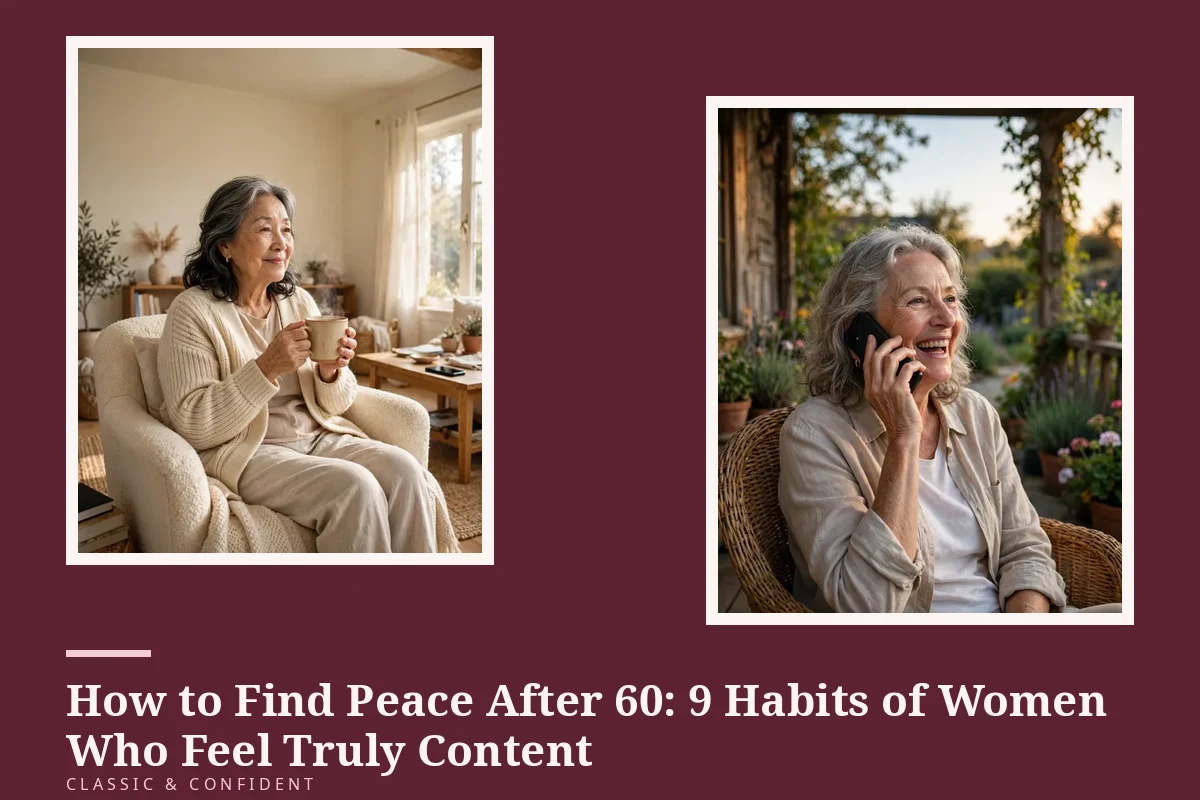
Here is the quiet confession nobody warns you about: contentment does not arrive automatically when the house goes quiet and the calendar clears. Many women reach 60 expecting a wave of calm — and then wonder why the stillness feels more like an echo than a reward. Finding peace after 60 is not a prize for getting here; it is a set of small, deliberate habits, repeated on ordinary days.
This guide gives you 9 habits, grouped around the occasions of an ordinary day — slow mornings, restless afternoons, quiet evenings — the ones women who describe themselves as genuinely content keep coming back to. Each takes minutes, costs almost nothing, and starts this week. One of them will fit your life right away.
If you only read five
- The quietest morning upgrade → Start the day without the news scroll (#1)
- The fastest mood lift → Walk for 20 minutes after lunch (#4)
- The simplest evening ritual → Write three lines before bed (#8)
- The habit that guards your friendships → One good phone call a week (#9)
- The one that makes your effort visible → Keep a “done” list (#6)
Contents
All 9 habits at a glance
Every habit below on one screen — scan for the one with the least friction and start there. Most take under 20 minutes and cost nothing.
| Habit | Time it takes | Cost | Best moment of day |
|---|---|---|---|
| 1. Start the day without the news scroll | First 30–60 minutes | Nothing | Waking up |
| 2. Ten minutes of morning light | 10 minutes daily | Nothing | With your morning tea or coffee |
| 3. Sit down for a real breakfast | 15–20 minutes | Nothing | Breakfast |
| 4. Walk for 20 minutes after lunch | 20 minutes, 5 days a week | Nothing | Right after lunch |
| 5. Learn one small new thing each month | 15 minutes a day | Nothing — library and free apps | Whenever your mind is freshest |
| 6. Keep a “done” list | 2 minutes at night | Nothing | Before bed |
| 7. The 10-minute evening reset | 10 minutes daily | Nothing | After dinner |
| 8. Write three lines before bed | 5 minutes | The price of a notebook | In bed, lights low |
| 9. One good phone call a week | 20–30 minutes weekly | Nothing | Pick a fixed slot |
How to choose your first habit
Start where it hurts: don’t pick the habit that sounds noblest — pick the one your week is actually missing. If your mornings vanish into the phone, start with #1; if the afternoons sag, start with #4. The right first habit is the one that fixes your worst hour.
One at a time beats all at once: give a single habit three full weeks before you add another. Routines survive on repetition, not enthusiasm. A useful filter while you choose: ask what will still matter to you at 70 and let the rest go gently — our guide to things that stop mattering after 70 walks through that filter in full.
Guard the quiet: peace often begins where the apologising ends — for resting when you’re tired, for saying no to a draining invitation, for wanting your evenings to yourself. Our piece on things to stop apologizing for after 60 says the rest, and it pairs naturally with habit #9.
If the quiet feels lonely, not peaceful: that is a different problem from a missing habit, and it deserves its own attention — start with our guide to life after 60 for women alongside these habits, and give the phone call (#9) priority over everything else.
For your slow mornings: protect the first hour
Mornings decide the day before anyone else is awake. Three small habits that keep the first hour yours — and out of the phone’s hands.
1. Start the day without the news scroll

Reaching for the phone before your feet touch the floor dumps a full day of decisions, disasters and other people’s opinions into your system before your brain is awake enough to process them. Cortisol is already at its natural peak in the first 30 minutes after waking — bad news stacked on top of it turns a normal morning into a low-grade emergency. The fix is almost embarrassingly simple: delay the scroll by 30 to 60 minutes and the whole day lands softer.
You don’t need willpower for this one; you need distance. Charge the phone in the kitchen tonight and it stops being the first thing you touch tomorrow. Seven mornings is enough to feel the difference — most women report the quiet itself starts to feel like a gift by day four.
- Time: the first 30–60 minutes of the day
- Cost: nothing
- Who it suits: anyone who checks the phone before saying good morning to the day
Try this: Tonight, charge the phone in the kitchen — and make your tea before you touch it tomorrow morning.
How to do it:
- Plug the phone in somewhere you can’t reach from bed — the kitchen or hallway. This one move does 80% of the work.
- Give the first minutes a fixed shape: kettle on, curtains open, tea made. Three small moves leave no gap for the old reflex to creep through.
- Put something better where the phone used to sit — a book, a magazine, the crossword. The hand wants something; give it a kinder option.
Skip it if the phone is genuinely your only alarm clock — buy a simple travel alarm for a few pounds and try the habit for one week before deciding.
Best for: doom-scrolling mornings that set the wrong tone before 8 a.m.
2. Ten minutes of morning light

Daylight is the strongest time-signal your brain has. Ten minutes of outdoor light within an hour of waking tells your body clock that the day has started — which in turn tells it when the day should end, so evening sleepiness arrives on schedule. Women who get morning light consistently report falling asleep faster and waking less in the night, without changing anything else. The effect is measurable even on cloudy days, when the sky still delivers far more light than any indoor lamp.
You don’t need a sunrise walk or special equipment. Sit by the window with your tea, step onto the doorstep, hang the washing out — it all counts. On the darkest winter weeks, a 10,000-lux light box used for 20 to 30 minutes is the clinical substitute, but for most of the year the sky is free and sufficient.
- Time: 10 minutes, within the first hour after waking
- Cost: nothing (a light box is £25–£40 if you want one)
- Who it suits: light sleepers and anyone who fades at 3 p.m.
Try this: Tomorrow, drink your first cup by the window — or on the doorstep — instead of under the lamp.
How to do it:
- Within an hour of waking, get your face into daylight for 10 minutes — no sunglasses, no special pose. Glasses and contact lenses are fine.
- Attach it to something you already do: tea by the window, the school-run walk, pegging out the washing.
- On dark winter weeks, use a light box at the breakfast table for 20 to 30 minutes instead.
Skip it if you work nights and sleep through the mornings — get your 10 minutes at your own “morning,” whenever the day starts for you.
Best for: groggy afternoons and 3 a.m. wake-ups.
3. Sit down for a real breakfast

Standing at the counter with toast in one hand doesn’t register with your brain as a meal — so an hour later it’s asking for another one. Sitting down, undistracted, lets the fullness signals do their job: it takes around 20 minutes for them to reach the brain, and a proper seated breakfast is the only kind that lasts that long. The mechanism is simple — the meal your mind notices is the meal your body counts.
This isn’t about cooking something elaborate. Porridge, toast, yoghurt — whatever you already eat, eaten at the table, at a normal pace, with the phone still in the kitchen. Set the table the night before and the whole ritual costs you two minutes of setup.
- Time: 15–20 minutes
- Cost: nothing — you already own the food and the chair
- Who it suits: anyone raiding the biscuit tin at 11 a.m.
Try this: Set the table tonight — bowl, spoon, place mat — so breakfast is a two-minute setup tomorrow.
How to do it:
- Eat at the table, seated, without a screen. Twenty minutes, a normal pace — that is the entire technique.
- Put the kettle on first and eat while the day starts around you. The unhurried part is the point, not the menu.
Skip it if you genuinely aren’t hungry until 11 — then make your first meal the seated one, whatever time it happens.
Best for: the 11 a.m. grazing that follows a standing breakfast.
For restless afternoons: move, learn, notice
The afternoon is where contentment either holds or slips — the lunch dishes are done, the day’s main business is over, and the hours until dinner can either nourish you or nag you. Three habits that fill them on purpose.
4. Walk for 20 minutes after lunch

This is the single highest-return habit on this list. A 20-minute walk after lunch does two things at once: it lowers the post-meal blood sugar spike that causes the 2 p.m. flatness, and the steady left-right rhythm of walking breaks the rumination loop — the circling worries that feel bigger when you’re sitting still. Twenty minutes is the threshold where the mood lift reliably shows up; at a pace where you can still hold a conversation, five days a week is enough.
The trigger matters more than the route. “Right after I clear the lunch plates” beats “sometime this afternoon” every time, because habits with a fixed anchor survive and floating intentions don’t. Keep a pair of walking shoes by the door so the decision takes ten seconds.
- Time: 20 minutes, 5 days a week
- Cost: nothing
- Who it suits: restless afternoons and anyone whose thoughts run in circles
Try this: Tomorrow, walk to the end of the street and back the moment you clear the lunch plates.
How to do it:
- Park walking shoes by the door tonight — the whole habit should take ten seconds to start.
- Fix the trigger: the walk begins the moment the lunch plates are cleared, not “later.”
- Pick a fixed 20-minute loop — the end of the street and back, round the park once. Same route, no decisions.
- Twice a week, leave the headphones at home. The settling of your thoughts is the exercise on those days.
Skip it if your joints protest at 20 minutes — two 10-minute walks give you the same mood benefit with half the load.
Best for: the 2 p.m. flatness and the afternoons that feel endless.
5. Learn one small new thing each month

Novelty is the brain’s plasticity trigger. Fifteen minutes a day spent on something you haven’t mastered — a few chords, a language app, sourdough, watercolour skies — keeps the mind flexible in a way that an hour of something you already know simply can’t. It’s not about becoming good at it; the growth is the point. Women who keep one small learning project on the go describe feeling mentally younger, and the reason is chemical: new learning keeps the brain’s connections being rewired instead of rusting.
Keep it small and monthly. One topic per month, fifteen minutes a day, and a visible finish line — a loaf, a song, ten Spanish phrases. The library and free apps cover almost everything, so this habit costs nothing but attention.
- Time: 15 minutes a day, one topic per month
- Cost: nothing — library books and free apps
- Who it suits: anyone who has started saying “my brain isn’t what it was”
Try this: Pick one thing for this month — chords, Spanish verbs, sourdough — and give it 15 minutes a day.
How to do it:
- Choose one topic with a visible finish line: ten phrases, one song, one loaf. “Learn Spanish” is a wish; “ten Spanish phrases” is a project.
- Anchor it to an existing habit — 15 minutes with the afternoon tea, right after the walk.
- At month’s end, show someone. Teaching the thing you learned locks it in and gives you the pleasure of it twice.
Skip it if your calendar is genuinely full — do the five-minute version instead: one Spanish word, one chord. Small beats skipped.
Best for: the quiet fear that your best thinking years are behind you.
Good to know
Stack, don’t schedule: the habits that survive are the ones tied to a fixed anchor — the walk starts when the lunch plates are cleared, the light comes with the morning tea, the three lines come after the lamp goes off. A habit with a trigger needs no willpower; a habit floating free in “sometime today” quietly dies. Pin this page now — the evening half of these habits builds on this idea.
6. Keep a “done” list

A to-do list only ever shows you what’s missing — no wonder the days can feel unproductive even when they weren’t. The brain counts what it sees, so give it something better to count: three things you actually did today, written down at night. Watered the roses counts. Rang your mother counts. Finally phoned the dentist counts. Visible progress steadies the mood because it replaces the vague feeling of “I did nothing” with evidence.
Two minutes, before bed, three items. Don’t overthink what qualifies — if you did it and it took effort or care, it goes on the list. On the hard days, when three feels impossible, allow yourself the smallest possible entries: “got up,” “made the bed,” “ate lunch.” The list is a kindness, not an audit.
- Time: 2 minutes at night
- Cost: nothing — a scrap of paper works
- Who it suits: anyone whose days feel full but strangely empty
Try this: Tonight, write down three things you did today — even small ones. “Watered the roses” absolutely counts.
How to do it:
- Keep the paper where you’ll see it at night — the bedside table, the kitchen counter.
- Write three things you did today. Done is done; no qualifying exam.
- On hard days, lower the bar to the floor: “got up,” “made the bed.” Small entries still count.
Skip it if you already keep a journal — just add a one-line “done” entry at the end of it.
Best for: days that feel unproductive despite being full.
For your quiet evenings: close the day well
Evenings are when the day’s loose ends gather — the unsent text, the unwashed mug, the thought you can’t quite place. Three habits that close the day on purpose, so the night feels chosen rather than leftover.
7. The 10-minute evening reset

Visual clutter raises low-level stress — a room full of half-finished tasks keeps telling your nervous system that the day isn’t over. A ten-minute reset with a timer on closes those open loops: cushions plumped, mugs in the dishwasher, the day’s post sorted into its place. It isn’t deep cleaning; it’s telling the evening, physically, that the work part is finished and the rest part has begun.
The timer is the whole trick. Ten minutes with an end in sight feels easy; “tidy up” with no end feels like a chore. Work three zones — living room, kitchen, hallway — and stop when the timer stops, even if it’s imperfect. You’ll wake to a calm house, which is tomorrow’s first gift to yourself.
- Time: 10 minutes, every evening
- Cost: nothing
- Who it suits: anyone who wakes up to yesterday’s mess
Try this: After dinner tonight, set a 10-minute timer and put the living room back to calm.
How to do it:
- Set a timer for 10 minutes — out loud, on the phone or the kitchen timer.
- Work three zones only: living room, kitchen, hallway. Cushions, mugs, post, throws — surface order, not deep cleaning.
- Stop when the timer stops, even mid-mess. The boundary is the habit; perfection would kill it.
Skip it if your evenings are genuinely your social time — run the same ten minutes in the morning instead; the payoff is identical.
Best for: waking up to a house that already feels kind.
8. Write three lines before bed

The worry loop needs an exit, and a page gives it one. Writing down what went well, what was hard, and one line of gratitude moves the day’s noise out of your head and onto paper — externalised, it shrinks; internalised, it circles all night. The gratitude line does the quieter work: attention retrains itself toward what’s working, and over weeks that shift changes how the whole day feels. Three lines, five minutes, no literary merit required.
Keep a notebook by the bed and keep the bar low. “What went well: the roses opened. What was hard: the phone bill. Grateful for: the rain stopping.” That is a perfect entry. The habit works because it’s small enough to survive the tiredest evening — which is exactly when you need it most.
- Time: 5 minutes
- Cost: the price of a notebook
- Who it suits: busy brains at midnight
Try this: Tonight, write what went well, what was hard — and one line you’re grateful for.
How to do it:
- Line one: what went well today — one thing, however small.
- Line two: what was hard — name it plainly, then close the notebook on it.
Skip it if writing feels like homework — say the three lines out loud to yourself instead; the naming is what matters, not the ink.
Best for: the thoughts that wait until the lights go out.
9. One good phone call a week

Here is what the research on wellbeing keeps finding, stated plainly: one real conversation a week predicts contentment in your 60s better than daily small talk ever does. Friendships don’t die from distance — they die from drift, from “we must catch up” never becoming a date. A scheduled call fixes that: 20 to 30 minutes, the same slot every week, with someone whose voice actually lifts you.
Make it a standing plan, not a when-I-think-of-it plan. Text them tonight, fix the slot, and keep a running note on your phone of small things to tell them — the funny thing the neighbour said, the film you watched. The call then feeds itself, week after week.
- Time: 20–30 minutes, once a week
- Cost: nothing
- Who it suits: friendships currently living in text messages
Try this: Text one person tonight and fix a weekly call — Thursday at 4, say. It’s in the calendar now.
How to do it:
- Pick one person — the one whose voice you miss. Not three people; one.
- Fix a weekly slot together, like any other appointment. Standing beats spontaneous.
- Keep a running note of small things to tell them between calls — the call then never runs dry.
Skip it if phone calls genuinely drain you — a standing monthly lunch does the same work for the friendship.
Best for: the quiet ache of friendships fading into “we must catch up.”
Practical tips for finding peace after 60
The habits above are the what — here is the how of making them stick past the first enthusiastic week.
- Attach new habits to old ones. The walk starts when the lunch plates are cleared; the three lines come after the lamp goes off. Anchored habits survive; floating ones don’t.
- Shrink the habit before you skip it. A five-minute walk beats a skipped twenty-minute one. On the worst days, do the smallest possible version and count it fully.
- Change the environment, not yourself. Shoes by the door, phone in the kitchen, notebook on the pillow — design the easy choice instead of relying on discipline.
- Track the streak lightly. A tick on the calendar for each day you walked is motivation you can see. If the streak breaks, the only rule is: never miss twice.
- Tell one person. Saying “I’m walking after lunch now” to a friend or your daughter makes the habit real — and gives you someone to be gently accountable to.
- Expect the wobble at week two. Enthusiasm fades around day ten to fourteen; that is the habit forming, not failing. Lower the bar that week and keep going.
A calm-day routine:
- Phone stays in the kitchen; tea and ten minutes of daylight come first.
- Breakfast at the table, seated — the day’s first deliberate act.
- Twenty-minute walk the moment the lunch plates are cleared.
- Ten-minute reset after dinner; the house closes with you.
- Three lines and the done list in bed — the day, accounted for and released.
The bottom line
If I had to pick one habit, it would be #4 — the 20-minute walk after lunch. It is the only habit here that moves your body, steadies your blood sugar and untangles your thoughts at the same time, and it costs nothing but twenty minutes you already have. Start there, and give it the full three weeks.
The runner-up is #8 — the three lines before bed. It’s the smallest habit on the list and the one that changes the nights fastest; a busy brain with an exit writes a calmer day tomorrow. Pin this guide to your “Life After 60” board so the quiet reminders are waiting whenever the week gets loud.
Frequently asked questions
Is finding peace after 60 really about habits, or does it depend on your circumstances?
Both are true — circumstances set the weather, but habits are the roof. You can’t habit your way out of grief or a health crisis, and no one should try. What habits do is shrink the ordinary, daily friction — the restless afternoons, the busy brain at midnight — which frees up your energy for the things that actually need it.
How long does it take for a new habit to feel natural?
Expect three to four weeks of conscious effort, with a wobble around day ten to fourteen when the novelty wears off. That wobble is the habit forming, not failing — lower the bar that week (a five-minute walk instead of twenty) rather than quitting. Small, anchored habits beat ambitious ones every time.
What if I live alone and the quiet feels lonely rather than peaceful?
Then loneliness is the problem to solve first, and the habits are the scaffolding around it. Prioritise habit #9 — the weekly phone call — over everything else, and read our guide to life after 60 for women alongside this one. If the loneliness is heavy or constant, talking to your GP is a strong, sensible move — peace and support are not opposites.
I’m in my late 60s — is it too late to change how I feel day to day?
No — and the habits here are deliberately chosen to work at any age. The walk, the light, the three lines: none of them depends on being 60 rather than 69. What matters is the repetition, not the starting date. Many women find the late 60s are actually easier, because the busiest obligations have loosened and the hours are genuinely yours.
Which single habit should I start with?
Start with #4, the 20-minute walk after lunch — it’s the highest-return habit on the list and the easiest to anchor to an existing routine. If walking is genuinely difficult, start with #8, the three lines before bed: it’s the smallest habit here and the one that changes the nights fastest.