10 Things That Stop Mattering After 70 (And 5 That Matter More Than Ever)
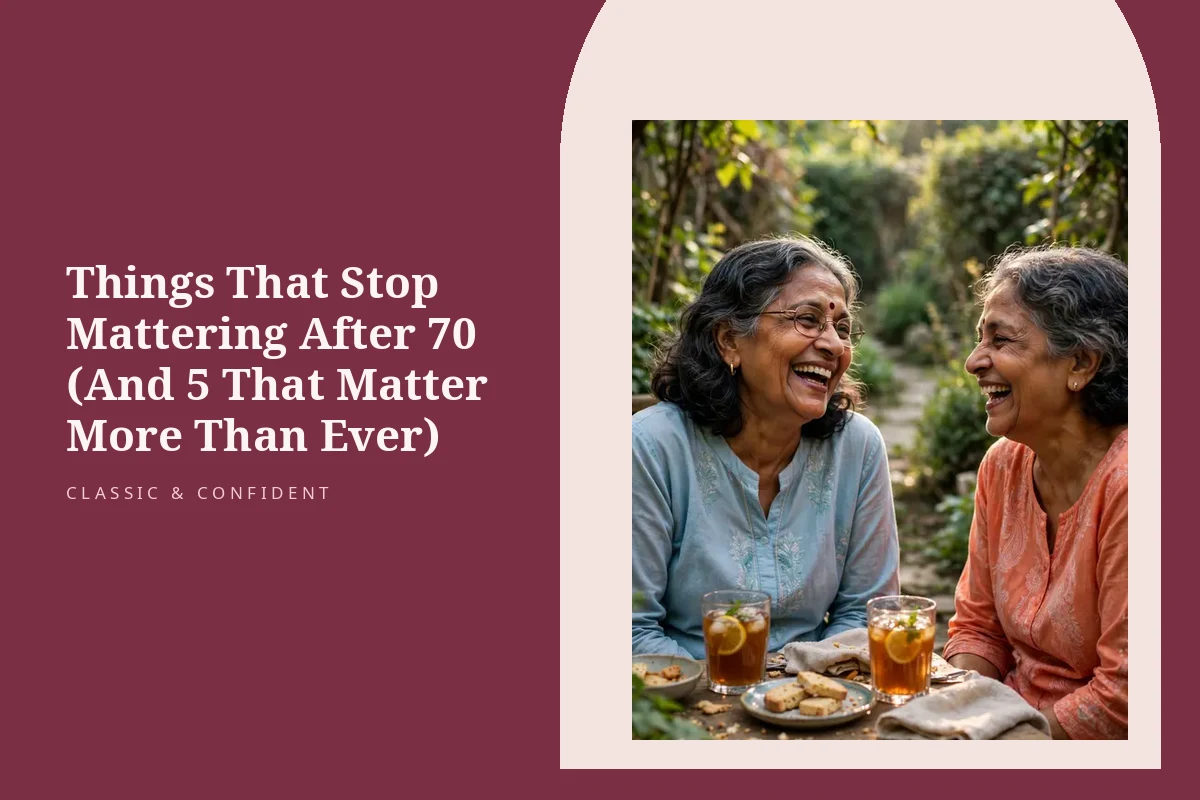
Have you ever caught yourself standing in a spotless kitchen, tired from polishing it, and wondered who exactly you were keeping it perfect for? Or rehearsed a clever comeback to win an argument no one will remember next week? That quiet question — why did this ever matter so much? — is behind one of the most-searched phrases among women our age: the things that stop mattering after 70.
This is not a list of what to give up. It is a list of what to put down: ten pressures that quietly lose their power with age. And for every two you set down, I will show you one of the five things that matter more than ever once you do. Think of it as a trade — each pressure leaves, and something kinder takes its place.
Quick picks
- Start here: Put down the scorecard with old friends (#6)
- Start here: Reclaim your calendar — stop saying yes to everything (#4)
- Start here: Dress for your own eye, not the trend cycle (#3)
- Start here: Let the house be lived in, not displayed (#2)
- Start here: Trade the scale for a body that serves you (#5)
Contents
How to spot the things that stop mattering after 70
Start with what costs you sleep. If a habit or worry keeps you rehearsing conversations at 2 a.m., it has taken up residence in your head without paying rent. Those are the pressures to trade first — they cost the most and return the least.
Check whose voice is talking. Many women find the pressure for a perfect house, a perfect figure or a spotless reputation comes from rules they learned decades ago — a mother’s standards, a magazine’s, a neighbour’s. Naming the source takes away half its power. For a full reset on the rules of this stage of life, read our fresh-start guide to life after 60 for women.
Ask what you would do with the freed-up hours. Every “stop mattering” below comes with a “matters more instead.” If the replacement is something you would genuinely love — an afternoon with a friend, a garden you actually enjoy — then the trade is worth making. That is the same logic behind finding real peace after 60: fewer obligations you dread, more time you choose.
Separate the habit from your identity. You are not “the woman who keeps a perfect house” — you are a woman who once chose to keep one, and can choose differently now. Habits are not personality traits, even ones you have carried for forty years.
Release one, not all. Do not overhaul your life in a week; that is the perfectionism wearing a new disguise. Pick the single pressure that feels heaviest right now and start there. And if the quiet ache underneath is that you feel overlooked or unseen, that is a different problem with its own answer — start with why so many women feel invisible after 60.
At a glance: the ten trades
| # | Stops mattering | Matters more instead |
|---|---|---|
| 1 | Being right in every argument | The relationships worth keeping |
| 2 | A spotless, show-home house | A home that feels good to live in |
| 3 | Chasing every fashion trend | Trusting your own eye |
| 4 | Saying yes to every invitation | Your time and energy |
| 5 | Hitting a “perfect” weight | A body that works for you |
| 6 | Keeping score with old friends | The friends who show up now |
| 7 | Looking busy and important | Actually enjoying your days |
| 8 | Owning the newest everything | Things that already serve you |
| 9 | Fussing over every small flaw | Ease with how you look |
| 10 | Comparing yourself to younger women | Your own accumulated life |
The pressure to prove yourself
Proving yourself is exhausting work — and after 70, it pays almost nothing. The five fixes below all trade a performance for something real: a relationship kept, an afternoon reclaimed, your own steady company.
1. Being Right in Every Argument

Here is the mechanism: every disagreement your brain replays has a real cost — studies on rumination show that replaying conflict keeps your stress hormones raised for hours after the conversation ends. At 70, that is hours of your actual life spent winning a debate in an empty kitchen. The payoff for being right has also shrunk: few arguments at this stage change anyone’s mind, and the prize for victory is usually a bruised relationship and a sore evening.
What matters more instead is the relationship itself. Most women find that the friendships and family ties that survived to this age are too few and too valuable to spend on proving points. Letting someone else have the last word is not weakness — it is a decision about where your energy belongs.
- Time: 30 seconds per disagreement — one pause before you reply
- Cost: Free
- Suits: Anyone who lies awake replaying what they “should have said”
Try this: Before your next disagreement, say silently: “Do I want to be right, or do I want to enjoy lunch?” Then act on the answer.
How to do it:
- Feel the surge to correct, argue or prove — and pause for one full breath instead of speaking.
- Ask yourself the lunch question above, honestly.
- Say the graceful exit line: “You might be right about that” or “Let’s not spend our afternoon on this.” Then change the subject kindly.
Skip it if the disagreement is about something that truly endangers you or someone you love — being right matters there.
Best for: family debates, neighbour disputes and any argument you would not remember in a month anyway.
4. Saying Yes to Every Invitation

The mechanism is simple arithmetic: at 70, your energy is a fixed daily budget, and every automatic “yes” spends it before the things you actually want. Many women say yes from habit — decades of being the reliable one who never turns anything down — and then resent the event they never wanted to attend. The invitation is not the obligation; the reflex is.
What matters more instead is your time and energy, spent on purpose. A calendar with white space is not laziness — it is the difference between dragging yourself to a fourth lukewarm committee lunch and having the energy for the grandchild, the garden or the nap you actually want. Protecting your time is how you protect your health.
- Time: 2 minutes per invitation — a pause before answering
- Cost: Free
- Suits: Anyone whose calendar is full of things they dread
Try this: For the next two weeks, answer every invitation with “Let me check and get back to you” — no instant yeses.
How to do it:
- When invited, give yourself a 24-hour decision window — “I’d love to think about it; can I let you know tomorrow?”
- Ask: would I choose this over a free afternoon? If not, decline warmly and briefly: “I can’t this time — hope it’s lovely.”
- No explanation beyond that one line. Long excuses invite negotiation.
- Block the freed afternoon for something you actually want, before it fills itself.
Skip it if the invitation comes from someone who genuinely needs you — a friend in crisis, family who depend on you.
Best for: committee lunches, obligation parties and any event you attend out of guilt rather than pleasure.
6. Keeping Score With Old Friends

The mechanism here is a mental ledger: who called last, who forgot the birthday, who owes whom a dinner. Keeping that ledger running in your head burns attention and quietly poisons the friendship it is supposed to protect — every warm moment gets weighed against an old debt. After 70, the friends you still have are the ones who survived decades of imperfection; auditing them now is an excellent way to shrink an already precious circle.
What matters more instead is the friend who shows up now — not perfectly, not every time, but enough. Many women find that friendships get better, not worse, when the accounting stops: calls become fun again instead of obligations, and small kindnesses stop arriving with invoices attached.
- Time: One honest evening of reflection, then done
- Cost: Free
- Suits: Anyone nursing a grudge older than five years
Try this: Pick the one old grievance you replay most, and say out loud: “The ledger is closed.” Then call that friend about something pleasant.
How to do it:
- Write down the three scores you keep most carefully — who called last, who owes whom, the forgotten occasion.
- For each, ask: is this grievance worth losing the friendship over? Almost always, no.
- Make the next contact about something you share — a memory, a recipe, a joke — not the old debt.
Skip it if the “score” is a pattern of real disrespect or harm — letting go of grudges is not the same as tolerating bad treatment.
Best for: decades-old friendships, sibling friction and anyone you love but keep score against.
7. Looking Busy and Important

The mechanism is a leftover from working life: for forty years, being visibly busy signalled being valuable, and the habit survives long after the job ends. So the calendar stays crammed, the to-do list stays long, and exhaustion gets mistaken for purpose. But a packed schedule that nobody assigned you is just a way of being tired on purpose — and tiredness at 70 has a real cost in health and mood.
What matters more instead is actually enjoying your days. Many women discover that the unhurried afternoon — the long lunch, the slow walk, the hour with a book — gives more satisfaction than a week of impressive busyness. You do not need to look important anymore. You need to feel well.
- Time: One calendar review, 20 minutes
- Cost: Free
- Suits: Anyone who brags about being busy while feeling drained
Try this: Cancel or postpone one commitment this week purely because you would rather rest — and notice that nothing collapses.
How to do it:
- Look at next week’s calendar and mark everything you would not miss if it vanished.
- Cancel one of them, kindly and without a long excuse.
- Spend that hour doing something genuinely pleasant, and pay attention to how it feels compared with the obligation.
Skip it if your busyness is the social life that keeps you going — some women genuinely thrive on a full diary; this is about compulsive, not joyful, activity.
Best for: new retirees, habitual volunteers and anyone who answers “how are you?” with “so busy.”
10. Comparing Yourself to Younger Women

The mechanism is rigged from the start: comparing your 70-something self to a 40-year-old is comparing your behind-the-scenes to someone else’s highlight reel — and you lose every time, because you are measuring against a standard you cannot win and should not want. Psychologists call this upward comparison, and it reliably produces the same result: lower mood, no useful information. You already know you are not 40. The comparison teaches you nothing you do not know.
What matters more instead is your own accumulated life — the decades of judgment, humour and competence that no younger woman has yet. Many women find that the moment they stop auditioning against youth, they start enjoying what age actually offers: being taken seriously, knowing what works, and no longer needing anyone’s permission.
- Time: Ongoing — a habit to catch, 5 seconds at a time
- Cost: Free
- Suits: Anyone whose feed or magazines leave them feeling deflated
Try this: The next time you catch the comparison starting, finish the sentence with “…and I have forty years of knowing things she hasn’t learned yet.”
How to do it:
- Notice the comparison the moment it starts — the tightness in your chest is the signal.
- Replace it with one specific thing your years gave you: a skill, a story, a friendship older than her career.
- Reduce the inputs: mute or unfollow the accounts that reliably trigger the spiral.
- Compliment a younger woman genuinely when you feel it — admiration aimed outward ends the contest.
Skip it if the comparison is motivating in a healthy way — admiring a friend’s walking routine and joining her is inspiration, not envy.
Best for: social-media scrollers, reunion dreaders and anyone who has ever thought “she makes it look easy.”
Good to know
The 80-year-old test. When you are torn about whether something still deserves your worry, ask: “Will this matter when I’m 80?” If the honest answer is no, it has already stopped mattering — you are just the last to be told. Women who use this question regularly report that about half their standing worries fail it within the first week.
The pressure to get everything perfect
Perfection is a treadmill with no finish line — and it gets steeper with age, because the standards were set for a younger body, a fuller house and an endless supply of evenings. These five fixes trade the impossible standard for a home, a wardrobe and a body that are comfortable to actually live in.
2. Keeping a Spotless, Show-Home House

The mechanism is visible the moment guests leave: you spent three hours polishing for a two-hour visit, and the visit would have been exactly as warm with a little dust on the shelf. A show-home standard turns your own house into a stage you are constantly resetting — the effort is invisible when it works and conspicuous only when it fails. That is a lot of weekly hours for a payoff nobody notices.
What matters more instead is a home that feels good to live in — clean enough to be healthy, comfortable enough to relax in. Many women find that lowering the standard by about 20 percent changes nothing about how the house looks to visitors, but gives back whole evenings. Guests remember warmth, not grout lines.
- Time: Saves 3–5 hours a week once the standard drops
- Cost: Free (you may spend less on cleaning products too)
- Suits: Anyone who cleans before the cleaner comes
Try this: Before the next visit, clean only the bathroom, the kitchen surfaces and the room you’ll sit in — then stop, even if the spare room isn’t perfect.
How to do it:
- Rank your cleaning tasks by what a guest would actually notice in the first five minutes.
- Do the top three. Stop there. Leave the rest for the normal weekly round.
- When the urge to keep polishing hits, sit down with your tea in the “good enough” living room and enjoy it.
Skip it if a spotless home genuinely relaxes you and the cleaning itself is pleasant — this is about compulsion, not tidiness.
Best for: the host who apologises for “the mess” in a visibly clean house.
3. Chasing Every Fashion Trend

The mechanism is the trend cycle itself: it is engineered to make last season’s clothes feel wrong so you buy this season’s. Chasing it means your wardrobe is always slightly out of date and your wallet is always slightly lighter — and the irony is that the chase reads as trying too hard, which is the opposite of style. At 70, the fastest route to looking good is not knowing what is new; it is knowing what suits you.
What matters more instead is trusting your own eye. After decades of getting dressed, you know your colours, your best lengths and the shapes that flatter you — that knowledge is worth more than any trend forecast. Many women find their style gets better, not worse, the moment they stop checking what is “in.”
- Time: One wardrobe review, 30 minutes
- Cost: Saves money — fewer trend purchases
- Suits: Anyone with a wardrobe full of “worn once” mistakes
Try this: Pull out the five outfits you reach for most and ask what they have in common — that’s your real style, and it’s better than any trend list.
How to do it:
- Identify your five most-worn outfits and note the pattern: the colours, the lengths, the necklines.
- Before any future purchase, ask: “Does this match my pattern?” If not, it needs to be extraordinary to earn its place.
- Donate or pass on the trend pieces you bought but never loved — someone else will wear them happily.
Skip it if playing with trends is genuinely fun for you — some women love fashion as a hobby, and joy is always a good enough reason.
Best for: anyone whose wardrobe is full but who still feels they have “nothing to wear.”
5. Hitting a “Perfect” Weight

The mechanism is a number that stopped being useful: after 70, the weight that supposedly defined “healthy” decades ago correlates far less with actual health than strength, balance and mobility do. Chasing a scale number often means restrictive eating that costs you muscle — and muscle is exactly what keeps you upright, independent and out of hospital. The number goes down; the risk goes up.
What matters more instead is a body that works for you — one that climbs stairs, carries groceries and gets up off the floor without a plan. Many women find that shifting the goal from “lighter” to “stronger” changes everything: food becomes fuel instead of the enemy, and the mirror stops being a courtroom.
- Time: 20–30 minutes of strength or balance work, 3 times a week
- Cost: Free (bodyweight exercises; a set of light dumbbells helps)
- Suits: Anyone whose self-worth still lives on the bathroom scale
Try this: Put the scale in a cupboard for a month. Judge your body by what it does — the walk you finished, the bag you carried — not by a number.
How to do it:
- Hide the scale for 30 days — out of sight genuinely reduces the urge to check.
- Add two or three strength sessions a week: chair squats, wall push-ups, light weights — 20 minutes is plenty.
- Pick one functional goal: carrying the shopping in one trip, or getting up from the floor without using furniture.
- Notice how your energy and steadiness change — that is the number that counts now.
Skip it if your doctor has set a weight target for a specific medical reason — then the number has a job to do, and this does not apply.
Best for: lifelong dieters and anyone who has ever cancelled plans because of how they felt they looked.
8. Owning the Newest Everything

The mechanism is upgrade culture: phones, appliances and gadgets are designed to feel obsolete about eighteen months after you buy them, and the itch to replace them is manufactured as carefully as the products. Giving in means a constant, low-level spend — and a house slowly filling with the barely-used predecessors. The newest model rarely changes your day; it mostly changes your receipt pile.
What matters more instead is things that already serve you well. A ten-year-old kettle that boils water is doing its job; the money you did not spend on its replacement is yours to enjoy on something you will actually notice. Many women find real satisfaction in the opposite of upgrading — maintaining, repairing and getting the full life out of what they own.
- Time: One afternoon auditing what you own
- Cost: Saves money — the whole point
- Suits: Anyone tempted by adverts for things that already work fine
Try this: The next time you want the new version of something, wait 30 days — if you still want it then, it might be worth it.
How to do it:
- Write the coveted item on a list with today’s date. Do not buy it yet.
- Revisit the list after 30 days. Most entries will look faintly absurd — cross them off.
- For anything still on the list, repair or replace only what is genuinely broken first.
Skip it if the old thing is unsafe or costs you real independence — a failing phone you rely on for emergencies is not a luxury, it is a tool.
Best for: gadget-tempted shoppers and anyone whose drawers hold three versions of the same device.
9. Fussing Over Every Small Flaw

The mechanism is the magnifying mirror: examined at ten centimetres, every face over 70 has “flaws” — and ten centimetres is not a distance anyone else ever sees you from. Fussing over pores, stray hairs and lines nobody notices costs real minutes every morning and trains your eye to scan for defects instead of seeing a person. The flaw gets your attention; the face gets lost.
What matters more instead is ease with how you look — the relaxed, un-fussed face that other people actually find attractive. Many women find that doing a little less in the mirror reads as confidence, not neglect: a simple routine, worn lightly, beats an hour of anxious correction every time.
- Time: Saves 15–30 minutes every morning
- Cost: Free — possibly fewer products bought
- Suits: Anyone who owns a magnifying mirror and regrets it
Try this: Do your usual routine, then step back two metres from the mirror — that’s what the world sees, and it looks just fine.
How to do it:
- Retire the magnifying mirror to a drawer — keep it only for plucking, if you must.
- Set a 15-minute morning routine: cleanse, moisturise, the few touches you love, done.
- When the urge to keep fixing hits, walk away from the mirror and start your day.
Skip it if you genuinely love an elaborate beauty routine — ritual you enjoy is not fussing, it is pleasure.
Best for: mirror-checkers, product over-buyers and anyone who has ever been late because of their eyebrows.
Small, everyday ways to practice letting go after 70
Letting go is a skill, not a single decision — and like any skill, it gets easier with small repetitions. These are the ones that work.
- Run the 80-year-old test on every worry that loops in your head: will this matter at 80? About half of them fail it.
- Schedule one unplanned afternoon a week — no errands, no obligations — and defend it like a doctor’s appointment.
- Compliment instead of compare. When the comparison spiral starts, say the kind thing out loud and watch the contest dissolve.
- Keep a “done letting go” list on the fridge: each pressure you release gets written down, so you can see the progress.
- Ask for help before you need it badly. Accepting help early — a lift, a jar opened — keeps you independent longer than refusing it does.
- Tell one friend what you’re doing. Saying “I’m working on caring less about keeping a perfect house” makes it real — and she will probably join you.
A gentle four-week letting-go routine:
- Week 1: Pick your heaviest pressure from this list and name it out loud. Awareness is the whole task this week.
- Week 2: Try the “Try this” step for that point, once. Notice what changes — and what doesn’t.
- Week 3: Pick a second pressure and repeat. Two released is a real, felt difference.
- Week 4: Look at what you gained — the hours, the calm, the friendships — and decide which pressure goes next.
The bottom line
If I had to pick one, make it #4: stop saying yes to every invitation. It is the fastest trade on this list — one honest sentence buys back whole afternoons, and afternoons are the currency of the good years. Everything else on this list gets easier once your calendar has breathing room.
Pin this list to your “Life After 60” board — future you will thank present you every time a low-priority “yes” tries to sneak past.
Frequently asked questions
What are the things that stop mattering after 70?
The most common ones women name are: winning every argument, keeping a show-home house, chasing fashion trends, saying yes to everything, hitting a “perfect” weight, keeping score with old friends, looking busy and important, owning the newest everything, fussing over small flaws and comparing themselves to younger women. What replaces them — the five things that matter more than ever — are your real relationships, a comfortable home, trusting your own eye, your time and energy, and a body that works for you.
Is it normal to feel guilty about caring less?
Completely normal — and temporary. The guilt is the old rulebook protesting, not your conscience speaking. Most women find it fades within a few weeks of the new habit, especially once they feel the relief that replaces it. If the guilt persists beyond a month or starts to feel like sadness, that is worth talking about with a friend or a counsellor — it may be grief for an old identity rather than guilt about a habit.
How do I stop saying yes to things I don’t want to do?
Never answer on the spot — “Let me check and get back to you” is your new default. Then decline the ones you would not choose over a free afternoon, warmly and in one line: “I can’t this time — hope it’s lovely.” No long explanation, because long excuses invite negotiation. The first two declines feel awful; by the fifth, you will wonder why you ever said yes.
What if my friends and family don’t understand that I’m changing?
Some won’t, at first — especially if they benefited from your old habits, like always hosting or always saying yes. You do not need their permission, only their gradual adjustment. Change one thing at a time rather than announcing a whole new philosophy, and most people adapt within a few weeks. The ones who genuinely love you will adjust; the ones who only loved your usefulness were never the audience for this list anyway.
Does letting go mean giving up on how I look?
Not at all — it means giving up on how you worry about how you look. The women who look best at 70 are usually the relaxed ones: a simple routine, clothes they love, and no anxious fussing. Letting go of trends and flaw-fixing is not the same as letting yourself go; it is the difference between style you enjoy and style you perform. If you love your beauty routine, keep it — pleasure was never the problem.
I’m 65, not 70 — does this apply to me yet?
Yes, with one caveat: at 65 some of these are still in transition. The pressures around busyness and saying yes often peak in the first years of retirement and then fade naturally — you can simply speed the process along. The physical ones, like the “perfect” weight, apply at any age past 60. Take what resonates now and bookmark the rest; the list will still be here when you need it.
What’s the first step I can take this week?
Pick the single pressure that feels heaviest and do its “Try this” step from the list above — most take under two minutes. Do not try to release all ten at once; that is the old perfectionism wearing a new disguise. One pressure, one small step, one week. Then notice what you gained and choose the next one.