15 Petite Outfits for Women Over 50
Every petite woman over 50 dresses for the same five occasions, over and over: the working day, the long lunch, the airport run, the evening invitation, the Sunday errand sprint. And every one of those occasions punishes the same two mistakes — fabric that swallows your frame, and proportions drawn for someone five inches taller.
Petite fashion over 50 is not a size story. It is a proportion story, and once you see the three lines that matter — the waist line, the hem line and the shoe line — you stop buying clothes that work against you and start collecting the fifteen outfits below.
The physics is simple and it works in your favour. Below 5’4″, the eye measures you in segments: shoulder to waist, waist to hem, hem to shoe. Every centimetre of uninterrupted vertical line between those markers reads as length; every horizontal break — a low-rise waistband, a calf-length hem, a contrasting shoe — reads as a full stop.
The outfits that follow are engineered around that fact. Each one buys you back 3–5 cm of perceived height through one deliberate mechanism: a raised waist, a shortened jacket, a colour column, a revealed ankle. None of them requires a heel over 5 cm, and none of them asks you to look like someone else.
This is a deep dive because the details are the whole game. Petite fit fails in the margins — 2 cm of extra jacket, a hem that sits 5 cm too low, a waistband that cuts at the hip instead of the waist — so each outfit below names the exact measurement to check in the changing room.
The fifteen are grouped by your shape (apple, pear, hourglass, straight), because a petite apple and a petite pear need opposite things from the same centimetres. Find your shape’s group, start with its first outfit, and build outward from there.
Fast answers
- The high-rise straight jean (#1) — the everyday length-giver
- The V-neck wrap dress (#2) — the occasion outfit that never misses
- The short trench + slim trouser (#5) — the travel-day uniform
- The belted midi with a slit (#8) — the evening look in one piece
- The monochrome column dress (#15) — the instant 5 cm, no heel required
- The tunic + legging, done right (#13) — the home-day comfort that still looks dressed
Contents
- How to choose petite fashion over 50 that flatters
- The 15 outfits at a glance
- If your shape is apple: keep the middle line clean
- If your shape is pear: draw the eye up, let the hem move
- If your shape is hourglass: keep the waist the headline
- If your shape is straight: build the curves you want
- Petite fit tips that never fail
- The bottom line
- Frequently asked questions
How to choose petite fashion over 50 that flatters
Know your three lines before you shop. Stand in front of a full-length mirror and mark, mentally, your natural waist (the narrowest point, usually 2–3 cm above the navel), your knee, and your ankle. Every outfit in this guide places a deliberate line at one of those three points and avoids placing one anywhere else.
A hem that lands between knee and mid-calf is the classic petite trap — it cuts the leg at its thickest-looking point and shortens it by a visible 5–8 cm.
Waist position is the lever. A waistband that sits at your true waist makes your legs start 3–4 cm higher than a hip-sitting band — on a 5’2″ frame, that is the difference between balanced and bottom-heavy. This is why high-rise trousers recur through the fifteen outfits below, and why low-rise never appears.
If you only change one thing about how you dress, make it this. The seasonal rotation in fall outfits for women over 50 shows the same waist rule applied to heavier fabrics, which is where petites usually lose the battle.
Jacket length is a hard rule, not a preference. Hip-length jackets halve the visible leg; waist-length or cropped jackets hand it back. Measure the jacket’s back length in the shop: for most women under 5’4″ it should be 50–55 cm, ending at or just below the waistband of a high-rise trouser.
Anything past 58 cm is a coat on you, whatever the label says — buy it only if it reaches the knee, where a second honest line can work.
Shoes are the last 5 cm. You do not need height to look tall; you need continuity. A shoe in the same colour family as your trousers or your skin extends the leg line to the floor instead of amputating it at the ankle.
Nude-for-you flats, navy boots with navy trousers, black pumps with black tights — the mechanism is identical each time. For evenings, the dressed-up versions are in classy outfits for women over 50, where the same continuity rule runs under every hemline.
Tailoring is not optional at this height. Budget $15–25 per alteration and plan on hemming nearly everything: standard inseams run 76–81 cm, and most petites need 66–71 cm. A $50 pair of trousers with a $20 hem out-dresses a $200 pair that pools.
The dress silhouettes worth tailoring are in dresses for women over 50 — start there if your wardrobe is dress-heavy, because a dress is one alteration instead of two.
The 15 outfits at a glance
| Outfit | The petite mechanism | The number to get right |
|---|---|---|
| 1. The High-Rise Straight Jean + Tucked Knit | Raised waist = longer leg line | Inseam 66–71 cm, no pooling |
| 2. The V-Neck Wrap Dress | Diagonal wrap + V opens the torso | V ends 10–12 cm below the collarbone |
| 3. The Empire-Waist Maxi Dress | Waist seam under the bust shortens the torso | Hem grazes the top of the foot |
| 4. The Cropped Jacket + Column Skirt | Short jacket, long skirt = full leg visible | Jacket back 50–55 cm |
| 5. The Short Trench + Slim Trouser | Trench above the knee keeps the leg open | Trench ends 8–10 cm above the knee |
| 6. The Vertical-Stripe Shirt Dress | Stripes draw one unbroken vertical | Belt at the true waist, not the hip |
| 7. The Fit-and-Flare Knee Dress | Defined waist + knee hem = longest leg segment | Hem skims the top of the kneecap |
| 8. The Belted Midi With a Slit | Slit reveals leg, breaking the midi trap | Slit rises to mid-thigh |
| 9. The V-Neck Jumpsuit | One garment, one colour, waist defined | Waist seam at your true waist |
| 10. The High-Waist Wide-Leg Trouser + Fitted Shell | Wide leg + high waist = column effect | Trouser hem covers the shoe’s top |
| 11. The Mini-Pleated Skirt + Fitted Top | Short hem shows the full leg | Hem 8–10 cm above the knee |
| 12. The Tailored Blazer With Pushed Sleeves | Structure without swamping the frame | Sleeve pushed to 5 cm below the elbow |
| 13. The Tunic + Legging, Done Right | Tunic ends mid-thigh, the safe zone | Tunic hem at mid-thigh, never below |
| 14. The Bootcut Jean + Heel | Flare over the shoe = one long line | Hem covers the heel, kisses the floor |
| 15. The Monochrome Column Dress | Single colour, zero horizontal breaks | Shoe matches the dress tone |
If your shape is apple: keep the middle line clean
An apple shape carries its weight through the middle, and at petite height the middle is a larger share of the whole — so every one of these four outfits moves the eye’s measuring point away from the waist and onto the legs. The tools are raised waistlines, open necklines and fabric that skims rather than clings.
1. The High-Rise Straight Jean + Tucked Knit
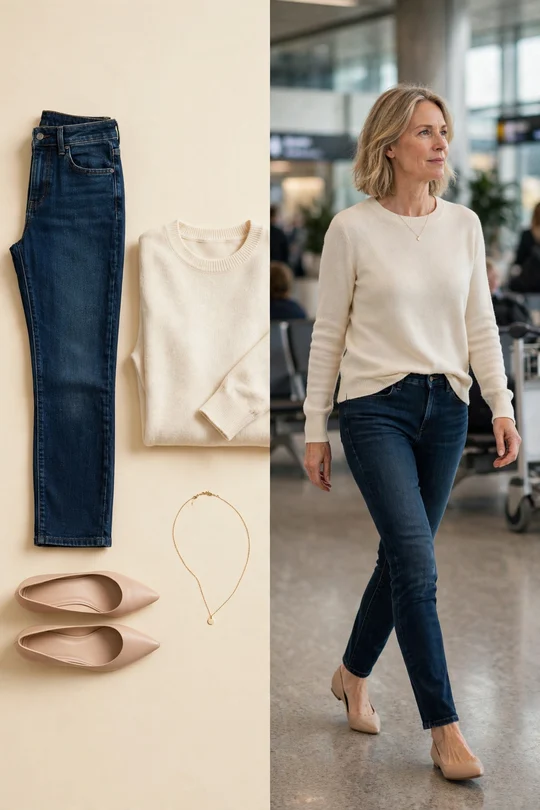
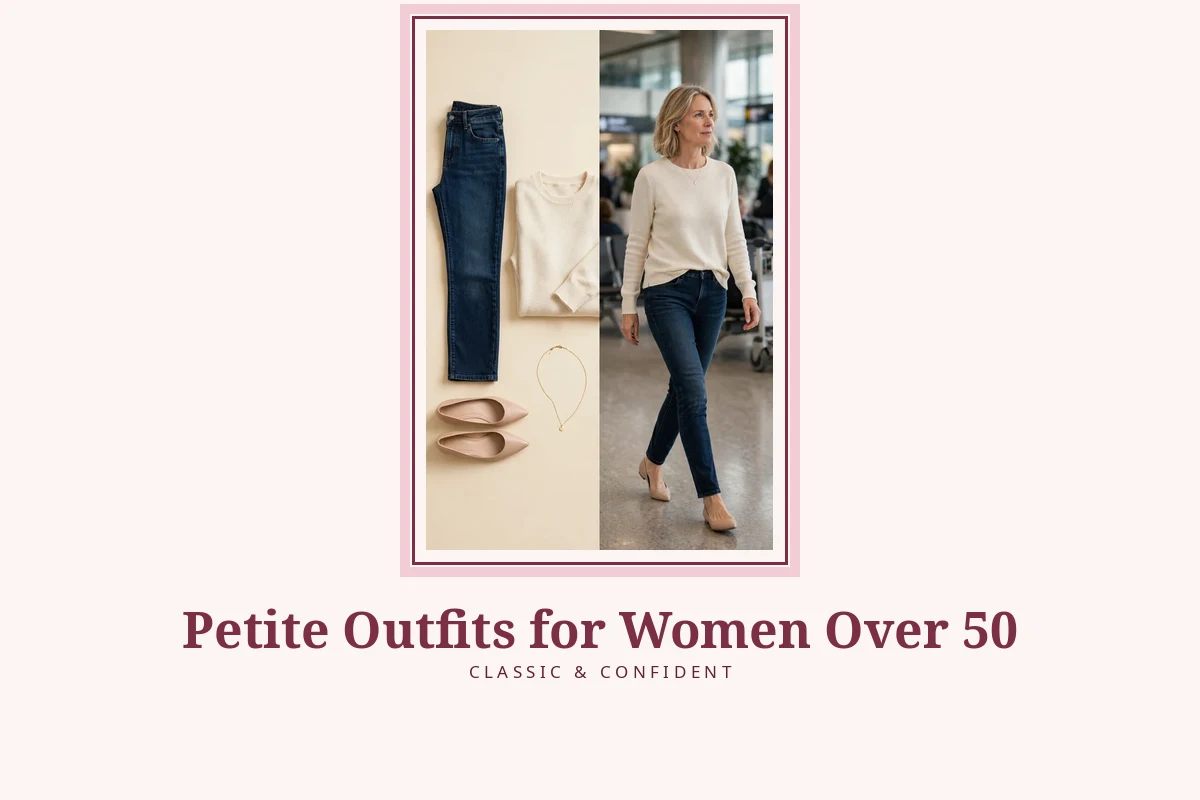
A high rise is the single highest-leverage change a petite apple can make, because it redraws where the leg begins. A waistband sitting 3–4 cm above the navel starts the leg line a full hand’s width higher than a mid-rise — on a 5’2″ frame that converts directly into 4–5 cm of perceived leg length.
The straight leg matters just as much: it falls in one clean column from hip to ankle with no taper to cut the line, and a dark rinse absorbs light instead of reflecting it, so the column reads slimmer as well as longer.
The tuck is the mechanism’s partner, not decoration. A half-tucked fine knit shows exactly where the waistband sits — which is the whole point — while the untucked back half skims over the midsection. Keep the knit fine-gauge: chunky knits add volume where an apple least wants it.
- Key pieces: high-rise straight jean in dark rinse, fine-gauge crew or V-neck knit
- Shoes: pointed flats in a dark tone, or a 3–4 cm block heel
- Occasion: everyday, weekends, casual lunches
- Budget tip: the hem is the whole outfit — budget the alteration before you buy
Shop for: a high-rise (25–28 cm front rise) straight-leg jean with 1–2% stretch, inseam 66–71 cm so it ends at the ankle bone with flats, in a dark indigo or black rinse with no whiskering at the hip.
How to wear it:
- Half-tuck the knit at the front, just left of centre — the tuck’s job is to mark the waistband’s position, so make it visible, not shy.
- Match the shoe tone to the jean: dark shoe, dark jean, one unbroken line to the floor.
- Keep the top half simple — one necklace at most. The outfit’s interest lives in the proportion, not the accessories.
Skip it if the jean gaps at the back waist — a waistband that stands away from your back breaks the clean line this outfit is selling, and no belt fixes it properly.
Best for: the four-days-a-week uniform — errands, school runs, coffee with friends, anything where comfort has to look deliberate.
2. The V-Neck Wrap Dress
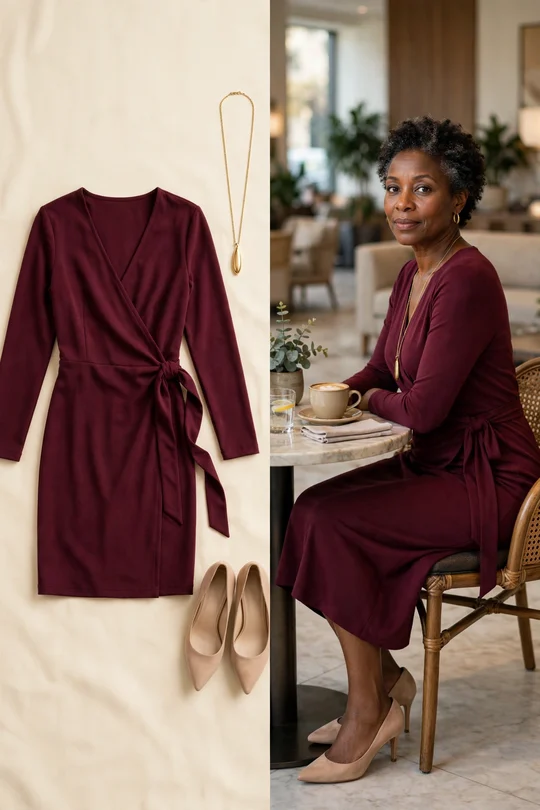
The wrap dress works on a petite apple through two mechanisms at once. The V-neckline opens the chest into a long vertical triangle, which lengthens the torso the way a window lengthens a wall — the eye travels down the V instead of across the bust.
The diagonal wrap line then crosses the midsection at an angle, and an angled line can never read as a waistband: it refuses to give the eye a horizontal mark to measure from. Together they explain why the wrap is the most recommended dress cut for this shape — it is geometry, not fashion.
At petite height the V’s depth is the control to watch. A V that ends 10–12 cm below the collarbone elongates; one that plunges further starts to read evening-only and throws the proportion off. Sleeves to the elbow or three-quarter keep the arm line long without fabric pooling at the wrist.
- Key pieces: true wrap dress in matte jersey, knee-skimming hem
- Shoes: nude-for-you pumps or pointed flats
- Occasion: lunches, events, anything that needs polish
- Budget tip: matte jersey over sheen — shine widens, matte recedes
Shop for: a true wrap (not a faux-wrap with a fixed seam) in matte jersey or crepe, V ending 10–12 cm below the collarbone, skirt falling from just under the bust to skim the top of the knee, in a small print or solid jewel tone.
How to wear it:
- Tie the wrap at the side waist, not the centre front — the off-centre knot keeps the diagonal line asymmetric, which reads slimmer.
- Let the hem sit at the top of the knee: any lower and the dress starts cutting the leg into the calf trap.
- Choose the shoe for continuity — nude with bare legs, or a dark shoe only if you’re wearing dark tights.
- Add one vertical element, like a long pendant, to double down on the V’s lengthening work.
Skip it if the wrap gaps at the bust when you sit — a wrap that needs constant adjusting is the wrong size, not the wrong style; go up and have the waist taken in.
Best for: the lunch-to-event dress — polished enough for a wedding guest slot, comfortable enough to sit through one.
3. The Empire-Waist Maxi Dress
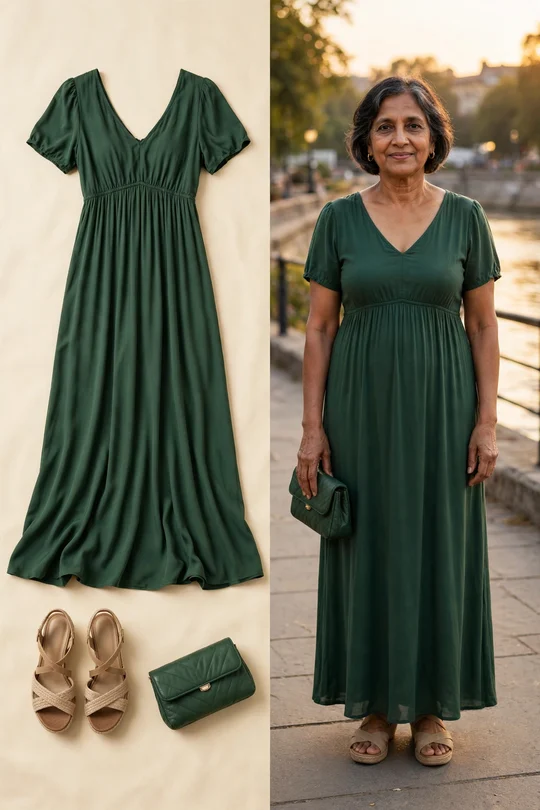
The empire seam is a cheat code for a petite apple: by placing the waistline directly under the bust, it makes the torso end 10–15 cm higher than it actually does, and everything below that seam reads as leg — even though it is skirt.
The eye does not measure the real leg; it measures from the highest horizontal line it can find, and the empire seam moves that line up. A fluid skirt falling from it hides the midsection entirely while the raised seam keeps the proportion long.
The danger is volume. An empire dress with a gathered, billowing skirt turns a petite frame into a tent — the skirt must fall in a clean A-line from the seam with no more than 15–20 cm of sweep beyond the hip. The hem should graze the top of the foot: floor-dragging hems shorten you by hiding the shoe line.
- Key pieces: empire-waist maxi in fluid crepe or viscose, slim straps or cap sleeves
- Shoes: a low wedge or flat sandal — the hem hides the shoe, so comfort wins
- Occasion: summer events, holidays, warm-weather evenings
- Budget tip: the one alteration that matters is the shoulder — a slipping strap ruins the seam’s position
Shop for: an empire seam sitting 5–8 cm below the bust (not at it — that reads maternity), skirt falling straight with minimal gather, hem grazing the top of the foot, in a solid colour or a vertical-feeling print.
How to wear it:
- Check the seam position standing sideways in the mirror — it should sit in the hollow just under the bust, no lower.
- Keep the neckline open: a V or scoop extends the torso above the seam instead of capping it.
Skip it if the skirt has tiers or heavy gathering below the seam — on a petite frame that volume reads wide, not long.
Best for: hot-weather occasions when you want coverage without layers and length without heels.
4. The Cropped Jacket + Column Skirt
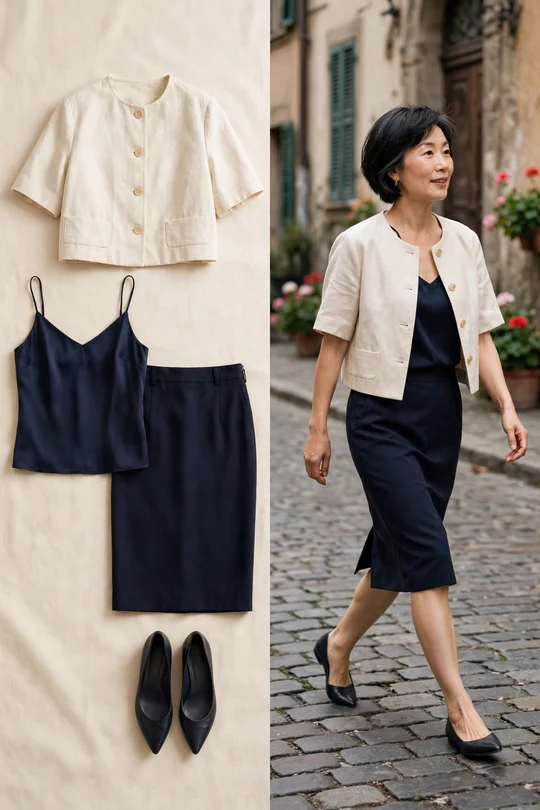
This pairing exploits the contrast between a short top line and a long bottom line. A jacket ending at the waistband shows the full length of the skirt beneath it, and because the skirt falls straight from waist to knee in one column, the visible leg starts at the waist — the longest possible leg segment on a petite body.
The jacket adds the structure an apple shape wants around the shoulders and arms without adding a horizontal hem at the hip, which is where longer jackets quietly steal 5–8 cm.
The column skirt is doing quiet work too: a straight, knee-skimming skirt in a dark tone narrows the lower half, which balances a fuller middle without a belt shouting about the waist. Wear the jacket open — the open fronts create a second vertical line down the torso.
- Key pieces: cropped jacket (50–55 cm back length), straight knee skirt, simple shell top
- Shoes: pointed flats or a 4 cm heel in a dark tone
- Occasion: office, dinners, smart daytime
- Budget tip: the jacket is the investment piece; the skirt can be the budget one
Shop for: a boxy cropped jacket with the back hem hitting exactly at your waistband — 50–55 cm from the nape for most women under 5’4″ — plus a straight skirt ending at the top of the knee in a dark neutral.
How to wear it:
- Wear the jacket open over a shell in the same colour family as the skirt — three dark pieces, one long reading.
- Push the sleeves to just below the elbow to keep the arm line visible and the jacket from wearing you.
- Check the skirt from the side: it should fall straight, not pull — if it pulls at the hip, size up and tailor the waist.
Skip it if the jacket’s hem lands mid-hip — that is the exact length that halves the leg, and it is the one length to avoid.
Best for: the smart-casual middle ground — office days, restaurant dinners, anywhere a blazer feels too corporate.
If your shape is pear: draw the eye up, let the hem move
A petite pear carries volume in the hips and thighs, so the strategy inverts: build interest above the waist — necklines, jackets, colour — and keep the lower half in clean, moving lines. Every outfit here gives the hips fabric that falls instead of clings, and gives the eye a reason to start its measuring at the shoulders.
If this feels like unfamiliar territory, How to Wear Polka Dots Over 50 is a gentle, practical place to start.5. The Short Trench + Slim Trouser
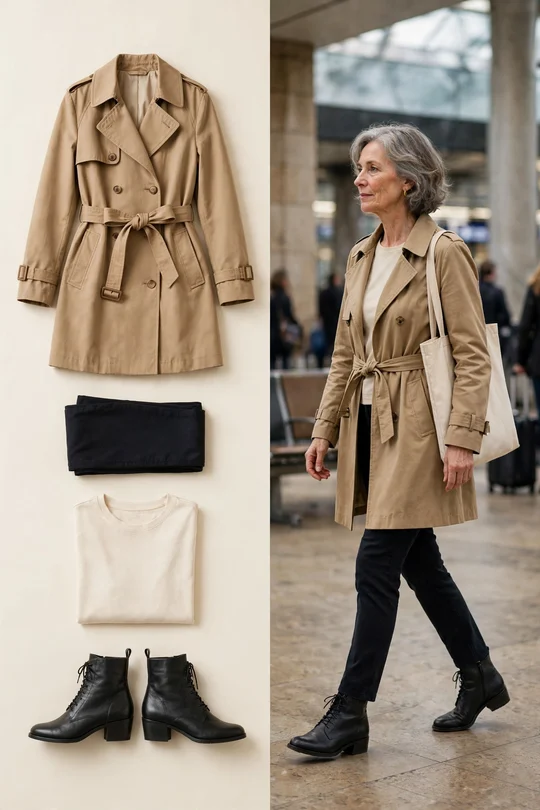
A trench that ends above the knee is a petite pear’s best outerwear because it does two jobs the classic mid-calf trench cannot. First, it leaves the full leg visible below it, so the leg line runs uninterrupted from thigh to shoe instead of being cut at the calf’s widest point.
Second, the trench’s shoulder structure — epaulettes, a defined shoulder seam — adds visual width up top, which balances the hip line without a single extra garment. The slim trouser underneath keeps the lower half in one dark column while the trench provides the movement.
Belt the trench at the true waist, not slung low. A low-slung belt drops the eye’s measuring point to the hip — the one place a pear does not want it — while a waist belt recreates the waist the shape already has and shows it off.
- Key pieces: short trench (ending 8–10 cm above the knee), slim dark trouser, simple top
- Shoes: ankle boots or loafers in a dark tone
- Occasion: travel days, rainy weeks, smart casual
- Budget tip: the trench is a decade piece — buy the best cotton gabardine you can afford
Shop for: a single-breasted trench with the hem ending 8–10 cm above your knee, raglan or set-in sleeves that end at the wrist bone, in classic tan or navy — plus a slim trouser with a 66–71 cm inseam.
How to wear it:
- Belt it at the true waist and tie the belt at the back or side — a front knot adds bulk where you are trying to remove it.
- Pop the collar for travel days: the raised collar frames the face and adds the upward interest pears want.
- Keep the trouser dark and the top lighter — the contrast sits above the waist, exactly where the eye should start.
Skip it if the trench’s hem lands at mid-calf — that length plus a petite frame reads as a coat wearing you, and it cuts the leg at its worst point.
Best for: the airport and the in-between seasons — the one outerwear piece that works over everything in this guide.
6. The Vertical-Stripe Shirt Dress
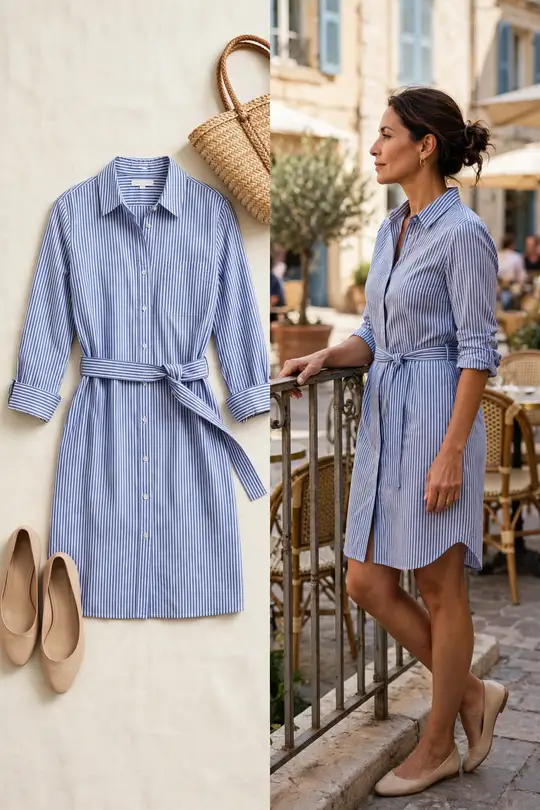
Vertical stripes are the closest thing to an optical illusion you can wear: the eye follows each stripe from shoulder to hem without stopping, so the body reads as one continuous line rather than a set of segments.
On a petite pear this matters doubly, because the stripes refuse to register the hip as a stopping point — the line simply continues past it. The shirt dress adds a collar and button front, which gives the upper body the structure and detail that draws the eye upward.
The belt is non-negotiable and its position is the whole trick. Belted at the true waist, the stripes converge slightly and the waist reads defined; belted at the hip, the stripes flare and the hips read wider. A slim self-belt, not a wide statement one, keeps the line unbroken.
- Key pieces: vertical-stripe shirt dress, slim self-belt, knee-skimming hem
- Shoes: nude flats or low wedges — keep the leg line going
- Occasion: daytime events, holidays, warm-weather office
- Budget tip: narrow stripes (under 1 cm) lengthen; wide stripes widen — check the stripe before the price
Shop for: a shirt dress in narrow vertical stripes (under 1 cm wide), with a collar, button front, and a hem that skims the top of the knee — the belt must sit at your true waist, so check it ties there without riding up.
How to wear it:
- Roll the sleeves to the elbow — the forearm flash keeps the upper body light and the eye up.
- Leave the top two buttons open for a V at the neck; a buttoned-to-the-top collar shortens the neck on a petite frame.
Skip it if the stripes bow outward at the hip when you stand still — that means the cut is too slim through the seat; size up and belt tighter.
Best for: one-piece dressing on days you cannot face decisions — the stripes do the styling for you.
Good to know
The petite alteration rule: hem first, everything else second. A trouser or skirt at the right length fixes 70% of proportion problems on its own, because length errors are what the eye reads first. Sleeves come next — a sleeve that ends at the wrist bone instead of covering the hand gives back the arm line.
Shoulders are last and hardest to alter, so if the shoulder seam sits more than 2 cm past your shoulder bone, put the garment back; no hem will save it.
7. The Fit-and-Flare Knee Dress
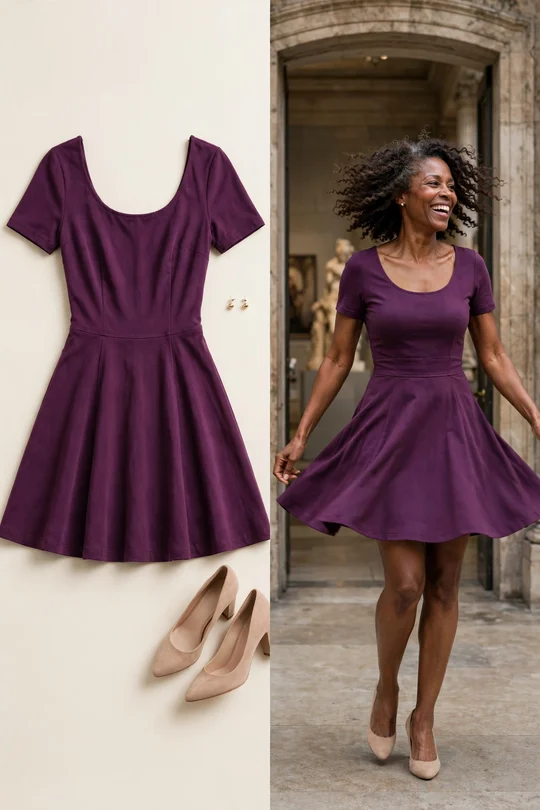
The fit-and-flare is engineered for the pear: a fitted bodice defines the waist — the narrowest point — and the skirt flares from there, skimming over the hips without touching them. Fabric that floats past the hip cannot report the hip’s size, so the silhouette reads as waist-plus-movement instead of waist-plus-width.
At petite height the hem must stop at the top of the knee: that is the longest leg segment available, and it is also the point where the leg is slimmest.
Neckline choice steers the eye upward, which is the pear’s standing instruction. A scoop or boat neck widens the shoulder line visually and balances the flare below; a high closed neck does the opposite and should be avoided here.
- Key pieces: fit-and-flare dress with a defined waist seam, scoop or boat neckline
- Shoes: nude-for-you heels (4–5 cm) or pointed flats
- Occasion: parties, weddings, any dress-up day
- Budget tip: a defined waist seam beats a belt here — it cannot ride up or sit wrong
Shop for: a dress with a seamed waist at your true waist (not an inch below), a skirt that stands away from the hip on its own, hem skimming the top of the kneecap, in a solid colour or small-scale print.
How to wear it:
- Check the waist seam in the mirror from the side — it should sit in your natural hollow, not below it.
- Spin once: the skirt should clear the hips by a hand’s width all the way round. If it clings anywhere, the cut is wrong for you.
- Match the shoe to your leg — nude with bare legs extends the line the knee hem starts.
- Keep it to one necklace and simple shoes — the dress is the outfit; a jacket only joins if the evening needs one (and then the cropped jacket from #4, never a long one).
Skip it if the bodice pulls across the bust — a fit-and-flare that strains at the top ruins the line it is trying to draw; size for the bust and tailor the waist.
Best for: every occasion with a dress code — the silhouette photographs well because the flare moves.
If your shape is hourglass: keep the waist the headline
A petite hourglass has the waist everyone else is trying to fake — the job here is to mark it clearly and keep everything else in proportion. These four outfits define the waist with belts, seams and wrap lines, then let the top and bottom halves balance each other.
The rule for this shape is simple: never hide the waist, and never let a garment end at the hip.
8. The Belted Midi With a Slit
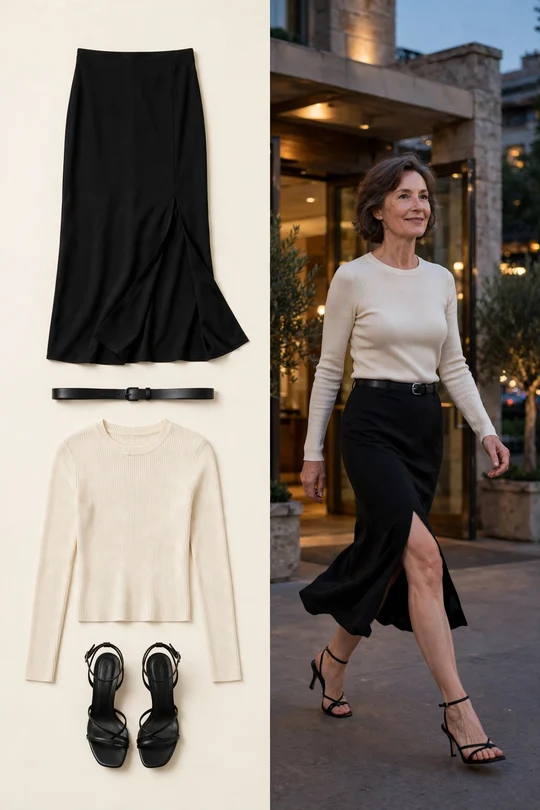
The midi is the hemline petites are warned about, and the slit is what makes it safe.
A solid midi skirt cuts the leg at mid-calf and costs 5–8 cm of visible length — but a slit rising to mid-thigh re-opens the leg line every time you move, so the eye keeps measuring to the thigh instead of stopping at the hem.
The belt then fixes the waist at its true position, which is the hourglass’s headline, and the combination reads as one long proportion instead of two short ones.
Keep the top fitted and tucked or cropped. Volume on top of a midi plus an hourglass hip is the one combination that reads heavy at petite height — the outfit needs one defined line at the waist and clean lines everywhere else.
- Key pieces: midi skirt with a thigh-high slit, slim belt, fitted top
- Shoes: heeled sandal or pointed pump (4–5 cm)
- Occasion: evenings, dinners, dress-up days
- Budget tip: the slit can be added by any tailor for under $15 — buy the midi you love and cut the line you need
Shop for: a midi skirt in a fluid fabric (crepe, matte satin) with the slit rising to at least mid-thigh, plus a slim belt 2–3 cm wide that sits at your true waist without needing constant adjustment.
How to wear it:
- Position the slit at the front or side — never the back, where it reads as a vent and does none of the lengthening work.
- Tuck the top fully and smooth it flat; any blousing over the belt softens the waist line you are paying to define.
- Choose a heel that shows the foot — a sandal or pump, not a boot — so the leg line runs all the way down.
Skip it if the slit pulls open when you sit — a slit that gaps is cut too high for the skirt’s width; have it lowered 5 cm and the line still works.
Best for: evenings when you want one strong look — the slit does the talking, so everything else stays quiet.
9. The V-Neck Jumpsuit
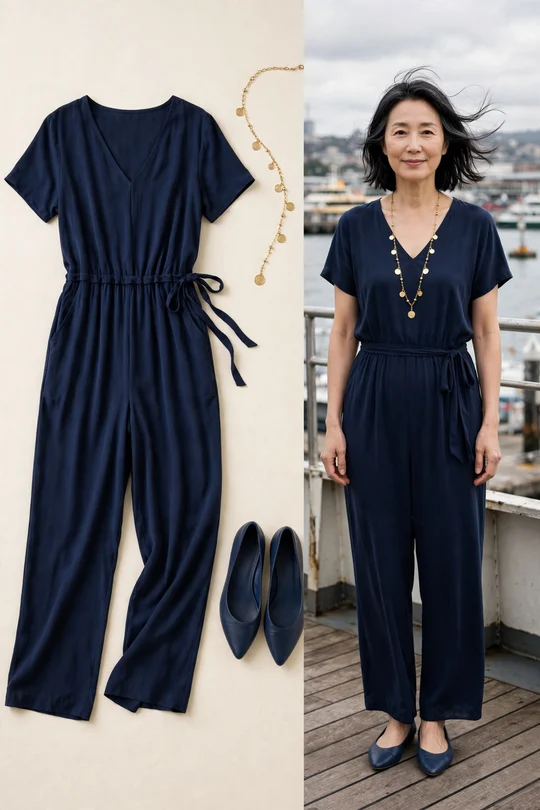
A jumpsuit is a single garment from shoulder to ankle, which means zero horizontal breaks between top and bottom — no waistband, no tuck line, no hem meeting a top.
On a petite hourglass that continuity is worth 5 cm on its own, and the V-neck adds the torso-lengthening triangle from #2 while a defined waist seam (or tie) marks the narrowest point. It is the only one-piece here that works the waist instead of skipping it.
The waist position is the make-or-break measurement: on a standard jumpsuit the waist seam sits 3–5 cm below a petite woman’s true waist, which reads as a dropped waist and shortens the leg. Check it in the mirror from the side and budget the alteration — moving a waist seam is a $20 job that transforms the garment.
- Key pieces: V-neck jumpsuit with a defined waist, tapered or straight leg
- Shoes: pointed flats or a low block heel peeking from the hem
- Occasion: events, evenings, travel days
- Budget tip: the waist-seam alteration is the whole purchase — factor it into the price before you decide
Shop for: a V-neck jumpsuit in a fluid dark fabric with a waist seam or tie that can sit at your true waist, leg ending at the ankle bone — not pooling, not cropped mid-calf.
How to wear it:
- Try it on with the shoes you will actually wear — the leg length must be judged at heel height, not barefoot.
- Cinch the waist tie at the side, not the front, to keep the centre line clean.
- Push the sleeves to the elbow if it has them; covered wrists shorten the arm line on a petite frame.
- One long necklace or none — the V is already doing the vertical work.
Skip it if the torso is too long and the V sits below your bust — a jumpsuit that doesn’t fit the torso cannot be saved by hemming the legs.
Best for: the one-and-done evening — no separates to coordinate, no tuck to maintain, and it packs without wrinkling for travel.
10. The High-Waist Wide-Leg Trouser + Fitted Shell
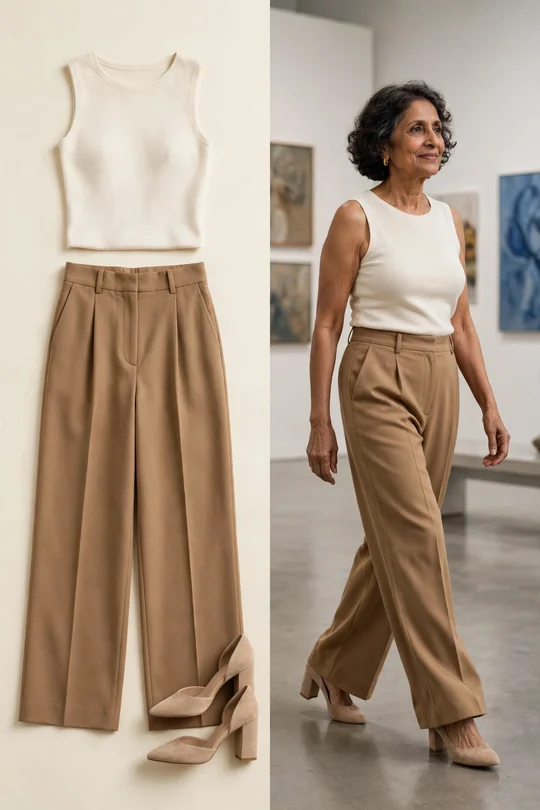
Wide legs scare petite women and they shouldn’t — the width is exactly what creates the column effect, provided the waist is high and the top is fitted.
A high waist starts the leg line at its highest point while the wide leg falls in one unbroken plane from hip to floor, and because the fabric never touches the leg, the eye cannot find a single place to stop measuring.
The fitted shell on top keeps the proportion honest: volume below needs containment above, or the outfit reads as one big shape.
The hem must cover the shoe. A wide-leg trouser that ends at the ankle shows the ankle as a horizontal break and chops 5 cm off the column; one that grazes the floor over the shoe extends the line all the way down. This is the one trouser where longer is better — hem it to your tallest shoe.
- Key pieces: high-waist wide-leg trouser, fitted shell or knit top
- Shoes: a heel (5 cm) or platform hidden under the hem
- Occasion: office, evenings, smart daytime
- Budget tip: buy for the waist and hip, tailor the length — the hem is always the alteration
Shop for: a high-rise wide-leg trouser with a clean flat front (no pleats — they add volume at the hip), in a fluid suiting fabric, hemmed to cover your tallest shoe and kiss the floor.
How to wear it:
- Tuck the shell fully and belt if the trouser has loops — the waist must read as a line, not a suggestion.
- Keep the top in the same tonal family as the trouser for maximum column effect, or one shade lighter to keep it daytime.
Skip it if the fabric is stiff — a rigid wide leg stands away from the body and reads as a tent on a petite frame; fluidity is the whole trick.
Best for: days you want drama without effort — the trouser moves like a skirt but works like a trouser.
11. The Mini-Pleated Skirt + Fitted Top

A short hem is the most honest lengthening tool there is: it simply shows more leg. On a petite hourglass the mini works because the fitted top defines the waist while the pleated skirt flares just enough to balance the hip — the pleats add movement without adding the width a full circle skirt would.
The key ratio is hem to waist: with the waist marked high and the hem 8–10 cm above the knee, the visible leg is the longest segment of the body.
Pleat size matters at this height. Knife pleats under 2 cm read as texture; wide box pleats read as volume. And the top must be truly fitted — anything boxy over a mini erases the waist and the outfit collapses into a rectangle.
- Key pieces: knife-pleated mini skirt, fitted crew or V-neck top
- Shoes: loafers, ballet flats, or low block heels
- Occasion: daytime, weekends, casual office
- Budget tip: pleats hold their shape for years — this is a cost-per-wear bargain
Shop for: a knife-pleated skirt (pleats under 2 cm) with the hem 8–10 cm above your knee, in a dark neutral or subtle metallic — plus a fitted top that tucks cleanly without blousing.
How to wear it:
- Tuck the top and check the waist from the side — the tuck line is the outfit’s headline, so make it crisp.
- Match your tights to the skirt in cold weather; bare legs or nude in warm weather. A contrasting tight cuts the leg you just lengthened.
- Keep the shoe simple and low — the leg is the statement, not the footwear.
Skip it if the pleats flip open at the hip when you walk — that means the skirt is too tight through the seat; go up a size.
Best for: the youthful end of the wardrobe — proof that over 50 and petite can still do a short hem well.
If your shape is straight: build the curves you want
A straight shape has the easiest petite problem: nothing needs hiding, everything needs shaping. These four outfits add definition where you want it — a shoulder line here, a waist suggestion there — using tailoring and proportion rather than padding. The goal is not an hourglass; it is a silhouette with intent.
12. The Tailored Blazer With Pushed Sleeves

A blazer gives a straight shape the two things it lacks: a shoulder line and a waist suggestion. The shoulder’s light padding squares the top of the silhouette, and a single-button closure nipped at the waist creates a waist where the body doesn’t offer one — the eye reads the blazer’s shape as the body’s shape.
Pushing the sleeves to 5 cm below the elbow keeps the arm visible, which stops the tailoring from swallowing a petite frame, and the flash of wrist is a slimming detail in its own right.
Single-breasted only. Double-breasted blazers add a full panel of fabric across the torso, which on a straight petite reads as a box — the single button’s diagonal closure is doing the shaping work.
- Key pieces: single-breasted blazer, simple shell, straight trouser or dark jean
- Shoes: loafers, pointed flats, or a low heel
- Occasion: office, travel, smart daytime
- Budget tip: the shoulder fit is everything — if the seam sits past your shoulder bone, walk away
Shop for: a single-breasted blazer with light shoulder padding, back length 55–58 cm (ending at the low hip, not mid-thigh), sleeves that push easily to 5 cm below the elbow, in navy, charcoal or camel.
How to wear it:
- Button the single button when standing — the closure’s diagonal is the waist-shaping mechanism, and it only works closed.
- Push both sleeves to the same point, 5 cm below the elbow, and leave them there; uneven sleeves read as an accident.
- Keep the trouser slim and dark so the blazer is the widest thing in the outfit — that contrast is what builds the shape.
Skip it if the blazer pulls into an X at the button — it is too small through the torso, and a straining blazer shapes nothing.
Best for: the working wardrobe’s anchor — the piece that makes jeans look intentional and trousers look expensive.
13. The Tunic + Legging, Done Right
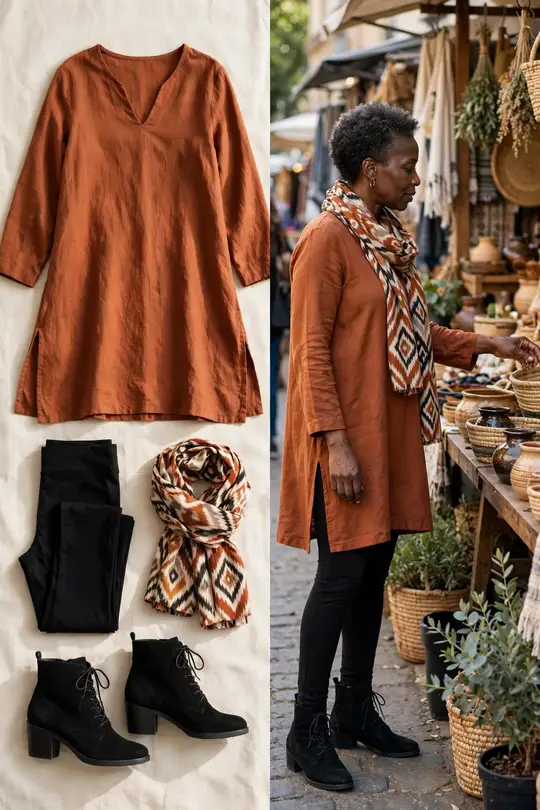
The tunic-and-legging combination fails on petites for one reason: a tunic that ends below mid-thigh covers the leg’s slimmest segment and leaves only the calf visible, which reads as all leg and no length.
Done right — tunic ending at mid-thigh, leggings in a dark matte fabric, a shoe with a small heel — the proportions flip: the visible leg runs from mid-thigh to shoe in one line, the tunic skims without clinging, and the whole outfit reads as intentional rather than default.
The tunic’s cut does the shaping a straight shape wants. Look for gentle A-line shaping through the body and a neckline with interest — a split neck or small V — so the top half has somewhere for the eye to land. Side slits of 8–10 cm keep the tunic from clinging at the hip when you sit.
- Key pieces: A-line tunic ending at mid-thigh, dark matte leggings
- Shoes: ankle boots with a 3–4 cm heel or sleek sneakers
- Occasion: home days, errands, casual travel
- Budget tip: matte leggings over shiny — shine highlights every line, matte recedes
Shop for: a tunic with the hem at your mid-thigh (measure it — “tunic length” on the label means nothing), side slits of 8–10 cm, in a fluid knit — plus full-length matte leggings with no sheen.
How to wear it:
- Check the hem standing sideways: mid-thigh is the target — 5 cm lower and the proportion tips into frumpy.
- Add one structured element — a scarf, a crossbody bag, a jacket over the shoulders — so the outfit has one tailored note.
Skip it if the tunic clings at the hip when you walk — size up; a tunic must skim, and skimming needs ease.
Best for: the real-life uniform — school runs, grocery dashes, long-haul flights, every day comfort has to pass as dressed.
14. The Bootcut Jean + Heel

The bootcut is the petite jean that understands geometry: the slight flare from the knee covers the shoe, so the eye travels from hip to floor without encountering the ankle as a stopping point. A skinny jean ends at the ankle and hands the eye a full stop; a bootcut carries the line past it.
Add a 4–5 cm heel hidden under the hem and you have bought 8–10 cm of leg without anyone seeing the transaction.
The rise must be high — a low-rise bootcut drops the waist and hands back everything the flare earns. And the hem must be fitted to the heel: too long and you trip, too short and the ankle break returns. Hem them wearing the shoes.
- Key pieces: high-rise bootcut jean in dark rinse, fitted top or tucked blouse
- Shoes: a 4–5 cm heel, mostly hidden under the hem
- Occasion: evenings out, dinners, smart casual
- Budget tip: the hem-to-heel fitting is the purchase — never skip it on this cut
Shop for: a high-rise bootcut with the knee break sitting at your actual knee (not below it — that reads as a flare), dark rinse, hemmed to cover a 4–5 cm heel and kiss the floor.
How to wear it:
- Get the hem done wearing the exact shoes — 1 cm of error is visible on this cut.
- Tuck or half-tuck the top to mark the high waist; an untucked top over a bootcut hides the rise you paid for.
- Keep the top fitted through the torso — volume on top of a flare reads wide at petite height.
Skip it if the knee break sits below your knee — the flare then starts too low and the leg reads short instead of long.
Best for: evening denim — the jean that dresses up instead of down.
15. The Monochrome Column Dress

One colour from shoulder to shoe is the purest lengthening mechanism in this guide: with no horizontal break anywhere — no contrasting waistband, no shoe in a different tone — the eye has nothing to stop on, so it reads the body as a single vertical line.
On a straight petite shape this also solves the shaping question sideways: a column dress in a fluid fabric skims the body and suggests a silhouette without demanding one, and a V or scoop neckline keeps the top half open.
The colour choice is doing half the work. Dark tones (navy, black, burgundy, forest) absorb light and read slimmer; the shoe must match the dress tone or the whole mechanism fails at the last centimetre.
A nude shoe with a navy dress is a full stop at the ankle — pretty, but it costs you the 3 cm the column earned.
- Key pieces: column dress in one dark tone, knee-skimming hem
- Shoes: same-tone pumps or pointed flats — non-negotiable
- Occasion: evenings, events, anywhere you want maximum effect
- Budget tip: the cheapest outfit here to get right — one dress, one shoe rule, done
Shop for: a straight-cut dress in fluid crepe that skims without clinging, hem at the top of the knee, V or scoop neckline, in navy, black, burgundy or forest — plus shoes in the same tone.
How to wear it:
- Match the shoe to the dress before anything else — hold them together in daylight; close enough is not enough.
- Add interest vertically, not horizontally: a long pendant, an open jacket in the same tone, never a contrasting belt.
Skip it if the fabric clings — a column that shows every line underneath breaks the clean reading; size for skim, not fit.
Best for: the evening you want to look 5 cm taller with zero effort — the highest return per decision in the guide.
Petite fit tips that never fail
These are the habits that make all fifteen outfits work harder. None of them costs more than a tailor’s visit; all of them compound.
- Find a tailor and use them monthly. A $20 hem transforms a $50 trouser; petites who tailor look like they shop in a different price bracket.
- Shop the petite ranges first, not last. Petite-specific lines cut the rise, the knee break and the sleeve for your frame — alterations start from closer to right.
- Monochrome is your cheat code. When in doubt, dress in one tonal family top to shoe — it never fails and it always lengthens.
- Show the wrist and the ankle. A flash of wrist slims the arm; a visible ankle bone lengthens the leg. Covered extremities shorten both.
- Small-scale prints only. A print’s scale should match your scale — large florals wear you; ditsy prints and narrow stripes work with you.
- One statement, never three. At petite height, a bold necklace plus bold earrings plus a bold bag compete with your frame. Pick one.
The five-minute petite check:
- Stand sideways: is the waistband at your true waist? If not, change the tuck or the trouser.
- Check every hem against the three lines — knee, ankle, floor. A hem between lines is a hem to alter.
- Match the shoe to the trouser or the leg — whichever continues the longer line.
- Push one sleeve and check the wrist — if you can’t see it, the sleeve is too long.
The bottom line
If I had to pick one outfit, it would be the high-rise straight jean (#1) — it is the only formula here that works for every shape group, it costs the least to get right, and a proper hem turns it into four-days-a-week armour. Start there and the rest of the fifteen become variations, not new purchases.
By lifestyle: for working days, live in the tailored blazer (#12) over the straight jean — polish without thinking. For home and errands, the tunic and legging done right (#13) is the honest answer. For social days — lunches, galleries, long afternoons — the wrap dress (#2) never misses.
And for evenings, the monochrome column (#15) is the whole trick in one garment.
Save this guide to your “petite style” board before your next shopping trip — screenshot the at-a-glance table and take it to the changing room; the “number to get right” column is your fitting-room checklist.
Frequently asked questions
What is the most flattering petite fashion over 50?
The outfits that place deliberate lines at the waist, knee or ankle and avoid lines anywhere else. In practice that means high-rise trousers, waist-length jackets, knee-skimming hems and shoes that continue the leg line. If your shape is apple, start with the wrap dress (#2); pear, the fit-and-flare (#7); hourglass, the belted midi (#8); straight, the tailored blazer (#12).
The mechanism is the same in every case — uninterrupted vertical lines — only the garments change.
I’m 5’1″ — will these proportions work for me, or only for taller petites?
They work harder the shorter you are, because every centimetre of line matters more on a smaller frame. At 5’1″, take the measurements in the at-a-glance table as starting points and go 2–3 cm shorter on hems — a knee-skimming hem for a 5’4″ petite sits differently on you.
The one adjustment: be stricter about jacket length (nothing past 53 cm back length) and consider the mini (#11) and the column dress (#15) your strongest plays, since both maximise visible leg.
Can petite women over 50 wear wide-leg trousers?
Yes — with two conditions from #10: the waist must be high and the hem must cover the shoe. A wide leg in a fluid fabric falls in one unbroken plane and reads as a column, which lengthens.
What fails is a wide leg in stiff fabric (it stands away from the body and tents) or one hemmed at the ankle (the ankle break chops the line). If you are apple-shaped, choose the straight jean (#1) first and treat the wide leg as the evening upgrade.
What length should dresses be for petite women over 50?
Two safe zones: skimming the top of the knee, or grazing the top of the foot. Everything between the knee and mid-calf is the danger zone — it cuts the leg at its thickest-looking point. If you love midi, it only works with a slit (#8) that re-opens the leg line.
Maxis need the empire trick (#3) or a single colour (#15) to keep the proportion long; a shapeless mid-calf dress with no waist is the one silhouette to avoid entirely.
Do I need heels to look taller at 5’3″ and under?
No — continuity beats height. A flat shoe in the same tone as your trousers lengthens more than a contrasting 7 cm heel, because the heel adds height but the contrast adds a full stop. That said, a 3–5 cm heel hidden under a bootcut (#14) or wide leg (#10) is free length with no comfort cost.
If you love flats, wear them — just match them to the leg line and let the proportions do the work.
How much should I budget for petite alterations?
Plan $15–25 per hem and $20–30 for taking in a waist or moving a waist seam. Most petites need nearly every trouser hemmed (standard inseams run 76–81 cm; most petites need 66–71 cm), so budget alterations as part of every purchase, not an afterthought.
The maths still favours it: a $50 trouser plus a $20 hem that fits perfectly out-dresses a $200 trouser that pools at the shoe.
Can I wear oversized or relaxed fits as a petite over 50?
One relaxed piece per outfit, never two — and it should be on top, balanced by something fitted below (relaxed tunic over slim leggings works; oversized sweater over wide trousers drowns a petite frame). The blazer (#12) shows the principle: structure reads as intentional, shapelessness reads as swamped.
If you love the relaxed look, keep the waist visible somewhere — a half-tuck, a pushed sleeve, an open front — so the eye still finds your proportions.
Where should petite women over 50 shop for the best fit?
Start with petite-specific ranges rather than regular lines — they cut the rise, knee break, sleeve and shoulder for a shorter frame, so alterations start closer to right. Then tailor the rest: hems first, sleeves second, and never buy a garment whose shoulder seam sits more than 2 cm past your shoulder bone.
Secondhand is a strong play for the investment pieces (blazers, trenches, wool coats) since the cut matters more than the season, and the alteration budget stretches further on a $40 find than a $400 one.