18 Petite Outfits for Women Over 60
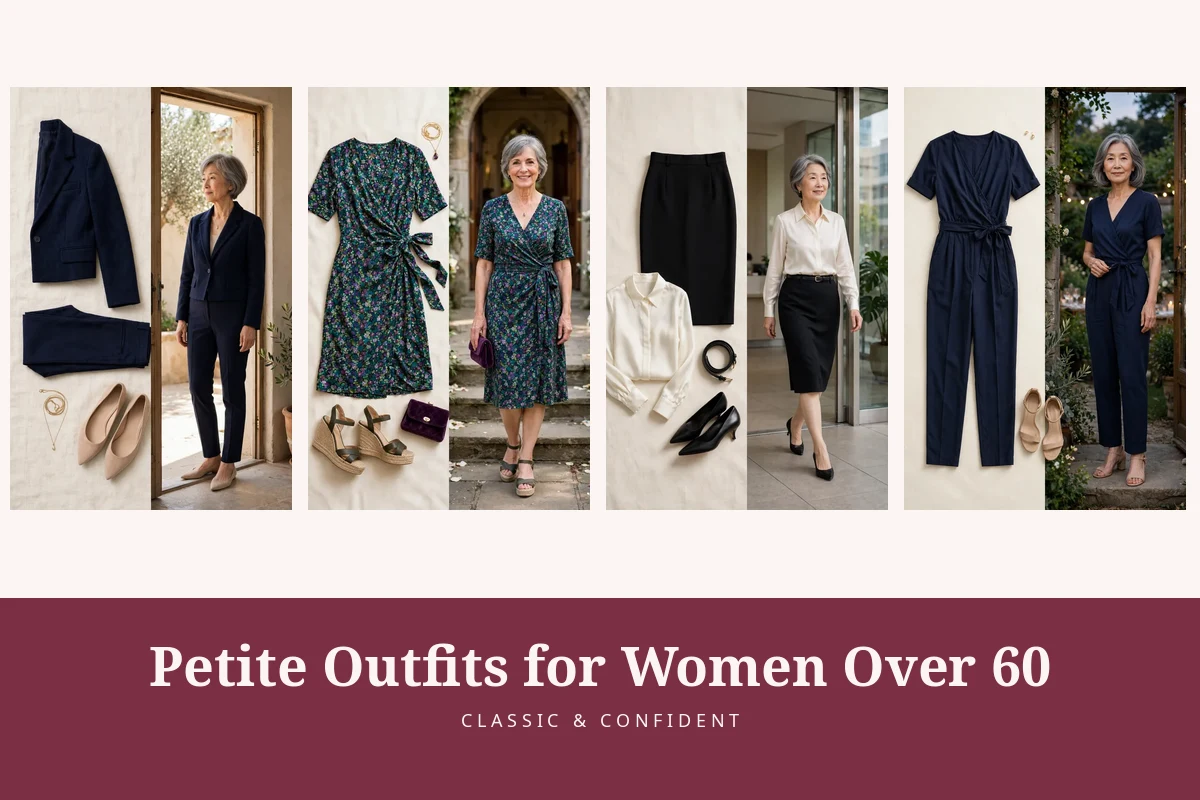
Petite over-60 fashion fails in one predictable way: everything is built for a taller frame, so hems pool, shoulders slip and waists land on the hips. The dress is lovely on the rail and wrong on your body.
The fix is not a wardrobe clear-out. It is a length map: know exactly where a hem, a waist and a shoulder should sit on your frame, and every outfit below suddenly works. These 18 are built around that map.
Start here
- Shortest leg line — 3. High-Waist Cropped Wide-Leg Jeans (#3)
- Dresses that end right — 7. The Knee-Length Wrap Dress (#7)
- Work polish, no tailoring — 12. The At-the-Knee Pencil Skirt (#12)
- One coat that doesn’t swamp — 13. The Longline Coat Over Ankle Trousers (#13)
- Evening with zero hemming — 14. The Fitted Maxi Dress (#14)
Contents
How to choose petite outfits over 60
Measure your knee, not the tag. Hold the garment’s hem at your body before buying: the difference between a skirt that ends 3 cm above the knee and one that ends 3 cm below is the difference between lengthened legs and shortened ones. A soft tape in your handbag does more than a size label.
Buy the smallest shoulder that closes. On a petite frame, shoulder seams that sit 1–2 cm past the shoulder bone make every layer look borrowed. If the bust or hip then pulls, that is what a tailor is for — shoulder alterations cost three times what a hem does.
Keep one long unbroken line. Monochrome or near-monochrome pairings read as one column of colour, which the eye follows top to bottom. This is the same principle behind our favourite classy outfits for women over 50 — colour continuity does the lengthening work so your legs don’t have to.
Count the breaks. Every horizontal line — a belt, a cuff, a hem, a colour change — cuts you into shorter pieces. Petite dressing is about spending your two or three breaks deliberately: one at the natural waist, one at the ankle, and stop there.
Petite is a proportion, not a weight. You can be petite at any size; what matters is where the waist, knee and ankle fall relative to the garment. For a broader take on proportion dressing, see our fall outfits for women over 50 — the same length rules apply once the layers go on.
At a glance
| Outfit | Why it works | Key number |
|---|---|---|
| 1. Cropped Blazer + Slim Trousers | Cropped jacket raises the waistline | Jacket 50–52 cm long |
| 2. Boxy Cardigan + Pencil Skirt | Short layer over a knee baring column | Cardigan ends at the waist |
| 3. High-Waist Cropped Jeans | 28–30 cm rise stretches the leg | Hem at the ankle bone |
| 4. Above-Knee Shift Dress | One unbroken panel, no waist seam | Hem 5–8 cm above knee |
| 5. Cropped Utility Jacket + Jeans | Short top, long bottom = longer legs | Jacket ends at high hip |
| 6. Swing Tunic + Slim Leggings | Mid-thigh end keeps legs visible | Tunic 70–74 cm long |
| 7. Knee-Length Wrap Dress | Diagonal closure lifts the eye | Hem right at the knee |
| 8. Monochrome Knit Dress | Single colour = one long column | Knee-skimming, 3/4 sleeve |
| 9. Knee-Pleated Skirt + Fitted Knit | Pleats move, tucked top shows waist | Skirt hem at the knee |
| 10. Tailored Bermudas + Blazer | Knee covered, calf shown | Shorts end 2–3 cm above knee |
| 11. Denim Shirt Dress | Vertical button line lengthens | Belted at the natural waist |
| 12. Pencil Skirt + Tucked Blouse | Tuck defines the waistline | Skirt ends at the knee |
| 13. Longline Coat + Ankle Trousers | Long over short = height | Coat 100–105 cm back length |
| 14. Fitted Maxi Dress | Fitted through waist, flares below | Hem grazes the shoe |
| 15. Palazzo Trousers + Low Heel | Floor-skimming width reads long | 4–5 cm heel minimum |
| 16. Long Column Skirt | Straight fall, no volume to lose | Ankle-grazing, high waist |
| 17. Duster Cardigan + Column Trousers | Long open layer over slim base | Duster ends mid-calf |
| 18. Ankle Wrap Jumpsuit | One piece, waist tie, no breaks | Cropped at the ankle |
Above the knee: short pieces that lengthen
Anything that ends above the knee hands you extra visible leg, which is the cheapest lengthening trick there is. The trade-off is balance — keep the top half neat so the proportions read intentional, not unfinished.
1. The Cropped Blazer and Slim Trousers
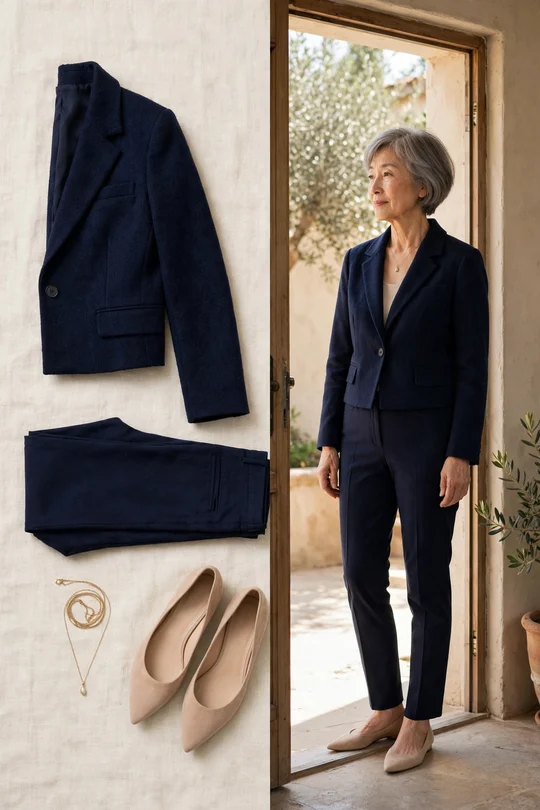
A blazer that ends at the high hip does something a standard blazer can’t: it tells the eye your waist sits higher than it does. The mechanism is the visible ratio — when the jacket covers only the top third of your torso-plus-leg line, the trousers underneath read longer by comparison.
On a 5’2″ frame this can add a perceived 5–7 cm of leg. Choose a single-button style with a notched lapel and patch-free front so nothing adds horizontal bulk.
- Key pieces: cropped single-button blazer, slim flat-front trousers, pointed flats
- Fit notes: blazer 50–52 cm from shoulder; trouser inseam 68–71 cm; rise 25–27 cm
- Colours: navy on navy, charcoal on black, or camel on cream
Shop for: a cropped blazer in a petite line, 50–52 cm long, with sleeves that end at the wrist bone; slim trousers with a 25–27 cm rise and no front pleats.
How to wear it:
- Put the trousers on first and check the hem — it should just kiss the top of a pointed flat, showing 2–3 cm of ankle.
- Close the blazer’s single button at your natural waist; the fronts should meet without pulling.
- Push the sleeves to show 1 cm of wrist — it stops a cropped jacket reading boxy.
- Skip the belt; add a slim pendant that ends at the sternum to keep the vertical line.
Skip it if your shoulders are the widest part of your frame — a cropped blazer adds structure exactly where you don’t need it.
Best for: lunch dates, gallery visits, smart-casual offices.
2. The Boxy Cardigan and Knee-Baring Pencil Skirt

A short boxy cardigan worn open over a slim pencil skirt works because the two lengths argue in your favour: the cardigan ends at the waist while the skirt keeps going, so the eye measures you from the cardigan’s hem down. Keep the cardigan to 48–50 cm — anything longer swallows the skirt’s waistband and with it the whole point.
A fine-gauge knit lies flat at the hip instead of adding the volume a chunky knit would.
- Key pieces: boxy fine-knit cardigan, straight pencil skirt, low block-heel court shoes
- Fit notes: cardigan 48–50 cm; skirt ends 4–6 cm above the knee; heel 4–5 cm
- Colours: blush cardigan over charcoal skirt; cream over navy
Shop for: a fine-gauge boxy cardigan, 48–50 cm long, no pockets; a straight pencil skirt with a back vent, ending 4–6 cm above the knee.
How to wear it:
- Wear the cardigan open and pushed to the elbows — the vertical opening is doing the lengthening.
- Choose a top in the skirt’s colour family so the cardigan frames one column, not three blocks.
- Finish with a low block heel; a stiletto fights the cardigan’s softness.
Skip it if you carry weight at the waist — an open boxy cardigan frames the midriff instead of skimming it.
Best for: office days, parent-teacher evenings, spring weddings as a guest.
3. The High-Waist Cropped Wide-Leg Jeans

High-rise cropped jeans are the single most forgiving trouser a petite woman can own. A 28–30 cm rise places the waistband at your narrowest point, which resets where the eye thinks your legs begin — roughly 8–10 cm higher than a mid-rise does.
The crop matters just as much: a hem that stops at the ankle bone shows the slimmest part of the leg, while full-length wide legs pool and erase the whole effect.
- Key pieces: high-rise cropped wide-leg jeans, fitted ribbed top, low-profile trainers or loafers
- Fit notes: rise 28–30 cm; inseam 63–66 cm; leg opening 40–44 cm
- Colours: mid-blue or ecru denim; top tucked in a matching or darker tone
Shop for: petite high-rise jeans with a 28–30 cm rise and a 63–66 cm inseam; if buying regular, budget for a £12–£15 hem — it is worth every penny.
How to wear it:
- Tuck the top fully — a half-tuck breaks the waistline the high rise just created.
- Check the back: the waistband should sit flat with no gaping when you sit.
- Keep shoes low-profile; a chunky sole eats the ankle flash the crop is showing.
- Add a slim belt in a dark tone to sharpen the waist point.
Skip it if you are very short-waisted — an ultra-high rise can crowd the ribs; look for a 26 cm rise instead.
Best for: weekends, market mornings, casual travel days.
4. The Above-Knee Shift Dress
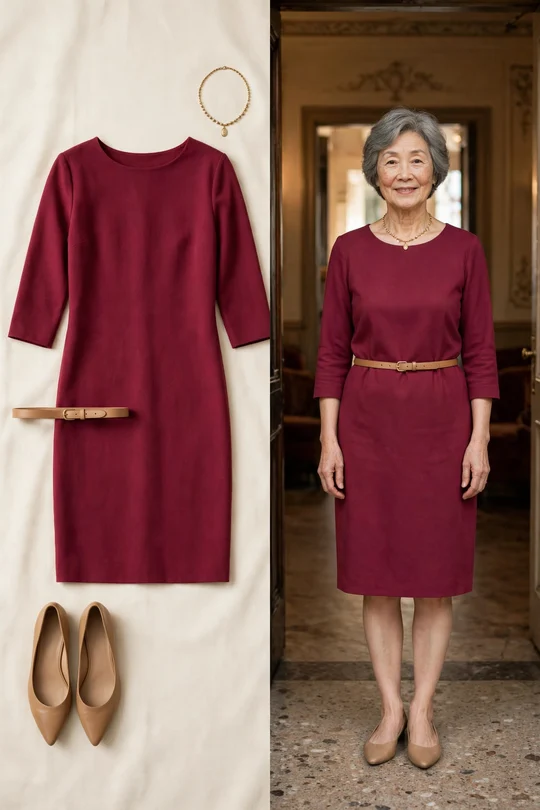
A shift dress with no waist seam is a blank panel, and on a petite frame a blank panel reads long. Waist seams are useful on taller bodies; on a shorter one they chop the torso into a short piece and a long piece, and the eye always takes the short piece.
Aim for a hem 5–8 cm above the knee — roughly 90–94 cm from the shoulder on a 5’2″ frame — so the dress ends where the leg is still slim and straight.
- Key pieces: sleeveless or 3/4-sleeve shift dress, slim belt (optional), pointed flats or low heels
- Fit notes: hem 5–8 cm above knee; shoulder seams on the shoulder; armhole not gaping
- Colours: berry, forest, or a small-scale print — large prints overwhelm a small frame
Shop for: a shift dress 90–94 cm from shoulder to hem (for 5’0″–5’3″), with the shoulder seam sitting on the bone and a neckline that shows the collarbone.
How to wear it:
- Stand side-on in the mirror: the dress should skim, not cling, at the hip.
- If you belt it, keep the belt 2–3 cm wide and at the natural waist — wide belts shorten.
- Show the collarbone with a scoop or V neckline; a high neckline plus a short hem reads top-heavy.
Skip it if you want waist definition — the shift’s whole point is the absence of it; take #7 instead.
Best for: warm-weather lunches, theatre matinees, occasions when you want one-and-done dressing.
5. The Cropped Utility Jacket and Ankle Jeans
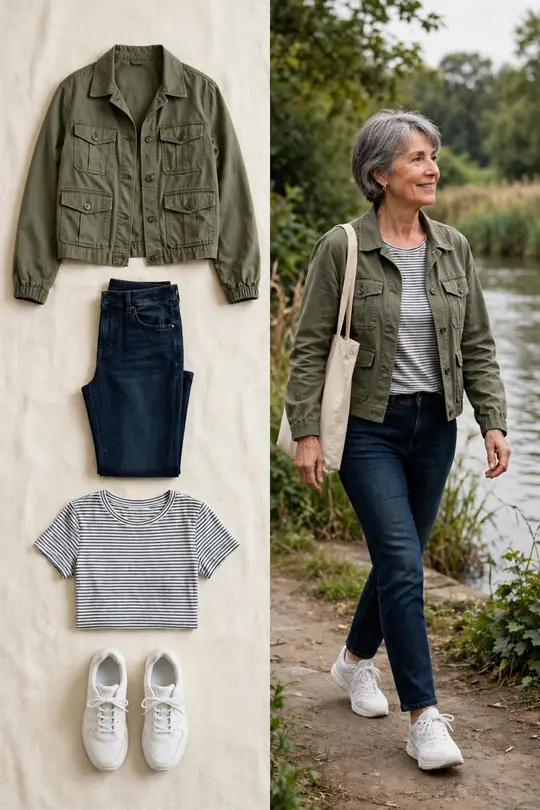
This is the short-top-long-bottom formula in its most casual form. A cropped utility jacket that ends at the high hip keeps all the rugged detail — the pockets, the collar — above the waistline, so none of it lands on the hip where it would widen you.
Underneath, dark ankle jeans with a 68–70 cm inseam give one long dark column. The eye reads: short jacket, long legs.
- Key pieces: cropped utility jacket, dark ankle-skimming jeans, striped tee, white trainers
- Fit notes: jacket ends at high hip (52–55 cm); jeans inseam 68–70 cm
- Colours: olive or sand jacket; indigo or black jeans
Shop for: a cropped utility jacket, 52–55 cm long, with the hem band sitting above the jean waistband; dark jeans that end at the ankle bone.
How to wear it:
- Wear the jacket open — the open fronts create the vertical line, closed fronts create a block.
- Roll the sleeves once to the forearm; full-length utility sleeves look heavy on a small frame.
- Keep the tee’s stripe narrow — wide stripes widen, narrow stripes lengthen.
- Match the trainer to the jean (white with light denim, dark with indigo) to avoid a visual full stop at the foot.
Skip it if the jacket’s pockets sit on your bust — chest pockets on a cropped jacket add width exactly where petite frames need none.
Best for: dog walks, sightseeing days, school-run-adjacent errands.
6. The Short Swing Tunic Over Slim Leggings
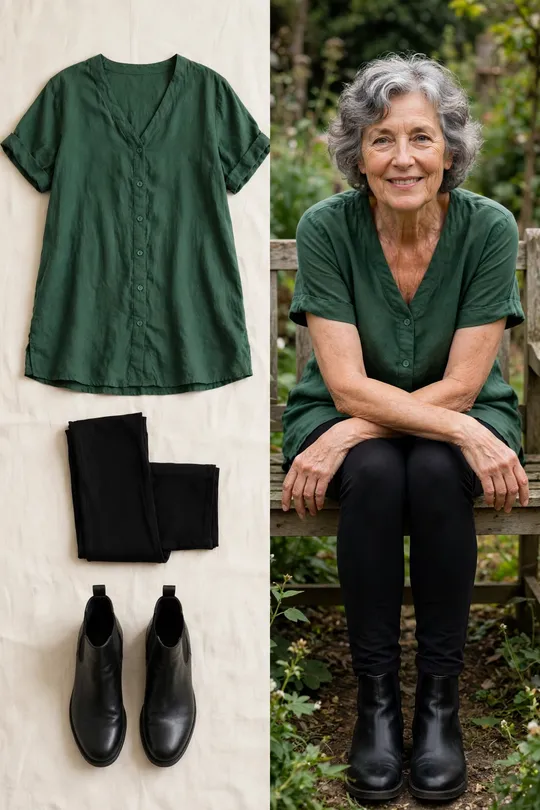
A swing tunic works on a petite frame only when it ends decisively at mid-thigh — 70–74 cm from the shoulder. Longer and it becomes a dress that forgot its hem; shorter and it reads as a top that doesn’t cover.
At mid-thigh it shows the full lower leg, which is the longest-looking part of most petite bodies, while the swing shape skims the hip and stomach without clinging.
- Key pieces: swing tunic, opaque slim leggings, knee-high or ankle boots
- Fit notes: tunic 70–74 cm; leggings with a wide waistband that stays put
- Colours: tunic in a rich solid; leggings in black or charcoal
Shop for: a swing tunic 70–74 cm long with a V or scoop neck; leggings in a ponte or scuba knit thick enough that no light shows through at the knee.
How to wear it:
- Check the tunic’s hem in a full-length mirror from the side — mid-thigh, not grazing the knee.
- Wear boots in the legging colour so the lower leg reads as one line.
Skip it if the tunic has side slits above the hip — they break the swing line and chop the leg visually.
Best for: cold-day comfort, long car journeys, relaxed weekends at home with visitors.
At the knee: knee-skimming pieces
The knee is the sweet spot for petite dressing over 60: it shows enough leg to lengthen, covers enough to feel comfortable, and works for every dress code from office to wedding. The rule here is precision — 3 cm either way changes everything.
When you want the same polished feel for a different occasion, our casual dresses round-up has plenty of options to try.7. The Knee-Length Wrap Dress
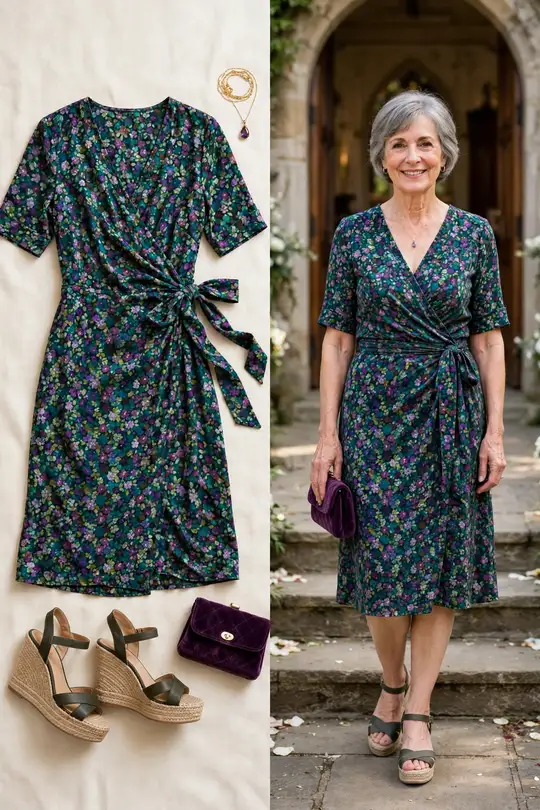
The wrap dress is practically engineered for petite women: the diagonal closure draws a diagonal line across the torso, and diagonal lines always read longer than horizontal ones. The tie defines the waist exactly where you put it — no seam guessing your proportions for you.
Choose a hem that lands right at the kneecap; the V neckline plus the wrap diagonal plus the knee hem gives you three lengthening lines in one garment.
- Key pieces: true wrap dress with interior tie, 3/4 sleeves, wedge sandals or block heels
- Fit notes: hem at the kneecap; interior tie plus exterior tie so it can’t gape
- Colours: small ditsy prints, jewel solids; avoid large geometrics
Shop for: a TRUE wrap dress (not a faux wrap — the interior tie is what keeps it closed when you sit), with the hem landing at the kneecap on your frame.
How to wear it:
- Tie the interior string first, snug at the natural waist, then wrap and tie the exterior.
- Sit down before you leave — if the skirt rides more than 5 cm, the dress is too short for the wrap style.
- Add a pendant that ends inside the V; earrings alone leave the neckline’s vertical line unfinished.
Skip it if you are large-busted — a wrap’s crossover can gape; look for wrap styles with a snap at the bust point.
Best for: weddings, christenings, any event where you need to look dressed with ten minutes’ notice.
8. The Monochrome Knit Dress
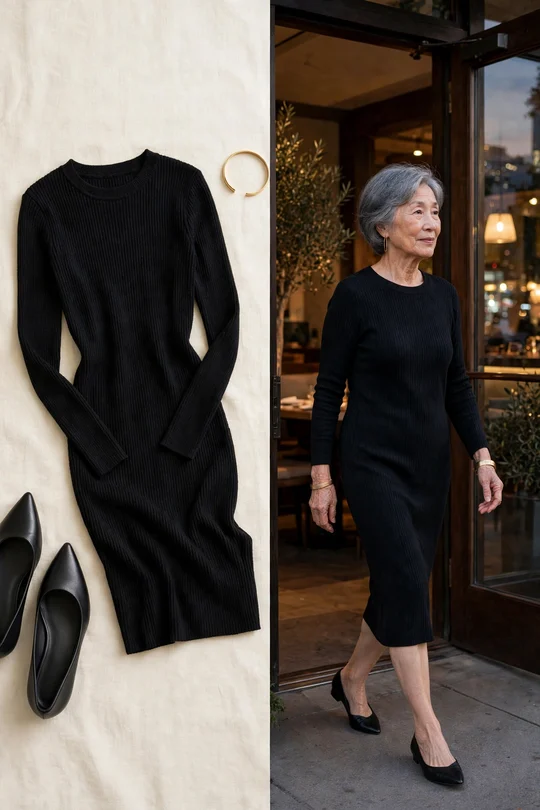
One colour from shoulder to knee is the closest thing to an optical illusion in petite over 60 fashion. Without a colour change to stop at, the eye travels the full length of the dress and credits you with all of it.
A fine ribbed knit adds a second trick: the vertical ribs are pinstripes in disguise, each one a tiny lengthening line. Keep the sleeve at 3/4 — full sleeves on a knee dress close off the arm line.
- Key pieces: fine ribbed knit dress, tonal tights or bare legs, shoes in the dress colour
- Fit notes: hem skims the knee; knit with 5% stretch so it recovers
- Colours: black, espresso, burgundy, forest — deep tones read longest
Shop for: a fine ribbed knit dress in one deep colour, hem at the knee, with shoes in the same colour family — the tonal shoe is half the trick.
How to wear it:
- Match shoe colour to dress colour as closely as you can — black dress, black shoe.
- If you add a jacket, make it the same colour or take it off indoors; a contrasting layer chops the column.
- Keep jewellery to one metal so nothing competes with the single-colour line.
- Steam, don’t iron — ribbed knits press flat and lose their texture under a hot iron.
Skip it if the knit is thin enough to show every line underneath — hold it to the light in the shop; if you can see your hand, size up or walk away.
Best for: evening dinners, winter events, days when getting dressed needs to take four minutes.
9. The Knee-Pleated Skirt and Fitted Knit

Pleats are movement, and movement distracts from measurement — nobody is judging the length of a skirt that swings. The fitted knit tucked in on top does the structural work: it marks the waist precisely, so the pleats fall from a defined point instead of from nowhere.
Keep each pleat narrow (2–3 cm); wide knife pleats add volume that a petite hip doesn’t need.
- Key pieces: narrow-pleat skirt, fine fitted crew or polo neck, tucked; ankle-strap or court shoes
- Fit notes: skirt hem at the knee; knit fine enough to tuck without bulk
- Colours: pleated skirt in a print, knit in one pulled colour; or tonal head-to-toe
Shop for: a pleated skirt with 2–3 cm pleats ending at the knee, plus a fine-gauge knit in a colour pulled from the skirt’s print.
How to wear it:
- Tuck the knit fully and smooth it flat — half-tucks fight pleats.
- Shake the skirt out after sitting; pleats remember the chair otherwise.
Skip it if the pleats start below the hip — stitched-down pleats that release at the thigh add width at the widest point.
Best for: spring lunches, garden parties, days you want to feel feminine without a dress.
Good to know
The 3-cm rule: hold any knee-length hem against your leg and note where it falls — 3 cm above the knee lengthens, at the knee is neutral, 3 cm below shortens. When you’re choosing between two sizes or two styles in a fitting room, this single measurement settles it faster than any amount of deliberation.
10. The Tailored Bermudas and Blazer

Bermuda shorts that end 2–3 cm above the knee give a petite woman something trousers can’t: a full view of the knee and the slim start of the calf, which reads as leg length even in flat shoes. The tailored blazer on top keeps it grown-up — the structure says “outfit”, the shorts say “summer”.
Keep the shorts’ leg straight, not tapered; a tapered short narrows toward the knee and makes the thigh look wider by comparison.
- Key pieces: tailored Bermuda shorts, unstructured blazer, simple shell top, loafers
- Fit notes: shorts end 2–3 cm above knee; blazer hip-length, sleeves pushed up
- Colours: stone, navy or khaki shorts; blazer in a matching or navy tone
Shop for: tailored shorts with a 25–28 cm inseam (ending just above the knee on a petite frame), in a crease-holding twill or linen blend.
How to wear it:
- Press a front crease into the shorts — it adds a vertical line down each leg.
- Wear the blazer open with sleeves pushed to the forearm.
- Keep the shell top simple; the outfit already has two strong pieces.
Skip it if the shorts have cargo pockets — side pockets add litres of visual volume to the thigh.
Best for: hot-weather sightseeing, outdoor lunches, smart summer events.
11. The Denim Shirt Dress at the Knee

A denim shirt dress gives you a full-length vertical button placket — a centre line that runs from collar to knee and pulls the eye straight down. Belted at the natural waist, it creates the hourglass outline without any tailoring; unbelted, it’s a column.
The denim itself matters: a mid-weight stretch denim (with 2–3% elastane) skims instead of standing away from the body the way rigid denim does on a small frame.
- Key pieces: denim shirt dress, slim tan belt, white trainers or tan sandals
- Fit notes: hem at the knee; shoulder seams on the bone; belt 2–3 cm wide
- Colours: mid-blue or washed black denim
Shop for: a stretch-denim shirt dress (2–3% elastane) with the hem at your knee and a waist tie or belt loops included.
How to wear it:
- Belt at the natural waist — not the hips — and let the skirt fall straight from the belt.
- Roll the sleeves to just below the elbow to show the forearm.
- Undo the top button and add a short necklace that sits in the opening.
- Keep shoes light — white trainers or tan sandals continue the casual line.
Skip it if the denim is rigid and boxy — non-stretch denim adds a full size of visual bulk on a petite frame.
Best for: weekend errands, casual Fridays, travel days when you want one piece and done.
12. The At-the-Knee Pencil Skirt and Tucked Blouse

The tuck is the whole mechanism here: a blouse tucked into a high-waisted pencil skirt draws a hard horizontal line at your narrowest point, and everything below that line reads as leg. On a petite frame that line needs to sit at the true waist — even 3 cm low costs you visible leg.
Choose a blouse with enough length to stay tucked (65 cm plus) and a skirt with a waistband that doesn’t roll.
- Key pieces: high-waist pencil skirt, silk-touch blouse, pointed-toe flats or kitten heels
- Fit notes: skirt ends at the knee; blouse 65 cm+ so the tuck holds
- Colours: skirt in black, navy or tweed; blouse in ivory, blush or a small print
Shop for: a high-waist pencil skirt ending at the knee with a back vent for walking, plus a blouse long enough (65 cm+) to stay tucked all day.
How to wear it:
- Tuck the blouse with a little blouse — pull 2 cm of fabric out at the front so it doesn’t strain.
- Add a slim belt in the shoe colour to link the waist to the foot.
Skip it if the skirt has no stretch — you’ll be tugging it down all day, which defeats the knee-length precision.
Best for: the office, interviews, any day you need to look authoritative.
Below the knee: long pieces that don’t swamp
Long hems are the danger zone for petite women — but they’re also the most elegant, if you control the fit. The rules down here: fitted through the waist, no excess fabric pooling, and always a heel or a cropped layer to keep the proportions honest.
13. The Longline Coat Over Ankle Trousers
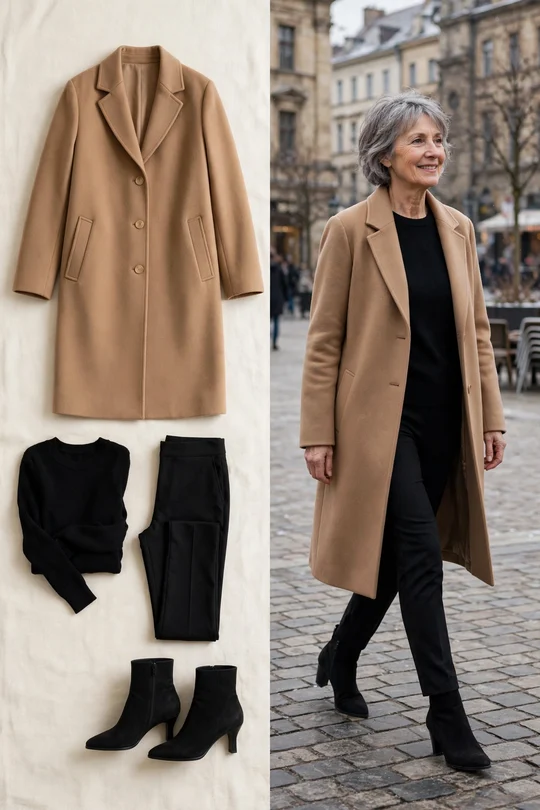
A long coat works on a petite frame when everything underneath is short and slim. The coat — 100–105 cm in the back, ending just below the knee — becomes one long vertical panel, and the ankle trousers beneath it flash 8–10 cm of ankle that proves there are legs under there.
The contrast of long over short is what creates the height; a long coat over long trousers just makes a tent.
- Key pieces: single-breasted longline coat, slim ankle trousers, fine knit top, heeled ankle boots
- Fit notes: coat 100–105 cm back length; trousers end at the ankle bone
- Colours: camel coat over black; charcoal coat over navy
Shop for: a single-breasted coat, 100–105 cm in the back, with the shoulder seam on the bone — double-breasted adds a full visual size on a small frame.
How to wear it:
- Wear it open whenever you can — the open fronts are the vertical line.
- Keep everything underneath slim and dark so the coat is the only volume.
- Choose heeled ankle boots that disappear under the trouser hem; a gap of skin between trouser and boot chops the line.
Skip it if the coat’s pockets sit at hip level and gape — patch pockets on a longline coat widen the exact spot you want narrow.
Best for: winter city days, evening events in cold weather, travel when you need one coat to do everything.
14. The Fitted Maxi Dress
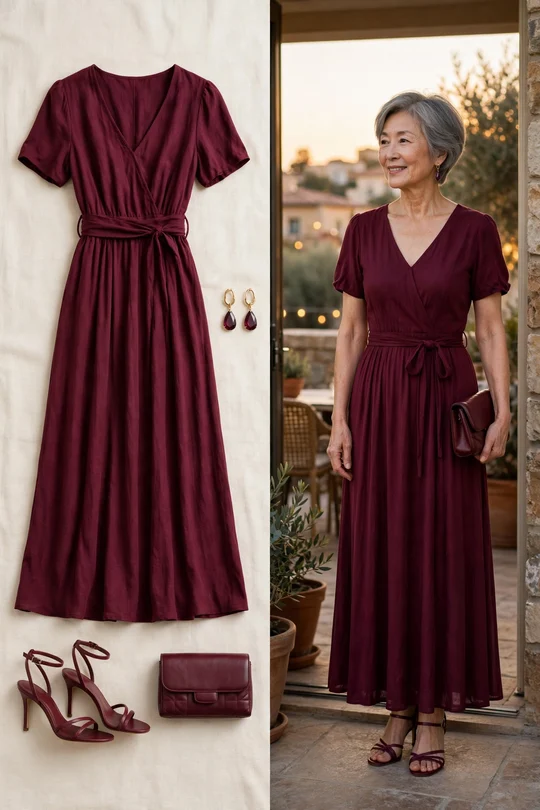
Most maxi dresses fail petite women because they’re cut straight from bust to floor, hiding the waist entirely. The fitted maxi does the opposite: it follows the body through the waist and hip, then releases below the knee.
That fitted middle third is the mechanism — it shows your shape, which gives the eye scale, and the skirt’s length then reads as elegance rather than excess fabric. The hem should just graze the top of your shoe.
- Key pieces: fitted-waist maxi dress, strappy heeled sandals, small clutch
- Fit notes: defined waist (seamed or belted); hem grazes the shoe, never pools
- Colours: deep jewel tones or a vertical-stripe print; avoid horizontal borders at the hem
Shop for: a maxi with a defined waist — seamed, smocked or belted — and a hem you can have shortened to graze your heel height; petite maxis exist and are worth hunting.
How to wear it:
- Buy the dress for the bodice fit; budget £15–£20 for the hem — it’s the cheapest alteration there is.
- Wear the heel height you’ll wear on the night for the hem marking, not flats.
- Keep the neckline open — a V or scoop balances the dress’s full length.
- Carry the clutch, not a shoulder bag; a long strap cuts the dress’s line in half.
Skip it if the dress has no waist definition at all — an undefined maxi on a petite frame reads as a nightdress.
Best for: summer weddings, cruise dinners, any evening you want to feel statuesque.
15. The Palazzo Trousers With a Low Heel

Palazzo trousers look like the riskiest petite choice and are secretly one of the safest — because the wide leg falls in one straight plane from hip to floor, with no knee or calf interruption to measure against.
The trick is the heel: 4–5 cm minimum, hidden under the hem, so the trouser breaks exactly at the shoe and the leg reads 10 cm longer than it is. Flat palazzos pool; heeled palazzos float.
- Key pieces: high-waist palazzo trousers, fitted camisole or knit, cropped jacket or short cardigan, block heels
- Fit notes: waistband at the natural waist; hem kisses the floor in your heels
- Colours: black, navy or chocolate palazzos; top in a lighter tone
Shop for: high-waist palazzos with a flat front and a hem you can adjust to your exact heel height — buy long and hem, never buy short.
How to wear it:
- Have the hem marked while wearing the exact shoes you’ll pair them with.
- Keep the top fitted and tucked — volume on top plus volume below drowns a petite frame.
Skip it if the fabric is stiff — palazzos need to move; rigid fabric makes the wide leg look like curtains.
Best for: evening events, holidays, days you want drama without a dress.
16. The Long Column Skirt

A straight column skirt in a fluid fabric is the long-skirt answer for petite women who find A-lines overwhelming. Because it falls straight from hip to ankle with no flare, there’s no triangle of fabric for the eye to measure — just one slim vertical.
The waistband must sit at the natural waist and the fabric must have drape; a stiff column skirt stands away from the leg and adds the width you were avoiding.
- Key pieces: fluid column skirt, tucked fine-knit top, cropped jacket, heeled boots
- Fit notes: hem grazes the ankle; back vent or side slit for walking
- Colours: black, espresso or a subtle animal print; top tucked in a solid
Shop for: a column skirt in a fluid crepe or viscose with a back vent, hemmed to graze the ankle bone.
How to wear it:
- Tuck the top and add a slim belt to mark the waist — the skirt’s straightness needs the contrast.
- Layer a cropped jacket that ends above the hip so the skirt’s full length shows.
- Wear a heel that hides under the hem; the ankle flash keeps it from reading heavy.
Skip it if the skirt clings at the knee when you walk — you need a vent or a slit, not a struggle.
Best for: work dinners, autumn events, minimalist wardrobes.
17. The Duster Cardigan and Column Trousers

A duster cardigan that ends at mid-calf creates the longest vertical line in this whole list — one unbroken panel from shoulder to calf. Worn open over slim column trousers in the same colour family, it frames a narrow inner column that looks a full size longer than it is.
The cardigan must be fine-gauge; a chunky long cardigan is simply a blanket with sleeves on a petite frame.
- Key pieces: fine-gauge duster cardigan, slim column trousers, simple shell top, pointed flats
- Fit notes: duster ends mid-calf; trousers slim with a 68–70 cm inseam
- Colours: tonal — camel over tan, grey over charcoal, black over black
Shop for: a fine-gauge duster in a petite length (ending mid-calf on you, not the model), with narrow fronts that don’t overwhelm.
How to wear it:
- Keep the inner column one colour family — the duster frames it, the eye measures it.
- Push the duster sleeves to the forearm; long fine-knit sleeves stretch and look tired.
- Belt the duster loosely at the waist for evenings — it creates an hourglass over the column.
- Pointed flats extend the foot line the trousers start.
Skip it if the duster’s hem hits at the widest part of your calf — mid-calf means the narrow part, 8–10 cm below the knee.
Best for: layered autumn days, long lunches, gallery afternoons.
18. The Ankle Wrap Jumpsuit
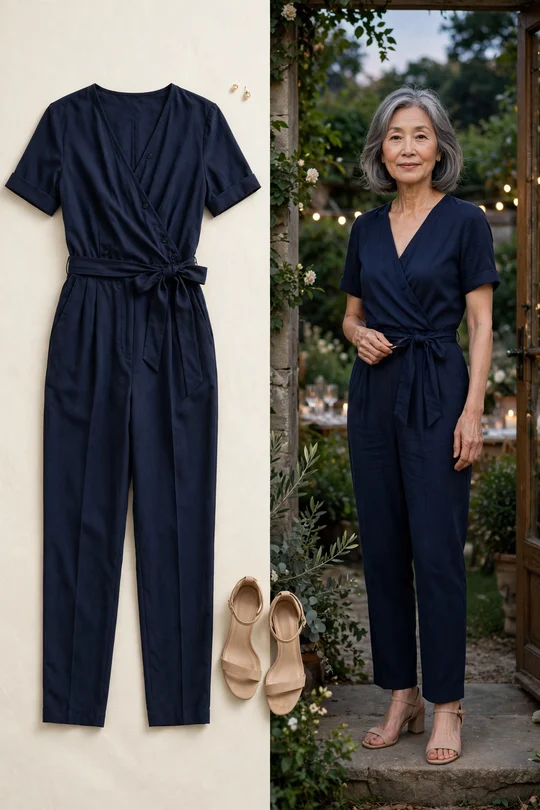
A jumpsuit is a single piece from shoulder to ankle — zero horizontal breaks between top and bottom, which is the dream formula for petite dressing. The wrap front adds the diagonal line and the waist tie marks your narrowest point exactly where you choose.
Cropped at the ankle, it shows the slim ankle bone and lets a heeled sandal do the final lengthening work.
- Key pieces: wrap-front jumpsuit, waist tie, heeled sandals, small earrings
- Fit notes: legs cropped at the ankle; torso length suits 5’0″–5’4″ (check the rise measurement)
- Colours: black, navy or deep green; one solid reads longest
Shop for: a wrap jumpsuit with an adjustable waist tie and a stated petite torso length — the crotch sitting 2 cm too low ruins the whole line.
How to wear it:
- Check the rise sitting down — if it pulls, the torso is too short for you.
- Tie the waist at the natural waist and let the ends hang; a bow adds bulk.
Skip it if the legs are full-length and pooling — a jumpsuit you have to hem extensively is the wrong jumpsuit.
Best for: parties, summer evenings, occasions when a dress feels too expected.
Petite fitting rules that never change
Outfits come and go; these rules hold for every petite wardrobe after 60. Pin them to the inside of your wardrobe door.
- Hem everything once, wear it forever. A £12–£15 hem transforms a regular-size bargain into a petite-perfect piece. Budget one alteration per month and the high street becomes a petite shop.
- Shoulders decide, everything else follows. If the shoulder seam sits on the bone, a tailor can fix the rest cheaply. If it doesn’t, put it back.
- Two breaks maximum. Waist and ankle is the classic pair. Adding a belt, a cuff and a colour change spends all your length at once.
- Pointed toes buy you 3 cm. A pointed flat or low heel extends the foot line; round toes stop it dead. This is the cheapest lengthening trick in footwear.
- Small bag, small frame. An oversized tote makes you look smaller by comparison. A medium crossbody at hip level keeps the scale honest.
- Monochrome is a strategy, not a rut. One colour family head to toe reads 5–8 cm taller. Vary the textures — knit, crepe, denim — so it never looks like a uniform.
The 2-minute mirror check — do this before you leave:
- Stand side-on: does the longest hem end where you intended — knee, calf or ankle?
- Count your horizontal breaks — waist, hem, colour change. More than three? Remove one.
- Check the shoulder seams from the front; they should sit on the bone, not past it.
- Look at your shoes last: do they continue the leg line or stop it?
The bottom line
If I had to pick one, it would be 7. The Knee-Length Wrap Dress — the diagonal closure, the waist you place yourself, and the knee hem that needs no alteration make it the hardest-working petite piece ever designed. Buy it in a print you love and it will outlast every trend in this list.
Save this guide to your “petite style” board on Pinterest before your next shopping trip — having the 3-cm rule on your phone in the fitting room is worth more than any single new purchase.
Frequently asked questions
Is petite sizing essential for over 60 fashion, or can I just alter regular sizes?
Petite sizing matters most for anything with a defined waist, shoulder or knee position — jackets, dresses and trousers. If the waist seam or knee of a regular size lands 5 cm too low, no hem fixes that; the garment’s proportions are wrong for you. For simple pieces like knit tops and scarves, regular sizes are fine.
The rule of thumb: if the piece has structure, buy petite; if it drapes, alter or wear as is.
What heel height is actually comfortable and still lengthening?
For most women over 60, a 4–5 cm block heel is the sweet spot — enough lift to change the trouser break and posture, stable enough for a full day. If heels are off the table entirely, a pointed flat gives you roughly half the lengthening effect of a low heel through the extended toe line alone. Avoid completely flat round-toe shoes with cropped trousers; that combination shortens more than any other.
Can petite women over 60 wear maxi dresses without looking swamped?
Yes — if the dress has a defined waist and the hem is shortened to graze your shoe. The swamping happens with undefined, over-long maxis, not with maxis as a category. Look for petite-specific maxis, or budget £15–£20 for a hem; it is the single highest-value alteration. Fitted through the waist and flared below the knee is the silhouette that works — straight up-and-down maxis hide your shape and with it your scale.
Are cropped jackets flattering after 60, or do they look too young?
Cropped jackets are about proportion, not age — a blazer ending at the high hip lengthens the leg line at 35 and at 65 equally. What reads “too young” is usually styling, not length: pair the cropped jacket with tailored trousers and a classic shoe rather than distressed denim and trainers, and it reads polished. If boxiness bothers you, choose a cropped jacket with a single button and a defined shoulder rather than an oversized cut.
How do I know if a “petite” label is real or just a shorter hem?
A true petite garment is re-proportioned: higher knee position, shorter rise, narrower shoulder, raised waist. Check two things in the fitting room — where the waist seam sits relative to your natural waist, and where a knee-length hem actually falls. If only the overall length changed but the waist still sits low, it’s a shortened regular, not a petite. Dedicated petite lines from established retailers are usually genuine; a “short” length option often isn’t.
What should I avoid entirely as a petite woman over 60?
Nothing is truly forbidden, but three things fight you hardest: tunics that end at the widest part of the thigh with no waist definition, midi skirts that stop mid-calf at the calf’s widest point, and oversized anything — oversized blazers, slouchy boots, giant totes all shrink you by comparison. If you love a risky piece, apply the article’s rules to it: define the waist, control the hem, limit the breaks. Most “rules” are just proportions done deliberately.