Style Icons Over 50: 12 Women Worth Stealing Ideas From

Confidence is the most wearable thing a woman over 50 owns, and nobody proves it like the great style icons over 50. These are women who stopped dressing for approval and started dressing with intent — every hem, every heel, every colour choice working toward the same job: making the woman in the mirror feel formidable.
You do not need their wardrobes, their stylists or their lighting. You need their thinking, which is entirely stealable, and mostly free.
Below are twelve women whose style signatures have held up under decades of scrutiny. I am not asking you to copy any of them wholesale. I am asking you to borrow one mechanism each — the reason it works on her, the reason it can work on you — and leave the rest.
That is how best dressed women over 50 actually shop: by theft with intent.
Quick picks
- Elisa’s shortlist: everyday polish that never tries too hard – Jennifer Aniston (#1)
- Elisa’s shortlist: colour worn like a weapon – Helen Mirren (#4)
- Elisa’s shortlist: maximalism for the brave – Sarah Jessica Parker (#5)
- Elisa’s shortlist: the gala moment, engineered – Michelle Yeoh (#7)
- Elisa’s shortlist: menswear worn entirely her way – Diane Keaton (#10)
- Elisa’s shortlist: sleek silver and nothing to prove – Jamie Lee Curtis (#11)
Contents
At a glance
| Woman | Signature style | Steal it for |
| Jennifer Aniston (#1) | Off-duty minimalism, perfected | Days that need polish without effort |
| Meryl Streep (#2) | Understated, immaculate restraint | When “appropriate” matters |
| Jodie Foster (#3) | Quiet, androgynous ease | Low-key weekends |
| Helen Mirren (#4) | Saturated colour, fearless tailoring | Cocktails and celebrations |
| Sarah Jessica Parker (#5) | Fearless maximalism | Nights you want to be remembered |
| Angela Bassett (#6) | Monochrome power suiting | Events where presence is the point |
| Michelle Yeoh (#7) | Architectural, sculptural gowns | Galas and weddings |
| Cate Blanchett (#8) | Avant-garde, museum-grade tailoring | Art events, bold invitations |
| Jane Fonda (#9) | Statement dressing with intent | Days you dress for a cause |
| Diane Keaton (#10) | Menswear, worn entirely her way | Weekends with personality |
| Jamie Lee Curtis (#11) | Sleek, silver, modern | Anything, honestly |
| Viola Davis (#12) | Colour that celebrates | Days that need joy |
How to choose your icon to steal from
Match the icon to your actual calendar. Aniston’s uniform is the right theft if your weeks are full of errands, appointments and lunches; Mirren’s colour is the right theft if your life has more dinners and celebrations in it.
Celebrity style over 60 works as inspiration precisely when you stop copying the outfit and start copying the occasion strategy — she dresses for her life, you dress for yours.
Steal the mechanism, not the wardrobe. The mechanism is the physical reason a look works: Keaton’s menswear works because borrowed-from-the-boys proportions are always anchored by one unmistakably feminine detail (the glove, the hat, the heel); Diane Keaton’s style is a formula you can run on pieces you already own.
Bassett’s monochrome works because a single colour from shoulder to shoe adds a visual 3–4 cm of height — the piece itself is replaceable, the physics is not.
Anchor one signature, not twelve. Every woman below owns one recognisable thing — silver hair worn like armour, a silhouette, a colour family. Pick the one signature that feels like you on your best day and repeat it for a month.
Helen Mirren’s style did not happen in a fitting room; it happened because she committed to bold colour for years and let it become her calling card. Consistency reads as confidence faster than any single garment.
Mind the honesty filter. These women have fittings, tailors and occasion dressing; you have a Tuesday. So translate ruthlessly: Yeoh’s architectural gown becomes a structured cocktail dress with one sculptural seam; SJP’s maximalism becomes one brave print plus quiet everything else, as Sarah Jessica Parker’s outfits themselves often demonstrate — her wildest looks always keep the palette under control.
The mechanism survives translation; the literal outfit doesn’t need to.
Start where your closet already leans. Open your wardrobe and notice what you reach for on good days — that is your undeclared signature. If it’s black, Bassett and Aniston are your teachers.
If it’s colour, run toward Mirren and Davis. If it’s tailoring, Keaton and Blanchett are waiting. Stealing works best when it meets you halfway.
Everyday polish
The icons of ordinary days — women who understood that daily polish is a system, not an accident. Jennifer Aniston’s style over the years is the clearest proof: a tiny wardrobe of near-perfect basics, rotated with discipline, never asking for attention and always getting it.
1. Jennifer Aniston — the off-duty uniform, perfected

The mechanism is reduction: Aniston’s day look is typically 3 pieces — a great tee or knit, great denim, great footwear — with zero competing detail. Restraint works because the eye has nothing to trip over, so it reads the whole woman as pulled-together.
Her documented uniform of black-on-black works the same way: one colour eliminates the risk of clashing entirely, which is why it photographs (and ages) so well.
What makes it stealable is the standard, not the label. Every piece in the formula has to earn its place through fit and fabric — a tee in heavyweight cotton that doesn’t cling, denim with 2% stretch that recovers, shoes with a real sole.
She reportedly owns multiples of the same thing, which is the actual secret: buy the best version once, then buy it again.
- Formula: knit + straight-leg denim + loafers or trainers
- Fabric rule: nothing lighter than mid-weight; drape, not cling
- Colour: one family at a time — all black, all navy, all camel
Copy it: Three pieces, one colour family, everything in your best-fitting version — and buy the tee twice.
How to style it:
- Choose one colour family for the day — all black is the safest, all camel the warmest.
- Put on the mid-weight knit first; tuck just the front 10 cm into the waistband for a defined waist.
- Add straight-leg denim that grazes the top of the shoe — no bunching, no ankle reveal unless deliberate.
- Finish with one quiet accessory: small hoop earrings or a thin gold chain, never both.
Skip it if your style needs colour to feel like yourself — this formula will read as a costume. Best for: errands, school pickups of grandchildren, lunch with friends, travel days.
2. Meryl Streep — understated, immaculate restraint
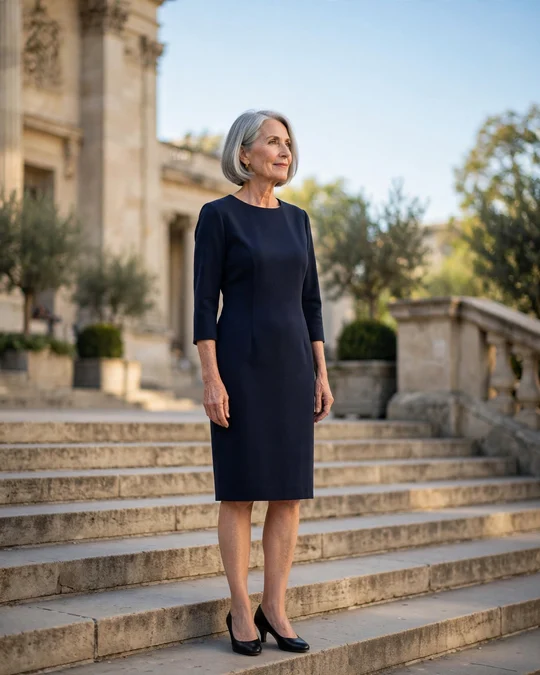
The mechanism is appropriateness as power: Streep’s public style has run for decades on the principle that the right dress for the room beats the most striking dress in the room.
Technically this works because well-cut, mid-tone pieces with matte fabrics absorb light instead of reflecting it — the eye goes to the face, not the outfit, which is exactly where a woman who communicates for a living wants it.
The steal is the hemline-and-neckline discipline: her skirts land at or just below the knee (roughly 58–62 cm from the waist on most women), her necklines stay above the collarbone, her sleeves have substance. Nothing about this is about hiding — it is about deciding the face wins every time.
A navy sheath with three-quarter sleeves will do more professional heavy lifting than five trend pieces combined.
- Signature: sheath or wrap dress, knee length, matte crepe
- Palette: navy, charcoal, aubergine, black — never neon
- Finish: low closed-toe heel (4–5 cm), one classic bag
Copy it: One matte, knee-length dress in a mid-tone neutral — and let your face do the talking.
How to style it:
- Fit the shoulders first — a sheath that fits the shoulder can be taken in everywhere else for £15–£30.
- Keep the neckline simple: scoop, V or boat — one, not layered.
- Match shoe and bag in tone (not necessarily colour): navy with navy, black with black.
Skip it if you find neutrals draining — borrow her discipline, not her palette, and run it in teal or burgundy. Best for: work events, family occasions, anywhere the word “appropriate” is in the invitation.
3. Jodie Foster — quiet, androgynous ease
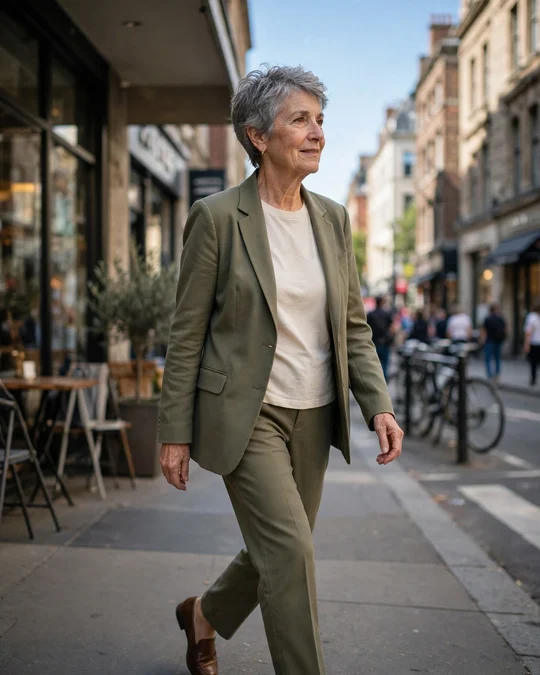
The mechanism is borrowed proportion: Foster’s signature is menswear-adjacent ease — relaxed blazers, straight trousers, simple shirts — cut for a woman’s body but carrying masculine confidence. It works because slightly oversized shoulders and a straight leg create one long, unbroken line from shoulder to shoe, and that line reads as self-possession.
Nothing nipped, nothing fussy, nothing performing femininity on demand.
The practical steal is the single-breasted blazer with a soft shoulder — no padding, no structure fighting you — over a plain crew-neck tee and straight-leg trousers. Keep the whole thing in one muted family (grey on grey, olive on olive) and add one sharp shoe: a loafer or low boot.
She wears almost no visible jewellery, which is itself the lesson — restraint is the accessory.
- Signature: soft-shoulder blazer + straight trousers
- Palette: grey, olive, charcoal, off-white
- Rule: one sharp shoe, zero competing jewellery
Copy it: A soft-shoulder blazer in your size, straight trousers, plain tee — all one quiet colour family.
How to style it:
- Push the blazer sleeves to just below the wrist bone — a 3 cm roll shows the shirt cuff and slims the arm.
- Trousers should just kiss the top of a loafer or low boot — get them hemmed, don’t fold.
- One watch or one ring. That is the jewellery budget. Spend it well.
Skip it if soft structure makes you feel shapeless — you need the blazer’s line, not its softness, and a nipped waist might serve you better. Best for: gallery visits, travel, dinners where you want to look serious without a suit.
Evening out
Evening is where the icons stop being sensible. These three treat night as permission — Mirren with colour you can see from the street, Parker with combinations nobody else would dare, Bassett with the discipline of a single colour.
For party and evening inspiration with more looks to browse, Helen Mirren’s outfits and Sarah Jessica Parker’s outfits are worth a proper look — each one is a lesson in commitment.
4. Helen Mirren — colour worn like a weapon
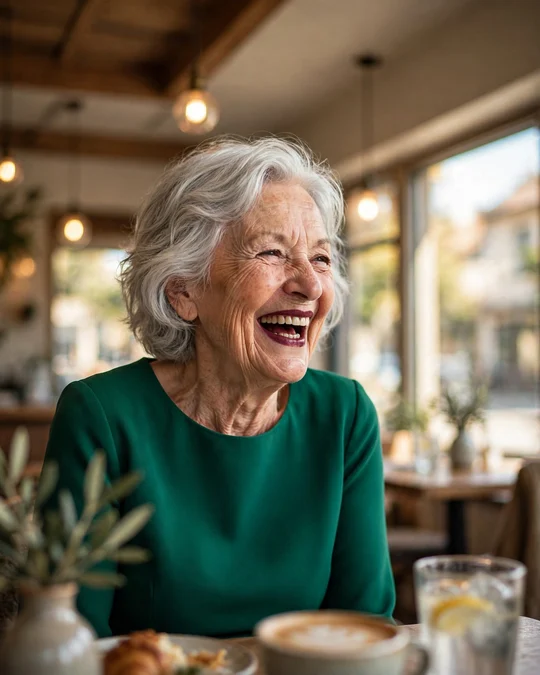
The mechanism is saturation as structure: Mirren wears bold colour — emerald, cobalt, fuchsia, the famous pink hair moment — in simple, well-cut shapes, and the colour does the architectural work that tailoring would otherwise do.
A saturated colour holds its own outline against the light, which is why her looks read “strong” rather than “loud”: the eye registers one decisive block, not competing details.
The steal for evening is the single-saturated-garment rule. One piece in your most flattering saturated shade — a dress, a jumpsuit, a blazer — with everything else (shoes, bag, jewellery) quiet and dark. Keep the fabric matte or lightly textured; shine plus saturation tips into costume.
Her well-documented love of a bold lip in a matching family to the outfit is the finishing move — lipstick that echoes the dress reads as intentional in a way no accessory can.
- Signature: one saturated colour, simple cut, matte fabric
- Shades that work hardest: emerald, cobalt, fuchsia, crimson
- Anchor: dark quiet shoes and bag; lip echoing the garment
Copy it: One garment in your most flattering saturated colour — everything else dark and quiet, lip to match.
How to style it:
- Find your saturation family first: hold fabrics to your face in daylight — the one that makes your eyes look brighter wins.
- Choose the simplest cut you own in that colour — sheath, column skirt, or straight-leg trouser with a matching top.
- Add dark shoes (black or deep navy) and one dark clutch — the quiet frame around the loud picture.
- Finish with a lip in the same colour family, one shade deeper. That is the whole makeup plan.
Skip it if strong colour drains you in evening light — borrow her commitment instead and go all-in on your best neutral (all-black evening is its own weapon). Best for: dinners, parties, celebrations, any room you want to enter rather than arrive in.
5. Sarah Jessica Parker — fearless maximalism, engineered
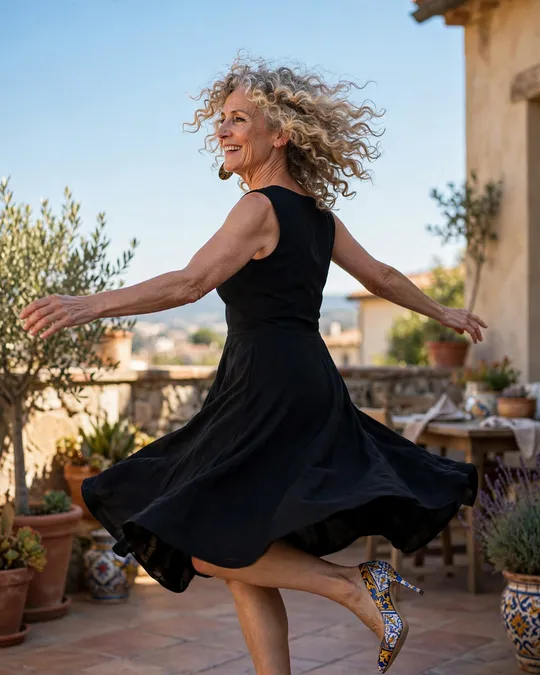
The mechanism is controlled chaos: Parker’s famous looks — the tutu, the giant floral headpieces, the clashing prints — work because every single one obeys a hidden discipline: the palette stays within one family, and the silhouette stays simple while the surface goes wild.
Maximalism fails when it’s loud in every dimension; she is only ever loud in one or two, which is why it reads as art rather than accident.
The steal is the “one loud, everything else loyal” rule. Pick your loud element — a printed skirt, an oversized earring, a dramatic shoe — and make every other choice serve it: same palette, quieter textures, simple hair.
Her most wearable lesson is actually the shoe: a statement shoe with an otherwise simple outfit changes the entire read of the look for a fraction of the risk of a statement dress.
- Signature: one loud element, loyal supporting cast
- Easiest entry: statement shoes + simple black dress
- Discipline: one palette family, simple hair
Copy it: One brave element — loudest shoes you dare — with everything else in the same quiet family.
How to style it:
- Choose the loud element and name what makes it loud — print, scale, or colour.
- Build the rest of the outfit from the loud element’s palette, 2–3 shades quieter.
- Keep hair and makeup simple — a clean ponytail or smooth blowout, one lip colour.
Skip it if you feel ridiculous rather than thrilled — maximalism only works when the wearer is in on the joke with delight, not doubt. Best for: parties, openings, nights with friends who will love it, any evening that needs a story.
6. Angela Bassett — monochrome power tailoring
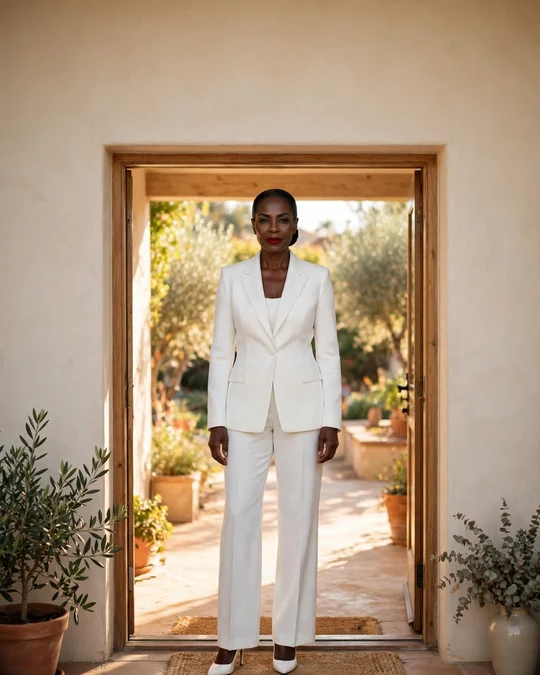
The mechanism is the unbroken line: Bassett’s signature red-carpet move is head-to-toe monochrome — suit, shoe, sometimes even the bag — in white, black or a deep jewel tone. One colour from shoulder to shoe erases every horizontal break in the silhouette, which adds a visual 3–4 cm of height and makes the posture read as absolute.
It is optical engineering disguised as a suit.
The steal is simpler than the red carpet suggests: a trouser suit (or a dress plus matching jacket) in one colour, with shoes in the same tone. The fabric must have some body — crepe, stretch suiting, a heavy satin — because monochrome shows every wrinkle and sag.
Her secondary lesson is grooming as architecture: sleek hair, defined brow, one strong lip — the face gets the same unbroken-line treatment as the outfit.
Good to know: monochrome works in any size and at any budget — the effect comes from the single colour, not the label. The one thing it demands is fit: take the trousers to a tailor (waist in, hem to the shoe) and the look doubles in impact for the price of two alterations.
- Signature: head-to-toe monochrome suit, same-tone shoes
- Fabric: crepe or stretch suiting with body — no cling, no shine
- Face: sleek hair, defined brow, one strong lip
Copy it: One colour, shoulder to shoe — suit, dress-plus-jacket, even trousers-plus-knit — with shoes in the same tone.
How to style it:
- Pick your monochrome family: white (boldest), black (safest), or a deep jewel (most flattering).
- Match the shoe tone as closely as possible — nude-for-you counts as matching in white or cream families.
- Pull hair sleek or smooth — the silhouette needs a clean frame at the top.
- One lip colour with presence. Everything else on the face stays quiet.
Skip it if all-over white feels unforgiving in your climate or life — black monochrome delivers 90% of the effect with none of the maintenance anxiety. Best for: evening events, milestone birthdays, any room where you want to be the exclamation mark.
Big events and galas
The icons of the grand occasion — women who treat a gala like a thesis statement. Yeoh builds architecture, Blanchett wears the museum, Fonda dresses the message. None of it is directly wearable, and all of it is directly stealable, because each one reduces to a single transferable principle.
7. Michelle Yeoh — the architectural gown, translated
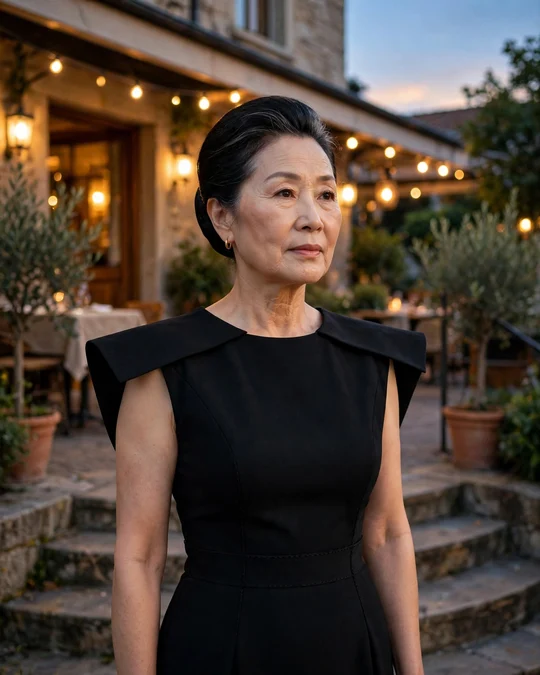
The mechanism is structure as ornament: Yeoh’s gala looks are famous for sculptural construction — a strong shoulder, a defined waist seam, fabric that stands away from the body. Structure works because it creates the silhouette for you; the dress does the posture work, so you stand taller and move more deliberately inside it.
That is why her looks photograph so well — the camera loves a clear outline.
The translation for real galas (weddings, charity dinners, milestone birthdays) is one structured element, not a couture gown: a cocktail dress with a defined waist seam and a slightly extended shoulder, or a column skirt with a peplum top. The fabric needs weight — a bonded crepe, a duchess satin — because structure dies in flimsy fabric.
One sculptural seam beats ten ruffles.
- Signature: sculptural construction — strong shoulder, defined waist
- Fabric: bonded crepe, duchess satin, anything with weight
- Translation: one structured element, not a couture gown
Copy it: One dress with a real waist seam and a real shoulder — in a fabric heavy enough to hold its own shape.
How to style it:
- Shop the seam, not the sparkle: look for a defined waistline and a shoulder with 1–2 cm of extension.
- Check the fabric weight in the fitting room — hold it up; if it collapses, walk away.
- Keep jewellery minimal and hard: one cuff or one pair of drops. The dress is the jewellery.
Skip it if stiff fabrics make you fidget — structure only works when you forget you’re wearing it. Best for: weddings, galas, charity dinners, the events with a photographer.
8. Cate Blanchett — avant-garde tailoring, tamed
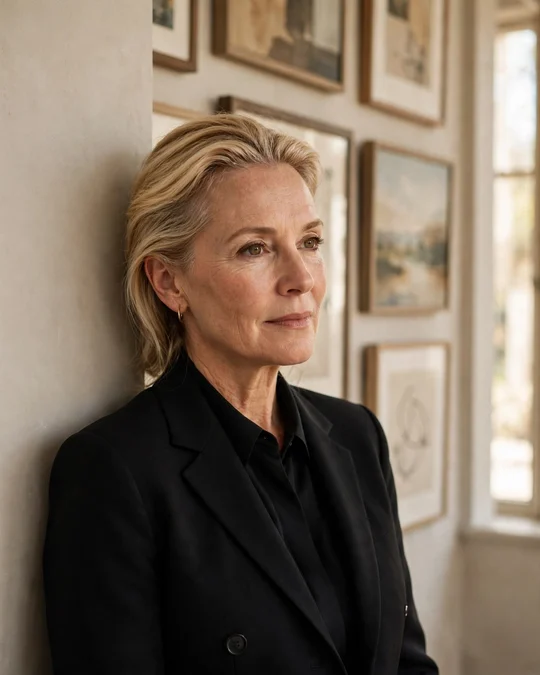
The mechanism is one surprise: Blanchett’s most memorable looks always contain exactly one unconventional element — an asymmetric neckline, a cape-back jacket, trousers in an unexpected proportion — floating in an otherwise impeccable, classic outfit. The surprise works because contrast needs a calm background; one oddity in a sea of perfection reads as genius, while three oddities read as confusion.
The tame translation: take your most reliable classic outfit (the black suit, the navy dress) and swap one element for its interesting cousin — the blazer becomes the one with the asymmetric closure, the trousers go wide-leg, the top gets one dramatic sleeve. Everything else stays exactly as reliable as before.
This is the lowest-risk way to look fashion-forward, because 90% of the outfit is already proven on you.
- Signature: one unconventional element in a classic frame
- Best surprises: asymmetric closure, wide-leg proportion, one dramatic sleeve
- Ratio: 90% proven, 10% daring — never more
Copy it: Your most reliable outfit, with exactly one element swapped for its interesting cousin.
How to style it:
- Lay out the reliable outfit you wear when you need to look right.
- Identify the single element to swap — blazer, trouser, or top.
- Choose the interesting version in the same colour as the original — colour change plus shape change is two surprises, and the rule is one.
- Wear it to something low-stakes first — a dinner, not the wedding — and watch how it feels.
Skip it if you genuinely love your classics exactly as they are — not every wardrobe needs a surprise, and hers is a choice, not a requirement. Best for: art events, fashion-forward invitations, days you want to feel interesting.
9. Jane Fonda — statement dressing with intent
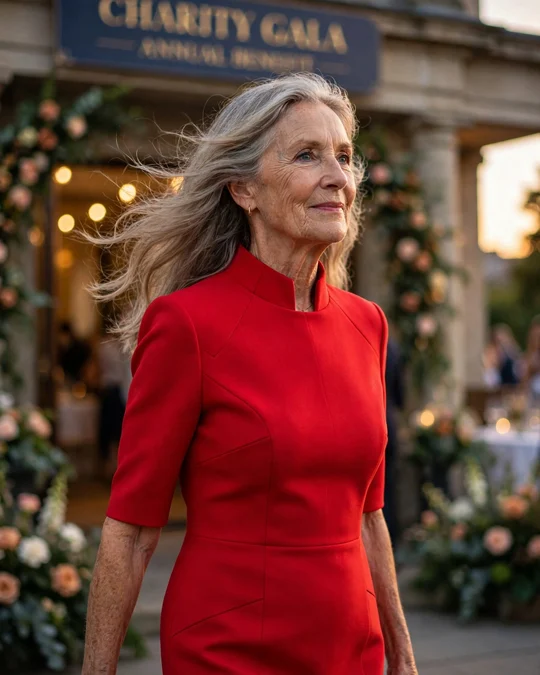
The mechanism is dressing for something: Fonda’s style has always carried a message — the activism-era looks, the later red-carpet gowns worn with visible conviction. The principle transfers cleanly: an outfit chosen with intent (I am here to be seen, to celebrate, to stand for something) photographs and registers completely differently from an outfit chosen by default. Intention is visible.
People can tell.
The practical version is the occasion uniform: decide before you dress what the event is for — celebration, solidarity, joy — and let one element carry it. A red dress for the fundraiser. The good suit for the day you speak up.
Metallics for the night that is purely about pleasure. Fonda’s other lesson is maintenance as message: her famous fitness is part of the style, because a body that moves well makes every garment look intentional.
- Signature: the outfit carries a declared intent
- Method: name the occasion’s purpose, dress one element to it
- Underrated: posture and movement as part of the look
Copy it: Before you dress, name what the occasion is for — then let one element of the outfit answer it.
How to style it:
- Say the intent out loud: “tonight is for celebration” / “today I need to feel strong”.
- Choose the one element that carries it — colour, shine, or structure.
- Stand in it for two minutes before you leave. If your shoulders drop, the outfit is right.
Skip it if the whole thing feels too earnest — intent can be private; nobody needs to know your red dress means business but you. Best for: fundraisers, milestone events, any day that deserves better than default.
Weekend off-duty
The icons of the unguarded hours — women whose weekend style has more personality than most people’s red carpet. Keaton turned menswear into a personal language, Curtis made silver hair and clean lines a whole aesthetic, and Davis wears weekend colour the way other people wear perfume: because it makes the day better.
10. Diane Keaton — menswear, worn entirely her way

The mechanism is borrowed structure, personalised: Keaton’s famous formula — the white or pinstripe suit, the turtleneck, the gloves, the hat — works because masculine proportions (long line, covered up, structured shoulder) are always interrupted by one unmistakably feminine flourish. The tension between the two is the whole style.
Without the flourish it’s a costume; without the structure it’s just accessories.
The wearable version needs only two pieces: one borrowed-from-the-boys garment (a white blazer, a pinstripe trouser, an oversized shirt) and one flourish (a great hat, gloves, a bold lip, an interesting shoe). Keep the palette restrained — her world is black, white, camel — so the proportions do the talking. The gloves are optional; the attitude is not.
- Formula: one menswear piece + one feminine flourish
- Palette: black, white, camel — proportions do the talking
- Flourish options: hat, gloves, bold lip, interesting shoe
Copy it: One borrowed-from-the-boys piece and one flourish — a white blazer plus a hat will change your whole Saturday.
How to style it:
- Start with the menswear piece: white blazer, pinstripe trouser, or an oversized white shirt worn open over a tee.
- Add the flourish second — and commit to it fully. A half-hearted hat is worse than no hat.
- Keep everything else simple: dark trouser or jean, flat shoe, minimal bag.
- Check the mirror for the tension: structured somewhere, soft somewhere. That contrast is the look.
Skip it if hats and gloves make you feel costumed — the flourish can be as small as a red lip, but it has to be there. Best for: weekends, markets, museum days, any Saturday with personality.
11. Jamie Lee Curtis — sleek, silver, and entirely modern

The mechanism is the hair as the accessory: Curtis’s famous silver pixie does the decorative work that other women assign to jewellery, scarves and prints. Because the hair is the statement, everything else can be radically simple — a black turtleneck, a great coat, clean trousers — and the whole look still registers as designed.
Grey hair, worn with total intention, is the cheapest statement piece in fashion.
The steal has two halves: first, a haircut with real architecture (the pixie works because it has shape — a grown-out pixie loses the effect in about 4 weeks, so the trim interval matters); second, the simplified wardrobe it unlocks. With statement hair, your clothes can drop to basics: black, white, one great coat.
Add one pair of interesting earrings and you are done — the earring plus the hair is the whole jewellery plan.
- Statement: architectured silver/grey hair, worn with intent
- Wardrobe: radically simple — black, white, one great coat
- Maintenance: pixie trim every 4–5 weeks; purple shampoo weekly
Copy it: Let your grey be the statement — get the cut shaped properly, then simplify everything it sits above.
How to style it:
- Book the cut with a stylist who does short hair well — bring a photo of the shape, not just the length.
- Keep a purple shampoo in rotation once a week to keep silver bright, not yellow.
- Build the uniform: black turtleneck, straight trouser, one great coat — then stop shopping.
Skip it if you are not ready to commit to the grey — this only works at full intention; in-between colour reads as neglect, not style. Best for: everything — this is the lowest-maintenance high-impact look on the list.
12. Viola Davis — colour that celebrates

The mechanism is joy as strategy: Davis’s documented love of vivid colour — emerald gowns, cobalt suits, fuchsia on the carpet — works on a principle most women forget: colour changes the wearer’s mood before it changes anyone else’s. Studies of colour psychology aside, the observable effect is simpler — a woman in a colour she loves stands differently.
The garment lifts the posture, and the posture sells the garment.
Her technical lesson is saturation matched to skin: on deep skin tones, fully saturated jewel colours glow without washing out, which is why her boldest looks never fight her. The transferable rule for every skin tone is the same — find your saturation level (the intensity where your eyes look brightest in the mirror) and spend your colour budget there.
One vivid piece on a weekend beats a closet of maybes.
- Signature: fully saturated jewel colour, worn with joy
- Rule: match saturation to skin — eyes brightest wins
- Weekend version: one vivid knit, shirt or trouser
Copy it: One vivid piece in your brightest saturation — wear it on the next ordinary Saturday and watch the day change.
How to style it:
- Hold saturated fabrics to your face in daylight — emerald, cobalt, fuchsia, amber — and note which makes your eyes look brightest.
- Buy that colour in one weekend piece: a knit, a shirt, or a wide-leg trouser.
- Wear it with your simplest neutrals — white, denim, or black — and let it be the whole story.
Skip it if vivid colour genuinely unsettles you — borrow Davis’s joy instead and spend it on print or texture. Best for: weekends, holidays, grey days, any Saturday that needs lifting.
Style-icon rules you can use this week
You don’t need twelve new outfits. You need five habits, borrowed from the women above, that change how your existing wardrobe performs.
- Name your signature. Write down the one thing you want to be known for — the colour, the silhouette, the hair. Dress toward it for 30 days and it becomes true.
- Fit beats fashion, every time. Every woman on this list wears clothes that fit. A £25 alteration on a £60 blazer outperforms a £200 jacket off the rack.
- One loud, the rest loyal. Before you leave, count the loud elements. If there are two, demote one.
- Match the occasion’s intent. Ask what the day is for before you dress for it. Intention shows.
- Maintain the statement. Silver hair needs its trim every 4–5 weeks; a pixie needs its shape; monochrome needs its press. The statement is a commitment, not a purchase.
- Photograph your wins. When an outfit works, take a mirror photo. In three months you’ll have a personal lookbook better than any magazine.
Your 5-step icon routine:
- Pick your icon for the week — the one whose mechanism matches your calendar.
- Pull three pieces from your closet that could run her formula.
- Try the formula once, in full, before the event — never debut on the day.
- Photograph it. Adjust one thing. Photograph again.
- Wear it out. Notice how you stand. That’s the mechanism working.
The bottom line
If your weeks are full and your mornings are short, steal from Jamie Lee Curtis (#11): let your hair be the statement and simplify everything below it — it’s the highest impact per minute on this list.
If your life runs on evenings out, steal from Helen Mirren (#4): one saturated colour, worn with total commitment, will carry you through any room.
And if you’re somewhere in between — a working woman with a real social life — steal from Angela Bassett (#6): monochrome tailoring is the one formula that works for the boardroom and the birthday party without changing a thing.
If I had to pick one woman to shadow for a month, I’d pick Curtis — because her mechanism is the most transferable: one maintained statement, everything else quiet, zero daily decisions. That is not just style. That is freedom.
📌 Pin this for the next time you stand in front of your closet with nothing to wear — twelve icons, twelve stealable formulas, one for every kind of week.
Frequently asked questions
Which style icons over 50 are best to copy for everyday life?
For real life, copy Jennifer Aniston (#1), Jodie Foster (#3) or Jamie Lee Curtis (#11) — their formulas run on basics you likely own and need no occasion. If your everyday includes professional settings, add Meryl Streep (#2). Save Mirren, Parker and Yeoh for evenings; their mechanisms are built for rooms with lighting, not school runs.
Can I wear bold colour like Helen Mirren if I’m over 60?
Yes — with two conditions. First, the colour must be in your saturation family (hold fabrics to your face in daylight; the winner makes your eyes look brighter). Second, keep the cut simple and the fabric matte — bold colour in a fussy cut reads as costume. If full saturation feels like too much, start with Mirren’s mechanism at half strength: a saturated accessory (scarf, shoe, lip) with a neutral outfit.
How do I try maximalism without looking like I’m in costume?
Follow Parker’s hidden discipline: one loud element, everything else loyal to its palette, simple hair. If you’re nervous, start with the lowest-risk maximalism — statement shoes with a simple black dress — and wear it somewhere friendly first. If you catch yourself apologising for the outfit (“it’s a bit much, isn’t it?”), demote one loud element. The outfit should feel like delight, not a dare.
Does monochrome dressing work for plus-size women over 50?
It works especially well: the unbroken line of Bassett’s formula (#6) is one of the most elongating effects in dressing, and it doesn’t depend on size at all. The keys are fabric with body (crepe, stretch suiting — nothing clingy) and fit (waist taken in, hem to the shoe). Black monochrome is the most forgiving starting point; a deep jewel tone like emerald or sapphire is the most flattering for most skin tones.
How often should I trim a pixie to keep it looking like Jamie Lee Curtis’s?
Every 4–5 weeks — the architecture of a pixie is what makes it a statement, and it softens fast. Between trims, a pea-sized amount of matte styling cream worked through dry hair keeps the shape. If you’re growing out grey at the same time, a purple shampoo once a week keeps silver bright rather than yellow, which is half the Curtis effect.
What’s the easiest Diane Keaton look to copy on a budget?
The white blazer plus dark trouser plus one flourish — the blazer does 80% of the work. A white or cream blazer from any high-street shop, dark straight-leg trousers you already own, and the flourish of your choice: a wide-brim hat is the most Keaton, a bold red lip the cheapest, interesting flat shoes the most wearable. Total new spend can be one blazer.
I’m petite — do these icons’ formulas still work for me?
Yes, with proportion adjustments. For monochrome (#6) and the Aniston uniform (#1), keep the trouser hem exactly at the shoe top — pooling fabric shortens petite frames more than anything. For Keaton’s menswear (#10), choose the cropped or 7/8-length trouser so the borrowed proportion doesn’t swallow you. And for Yeoh’s structure (#7), a defined waist seam is even more important on a petite frame — it’s what keeps architecture from becoming box.