Helen Mirren Style Outfits: 10 Looks to Copy at Any Budget
I’ll be honest: most “copy a celebrity’s style” guides fail before they start, because they copy the woman, not the outfit — her height, her budget, her full-time stylist. That’s exactly why helen mirren style outfits are the rare exception. Her signatures are formulas, not fantasy: a blazer, a bold colour, a coat that does all the talking.
And she has spent decades dressing women like us — over 50, over 60, fully grown — while insisting clothes should be fun, not fearful. Here are the 10 formulas worth stealing, ranked from zero effort to worth-the-splurge.
Every look below comes with the exact pieces to shop for and a “Copy it” line you can take to a store or a tailor. And the budget promise in the title is real: most of these cost under £150 if you shop cleverly, and the splurge pieces are the ones genuinely worth saving for.
Five to try first
- The zero-effort upgrade: the statement necklace over a plain knit (#2)
- The instant polish: the sharp blazer, white shirt and dark jeans (#1)
- The one new piece: the long-sleeved jewel-tone maxi (#4)
- The coat that does the talking: the statement wool coat (#7)
- The showstopper: the cobalt blue evening gown (#10)
Contents
Why do helen mirren style outfits actually work?
She dresses from the neckline up. Mirren’s most famous trick is also her most copyable: she treats everything from the collarbone down as a frame, and puts the interest — colour, jewellery, a statement neckline — up near the face.
That is why her looks photograph so well and why they suit women whose faces we actually want people to look at. The same principle sits behind our whole style icons over 50 hub: the women worth copying build outfits around their faces, not their figures.
Long sleeves are a strategy, not a cover-up. Her love of sleeves is often misread as modesty; it is proportion. A sleeve to the wrist bone lengthens the arm line, balances a bare neckline, and lets a bold dress stay elegant rather than exposed.
If you have ever felt a sleeveless dress makes you look “finished”, the sleeve is usually the missing piece.
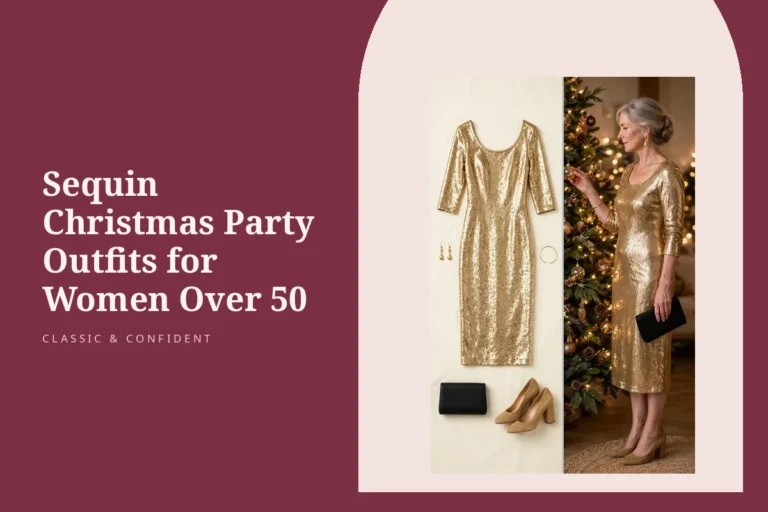
She commits to colour. Most of us wear black to events and call it safe; Mirren wears emerald, ruby, cobalt. The mechanism is flattering rather than brave: saturated colour reflects a clean light onto the face, while black near the face can cast shadows and drain colour.
If jewel tones scare you, start with the darkest version of the colour — a deep teal reads as “safe” but performs like a jewel tone.
One hero piece per outfit. Look closely and her outfits never have two loud elements competing: a statement coat with quiet clothes underneath, a bold necklace with a plain knit, a patterned dress with bare shoes. That restraint is what keeps the look expensive.
It is also what separates her from Diane Keaton’s menswear-inspired style, which piles on layers — pick the approach that suits your temperament, not hers.
She wears her hair like an accessory. That silver bob is part of every outfit, which is why tonal silver-grey dressing looks so intentional on her. You do not need her hair to copy the principle: whatever your hair colour, one outfit a week in a matching tone will make your hair look like a styling decision.
Our Helen Mirren style guide goes deeper into her specific signatures if you want the full picture.
At a glance
| Look | Signature piece | Effort / budget |
|---|---|---|
| #1 | Blazer, white shirt, dark jeans | Zero effort — wardrobe staples |
| #2 | Statement necklace over plain knit | Zero effort — one necklace |
| #3 | Silver-grey tonal outfit | Zero effort — colour matching |
| #4 | Jewel-tone maxi dress, long sleeves | One purchase, £60–£150 |
| #5 | Bold printed midi dress | One purchase, £50–£130 |
| #6 | Tailored trouser suit | One purchase + tailoring, £120–£300 |
| #7 | Statement wool coat | Worth the splurge, £150–£400 |
| #8 | Tweed jacket and boots | Worth it, £100–£250 |
| #9 | Long-sleeved red dress | Worth it for events, £70–£200 |
| #10 | Cobalt blue evening gown | The splurge, £90–£250 |
What can you copy with zero effort?
These three looks need nothing you don’t already own — just a new combination and, in one case, a single necklace. Start here this week.
1. The Sharp Blazer, White Shirt and Dark Jeans

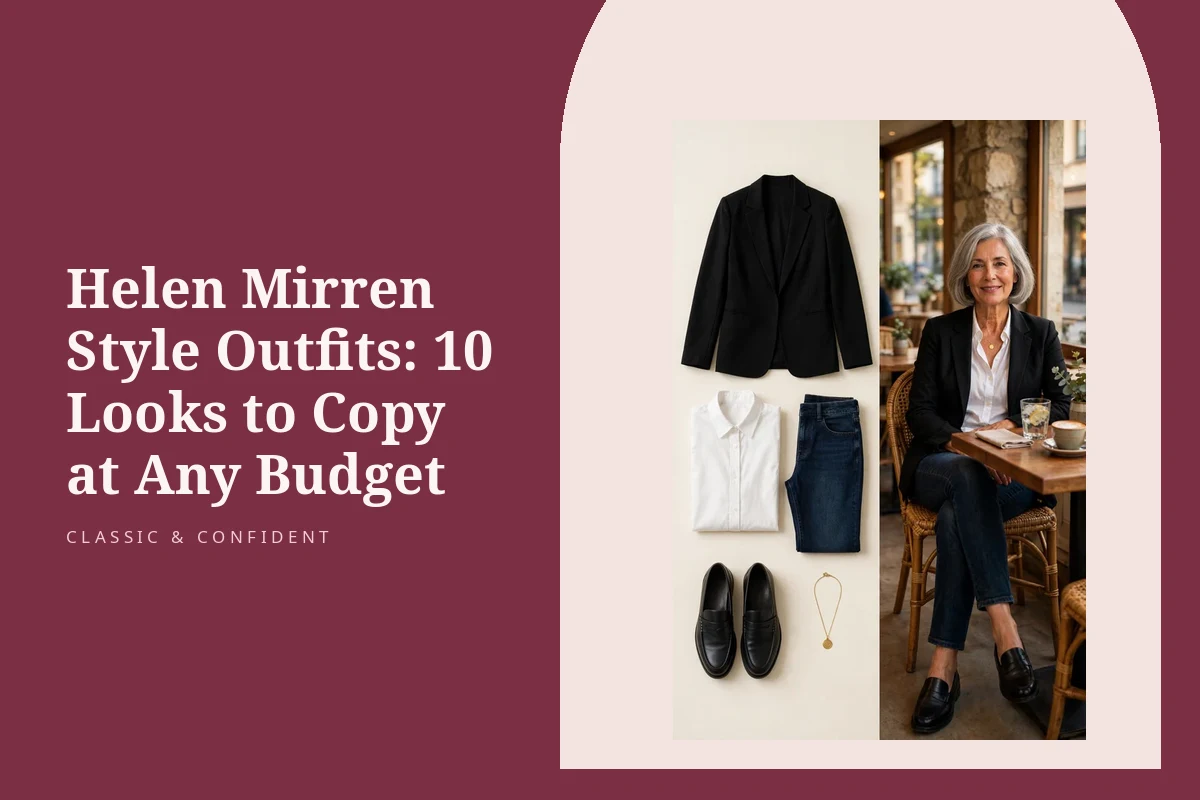
This is off-duty Mirren: structured shoulders, crisp white, dark denim, done. The mechanism is all in the shoulder line — a blazer with even a light shoulder pad widens the top of the silhouette, which makes the waist look narrower by comparison and pulls the eye up to the face.
The white shirt matters more than you’d think: white near the face bounces light upward, softening shadows under the chin. Dark jeans do the opposite job at the bottom, receding visually so the legs look slimmer.
Fit is the whole game here. A blazer that hits 63–66 cm long (about mid-hip on most women) keeps the leg line long; longer and you look swamped, shorter and it reads like a jacket from a suit set. Keep the blazer unstructured — no stiff lining — so it drapes rather than boxes.
Jeans should be dark indigo with an inseam of 28–30 inches and no fading at the thigh.
- Blazer: single-breasted, 1–2 buttons, unstructured, mid-hip length
- Shirt: white cotton poplin with a proper collar — skip the stretch blends
- Jeans: dark indigo, straight or slim leg, 28–30 inch inseam
- Shoes: loafers or ballet flats; sleeves pushed up one turn
Copy it: black or navy unstructured blazer, white cotton shirt with a real collar, dark indigo jeans, one pendant necklace, loafers. Tuck the shirt, roll the sleeves once.
How to style it:
- Tuck the shirt fully and fasten only the middle blazer button — the open V at the neck lengthens the torso.
- Push the blazer sleeves up one turn to the forearm; visible wrists make the whole outfit look relaxed rather than corporate.
- Add one necklace and stop. Mirren’s version is always one piece, never a stack.
Skip it if your blazer is boxy or overlong — a poor blazer ruins this faster than any other piece. Tailor the one you have (sleeves to the wrist, £15–£25) rather than copying with the wrong shape.
Best for: lunches, gallery visits, any day you want to look pulled together in ten minutes.
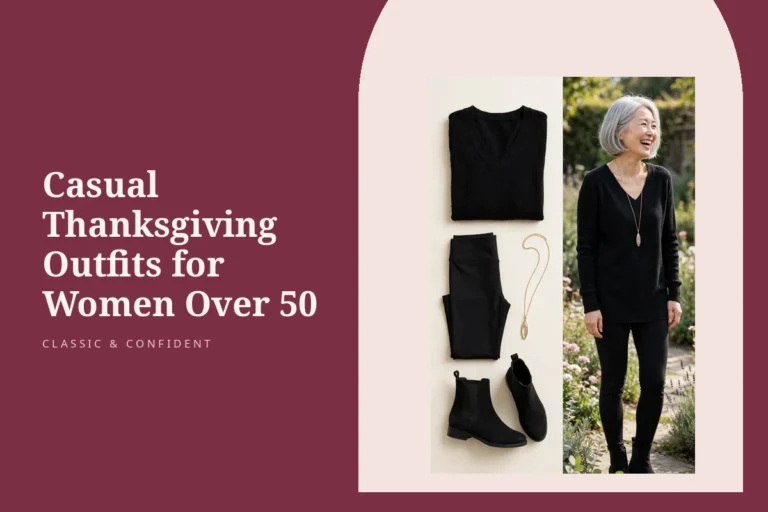
2. The Statement Necklace Over a Plain Knit

Mirren wears enormous necklaces with the confidence of a woman who knows the trick: a statement necklace fixes the viewer’s gaze at exactly one point, and everything else in the outfit disappears.
The mechanism is misdirection — the eye cannot take in a 5 cm pendant and a plain jumper at the same time, so the plain jumper (and everything about it you might fuss over) simply stops registering. It is the cheapest face-framing device in this whole article.
- Necklace: 45–50 cm chain, pendant or cluster 4–6 cm across
- Knit: fine-gauge crew or boat neck in navy, charcoal or black
- The rule: necklace sits on fabric, never on bare skin, for daytime
Copy it: one oversized necklace (stone, resin or bold metal), a plain dark knit, everything else quiet — no earrings bigger than a stud.
How to style it:
- Lay the necklace on the knit before you put it on — if the pendant covers less than a third of the chest width, it will look lost.
- Keep the neckline high and plain: a crew or boat neck gives the necklace a clean stage.
- Shrink the earrings to studs and skip the bracelet on that wrist — one hero piece, always.
- For evening, swap the knit for a plain black top and move the same necklace to bare skin at the collarbone.
Skip it if the necklace is dainty — a small pendant on a plain knit reads as nothing. This look needs scale to work.
Best for: dinners where you want to look dressed without buying a dress.
3. The Silver-Grey Tonal Outfit
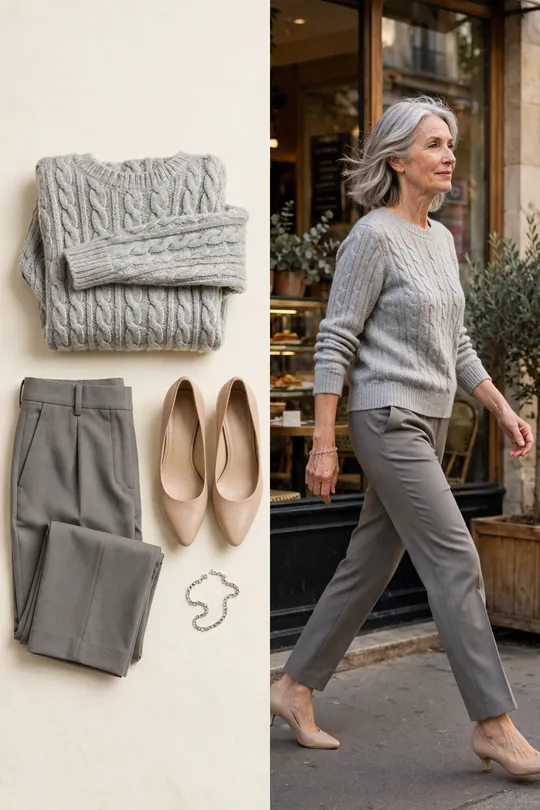
Nobody wears her own hair colour as an outfit strategy like Mirren does. Head-to-toe silver-grey is her signature move, and the mechanism is pure optical illusion: one unbroken column of colour from shoulder to shoe reads as a single vertical line, which the eye follows downward and registers as taller and leaner.
When the colour also echoes her silver hair, the whole thing looks deliberate in a way mixed neutrals never quite manage.
You don’t need silver hair to steal this — you need commitment to one family of grey. Mix textures so it doesn’t read as a uniform: a soft knit with tailored trousers, or a silk blouse with a wool skirt. Keep every piece within two shades of its neighbour.
If your hair is dark, this still works; it just reads as “chic column” rather than “hair-matched”, which is still a win.
- Palette: silver, pewter, dove and charcoal — all within two shades
- Textures: mix at least two (knit + tailoring, silk + wool)
- Shoes: grey or nude — black shoes chop the column in half
Copy it: grey knit, grey tailored trousers or skirt, grey or nude shoes, silver jewellery. Two textures minimum, zero black.
How to style it:
- Pull every grey piece you own onto the bed and hold them in daylight — keep only the ones within two shades of each other.
- Pair the softest texture on top (knit) with the sharpest on the bottom (tailored trousers) for balance.
Skip it if your greys clash warm and cool — a warm taupe next to a cool silver reads as a mistake, not a column.
Best for: women with silver or white hair who want their hair to look like a styling choice.
What’s worth one new purchase?
Each of these needs exactly one new piece — everything else comes from your wardrobe. Shop secondhand first; Mirren herself is on record favouring pre-loved finds, and tailoring a £30 charity-shop dress beats a £120 new one that fits badly.
4. The Long-Sleeved Jewel-Tone Maxi Dress

This is the red-carpet Mirren: emerald, ruby or sapphire, sleeves to the wrist, floor-skimming. The mechanism is colour physics — saturated jewel tones reflect clean, bright light onto the face, while black absorbs light and can cast shadows under the eyes and chin.
That is why she so often outshines women half her age in black: her face is literally better lit. The long sleeve balances the drama so the dress reads elegant rather than exposed.
Length matters enormously: the hem should skim the top of the shoe (around 140–150 cm from shoulder on most women) — shorter breaks the column, longer and you trip. Sleeves should end at the wrist bone, not mid-hand.
In the shops, try the darkest version of the jewel tone first: a deep teal or oxblood feels “safe” to colour-shy women but performs exactly like emerald or ruby.
- Fabric: crepe or matte jersey — never shine, which photographs harshly
- Sleeves: full length to the wrist bone
- Hem: skims the shoe top, 140–150 cm from shoulder
- Budget: £60–£150 new, £25–£60 pre-loved
Copy it: one long-sleeved maxi in emerald, ruby, sapphire or deep teal; matte crepe; nude or metallic low heels; no necklace — let the colour do the work.
How to style it:
- Try the dress with the shoes you’ll actually wear and check the hem in a full-length mirror — alterations on a maxi cost £12–£20 and transform it.
- Add a slim belt at the natural waist only if the dress has no waist shaping; otherwise leave it clean.
- Keep jewellery to earrings — the colour is the statement, and a necklace competes with it.
Skip it if the fabric is shiny satin — shine plus jewel tone plus maxi reads costume. Matte is what keeps it modern.
Best for: weddings, galas, any evening where you want to be the best-dressed woman in the room.
5. The Bold Printed Midi Dress

Mirren’s prints are never shy — big florals, tropicals, geometrics — and she wears them with the ease of a woman who cracked the code. The code is ground colour: a print on a dark navy, black or forest ground reads sophisticated because the dark base recedes, while the same print on white or pastel reads loud.
The dark ground also does the practical work of camouflage — a busy pattern on a dark base hides every lump and line the way a solid never can.
Keep the hem at midi — 100–115 cm from shoulder, hitting mid-calf. Shorter and a big print can look girlish; longer and it can look like evening wear.
Wear it with bare legs in summer or opaque dark tights (60–80 denier) in winter, and keep the shoe plain: a nude or black pump, never a patterned shoe with a patterned dress.
- Print: large-scale floral or geometric on a dark ground
- Hem: midi, 100–115 cm from shoulder
- Sleeves: elbow length or longer — never cap sleeves with a big print
- Budget: £50–£130 new, £20–£50 pre-loved
Copy it: one dark-ground printed midi, elbow-length sleeves or longer, plain nude or black shoes, one quiet bracelet. Let the print be the only loud thing.
How to style it:
- Hold the dress against your face in the shop mirror — if the print’s brightest colour sits near your eyes and flatters your skin, it’s yours; if it washes you out, walk away.
- Add a belt only if the dress is shapeless — a 2–3 cm plain belt at the natural waist; otherwise leave the print uninterrupted.
- In winter, add 60–80 denier tights in the print’s darkest colour and a plain coat — the coat should never have a print of its own.
- Skip the necklace; a print at the neckline plus jewellery is visual noise. Earrings only.
Skip it if the print is small and ditsy on a light ground — that reads vintage-shop cute, not Mirren bold.
Best for: daytime events, holidays, any occasion where a solid dress would feel dull.
Good to know
Mirren’s team reportedly tailors nearly everything she wears — and you can steal that too. A £20 alteration (hem, sleeve, waist taken in 2–3 cm) makes a £40 dress look like a £400 one. The copyable lesson isn’t the designer label; it’s the fit.
6. The Tailored Trouser Suit
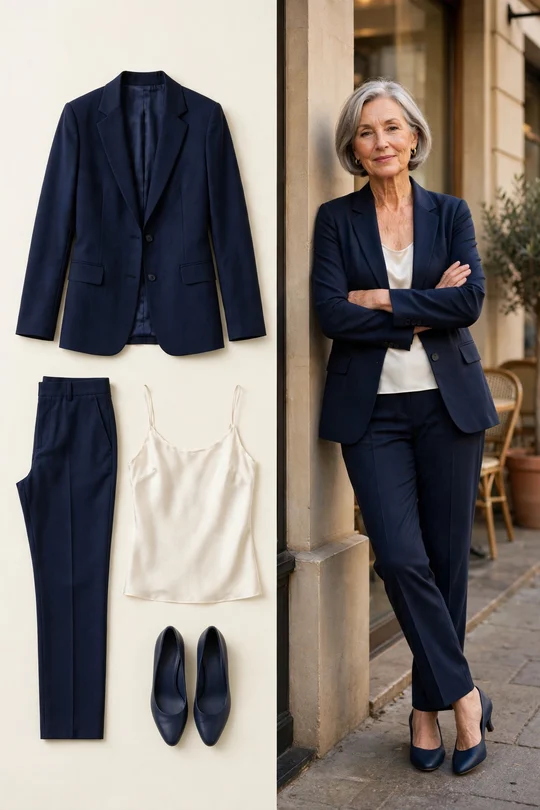
Her suits are never corporate — they’re armour. The mechanism is tailoring geometry: a jacket nipped 2–3 cm at the waist and trousers cut straight from the hip create an hourglass even where nature didn’t provide one.
And a suit in one colour does the same vertical-line trick as the tonal outfit in look #3, except with structure, which photographs as authority.
The modern update she nails is the softness: her suits are rarely stiff-shouldered or heavily lined. Look for a half-lined jacket with a natural shoulder, trousers with a 2–3 cm break over the shoe (no pooling), and a jacket length that covers the hip — 65–70 cm from the shoulder on most women.
Navy and charcoal flatter more faces than black.
Several of these outfits lean on silk for their ease — our how to wear silk over 50 covers the care and the cuts that keep it looking effortless.- Jacket: half-lined, natural shoulder, nipped waist, hip-covering length
- Trousers: straight leg, 2–3 cm break, no pooling at the ankle
- Underneath: silk-look shell or plain fine knit — never a fussy blouse
- Budget: £120–£300 new plus £30–£50 tailoring, £40–£100 pre-loved
Copy it: a navy or charcoal trouser suit, half-lined, with £30–£50 of tailoring booked before you buy. Wear with a plain shell and low heels.
How to style it:
- Buy for the shoulders and hips, not the waist — a tailor can take a waist in 2–3 cm cheaply, but shoulders cost £60+ to alter.
- Wear the jacket open with a plain shell underneath for daytime; buttoned with nothing under the lapels for evening.
Skip it if the shoulders are stiff and padded — that reads 1980s boardroom, not modern authority.
Best for: work events, formal lunches, any room where you want to be taken seriously.
What should you invest in once?
These four are the investment pieces — the ones you’ll still be wearing in ten years. Buy the best you can afford and look after them, and the cost-per-wear drops below the cheap alternatives within two seasons.
7. The Statement Wool Coat

If you only invest in one thing from this list, make it the coat. Mirren’s coats are famous because a coat is the only garment strangers see first and longest — in winter it IS your outfit.
The mechanism: a coat with a strong shoulder and a defined waist creates the entire silhouette, so whatever is underneath (jeans, a dress, pyjamas — nobody knows) becomes irrelevant. That is why a great coat makes cheap clothes look expensive.
Her coats share three traits: real wool content (80% or more, which holds its shape and resists pilling), a length that ends at the knee or mid-calf (105–115 cm from shoulder), and a colour with presence — camel, deep red, emerald, or a bold check. A knee-length coat flatters every height; mid-calf suits women 165 cm and over.
- Fabric: 80%+ wool, lined, with a proper collar or lapel
- Length: knee (105 cm) or mid-calf (115 cm) from the shoulder
- Colour: camel, deep red, emerald, or bold check — never plain black if you can avoid it
- Budget: £150–£400 new, £60–£150 pre-loved
Copy it: one knee-length wool coat in a colour with presence, 80%+ wool, sleeves ending at the wrist. Wear open over everything you own.
How to style it:
- Try the coat over your actual everyday clothes in the shop — if it elevates jeans and a jumper, it’s the one.
- Check the sleeve ends at your wrist bone with arms relaxed; coat sleeves cost £20–£30 to shorten and it’s worth doing.
- Wear it open whenever possible — an open coat shows the outfit underneath and looks twice as expensive as a belted one.
Skip it if the wool content is under 50% — it will pill and sag within one season, and the investment is wasted.
Best for: the whole of autumn and winter — the single highest-impact purchase on this list.
8. The Countryside Tweed Jacket and Boots

Off-duty Mirren is gloriously British: a tweed or wool jacket, jeans or cords, proper boots. The mechanism is texture — nubby, flecked fabrics like tweed break up the surface of the body the way a print does, softening every line without trying.
It is the most forgiving fabric a woman over 50 can wear, and it never looks like you’re trying too hard.
- Jacket: tweed or textured wool, hip length, natural shoulder
- Bottom: dark jeans or cords, straight leg
- Boots: ankle or knee, 3–5 cm heel, leather — the one place not to economise
- Budget: £100–£250 total, £40–£100 pre-loved
Copy it: a textured tweed jacket, dark jeans, leather ankle boots with a 3–5 cm heel, and a plain scarf. Weekend uniform, sorted.
How to style it:
- Keep everything else plain — the tweed is the texture and the pattern; a striped top underneath fights it.
- Roll the jacket sleeves once to show a plain cuff — it stops the tweed reading heavy.
- Add one leather piece that matches the boots (bag or belt) and the outfit clicks together.
- In rain, this is your armour: tweed sheds weather and looks better slightly lived-in.
Skip it if the tweed is scratchy against bare skin — wear a long-sleeved base layer underneath, never a sleeveless one.
Best for: weekends, country walks, market days — the anti-precious side of her style.
9. The Long-Sleeved Red Dress for Events
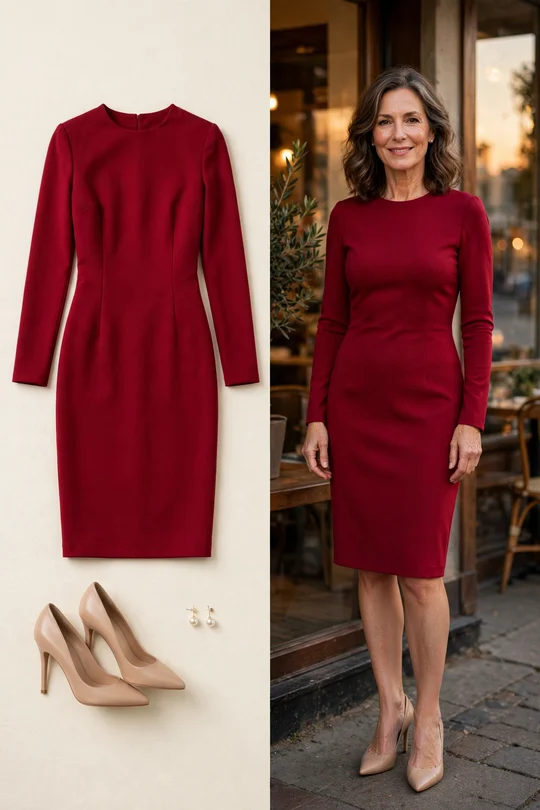
Mirren in red is a cultural event in itself, and the reason red works so hard after 60 is circulation: red near the face increases the appearance of warmth and colour in the skin — it genuinely makes cheeks look rosier and eyes brighter. The mechanism is the same as blusher, scaled up.
And the long sleeve is doing its usual balancing act, keeping the drama elegant.
Choose your red carefully: blue-reds (crimson, cherry) flatter cool skin and silver hair; orange-reds (poppy, tomato) flatter warm skin and golden tones. Hold the fabric to your face in daylight — the right red makes your eyes look clearer in seconds. Keep the silhouette simple: sheath or A-line, knee to midi length, no ruffles competing with the colour.
- Shade: blue-red for cool skin, orange-red for warm skin — test in daylight
- Shape: simple sheath or A-line, knee to midi, long sleeves
- Shoes: nude or black — the dress is the whole outfit
- Budget: £70–£200 new, £30–£80 pre-loved
Copy it: one simple long-sleeved red dress in your red, knee to midi, matte fabric. Nude shoes, small earrings, done.
How to style it:
- Find your red first — drape three reds against your face in daylight and pick the one that brightens your eyes.
- Keep the neckline modest — boat neck or shallow V — so the colour, not the cleavage, is the statement.
Skip it if the red is neon or orange when you’re cool-toned — the wrong red is worse than no red.
Best for: Christmas parties, milestone birthdays, any event where you want to be remembered.
10. The Cobalt Blue Evening Gown
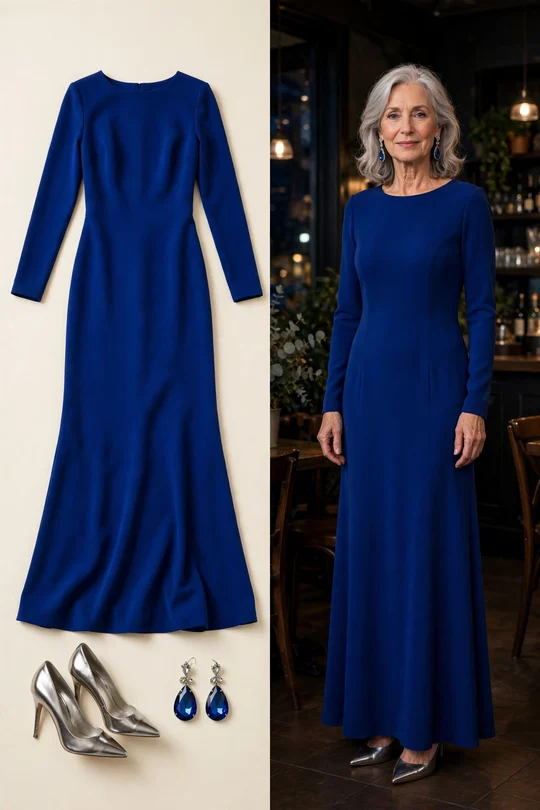
Save the boldest for last: her cobalt blue moments are the ones fashion editors still talk about. Cobalt is the single most flattering evening colour for silver and white hair — the cool blue echoes the hair’s own tones, creating a harmony that reads as intentional and striking.
The mechanism is colour temperature matching: cool hair plus cool colour equals a look that seems designed, while cool hair plus warm orange can clash.
Because the colour is doing all the work, keep everything else minimal: a clean neckline (scoop or shallow V), long sleeves, a simple silhouette, and barely-there jewellery. A floor-length gown at 145–155 cm from shoulder, in matte crepe, with metallic or nude heels. This is the look that makes a woman over 60 the photograph everyone saves.
The worth-it outfits here are mostly dresses done right — our dresses for women over 50 collect the shapes and lengths that flatter without fuss.- Colour: true cobalt — vivid but deep, never navy, never electric
- Shape: clean neckline, long sleeves, simple column or A-line
- Hem: floor-skimming, 145–155 cm from shoulder
- Budget: £90–£250 new, £40–£100 pre-loved
Copy it: a matte cobalt gown, long sleeves, clean neckline, metallic heels, one pair of earrings. Nothing else — the colour is the event.
How to style it:
- Stand next to the mirror and check the cobalt against your hair in daylight — true cobalt should make silver hair look brighter, not greyer.
- Strip the jewellery back to one pair of earrings — this gown plus a necklace is too much of a good thing.
- Get the hem altered to skim your actual evening shoes (£12–£20) — a dragging hem ruins the line.
Skip it if your hair is warm blonde or auburn — cobalt can fight warm hair. Teal or emerald gives you the same drama in a warmer temperature.
Best for: the biggest night of your year — the one where photographs will outlive the evening.
Tips for copying a celebrity without the costume effect
The difference between “inspired by” and “dressed as” is always in the restraint. These are the guardrails that keep every look above feeling like you.
- Copy the formula, not the exact garment — her blazer-and-jeans idea matters more than finding her blazer.
- One hero piece per outfit, always. If the coat is loud, the dress is quiet; if the necklace is big, the earrings are small.
- Fit beats label at every price. A £40 dress with £20 of alterations outshines a £200 dress that gapes.
- Keep your own hair, your own shoes, your own walk. The moment you copy her haircut too, it’s a costume.
- Test colour in daylight, not shop lighting — especially reds and cobalts, which shift dramatically.
- Photograph the outfit from three metres away. If it reads as “a great outfit” rather than “a celebrity imitation”, you’ve nailed it.
The 20-minute copy routine:
- Pick one formula from the ten above — the one that made you lean forward.
- Pull your closest version of each piece from your wardrobe onto the bed.
- Check it in a full-length mirror from three metres — that’s how the world sees it.
- Remove one thing. Whatever you added last is usually the thing to lose.
- Wear it out the same day. Confidence comes from wearing, not from planning.
The bottom line
If I had to pick one look from this list, it would be the statement wool coat (#7) — because it upgrades literally everything you already own, it lasts a decade, and it is the single piece that makes strangers assume the whole outfit was expensive.
My runner-up is the jewel-tone maxi (#4): one purchase, one evening, and you will feel like the best-dressed woman in the room. Save this guide to your style board now, so next time you stand in front of your wardrobe thinking “nothing works”, Mirren’s ten formulas are waiting to rescue you.
Frequently asked questions
Are helen mirren style outfits flattering for petite women over 60?
Yes, with two adjustments. Keep the maxi hems and coat lengths from pooling — a petite woman needs the knee-length coat (105 cm) rather than mid-calf, and the maxi hemmed to skim the shoe. And favour the tonal and column looks (#3, #6), which add visual height.
Avoid the mid-calf coat and the wide-leg trouser suit unless they’re tailored to your exact inseam.
Do I really need her budget to copy these looks?
No — three of the ten cost nothing beyond what you own, and the rest are shoppable for £50–£150 if you buy pre-loved or high-street. The one place the budget genuinely matters is the wool coat (#7), and even there a £60 pre-loved coat in 80%+ wool outperforms a £150 new one in cheap fabric.
Spend on fabric and fit, economise on everything else.
Why does she always wear long sleeves — should I?
Her sleeves are about proportion, not hiding: a sleeve to the wrist lengthens the arm line and balances a dramatic dress. You should copy the principle, not the rule — if your arms are a feature you love, three-quarter sleeves give you the same balance with more skin.
If you prefer coverage, full sleeves in a lightweight fabric are the most flattering sleeve a woman over 60 can wear.
Can I copy her style if I’m midsize or plus-size?
Absolutely — most of her formulas are size-neutral because they work on proportion, not slimness. The tonal column (#3), the statement coat (#7) and the dark-ground print (#5) are particularly kind to fuller figures.
For the trouser suit (#6), the tailoring matters more at larger sizes: budget £40–£60 for alterations rather than £30, and insist on the waist being taken in rather than buying a bigger size that swamps the shoulders.
What shoes does she favour, and should I copy them?
She leans on low, wearable heels — block heels, elegant flats and the occasional trainer — because comfort keeps the posture confident, and confident posture is half of style after 60.
Copy the heel height (3–5 cm) rather than the shoe: a block heel in nude or metallic goes with everything on this list, while a stiletto would undo the relaxed confidence these outfits are built on. If you live in flats, every look here works in flats.
Is red really wearable after 60?
More than wearable — it’s one of the most flattering colours after 60, because red near the face adds visible warmth to the skin. The trick is finding your red: blue-reds for cool skin and silver hair, orange-reds for warm skin.
Start with accessories (a red shoe, a red bag) if a full dress feels like too much, and work up to look #9 when you’re ready.
How do I stop a statement coat looking like fancy dress?
Wear it with the most ordinary clothes you own. A bold coat over jeans and a jumper reads confident; the same coat over a cocktail dress reads costume. Keep the hair and makeup exactly as you’d wear them on a normal day — the coat is the event, and everything else should look like you just threw it on.
What’s the one mistake to avoid when copying a celebrity?
Copying two of her signatures at once. The statement necklace with the bold print, the red dress with the statement coat — that’s how “inspired by” becomes “dressed as”. Her real signature is restraint: one hero piece, everything else quiet.
Copy that rule and you can copy any single look on this list safely.