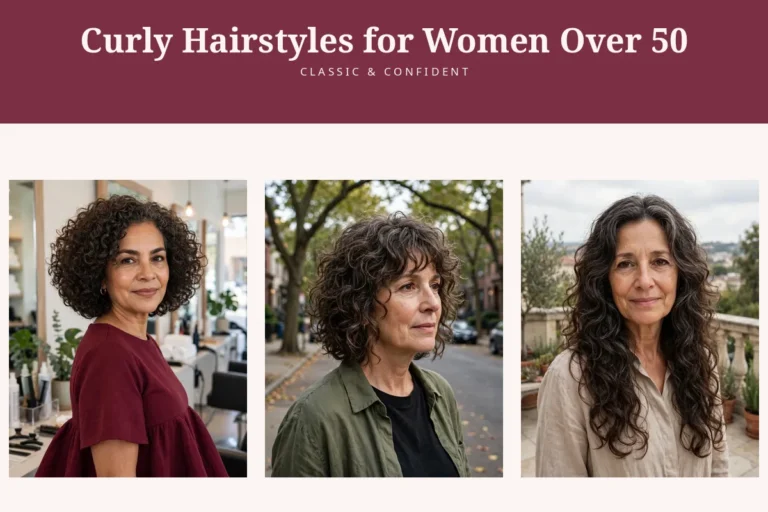
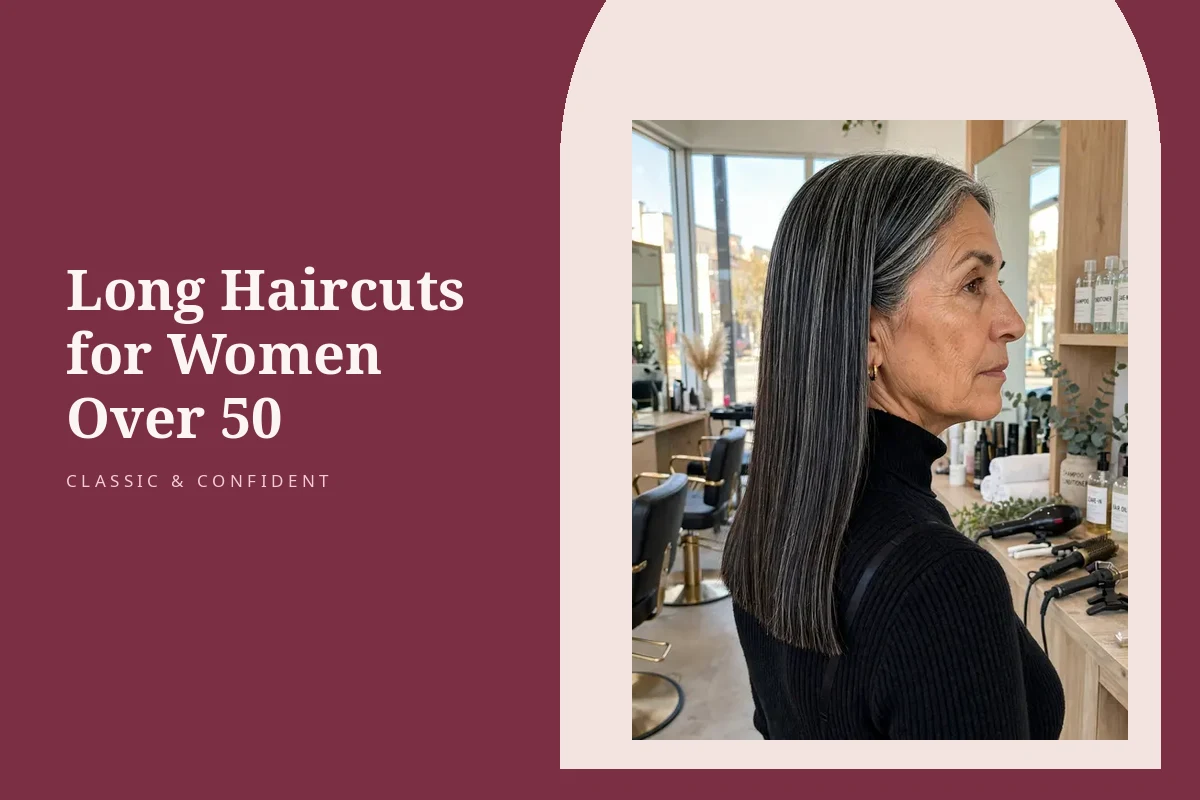
18 Long Haircuts for Women Over 50
Here is your permission slip: you do not have to cut your hair short at 50. Long hair over 50 is not a mistake — but long hair with the wrong cut can drag your whole look down.
One-length ends that go stringy, no face-framing so your features disappear, a part that emphasises thinning — these are cut problems, not age problems.
Below you will find 18 long haircuts that genuinely flatter older women, grouped by what you actually want: hair that takes care of itself, hair with movement and shape, polished lengths that photograph beautifully, and cuts designed for fine, thinning or grey-growing hair.
Each one tells you the exact words for your stylist, the upkeep in weeks, and who should skip it.
Quick picks
- Zero-fuss length: The one-length classic (#1)
- Instant lift around the face: Face-framing layers from the cheekbone (#5)
- Thin ends that look fuller: Invisible layers for fine hair (#15)
- Big-event hair: The bouncy blowout (#12)
- Growing out your grey: The grey grow-out, done on purpose (#16)
- Elisa’s pick: Face-framing layers from the cheekbone (#5)
Contents
How to choose your long cut
Hair density decides the layering. If your hair is thick, you need weight removed — long layers or a U-shaped hem. If it is fine or thinning, you need weight kept — one-length ends or invisible internal layers, because visible long layers on fine hair make the bottom third disappear.
The guide to hairstyles for fine hair over 50 covers density in more depth.
Texture decides the daily effort. Straight hair shows every flaw in a one-length cut, so it needs a razor-clean trim schedule; wavy and curly hair hides dry ends better but needs layers that fall at the right points or it triangles out. If you have under 10 minutes a morning, rule out anything that needs a round brush every day.
Face shape decides where the shortest layer sits. The shortest face-framing layer should land where you want attention: cheekbone for round and square faces (adds length), jaw for long faces (adds width). Layers that start at the chin suit almost every face over 50 — it is the safest starting point a stylist can give you.
Colour and grey change the cut. Grey hair is coarser and drier, so grey-growing hair needs blunter, stronger ends and a cut that still looks deliberate mid-grow-out. If you colour, dimensional colour (a few tones woven through) makes long hair look twice as thick — one flat colour on long hair is the fastest way to look older.
The bob guide for fine hair has the colour-density rules that apply here too.
Honest styling time beats wishful thinking. Long hair after 50 needs more maintenance, not less — ends are 2–4 years old by the time they reach your bra strap. If you will not do a weekly mask and a trim every 10–12 weeks, choose one of the first four cuts in this guide and skip the high-polish ones.
Long styles are still having a moment — see the newest hairstyles for women over 60 for what is current.
At a glance: all 18 cuts
| Cut | Length | Trims | Best for |
|---|---|---|---|
| 1. One-length classic | Bra-strap to waist | Every 10–12 weeks | Thick, straight hair |
| 2. Front long layers | Bra-strap | Every 10–12 weeks | Everyday softness |
| 3. U-shaped hem | Mid-back | Every 12 weeks | Removing bulk, keeping length |
| 4. Softened blunt cut | Bra-strap | Every 8–10 weeks | Fine hair that needs weight |
| 5. Face-framing layers | Bra-strap | Every 10 weeks | Almost every face shape |
| 6. Long shag | Shoulder to bra-strap | Every 8–10 weeks | Wavy/curly texture |
| 7. Feathered ends | Mid-back | Every 10–12 weeks | Soft, romantic movement |
| 8. Curtain bangs + long hair | Bra-strap+ | Every 6–8 weeks (bangs) | Forehead lines, softening |
| 9. Deep side part | Any long length | Every 12 weeks | Thinning at the part |
| 10. Sleek straight long | Bra-strap to waist | Every 8 weeks | Formal polish |
| 11. Soft Hollywood waves | Mid-back | Every 10 weeks | Evenings, photos |
| 12. Bouncy blowout layers | Bra-strap | Every 8–10 weeks | Big-volume events |
| 13. Dimensional colour long | Any long length | Colour every 8–12 weeks | Hair that looks flat |
| 14. Grown-out lob | Shoulder to collarbone+ | Every 8 weeks | Transitioning longer |
| 15. Invisible layers | Bra-strap | Every 10–12 weeks | Fine, thin hair |
| 16. Grey grow-out cut | Any length | Every 8–10 weeks | Growing out dye |
| 17. Side-swept fringe | Bra-strap | Every 6–8 weeks (fringe) | Softening the forehead |
| 18. Braid-friendly one-length | Waist | Every 12 weeks | Updos and braids |
Long hair that takes care of itself
These four cuts keep their shape with almost no daily styling. If your mornings are short and your brush is basic, start here.
1. The one-length classic
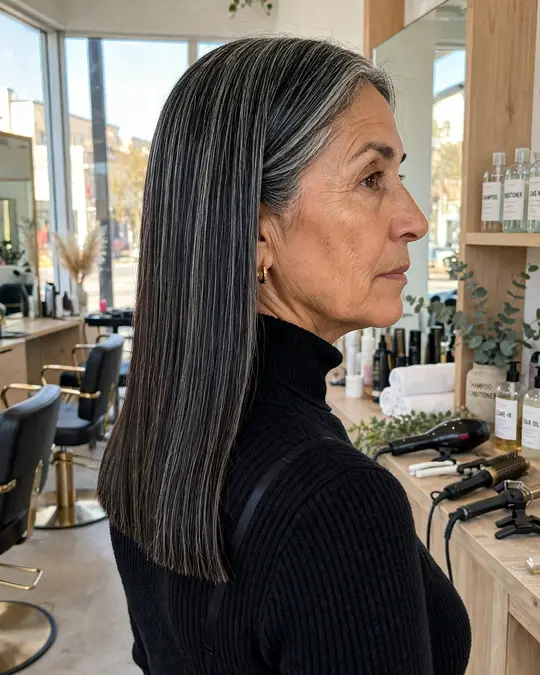
A blunt, even hem is the densest-looking thing you can do with long hair. Every strand ends at the same point, so the last 5 cm read as a solid ribbon instead of a wispy tail — this is the single fastest way to make fine or ageing ends look thicker.
It also means split ends are easy to see and trim, so the cut stays honest.
The trade-off is that one length has nowhere to hide. It shows exactly how healthy your ends are, which is why it pairs with a strict trim schedule rather than a hopeful one. Straight and slightly wavy hair shows this cut at its best; very curly hair tends to spring up and lose the blunt line.
- Length: Bra-strap to waist (45–60 cm from crown)
- Trims: Every 10–12 weeks, 1–2 cm off
- Styling time: 5 minutes: air-dry or quick straighten
- Face shapes: Oval, heart, long
Ask your stylist for: “one length all round, no layers, blunt hem finished with the ends point-cut just 2 millimetres so it is not knife-sharp”
How to style it:
- Rough-dry until 90% dry, then smooth the top layer only with a paddle brush for shine.
- Work a pea-size drop of serum through the last 10 cm of dry ends — never near the roots.
Skip it if your ends are breaking off faster than they grow (the blunt line will just expose it); or your hair is very curly and will not sit in a straight hem.
Best for: Thick, straight or slightly wavy hair that is in good condition and wants maximum simplicity.
2. Long layers that start at the front
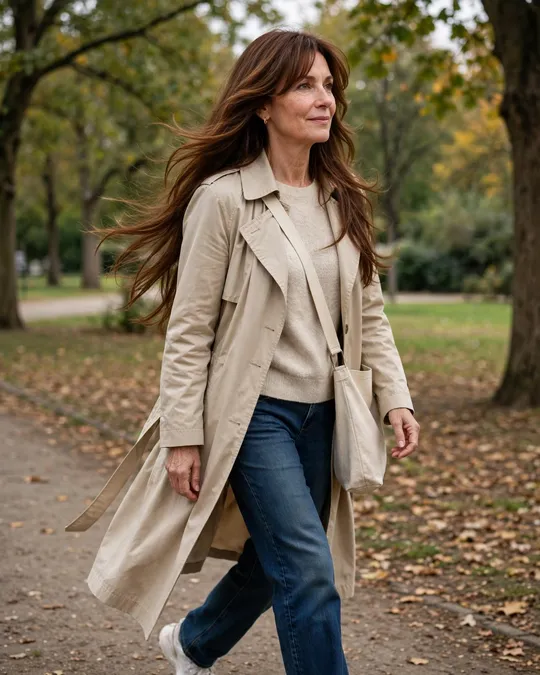
Putting the layers only through the front third is a compromise that flatters almost everyone: the back keeps its full weight and length, while the front gets softness and movement around your face.
The reason it works is that the eye reads the shorter front pieces first, so your face looks lifted even though the bulk of the hair is unchanged.
The layers should start no higher than the chin and step down gradually — pieces that start at the cheekbone on fine hair can go see-through. Two to three graduated pieces each side is enough; more than that and the front starts to look like a separate haircut from the back.
- Length: Bra-strap (40–50 cm)
- Trims: Every 10–12 weeks
- Styling time: 8 minutes with a round brush on the front
- Face shapes: Round, square, heart
Ask your stylist for: “keep the back one length, and give me long layers only through the front, starting at the chin and stepping down about 2 cm per layer”
How to style it:
- Blow-dry the front pieces with a medium round brush, rolling them away from your face so they sweep back.
- Pin the front pieces loosely behind your ears while they cool — the bend sets without heat.
- Mist the back lightly with a flexible spray; do not over-style it or the two zones look disconnected.
Skip it if your hair is very fine and the front pieces turn wispy within a month.
Best for: Women who want softness around the face without giving up the feeling of long hair.
3. The U-shaped hem
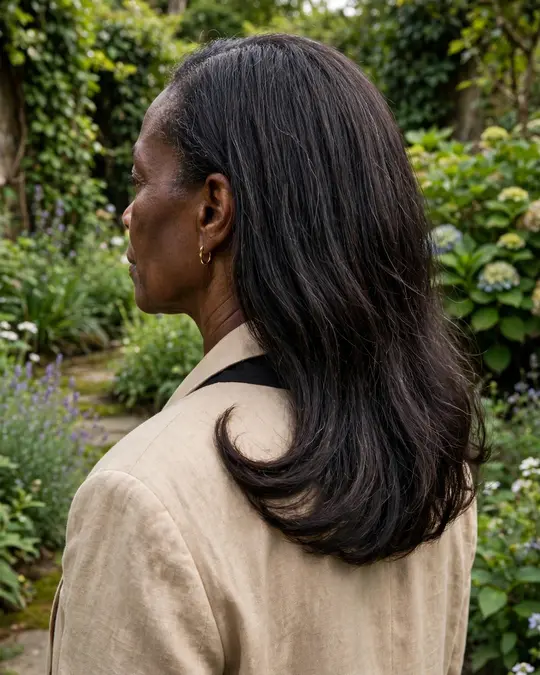
A U-shaped hem removes the two corners at the front of the hairline, which are the oldest, thinnest and most damaged strands on most heads. Physically, you keep full length down the back while the front behaves — no more straggly pieces hanging past your shoulders that will not hold a style.
It is the haircut equivalent of hemming a dress so it hangs right.
It also buys you time between trims, because the rounded shape grows out more gracefully than a blunt line. On thick hair the U-shape takes out visual bulk without layering; on medium hair it simply looks intentional.
- Length: Mid-back (50–55 cm at the centre back)
- Trims: Every 12 weeks
- Styling time: 5–8 minutes
- Face shapes: All — the curve suits every jawline
Ask your stylist for: “a U-shaped perimeter: keep my length in the back, but round the hem so the front corners come up about 7 cm”
How to style it:
- Air-dry or rough-dry; the shape does the work, so skip the straighteners.
- Scrunch a walnut-size amount of mousse into the mid-lengths to encourage the curve under.
- Once a month, check the front corners in a hand mirror — they are the first to go thin.
- Sleep with hair in a loose low braid to stop the shorter front pieces frizzing.
Skip it if you wear your hair pulled straight back every day (the shape is wasted); or your hair is above the shoulders.
Best for: Thick or medium hair that looks heavy at one length but you do not want layers.
4. The softened blunt cut
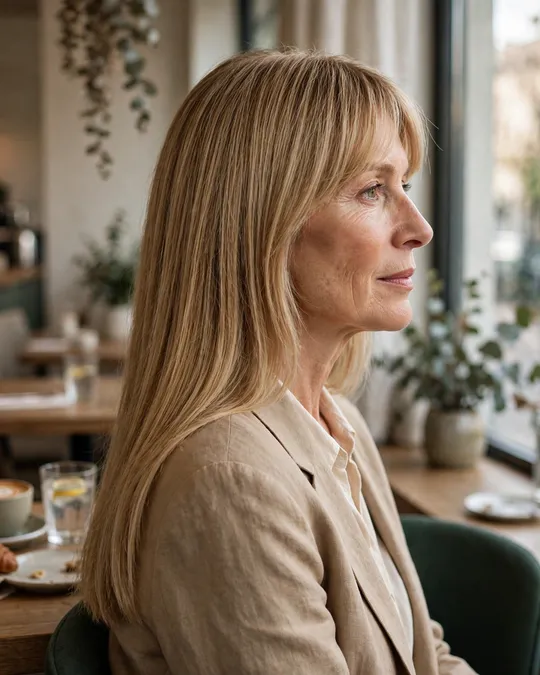
This is the one-length classic with its edges taken off: the hem is cut blunt for density, then the very last centimetre is point-cut so the line looks soft rather than severe.
The mechanism is simple — a severe blunt line on hair over 50 can read harsh, especially with grey or strong jawlines, and that 1 cm of softening is the difference between polished and severe.
It is the best long option for fine hair, because unlike layered cuts it removes nothing from the ends. Keep the length at or just below the bra strap; past that, fine hair rarely holds a blunt line.
- Length: Bra-strap (40–45 cm)
- Trims: Every 8–10 weeks — the line is the whole point
- Styling time: 6 minutes
- Face shapes: Oval, long, heart
Ask your stylist for: “a blunt cut to the bra strap, then soften the last centimetre with point-cutting so the edge is not a hard line”
How to style it:
- Blow-dry smooth with a paddle brush, directing the air down the hair shaft.
- Flat-iron only the last 5 cm if they flick — the rest does not need it.
Skip it if your ends are very damaged (go shorter first, then grow the blunt line back); or you want wash-and-go curls.
Best for: Fine to medium hair that needs every strand to count toward the hem.
Shape and movement
If your long hair hangs like a curtain and never moves, the cut is the problem. These five add shape, swing and face-framing without taking your length.
5. Face-framing layers from the cheekbone

Shorter pieces that start at the cheekbone do two jobs at once: they break up the flat curtain of long hair, and they draw the eye to your cheekbones instead of to the length. The lift is optical — hair that swings at the cheek reads as energy and youth, while one unbroken length reads as weight.
Keep the shortest piece at the cheekbone, never above it; above the cheekbone the pieces poke out and will not tuck. Two to three layers stepping down to the chin is the classic, and it grows out without drama. This is the single most requested long-hair detail for women over 50, and the one I would choose first.
- Length: Bra-strap (40–50 cm)
- Trims: Every 10 weeks
- Styling time: 8 minutes
- Face shapes: Round, square, heart, oval — nearly universal
Ask your stylist for: “face-framing layers starting at the cheekbone, stepping down in 2 cm increments to the chin, blended into the length”
How to style it:
- Blow-dry the face pieces forward and under with a medium round brush for lift at the root.
- Flip them back over the crown while they cool to lock in the sweep.
- Run the straighteners through once, bending the ends slightly under — the pieces should curve toward your face, not away.
Skip it if your hair is extremely fine and the cheekbone pieces will not hold their shape past week six.
Best for: Almost everyone — it is the safest way to make long hair look styled rather than just long.
6. The long shag

The shag works by controlled chaos: short-to-long layers through the crown and mid-lengths remove weight so the hair moves, while the length stays. On wavy and curly hair over 50 this is transformative, because weight is what drags curls into a triangle. The layers let each section spring up to its natural pattern.
It needs the right texture to sing — on pin-straight hair it can look unfinished rather than cool. Ask for the layers to start at the cheekbone and keep the ends piecey, not blunt. A shag grows out into more shag, which is part of its charm.
- Length: Shoulder to bra-strap (35–50 cm)
- Trims: Every 8–10 weeks
- Styling time: 10 minutes, mostly diffusing
- Face shapes: Oval, heart, long
Ask your stylist for: “a long shag: layers through the crown starting at the cheekbone, piecey ends, keep my length past the shoulders”
How to style it:
- Apply a golf-ball of mousse to damp hair, roots to ends.
- Diffuse on medium heat, scrunching upwards — do not touch it until it is 100% dry.
- Once dry, shake the roots with your fingertips and break the ends apart with a tiny amount of wax.
- Sleep in a high loose bun to protect the crown layers overnight.
Skip it if your hair is pin-straight and you will not style it (the layers fall flat); or you need a very conservative work look.
Best for: Wavy, curly or coily hair that wants movement, and women who like a bit of edge.
7. Feathered ends
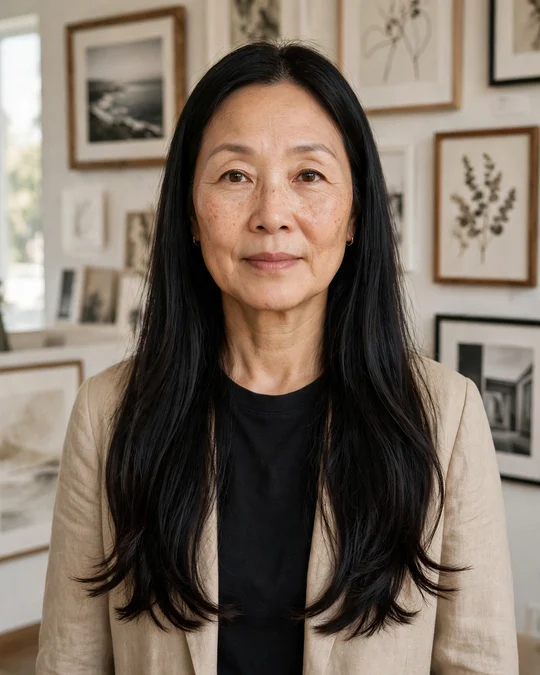
Feathering is slide-cutting the last 8–10 cm so each strand ends at a slightly different point — like a bird’s feather. The mechanism is optical softness: instead of a hard horizontal line that stops the eye, the ends dissolve, which is kinder to necks and jawlines that have lost some definition.
It is the 1970s technique that keeps coming back because it works.
Unlike a shag, feathering keeps the interior full — only the perimeter is thinned. That makes it a good choice for medium-density hair that wants romance without losing body. It needs reshaping every couple of months or the feathers turn to frizz.
- Length: Mid-back (50–55 cm)
- Trims: Every 10–12 weeks, re-feather each visit
- Styling time: 10 minutes with a round brush
- Face shapes: Square, heart, long
Ask your stylist for: “keep the length and the weight, but feather the last 8 to 10 cm with slide-cutting so the ends are soft, not blunt”
How to style it:
- Blow-dry with a large round brush, turning the ends under and slightly back.
- Flip your head upside down for the last 30 seconds of drying for lift at the crown.
- Smooth a pea-size amount of cream through the feathered ends only — they are the oldest hair and the driest.
Skip it if your hair is very fine (feathering thins the perimeter you need); or your ends are already splitting.
Best for: Medium to thick straight or wavy hair that wants a soft, feminine finish.
8. Curtain bangs with long hair
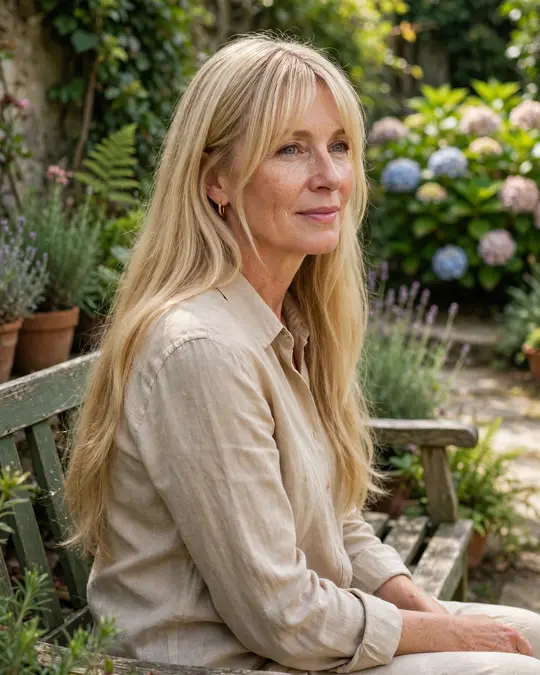
Curtain bangs part in the middle and sweep to each side, ending somewhere between the cheekbone and the jaw. They work on older faces because they do not cover the forehead the way a blunt fringe does — they frame it, which softens forehead lines without hiding your face.
The centre part also widens a narrow forehead and balances a strong chin.
The catch is commitment: bangs need trimming every 6–8 weeks or they become face-framing layers, which is a different cut. They also need 3 minutes every morning — no one has wash-and-go curtain bangs, whatever the photos suggest.
- Length: Bra-strap and below
- Trims: Bangs every 6–8 weeks; length every 12
- Styling time: 10–12 minutes
- Face shapes: Oblong, heart, diamond, square
Ask your stylist for: “curtain bangs parted in the centre, longest pieces reaching my cheekbones, blended into my long layers”
How to style it:
- Blow-dry the bangs first, while they are wettest, with a small round brush — sweep left, then right.
- Do not round-brush them into a bubble; they should lie fairly flat and split naturally.
Skip it if you will not trim them regularly; or your hairline is very strong and cowlicked at the front (they will fight you daily).
Best for: Women who want to soften the forehead and add a current, youthful detail to long hair.
9. The deep side part
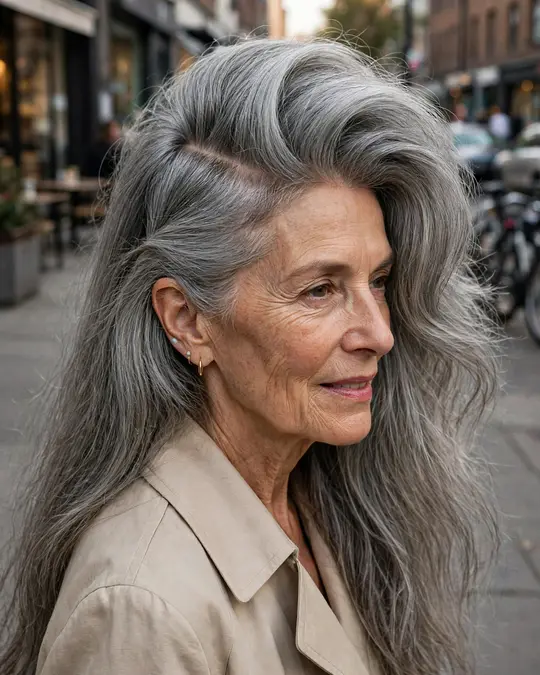
Moving your part 5–7 cm off centre is the cheapest haircut in this guide — it costs nothing and changes everything. The mechanism is volume: hair trained to fall from a deep part lifts at the root on the heavy side, which is instant fullness exactly where thinning shows first.
It also breaks the symmetry that makes long hair look severe.
It doubles as a camouflage strategy. If your part is widening, a deep side part simply moves the part line to where the hair is denser. Train it by parting wet hair deeply and clipping it for 10 minutes; after two weeks the hair remembers.
- Length: Any long length
- Trims: Every 12 weeks
- Styling time: 2 minutes
- Face shapes: Round, square (softens width); avoid very long faces
Ask your stylist for: “no cut change — but thin out the weight on the heavy side slightly so the deep part sits flat”
How to style it:
- Part soaking-wet hair 5–7 cm to one side, then clip the heavy side flat for 10 minutes while it air-dries.
- Blow-dry the roots on the heavy side in the opposite direction first, then flip — that is where the volume comes from.
- Refresh on day two by re-wetting just the part line and re-clipping for 5 minutes.
Skip it if your face is very long (it adds width you may not want); or you have a strong crown cowlick that dictates the part.
Best for: Anyone with a widening part or flat roots who wants fullness without cutting a thing.
Polished looks that photograph well
Some occasions ask for hair that looks done. These four cuts are built for shine, smoothness and the kind of finish that holds up in photographs — weddings, portraits, evenings out.
10. The sleek straight long cut

Sleek long hair reads as deliberate and expensive — but only when the ends are immaculate. The mechanism is light reflection: perfectly smooth hair reflects light in one unbroken sheet, and that shine is what photographs as healthy and youthful. The moment the ends go dull or frizzy, the same cut reads as tired.
This is a high-maintenance choice disguised as a simple one. It needs a trim every 8 weeks without fail, a weekly smoothing mask, and heat protection every single time. On the right hair, though — straight, medium to thick, in good condition — nothing looks more polished.
- Length: Bra-strap to waist (45–60 cm)
- Trims: Every 8 weeks
- Styling time: 20 minutes with straighteners
- Face shapes: Oval, heart
Ask your stylist for: “long and sleek: one length, blunt hem, no layers in the last 15 cm so the ends stay solid”
How to style it:
- Blow-dry in sections with a paddle brush, nozzle pointing down the shaft.
- Flat-iron in 3 cm sections — one slow pass each, not five fast ones.
- Finish with one pump of shine serum smoothed over the canopy only.
- Carry a mini brush; sleek hair shows every wind tangle.
Skip it if you will not commit to 8-week trims; or your hair frizzes in humidity (this cut has no hiding place).
Best for: Straight, healthy hair and occasions where polish matters — weddings, portraits, big dinners.
Good to know: the 3 pm test. If your long hair looks good at 9 am but tired by 3 pm, the problem is almost always the ends, not the cut — carry a travel-size serum and smooth the last 10 cm at lunch.
And if you are pinning this guide for later, save it to your “Hair over 50” board — the at-a-glance table at the top is the fastest way to compare all 18 cuts when you are in the stylist’s chair.
11. Soft Hollywood waves

Old-Hollywood waves flatter older faces because the S-curves catch light at every turn — each wave is a highlight. The curves also add width at the cheek and jaw, which softens the vertical pull of a long face and fills out faces that have lost fullness. It is the most forgiving formal style in this guide.
The trick is uniformity: waves that match in size and direction look expensive; random curls look accidental. A 32 mm iron and a cool-down set are non-negotiable. This is not an everyday cut — it is a long cut (one length or soft layers) styled for occasions.
- Length: Mid-back (50–55 cm)
- Trims: Every 10 weeks
- Styling time: 25–30 minutes
- Face shapes: Long, oval, heart
Ask your stylist for: “keep it one length or with very soft long layers — I will style the waves myself, I just need the ends solid enough to hold a curl”
How to style it:
- Curl 4 cm sections away from your face on a 32 mm iron, leaving the last 3 cm out.
- Pin each curl to your scalp to cool for 10 minutes — this is what makes it last.
- Release, brush through once with a soft bristle brush, and mist lightly.
Skip it if your hair does not hold a curl past two hours (fine, slippery hair — choose the blowout instead); or you want a daily style.
Best for: Evenings, weddings and photographs — hair that needs to look glamorous on demand.
12. The bouncy blowout

A blowout cut has layers engineered to flip and bounce: shorter through the crown for lift, long layers through the lengths for swing. The bounce comes from the cut, not just the styling — layers cut at the right elevation spring away from the head when round-brushed, while one-length hair just lies there.
This is the salon blowout you can partly recreate at home.
It needs body to work with, so it suits medium to thick hair best. The layers also mean more frequent trims — grown-out blowout layers collapse. Ask your stylist to show you the brush technique before you leave the chair; five minutes of coaching is worth more than any tutorial.
- Length: Bra-strap (40–50 cm)
- Trims: Every 8–10 weeks
- Styling time: 20 minutes
- Face shapes: Oval, long, heart
Ask your stylist for: “blowout layers: lift through the crown, long layers through the lengths, ends that turn under — cut for movement”
How to style it:
- Rough-dry to 80%, then round-brush in sections, rolling each under and holding the heat 5 seconds.
- Velcro rollers on the crown while you do your makeup — 10 minutes of set time doubles the volume.
Skip it if your hair is fine and goes flat by noon (the layers will not save it); or you air-dry exclusively.
Best for: Medium to thick hair that wants maximum volume for events — the red-carpet effect at home.
13. Long hair with dimensional colour

This is not a cut, it is the colour strategy that makes every long cut in this guide look better. Dimensional colour — two to three tones woven through — creates fake depth: darker pieces recede, lighter pieces come forward, and the eye reads the result as thickness.
On long hair over 50, where density naturally drops, that illusion is worth more than any layering.
The rules are specific: keep the lightest pieces around your face (they brighten), keep the base close to your natural level (regrowth is invisible), and never go more than two shades lighter overall in one appointment. Flat, single-process colour on long hair is ageing; dimension is youth.
- Length: Any long length
- Trims: Every 10–12 weeks; colour every 8–12
- Styling time: No extra daily time
- Face shapes: All — colour is face-neutral
Ask your stylist for: “dimensional colour: keep my base near my natural level, weave two tones through — the lightest pieces framing my face”
How to style it:
- Wash with lukewarm water — hot water strips tone in weeks.
- Use a colour-safe mask weekly; long coloured hair is thirsty hair.
- Book a toner refresh between full colours — a 20-minute gloss every 6 weeks keeps it expensive-looking.
- Protect from sun like skin: a hat or UV spray, because faded colour looks older.
Skip it if you are growing out grey on purpose (dimension fights the grow-out — see #16 instead); or you will not maintain the colour.
Best for: Hair that looks flat, dull or thinner than it is — colour as a density illusion.
For fine, thin or changing hair
Long hair and fine hair can absolutely coexist — but the cut has to protect every strand. These five are engineered for density, camouflage and honesty about what hair does after 50.
14. The grown-out lob

If you are growing from a bob to long hair, the months between are the danger zone — and a grown-out lob cut is how you survive them. The trick is shaping the in-between length deliberately: soft layers through the ends and a clean neckline so it looks like a choice, not neglect.
The reason most grow-outs fail is that women stop trimming entirely; ends go thin and the whole thing looks accidental.
Trim every 8 weeks while growing — yes, while growing. You lose 1 cm of damaged end and gain 3 cm of healthy growth in the same period, so the net is still longer, and the hem stays thick enough to look intentional.
- Length: Collarbone to shoulders (25–35 cm, growing)
- Trims: Every 8 weeks, 1 cm only
- Styling time: 8 minutes
- Face shapes: All
Ask your stylist for: “I am growing out my bob — shape it as a long bob with soft ends, take only 1 cm, keep the neckline clean”
How to style it:
- Blow-dry the ends under with a round brush so the growing layers sit in one line.
- Tuck one side behind the ear while it cools to train the shape.
Skip it if you want instant long hair (consider the health of your ends first); or you will skip the 8-week trims.
Best for: Anyone in the awkward growing phase who wants to look styled, not stuck.
15. Invisible layers for fine hair

Invisible — or internal — layers are cut underneath the top canopy, so the surface looks one-length while the interior has movement. The mechanism is density protection: visible layers on fine hair remove the very ends you need, but internal layers remove weight from the middle, letting the canopy fall over a slightly shorter underlayer that pushes it up.
The result reads as thicker ends with natural swing.
This is a specialist cut — not every stylist does it well, so ask directly whether they cut internal layers. Done right, it is the best long-hair solution for fine hair over 50; done badly, it is just layers. The tell is the surface: it should look blunt.
- Length: Bra-strap (40–45 cm)
- Trims: Every 10–12 weeks
- Styling time: 8 minutes
- Face shapes: Oval, heart, long
Ask your stylist for: “invisible internal layers — I want the surface to look one length, with the layering hidden underneath for movement”
How to style it:
- Blow-dry with your head upside down for the first half — the internal layers need root lift to show.
- Smooth only the canopy with a paddle brush; leave the underlayers alone.
- A light volumising powder at the roots on day two revives the lift.
Skip it if your hair is thick (it will just get bigger); or your stylist does not do internal layering — do not let them substitute visible layers.
Best for: Fine, thin hair that wants to stay long without the see-through ends that layers cause.
16. The grey grow-out, done on purpose

Growing out dye to natural grey takes 12–18 months, and the line of demarcation is what makes most women quit. The cut strategy is a strong, deliberate shape — usually a blunt bob-to-long line or a clean one-length — that makes the two-tone hair look like an editorial choice rather than neglect.
A sharp cut says intention; a shapeless one says giving up.
Plan three trims in the first six months to keep the line crisp as the grey advances. Many women add lowlights through the dyed ends to blur the line — half a head of lowlights every 10 weeks softens the contrast dramatically. By month nine, the grey usually reaches the jaw and the whole thing starts to look striking.
- Length: Any — usually shoulder to bra-strap
- Trims: Every 8–10 weeks to keep the line sharp
- Styling time: 10 minutes
- Face shapes: All
Ask your stylist for: “a strong blunt line I can grow out — and lowlights through the old colour to blur the demarcation line”
How to style it:
- Style it sleek while growing out — smooth hair makes the two tones look deliberate.
- Purple shampoo once a week keeps the new grey bright, not yellow.
Skip it if you are not sure you want grey (this is a one-way commitment for a year); or you will not maintain the demarcation.
Best for: Women committed to their natural silver who want the grow-out to look like a decision.
17. The side-swept fringe

A side-swept fringe is the low-drama cousin of curtain bangs: one soft section swept across the forehead, ending at the temple or cheekbone. It softens forehead lines and adds asymmetry, which is flattering because perfectly symmetrical long hair can look severe after 50. The sweep also gives fine hair at the hairline somewhere to go instead of lying flat.
It is more forgiving than a centre-parted bang — it grows out into face-framing layers gracefully, and it needs trimming only every 6–8 weeks. Train it by blow-drying it across while damp; after a week it falls into place on its own.
- Length: Bra-strap (40–50 cm)
- Trims: Every 6–8 weeks for the fringe
- Styling time: 8 minutes
- Face shapes: Round, square, heart
Ask your stylist for: “a soft side-swept fringe, longest point at my cheekbone, blended into the length on one side”
How to style it:
- Blow-dry the fringe across your forehead in the opposite direction first, then sweep it into place — that builds the swoop.
- Pin it flat while it cools for 2 minutes to set the direction.
- A tiny flat-iron pass on the ends keeps it piecey, not bulky.
- On day two, re-wet just the fringe and re-sweep — it takes 60 seconds.
Skip it if you part strictly in the centre and will not change it; or your forehead is very short (it will overwhelm it).
Best for: Women who want forehead softening with less commitment than curtain bangs.
18. The braid-friendly one-length
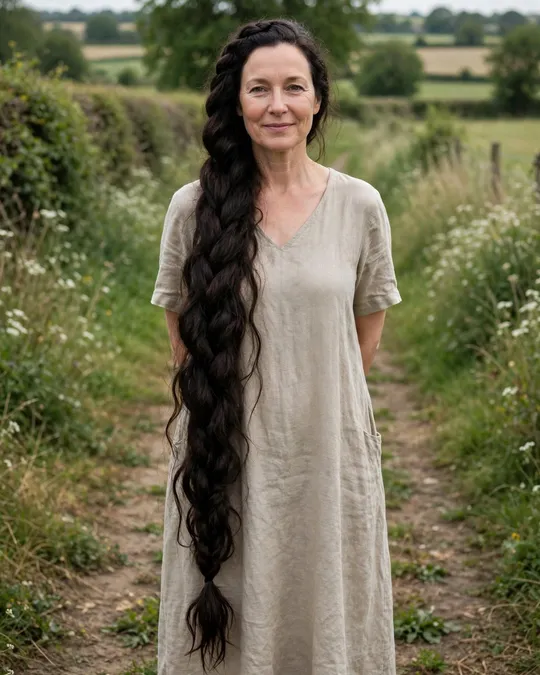
If you wear your hair up half the week — braids, low buns, twists — layers are your enemy, because every layer becomes a sticky-out end in an updo. A true one-length cut, grown to the waist, gives you the maximum hair to work with and the cleanest braids.
The mechanism is simple physics: uniform length means uniform tension, so styles hold longer and look neater.
Waist-length hair after 50 is a statement, and it only works with immaculate ends — this is the highest-maintenance cut in the guide disguised as the simplest. Protective sleeping (braid or silk cap), weekly masks and 12-week trims are the price. But for women who live in updos, nothing else gives the same versatility.
- Length: Waist (55–65 cm)
- Trims: Every 12 weeks, dust the ends
- Styling time: 5 minutes down; 10 for updos
- Face shapes: Oval, heart
Ask your stylist for: “true one length to the waist, no layers at all — I wear it up most days and need clean ends for braiding”
How to style it:
- Sleep in a loose braid or silk cap — waist-length ends break on cotton pillowcases.
- Oil the last 15 cm before any updo; it stops the elastic snapping dry ends.
- Rotate your styles — the same tight bun in the same spot causes breakage.
Skip it if your ends are fragile or breaking (go shorter and rebuild first); or you wear it down every day (choose #1 instead).
Best for: Women who braid, twist or bun their hair regularly and want maximum styling material.
Keeping long hair healthy after 50
Long hair after 50 is a long game — your ends are years old, and they need a routine, not just a cut. These are the habits that keep the 18 cuts above looking the way they did in the salon.
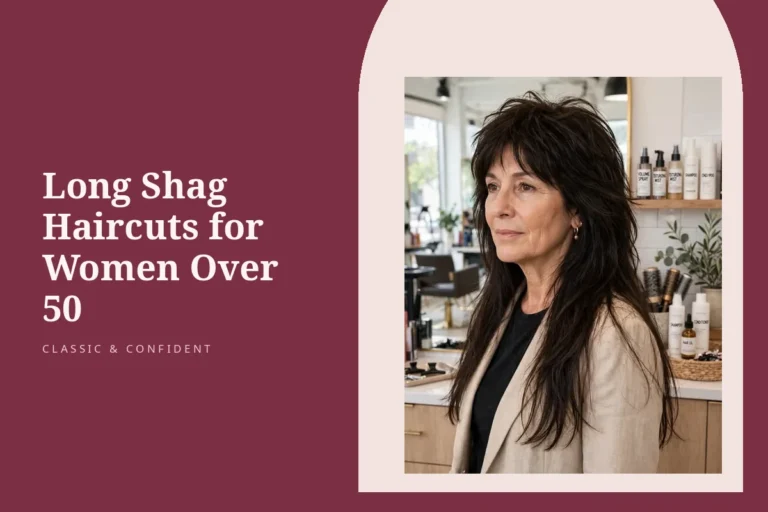
If your long hair needs movement more than length, our long shag haircuts for women over 50 show how layers can do the work without losing a centimetre.- Trim on a schedule, not on damage. Every 10–12 weeks for most long cuts, 8 weeks for blunt lines and blowout layers. Waiting until you see splits means you will lose centimetres, not millimetres.
- Mask weekly, oil the ends. A 10-minute mask once a week and a drop of oil on the last 10 cm daily — ends this old cannot moisturise themselves.
- Heat protection is non-negotiable. Every blow-dry, every iron, every time. Heat damage on 3-year-old ends does not grow out quickly.
- Sleep like you mean it. A loose braid or a silk pillowcase cuts mechanical breakage dramatically — cotton pillowcases are sandpaper to long ends.
- Wash less, rinse smart. Two to three washes a week is plenty; shampoo the scalp only and let the suds run through the lengths.
- Eat for it too. Protein and iron will not fix split ends, but consistent nutrition is what keeps new growth strong enough to become long hair.
The weekly long-hair reset (15 minutes, Sunday evening):
- Brush dry hair gently from ends to roots with a wide-tooth comb.
- Apply a mask from mid-lengths to ends; clip it up and leave 10 minutes.
- Rinse with lukewarm water, then a cool shot to close the cuticle.
- Work a pea-size amount of leave-in through the last 10 cm.
- Braid loosely for bed — you will wake up with protected, wavy hair.
The bottom line
If I had to pick one, it would be #5, face-framing layers from the cheekbone — because it fixes the two things that age long hair fastest (a flat curtain and an invisible face) while letting you keep every centimetre of your length. It suits nearly every face, grows out gracefully, and asks for eight minutes a morning.
That is the best return on effort in this entire guide.
Found your cut? Save this guide to your “Long hair over 50” Pinterest board before your next salon visit — bring the at-a-glance table with you and show your stylist the exact words in quotes. She will know precisely what to do.
Frequently asked questions
Can a 60 year old woman wear long hair?
Yes — if the cut does the work. Long hair over 50 looks best with face-framing, a deliberate hem (blunt, U-shaped or softened) and healthy ends; what ages it is not the length but stringy ends and no shape.
If your ends are breaking faster than they grow, go to bra-strap length with a blunt line first and rebuild from there.
What length of hair makes you look younger over 50?
There is no magic number, but the sweet spot for most women over 50 is bra-strap length — long enough to feel like long hair, short enough that the ends are young and thick. Past the waist, only very healthy, thick hair avoids the thinning-tail effect.
If your hair is fine, bra-strap with a blunt or softened hem will look younger than waist-length with wispy ends.
How often should long hair be trimmed after 50?
Every 10–12 weeks for most long cuts; every 8 weeks for blunt lines, blowout layers and bangs. Hair over 50 grows at the same rate (about 1–1.5 cm a month) but the ends are more fragile, so skipping trims costs you length in the long run — splits travel upward and force a bigger cut later.
Is long hair thinning at the crown normal in your 50s?
Some shedding and a widening part are common with hormonal changes after 50. A deep side part (see #9) moves the part line to denser hair instantly, and invisible internal layers (#15) add lift without sacrificing ends.
If shedding is sudden or patchy rather than gradual, see your doctor before blaming the cut — that is a health question, not a styling one.
Does long hair drag your face down after 50?
One unbroken length can — the eye follows the hair down and the face follows. The fix is not cutting it short; it is breaking the line: face-framing layers from the cheekbone, a side part, or waves through the mid-lengths all interrupt the downward pull.
Necklines matter too — a V-neck with long hair elongates, while a high crew neck with long hair shortens.
What is the best long haircut for fine hair over 50?
The softened blunt cut (#4) or invisible layers (#15), kept at bra-strap length. Both protect the ends — the blunt line by keeping every strand at the same point, the invisible layers by hiding the movement underneath a solid canopy. Avoid visible long layers and feathering on fine hair; both remove the perimeter density you need most.