20 Apple Shape Outfits for Women Over 50
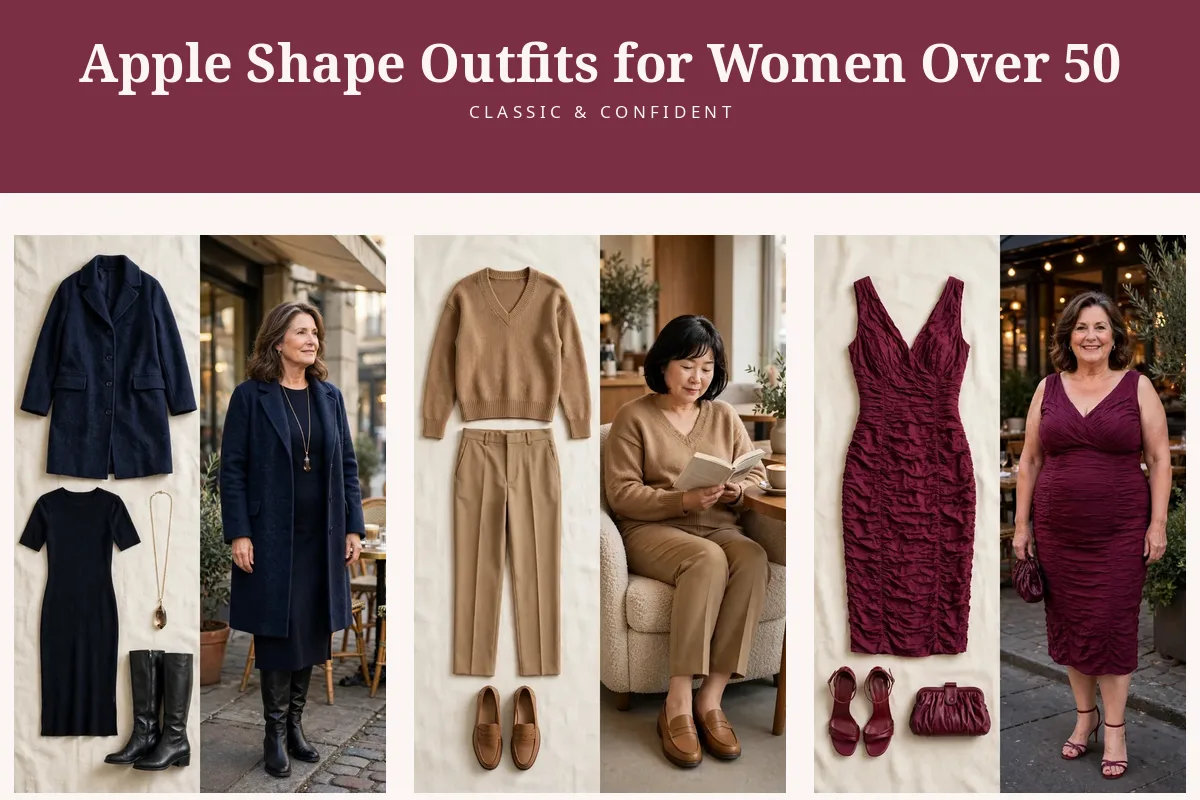
If your midsection runs the show, you know the waistband wars. Buttons that gap by noon, tucked tops that creep upward, dresses that cling exactly where you don’t want the attention.
This is not a willpower problem — it’s a physics problem, because most clothes are cut to cinch the waist, and good over 50 apple shape fashion starts by refusing that premise entirely.
Here are 20 outfits built comfort-first: nothing digs, nothing clings, nothing needs adjusting once you walk out of the door. They are grouped by season moment — five for each season, early winter through late spring — and they run day-to-night, from easy morning looks right through to one evening dress that genuinely works.
Best first tries
- Morning errands → The cocoon coat column (#1)
- Workdays → The wrap blouse and wide-leg trousers (#7)
- Lunch out → The linen shirt dress (#11)
- Dinner → The wrap midi dress (#16)
- Evening → The evening column dress (#20)
- If you’re starting over → The A-line skirt and tucked sweater (#5)
Contents
- How to choose outfits that flatter an apple shape
- The 20 outfits at a glance
- Early winter: cocoon coats and knit dresses
- Late winter: layers that don’t bulk
- Early spring: lighter fabric, same rules
- Late spring: skimming dresses and bare ankles
- Day-to-night dressing: comfort from 9 a.m. to 9 p.m.
- The bottom line
- Frequently asked questions
How to choose over 50 apple shape fashion that actually fits
Skim, don’t squeeze. The apple shape carries its fullness around the middle, so anything with a hard, fixed waistband lands exactly on the widest point and announces it. Look for pieces that float 3–5 cm off the body at the waist — A-lines, cocoons, shifts — and your silhouette reads 5–10 cm narrower without any shapewear.
Raise the visual waist. Where a waistband sits is a choice, not a given. Seams, ties and belts placed 8–10 cm above your natural waist — under the bust — create a waist where there wasn’t one.
A belt worn at the natural waist on an apple shape simply frames the fullest point.
Build one dark column underneath. A top and bottom (or a dress) in the same deep tone underneath an open jacket or cardigan reads as one long line. This is the single most slimming trick in the book, and it works with the dresses that skim the middle in every season below.
Choose fabric with memory, not cling. Ponte, scuba crepe, double-faced wool and rib knits with 3–5% elastane stretch over curves and spring back; thin jersey and silk charmeuse collapse into every contour. If you can read the weave through the fabric when you hold it to light, it will read your body the same way.
Let the neckline do the lifting. V-necks, scoop necks and open collars draw the eye up toward your face and create a vertical line down the torso. A high round neck on an apple shape shortens the neck visually and makes the torso look like one block — open it up by 5–8 cm and everything above the bust relaxes.
For evening, the same rules scale up; see the notes on holiday and evening dressing in outfit #20.
The 20 outfits at a glance
| Outfit | Key pieces | Best season |
|---|---|---|
| 1. The cocoon coat column | Cocoon coat, dark knit dress, boots | Early winter |
| 2. The sweater dress with boots | Rib-knit midi dress, knee boots | Early winter |
| 3. The tunic and slim trousers | Long tunic, slim ankle trousers | Early winter |
| 4. The long cardigan over a column | Duster cardigan, dark base layer | Early winter |
| 5. The A-line skirt and tucked sweater | A-line midi skirt, fine-knit sweater | Early winter |
| 6. The puffer vest over knit | Cropped puffer vest, roll-neck, jeans | Late winter |
| 7. The wrap blouse and wide-leg trousers | Wrap-front blouse, wide-leg trousers | Late winter |
| 8. The poncho with leather leggings | Knit poncho, faux-leather leggings | Late winter |
| 9. The blazer with a relaxed dress | Unstructured blazer, shift dress | Late winter |
| 10. The cashmere set | Matching knit top and trousers | Late winter |
| 11. The linen shirt dress | Belted-back shirt dress, sandals | Early spring |
| 12. The midi dress with a denim jacket | Dark midi dress, cropped denim jacket | Early spring |
| 13. The striped Breton and cropped trousers | Breton top, cropped chinos | Early spring |
| 14. The trench over a dark column | Classic trench, dark dress or set | Early spring |
| 15. The fit-and-flare sundress | Under-bust seam sundress, wedges | Early spring |
| 16. The wrap midi dress | True wrap midi, heeled sandals | Late spring |
| 17. The palazzos and cropped top | High-waisted palazzos, boxy crop | Late spring |
| 18. The shift dress with a kimono | Straight shift, longline kimono | Late spring |
| 19. The maxi skirt and fitted tee | A-line maxi skirt, fitted tee | Late spring |
| 20. The evening column dress | Ruched dark column dress, heels | Late spring |
Early winter: cocoon coats and knit dresses
Start here, because these five do the most work with the least effort: soft structure up top, one long line underneath, and everything warm enough for a frosty morning school run — then straight on to whatever the evening holds.
1. The Cocoon Coat Column
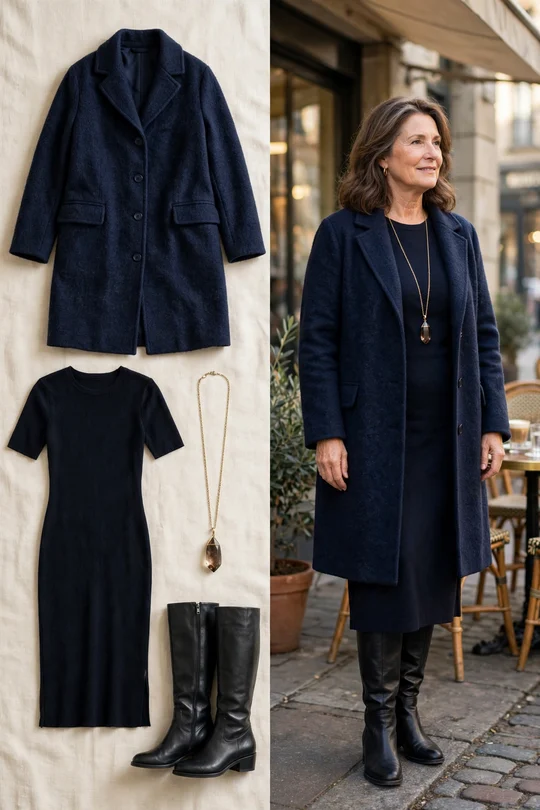
A cocoon coat is the apple shape’s best friend in coat form, because it breaks the rule coats usually follow. Instead of tapering to the waist — which would pin a seam exactly on your widest point — the cocoon curves out from the shoulder and back in at the thigh. Your middle simply isn’t part of the coat’s geometry.
Underneath, a dark knit dress makes one unbroken column, so the whole outfit reads as one long line from shoulder to boot.
Length matters here: the coat should end mid-thigh, about 60–65 cm from the shoulder seam on most women. Shorter and it cuts you in half; longer and it swamps you. A single-breasted front with a hidden closure keeps the front line clean — no buttons straining across the front is the whole point.
- Key pieces: wool-blend cocoon coat, dark ponte or rib-knit midi dress, knee boots
- Shoes: knee boots with a 4–5 cm block heel — the boot’s long line extends the column
- Occasion: everyday winter, work, travel
- Budget tip: the coat is the investment piece here; the dress underneath can be high street
Shop for: “A single-breasted cocoon coat in a wool blend, mid-thigh length, no waist seam, in navy or charcoal” and “a dark ponte midi dress, crew or V-neck, knee length”.
How to wear it:
- Put the dark dress on first and check the hem sits at or just below the knee — this is your column.
- Add the coat open for daytime; close it only against real cold, never belted.
- Finish with knee boots in a dark tone close to the dress colour, so the leg line runs uninterrupted.
Skip it if the coat has a drawstring or belt at the waist — that defeats the entire mechanism.
Best for: cold mornings when you want to look pulled together with zero fuss.
2. The Sweater Dress With Boots
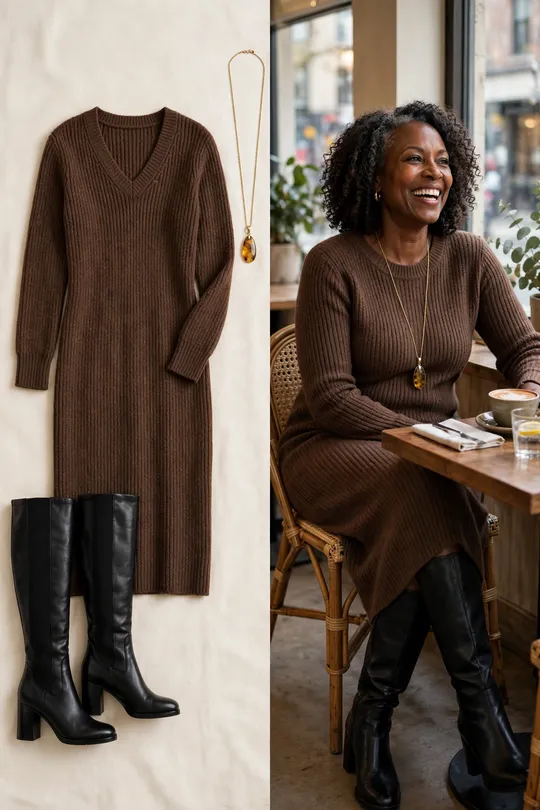
A rib-knit sweater dress works where a woven dress fails, because of how the fabric behaves. Rib knit stretches horizontally over the midsection and springs back, so it skims rather than gripping — and because there is no horizontal waist seam, there is nothing to mark where your waist starts.
The vertical ribs themselves act like pinstripes, drawing the eye up and down instead of across. Choose a dress with 3–5% elastane; a 100% acrylic rib will bag at the tummy by lunchtime.
The boots do half the visual work. A knee boot under a knee-length dress shows 10–15 cm of leg and continues the dark line of the dress, while an ankle boot chops the leg at its widest part of the calf.
If your calves are full, look for boots with an elasticated back panel rather than sizing up a full size.
- Key pieces: rib-knit sweater dress (midi), knee boots, long pendant necklace
- Shoes: knee boots, heel 3–5 cm, dark leather or suede
- Occasion: office, lunch, smart-casual evenings
- Budget tip: one good rib-knit dress in black or espresso wears three seasons and costs £25–45 on the high street
Shop for: “A rib-knit sweater dress with elastane, V or scoop neck, hem at the knee, in black, espresso or deep olive”.
How to wear it:
- Choose the dress one size up from your usual if you’re between sizes — skimming needs ease, not stretch marks.
- Add a long pendant that ends 8–10 cm below the bust; it creates a vertical line down the centre of the torso.
- Pull on knee boots and check in a full-length mirror: the visible leg between hem and boot should read as one line.
- For evening, swap the pendant for a cuff bracelet and add a clutch — the dress is already evening-appropriate.
Skip it if the knit is thin enough to show every contour — hold it to the light; if you can see your hand through it, walk away.
Best for: days that run into evenings without a chance to change.
3. The Tunic and Slim Trousers

This is the outfit formula half the country already lives in, and it works for a mechanical reason most people never articulate: the tunic’s hemline is the eye’s stopping point, and a tunic that ends mid-thigh — 75–80 cm from the shoulder — stops the eye well below the widest part of the torso.
Everything above the hem reads as one soft shape, and everything below is the slimmest part of your leg in a slim trouser. You get coverage without volume.
The trousers must be genuinely slim through the calf and ankle — not skinny-stretched, which pulls, but a straight, narrow cut. A dark trouser in ponte or a wool blend holds its line all day, and a 7/8 ankle length showing 5–8 cm of ankle keeps the proportions modern rather than frumpy.
- Key pieces: long tunic (mid-thigh), slim ankle trousers, loafers or ankle boots
- Shoes: loafers, pointed flats or ankle boots — anything that keeps the ankle visible
- Occasion: the everyday uniform — errands, school runs, casual work
- Budget tip: the cheapest formula in this guide; a full outfit lands at £50–70 high street
Shop for: “A tunic top ending mid-thigh with side slits, in a stable knit” and “slim ankle trousers with an elasticated back waist, in black or navy”.
How to wear it:
- Check the tunic’s side slits: 10–12 cm slits at each side stop the fabric pulling across the hips when you sit.
- Wear the trousers at your natural waist — the tunic covers the waistband entirely, so comfort is built in.
Skip it if the tunic ends at the widest part of your hip — that hemline placement frames fullness instead of floating past it.
Best for: the days you want to feel completely comfortable and still look intentional.
4. The Long Cardigan Over a Column

An open long cardigan is essentially architecture: its two front edges form vertical lines that frame your body, and the eye follows verticals. Worn over a dark top and trousers (or dress) in one tone, the cardigan’s edges become the sides of a long, narrow frame — your actual silhouette disappears inside it.
This is why the duster cardigan flatters every apple shape; it doesn’t touch the waist at all.
Length is the whole game: the cardigan should end at or below the knee, at least 90 cm from the shoulder, so its lines run the full length of the torso. A hip-length cardigan cuts the body at exactly the wrong place.
Fine-gauge knit drapes better than chunky cable here — chunky knits add 3–4 cm of visual width on each side.
- Key pieces: knee-length open cardigan, dark base-layer dress or top + trousers
- Shoes: anything dark and simple — the outfit’s line is the star
- Occasion: office layers, travel, evenings out
- Budget tip: a fine-knit duster in black or camel is a £20–35 high-street staple that upgrades everything under it
Shop for: “An open-front duster cardigan, knee length or longer, fine gauge, no buttons” worn over “a dark V-neck top and dark trousers in the same tone”.
How to wear it:
- Build the dark column first — same tone top and bottom, or a dark dress.
- Layer the cardigan open and let the front edges hang straight; never belt it.
- Push the sleeves to the forearm — it stops the knit swamping your hands and looks deliberate.
- Add one necklace or scarf at the neck to keep the eye moving vertically.
Skip it if the cardigan has patch pockets at hip level — they add bulk exactly where you don’t want the eye to stop.
Best for: offices with aggressive air conditioning and evenings that cool down fast.
5. The A-Line Skirt and Tucked Sweater

The A-line skirt is cut to do the one thing an apple shape needs: it releases from the waist, not the hip. Where a pencil skirt traces the body, an A-line leaves the body at the waistband and falls in its own line to the knee — the fabric’s geometry, not your body’s, decides the silhouette.
Tucking a fine-knit sweater into a waistband that sits at your natural waist (or 2–3 cm above it) then defines a waistline at the skirt’s narrowest point, which is above your fullest point.
This only works if the sweater is fine-gauge. A chunky tuck adds 4–5 cm of bulk at exactly the waist you’re trying to define. Look for a lightweight merino or cashmere-blend crew or V-neck, and do a half-tuck at the front if a full tuck feels too neat.
- Key pieces: A-line midi skirt, fine-knit sweater, knee or ankle boots
- Shoes: knee boots for winter polish; ankle boots for a relaxed day
- Occasion: work, lunch dates, smart weekends
- Budget tip: the skirt is the keeper piece — a good wool-blend A-line lasts a decade
Shop for: “A knee-length A-line skirt with a flat waistband, in a wool blend” and “a fine-gauge V-neck sweater to tuck”.
How to wear it:
- Tuck the sweater fully at the front and sides, leaving the back loose for comfort.
- Blouse the sweater 2–3 cm over the waistband — that little ease is what keeps it from looking severe.
- Check the skirt’s hem hits at the knee, the slimmest nearby landmark, not mid-calf.
Skip it if the skirt’s waistband digs when you sit — the tuck only looks good if the waistband is comfortable.
Best for: anyone rebuilding a wardrobe from scratch — this is the single most versatile formula here.
Late winter: layers that don’t bulk
Late winter is when layering goes wrong — three jumpers deep and suddenly you’re twice the width. These five keep the warmth and lose the bulk: each layer is thin, each line is vertical, and every outfit still works if you peel one piece off indoors.
Building a wardrobe that works harder starts with the right foundations — our elegant winter outfits guide shows how a few good pieces cover a whole season.6. The Puffer Vest Over Knit

A puffer vest works for an apple shape for one reason: it ends where a full puffer coat fails.
A quilted coat that runs past the hip wraps the whole midsection in volume; a vest that ends at the hip bone puts its padding across the shoulders and chest — the narrowest part of the upper body — and stops before the waist. The roll-neck underneath provides the dark column, and your arms stay slim in the knit.
Keep the vest cropped rather than long: hip-bone length, roughly 55–60 cm from the shoulder, so the eye stops at the hip and the legs look longer. Matte fabric reads slimmer than shiny nylon, which reflects light and adds visual width.
- Key pieces: cropped matte puffer vest, dark roll-neck, straight-leg jeans or trousers
- Shoes: trainers, ankle boots or walking shoes
- Occasion: dog walks, weekend errands, casual days
- Budget tip: vests are a £25–40 high-street item; the roll-neck underneath does the real work
Shop for: “A matte cropped puffer vest ending at the hip, in black or olive” over “a dark fine-knit roll-neck”.
How to wear it:
- Wear the vest zipped for warmth but leave the bottom 10 cm open — it stops the hem pulling across the tummy.
- Keep everything under the vest dark; the vest itself can carry the colour.
Skip it if the vest is shiny or extends past the hip — both add width where you don’t want it.
Best for: the coldest weeks, when you refuse to choose between warm and flattering.
7. The Wrap Blouse and Wide-Leg Trousers
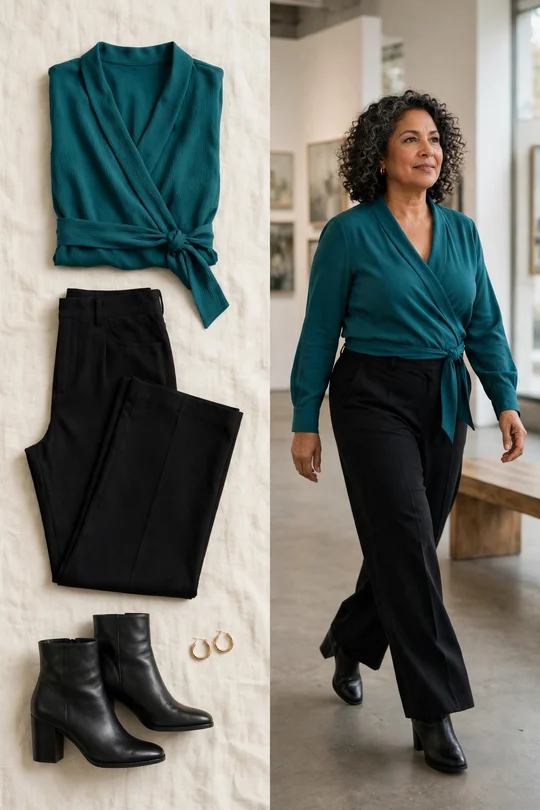
The wrap blouse is the closest thing to tailoring made for the apple shape, because its defining line is a diagonal. The wrap’s V crosses the torso on the bias, and diagonal lines read as narrower than horizontal ones — the eye travels down the diagonal instead of across the body.
Meanwhile the V-neck opens the throat and lifts the face, and because a true wrap adjusts with a tie, it never pulls or gaps across the bust the way button blouses do.
Wide-leg trousers balance the proportions: with volume below, the torso looks smaller by comparison. Choose a high rise that sits at or just above the natural waist, and a leg that falls straight from the hip — 22–25 cm wide at the hem keeps them modern rather than overwhelming.
- Key pieces: true wrap blouse, high-rise wide-leg trousers, heeled ankle boots
- Shoes: heeled ankle boots (5–7 cm) to keep the wide leg from dragging you down
- Occasion: work, dinners, anything where you want to look sharp
- Budget tip: a crepe wrap blouse in a jewel tone is the workhorse — £20–35 and endlessly re-wearable
Shop for: “A true wrap blouse with a V-neck and three-quarter sleeves, in crepe” and “high-rise wide-leg trousers in black or navy”.
How to wear it:
- Tie the wrap at the side waist, not the centre front — a side tie avoids a knot sitting on the tummy.
- Tuck the blouse’s front into the trousers’ high waistband for a clean line.
- Check the trouser hem grazes the top of the shoe — too short and the proportion collapses.
- Add small hoop earrings; the open neckline wants something at the face, not the chest.
Skip it if it’s a faux-wrap with a fixed seam — without the adjustable tie you lose the fit advantage.
Best for: workdays that end at a restaurant — this goes straight through.
8. The Poncho With Leather Leggings

A poncho drapes from the shoulder in a cone, which means it never touches the waist at all — the fabric’s widest point is wherever your body ends and the drape begins, and it moves when you move instead of clinging. That makes it one of the most forgiving shapes an apple shape can wear.
Underneath, faux-leather leggings do the opposite job: they hold a clean, dark line down the leg, so the softness up top is balanced by structure below.
The leggings must be genuinely opaque — hold them stretched over your hand; if you can see skin, they’ll show everything. A ponte-backed faux leather with a 7/8 length works best, and a tunic-length layer underneath the poncho (even just a long tee) keeps the hip line covered when the poncho shifts.
- Key pieces: knit poncho, opaque faux-leather leggings, long tee or tunic underneath
- Shoes: knee boots or heeled ankle boots — height balances the poncho’s volume
- Occasion: weekends, travel, relaxed evenings
- Budget tip: ponchos are a £20–30 knitwear staple; spend the money on opaque leggings instead
Shop for: “A knit poncho with a cowl or funnel neck, hip length or longer” and “high-waisted opaque faux-leather leggings”.
How to wear it:
- Layer a long dark tee under the poncho so there’s no gap at the hip when you move.
- Pull the poncho’s neckline slightly off one shoulder — asymmetric drape reads slimmer than centred.
- Finish with boots that add 4–6 cm of height; flat shoes under a poncho can look dumpy.
Skip it if the poncho is shorter than hip length — a cropped poncho ends at the bust and widens the torso visually.
Best for: travel days and long lunches — maximum comfort, zero waistband.
9. The Blazer With a Relaxed Dress

An unstructured blazer — no shoulder pads, no nipped waist — works like the long cardigan’s smarter sibling: worn open, its front edges draw the same slimming verticals, but the lapels and structured shoulders add polish and balance the middle by broadening the shoulder line slightly.
Underneath, a relaxed shift or sheath dress in a dark tone keeps the column unbroken.
The blazer should be a boyfriend or relaxed cut, ending at mid-hip (65–70 cm from the shoulder) so it covers the waistband zone of the dress without swallowing you. Push or roll the sleeves to the forearm — it stops the look reading corporate and shows the slimmest part of your arm.
- Key pieces: unstructured blazer, dark shift dress, heeled loafers or court shoes
- Shoes: heeled loafers or low court shoes — polished without the pain of stilettos
- Occasion: work, meetings, smart lunches
- Budget tip: a relaxed blazer in navy or black is a £30–50 high-street buy that sharpens ten outfits
Shop for: “An unstructured, unlined blazer in a relaxed cut, mid-hip length” over “a dark knee-length shift dress with a V or scoop neck”.
How to wear it:
- Wear the blazer open — always; a closed blazer reintroduces the waist problem.
- Roll the sleeves once to the forearm for a deliberately relaxed finish.
- Keep jewellery above the blazer’s lapel line — a short necklace or earrings, not a long pendant competing with the lapels.
- For evening, swap the loafers for heeled sandals and add a clutch; the blazer stays.
Skip it if the blazer has a single button closure you’re tempted to fasten — buy the open-front style instead.
Best for: looking authoritative at work without a tailored waist in sight.
10. The Cashmere Set

A matching knit top and trousers in one colour is a cheat code: because there’s no colour break at the waist, the eye reads the whole body as one continuous line, which is the most lengthening effect you can get without heels.
The softness of cashmere (or a cashmere blend) skims rather than defines, and a slightly relaxed — not oversized — cut floats 3–4 cm off the midsection.
Fit is everything here: the top should end at the high hip, not tucked and not tunic-long, so the proportion reads as a set rather than pyjamas. A V-neck or wide boat neck keeps the top half open; a crew neck on a matching set can look like loungewear.
- Key pieces: matching V-neck knit top and wide-leg or straight trousers
- Shoes: clean trainers, loafers or low-profile boots
- Occasion: travel, working from home in style, relaxed weekends
- Budget tip: a cashmere-blend set is £60–90 and wears like a uniform for three seasons
Shop for: “A matching knit set — V-neck top and straight trousers — in camel, grey or navy, with 3–5% elastane”.
How to wear it:
- Choose the set in your truest neutral — the one-colour column is the mechanism, so don’t break it with contrast shoes.
- Add one piece of jewellery at the neck to keep the look intentional, not sleepy.
Skip it if the top is boxy and cropped — that combination shortens the torso and widens it simultaneously.
Best for: the days you want to feel like you’re wearing pyjamas but look like you planned it.
Good to know
The 3 cm rule that fixes half of all apple-shape outfits: hemlines — of tops, tunics, jackets and cardigans — should land at least 3 cm above or below your widest point, never on it. A hem sitting exactly on the fullest part of the tummy or hip frames it like a picture.
Check in a mirror, nudge the hem 3 cm either way, and watch the difference. Pin this one to your style board — it’s the fastest fit check you’ll ever learn.
Early spring: lighter fabric, same rules
The light changes, the coat comes off — and the same principles carry straight through. These five are the warm-weather translations of everything above: open necklines, vertical lines, hems that land in the right places, and fabrics that move instead of clinging.
11. The Linen Shirt Dress

A shirt dress gives you two mechanisms for the price of one: a full-length vertical button placket that draws the eye straight down the centre of the body, and a collar that frames the face.
The classic mistake is belting it at the natural waist with the belt’s bow at the front — on an apple shape that bow sits on the tummy and points at it. The fix costs nothing: tie the belt at the back, or swap it for a tie 8–10 cm above the natural waist.
Linen’s slight stiffness is actually an advantage here — it holds away from the body instead of collapsing onto it. Look for a washed linen or linen blend (pure linen creases within the hour); a knee-length hem and rolled three-quarter sleeves keep it relaxed.
- Key pieces: linen shirt dress, fabric belt, flat sandals or espadrilles
- Shoes: flat leather sandals or espadrilles — easy and leg-lengthening in a nude tone
- Occasion: lunch out, holidays, warm weekends
- Budget tip: a washed-linen shirt dress at £30–45 is a three-summer workhorse
Shop for: “A knee-length linen shirt dress with a fabric belt, in white, chambray or olive”.
How to wear it:
- Undo the top two buttons and roll the sleeves to the elbow — the open neckline is doing real work.
- Tie the belt at the back or the side, never in a bow at the front.
- Leave the skirt’s buttons done up to mid-thigh; one undone button at the hem adds movement when you walk.
Skip it if the dress pulls across the bust when buttoned — size for the bust and let the belt define the shape.
Best for: the first properly warm day, when you want one piece and done.
12. The Midi Dress With a Denim Jacket

A dark midi dress is already a column; the cropped denim jacket is what makes it an outfit.
Because the jacket ends at the high hip — well above the waist — it shows off the dress’s skimming line instead of covering it, and its structured shoulders add a horizontal line at the top of the body that balances the middle.
The contrast between the jacket’s structure and the dress’s softness is what keeps this from looking like a uniform.
The jacket must be genuinely cropped: ending 5–8 cm above the natural waist. A hip-length denim jacket cuts the torso at the widest point and undoes the whole effect. A medium wash is the most versatile; black denim reads dressier.
- Key pieces: dark midi dress, cropped denim jacket, trainers or flat sandals
- Shoes: white trainers for day; flat sandals for evening
- Occasion: weekends, casual dinners, travel
- Budget tip: the dress can be the £20 high-street rib knit from outfit #2’s family
Shop for: “A cropped denim jacket ending above the waist, in a medium or black wash” over “a dark V-neck midi dress”.
How to wear it:
- Wear the jacket open and push the sleeves to the elbow.
- Check the jacket’s hem clears your natural waist by a hand’s width — if it doesn’t, it’s not cropped enough.
Skip it if the jacket is oversized and boxy — volume on volume widens the whole torso.
Best for: spring days that start cool and end warm — the jacket comes off and the outfit still works.
13. The Striped Breton and Cropped Trousers

Horizontal stripes have a bad reputation they don’t deserve — the problem was never the direction, it was the width and the fit.
Narrow Breton stripes (1–2 cm) on a top with ease through the body read as texture, not width, especially when the top’s hem ends at the high hip and the eye drops straight to a clean cropped trouser.
The stripe’s real job here is at the neckline: a boat neck shows the collarbones and widens the shoulder line slightly, which balances the middle.
Cropped trousers — ending 5–8 cm above the ankle — show the slimmest part of the leg and keep the whole outfit feeling light. A flat-front chino or pull-on crop in navy, stone or black works; avoid cargo pockets, which add bulk at the hip.
- Key pieces: narrow-stripe Breton top, cropped flat-front trousers, ballet flats or loafers
- Shoes: ballet flats, loafers or low trainers — keep the ankle visible
- Occasion: weekends, holidays, casual lunches
- Budget tip: a proper Breton is £15–25 and never dates
Shop for: “A cotton Breton top with narrow stripes and a boat neck, relaxed — not tight — fit”.
How to wear it:
- Do a small front tuck of the Breton — just 5 cm at the centre — to mark the waistband without defining the waist.
- Roll the trouser hem once if needed so 5–8 cm of ankle shows.
- Add a long necklace to break the horizontal lines with one vertical.
- Scrunch the Breton’s sleeves to the elbow for an easy, unstudied finish.
Skip it if the stripes are wider than 3 cm or the top clings — wide, tight stripes do exactly what people fear.
Best for: proving that stripes were never the enemy.
14. The Trench Over a Dark Column
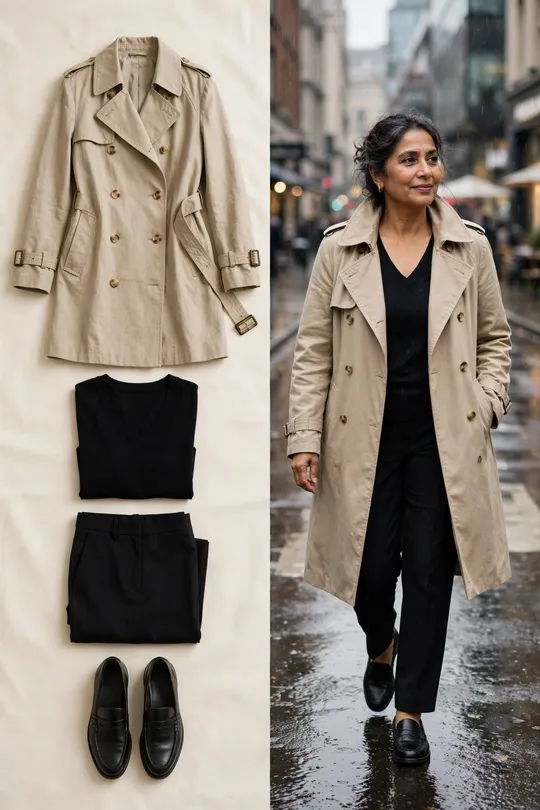
The trench coat is precision-engineered flattery: the storm flap, epaulettes and wide lapels all sit at the shoulders and chest, pulling the eye up and out, while the belt — worn tied at the back or left open — never marks the waist.
Worn open over a dark dress or dark top and trousers, the trench’s front edges form the same slimming verticals as the long cardigan, but in a fabric with real structure.
Fit the shoulders and don’t worry about the rest: a trench should skim, and the classic length — ending just below the knee, 100–110 cm from the shoulder — gives the longest line. Water-resistant cotton gabardine holds its shape in drizzle; anything too soft collapses and clings.
- Key pieces: classic trench coat, dark column underneath (dress or top + trousers)
- Shoes: loafers, ankle boots or trainers depending on the day
- Occasion: everything from work to weekends — the trench dresses up anything
- Budget tip: this is the investment piece of the guide; a good trench is £80–150 and lasts 15 years
Shop for: “A double-breasted trench in water-resistant cotton gabardine, knee length, in stone or navy” — belt tied at the back.
How to wear it:
- Build the dark column first — the trench is the frame, not the picture.
- Wear it open for the longest line, or tie the belt loosely at the back.
- Turn the collar up in rain; the raised collar frames the face beautifully.
Skip it if the trench is belted tightly at the natural waist — that’s a different garment’s trick, and it doesn’t work here.
Best for: the one coat that makes every outfit underneath look more expensive.
15. The Fit-and-Flare Sundress

The fit-and-flare’s seam sits under the bust — 8–10 cm above the natural waist — which means the dress defines a waist where your body is narrowest and then releases into a skirt that never touches the middle at all. It’s the raised-visual-waist principle built into the pattern.
The fitted bodice also gives the bust proper support and shape, which stops the torso reading as one undifferentiated column.
Look for a bodice with light boning or a substantial lining — it holds the shape instead of collapsing — and a skirt that starts flaring immediately below the seam rather than pleating from it (pleats add volume at the release point). Knee length keeps it daytime; a wedge sandal adds height without the wobble of a stiletto.
- Key pieces: fit-and-flare sundress with under-bust seam, wedge sandals
- Shoes: wedges (5–7 cm) or block-heel sandals
- Occasion: garden parties, holidays, summer lunches
- Budget tip: the high street does this silhouette brilliantly at £25–40
Shop for: “A fit-and-flare dress with the seam under the bust, lined bodice, knee-length skirt, in a solid colour or small print”.
How to wear it:
- Check the seam sits under the bust, not at the natural waist — that’s the whole mechanism.
- Choose a V or sweetheart neckline to keep the top half open.
Skip it if the skirt is gathered rather than flared from the seam — gathers add volume right at the release point.
Best for: occasions when you want to look dressed up with zero effort.
Late spring: skimming dresses and bare ankles
By late spring the layers are gone and the outfits get simpler — which is when fit matters most. These five are the warm-weather core of over 50 apple shape fashion: bare ankles, open necklines, and silhouettes that move with you from a daytime lunch straight through to dinner.
16. The Wrap Midi Dress

The true wrap midi is the single most recommended dress shape for the apple figure, and the reason is adjustability: the tie cinches exactly where you want it — at the side, above the natural waist — and the V-neckline and diagonal skirt line do the rest.
Unlike a fixed-waist dress, a wrap never fights your body; it negotiates with it. The midi length (hem 10–15 cm below the knee) keeps the proportion elegant rather than girlish.
Fabric choice decides whether it skims or clings: a crepe or heavy jersey with some body holds the wrap’s shape, while thin jersey collapses into the tie and shows every fold. A three-quarter sleeve is the most flattering arm option — it ends at the forearm’s slimmest point.
- Key pieces: true wrap midi dress, heeled sandals, small crossbody or clutch
- Shoes: heeled sandals (5–7 cm) — the midi hem needs the lift
- Occasion: dinners, weddings, any invitation that says “smart”
- Budget tip: one wrap midi in a deep jewel tone covers every smart invitation for years
Shop for: “A true wrap midi dress in crepe with three-quarter sleeves, tie at the side, in teal, berry or navy”.
How to wear it:
- Step in, wrap, and tie at the side waist — then check the V sits at a comfortable depth; a small stitch can secure it if it gapes.
- Let the skirt’s diagonal hem fall naturally — don’t straighten it into symmetry.
- Keep the bag small and the shoes heeled; the dress is doing the talking.
- For daytime, the same dress works with flat sandals and a straw bag — that’s the day-to-night payoff.
Skip it if it’s a faux wrap — the fixed seam gives you the look without the adjustable fit, which is the entire point.
Best for: the dinner invitation — this is the dress that always works.
17. The Palazzos and Cropped Top

Palazzo trousers work on an apple shape because of where they start: a high waistband sitting at or just above the natural waist holds the tummy smoothly, and then the leg falls in one wide, fluid line from the hip. The eye reads the long leg line, not the middle.
The cropped top — boxy, ending exactly at the waistband — shows no midriff and no tuck bulk; the two pieces meet in one clean horizontal line at the body’s narrowest meeting point.
The proportions are precise: the top should end within 2–3 cm of the waistband (a gap of bare skin breaks the line), and the palazzos need 3–5 cm of heel underneath to keep the wide leg from pooling. A fluid crepe or viscose moves better than stiff cotton.
- Key pieces: high-waisted palazzo trousers, boxy cropped top, heeled sandals
- Shoes: heeled sandals or wedges, 5–8 cm
- Occasion: holidays, summer evenings, garden parties
- Budget tip: buy the set in one colour for the column effect — separates in black are endlessly useful
Shop for: “High-waisted palazzo trousers with a flat front, in black crepe” and “a boxy cropped top ending at the waistband”.
How to wear it:
- Put the heels on first, then check the palazzo hem grazes the ground — too short ruins the line.
- Meet the top’s hem to the waistband with no gap and no overlap.
Skip it if the palazzos have an elasticated paper-bag waist with lots of gathering — that volume sits right on the tummy.
Best for: holidays and evenings when you want drama without discomfort.
18. The Shift Dress With a Kimono

A straight shift dress skims because it was never asked to do anything else — no waist seam, no shaping, just a clean line from shoulder to knee that floats past the middle. On its own it can read plain; the longline kimono is what gives it intention.
Worn open, the kimono’s front edges create the familiar slimming verticals, and its pattern or colour carries the outfit’s personality while the dress underneath stays quiet.
The kimono should end at or below the knee — a hip-length kimono chops the shift at the wrong place. Keep the shift’s neckline open (V or scoop) so the kimono’s V echoes it rather than fighting a high neck.
- Key pieces: straight shift dress, longline open kimono, flat sandals
- Shoes: flat strappy sandals or low wedges
- Occasion: holidays, summer lunches, warm-weather travel
- Budget tip: the kimono is the statement — the shift underneath can be a £15 basics buy
Shop for: “A knee-length straight shift dress with a V-neck, in black or navy” and “a longline kimono ending below the knee”.
How to wear it:
- Let the kimono hang open — never belt it over the shift.
- Match the shift to the kimono’s darkest tone so the column holds.
- Roll the kimono’s sleeves to three-quarter length for a deliberate finish.
Skip it if the kimono is shorter than the dress — the layering looks accidental rather than styled.
Best for: hot days when you want coverage that breathes.
19. The Maxi Skirt and Fitted Tee
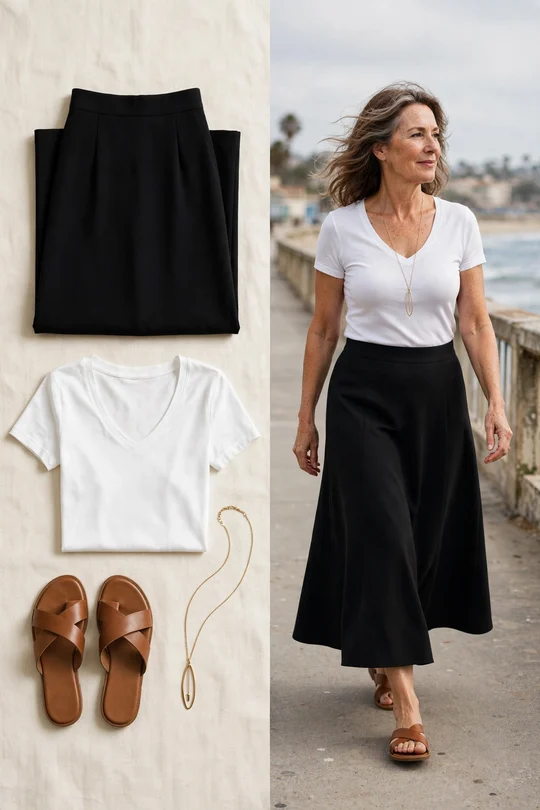
A maxi skirt gives you the longest uninterrupted line of any daytime piece — from waist to ankle with no breaks — which is pure elongation.
The trick for the apple shape is the top: a fitted (not tight) tee, front-tucked just 5 cm at the side, marks the waistband without adding the bulk of a full tuck, and the skirt’s A-line release from the waist means the fabric falls in its own line past the middle.
Choose a skirt with a flat, wide waistband rather than elastic shirring — shirring gathers volume at the waist. A side zip in a woven fabric, or a ponte with a yoga-style waistband, lies flat and smooth. The tee should have 3–5% elastane so it skims the bust without pulling.
- Key pieces: A-line maxi skirt, fitted V-neck tee, flat sandals
- Shoes: flat leather sandals — the skirt’s length provides the drama, not the shoe
- Occasion: weekends, holidays, warm evenings
- Budget tip: a black ponte maxi at £20–30 is one of the hardest-working pieces you can own
Shop for: “An A-line maxi skirt with a flat waistband, ankle length, in black ponte or a small print” and “a fitted V-neck tee with elastane”.
How to wear it:
- Tuck just the side front of the tee — 5 cm is enough to mark the waistband.
- Let the back stay loose for comfort and a relaxed line.
- Add a long pendant to keep the eye moving down the column.
- For evening, swap flats for wedges and add earrings — the skirt is already evening-ready.
Skip it if the skirt is tiered with gathers at the waist — tiers add volume exactly where the A-line is meant to release.
Best for: the simplest outfit in this guide — two pieces, done.
20. The Evening Column Dress

For evening, everything in this guide converges on one dress: a dark column with ruching across the midsection. Ruching works optically — the gathered fabric scatters light instead of reflecting it in one flat plane, so the eye can’t find a single smooth surface to measure. It’s camouflage by physics, not by hiding.
A V-neckline, three-quarter sleeves and a knee or midi hem complete the formula.
The ruching should sit across the front of the torso, not at the sides — side ruching pulls the fabric taut across the middle. Look for a dress with a built-in slip or lining so the outer layer drapes rather than clings, and choose a matte fabric; shine reflects light and undoes the ruching’s work.
- Key pieces: ruched dark column dress, heeled sandals, clutch
- Shoes: heeled sandals, 6–8 cm — evening is the time for height
- Occasion: weddings, dinners, parties, the theatre
- Budget tip: this is worth the investment slot — see the bottom line
Shop for: “A knee-length ruched column dress with front ruching, V-neck and three-quarter sleeves, in black, navy or deep berry, matte fabric”.
How to wear it:
- Check the ruching lies flat across the front with no pulling — if it pulls, size up.
- Keep jewellery at the neck and ears; the dress’s texture is the detail.
- Carry a small clutch — a big bag breaks the column’s line.
Skip it if the fabric is shiny satin — shine + ruching reflects light in patches and draws the eye to the middle.
Best for: the night you want to feel genuinely glamorous — and comfortable until midnight.
Day-to-night dressing: comfort from 9 a.m. to 9 p.m.
The whole point of comfort-first dressing is that it doesn’t quit at 6 p.m. Every outfit in this guide was chosen to run the full day — but a ten-minute switch takes it from daytime ease to evening polish. Here’s how.
- Shoes do 70% of the switch. Flat sandals or trainers to heeled sandals changes the posture of every outfit here — keep the evening pair in the car or your bag.
- Shrink the bag. A daytime crossbody becomes a clutch’s job at night; a small bag keeps the column’s line clean.
- Move the jewellery up. Daytime long pendant off, evening earrings and a cuff on — the eye stays at the face and hands, away from the middle.
- Add one structured layer for evening. The unstructured blazer (#9) or the trench (#14) over a day dress reads instantly smarter after dark.
- Refresh the lip, not the outfit. A deeper lip colour is the fastest evening signal there is — two minutes, no changing room.
- Steam the creases, not the shape. A handheld steamer (2–3 minutes) revives linen and crepe between day and night without an iron.
The 10-minute evening switch:
- Swap to heeled shoes (3 minutes).
- Switch to the small evening bag, moving only phone, keys, lip colour (2 minutes).
- Change the jewellery to evening pieces (2 minutes).
- Steam any creases and refresh lip colour (3 minutes).
The bottom line
If I had to pick by budget, here’s the honest answer. Money’s tight? Start with #3 — the tunic and slim trousers costs £50–70 all-in on the high street and you’ll wear it three days a week.
Mid-range to spend? Buy the trench in #14 — £80–150, and it makes every outfit underneath look twice the price for the next fifteen years. One true investment?
The evening column dress in #20 — a well-cut ruched dress in a matte dark fabric is the piece you’ll reach for every time an invitation lands, and cost-per-wear makes it the cheapest glamour you’ll ever buy.
Keep this guide on your “outfits that actually fit” board — the 3 cm hem rule in the Good to know box alone will fix half your wardrobe.
Frequently asked questions
What should an apple shape not wear over 50?
The honest list is short: belts cinched at the natural waist, clingy thin jersey tucked into high-waisted anything, cropped boxy tops that end at the widest point, and shiny fabrics across the middle. Everything else is negotiable — it’s usually the fit and the hem placement doing the damage, not the garment itself.
If a piece you love breaks one of these rules, the 3 cm hem rule in this guide often rescues it.
Can apple-shaped women wear tucked-in tops after 50?
Yes — with two conditions. First, the top must be fine-gauge, because a chunky tuck adds bulk at the waist. Second, tuck into a waistband that sits at or above the natural waist (outfit #5’s A-line skirt is the textbook case), never into low-rise bottoms.
If a full tuck feels too exposed, a 5 cm front tuck gives you the definition without the commitment.
What dresses suit an apple shape over 50?
Wrap dresses, fit-and-flare styles with under-bust seams, A-line dresses, shirt dresses with the belt tied at the back, and ruched column dresses for evening — outfits #11, #15, #16 and #20 in this guide. The common thread is that none of them put a fixed horizontal line at the natural waist.
If you’re choosing one dress to buy first, make it the true wrap midi (#16): it’s adjustable, so it fits on good days and bad ones.
How can I look slimmer over 50 with an apple shape without shapewear?
Build one dark column underneath an open layer — it’s the single most effective trick in over 50 apple shape fashion, and it needs no special undergarments. Add a V-neckline to lift the eye, keep hemlines 3 cm clear of your widest point, and choose matte fabrics with a bit of structure.
Together those four moves read 5–10 cm slimmer, and every one of them is about the clothes, not your body.
Are leggings OK for apple shapes over 50?
Yes, if they’re the right leggings worn the right way: high-waisted, genuinely opaque (the hand test in outfit #8), and always with a top layer that covers the hip — a tunic, a long cardigan, or a poncho. What doesn’t work is leggings with a short top that ends at the waistband, because that frames the fullest point.
Think of leggings as the bottom half of a column, never as trousers on their own.