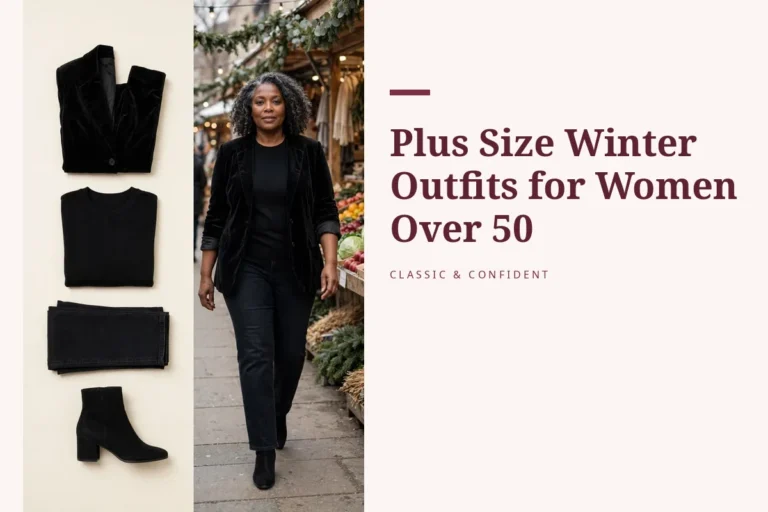
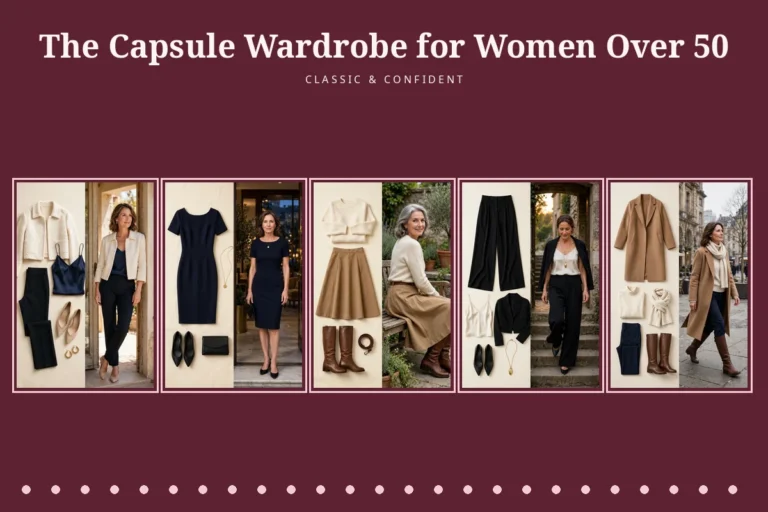
20 Midsize Winter Outfits for Women Over 50
The myth goes like this: once you’re midsize and over 50, winter means hiding — drown yourself in oversized jumpers, shapeless coats, and leggings, and nobody will notice. Here’s the truth nobody told us: oversized clothes on a midsize frame don’t hide anything.
They add visual volume exactly where you don’t want it, and they erase the waist, the wrists, the ankles — the very points that make an outfit look intentional. These 20 midsize winter outfits work on the opposite principle: structure where it counts, skimming where it matters, and one defined waistline per look.
Every outfit names the exact pieces, the fit numbers to look for, and what to skip. Start with my quick picks, then jump to the problem your winter wardrobe actually has: oversized layers swallowing you, fitted cuts digging in, bulk erasing your waist, or lengths landing wrong. Pick the fix that matches your morning.
Skip to your match
- The belted longline coat that builds the waist for you (#1)
- The true-wrap knit dress you tie exactly where you want (#7)
- The 2%-elastane jeans that never bag at the knee (#9)
- The belted flannel shirt dress with the brushed, forgiving finish (#13)
- The cropped denim jacket that restores your waist over any midi (#20)
- The one-colour column that adds centimetres of height (#5)
Contents
- How to choose midsize winter outfits that fit real life
- At a glance: all 20 looks
- The problem: everything oversized swallows you
- The problem: fitted cuts dig, pull or gape
- The problem: winter layers erase your waist
- The problem: lengths and proportions land wrong
- Midsize winter dressing rules that actually work
- The bottom line
- Frequently asked questions
How to choose midsize winter outfits that fit real life
Fit the shoulders and the waistband, forgive everything else. On a midsize frame, an outfit fails at two points: shoulders that pull and waistbands that dig. A coat that sits cleanly on the shoulder and a trouser waistband you can slide two fingers under will make the whole look read “intentional” even if the middle is relaxed.
If those two points are right, nothing else needs to be tight — and that is the entire secret of midsize winter outfits. Start there, in the fitting room, before you look at a mirror.
One defined waist per outfit, never zero, never two. Zero defined waists and you look like you’re wearing a duvet; two competing waistlines (belted coat over a belted dress, say) and the eye doesn’t know where to land.
Pick your single waist marker — a belt, a tuck, a cropped layer ending at the waist, a wrap tie — and let everything else skim. This one rule fixes more midsize winter outfits than any purchase. Compare it with the broader winter outfits guide and you’ll see the same principle running through every look that works.
Matte fabrics skim; sheen spotlights. Satin, high-shine faux leather and glossy coated denim catch the light on every curve — which is lovely if that’s the effect you want, and unforgiving if it isn’t. Brushed flannel, matte ponte, fine-gauge merino and washed denim absorb light instead, so the fabric reads as one smooth surface.
This doesn’t mean avoiding shine altogether; it means putting shine where you want attention (shoes, a bag, jewellery) and matte where you want calm.
Buy to your largest measurement, then tailor down. Midsize bodies are rarely one size all over — most of us are a 14 on top and a 16 on the bottom, or the reverse. Buy the size that fits the largest part comfortably, then spend $12–$18 at a tailor taking in the waist or hemming.
A $40 pair of trousers with a $15 waist alteration looks more expensive than a $120 pair that gapes. Our everyday outfits for women over 50 roundup leans on this same buy-big-tailor-down logic for the same reason: it works.
Sit down before you decide. Winter outfits are worn sitting — at desks, in cars, at lunch tables — and a waistband that feels fine standing can saw into you by the second hour. In the fitting room, sit for a full two minutes, cross your legs, reach forward.
If anything digs, rides or pulls, it will be ten times worse by 3 p.m. For relaxed-day inspiration built on this comfort-first test, see these casual winter outfits — every one of them passes the two-minute sit.
At a glance: all 20 looks
| Look | The problem it fixes | Key piece |
|---|---|---|
| 1. The Belted Longline Coat | Swallowed by oversized layers | Belted wool-blend coat, 100–110 cm |
| 2. Fitted Roll-Neck Under an Open Blazer | Swallowed by oversized layers | 12-gauge roll-neck + open blazer |
| 3. The Half-Tuck with Straight-Leg Jeans | Swallowed by oversized layers | High-rise straight-leg jeans |
| 4. Cropped Puffer Over a Long Base Layer | Swallowed by oversized layers | Cropped puffer, 50–55 cm |
| 5. The One-Colour Column | Swallowed by oversized layers | Head-to-toe single colour |
| 6. The Ponte Knit Midi Skirt | Fitted cuts that dig or pull | 280–320 gsm ponte midi |
| 7. The True-Wrap Knit Dress | Fitted cuts that dig or pull | Genuine wrap dress, self tie |
| 8. Elastic-Back Trousers That Look Tailored | Fitted cuts that dig or pull | Flat-front, elastic-back trousers |
| 9. Stretch Denim with a 2% Elastane Rule | Fitted cuts that dig or pull | 98/2 cotton-elastane jeans |
| 10. The Ribbed Knit Midi with a Side Slit | Fitted cuts that dig or pull | Ribbed midi, 15–20 cm slit |
| 11. The Cropped Cardigan Over a Column Dress | Winter bulk erases your waist | Cropped cardigan, 45–50 cm |
| 12. Paperbag-Waist Wool Trousers | Winter bulk erases your waist | Paperbag-waist wool trousers |
| 13. The Belted Flannel Shirt Dress | Winter bulk erases your waist | Flannel shirt dress + belt |
| 14. The Peplum-Hem Knit | Winter bulk erases your waist | Peplum-hem sweater |
| 15. High-Rise Wide-Leg Trousers and a Cropped Sweater | Winter bulk erases your waist | High-rise wide-legs + crop |
| 16. The Knee-to-Calf Skirt Rule | Lengths land wrong | Knee or mid-calf hem |
| 17. Ankle Boots, Not Knee Boots, with Midis | Lengths land wrong | Ankle boots, 12–15 cm shaft |
| 18. The 3/4-Sleeve Arm Trick | Lengths land wrong | 3/4 sleeves |
| 19. V-Neck Layers Over Crew Necks | Lengths land wrong | 12–15 cm V opening |
| 20. The Cropped Denim Jacket Over a Midi Dress | Lengths land wrong | Cropped denim jacket, 50–55 cm |
The problem: everything oversized swallows you
You bought the oversized jumper because the size chart said “relaxed fit” — and now you look like a talented but shapeless rectangle. The fix isn’t going tighter everywhere; it’s giving the eye one clean line to follow and one place where the shape is defined. These five midsize winter outfits do exactly that.
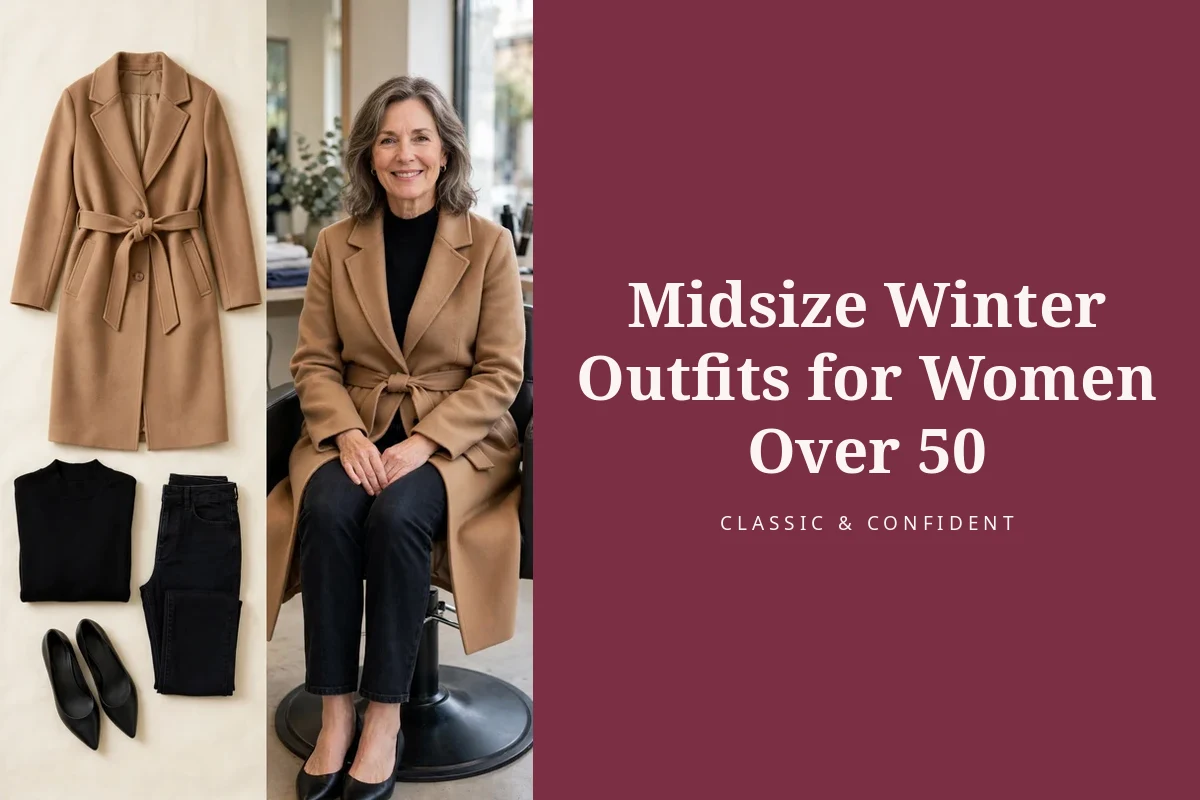
1. The Belted Longline Coat

A longline coat works on a midsize frame because it creates one unbroken vertical line from shoulder to knee — the eye travels down without stopping, which reads as height.
The belt is the mechanism that saves it from shapelessness: tied at your natural waist (usually 2–4 cm above the navel, where the torso is narrowest), it divides the body into a roughly 1:2 ratio that the brain reads as an hourglass, even over a bulky jumper.
Skip the belt and the same coat adds a stone of visual weight; tie it and the coat does your tailoring for you.
Length matters more than label size. Look for a back length of 100–110 cm — long enough to cover the hip and thigh, short enough to show ankle and boot. The belt should be at least 3 cm wide; a skinny belt disappears into winter layers and the waist definition goes with it.
Wear it over everything from jeans to dresses and it becomes the one coat that finishes every midsize winter outfit you own.
- Coat: wool-blend longline, 100–110 cm back length, self belt 3 cm+
- Underneath: anything — jeans, midi skirt, knit dress
- Price: from about $90 for a good wool blend
- Sizes: 12–18 widely available; buy to shoulder fit
Shop for: a single-breasted wool-blend longline coat, 100–110 cm back length, with a self fabric belt at least 3 cm wide; set-in sleeves (not dropped shoulders) so the shoulder line stays clean.
How to wear it:
- Put the coat on over your full outfit, then tie the belt at your natural waist — not your hips — and knot it at the side, not the front, so there’s no bulk at the tummy.
- Pop the collar up 4–5 cm at the back of the neck; it frames the face and stops the long line from looking flat.
- Push each sleeve up 5 cm to show wrist — one flash of your slimmest point balances the coat’s volume.
Skip it if you run hot — a belted wool coat over a jumper is genuinely warm, and you’ll be carrying it by noon on mild days.
Best for: work days, dinner out, and any day you want one piece to do the heavy lifting.
2. A Fitted Roll-Neck Under an Open Blazer

This is the layering formula that beats bulk: a thin, fitted base layer adds no visual volume, while the two open fronts of the blazer draw two vertical lines down the torso. The eye follows those lines instead of the body’s outline, which narrows the midsection without a single tight garment.
The roll-neck’s job is coverage with zero bulk — a 12-gauge fine knit in a dark colour sits flat under everything and keeps the neck warm without the scarf-level volume of a chunky knit.
The blazer must be worn open — buttoned, it becomes one more fitted layer fighting the middle. Look for a single-breasted blazer, hip length (70–75 cm), with enough room to close if you wanted to but no pulling when open. The roll-neck should be 200–250 gsm: substantial enough to be opaque, thin enough to layer.
Together they read polished, not padded.
- Base: 12-gauge roll-neck, 200–250 gsm, black or charcoal
- Blazer: single-breasted, hip length 70–75 cm, worn open
- Price: from about $60 total
- Sizes: 12–18; blazer sized to close without pulling
Shop for: a fine-gauge roll-neck in black, charcoal or deep navy, 12-gauge knit; plus a single-breasted blazer, one button, hip length, in wool blend or heavy crepe — buy the size that closes cleanly, then wear it open.
How to wear it:
- Start with the roll-neck tucked into trousers or jeans — the tuck marks the waistband and stops the base layer bunching.
- Add the blazer open, and pull both fronts forward 2–3 cm so they hang straight — the vertical lines only work if the fronts don’t splay.
- Roll the blazer sleeves once to the forearm; the contrast between the fitted cuff of the roll-neck and the blazer sleeve shows deliberate styling.
- Finish with a low heel or pointed flat — the pointed toe extends the leg line the blazer started.
Skip it if your office runs arctic air-conditioning — you’ll want a closed layer over the top, in which case add the longline coat from #1.
Best for: office days, lunches, and occasions where “put together” matters more than “cosy”.
3. The Half-Tuck with Straight-Leg Jeans
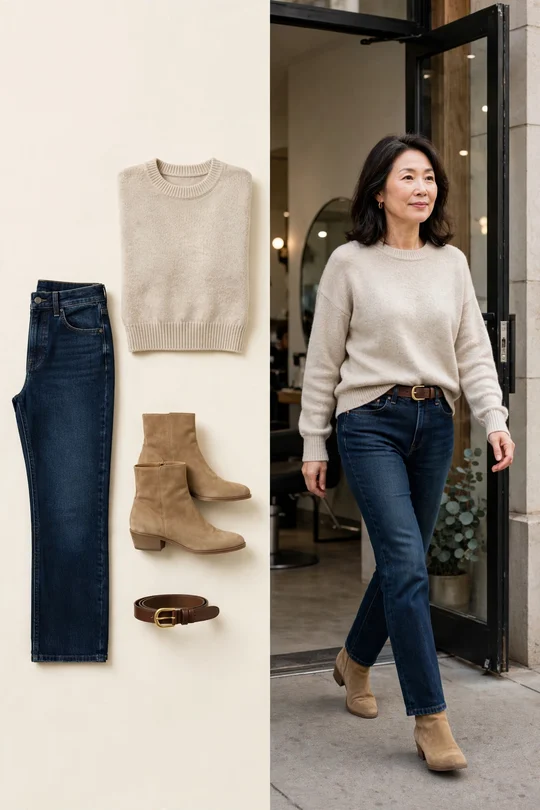
The half-tuck is a waistline illusion: tucking just the front 10–15 cm of a sweater into the jeans marks exactly where the waist is, while the untucked back and sides drape over the hip and lower tummy.
A full tuck on a midsize frame often creates a shelf of fabric at the front; no tuck at all lets the sweater fall straight from the bust and hide the waist entirely. The half-tuck splits the difference with physics on its side — one anchored point at the centre front, soft drape everywhere else.
It only works with the right jeans: a high rise of 26–28 cm at the front so there’s waistband to tuck into, and a straight leg that falls clean from hip to ankle. Low-rise jeans give you nothing to tuck into; skinny jeans add a second tight element that fights the relaxed sweater.
Finish the look with the sweater’s hem sitting 5–8 cm below the waistband at the back — long enough to cover, short enough to show the tuck’s work.
- Jeans: high rise 26–28 cm, straight leg, dark rinse
- Sweater: mid-weight knit, hip length, not cropped
- Price: from about $70 total
- Sizes: 12–18; buy jeans to fit the thigh, tailor the waist
Shop for: high-rise straight-leg jeans, 26–28 cm front rise, in a dark rinse with 1–2% elastane; plus a mid-weight crew or V-neck sweater that hits mid-hip — fine enough to tuck without bunching.
How to wear it:
- Put the jeans on and do them up fully, then take the front 10–15 cm of the sweater — just left of centre — and tuck it firmly into the waistband.
- Pull 2–3 cm of the tucked section back out so it blouses slightly; a drum-tight tuck looks fussy, a soft blouse looks effortless.
- Leave the sides and back untucked, and check the side view: you want one clear waistband line at the front, soft drape everywhere else.
Skip it if your sweater is chunky cable-knit — thick knits bunch instead of tucking; save the half-tuck for fine and mid-gauge knits.
Best for: weekends, school runs, coffee dates — the everyday uniform, fixed.
4. Cropped Puffer Over a Long Base Layer

A full-length puffer on a midsize frame is a sleeping bag with sleeves — it hides the leg line completely and the body reads as one wide column.
The cropped puffer fixes this with simple proportion: a 50–55 cm cropped outer worn over a 70–75 cm tunic or long sweater means the eye reads the outfit from the hem of the inner layer down, restoring 15–20 cm of visible leg you thought the weather had taken.
The puffer keeps you warm where it counts (core, arms, shoulders) while the longer layer underneath does the leg-length work.
The inner layer should be slim through the body — a longline thermal, a tunic sweater, a shirt dress — so it reads as a base, not a second bulky layer. Keep the puffer’s fill moderate; an expedition-weight cropped puffer still adds width at the exact place (the bust and upper arm) where midsize frames least need it.
Matte shell fabrics beat high-shine ones here for the same light-absorbing reason as ever.
- Puffer: cropped, 50–55 cm body length, matte shell
- Base: slim tunic or long sweater, 70–75 cm long
- Price: from about $85 total
- Sizes: 12–18; puffer sized to zip over the base layer
Shop for: a cropped puffer jacket, 50–55 cm back length, matte recycled shell, ending at or just below the waistband; plus a slim-fit tunic sweater or longline thermal, 70–75 cm, in a dark solid colour.
How to wear it:
- Layer the long base over leggings or slim trousers, and check in the mirror that 15–20 cm of it shows below the puffer’s hem.
- Zip the puffer three-quarters up and fold the collar down — a fully zipped high collar shortens the neck visually.
Skip it if you carry most of your weight in your bust — a cropped puffer ends at the fullest point; try the longline belted coat (#1) instead.
Best for: cold school runs, dog walks, and any day the temperature demands real insulation.
5. The One-Colour Column

Dressing head-to-toe in one colour is the oldest elongating trick in the book, and it works hardest on midsize frames. Every colour change at the waist, hip or knee is a horizontal line, and horizontal lines are where the eye stops — each stop chops you into shorter segments.
One continuous colour removes every stop: the eye travels from shoulder to shoe without pausing, which reads as 5–7 cm of extra height and one smooth silhouette. It doesn’t have to be black — all-navy, all-chocolate, all-camel work the same way.
The trick that keeps it from looking like a uniform is texture contrast: a matte wool jumper, leather-look leggings or trousers, suede boots. Same colour family, three different surfaces — the light behaves differently on each, so the outfit has depth without a single horizontal break.
Keep the shades within one tonal step of each other; a cream jumper with black trousers is two colours, not a column.
- Formula: top + bottom + shoes in one colour family
- Textures: mix 3 — e.g. knit + leather-look + suede
- Price: from about $75 using pieces you own
- Colours: black, navy, chocolate, camel, charcoal
Shop for: three pieces in one colour family but three different textures — e.g. a black fine-knit jumper, black coated straight trousers, black suede ankle boots; keep every shade within one tonal step.
How to wear it:
- Lay the three pieces on the bed and check them in daylight — indoor lighting lies about whether two blacks match.
- Put the most textured piece where you want the eye to linger (usually the top) and the smoothest where you want it to glide (usually the leg).
- Add one metallic accent — a gold necklace, a bronze belt buckle — at the neckline; it gives the eye a single deliberate focal point.
Skip it if the dress code is festive — a column is sleek, not celebratory; add the shine with accessories instead of breaking the colour.
Best for: evenings, travel days, and every “I have nothing to wear” morning — this formula never fails.
The problem: fitted cuts dig, pull or gape
The opposite trap: you buy your “real” size in a fitted piece and by 11 a.m. the waistband is sawing, the buttons are pulling, or there’s a three-finger gap at the back of the jeans. Fitted doesn’t have to mean punishing — it means engineered.
These five midsize winter outfits use fabrics and cuts with the give built in, so the shape holds without the suffering.
6. The Ponte Knit Midi Skirt
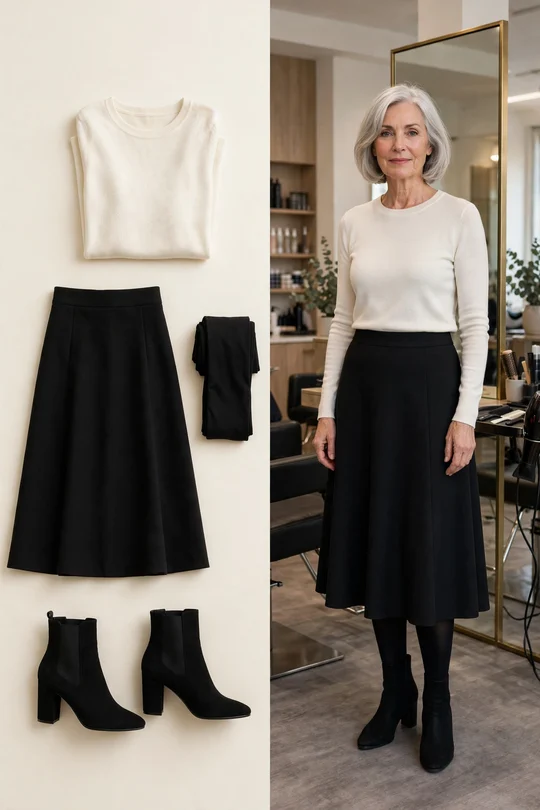
Ponte is the midsize skirt fabric because of its double-knit construction: two layers of knit locked together, usually viscose or polyester with 3–5% elastane, at 280–320 gsm. That structure does two things a single jersey can’t.
First, it stands slightly away from the body instead of clinging to it — the skirt skims over the hip and tummy rather than mapping them. Second, it springs back: sit for three hours and a ponte skirt recovers its shape, where a jersey skirt keeps the seat of the chair and a woven skirt keeps the creases.
Cut matters as much as cloth. An A-line or gentle trumpet ponte midi, 70–75 cm long, sitting at the natural waist, gives you the waist definition while the skirt does the forgiving.
Pair it with a tucked-in fine knit or a cropped sweater that ends at the waistband — never an oversized tunic over the top, which puts you straight back in the swallowing problem of group one.
- Skirt: ponte knit, 280–320 gsm, A-line midi 70–75 cm
- Waist: sits at natural waist, 5–7 cm wide waistband
- Price: from about $45
- Sizes: 12–20; ponte’s stretch covers size fluctuation
Shop for: an A-line ponte midi skirt, 70–75 cm long, 280 gsm minimum, with a 5–7 cm elasticated waistband covered in self fabric — no exposed elastic, no drawstring.
How to wear it:
- Tuck a fine-knit top fully into the skirt — ponte’s wide waistband holds a tuck without bunching, and the tuck marks the waist.
- Add opaque tights in the same colour family as the skirt (60–80 denier in winter) so the leg reads as one line to the boot.
- Finish with ankle boots and a 3–5 cm heel; the slight lift keeps the midi hem from dragging visually.
- If the skirt has pockets, use them — but empty them before you leave; a phone in a ponte pocket distorts the hip line.
Skip it if you need a truly formal look — ponte reads smart-casual; for evening, the wrap dress (#7) dresses it up a level.
Best for: office days, lunch dates, and long days where you’ll sit for hours.
7. The True-Wrap Knit Dress
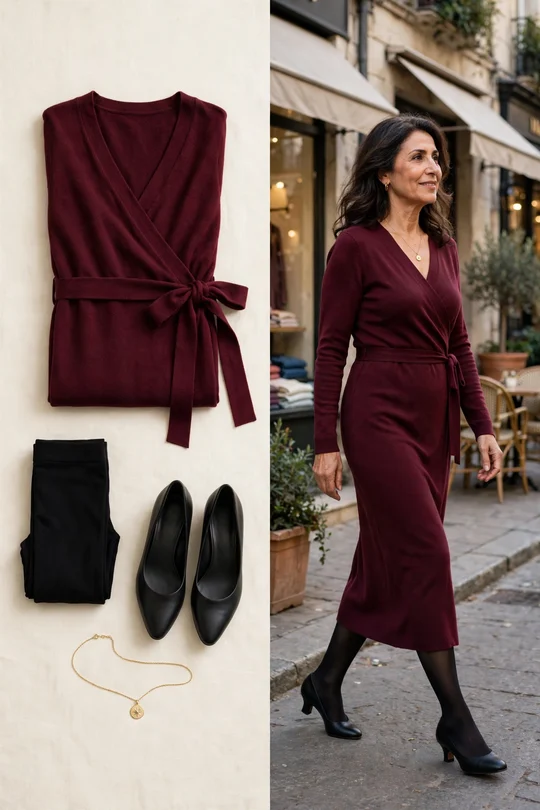
A genuine wrap dress — one that actually wraps and ties, not a faux-wrap with a fixed seam — is the most adjustable garment a midsize woman can own. The tie lets you set the waist exactly at your narrowest point, to the centimetre, and re-set it after lunch.
The diagonal crossover front creates a deep V neckline, typically 12–15 cm, which lengthens the neck and draws the eye down the centre of the body instead of across it. Nothing off the rack fits a fluctuating midsection this precisely, because nothing else is fitted by you, that morning, to that day’s body.
Knit, not woven, for winter: a mid-weight jersey or fine ponte wrap moves with you and layers under coats without the crackle of a woven wrap’s interlining. Knee to 10 cm below the knee is the working length — shorter rides up when you sit, longer needs a heel to avoid dragging the proportion.
The 3/4 sleeve is the classic wrap-dress sleeve for a reason (see #18): it shows the forearm and leaves room for a bracelet.
- Dress: true wrap, knit, knee to 10 cm below
- Tie: self fabric, ties at natural waist, side knot
- Price: from about $55
- Sizes: 12–20; size to the bust, the tie handles the waist
Shop for: a TRUE wrap dress in mid-weight knit (not a faux-wrap), with ties long enough to wrap fully around and knot at the side; V neckline 12–15 cm deep; skirt falling at or just below the knee.
How to wear it:
- Wrap and tie at your natural waist — find it by bending sideways; where the skin creases is the spot — and knot at the side seam, never centre front.
- Check the crossover at the bust: you want 8–10 cm of overlap so nothing gaps when you move; pin it with a small safety pin if your bust pulls it open.
- Add a pendant necklace that ends at the V’s point — it underlines the neckline instead of competing with it.
Skip it if you need to look buttoned-up conservative — the V neckline reads confident, not corporate; the blazer look (#2) is the office alternative.
Best for: evenings, events, and days when your size feels unpredictable — the tie adjusts to you.
8. Elastic-Back Trousers That Look Tailored

The engineering here is simple and brilliant: a flat front with no elastic, no gathering, no drawstring — so from the front the trousers look fully tailored — and elastic only across the back waistband, giving 5–8 cm of seated expansion exactly where a midsection needs it. All the comfort of pull-ons, none of the pyjama energy.
The flat front is the whole trick: gathers at the front waistband add visual volume to the tummy, while a flat front keeps the line clean and lets a tucked-in top sit smooth.
Look for a rise of 27–29 cm and a straight or gently tapered leg. The waistband should sit at the natural waist, not below it — a lower rise on an elastic-back trouser lets the back elastic roll, which is the one failure mode of this cut.
In winter fabrics — wool blend, heavy crepe, brushed twill — they read as proper trousers under a blazer or a long coat, and nobody knows about the elastic except you.
- Trousers: flat front, elastic back, rise 27–29 cm
- Leg: straight or tapered, full length to the ankle
- Price: from about $50
- Sizes: 12–20; buy to hip fit, back elastic forgives the waist
Shop for: flat-front trousers with elastic ONLY at the back waistband (check the inside: shirred elastic 8–10 cm across the back, flat woven tape at the front); rise 27–29 cm; in wool blend, heavy crepe or brushed twill.
How to wear it:
- Tuck your top in fully — the flat front is designed to be shown, and an untucked top wastes the tailoring.
- Add a slim belt only if the loops sit flat; skip the belt entirely if it adds bulk — the clean waistband is the point.
- Wear with a heel of 3–5 cm or a pointed flat to keep the full-length leg from pooling.
Skip it if you want a truly relaxed weekend trouser — these are office-smart; for weekends the stretch denim (#9) is the easier friend.
Best for: work, appointments, and travel days where comfort must look like tailoring.
9. Stretch Denim with a 2% Elastane Rule

The elastane percentage is the whole story of whether jeans survive a midsize day. Below 1% elastane, the denim has no recovery — it bags at the knee and seat by 2 p.m. and never comes back. At 1.5–2%, the fibres snap back after every wear, so the jeans look the same at 8 p.m. as at 8 a.m.
Above 3%, the denim starts behaving like a legging: it clings, shows every line, and loses the structured denim look that makes jeans flattering in the first place. The sweet spot — 98% cotton, 2% elastane — is specific, and it’s worth reading the inside label for.
Cut follows the same logic: a dark rinse (indigo or black) reads as one smooth surface, while heavy whiskering and fading draw horizontal lines across the thigh.
A straight leg in a dark rinse with 2% elastane is the hardest-working jean a midsize wardrobe can hold — it goes under the cropped puffer (#4), inside the half-tuck (#3), and beneath the longline coat (#1) without a second thought.
- Denim: 98% cotton / 2% elastane, dark rinse, straight leg
- Rise: high, 26–28 cm — no gapping at the back
- Price: from about $60 for the right composition
- Sizes: 12–20; always check the fibre label, not the marketing
Shop for: straight-leg jeans labelled 98% cotton, 2% elastane (accept 1.5–2.5%; reject under 1% and over 3%), in dark indigo or black rinse with minimal whiskering; high rise 26–28 cm.
How to wear it:
- Do the sit test in the fitting room: sit, cross your legs, stand — the denim should recover within a minute, not hold the knee bag.
- Wash cold and hang dry; heat is what kills elastane, and dead elastane is what bags.
Skip it if you want a wide-leg or flare silhouette — the 2% rule still applies, but buy the flare a touch long and wear the heel you’ll actually keep on.
Best for: literally everything casual — the foundation jean for half this list.
10. The Ribbed Knit Midi with a Side Slit
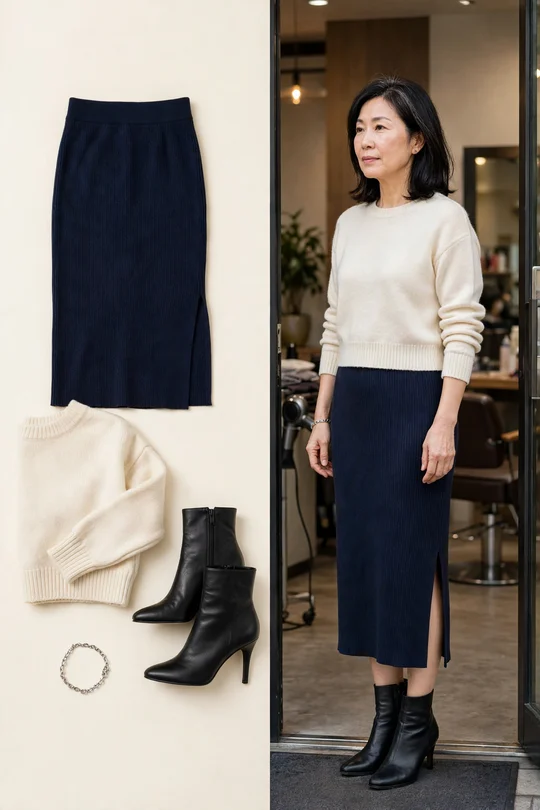
Vertical ribbing is a pinstripe you can wear: the raised ribs run the full length of the skirt, and the eye follows them down instead of across — the same elongating mechanism as the one-colour column, built into the fabric.
But a fitted ribbed midi has a known failure: without ease at the hem, it rides up when you walk and clings at the knee when you sit.
A 15–20 cm side slit solves both — it frees the stride so the skirt falls straight, and it flashes 15 cm of leg in motion, which breaks the knit column at exactly the right place.
The rib should be a medium rib — wide enough to read as texture, not so chunky it adds width. A 2×2 or 3×3 rib in a mid-weight merino blend holds its vertical lines all day; a fine 1×1 rib can go wavy at the hip on a curvier frame.
The slit goes at the side seam, not the back — a back slit splits when you sit, a side slit simply opens as you walk.
- Skirt: medium-rib knit midi, 70–75 cm, 15–20 cm side slit
- Fabric: merino blend, mid-weight, 2×2 or 3×3 rib
- Price: from about $55
- Sizes: 12–20; the rib’s stretch is forgiving
Shop for: a medium-rib (2×2 or 3×3) knit midi skirt, 70–75 cm long, in a merino blend, with a 15–20 cm slit at the SIDE seam; waistband 5 cm+ so it stays put.
How to wear it:
- Pair with a top that ends at the waistband — a tucked fine knit or a cropped sweater — so the ribs run uninterrupted from waist to hem.
- Wear the slit on your outer leg side when walking with a companion; it reads as intentional rather than accidental.
- Add boots with a 4–6 cm heel; the slit plus the heel shows the leg at its longest.
Skip it if you’ll be in wind all day — a slit plus a gust is a wardrobe event; the ponte midi (#6) is the calm-weather alternative.
Best for: dinners, dates, and days you want knitwear that behaves like tailoring.
Good to know
Good to know: “midsize” usually means sizes 12–16, but the label is the least reliable part — the same body measures a 12 in one brand and a 16 in another, a swing of up to 10 cm at the waist.
Ignore the number completely: measure your bust, waist and hip in centimetres, and compare against each garment’s size chart, not the size you “usually” buy. And buy winter coats to fit your shoulders with a jumper underneath — a coat that fits over a T-shirt in the shop will strain over knitwear in January.
The problem: winter layers erase your waist
Thermal, sweater, coat — by the third layer your waist is a rumour. But the waist doesn’t need to be tight to be visible; it needs a single horizontal marker the eye can find. These five midsize winter outfits rebuild the waistline with cropped layers, ties and cuts that define it without squeezing it.
11. The Cropped Cardigan Over a Column Dress

A cropped cardigan — 45–50 cm, ending right at the natural waist — puts a horizontal line exactly where you want the eye to stop. Underneath, a column dress in a dark knit runs straight from shoulder to knee with no shaping of its own.
The contrast is the mechanism: the long unbroken dress makes you look tall, and the cropped cardigan’s hem draws the single waist line across it. Without the cardigan, the column dress is a elegant tube with no waist; with it, you get an hourglass built from two rectangles.
The cardigan must actually be cropped, not just “a bit short” — a 55 cm cardigan ends below the waist and muddies the line. Button it at the top button only, or wear it open; fully buttoned, a cropped cardigan can pull at the bust on a midsize frame.
The column dress should be a fine or mid-gauge knit with 3–5% elastane so it skims rather than clings.
- Cardigan: cropped, 45–50 cm, fine or mid-gauge knit
- Dress: column dress, dark knit, knee length
- Price: from about $70 total
- Sizes: 12–20; cardigan sized to skim, not strain
Shop for: a cropped cardigan, 45–50 cm back length, ending at the natural waist, in fine or mid-gauge knit; plus a straight column dress in dark knit with 3–5% elastane, knee length, sleeveless or short-sleeved.
How to wear it:
- Put the dress on first and check the waist area is smooth — the cardigan draws attention there, so no bunching underneath.
- Add the cardigan open, or fastened at the top button only; push the sleeves to 3/4 length to show forearm.
- Belt the dress only if the cardigan is worn open — belt plus closed cardigan is the two-waistlines mistake.
- Finish with the boots from #17 — ankle boots keep the column’s leg line clean.
Skip it if your arms are the part you least like — a cropped cardigan with pushed sleeves shows the forearm; the blazer (#2) covers more.
Best for: office days, dinners, and occasions where a dress feels right but the waist needs help.
12. Paperbag-Waist Wool Trousers

The paperbag waist is a magic trick for the midsection: soft gathers above a tie belt create volume exactly at the waist, and the eye reads that deliberate volume as shaping rather than as body.
Below the tie, the leg tapers — so the silhouette goes full at the waist, narrow at the ankle, which is the hourglass in trouser form. The tie itself is adjustable to the centimetre, like the wrap dress’s tie, so it fits the body you have that day, including after lunch.
Wool or wool-blend is the winter fabric that makes this work — it holds the gathers crisply instead of collapsing like a soft rayon would. The taper matters: a paperbag waist on a wide leg reads as pyjamas, but on a trouser that narrows from knee to ankle it reads as tailoring.
Hem them to sit just above the ankle bone so the narrowest part of the leg shows.
- Trousers: paperbag waist, wool blend, tapered leg
- Hem: just above the ankle bone
- Price: from about $55
- Sizes: 12–20; the tie adjusts 5–8 cm
Shop for: paperbag-waist trousers in wool blend or heavy crepe, with a self fabric tie belt (not elastic), tapered from knee to ankle, hemmed to sit 2–3 cm above the ankle bone.
How to wear it:
- Tuck a fine-knit top into the trousers — the gathers need a smooth top to sit against, or the waist looks bulky instead of shaped.
- Tie the belt in a bow at the front or a knot at the side; let the gathers fall naturally rather than flattening them.
- Add a heel of 4–6 cm — the tapered ankle plus a heel is what keeps the silhouette sharp instead of slouchy.
Skip it if you dislike fuss at the waist — the gathers and tie are a look; the elastic-back trousers (#8) give the comfort with a cleaner line.
Best for: workdays that run into dinner, and anyone who wants comfort disguised as design.
13. The Belted Flannel Shirt Dress
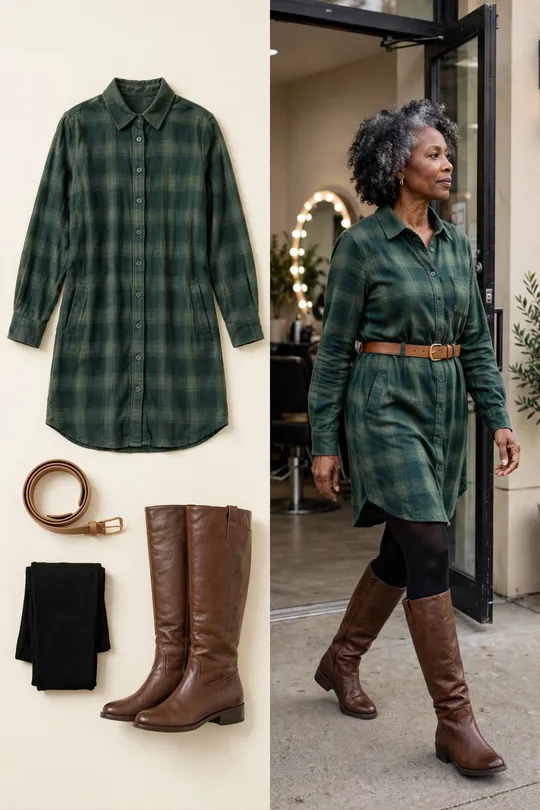
Flannel is the most forgiving winter fabric because its brushed surface scatters light instead of reflecting it — where a smooth sateen would spotlight every curve, flannel’s matte nap reads as one calm surface. A shirt dress in brushed flannel, worn straight, is comfortable but shapeless; the belt is what converts it.
Cinched at the natural waist with a 2.5–3 cm belt, the straight cut becomes an hourglass: the skirt flares gently over the hip, the bodice blouses softly above the belt, and the whole thing looks designed rather than defaulted to.
Length: just below the knee, so it works with tights and boots without the hem fighting the boot shaft. The shirt-dress details — collar, button front, cuffs — add the structure that keeps flannel from reading as nightwear.
Roll the cuffs once to show wrist, and leave the top two buttons open for a small V at the neck (the mechanism from #19, working quietly here too).
- Dress: brushed flannel shirt dress, just below knee
- Belt: 2.5–3 cm, worn at natural waist
- Price: from about $65 total
- Sizes: 12–20; shirting cuts run generous — check the chart
Shop for: a brushed-flannel shirt dress (matte finish, not glazed), falling just below the knee, with a collar and button front; plus a leather-look belt 2.5–3 cm wide in tan or black.
How to wear it:
- Button the dress fully, then add the belt at your natural waist — blouse 2–3 cm of fabric above the belt so it doesn’t pull.
- Unbutton the top two buttons and fold the collar open; the small V lengthens the neck.
- Roll each cuff once to the forearm — the flash of wrist balances the dress’s coverage.
- Add opaque tights and knee-high or ankle boots; the hem should clear the boot shaft by at least 10 cm.
Skip it if you need evening polish — flannel is daytime fabric; the wrap dress (#7) takes the same belt trick out at night.
Best for: weekends, casual offices, and cold days when you want to feel pulled together in one piece.
14. The Peplum-Hem Knit
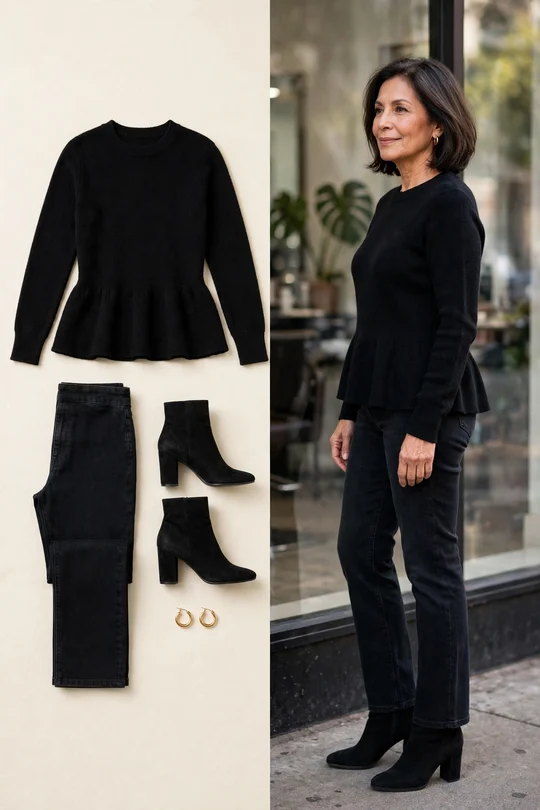
A peplum hem builds the waist-to-hip curve optically: the sweater fits through the bust and waist, then flares for 10–15 cm over the hip. On a straighter midsize figure, that flare creates the curve that isn’t naturally pronounced; on a curvier figure, it skims over the hip and tummy instead of clinging.
Either way the eye reads the narrowest point — where the flare starts — as the waist. It’s shaping without a single tight band, which is why it survives long days better than a belted knit.
The flare should start at or just below the natural waist and the knit should have enough body to hold the shape — a mid-weight knit with a touch of structure, not a slinky fine gauge that collapses.
Wear it over slim bottoms (the straight-leg jeans from #3, a ponte pencil) so the volume sits only where the peplum puts it.
- Sweater: peplum hem, mid-weight knit, flare from waist
- Bottoms: slim — straight jeans or ponte pencil
- Price: from about $50
- Sizes: 12–20; size to the bust
Shop for: a peplum-hem sweater in mid-weight knit (not fine gauge), with the flare starting at or just below the natural waist and falling 10–15 cm; fitted through the bust, not boxy.
How to wear it:
- Keep the bottoms slim and dark — the peplum is the volume; everything below it should recede.
- Let the peplum sit free, never tucked; check the side view that the flare starts at your waist, not your hip.
Skip it if you’re very petite — the flare’s volume can overwhelm a shorter frame; the cropped cardigan (#11) gives the same waist line with less fabric.
Best for: dinners, parties, and days you want shape without a waistband doing the work.
15. High-Rise Wide-Leg Trousers and a Cropped Sweater

This combination builds an hourglass from three engineered pieces. The high rise — 28–30 cm — holds the tummy and defines the waistband line. The wide leg balances the hip, so the silhouette narrows at the waist and widens below, which is the hourglass geometry.
And the cropped sweater, ending exactly at the waistband, shows the whole construction instead of covering it — the waist gets full credit. Remove any one of the three and the effect collapses: a long sweater hides the rise, a low rise loses the hold, a slim leg loses the balance.
The sweater’s crop is the precision part: it should end within 2 cm of the waistband — meeting it, not overlapping it by 10 cm (which blurs the line) and not floating 10 cm above it (which shows midriff nobody asked to see in January).
A fine or mid-gauge knit in a solid colour keeps the top half quiet so the trouser’s line does the talking.
The waistline fixes here work across sizes — our plus-size winter outfits for women over 50 use the same structure-first thinking with more room where it counts.- Trousers: high rise 28–30 cm, wide leg, full length
- Sweater: cropped to meet the waistband (±2 cm)
- Price: from about $80 total
- Sizes: 12–20; trousers sized to the waist, not the hip
Shop for: high-rise wide-leg trousers, 28–30 cm front rise, in wool blend or heavy crepe; plus a fine or mid-gauge cropped sweater that ends within 2 cm of the trouser waistband — measure, don’t guess.
How to wear it:
- Put the trousers on and mark where the waistband sits; hold the sweater against yourself and confirm the hem meets it within 2 cm.
- Add a heel of 5–7 cm — wide legs need the lift or the hem pools and the line dies.
- Keep the top tucked-free and jewellery minimal at the waist; a long pendant that ends mid-torso is the only accessory this line needs.
Skip it if you’re under 5’3″ — the wide leg needs length to work; the straight-leg version (#3) is the petite-friendly equivalent.
Best for: office days, evenings, and anyone who wants trousers to do what dresses usually do.
The problem: lengths and proportions land wrong
A hem that lands mid-calf on a 5’9″ model lands mid-shin on the rest of us — and suddenly the proportions the designer intended are gone. On a midsize frame, where every line is doing shaping work, a wrong length doesn’t just look off, it undoes the outfit’s engineering.
These five midsize winter outfits are about putting hems, sleeves and necklines exactly where they earn their keep.
16. The Knee-to-Calf Skirt Rule
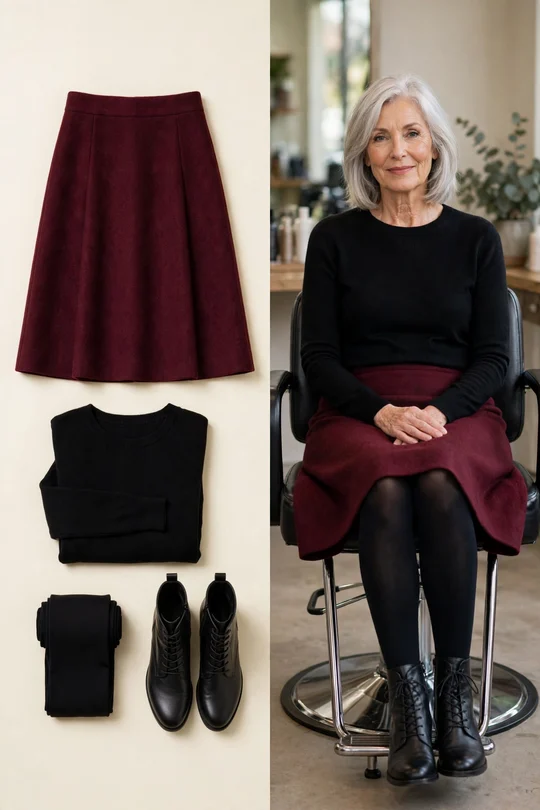
The most flattering skirt hems end at the knee or at mid-calf, and the reason is anatomical: those are the two slimmest points of the leg.
A hem that lands there frames slimness; a hem that lands mid-shin — the classic maxi-gone-wrong — frames the widest part of the lower leg and hides the ankle entirely, which shortens the leg line by 10–15 cm visually. On a midsize frame that leg line is doing real work, so the hem placement isn’t a detail, it’s the outfit.
In numbers: a knee-length skirt measures roughly 50–55 cm from the waistband; a midi 70–75 cm. If you’re between 5’2″ and 5’6″, buy the “midi” and check it doesn’t slide past mid-calf — many high-street midis are cut for 5’8″ and land at the ankle on everyone else, which is a different (heavier) look.
When in doubt, the knee is the safer bet: it shows the most leg with the least risk.
- Hem: at the knee (50–55 cm) or mid-calf (70–75 cm)
- Avoid: mid-shin hems that hide the ankle
- Price: hemming costs $10–$15 and fixes any skirt
- Sizes: 12–20; check length on YOUR height, not the model’s
Shop for: skirts with hems at the knee or mid-calf on your height — measure 50–55 cm (knee) or 70–75 cm (midi) from the waistband before buying; budget $10–$15 for hemming anything that lands mid-shin.
How to wear it:
- Try the skirt with the shoes you’ll actually wear — heel height changes where a hem lands by 2–4 cm.
- Check the back view: hems ride up 2–3 cm at the back when you walk, so a borderline midi becomes a safe midi in motion.
Skip it if you love maxis — they can work, but only with a defined waist and a heel; otherwise the ankle rule still applies.
Best for: every skirt you already own — this rule is a free alteration to your whole wardrobe.
17. Ankle Boots, Not Knee Boots, with Midis
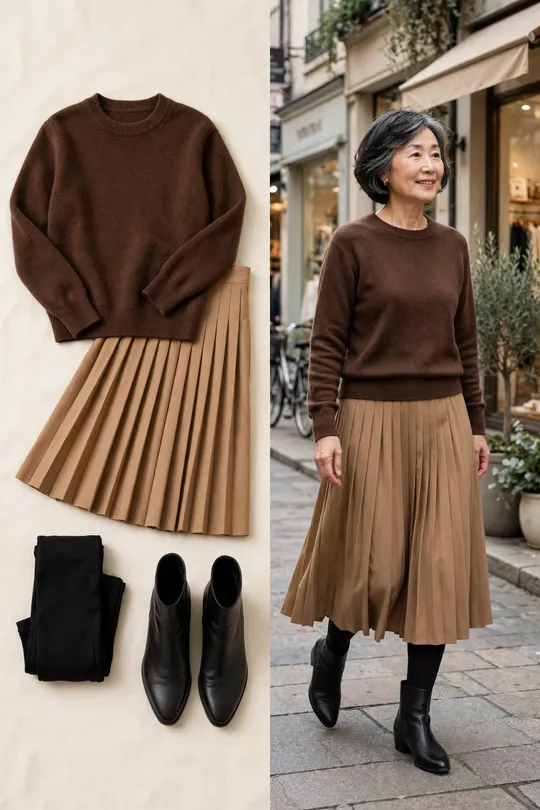
A midi skirt plus knee-high boots creates two horizontal lines across the leg — the hem and the boot top — and each one chops the leg into a shorter segment.
Swap the knee boots for ankle boots and one of those lines disappears: 8–12 cm of leg shows between hem and boot, and the eye reads it as one continuous line from hem to toe. The leg looks longer, the skirt looks lighter, and the whole outfit loses the heaviness that midi-plus-knee-boot can bring to a midsize frame.
The ankle boot’s own proportions matter: a shaft of 12–15 cm that sits cleanly at the ankle bone, a heel of 3–5 cm, and a slightly pointed or almond toe. A chunky round-toe ankle boot with a midi reintroduces the heaviness you just removed.
Match the boot colour to your tights — black boots with black 60–80 denier tights — and the 8–12 cm of visible leg becomes one unbroken dark line.
- Boots: ankle height, 12–15 cm shaft, 3–5 cm heel
- Tights: 60–80 denier, matched to boot colour
- Price: from about $70 for leather-look ankle boots
- Toe: almond or pointed — not round and chunky
Shop for: ankle boots with a 12–15 cm shaft, 3–5 cm heel and almond toe, in black or dark brown; plus opaque tights in the same colour, 60–80 denier for winter.
How to wear it:
- Put the midi, tights and boots on together and check the gap: you want 8–12 cm of leg visible — more reads leggy, less reads stubby.
- If the gap is under 8 cm, the skirt is too long for the boot — hem the skirt, not the boot.
- Keep the boot shaft smooth against the ankle; slouchy shafts add the horizontal bulk you removed.
Skip it if it’s genuinely freezing — warmth beats proportion below -5°C; wear the knee boots and add the longline coat (#1) for the vertical line instead.
Best for: every midi skirt on this list — #6, #10 and #11 all want this boot.
18. The 3/4-Sleeve Arm Trick
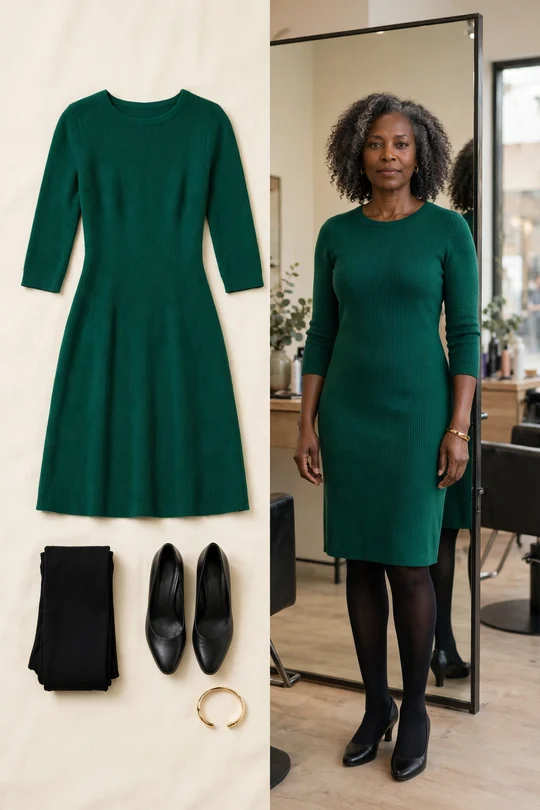
The upper arm is the part of the arm most women over 50 prefer to cover, and the forearm is the slimmest part of the arm — the 3/4 sleeve covers the first and shows the second with one hemline.
A sleeve ending 5 cm below the elbow frames the forearm exactly where it narrows, and the visible wrist and hand beyond it read as delicate against the covered upper arm. Full-length sleeves hide all of this; sleeveless shows all of it. The 3/4 sleeve is the precise compromise, and it works on every frame because it’s anatomy, not fashion.
It also solves a winter layering problem: a 3/4 sleeve leaves room for a bracelet or watch to show, and it stops at the exact point where coat sleeves end — no bunching of knit inside a coat cuff.
On dresses and blouses, look for the sleeve to end 4–6 cm below the elbow bone; on knitwear, simply push a full sleeve up to the same point and let it sit.
- Sleeve: ends 4–6 cm below the elbow
- Shows: forearm, wrist — the slimmest points
- Price: free — push up the sleeves you own
- Works on: dresses, blouses, knitwear alike
Shop for: dresses and tops with true 3/4 sleeves ending 4–6 cm below the elbow — or push any full sleeve to that point; add one bracelet at the wrist to mark the slim point.
How to wear it:
- Find your elbow bone, measure 5 cm down — that’s where the sleeve should end; push or alter to hit it.
- Add a single bracelet or watch at the wrist; it draws the eye to the narrowest point of the arm.
Skip it if you’re always cold in the arms — layer a fine thermal underneath; the 3/4 line still works over it.
Best for: dresses (#7, #11, #13) and any top where the arms feel like the issue.
19. V-Neck Layers Over Crew Necks
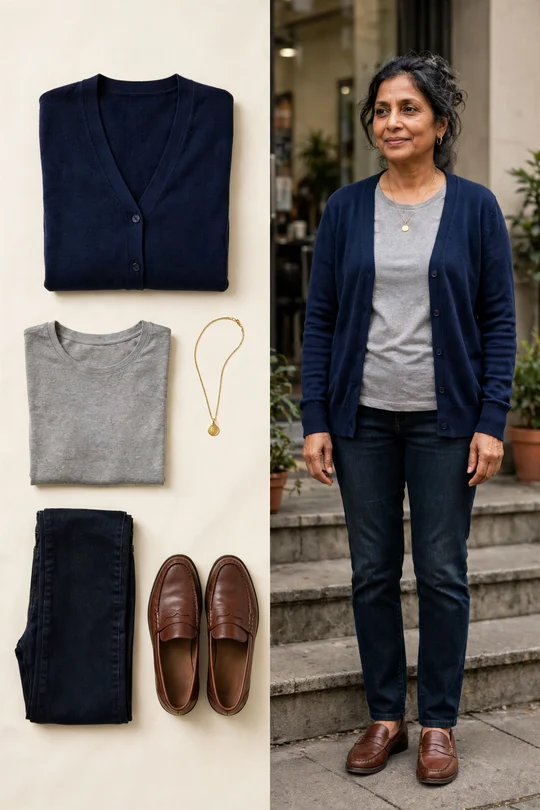
A crew neckline cuts a horizontal line across the base of the neck, which visually shortens the neck and widens the shoulders — on a midsize frame, that’s width exactly where it’s least wanted.
A V opening 12–15 cm deep does the opposite: it extends the neck line downward, draws the eye to the centre of the body, and creates the vertical emphasis that elongates. The difference between the two necklines on the same body is visible in any mirror — it’s one of the highest-impact single changes in this whole list.
You don’t need to replace every crew neck you own. Layer a V-neck cardigan, vest or open shirt over the crew — the V of the outer layer is what the eye reads, and the crew underneath becomes a non-issue.
A pendant necklace ending at the V’s point (8–10 cm below the collarbone) underlines the line; a choker-length necklace fights it.
- V depth: 12–15 cm — deep enough to read, modest enough for day
- Layer: V cardigan or vest over any crew neck
- Price: from about $40 for a V-neck knit vest
- Necklace: pendant ending at the V point, not a choker
Shop for: a V-neck cardigan, sweater vest or open overshirt with a 12–15 cm V opening — wear it over your existing crew necks; the outer V is what counts.
How to wear it:
- Layer the V-neck piece over the crew and check the mirror: the V should be the first thing you notice at the neckline.
- Add a pendant that ends exactly at the V’s lowest point — hold it up before fastening to check the length.
- Keep earrings small; the V plus a pendant is enough vertical interest at the neck.
Skip it if you love a high neckline for warmth — a roll-neck (#2) is the warm alternative; just keep the V trick for your indoor layers.
Best for: every crew-neck sweater you already own — this is a styling fix, not a shopping trip.
20. The Cropped Denim Jacket Over a Midi Dress
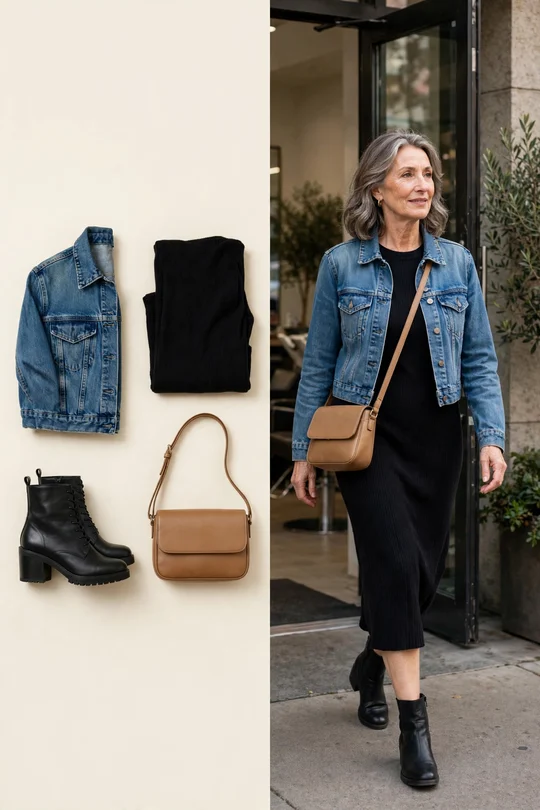
A midi dress on its own can be a beautiful column with no waist — which is exactly the problem group three solved with cardigans and belts.
The cropped denim jacket does the same job with more structure: at 50–55 cm it ends precisely at the natural waist, drawing the horizontal waist line across the dress, while denim’s woven rigidity holds its shape all day — no stretching, no riding up, no end-of-day sag like a soft cardigan.
The contrast of textures (structured denim over soft knit dress) also adds the visual interest that keeps a simple dress from reading flat.
The jacket must be genuinely cropped, not just “short” — try it on over the dress and check the hem hits within 3 cm of your natural waist. A classic medium wash works over dark dresses; a dark rinse works over lighter ones — the slight contrast is what makes the waist line read.
Leave it unbuttoned: buttoned, it becomes a second fitted layer; open, its two fronts add the vertical lines from #2 on top of the horizontal waist line. Both directions of shaping in one piece.
Once the lengths are right, the polish follows: our elegant winter outfits for women over 50 show how the same pieces dress up for evenings out.- Jacket: cropped denim, 50–55 cm, worn open
- Dress: knit midi dress, knee to mid-calf
- Price: from about $75 total
- Sizes: 12–20; jacket sized to sit clean on the shoulders
Shop for: a cropped denim jacket, 50–55 cm back length, ending within 3 cm of your natural waist, in medium or dark rinse with minimal distressing; wear it over a knit midi dress in a contrasting depth.
How to wear it:
- Put the dress on, then the jacket open; check the jacket hem lands at your natural waist — if it covers the waist, it’s too long for this job.
- Push the jacket sleeves to 3/4 (the #18 trick) so the dress’s sleeves or your forearms show beneath.
- Add ankle boots (#17) and a crossbody bag worn at hip level — the bag’s strap adds one more diagonal line to the composition.
- For evening, swap the denim for the velvet blazer in your wardrobe; the mechanism is identical, the fabric dresses it up.
Skip it if the dress is already heavily patterned — denim plus a busy print is two statements; keep the dress solid for this pairing.
Best for: weekends, travel days, and every midi dress that needs a waistline in under ten seconds.
Midsize winter dressing rules that actually work
Forget “dress for your shape” charts. These are the six rules my midsize friends actually live by, plus the five-minute mirror check that catches every mistake before you leave the house.
- Buy to your largest measurement, tailor the rest. A $15 waist alteration beats a $100 garment that almost fits, every single time.
- The two-finger waistband test. If you can’t slide two fingers under the waistband comfortably, it will saw into you by lunch. Size up or choose the elastic-back cut.
- Matte where you want calm, shine where you want attention. Brushed, washed and matte fabrics skim; save the sheen for shoes, bags and jewellery.
- One structured piece per outfit. A blazer, a belted coat, a tailored trouser — one piece with architecture stops the whole look from going soft.
- Show one slim point. Wrist, ankle, neckline — pick one per outfit and let it show. It’s the contrast with the covered parts that creates the shape.
- Steam knits, don’t iron them. Direct heat flattens ribbing and kills elastane; steam keeps the spring that makes knitwear skim instead of cling.
The 5-minute mirror check:
- Front view: can you see one clear waistline? If not, add the belt, the tuck or the cropped layer.
- Side view: is anything pulling at buttons or pockets? Pulling means size up; gaping means tailor down.
- Sit down for two minutes: does anything dig, ride or bunch? The chair test never lies.
- Walk ten steps: does the hem stay where you put it? If the skirt climbs or the sweater migrates, the cut is wrong for your day.
For staying warm without losing your waist, see how to layer clothes in winter over 50 without feeling bulky.
The bottom line
If I had to pick one piece from this whole list, it’s the belted longline coat (#1) — it’s the only item here that fixes every other outfit you own, because the belt builds the waistline your layers erased.
But pick by your life, not mine: if your winter is school runs and supermarket dashes, live in the 2%-elastane jeans (#9) with the half-tuck (#3). If your winter is an office, the elastic-back trousers (#8) with the roll-neck and open blazer (#2) will carry you through March.
And if your winter has evenings in it, the true-wrap dress (#7) adjusts to every version of you that shows up.
Save this to your winter board now — future you, getting dressed in a cold bedroom in January, will be glad the decisions are already made.
Frequently asked questions
What does “midsize” mean in women’s clothing?
Midsize generally means sizes 12–16 (UK 14–18) — the range between straight sizes and plus sizes, where mainstream brands often stop and plus lines haven’t started. For midsize winter outfits, the practical meaning is: you need the shaping tricks of tailoring (defined waists, structured shoulders) with the comfort engineering of stretch fabrics.
If a brand’s size chart puts you between sizes, always size up and tailor down — a $15 alteration beats a garment that fights you.
Should midsize women over 50 wear oversized or fitted clothes?
Neither, exclusively — the answer is shaped but not tight. Fully oversized layers add visual volume and erase the waist; fully fitted cuts pull and dig by midday. The sweet spot this whole article is built on: one defined waistline per outfit (a belt, a tuck, a cropped layer), with everything else skimming.
If you love the comfort of oversized, keep it to one piece — an oversized coat over a defined-waist outfit works; oversized top plus oversized bottom does not.
What winter coat is most flattering for a midsize figure?
A belted longline coat, 100–110 cm, with the belt tied at the natural waist — it’s #1 on this list for a reason. The long vertical line elongates, and the belt builds the waist the coat would otherwise hide.
If you run warm, the second-best option is a cropped puffer (50–55 cm) over a long base layer, which restores the leg line instead. Avoid single-shape coats with no waist definition: car coats and cocoon coats are comfortable but they add a stone of visual weight on a midsize frame.
How do I stop jeans from gapping at the waist?
If the gap is at the back waistband, the rise is wrong for your shape, not the size — try a higher rise (26–28 cm) before sizing down, because sizing down to fix a gap usually means the thighs and seat go too tight.
If the jeans fit everywhere but the waistband still stands away, that’s what a tailor’s $12–$15 waist alteration is for. And check the elastane: 1.5–2% recovers its shape through the day, while under 1% stretches out and gapes by afternoon.
Can I wear a belt if I carry weight around my middle?
Yes — but place it and size it right.
The belt goes at your natural waist (bend sideways; where the skin creases), not squeezed over the fullest part of the tummy, and it should be at least 2.5–3 cm wide — a skinny belt cuts in and emphasises what it crosses, while a wider belt reads as a deliberate design line.
If belts still feel like too much, get the same waist definition from a half-tuck, a cropped layer, or a wrap tie, which all mark the waist without encircling it.
What skirt length works best for midsize women over 50?
Knee or mid-calf — the two slimmest points of the leg. Knee length (50–55 cm from the waistband) is the safest bet; midi (70–75 cm) works beautifully with ankle boots and a 8–12 cm flash of leg. The length to avoid is mid-shin, which hides the ankle and frames the widest part of the lower leg.
And always check the hem on your height: high-street “midis” are cut for 5’8″, so at 5’4″ that midi is an ankle-grazer — budget $10–$15 for hemming.
How do I layer for warmth without looking bulky?
Thin, fitted base layers plus one structured outer layer — never three mid-weight layers of similar thickness. A thermal or fine roll-neck (200–250 gsm) under a blazer or belted coat gives you the warmth of bulk with the silhouette of tailoring. Keep the bulkiest layer as the outermost one, and make sure exactly one waistline shows through all of it.
If you can’t find your waist with your eyes closed, remove a layer or add the belt.