15 Winter Church Outfits for Women Over 50

You walk into church on a grey December Sunday and the cold reaches you before the music does. Stone floors, a draught sliding under the doors, and a good hour of sitting on a hard pew — while you’d still like to look like yourself, not a wrapped-up parcel.
Finding winter church outfits for women that are genuinely warm and still polished is a real, specific problem, and most winter style lists skip straight past it.
So here are 15 outfits built for the job, arranged the way your December actually runs: Sunday mornings first, then church lunches and weekday events, then the evening carol services and Christmas Eve. Every one handles sitting, standing and kneeling, every one works in a cold building, and every one starts with warmth solved before style is even discussed.
Quick picks
Fast answers
- Warmth without bulk → the merino sweater dress (#1)
- The coldest pew in the building → wool midi skirt and turtleneck (#2)
- Quietly polished, zero fuss → black trousers and a cashmere jumper (#3)
- One-and-done dressing → the burgundy knit co-ord (#7)
- Christmas Eve glamour → the forest-green midi dress (#11)
- Evening sparkle without the glare → champagne blouse and sequin skirt (#14)
Contents
How to choose your winter church outfit
Start with the building, not the weather. An old stone church in December can sit at 10–12°C through the whole service, with the coldest draughts running at ankle level across the floor.
Choose the warmth of the fabric first and the look second, and build every outfit on a thin thermal camisole or vest underneath — it adds a full layer of insulation without changing a single visible line. The same cold-outside logic shapes our broader winter outfits for women over 50 guide, if you want more layering ideas.
Pick lengths that survive the pew. You will sit, stand and possibly kneel, on a hard wooden bench with about 40 cm of seat depth. A midi length — roughly 55–65 cm from the waist — covers the knee when seated and doesn’t ride up when you stand.
Under a dress, opaque tights of 40–60 denier are the minimum in December; anything sheer is a spring choice.
Plan the coat, not just the outfit. Your coat will end up folded on your lap, squeezed beside you, or draped over the pew end — there is no cloakroom. A slim coat that folds small (a wool wrap coat, a quilted mid-length) beats a bulky puffer that fights you for seat space.
If the outfit can’t handle ten minutes of sitting in a coat without creasing badly, rethink it the night before.
Aim for smart-casual polish, not office formal. Church calls for respectful and put-together, not a boardroom suit. A structured knit, a proper trouser, a dress with sleeves — these hit the note without stiffness.
Our smart-casual outfits for women over 50 round-up sits in exactly this territory if you want everyday versions of the same idea.
Dresses still work in December — choose winter fabrics. Wool, velvet, ponte and heavy crepe insulate the way chiffon and cotton never will, so a dress in the right fabric is as warm as trousers. If dresses are your default, the fabric-first approach in our dresses for women over 50 guide translates straight across to winter services.
At a glance: all 15 winter church outfits
| Outfit | Key warmth fact | Best for |
|---|---|---|
| Merino sweater dress + tall boots | Fine merino fibres trap air — warm without bulk | Frosty Sunday mornings |
| Wool midi skirt + turtleneck | Dense weave blocks ankle-level draughts | The coldest churches |
| Black trousers + cashmere jumper | Cashmere insulates at half the thickness of wool | Simple, polished Sundays |
| Wrap dress + opaque tights | The tie waist sits above the coldest spot — the small of the back | Services with standing hymns |
| Dark jeans + blazer + silk scarf | Tight denim weave blocks wind; the blazer adds structure | Informal or family services |
| Tweed blazer + corduroy trousers | Tweed’s tight weave was built for weather | Church lunches |
| Burgundy knit co-ord | One knit from neck to ankle — no cold gap at the waist | Weekday fellowship meetings |
| A-line pinafore + blouse | Two bodice layers double core insulation | Craft mornings and casual events |
| Velvet skirt + soft knit | Velvet’s pile traps a layer of warm air | Autumn-through-winter lunches |
| Grey flannel + cream blouse | Flannel’s brushed face holds warmth to the skin | Smart weekday services |
| Forest-green midi dress | Deep colour reflects candlelight — colour does the work | Christmas Eve |
| Black velvet jumpsuit | Pile plus full-length legs — zero draught gaps | Carol services with standing |
| Navy lace-bodice dress | Lace covers the arms elegantly while looking delicate | Evening concerts in church |
| Champagne blouse + sequin skirt | A matte top balances one shine element | Festive but tasteful evenings |
| Berry satin skirt + black roll-neck | Dark colour reads festive without a single sequin | New Year and Epiphany services |
Sunday Morning Services: Winter Church Outfits for Women That Actually Keep You Warm
Daylight, a regular congregation, and usually the coldest slot of the week — the building hasn’t warmed up and neither have you. These five are built for warmth first, with the polish baked in.
1. The Merino Sweater Dress and Tall Boots
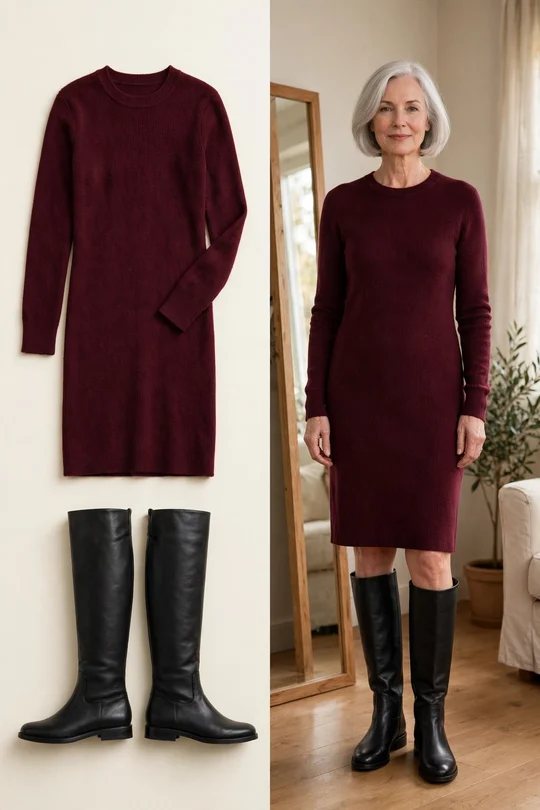
A fine-gauge merino dress works because merino fibres measure just 16–19 microns — fine enough to trap a layer of still, warm air against your body while the knit stays thin. That means you get close to the warmth of a coat without the bulk, which matters when you’re folding yourself into a pew for an hour.
Choose a knee length, roughly 50–55 cm from the waist, with long sleeves and a neckline that sits at or above the collarbone.
Tall, flat boots do two jobs here: they insulate the lower leg where the draughts run, and they balance the softness of the knit so the whole outfit reads intentional. Look for a boot shaft of 35–40 cm that fits over your calves — measure the widest point; most women’s calves run 36–42 cm.
- Key pieces: fine-gauge merino or merino-blend sweater dress, knee length, long sleeves
- Shoes: knee-high flat boots, 35–40 cm shaft
- Occasion: frosty Sunday mornings
- Budget tip: charity shops and end-of-line sales regularly turn up merino knits for $25–$60 — check the label for at least 50% merino
Shop for: a fine-gauge merino sweater dress with a high neckline and knee-length hem, plus flat knee-high boots that fit over your calves without pinching — if you can slide two fingers inside the top of the boot, the fit is right.
How to wear it:
- Layer a thin thermal camisole underneath — invisible, and it roughly doubles the warmth.
- Leave the dress unbelted for comfort, or add a slim belt at the natural waist if you want shape.
- Finish with a wool scarf at the neck, since the dress neckline and the scarf together seal the last heat-loss point.
Skip it if the knit is chunky cable — thick cables add width at the hips and shoulders and fight you for pew space.
Best for: the coldest Sunday mornings of the year.
2. Wool Midi Skirt and Turtleneck

This is the warmest combination on the list, and the reason is the skirt: a densely woven wool twill acts as a windbreak around your legs, exactly where a church’s draughts run.
Pair it with a turtleneck that seals the neck — one of the body’s main heat-loss points — and you’ve covered the two places most winter outfits leave exposed. An A-line midi of 60–65 cm from the waist gives you full knee coverage when seated and swings free when you kneel.
The turtleneck should be fine-gauge rather than chunky: a smooth knit layers under a coat without bunching at the shoulders, and it tucks cleanly into the skirt’s waistband so there’s no cold gap when you sit and the top rides up. Tights of 60 denier or more underneath complete the seal.
- Key pieces: A-line wool midi skirt (60–65 cm), fine-gauge turtleneck, 60-denier tights
- Shoes: ankle boots with a low block heel, or loafers with warm socks
- Occasion: unheated or draughty churches
- Budget tip: a wool-blend skirt ($40–$80) performs nearly as well as pure wool if the weave is tight — hold it to the light; you shouldn’t see through it
Shop for: an A-line wool or wool-blend midi skirt in a dark neutral, a fine-gauge turtleneck in a colour that flatters your face, and opaque 60-denier tights — the skirt should clear the top of your boots by 5–10 cm.
How to wear it:
- Tuck the turtleneck fully into the skirt and smooth the waistband flat — no gaps at the back when you sit.
- Add a thin belt only if the skirt has belt loops; otherwise let the waistband sit clean.
- Choose boots the skirt hem just meets — a visible 5 cm of tight between hem and boot looks deliberate, not cold.
Skip it if the skirt is a narrow pencil — it restricts kneeling and rides up when you sit, undoing the whole point.
Best for: the church in the village that hasn’t known central heating since 1890.
3. Black Trousers and a Cashmere Jumper

Cashmere’s fibres run about 15 microns — finer than merino — which is why a thin cashmere jumper insulates like a much thicker wool one. That thinness is the whole trick: you stay warm without the bulk that makes sitting in a pew uncomfortable, and the outfit keeps a clean, uncluttered line.
Flat-front black trousers in a full length ground it; the dark colour reads respectful in any congregation.
- Key pieces: flat-front black trousers, fine-knit cashmere or cashmere-blend crewneck
- Shoes: black loafers or low block-heel pumps
- Occasion: regular Sunday services
- Budget tip: a cashmere-blend (30% cashmere or more) at $50–$90 gives you most of the warmth; pure cashmere starts around $120
Shop for: flat-front black trousers with a mid-to-high rise and a full-length leg, plus a fine-knit crewneck in cashmere or a high-cashmere blend — do the pinch test: squeeze the knit; if it springs back with no wrinkle, the quality is there.
How to wear it:
- Half-tuck the jumper at the front — a full tuck adds bulk at the waistband, and untucked looks unfinished with flat-front trousers.
- Add one quiet piece of jewellery — small gold hoops or a pendant — so the black doesn’t read severe under dim church lighting.
Skip it if the jumper is a thin fashion knit with no loft — hold it up; if you can read text through it, it won’t keep you warm.
Best for: women who like their Sundays simple and unfussy.
4. The Knee-Length Wrap Dress with Tights

A true wrap dress solves a problem most dresses ignore: the tie fastens at your natural waist — the narrowest point of your torso — which means no gaping, no riding up, and no cold air sneaking in at the waistband when you sit.
In a winter-weight fabric like ponte or heavy crepe, the double layer across the bodice adds genuine insulation where your core is. A knee length of about 50 cm keeps the hem clear of the pew edge.
The wrap’s adjustability is the practical win: you set the V exactly where you want it, which means no safety pins, no gaping blouses, no fussing during the service. Underneath, 60-denier tights and a pair of block heels keep the lower half warm and the walk to church manageable on wet pavements.
- Key pieces: true-wrap dress in ponte or heavy crepe, knee length, 3/4 or long sleeves; 60-denier tights
- Shoes: block heels of 4–5 cm, or heeled ankle boots
- Occasion: services with standing hymns
- Budget tip: ponte wrap dresses run $35–$70 and hold their shape for years — the fabric barely creases on a pew
Shop for: a TRUE wrap dress (ties at the waist, not a faux-wrap with a fixed seam) in ponte or heavy crepe, knee length, with sleeves to at least the elbow — the V should sit no lower than 15 cm below the collarbone.
How to wear it:
- Tie the wrap at your natural waist — the narrowest point — and check the V in a mirror before you leave.
- Pull the tights up properly and smooth the dress over them; a bunched tight at the thigh shows through a close-fitting skirt.
- Choose block heels over stilettos — wet church steps and stilettos are a combination to avoid.
- Carry a pashmina in your bag; it doubles as a shoulder cover if the heating fails and a wrap if the evening turns cold.
Skip it if the fabric is slippery rayon — it rides up every time you sit and you’ll spend the sermon tugging it down.
Best for: hymn-heavy services where you’re up and down all morning.
5. Dark Jeans, Blazer and a Silk Scarf
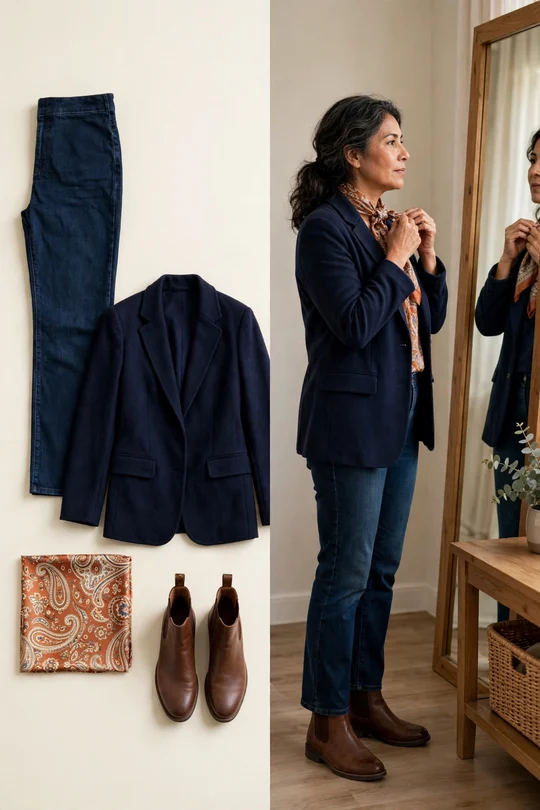
Dark indigo denim works for an informal service because its tight twill weave genuinely blocks wind — it’s a far warmer fabric than its casual reputation suggests. The blazer is what makes it church-appropriate: structured shoulders and a defined line tell the room you’ve dressed with intention, not just thrown on the weekend default.
A silk scarf at the neck adds the one dressy note that lifts the whole thing.
- Key pieces: straight-leg dark indigo jeans (no distressing), unstructured wool blazer, silk square scarf
- Shoes: Chelsea boots or dark loafers
- Occasion: informal or family services
- Budget tip: the jeans matter less than the blazer — spend on the blazer ($80–$150) and keep the jeans simple
Shop for: straight-leg jeans in the darkest indigo you can find with zero fading or rips, an unstructured wool blazer in navy or charcoal that skims the hip, and a silk scarf of about 90 cm square in a colour that flatters your face.
How to wear it:
- Fold the scarf into a band and tie it once at the side of the neck — a full knot looks fussy with a blazer lapel.
- Push the blazer sleeves up one turn to the forearm; it stops the outfit reading corporate.
Skip it if your church leans traditional-formal — jeans, however dark, will feel out of place there. Read the room first.
Best for: family services, informal congregations, and the Sunday you bring the grandchildren.
Church Lunches and Weekday Events
The church hall crowd is a different dress code: warmer rooms, longer sitting, tables to lean on, and a lot of standing around with a cup of tea. Comfort stretches further here, but looking cared-for still matters.
6. The Tweed Blazer and Corduroy Trousers
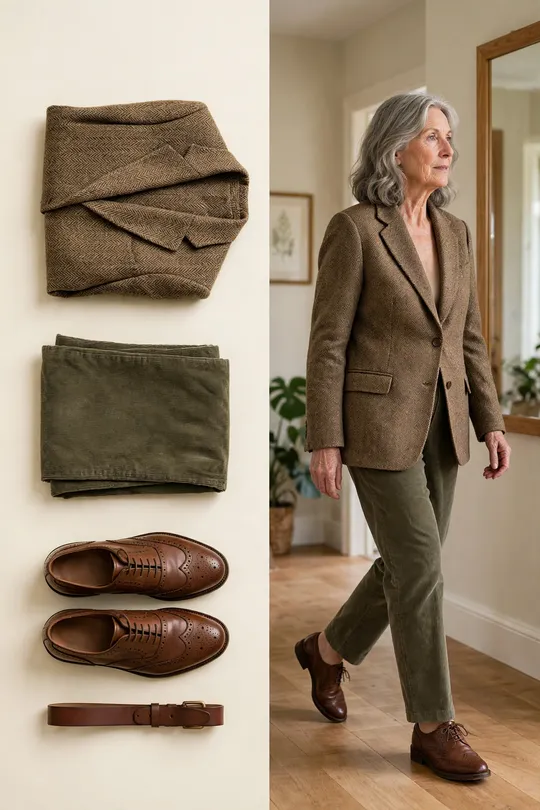
Tweed was woven for weather — its tight, dense weave was designed to shed wind and rain on hillsides, which makes it one of the warmest jacket fabrics you can wear to a church lunch.
Corduroy earns its place the same way: the raised ribs trap small pockets of warm air against the leg, and the fabric has a softness that reads friendly rather than formal. Together they look classic without trying.
Fit matters more than pattern here. A tweed blazer cut for a woman — nipped at the waist, sleeves to the wrist — keeps the heritage fabric from swamping you. Corduroy trousers should be a fine wale (the thinner the rib, the dressier the trouser) in a straight or gently tapered leg.
- Key pieces: women’s-cut tweed blazer, fine-wale corduroy trousers
- Shoes: brogues or low Chelsea boots
- Occasion: church lunches and harvest suppers
- Budget tip: tweed blazers are a charity-shop goldmine — check the shoulder seams sit at your actual shoulders ($20–$50)
Shop for: a tweed blazer cut for a woman’s frame with the shoulder seam exactly on your shoulder bone, and fine-wale corduroy trousers in olive, brown or navy with a full-length leg that just kisses the top of your shoe.
How to wear it:
- Wear a thin knit or shirt underneath — a bulky layer under tweed makes the shoulders sit wrong.
- Roll the corduroy once at the ankle only if the leg is long; otherwise leave the full break — tweed and turn-ups are old friends.
- Add a simple leather belt if the trousers have loops; it stops the look sliding into shapeless.
Skip it if the blazer is a boxy men’s cut — on a woman’s frame it adds visual weight everywhere and none of the warmth benefit changes that.
Best for: the church lunch where you know half the room by name.
7. Burgundy Knit Co-ord Set

A matching knit top and skirt works because it eliminates the waist cold-gap — the place where a separate top rides up and a skirt waistband rides down when you sit, leaving a strip of unprotected back. One continuous knit from neck to ankle has no gap to open.
Burgundy is the ideal colour: festive enough for December, dark enough to be slimming, and warm-toned enough to flatter most complexions under artificial light.
- Key pieces: fine-gauge knit top and matching midi skirt, same dye lot
- Shoes: burgundy or black ankle boots
- Occasion: weekday fellowship meetings
- Budget tip: co-ords run $45–$90; buy the set together so the dye lots match exactly
Shop for: a fine-gauge knit co-ord — top and midi skirt in the SAME dye lot — in burgundy, with the skirt falling at least 5 cm below the knee; hold the knit to the light before buying, since some are woven too loosely for December.
How to wear it:
- Tuck the top in fully and smooth it flat — the unbroken line of one colour is what makes a co-ord elegant.
- Break up the single colour with contrasting shoes or a scarf, so it reads as an outfit rather than a uniform.
Skip it if the knit is loosely woven enough to see through — hold it to a window; if light passes easily, December air will too.
Best for: the morning you need to look put-together with five minutes of effort.
8. The A-Line Pinafore Over a Blouse
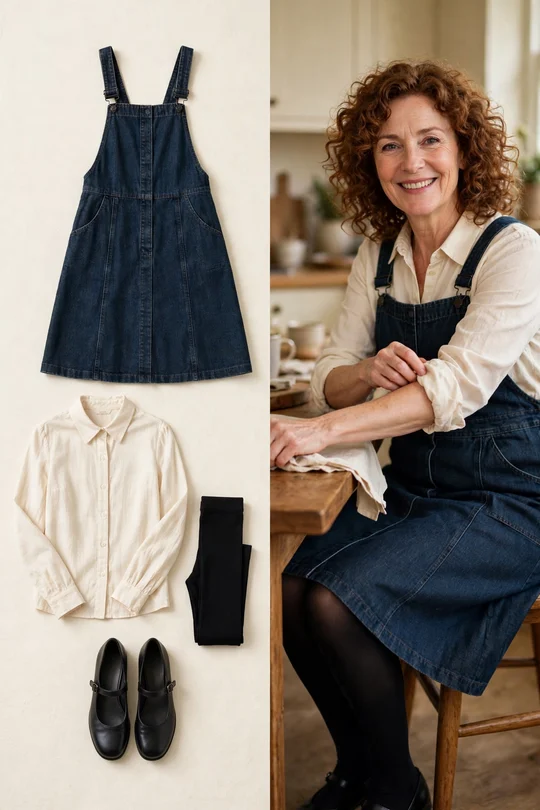
A pinafore doubles your insulation exactly where it counts: two bodice layers over your core, where your body generates and holds the most heat.
The A-line skirt swings free from the hip, which means sitting, standing and kneeling all happen without the fabric fighting you — a real advantage at a busy church event where you’re up and down helping out. Over a long-sleeved blouse in brushed cotton or flannel, it’s warm, modest and quietly charming.
Choose the pinafore in needlecord or a soft denim rather than heavyweight workwear denim — the lighter fabric drapes instead of pulling on your shoulders after an hour. A length that hits just below the knee keeps it grown-up rather than schoolroom.
- Key pieces: A-line pinafore in needlecord or soft denim, long-sleeved blouse in brushed cotton
- Shoes: flat ankle boots or Mary Janes with warm tights
- Occasion: craft mornings, church fairs, casual events
- Budget tip: pinafores run $30–$60; the blouse underneath can be any long-sleeved shirt you already own
Shop for: an A-line pinafore in needlecord or lightweight denim that falls just below the knee, with adjustable straps — plus a long-sleeved blouse in brushed cotton or flannel, since the blouse is doing half the warming work.
How to wear it:
- Set the straps so the bib sits flat on your chest — too long and it bags, too short and it pulls.
- Roll the blouse sleeves once above the pinafore’s armholes so the cuff shows — it looks deliberate and keeps cuffs out of the washing-up.
- Add opaque tights and flat boots; the pinafore’s charm fades fast with bare legs in December.
Skip it if the denim is heavyweight workwear — it drags on your shoulders all morning and the charm wears off by lunchtime.
Best for: the church Christmas fair, where you’ll be on your feet half the time.
Good to know
Do the pew test the night before: sit on a hard dining chair for ten minutes in your full outfit, then stand up and kneel once. Check three things — the hem when you sit (does it ride up?), the back of your waist (any cold gap?), and your tights at the thigh (any sagging?).
Ten minutes now saves an hour of fidgeting on Sunday. Pin this checklist to your winter style board on Pinterest before the weekend, so it’s there when you need it.
9. Velvet Skirt and a Soft Knit

Velvet’s cut pile traps a layer of still air against the skin — the same insulation principle as a fleece, but with a surface that catches the light beautifully. A midi velvet skirt in a deep tone (forest, burgundy, chocolate) paired with a soft mohair-blend knit gives you warmth top and bottom with almost no visible bulk.
The knit should be fine rather than chunky: the halo of a mohair blend adds surprising warmth for its weight.
- Key pieces: midi velvet skirt (about 55 cm), fine mohair-blend or brushed knit jumper
- Shoes: heeled ankle boots or ballet flats with warm socks
- Occasion: autumn-through-winter lunches
- Budget tip: cotton-velvet skirts run $35–$70 and hold their pile better through sitting than cheap polyester velvet
Shop for: a midi velvet skirt in a deep, plain colour with a smooth (not crushed) pile, and a fine brushed or mohair-blend knit — sit in the skirt before buying; cheap velvet shows seat creases within minutes.
How to wear it:
- Half-tuck the knit at the front so the skirt’s waistband shows — a full tuck compresses the velvet pile.
- Keep jewellery minimal; velvet’s texture is the decoration here.
Skip it if the velvet is crushed or embossed — it shows every seat crease and reads dated under church lighting.
Best for: the lunch that runs straight into an afternoon of visiting.
10. Grey Flannel Trousers and a Cream Blouse
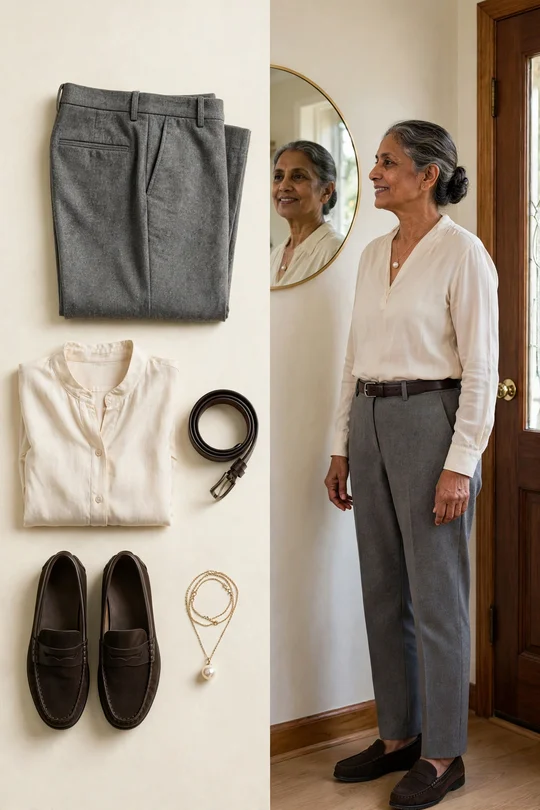
Flannel’s brushed face holds a layer of warm air right against the skin, which is why a pair of grey flannel trousers feels noticeably warmer than the same cut in plain wool suiting.
The cream blouse does the visual work: under dim church lighting, a light colour near your face reflects what little light there is upward, softening shadows in a way no foundation can. It’s a quiet, intelligent combination.
The blouse needs to be genuinely opaque — hold it to the light in the shop. A thin polyester blouse that clings and shows your camisole undoes the whole effect. Brushed cotton, a cotton-silk blend, or a good crepe all work; the key is a fabric with enough body to sit cleanly over the trousers’ waistband.
- Key pieces: flat-front grey flannel trousers, opaque cream blouse
- Shoes: dark loafers or low block heels
- Occasion: smart weekday services and meetings
- Budget tip: grey flannel trousers run $45–$90; the blouse is where a $30 brushed-cotton version beats a $90 flimsy one
Shop for: flat-front grey flannel trousers with a mid-to-high rise and full-length leg, and an OPAQUE cream blouse in brushed cotton or crepe — the hold-it-to-the-light test is non-negotiable.
How to wear it:
- Tuck the blouse fully and add a slim dark belt — the belt line gives the soft blouse some structure.
- Roll the sleeves once to the forearm if the service is informal; leave them long and buttoned for formality.
- Finish with a pendant that sits on the cream fabric — it draws the eye up to your face, where the light is.
Skip it if the blouse is thin or clingy — under a church’s fluorescent hall lights, every line shows.
Best for: the midweek service followed by the church council meeting.
Evening Carol Services and Christmas Eve
Night changes the brief: candlelight and fairy lights do half the styling work, so colour and texture matter more than coverage. These five lean into the evening — festive, a little dressier, and still warm enough for a cold church after dark.
11. The Forest-Green Midi Dress
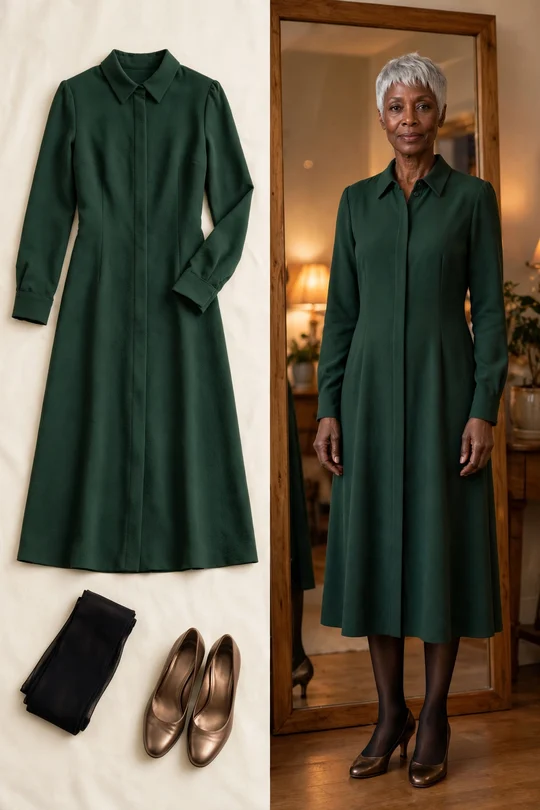
Deep green is the hardest-working colour of the Christmas season: under candlelight and fairy lights, a saturated satin or crepe reflects a warm glow that reads festive without a single sequin.
The colour does all the decorative work, which means the dress itself can stay simple — a clean midi of 55–60 cm, sleeves to the wrist or elbow, and a neckline that needs no jewellery to complete it.
Fabric choice decides whether this is warm or just pretty. A green dress in heavy crepe or a backed satin insulates; the same dress in thin polyester charmeuse is a summer dress painted green. Check the weight in your hands before you buy — if it feels substantial, it will behave substantially.
- Key pieces: forest-green midi dress (55–60 cm) in heavy crepe or backed satin, sleeves to at least the elbow
- Shoes: black or bronze low heels
- Occasion: Christmas Eve service
- Budget tip: deep-green occasion dresses run $60–$120; you’ll wear it for every December for years, so cost-per-wear is tiny
Shop for: a forest-green midi dress in heavy crepe or backed satin — NOT thin charmeuse — with sleeves to at least the elbow and a hem that covers the knee when seated; the fabric should feel weighty in your hands.
How to wear it:
- Wear sheer black 30-denier tights rather than opaque — the evening light is kind, and sheer reads dressier.
- Keep jewellery to one piece — the colour is the statement, and competing sparkle cheapens it.
- Carry a wrap or pashmina in dark green or black for the walk home; it won’t fight the dress in photos.
Skip it if the dress is sleeveless — even a heated church feels cold at 7 p.m. in December, and a shrug never looks as good as proper sleeves.
Best for: Christmas Eve, when you want to look like the season itself.
12. Black Velvet Jumpsuit

A velvet jumpsuit is the warmest evening option here for a simple structural reason: full-length legs plus a cut-pile fabric means zero draught gaps anywhere — no hem riding up, no tights slipping, no cold stripe at the ankle. The V or scoop neckline keeps it from reading severe, and a wide leg moves beautifully when you’re standing for carols.
It looks dramatic with almost no effort, which is exactly what you want at 6 p.m. on a dark December evening.
- Key pieces: black velvet wide-leg jumpsuit with V or scoop neckline
- Shoes: black heeled ankle boots or dressy flats (the wide leg hides them anyway)
- Occasion: carol services with a lot of standing
- Budget tip: velvet jumpsuits run $55–$110; try it sitting down in the fitting room — the rise has to be comfortable, not just standing-pretty
Shop for: a black velvet jumpsuit with a wide leg, a V or scoop neckline, and a rise you can sit in comfortably for an hour — sit down in the fitting room before you decide, and check the zip or buttons are manageable alone.
How to wear it:
- Test the closure at home — fussy back zips and church cloakroom queues are a bad combination.
- Add a slim metallic belt or a pendant to break up the black; velvet absorbs light, so it needs one reflective note.
Skip it if the closures are fiddly — anything you can’t manage alone in a church loo in two minutes is the wrong jumpsuit.
If a jumpsuit is your one-and-done party answer, our Christmas party jumpsuits for women over 50 cover the same warm, comfortable styles for December evenings.Best for: the carol service where you’ll be on your feet singing for an hour.
13. Navy Lace-Bodice Dress

Lace gives you the elegance of delicate fabric while actually covering you — a lace bodice with 3/4 or long sleeves looks intricate and evening-appropriate, but it’s a full layer of fabric on your arms and torso, not decoration over bare skin.
Navy is the smart colour choice for church evenings: it reads as dressy as black under lights, but it’s softer against the face and less severe in a congregation setting.
The non-negotiable is the lining: unlined lace is scratchy, see-through, and cold. A fully lined bodice and lined sleeves turn lace from a summer fabric into a genuine winter one. The skirt can be plain crepe — it doesn’t need to be lace all the way down, and a plain skirt keeps the price and the bulk down.
- Key pieces: navy dress with lined lace bodice and 3/4 or long lace sleeves, plain crepe skirt
- Shoes: navy or silver low heels
- Occasion: evening concerts and candlelit services
- Budget tip: lace-bodice dresses run $65–$130; check the lining extends through the sleeves, not just the body
Shop for: a navy dress with a FULLY LINED lace bodice and lined 3/4 or long sleeves — run your hand inside the sleeve; if you feel lace against your skin with no lining, put it back.
How to wear it:
- Let the lace be the only texture — plain shoes, plain bag, no competing embellishment.
- Choose silver or pearl jewellery over gold; cool metals sit better with navy under evening light.
- Carry a small clutch rather than a day bag — the dress is doing evening, and the bag should agree.
Skip it if the lace is unlined or scratchy — you’ll be aware of it through the entire second carol.
Best for: the candlelit concert where the music matters more than the sermon.
14. Champagne Blouse and a Dark Sequin Skirt
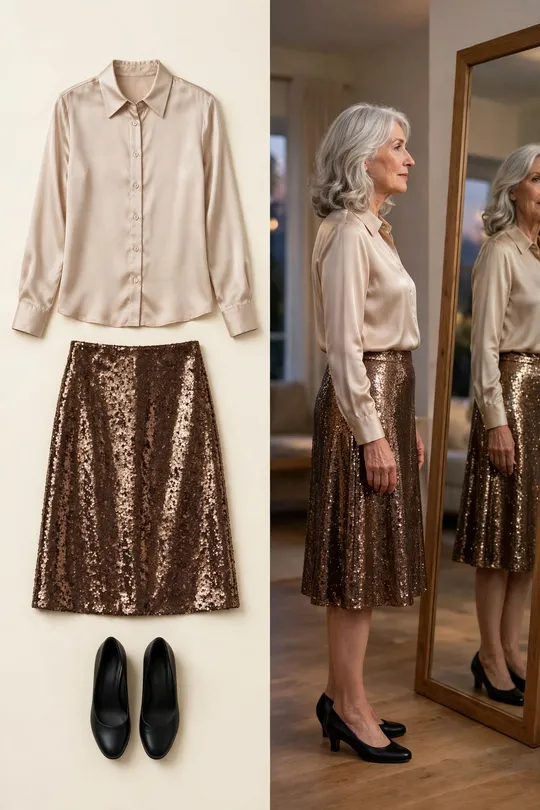
Sequins work at church when they’re the only shine in the outfit — that’s the rule. A matte champagne blouse on top gives the eye somewhere calm to rest, so a dark sequin skirt reads as tasteful festivity rather than glare.
And dark sequins (bronze, gunmetal, deep gold) matter: under church lighting, silver sequins throw hard reflections in every direction, while dark sequins glow instead of flashing.
Keep the skirt at the knee and the silhouette simple — an A-line or gentle pencil. The blouse should be a silk-look fabric with a covered placket or minimal buttons; anything fussy at the neckline competes with the skirt’s texture. This is a one-shine-element outfit, and discipline is what makes it elegant.
- Key pieces: matte champagne silk-look blouse; knee-length sequin skirt in bronze, gunmetal or deep gold
- Shoes: black or bronze low heels
- Occasion: festive evening services
- Budget tip: sequin skirts run $40–$85; check the sequins are stitched, not glued — glued sequins shed within a season
Shop for: a MATTE champagne blouse with a clean neckline, and a knee-length sequin skirt in a DARK shade — bronze, gunmetal or deep gold, never silver — with stitched (not glued) sequins; run your nail across them to check they lie flat.
How to wear it:
- Tuck the blouse in fully and smooth it — any blousing over a sequin waistband looks untidy.
- Wear no necklace; the sequins reach high enough visually. Earrings and a bracelet are plenty.
- Sit on a soft surface when you can — sequins and hard pews press into the backs of your thighs.
- Keep your coat dark and plain; a patterned coat over sequins is visual noise.
Skip it if you’re tempted by a full sequin dress instead — head-to-toe sequins under church lights is glare, not glamour.
Best for: the festive service where you want a little sparkle and a lot of taste.
15. The Berry Satin Midi Skirt and Black Roll-Neck
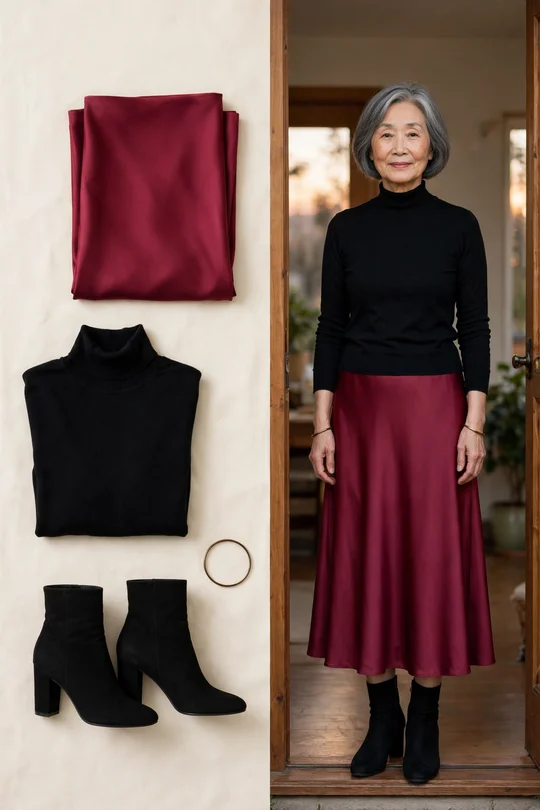
A roll-neck seals the neck — the body’s chimney, where heat escapes fastest — while berry satin brings all the festivity of the season with zero sparkle. It’s the answer for every evening service where sequins feel like too much but black feels like too little. The dark top slims and anchors; the coloured skirt does the celebrating.
A 55 cm satin skirt in a fine, matte-backed satin skims rather than clings.
- Key pieces: berry satin midi skirt (about 55 cm), fine black roll-neck
- Shoes: black heeled boots or low pumps
- Occasion: New Year and Epiphany services
- Budget tip: satin skirts run $30–$65; matte-backed satin creases less and shows fewer marks than shiny charmeuse
Shop for: a berry or wine satin midi skirt in MATTE-BACKED satin (not shiny charmeuse) at about 55 cm, and a fine black roll-neck that sits close without strangling — you should fit two fingers inside the collar comfortably.
How to wear it:
- Tuck the roll-neck in and let the satin sit on your natural waist — the colour break there lengthens the leg line.
- Add one metallic note — bronze earrings or a slim bracelet — to lift the dark top.
Skip it if the satin shows water spots — carry an umbrella rather than wearing this one in the rain.
Best for: New Year services and every evening in between Christmas and Epiphany.
Practical tips for cold-church mornings
The difference between a comfortable service and a long, cold one is rarely the outfit — it’s the five small decisions around it. These are the ones that actually matter.
- Wear the thermal layer, not the thicker jumper. A thin thermal vest under a fine knit beats a chunky knit on its own — same warmth, half the bulk, and your coat still closes.
- Warm your feet from the sock up. Cold feet ruin everything; a pair of thermal socks inside boots matters more than any other single item. Knee-high socks under a midi skirt close the last gap.
- Bring the pashmina, even if you don’t wear it in. Folded in your bag, it’s a lap blanket for a cold pew, a shoulder cover for a sleeveless dress, and a scarf for the walk home.
- Eat something warm before you go. A hot drink or porridge raises your core temperature before you sit still for an hour — it genuinely works better than adding another layer.
- Choose the aisle seat if you run cold. Aisle seats catch less of the draught that pools in the middle of a pew row, and you can slip your coat behind you without disturbing the row.
- Keep a pair of flat shoes in the car. Heels for the service, flats for the icy car park — nobody’s outfit survives a slip on the church steps.
The night-before routine:
- Lay out the full outfit — including tights, thermal layer and shoes — and do the pew test: ten minutes on a hard chair, then stand and kneel once.
- Check the weather and choose your coat; if rain is forecast, swap any water-spotting fabrics now, not at 9 a.m.
- Put the pashmina, a spare pair of tights and tissues in the bag you’ll carry.
- Set out breakfast things so the hot drink happens — future-you, sitting in a 10°C church, says thank you.
The bottom line
If I had to pick one, it would be #11, the forest-green midi dress — because December only gives you a handful of evenings that feel truly special, and a dress in a deep, candlelit green makes every one of them feel like an occasion without a single sequin or an ounce of fuss.
It handles the cold church, the photographs and the walk home, all in one piece.
The runner-up is #2, the wool midi skirt and turtleneck — the warmest, most practical thing on this list, and the one I’d reach for on the bleakest Sunday morning of the year. Between the two of them, your whole December is covered.
Save this guide to your Winter Style board on Pinterest — December-you will thank November-you when the first frost arrives.
Frequently asked questions
Can I wear jeans to church in winter?
It depends entirely on your congregation. In an informal or family-focused church, dark indigo jeans with a blazer and a silk scarf (see #5) are perfectly respectful — the dark wash and the structured jacket do the dressing-up work.
In a traditional or formal church, jeans will feel out of place whatever the wash, and you’d be better served by the black trousers in #3 or the corduroys in #6. When in doubt, look at what the regulars wore last December and match that level.
How do I stay warm in a cold church without looking bulky?
The secret to winter church outfits for women that stay slim is thin, hard-working layers rather than one thick one. A thermal camisole under a fine merino or cashmere knit gives you the warmth of a chunky jumper at half the bulk.
Add 60-denier tights under a midi skirt, thermal socks in your boots, and a roll-neck or scarf sealing the neck — none of it visible, all of it working. Bulk comes from thick outer layers; warmth comes from trapped air close to the skin.
Are tights or leggings better under a winter church dress?
For church, opaque tights win. Leggings can work under a long tunic-style dress, but under a knee-length dress they read as casual and the ankle gap between legging and shoe looks unfinished.
Tights of 40–60 denier in black or a tone close to your skin give a smooth, continuous line from hem to shoe, and fleece-lined tights (around 80–100 denier equivalent warmth) exist for the very coldest mornings. Match the tight to the shoe, not the dress — black tights with black boots always works.
What should I wear to a Christmas Eve service instead of a normal Sunday?
Christmas Eve is an evening occasion, so the dress code lifts a notch: darker colours, richer fabrics, and a little more polish than a Sunday morning. The forest-green midi dress (#11), the navy lace-bodice dress (#13) or the champagne blouse with a dark sequin skirt (#14) all hit the right note — festive without being flashy.
Keep one shine element at most, choose proper sleeves over bare arms, and remember the church will still be cold at 7 p.m. no matter how pretty the candlelight is.
What do I do with my coat in a narrow pew?
Fold it once lengthwise and sit on the back half of it, or drape it over your lap like a blanket — both keep it off the floor and add a layer of insulation where the pew is coldest. What doesn’t work is a bulky puffer, which will fight you and your neighbours for the whole service.
If your church runs very cold, a slim wool wrap coat or a quilted mid-length coat folds small enough to manage and still looks smart for the walk in.
Are sparkles or sequins appropriate for an evening carol service?
Yes, with discipline: one shine element per outfit, in a dark shade. A bronze or gunmetal sequin skirt with a matte blouse (#14) reads festive and tasteful under church lighting; silver sequins or a fully sequinned dress throws hard glare and feels more nightclub than nativity.
If sequins aren’t your style at all, deep jewel colours — forest green, burgundy, berry — give you all the festivity with none of the sparkle (see #11 and #15).